Yes, you can use many car jump starters on a motorcycle if the motorcycle has a compatible 12V battery and the jump starter manufacturer allows motorcycle or powersports use. The important checks are voltage, battery chemistry, polarity, and the jump starter’s instructions—not simply whether the unit has a large advertised amp rating. Yuasa specifically states that motorcycle batteries can be jump-started with a portable battery jump starter, while manufacturers such as Schumacher sell 12V car jump starters that are also explicitly approved for motorcycles.
There is one major exception: do not assume a jump starter intended for 12V lead-acid batteries is automatically safe for a motorcycle equipped with a lithium starter battery. Some lithium motorcycle battery manufacturers prohibit using lithium jump packs entirely, so battery chemistry must be verified before connecting anything.
The First Question Is Not Amps—It’s Voltage
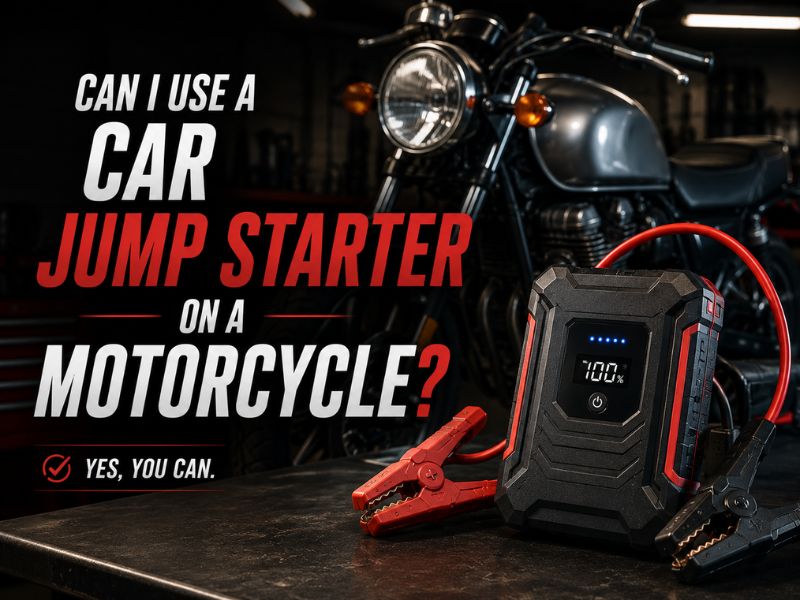
When deciding whether you can use a car jump starter on a motorcycle, check voltage before looking at amperage.
Most modern motorcycles use a 12V electrical system, and the majority of consumer automotive jump starters are also designed for 12V starting batteries. That makes many car-oriented portable jump packs electrically compatible with modern motorcycles.
However, not every motorcycle is 12V.
Yuasa still lists powersports batteries in both 6V and 12V configurations, particularly for various older applications.
Connecting a 12V jump starter to a 6V motorcycle is not an acceptable substitute for having the correct equipment.
So the basic rule is:
12V motorcycle + 12V-compatible jump starter = potentially compatible.
6V motorcycle + 12V-only jump starter = do not use it.
If you are uncertain about the motorcycle’s voltage, check the battery label or owner’s manual before proceeding.
Can a Powerful Car Jump Starter Be Too Many Amps for a Motorcycle?
A large peak-amp number does not automatically make a jump starter unsuitable for a motorcycle.
This is one of the most common concerns.
You might have a portable unit labeled:
800A, 1,000A, 1,500A, or even 2,000A
and wonder whether connecting it to a small motorcycle will send far too much current into the bike.
In practice, reputable manufacturers sell surprisingly powerful 12V jump starters that they explicitly describe as suitable for motorcycles.
Schumacher’s 800A SL1638, for example, is marketed for cars, motorcycles, ATVs, and more. Its 2,000A SL1642 is also listed for cars, SUVs, trucks, motorcycles, and ATVs.
That demonstrates why the headline current rating should not be treated as an amount that is continuously forced into every connected starter.
What matters is whether the manufacturer has designed and approved the unit for the motorcycle’s voltage and battery system.
A 2,000A maximum capability is therefore not, by itself, a reason to reject a jump starter for motorcycle use.
Battery Chemistry Is the More Important Limitation
This is where many otherwise correct jump-starting guides become too broad.
A jump starter can be 12V and still be incompatible with your motorcycle’s battery.
For example, NOCO specifies that its popular GB40 is intended for jump-starting 12V lead-acid batteries only. Its instructions explicitly tell users to determine both the battery voltage and chemistry before connecting the unit.
That includes common lead-acid motorcycle battery types such as conventional flooded batteries and many AGM designs when the jump-starter manufacturer permits them.
But motorcycles increasingly use lithium powersports batteries, including LiFePO4 designs.
You cannot assume the same jump-starting procedure applies.
Shorai, a manufacturer of lithium-iron powersports batteries, explicitly states that owners should not use lithium jump packs or boost packs to start or unlock Shorai-equipped motorcycles. Shorai instead provides its own battery-specific recovery instructions.
So before using a car jump starter, identify what battery is actually installed.
If it is lithium, follow the battery manufacturer’s instructions rather than generic automotive jump-start advice.
A Car Jump Starter Is Different From Jumping From a Running Car
There are two situations that are often confused.
One is using a portable car jump starter, which is the small rechargeable battery pack with clamps.
The other is connecting the motorcycle to a full-size car battery using jumper cables.
Yuasa says motorcycles can be jump-started from another motorcycle, a car battery, or a portable jump starter. However, when using an automobile as the donor battery, Yuasa specifically says do not start the car.
Yuasa’s more recent motorcycle battery guidance similarly says that when using another vehicle, the vehicle should remain turned off to reduce the risk of electrical surges and damage.
A portable jump pack eliminates the question of whether a donor vehicle’s engine should be running, which is one reason it can be a convenient motorcycle emergency tool.
How to Use a Car Jump Starter on a Motorcycle Safely
The exact instructions from the jump starter and motorcycle manufacturers should always take priority, but the general procedure for a compatible 12V lead-acid motorcycle is straightforward.
First, put the motorcycle in a safe position, turn the ignition off, and switch off accessories.
Locate the battery terminals or designated jump-start points.
Connect the jump starter’s positive red clamp to the positive battery terminal.
Then connect the negative clamp according to the jump starter and motorcycle instructions. Many systems permit the negative clamp to connect either to the battery’s negative terminal or an appropriate chassis ground. NOCO’s GB40 instructions, for example, specify positive to positive and negative to the negative terminal or vehicle chassis on a conventional negative-ground system.
Activate the jump starter as directed, then attempt to start the motorcycle.
Once the motorcycle starts, switch off the jump starter if required and disconnect the clamps in the manufacturer’s prescribed reverse order.
Avoid allowing the clamps to touch each other.
Yuasa warns that jumper-cable connections can produce sparks and recommends making the negative connection away from the battery when its procedure permits, particularly because some lead-acid batteries can release combustible hydrogen gas.
Don’t Keep Cranking Repeatedly
If the motorcycle does not start after reasonable attempts, more cranking may not solve anything.
A jump starter only helps when insufficient battery power is responsible for the no-start.
A motorcycle can fail to start for many other reasons, including a kill switch setting, safety interlock, ignition fault, fuel-delivery problem, or another mechanical issue.
Yuasa specifically reminds riders to check common motorcycle starting interlocks such as neutral position, clutch operation, and the kill switch before assuming the battery is the problem.
For fuel-injected motorcycles, Yuasa also warns against jump-starting when the fuel pump is not activating normally.
If the engine cranks strongly with the jump pack but still refuses to run, increasing jump-starter amperage is unlikely to fix the underlying problem.
What Size Jump Starter Does a Motorcycle Need?
Motorcycles generally do not require the same large engine-displacement ratings that full-size cars and trucks do.
You do not need to buy the most powerful jump starter available solely because it has a higher amp rating.
NOCO’s compact GB20, for example, is a 500A 12V jump starter that the company specifically markets for cars, boats, motorcycles, and other applications.
Schumacher similarly markets its 800A SL1638 for motorcycles as well as cars and ATVs.
This means that, for a typical 12V motorcycle with a compatible lead-acid battery, a reputable compact automotive jump starter can provide plenty of capability.
Rather than shopping for a specific minimum number such as 1,000A, look for a model that explicitly includes motorcycles or powersports vehicles in its approved applications.
That gives you a much stronger compatibility signal than peak amps alone.
What if the Motorcycle Battery Is Completely Dead?
Smart jump starters sometimes refuse to activate when battery voltage is extremely low.
For example, NOCO says its Boost jump starters are designed to detect low-voltage 12V lead-acid batteries automatically, with certain models providing a manual override mode when the battery voltage falls below the normal detection threshold.
Manual override requires extra caution because safety protections may be reduced or disabled.
Do not activate an override simply because the motorcycle will not start.
Verify polarity, battery voltage, battery chemistry, and the manufacturer’s procedure first.
A battery that has become severely discharged may also be permanently damaged rather than merely low on charge.
Will Riding Recharge the Battery After a Jump?
Possibly, but do not assume a short ride will fully recover a completely depleted motorcycle battery.
Yuasa explains that a motorcycle’s charging system can replenish its battery while riding, but normal riding may not fully recharge a battery that has been deeply discharged. It may still require an appropriate external battery charger or maintainer afterward.
That matters because many riders successfully jump the bike, ride home, shut it off, and then discover that the battery is dead again.
If your battery needed a jump because you accidentally left the lights on, recharge it properly afterward.
If it becomes discharged again without an obvious cause, test the battery and charging system.
Repeatedly using a jump starter is not a replacement for fixing a weak battery or charging-system fault.
When You Should Not Use the Car Jump Starter
Do not connect the jump pack when voltage or battery chemistry is incompatible.
You should also stop if the battery is visibly swollen, leaking, physically damaged, or otherwise unsafe according to its manufacturer.
Likewise, do not guess polarity when battery access is difficult.
Motorcycle batteries are compact and terminals can be close to frame components. Accidentally shorting a tool or clamp across the battery can create a serious electrical hazard.
And if your bike has an aftermarket lithium battery, verify that battery manufacturer’s jump-start instructions first. As the Shorai example demonstrates, even a jump pack that works perfectly on conventional motorcycle lead-acid batteries may be specifically prohibited with a particular lithium system.
Frequently Asked Questions
Can I Use a 1000 Amp Jump Starter on a Motorcycle?
Yes, potentially. The high maximum-current rating alone does not make the unit unsuitable. Schumacher sells a 1,000A portable jump starter that it explicitly lists as compatible with motorcycles and powersports vehicles.
Can I Use a 2000 Amp Jump Starter on a Motorcycle?
Possibly. Schumacher’s 2,000A SL1642 is explicitly marketed for motorcycles as well as cars, SUVs, trucks, and ATVs. Compatibility with your motorcycle’s voltage and battery chemistry still needs to be verified.
Will a Car Jump Starter Damage a Motorcycle Battery?
A properly compatible 12V jump starter used according to its instructions should not be assumed unsafe merely because it has a high current rating. Damage risk increases when voltage, polarity, battery chemistry, or operating procedure is wrong.
Can You Use a Car Battery to Jump a Motorcycle?
Yes, Yuasa says a motorcycle can be jump-started from a car battery, but the car should remain turned off during the procedure.
Can I Jump a 6V Motorcycle With a 12V Jump Starter?
No. Use equipment compatible with the motorcycle’s actual voltage. Yuasa sells powersports batteries in both 6V and 12V configurations, so older motorcycles should be checked rather than assumed to be 12V.
Can I Jump a Motorcycle With a Lithium Battery?
Only if the motorcycle battery manufacturer and jump-starter manufacturer permit it. Some jump starters are limited to lead-acid batteries, and Shorai explicitly prohibits lithium boost packs with its batteries.
Why Won’t My Jump Starter Detect My Motorcycle Battery?
The battery voltage may be below the jump pack’s automatic detection threshold, the clamps may have poor contact, or the battery may be damaged. Some smart jump starters offer a manual override mode for extremely low-voltage batteries, but it should only be used according to the manufacturer’s instructions.
Should I Leave the Jump Starter Connected After the Motorcycle Starts?
Follow the jump starter’s instructions and disconnect it promptly once the required starting procedure is complete. For example, NOCO recommends switching its Boost unit off and disconnecting according to the prescribed sequence after starting.
Does the Motorcycle Need a New Battery if It Requires a Jump?
Not necessarily. The battery may simply have been discharged by lights, accessories, or storage. However, if it repeatedly loses charge or cannot retain enough energy for another start, battery and charging-system testing is appropriate.
Should I Charge the Motorcycle Battery After Jump-Starting It?
A proper recharge is often advisable after a deep discharge. Yuasa notes that normal motorcycle riding may not fully replenish a battery that was completely depleted, so an appropriate charger or maintainer may still be required.
Can I Use a Car Jump Starter on a Motorcycle Safely?
Yes, you can use a car jump starter on a motorcycle when the jump starter is compatible with the motorcycle’s voltage and battery chemistry and its manufacturer approves that application. Yuasa confirms that portable jump starters can be used for motorcycles, and manufacturers such as Schumacher offer automotive jump packs explicitly intended for both cars and motorcycles.
Do not let a large amp rating scare you into thinking an 800A, 1,000A, or 2,000A jump pack automatically has too much power. Products at all of those output levels are sold for motorcycle use. Voltage and battery compatibility are more important than the headline peak-amp figure.
The bigger caution involves battery chemistry. Many automotive jump starters—including the NOCO GB40—are specified for 12V lead-acid batteries only, while some lithium powersports battery manufacturers such as Shorai specifically prohibit lithium boost packs.
Before connecting anything, confirm that the motorcycle is 12V, identify whether its battery is lead-acid or lithium, read both manufacturers’ instructions, verify polarity, and make secure connections. If those requirements match, a compact car jump starter can be a practical motorcycle emergency tool without requiring a motorcycle-only booster.