Finding the best car battery charger and jump starter is different from shopping for a small lithium booster that only provides enough power to crank an engine.
A true charger-and-starter combination connects to household AC power, can restore charge to a weak 12V or 6V lead-acid battery, and provides a high-current engine-start mode when waiting for a full charge is not practical.
For a home garage, workshop, farm, project car, pickup, SUV, or seasonal vehicle, that combination can replace several separate battery tools.
My primary recommendation is the Schumacher Electric SC1281 Fully Automatic Battery Charger and Engine Starter. It offers one of the best combinations of automatic charging, 100A engine start, boost charging, battery maintenance, diagnostics, broad lead-acid battery compatibility, and manageable bench-top size. It is powerful enough for typical cars and trucks without becoming as bulky as a full-size wheeled shop charger.
For drivers who want a lighter charger with a straightforward digital interface, the STANLEY BC25BS 25A Battery Charger with 75A Engine Start is another strong option. Its 25A charging capability, 75A starting assistance, alternator check, and battery reconditioning mode make it particularly useful for ordinary passenger vehicles and home-garage battery maintenance.
If you routinely work on pickups, SUVs, multiple vehicles, or larger batteries, I would move up to the Schumacher Electric SC1309 200A Wheeled Battery Charger and Engine Starter. Its 200A engine-start mode, 40A boost capability, wheels, long cable reach, and automatic charging system make it better suited to heavier garage use than the smaller bench chargers.

The ten models below are ordered primarily around established buyer feedback while remaining directly relevant to people who need both battery charging and engine-start assistance. I also considered battery chemistry, voltage support, charging amperage, boost capability, starter output, automatic versus manual operation, cable design, diagnostics, portability, and long-term battery-maintenance features.
Best Car Battery Charger and Jump Starter
| Image | Product Name | Check Price |
|---|---|---|
Best Choice | Schumacher Electric 6V/12V Battery Charger and 100A Engine Starter | Check Price |
Second Best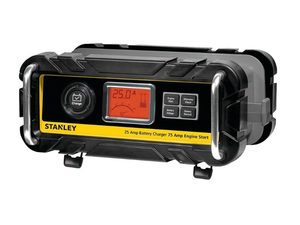 | STANLEY 25A Battery Charger with 75A Engine Start | Check Price |
Third Choice | Schumacher Electric 200A Wheeled Battery Charger and Engine Starter | Check Price |
 | Schumacher Electric SC1446 200A Manual Battery Charger and Engine Starter | Check Price |
 | Schumacher Electric SC1361 50A Battery Charger and Engine Starter | Check Price |
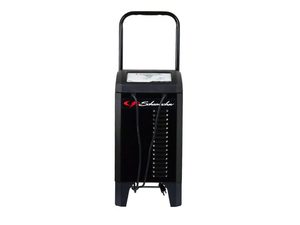 | Schumacher Electric SC1285 200A Wheeled Battery Charger and Engine Starter | Check Price |
 | Schumacher Electric SC1305 50A Battery Charger and Engine Starter | Check Price |
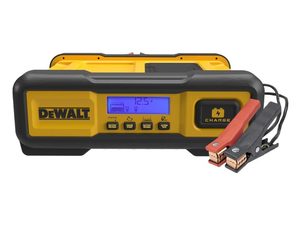 | DEWALT DXAEC100 30A Battery Charger with 100A Engine Start | Check Price |
 | Schumacher Electric SC1400 300A Wheeled Battery Charger and Engine Starter | Check Price |
 | Schumacher Electric FR01335 6V/12V 200A Battery Charger and Engine Starter | Check Price |
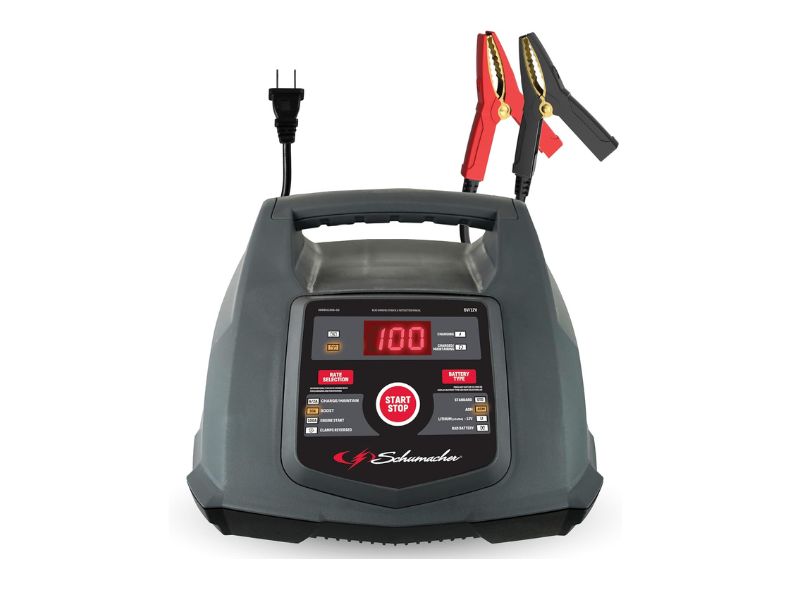
1. Schumacher Electric 6V/12V Battery Charger and 100A Engine Starter – Best Overall
Key Features
- 6V and 12V battery compatibility
- Up to 100A engine-start output
- 30A boost mode
- Automatic charge and maintain functions
- Standard, AGM, gel, and deep-cycle compatibility
- Battery and alternator testing
- Reverse hook-up protection
The Schumacher SC1281 earns my top recommendation because it fits the needs of more home-garage users than the larger wheeled machines below it.
It is not simply an emergency engine starter. The SC1281 is designed to charge, maintain, boost, test, and help start compatible lead-acid batteries, giving it a much broader role in routine vehicle maintenance.
For normal charging, the microprocessor-controlled system manages output automatically instead of requiring you to manually estimate charging time. This is particularly helpful if you maintain several battery types and do not want to constantly monitor an analog meter.
The 30A boost mode sits between ordinary charging and full engine start. If a battery is deeply discharged but you have several minutes available, boost mode can put energy back into the battery before you attempt to crank the engine.
Then there is the 100A engine-start function. It provides AC-powered starting assistance when a weak battery does not have enough current to crank the engine normally. Unlike a portable lithium jump pack, the SC1281 must be connected to an appropriate AC outlet during charging and starting operation.
Another advantage is diagnostics. A built-in battery and alternator tester provides additional information when the real issue may be a weak battery, charging-system problem, or alternator that is not maintaining proper voltage.
Battery versatility is also strong. Compatibility with common flooded, AGM, gel, and deep-cycle lead-acid batteries makes the charger useful around passenger cars, trucks, motorcycles, recreational vehicles, boats, and equipment.
The main limitation is lithium. This is fundamentally a conventional automotive lead-acid battery charger, so owners of LiFePO4 or other lithium starting batteries should use a charger explicitly approved for that chemistry.
What I Like
I like that the SC1281 provides meaningful capability without forcing you into a large wheeled charger. It can remain on a garage shelf yet still handle routine maintenance, faster recovery, diagnostics, and emergency engine starting.
Automatic charging also reduces guesswork, making it a better fit for the average vehicle owner than an old-school manual charger.
What I Do Not Like
It needs household AC power, so it is not a roadside replacement for a self-contained lithium jump pack. The 100A start mode is also less aggressive than the 200A to 300A modes available on larger shop chargers.
Verdict
The Schumacher SC1281 is the best car battery charger and jump starter for most home garages. It offers the most balanced combination of charging intelligence, engine-start capability, battery compatibility, diagnostics, manageable size, and proven everyday usefulness.
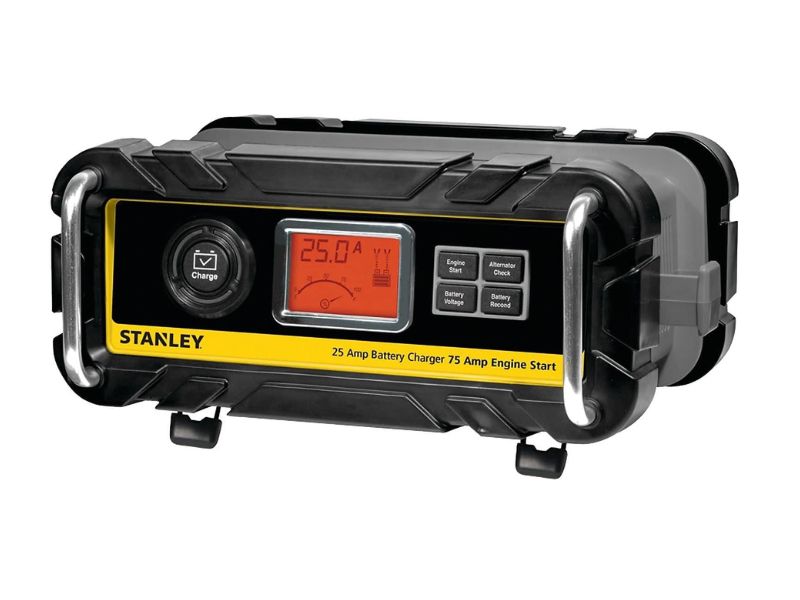
2. STANLEY 25A Battery Charger with 75A Engine Start – Best Compact Smart Charger
Key Features
- 12V battery charger
- 25A charging capability
- 75A engine-start assistance
- AGM, gel, and flooded battery compatibility
- Automatic multi-stage charging
- Alternator check
- Battery reconditioning mode
The STANLEY BC25BS is a compelling alternative for buyers who prioritize compact size and a simple digital interface.
Its 25A charging output is substantial enough to recover a discharged automotive battery far faster than a low-current maintainer. Once the battery approaches full charge, its smart charging system can transition through appropriate charging stages rather than continuing to push maximum current indefinitely.
The 75A engine-start function is useful when a battery has enough underlying health to accept assistance but lacks the energy required for a normal crank.
I would consider this unit especially appropriate for sedans, crossovers, minivans, motorcycles, boats, lawn equipment, and ordinary light-duty automotive batteries.
Another useful feature is battery reconditioning. Sulfation can develop on lead-acid battery plates, particularly when batteries remain undercharged for long periods. A reconditioning cycle may help certain sulfated batteries accept charge more effectively.
However, reconditioning should not be misunderstood as battery resurrection. It cannot repair cracked plates, internal shorts, severe corrosion, electrolyte loss, or a battery that has simply reached the end of its service life.
The alternator check is useful for the same reason. If a newly charged battery repeatedly goes dead, the problem may be parasitic drain or a charging-system fault rather than the battery itself.
What I Like
The BC25BS combines a relatively strong 25A charger with a compact body. It also offers a clear LCD interface, useful diagnostics, maintenance charging, and common lead-acid battery compatibility.
What I Do Not Like
It is 12V only, and the 75A engine-start mode is less powerful than the larger Schumacher wheeled chargers. Drivers with large-displacement trucks may want greater starting output.
Verdict
The STANLEY BC25BS is one of the better choices for someone who wants strong charging performance and useful engine-start assistance without dedicating much garage space to the equipment.
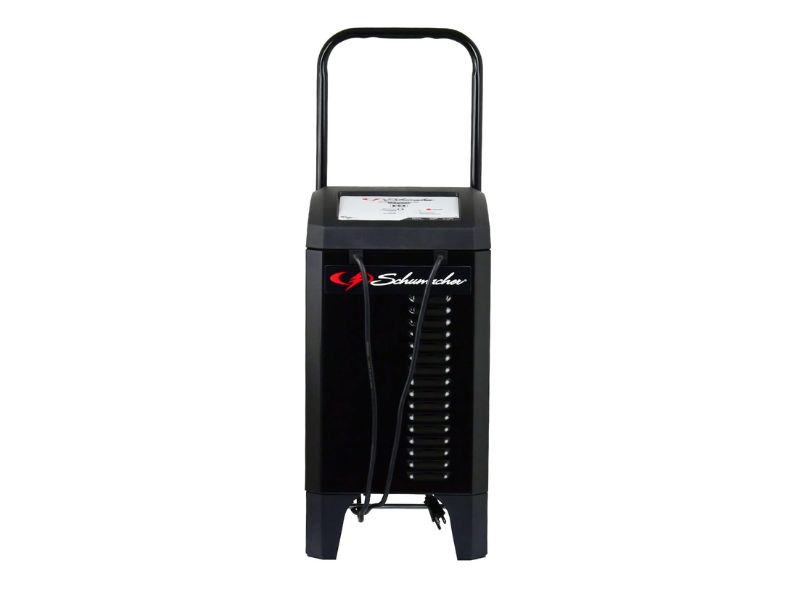
3. Schumacher Electric 200A Wheeled Battery Charger and Engine Starter – Best for Trucks and SUVs
Key Features
- 6V and 12V charging
- 200A engine-start output
- 40A boost mode
- Automatic charge and maintain operation
- Battery and alternator testing
- Wheeled design
- Long output-cable reach
The Schumacher SC1309 moves into true garage-equipment territory.
Its biggest advantage over compact bench chargers is the 200A engine-start output. For pickups, SUVs, larger engines, and heavily discharged batteries, having additional starting current can make the difference between needing a long charging session and getting the engine turning sooner.
A 40A boost mode provides another useful level of output. Rather than immediately attempting to crank a severely discharged battery, you can give it a short period of higher-current charging first.
The wheeled chassis is helpful because chargers in this class become noticeably heavier than compact electronic chargers. A retractable handle and wheels make it easier to move between vehicles without carrying the entire unit.
Cable reach is another practical advantage. In a real garage, the charger rarely sits directly beside the ideal AC outlet. Long power and output cables provide more flexibility when working around a pickup, SUV, boat, or project vehicle.
The SC1309 also incorporates automatic charging and float-mode maintenance, reducing the monitoring required compared with fully manual shop chargers.
Battery and alternator testing adds diagnostic value. When a starting problem repeatedly returns, testing the charging system can prevent unnecessary battery replacement.
What I Like
The combination of 200A starting assistance, 40A boost, wheels, automatic charging, and long cables makes this model far more capable around trucks and multi-vehicle garages than a typical compact charger.
What I Do Not Like
The wheeled format requires much more storage space. It is also less convenient if you only maintain one small passenger car.
Verdict
Choose the SC1309 if you regularly work with larger automotive batteries or want a charger that feels closer to professional garage equipment while retaining automatic controls.
4. Schumacher Electric SC1446 200A Manual Battery Charger and Engine Starter – Best Manual Wheeled Charger

Key Features
- 6V and 12V battery support
- 200A 12V engine-start mode
- 40A 12V boost
- 20A 6V/12V boost
- 10A 12V charging
- Manual timer control
- Wheeled steel construction
The Schumacher SC1446 is aimed at buyers who prefer traditional manual control rather than a fully automatic microprocessor deciding every charging stage.
A manual charger has real advantages for experienced users. The operator determines the charging mode and duration, which can be useful when managing different batteries in a workshop or diagnosing unusual battery behavior.
The SC1446 offers a 200A 12V engine-start mode and a 40A boost setting, giving it enough output for trucks, SUVs, boats, and other larger lead-acid battery applications.
Its manual timer provides control over the charging cycle. This is beneficial if you understand charging current and battery condition, but it also means the user carries more responsibility.
With an automatic charger, the device can reduce output as the battery approaches full charge. With a manual system, you need to pay greater attention to time, battery voltage, temperature, and the manufacturer’s charging procedure.
The wheeled design helps handle the unit’s weight, while long, flexible cables make connection easier around different vehicles.
What I Like
The SC1446 offers powerful engine starting, strong boost charging, and traditional manual control. Experienced mechanics may prefer this direct approach over automatic menus.
What I Do Not Like
It is not the charger I would hand to a first-time user and tell them to leave unattended. Manual charging demands better understanding and closer monitoring.
Verdict
The Schumacher SC1446 is ideal for experienced DIY mechanics who want direct control over charging instead of relying entirely on automatic electronics.
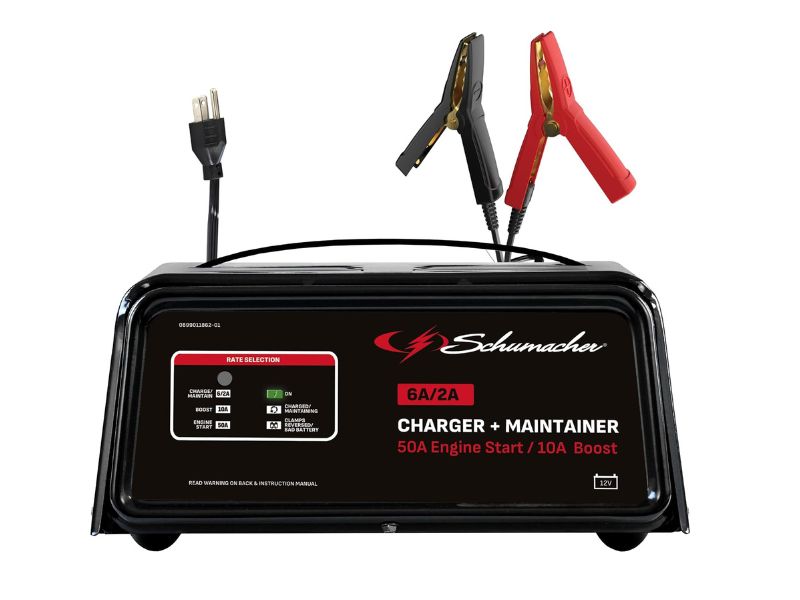
5. Schumacher Electric SC1361 50A Battery Charger and Engine Starter – Best Lightweight Automatic Option
Key Features
- 12V operation
- 50A engine-start mode
- 10A boost charging
- 6A/2A charging and maintenance
- Automatic microprocessor control
- Float-mode monitoring
- Reverse hook-up protection
The Schumacher SC1361 occupies a useful middle ground between a trickle charger and a full-size shop starter.
It provides 50A engine-start assistance, which is enough to help with many passenger-car starting situations without requiring the bulk of a wheeled 200A charger.
The 10A boost mode is useful for moderately discharged batteries. If a car has been sitting and the battery voltage is low, a period of boost charging may provide enough stored energy for a normal start without relying entirely on the 50A engine-start function.
For routine battery care, lower-rate charge and maintain operation is more important than the headline starting figure.
The SC1361 automatically controls charging stages and can enter float monitoring once the battery reaches the appropriate charge level. This makes it suitable for owners who want a charger that requires less manual intervention.
Reverse hook-up protection is valuable for occasional users because the charger is designed not to proceed normally when the clamps are attached incorrectly.
What I Like
This is a much easier charger to store than the 200A wheeled models. It covers routine charging, maintenance, modest boost charging, and emergency engine-start assistance in one relatively compact package.
What I Do Not Like
The 50A starting output is better suited to ordinary passenger vehicles than large engines or difficult cold-weather starts.
Verdict
The SC1361 makes sense for cars and crossovers when you want automatic battery care and occasional starting assistance without buying oversized shop equipment.
6. Schumacher Electric SC1285 200A Wheeled Battery Charger and Engine Starter – Best Heavy-Duty 12V Pick

Key Features
- 12V battery operation
- 200A engine-start mode
- 40A boost mode
- Automatic charging
- Charge and maintain capability
- Wheeled steel-case construction
- Standard, AGM, gel, and deep-cycle compatibility
The Schumacher SC1285 focuses on one voltage and does it with significantly more physical capacity than the compact chargers.
Its 200A engine-start function is the central attraction. If your garage regularly sees pickups, large SUVs, boats, recreational equipment, or higher-capacity batteries, the stronger starting mode gives you more reserve than a 50A or 75A starter.
A 40A boost mode helps recover deeply discharged batteries more quickly before a start attempt.
Despite its more traditional steel chassis and transformer-based appearance, the SC1285 still offers automatic charging control. That creates a useful combination: heavy-duty physical construction with less manual monitoring than a completely timer-controlled charger.
The wheels matter because this unit weighs far more than an electronic bench charger. Rather than placing it on a shelf, it is designed to stay on the garage floor and roll to the vehicle.
What I Like
I like the combination of 200A starting power and automatic operation. It is less demanding than a manual wheeled charger while still delivering serious garage capability.
What I Do Not Like
It is a 12V-focused unit, and its weight makes it excessive for someone who only needs occasional motorcycle or compact-car battery maintenance.
Verdict
The SC1285 is a strong heavy-duty choice for a home workshop where 12V automotive batteries dominate and high engine-start output matters.
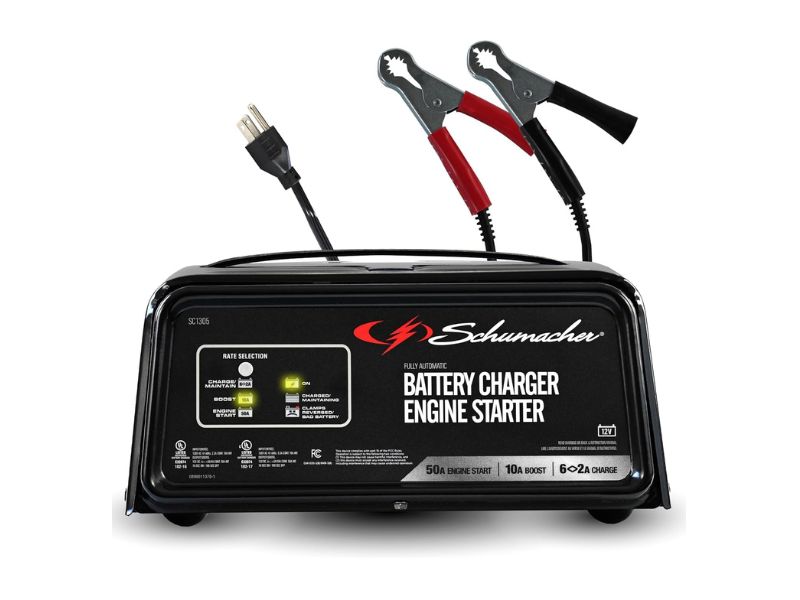
7. Schumacher Electric SC1305 50A Battery Charger and Engine Starter – Best Simple Home-Garage Pick
Key Features
- 12V battery compatibility
- 50A engine start
- 10A boost
- 6A/2A charge and maintain operation
- Automatic multi-stage charging
- Battery desulfation function
- Reverse polarity protection
The Schumacher SC1305 is one of the simpler choices on this list.
Rather than trying to replace a professional shop charger, it focuses on the functions an ordinary vehicle owner is most likely to need: charging a weak battery, maintaining a healthy one, providing a temporary boost, and helping crank an engine.
The 50A start mode is suitable for many normal gasoline-powered passenger vehicles.
A 10A boost mode gives you another option when the battery needs additional energy but the situation does not justify an immediate start attempt.
Automatic multi-stage charging is particularly useful for people who do not want to calculate charging duration manually. The charger monitors battery condition and adjusts its behavior as charging progresses.
The desulfation mode may help certain neglected lead-acid batteries, but I would treat it as a battery-care feature rather than a guarantee that an old battery can be restored.
What I Like
The SC1305 is relatively uncomplicated. Its controls and charging modes cover the majority of home automotive battery situations without the size or complexity of a professional machine.
What I Do Not Like
It is 12V only and has just 50A of engine-start assistance. Owners of large pickups may want a stronger starter.
Verdict
For a normal home garage with one or two passenger vehicles, the SC1305 provides a sensible balance of automatic charging and occasional engine-start assistance.
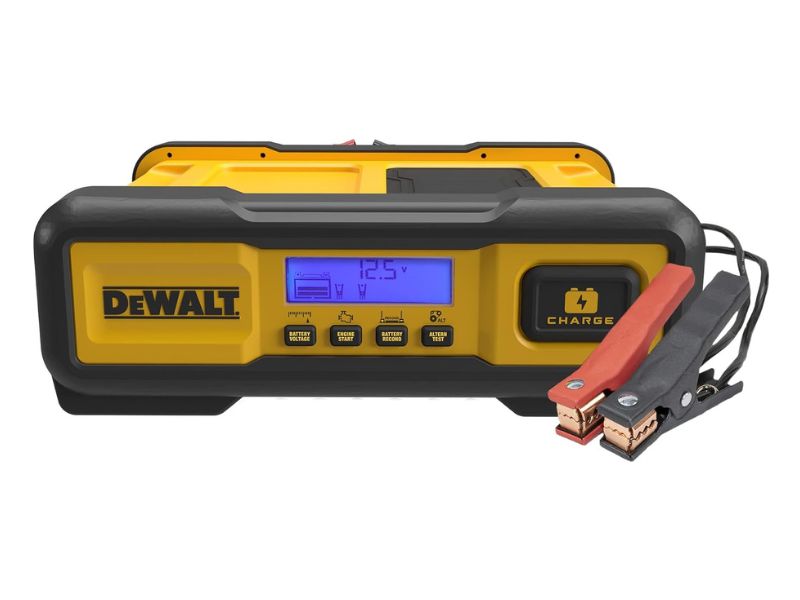
8. DEWALT DXAEC100 30A Battery Charger with 100A Engine Start – Best Compact High-Charge Pick
Key Features
- 6V and 12V compatibility
- 30A battery charging
- 3A maintenance mode
- 100A engine-start function
- AGM, gel, and flooded battery compatibility
- Alternator check
- LCD status display
The DEWALT DXAEC100 stands out because it combines a relatively strong 30A charging rate and 100A engine-start capability in a compact housing.
For users who regularly recover moderately discharged batteries, the 30A charge output can be more convenient than low-current chargers that may need many hours.
Once the battery is charged, a lower maintenance mode can help keep an infrequently used vehicle ready.
The 100A engine-start mode brings it into the same general starting class as my top-ranked SC1281, although the control layouts and charging strategies differ.
DEWALT also includes an alternator-check function and an LCD interface, helping users distinguish charging-system issues from a simple discharged battery.
Battery compatibility covers common wet/flooded, AGM, and gel lead-acid designs.
What I Like
The DXAEC100 provides strong charging current and meaningful engine-start capability without the footprint of a wheeled machine. The digital display is also easier to interpret than an old analog ammeter.
What I Do Not Like
It is still an AC-powered garage tool, not an independent roadside booster. Users should also verify chemistry before connecting specialty or lithium batteries.
Verdict
The DEWALT DXAEC100 is an excellent alternative if fast bench charging and a 100A starting mode are more important than owning a large wheeled charger.
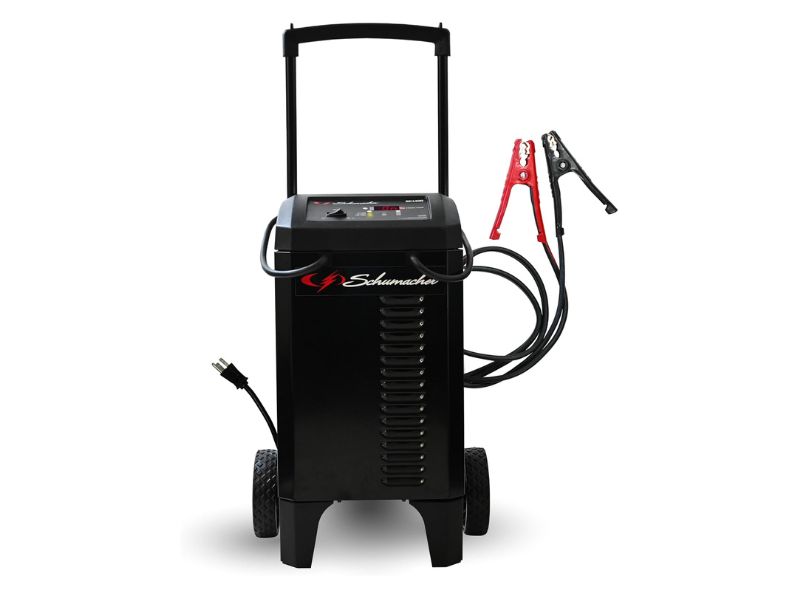
9. Schumacher Electric SC1400 300A Wheeled Battery Charger and Engine Starter – Best Maximum Start Output
Key Features
- 6V and 12V operation
- Up to 300A engine-start output
- 60A boost mode
- Automatic charging
- Battery maintenance
- Battery reconditioning capability
- Wheeled commercial-style design
The Schumacher SC1400 has one of the highest engine-start ratings in this group.
Its 300A 12V start capability is aimed at larger batteries and engines where a compact 50A starter may provide too little assistance.
A 60A boost mode is equally important. Deeply discharged batteries often benefit from receiving energy before the starter motor is engaged, especially when voltage has fallen substantially.
The SC1400 is therefore less about maintaining a motorcycle battery and more about being ready for demanding garage jobs involving trucks, SUVs, marine batteries, and other large lead-acid systems.
Because of that output, physical size and weight increase significantly. This is a floor-standing wheeled charger rather than something you casually place in a glove compartment or small cabinet.
What I Like
The SC1400 offers substantial starting and boost capability for users who routinely work with bigger batteries. Automatic operation also makes that power easier to manage than a completely manual commercial charger.
What I Do Not Like
It is overkill for routine small-car maintenance and takes up considerably more garage space than a bench charger.
Verdict
Choose the SC1400 when high engine-start and boost output matter more than portability.
10. Schumacher Electric FR01335 6V/12V 200A Battery Charger and Engine Starter – Best for Farm and Equipment Use

Key Features
- 6V and 12V compatibility
- 200A 12V engine-start mode
- 125A 6V engine-start capability
- 40A boost mode
- Automatic charge and maintain operation
- Battery and alternator testing
- Heavy 6-gauge output cables
The Schumacher FR01335 is particularly interesting for buyers whose battery-maintenance needs extend beyond passenger cars.
Its design targets heavier automotive, truck, marine, and farm-equipment applications. The 200A 12V engine-start mode provides substantial cranking assistance, while 6V support makes the machine more versatile around older equipment and specialty battery systems.
The 40A boost mode helps prepare heavily discharged batteries for starting.
Cable construction is another strength. Heavy output cables with generous reach matter when battery placement is awkward or the charger cannot sit immediately beside the battery.
The automatic charging system also provides a more modern approach than older farm chargers that require constant timer and ammeter monitoring.
Battery and alternator testing can help diagnose recurring starting issues, particularly on equipment that sits unused for extended periods.
What I Like
The FR01335 combines strong engine starting with broad voltage support, automatic charging, substantial cables, and practical diagnostic features.
What I Do Not Like
It is heavier and less convenient to store than compact consumer chargers. For one passenger car, the SC1281 is easier to justify.
Verdict
The FR01335 is a good match for farms, workshops, large garages, and users who regularly maintain trucks or equipment alongside normal vehicles.
Best Car Battery Charger and Jump Starter Comparison
| Product | Voltage | Charge/Maintain | Boost Mode | Engine Start | Battery Types | Operation | Best For |
| Schumacher SC1281 | 6V/12V | Automatic | Up to 30A | 100A | Standard, AGM, Gel, Deep-Cycle | Automatic | Best overall home garage |
| STANLEY BC25BS | 12V | Up to 25A | Smart charging | 75A | Wet, AGM, Gel | Automatic | Compact smart charging |
| Schumacher SC1309 | 6V/12V | Automatic | 40A | 200A | Standard, AGM, Deep-Cycle | Automatic | Trucks and SUVs |
| Schumacher SC1446 | 6V/12V | 10A charge | 20A/40A | 200A | Standard, AGM, Gel, Deep-Cycle | Manual | Experienced DIY users |
| Schumacher SC1361 | 12V | 6A/2A | 10A | 50A | Standard, AGM | Automatic | Cars and crossovers |
| Schumacher SC1285 | 12V | 6A/2A | 40A | 200A | Standard, AGM, Gel, Deep-Cycle | Automatic | Heavy-duty 12V use |
| Schumacher SC1305 | 12V | 6A/2A | 10A | 50A | Common lead-acid types | Automatic | Simple home use |
| DEWALT DXAEC100 | 6V/12V | 30A/3A | Fast charge | 100A | Wet, AGM, Gel | Automatic | Fast compact charging |
| Schumacher SC1400 | 6V/12V | Automatic | 60A | Up to 300A | Common lead-acid types | Automatic | Maximum starting output |
| Schumacher FR01335 | 6V/12V | 6A/2A | 40A | 200A 12V / 125A 6V | Standard, AGM, Gel | Automatic | Farm and equipment use |
Quick Comparison: Which One Should You Buy?
For most car owners, the Schumacher SC1281 offers the best balance. Its 100A engine-start function is strong enough for many passenger vehicles, while automatic charging, maintenance, boost mode, and diagnostic functions make it useful even when there is no starting emergency.
The STANLEY BC25BS makes sense if compact storage and stronger routine charging are priorities.
Owners of trucks and large SUVs should look closely at the Schumacher SC1309 or SC1285, both of which provide 200A engine-start capability.
Experienced users who prefer direct manual control may appreciate the SC1446.
For maximum AC-powered starting assistance, the SC1400 offers the most aggressive engine-start specification in this group.
The FR01335 is the specialized choice when your garage also includes tractors, farm machinery, older 6V systems, or other equipment.
Why a Battery Charger and Jump Starter Combo Makes Sense
A normal battery charger and an engine starter solve related but different problems.
A battery charger restores electrical energy over time. Depending on battery size and state of charge, that process can take anywhere from a relatively short session to many hours.
An engine-start mode supplies a temporary burst of high current intended to help the vehicle’s starter motor crank the engine.
Having both capabilities in one machine means you can choose the appropriate response rather than treating every weak battery as an emergency.
If a car will not be needed until tomorrow, slow or moderate charging is generally preferable to repeatedly attempting to crank the engine.
If you need the vehicle immediately and the battery is otherwise serviceable, an engine-start mode can provide a quicker solution.
A combination machine also helps reduce garage clutter. Instead of owning a charger, maintainer, booster, tester, and separate shop starter, certain models integrate several of those functions into one chassis.
Car Battery Charger vs Jump Starter: What Is the Difference?
This distinction is essential because product names can be confusing.
Battery Charger
A charger normally connects to 120V household AC power and sends controlled DC current into the vehicle battery.
Its job is to restore the battery’s state of charge.
A charger may provide:
- Slow charging
- Fast charging
- Battery maintenance
- Float charging
- Desulfation or reconditioning
- Battery testing
- Alternator testing
Portable Jump Starter
A portable jump starter contains its own internal battery.
It does not need a wall outlet during the starting attempt.
Its primary purpose is to deliver a short burst of current to crank an engine.
This makes it ideal for roadside emergencies.
Charger With Engine Start
The products in this guide fall mainly into a third category.
They use AC power to charge the battery normally but can also supply high-current engine-start assistance when needed.
They are therefore excellent garage tools, but they do not replace a self-contained roadside jump pack if you need emergency starting power far from an electrical outlet.
How to Choose the Best Car Battery Charger and Jump Starter
Start With Your Battery Voltage
Most modern passenger cars use a 12V electrical system.
Some motorcycles, classic vehicles, farm equipment, recreational equipment, and specialty batteries use 6V.
If you only own modern 12V vehicles, a 12V-only charger may be perfectly adequate.
If your garage includes older equipment or multiple battery systems, a 6V/12V charger provides greater versatility.
Never guess the voltage. Check the battery label and vehicle documentation before connecting charging equipment.
Match the Charger to Your Battery Chemistry
Battery chemistry is just as important as voltage.
Flooded Lead-Acid Batteries
These are traditional automotive batteries containing liquid electrolyte.
Most conventional automotive chargers support them.
AGM Batteries
Absorbent Glass Mat batteries use a fiberglass separator to hold electrolyte.
AGM batteries are common in modern vehicles with high electrical demand and start-stop systems.
They benefit from charging profiles designed specifically for AGM chemistry.
Gel Batteries
Gel batteries use a gelled electrolyte and can be sensitive to inappropriate charging voltage.
Use a charger that explicitly lists gel compatibility.
Deep-Cycle Batteries
Deep-cycle batteries are designed to discharge more deeply than conventional starter batteries.
They are commonly found in marine, RV, and recreational applications.
Some automotive chargers support deep-cycle batteries, but compatibility should be confirmed.
Lithium Batteries
This is where buyers need to be careful.
A charger designed for lead-acid, AGM, or gel batteries is not automatically safe for lithium or LiFePO4 batteries.
Lithium batteries require chemistry-specific charging logic and may include a battery-management system with unique requirements.
If your vehicle uses lithium starting batteries, choose a charger explicitly approved for that battery.
How Many Charging Amps Do You Need?
Charging amperage affects how quickly energy is returned to the battery.
A 2A maintainer is useful for long-term battery care but can take a very long time to recover a large, deeply discharged automotive battery.
A 6A charger is more practical for routine overnight charging.
Ten to fifteen amps can recover common automotive batteries more quickly.
A 25A to 30A charger is useful when faster turnaround matters.
A 40A to 60A boost setting is not generally intended to replace a proper full charging cycle. Its purpose is to return enough energy quickly to improve starting chances.
Battery size matters too.
Charging a small motorcycle battery at an unnecessarily high rate can be inappropriate, while a large truck or marine battery may take a long time on a very low-current charger.
What Does Engine-Start Amperage Mean?
Engine-start amperage is the high-current output the charger can provide temporarily while the starter motor turns.
Typical combinations include:
- 50A engine start
- 75A engine start
- 100A engine start
- 150A engine start
- 200A engine start
- 300A engine start
More is not automatically better.
A 50A or 75A starter may be enough to assist a normal passenger vehicle with a weak battery.
A large truck, SUV, or high-compression engine can benefit from 100A to 200A or more.
Temperature also matters. Batteries produce less usable current in cold weather, while cold engine oil increases cranking resistance.
This is why winter starting can be dramatically harder than starting the same vehicle on a warm summer afternoon.
Engine Start vs Boost Mode
These two functions are often confused.
Boost mode supplies a relatively high charging current for several minutes.
Its goal is to rapidly put usable energy back into a discharged battery.
Engine-start mode provides a much higher current for a very short period while the starter motor is engaged.
Whenever time allows, allowing the battery to accept some boost charge before attempting an engine start can reduce stress on the charger and vehicle electrical system.
Always follow the manufacturer’s specified timing and cool-down intervals.
Automatic vs Manual Battery Chargers
Automatic Charger
A modern automatic charger uses a microprocessor to monitor charging conditions.
Depending on the design, it may:
- Detect battery voltage
- Adjust current automatically
- Change charging stages
- Enter maintenance mode
- Detect reversed clamps
- Stop or reduce charging under abnormal conditions
For most homeowners, this is the safer and more convenient choice.
The Schumacher SC1281 is my preferred example.
Manual Charger
A manual charger gives the operator more direct control.
This can be beneficial to mechanics who understand battery condition and charging behavior.
However, the user must pay more attention to charging time and battery response.
Manual equipment should not be treated as a set-it-and-forget-it solution.
Why Battery Maintenance Mode Matters
A vehicle battery slowly loses charge even when the vehicle is parked.
Modern cars also have small parasitic loads from security systems, keyless-entry modules, computers, telematics, clocks, and other electronics.
Seasonal vehicles experience an even greater problem because they may sit for weeks or months.
A battery maintainer keeps a healthy battery near an appropriate state of charge without continuously applying an uncontrolled high charging current.
This can be useful for:
- Classic cars
- Convertibles stored for winter
- Weekend sports cars
- Motorcycles
- Boats
- RV batteries
- Seasonal equipment
- Backup vehicles
A maintainer is not a cure for a failing battery, but it can prevent avoidable damage caused by prolonged undercharging.
What Is Battery Sulfation?
Sulfation is a common issue with lead-acid batteries.
During normal discharge, lead sulfate forms on battery plates.
When the battery is properly recharged, much of this material converts back through the normal electrochemical process.
If a battery remains discharged for a long time, sulfate crystals can become more difficult to reverse, reducing available battery capacity.
Some chargers include a desulfation or reconditioning mode that applies a specialized charging strategy intended to improve certain sulfated batteries.
Results vary.
A reconditioning mode cannot repair:
- Physically damaged plates
- Internal short circuits
- Cracked cases
- Severe corrosion
- Frozen batteries
- Major electrolyte loss
- A battery that has reached the end of its useful life
Consider reconditioning a possible maintenance tool, not a guaranteed battery-restoration system.
Why an Alternator Tester Is Useful
A battery can be completely healthy and still repeatedly go dead if the vehicle’s charging system is not working properly.
Once the engine starts, the alternator normally supplies electrical power and recharges the battery.
A charging-system test can help identify situations where alternator output is outside the expected operating range.
Common symptoms of charging-system trouble include:
- Battery warning light
- Repeated dead batteries
- Dim headlights
- Electrical accessories behaving unpredictably
- Slow cranking after short periods of driving
- Battery voltage that never properly recovers
A charger with built-in battery and alternator testing does not replace professional diagnostics, but it can provide useful initial information.
Bench Charger vs Wheeled Charger
Bench Charger
Bench models such as the SC1281 or DXAEC100 are relatively easy to store.
They work well for:
- Passenger cars
- Crossovers
- Motorcycles
- Small trucks
- Occasional home maintenance
Their biggest advantage is convenience.
Wheeled Charger
Large wheeled machines provide higher starting and boost capability.
They make more sense for:
- Full-size pickups
- Large SUVs
- Multiple-vehicle households
- Workshops
- Farms
- Boats
- Project vehicles
- Frequent battery servicing
The tradeoff is obvious: they are heavy and require floor space.
Do not buy a 30- or 40-pound garage charger if you only need to maintain one compact car unless you genuinely need its higher starting output.
How to Use a Car Battery Charger Safely
Battery charging involves electricity, high current, and potentially explosive gases.
Correct procedure matters.
Read Both Manuals
Follow instructions from both the charger manufacturer and vehicle manufacturer.
Some vehicles provide dedicated remote charging or jump-start terminals rather than recommending direct connection to the battery.
Work in a Ventilated Area
Lead-acid batteries can release gases during charging.
Avoid sparks, cigarettes, flames, and other ignition sources near the battery.
Inspect the Battery First
Do not attempt normal charging if the battery is:
- Cracked
- Leaking
- Severely swollen
- Visibly damaged
- Frozen
- Producing unusual heat or odor
A damaged battery may require professional handling and replacement.
Confirm Voltage and Chemistry
Verify whether you have a 6V or 12V battery.
Then confirm whether it is flooded, AGM, gel, deep-cycle, or another chemistry.
Select the charger mode accordingly.
Keep the Charger Unplugged While Making Initial Connections
Follow the product manual’s connection sequence.
Avoid allowing clamps to touch one another.
Confirm Polarity
The positive battery terminal is marked +.
The negative terminal is marked −.
Reverse-polarity protection is helpful, but it should never replace careful connection.
Select the Correct Mode
Use normal charge mode when time permits.
Use boost or engine-start functions only according to their intended purpose.
Respect Engine-Start Duty Cycles
High-current starting modes generate considerable heat.
Chargers commonly specify limits on how long you can crank and how long the unit must cool between attempts.
Do not repeatedly crank without respecting those intervals.
Can You Leave a Smart Charger Connected Overnight?
A properly designed automatic charger with an appropriate maintenance function can often remain connected after reaching full charge, provided the manufacturer explicitly allows it.
However, “automatic” does not mean you should ignore obvious problems.
Periodically inspect:
- Battery temperature
- Charger temperature
- Cable connections
- Battery case condition
- Ventilation
- Error indicators
Older manual chargers should generally receive much closer supervision.
Can a Charger Start a Completely Dead Battery?
Sometimes, but not always.
A severely discharged battery presents several possible problems.
First, some automatic chargers require a minimum battery voltage before they can recognize that a valid battery is connected.
Second, a battery at extremely low voltage may be damaged rather than merely discharged.
Third, an engine-start function still works best when the vehicle battery can contribute to the starting process.
If a battery has internal damage or has deteriorated enough that it cannot accept charge, a charger cannot make it healthy again.
Why Won’t My Car Start Even With the Engine-Start Mode?
A dead battery is only one cause of a no-start condition.
Other possibilities include:
- Corroded battery terminals
- Loose ground cable
- Failed starter motor
- Starter solenoid failure
- Ignition-system fault
- Fuel-system problem
- Immobilizer issue
- Damaged battery
- Blown fuse or fusible link
- Poor charger-clamp contact
If the engine cranks strongly but does not fire, additional electrical starting current is unlikely to solve the problem.
Can These Chargers Replace a Portable Jump Starter?
Not completely.
AC-powered charger/starter combinations are excellent garage tools because they can actually recharge the vehicle battery.
A portable lithium jump starter provides a different advantage: independence from a wall outlet.
If your battery dies in a parking lot, at work, on a rural road, or far from your garage, an AC charger is not useful unless electrical power is available.
For comprehensive preparedness, I prefer owning:
- A proper automatic charger/engine starter for the garage.
- A portable lithium jump starter for the vehicle.
The tools complement each other rather than directly replacing each other.
Best Charger and Starter for Cold Weather
Cold weather creates two problems simultaneously.
Battery chemistry slows down, reducing available starting current.
Engine oil also becomes more viscous, increasing the load on the starter motor.
If you live in a climate with harsh winters, I would prioritize:
- Higher engine-start output
- Proper AGM compatibility if your vehicle uses AGM
- Heavy cables
- Strong clamps
- A charger capable of meaningful boost current
- A battery maintainer for infrequently driven vehicles
For typical passenger vehicles, the SC1281 remains an excellent balance.
For large pickups, I would lean toward the SC1309, SC1285, or another 200A-class unit.
Best Choice for a Truck
Trucks can have larger engines and higher-capacity batteries than ordinary passenger cars.
A 50A engine-start function may provide useful assistance, but 100A to 200A gives greater reserve.
The SC1309 is particularly attractive because it combines 200A engine-start capability with automatic charging and a 40A boost mode.
The SC1285 is another strong 12V truck-focused option.
For occasional light-truck use, the smaller SC1281 may still be entirely adequate.
Best Choice for AGM Batteries
AGM batteries require compatible charging voltage and charging logic.
Several products in this guide support AGM batteries, but the SC1281 is my preferred general-purpose choice because it combines AGM compatibility with automatic charging and a useful range of battery-care functions.
Do not assume that selecting a lower charging rate makes an incompatible charger safe for AGM.
Use the chemistry mode specified by the charger manufacturer.
Best Choice for an Older or Classic Car
Classic cars introduce different charging requirements.
Some may use 6V electrical systems, while others have been converted to 12V.
For a garage that includes older vehicles, a dual-voltage machine provides valuable flexibility.
The SC1281 supports both 6V and 12V charging in a manageable package.
For more frequent workshop use, the SC1446 or FR01335 provides heavier-duty 6V/12V capability.
Always verify electrical-system polarity and vehicle specifications because some vintage vehicles differ significantly from modern negative-ground systems.
Best Choice for a Project Car
Project cars often spend long periods parked while electrical work, engine repairs, bodywork, or restoration is underway.
That makes battery maintenance just as important as jump-start capability.
A charger that can maintain the battery during downtime and provide stronger charging after electrical testing is more useful than a pure jump pack.
The SC1281 works particularly well here because of its automatic maintenance and diagnostic functions.
Charger Size and Storage
Do not overlook physical size.
A large wheeled charger may be the more powerful machine, but that does not automatically make it the better purchase.
Ask where the charger will live when it is not being used.
A compact bench charger can fit on a shelf or workbench.
A wheeled charger generally needs dedicated floor space.
If storage is limited, choosing a smaller 50A to 100A engine-start model is often more practical than buying maximum output.
Cable Length and Clamp Quality
Starting current must travel from the charger through the cables and clamps before it reaches the battery.
Poor connections create resistance.
Look for:
- Flexible cables
- Strong clamp springs
- Clean conductive jaw surfaces
- Adequate cable gauge
- Enough reach for your garage layout
Large wheeled chargers often provide longer, heavier cables because they are intended for higher starting currents.
Regardless of the charger, keep battery terminals and clamp contact areas clean.
Reverse Polarity Protection
Reverse polarity occurs when positive and negative connections are accidentally swapped.
Many modern automatic chargers detect this condition and refuse to operate normally.
This is a worthwhile feature, particularly for occasional users.
However, safety electronics are a backup.
Always identify terminals correctly before attaching clamps.
Battery Reconditioning: Useful or Marketing Hype?
The answer is somewhere in the middle.
Controlled reconditioning can sometimes improve the behavior of a sulfated lead-acid battery.
That does not mean every weak battery can be restored.
If a five-year-old battery has lost most of its active material, has an internal short, or cannot hold charge overnight, reconditioning will not return it to new condition.
Use a repair cycle as an attempt to improve a marginal battery, not as a substitute for battery replacement when testing confirms the battery has failed.
How to Maintain Your Charger
The charger itself requires very little maintenance, but several habits improve reliability.
Store it in a dry area.
Keep cables loosely coiled rather than sharply bent.
Inspect insulation for cracks.
Keep clamp jaws clean.
Do not drag the charger by its cables.
Keep ventilation openings clear.
On wheeled chargers, periodically check wheels and handles.
If the charger has been dropped or exposed to water, inspect it carefully before reconnecting it to a battery.
Common Buying Mistakes
Buying a Maintainer When You Need a Charger
A 1A or 2A maintainer can keep a healthy battery topped up.
It is not the fastest way to recover a large deeply discharged battery.
Buying a Jump Pack When You Need Battery Charging
A lithium jump pack can start an engine but generally does not replace a proper automotive charger.
If your goal is to restore the battery’s state of charge, buy a charger.
Choosing Only by Engine-Start Amps
Higher amperage increases starting capability, but it also tends to increase size, weight, and cost.
Match the machine to your vehicles.
Ignoring Battery Chemistry
Using the wrong charging profile can shorten battery life or create safety problems.
Always confirm chemistry compatibility.
Assuming Reconditioning Repairs Failed Batteries
It does not.
A physically or chemically exhausted battery still needs replacement.
Ignoring AC Power Requirements
These charger/starter combinations require access to household electricity during operation.
For remote roadside emergencies, carry a separate portable jump pack.
Frequently Asked Questions
What is the best car battery charger and jump starter overall?
The Schumacher SC1281 is my top all-around choice for most home garages.
It combines automatic 6V/12V battery charging, maintenance, boost charging, a 100A engine-start function, battery and alternator testing, reverse-polarity protection, and broad lead-acid battery compatibility. More powerful wheeled chargers are available, but the SC1281 provides enough capability for many cars, SUVs, and light trucks without taking up excessive garage space.
Is a battery charger the same as a jump starter?
No. A charger restores battery energy over time, while a jump starter supplies temporary cranking power.
The products in this guide combine both functions. They can recharge a compatible battery through an AC outlet and provide a high-current engine-start mode when needed. A portable lithium jump pack is different because it contains its own battery and can operate without a wall outlet.
What amp charger is best for a car battery?
For routine automotive charging, roughly 6A to 15A is practical for many passenger-car batteries.
Lower current works well for maintenance but requires more time. Higher charging rates such as 20A to 30A can shorten recovery time on larger batteries. Always stay within the charger’s intended battery-size and chemistry guidelines rather than choosing current solely for speed.
Is a 50A engine starter enough for a car?
A 50A engine-start mode can assist many normal passenger vehicles with a weak battery.
It is less suitable for demanding cold-weather starts, large engines, or severely depleted high-capacity batteries. In those situations, 100A to 200A of starting assistance provides more reserve. Battery condition remains important regardless of the charger rating.
Is a 100A engine-start charger enough for an SUV?
It can be sufficient for many SUVs, depending on engine size, battery condition, and temperature.
The SC1281 and DEWALT DXAEC100 both offer 100A-class engine starting. For larger SUVs, pickups, or severe winter conditions, a 200A wheeled charger can provide more starting assistance.
Can I charge an AGM battery with these chargers?
Several models support AGM batteries, but compatibility must be verified for the specific charger and mode.
The SC1281, BC25BS, SC1446, SC1285, DXAEC100, and several other models in this guide support AGM applications. Use the manufacturer’s recommended settings because AGM charging requirements differ from conventional flooded batteries.
Can I charge a lithium car battery with a normal charger?
Not unless the charger explicitly supports that lithium chemistry.
Lead-acid charging algorithms are not automatically appropriate for lithium or LiFePO4 batteries. Lithium batteries often require specialized voltage control and communication with an internal battery-management system. Use a charger specifically approved for the battery manufacturer and chemistry.
Can a battery charger revive a completely dead battery?
It can recharge a deeply discharged but healthy battery, but it cannot repair every failed battery.
A battery with internal damage, severe plate deterioration, freezing damage, a shorted cell, or an inability to hold charge needs replacement. Some automatic chargers also require a minimum battery voltage before they recognize the battery.
What does the boost setting on a battery charger do?
Boost mode applies a relatively high charging current for faster short-term battery recovery.
It sits between normal charging and engine-start mode. The purpose is to put usable energy into a discharged battery quickly, which may improve the chance of starting after several minutes. Follow the charger’s specified boost duration.
Can I use engine-start mode instead of charging the battery?
Engine-start mode is intended for temporary starting assistance, not for restoring battery capacity.
After the vehicle starts, a substantially discharged battery still needs proper charging. Relying only on the alternator after a deeply discharged battery may place unnecessary load on the charging system and may not fully restore the battery during a short trip.
Should I buy an automatic or manual battery charger?
An automatic charger is the better choice for most vehicle owners.
Microprocessor-controlled chargers reduce current as needed and can transition into maintenance mode automatically. Manual chargers offer greater direct control but require the operator to monitor time, charging current, and battery condition more carefully.
What is the best charger and starter for a truck?
The Schumacher SC1309 is my preferred choice for larger trucks and SUVs in this group.
Its 200A engine-start mode and 40A boost setting provide more reserve than smaller bench chargers. The wheeled design, long cables, automatic charging, and diagnostic capability also suit regular garage use with larger batteries.
Can I leave my battery charger connected overnight?
A charger with an approved automatic maintenance mode may support extended connection, but follow its manual.
Automatic charging reduces the risk of uncontrolled overcharging, but the battery and charger should still be installed in a suitable ventilated location and periodically inspected. Do not treat a manual high-current charger as an unattended overnight maintainer.
Why does my battery keep dying after I charge it?
The battery may be failing, the alternator may not be charging correctly, or the vehicle may have a parasitic electrical draw.
A successful charging session only confirms that energy was placed into the battery. It does not prove the battery can retain that energy or that the vehicle’s charging system works properly. Battery and alternator testing can help narrow down the cause.
Will a battery charger fix a bad alternator?
No. A charger can replenish the battery, but it cannot repair the vehicle’s charging system.
If the alternator is failing, the battery may discharge again shortly after the external charger is removed. Diagnose and repair the underlying charging-system fault.
What is the difference between a maintainer and a trickle charger?
A modern maintainer usually monitors battery condition and adjusts output automatically.
Traditional trickle chargers can continuously apply a low current whether or not the battery needs it. Smart maintenance systems are generally better suited to long-term storage because they reduce or cycle output when the battery is fully charged.
Is battery reconditioning safe?
It can be safe when the charger and battery manufacturer support the procedure and the battery is physically sound.
Never attempt to recondition a cracked, leaking, frozen, swollen, or severely damaged battery. Reconditioning is intended primarily for certain sulfation conditions in compatible lead-acid batteries.
How long does it take to charge a dead car battery?
Charging time depends on battery capacity, remaining state of charge, charger output, temperature, and battery health.
A small maintainer may require many hours or more than a day. A 10A to 30A charger can recover a normal automotive battery much faster. Charging current usually tapers as the battery approaches full charge, so simple amp-hour division provides only an estimate.
Can I start the engine while the battery charger is connected?
Only use the engine-start function if the charger specifically provides that mode and follow its instructions.
A normal charger that lacks an engine-start setting should not automatically be treated as a starting power supply. Purpose-built combination units include circuitry and duty-cycle guidance for cranking assistance.
Does a higher engine-start amp rating mean a better charger?
No. It means the charger can provide greater temporary starting assistance, but that is only one part of overall quality.
Charging accuracy, battery compatibility, cable quality, clamps, safety features, automatic controls, diagnostics, construction, and appropriate maintenance modes are equally important.
What is the best option for multiple vehicles?
The Schumacher SC1281 is excellent for mixed everyday vehicles, while the SC1309 is better for a heavier garage workload.
If the fleet includes motorcycles, cars, SUVs, and light trucks, broad battery compatibility matters. If it includes several large trucks or frequently discharged batteries, the higher-output wheeled machine becomes more useful.
Final Buying Advice
There is no reason every household needs the largest 300A wheeled battery charger.
For a normal sedan, crossover, or light truck, a compact automatic machine with 50A to 100A engine-start capability can handle routine charging, battery maintenance, and many starting emergencies.
Move into the 200A class when you own larger trucks, maintain several vehicles, regularly deal with discharged batteries, or simply want greater starting reserve in the garage.
Choose 6V/12V compatibility when you own older vehicles, motorcycles, farm equipment, or other battery systems that may not all use 12 volts.
And if you need assistance away from electrical power, remember that an AC charger/engine starter is not a substitute for a self-contained lithium jump pack.
Conclusion
Choosing the best car battery charger and jump starter comes down to understanding whether you mainly need routine battery maintenance, faster charging, high-current engine starting, or a combination of all three.
The Schumacher Electric SC1281 remains my primary recommendation. Its manageable size, automatic 6V/12V charging, 100A engine-start mode, 30A boost capability, maintenance function, broad battery compatibility, reverse-polarity protection, and built-in diagnostics make it the most complete choice for a typical home garage.
The STANLEY BC25BS is an excellent compact alternative, particularly if you value a strong 25A charging mode and straightforward digital controls.
For trucks, large SUVs, and more demanding garage work, the Schumacher SC1309 provides a worthwhile jump to 200A engine-start output and 40A boost charging.
The SC1446 suits experienced users who prefer manual controls, while the SC1361 and SC1305 provide simpler automatic solutions for normal passenger vehicles.
If you need heavy-duty 12V capability, the SC1285 is worth considering. The DEWALT DXAEC100 offers a strong combination of compact dimensions, 30A charging, and 100A starting assistance.
For users who prioritize maximum engine-start output, the SC1400 offers substantial power, while the FR01335 is particularly useful around farms, workshops, trucks, and mixed 6V/12V equipment.
For most buyers, I would start with the Schumacher SC1281. It provides the broadest useful combination of battery charging, maintenance, boost charging, testing, and engine-start support without forcing the average vehicle owner to store a large commercial-style wheeled machine.