Finding the best shocks and struts is not simply a matter of choosing the cheapest four-piece kit. Fitment, suspension type, included hardware, vehicle weight, and installation requirements all affect whether a replacement restores a controlled, comfortable ride.
My first choice is Peforway Complete Front and Rear Strut Assemblies. Its complete assemblies include coil springs, which can simplify replacement when the original suspension is worn or tired.
My second choice is A-Premium Front Complete Struts. The front assemblies include the strut, spring, mount, and dust shield, while rear shock absorbers complete the set.
My third choice is MOSTPLUS Complete Front and Rear Strut Assemblies. MOSTPLUS Rear and Front Quick Complete Struts Shocks Absorbers earns my third-choice position for its coverage of several Chevrolet, GMC, and SUV applications. The four-piece kit includes complete assemblies with springs and mounts, making it a practical option for owners who want to avoid reusing old suspension hardware.
This guide compares the five selected kits by fitment, package contents, installation convenience, vehicle use, customer-feedback evidence, and important limitations. It also explains how to verify compatibility, prepare for installation, avoid common suspension mistakes, and decide whether a complete assembly or a more specialized replacement makes sense for your vehicle.
Best Shocks and Struts
I selected these products for their relevance to common replacement searches, the amount of useful fitment and package information supplied, and available customer-feedback evidence. The list also covers compact cars, midsize sedans, full-size pickups, SUVs, and electronically controlled suspension, so the comparison reflects different ownership needs rather than one vehicle category alone.
| # | Image | Product | Price on Amazon |
|---|---|---|---|
| 1 | 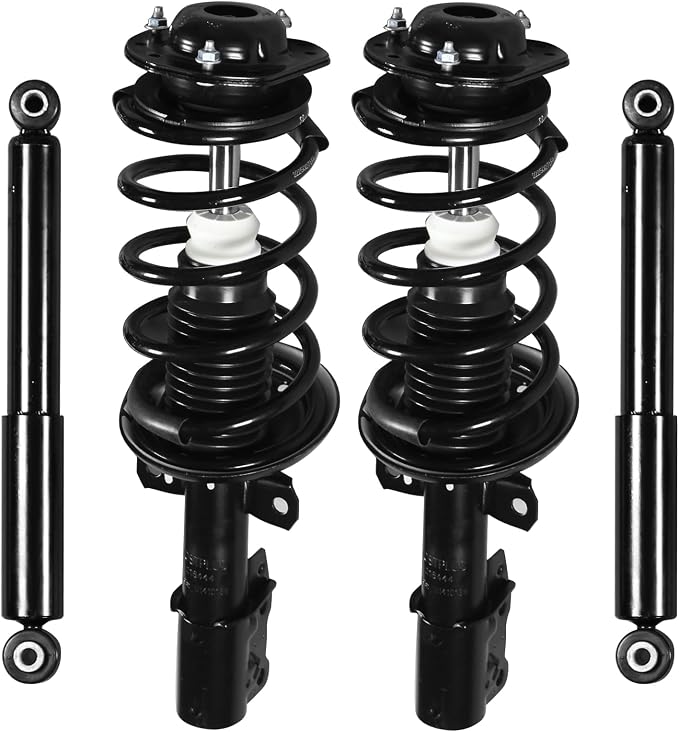 |
Peforway Complete Front and Rear Strut Assemblies | Check Price |
| 2 |  |
A-Premium Front Complete Struts | Check Price |
| 3 | 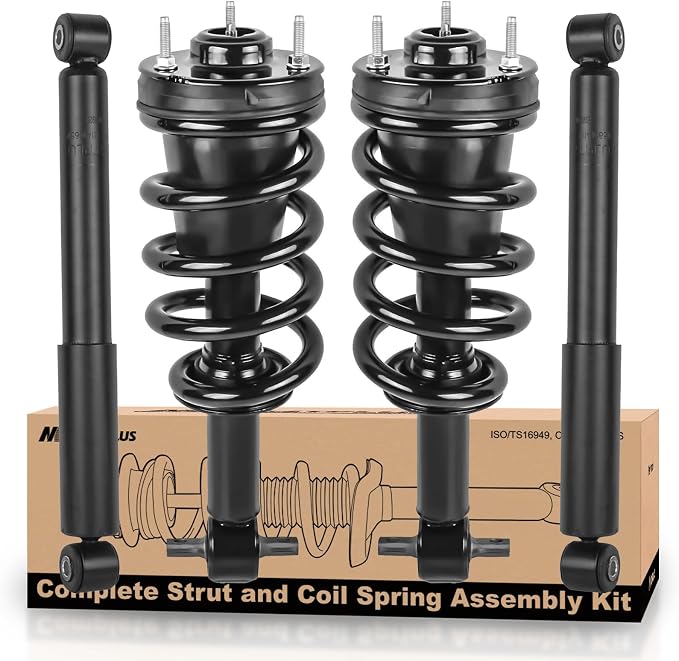 |
MOSTPLUS Complete Front and Rear Strut Assemblies | Check Price |
| 4 |  |
Aeagle Front and Rear Strut Shock Assemblies | Check Price |
| 5 |  |
TECTRONIX Magnetic-Ride Front and Rear Assemblies | Check Price |
Peforway Complete Front and Rear Strut Assemblies
Peforway’s four-piece kit is aimed at several compact GM applications: the 2005–2010 Chevrolet Cobalt, 2006–2011 Chevrolet HHR, 2007–2009 Pontiac G5, and 2005–2006 Pontiac Pursuit. It includes two front strut assemblies and two rear shock absorbers, giving the buyer one coordinated package for replacing suspension components at both ends of the vehicle.
The front and rear assemblies are supplied with coil springs, so this is more convenient than buying bare dampers and transferring old springs or mounts. That can reduce the amount of disassembly required, although the buyer still needs to confirm the exact year, body configuration, and applicable replacement numbers before ordering. The listed reference numbers include 172179R, 172179L, and 349043.
Construction details are also encouraging for a daily driver. Peforway identifies high-quality steel, carefully formed pipes, and welded construction intended to provide structural durability. The company also states that the assemblies undergo indicator, friction, and temperature-characteristic checks. Those claims do not replace proper installation or vehicle-specific verification, but they help explain why this kit ranks first.
With a 4.4-star rating across 1,461 ratings, this option has considerably more customer-feedback evidence than most of the other choices here. It suits an owner seeking a complete refresh for a commuter vehicle, especially when worn springs and dampers are being addressed together.
Pros
- Complete front and rear four-piece package with coil springs.
- Fits several popular Chevrolet, Pontiac, and Pursuit applications.
- High volume of customer feedback compared with the other selections.
- Direct-fit design is intended to simplify installation.
Cons
- Fitment is limited to the listed compact GM vehicles.
- Exact vehicle information must be checked before purchase.
- It is not intended for vehicles with unrelated suspension designs.
My Opinion
This is the strongest all-around pick when the vehicle is an eligible Cobalt, HHR, G5, or Pursuit. The complete coverage, spring inclusion, and substantial customer-feedback base make it easier to justify than a less documented kit, but compatibility remains the deciding factor.
A-Premium Front Complete Struts
A-Premium’s package targets the 2006–2011 Acura CSX with a four-cylinder 2.0-liter engine and the 2006–2011 Honda Civic sedan with 1.3-liter or 1.8-liter four-cylinder engines. It includes front assemblies for both sides and rear shock absorbers for the driver and passenger sides, making it a balanced replacement set for the specified applications.
The front units are especially complete. Each includes the strut, coil spring, mount, and dust shield, so the buyer does not need to automatically reuse those aging components. The listed front body length is 9.93 inches, extended length is 17.36 inches, compressed length is 10.43 inches, and travel length is 6.93 inches. These dimensions are useful for comparison, but they should not be treated as a substitute for confirming the exact application.
A-Premium also supplies a long list of reference numbers, including 172286, 172287, 182286, 182287, SR4241, SR4242, 5609, 343460, and 341523. Cross-referencing those numbers can help when a vehicle catalog shows more than one suspension option. The one-year unlimited-mileage guarantee adds some ownership reassurance for buyers who want a stated support policy.
Its 4.5-star rating is based on 205 ratings, which is a smaller evidence base than the top selection. This kit is best for a Civic sedan or Acura CSX owner who values a detailed specification list and a complete front assembly rather than a bare replacement strut.
Pros
- Complete front units include springs, mounts, and dust shields.
- Front and rear coverage is supplied in one package.
- Detailed dimensions and numerous reference numbers aid verification.
- One-year unlimited-mileage guarantee is stated.
Cons
- Fitment is restricted to specific Civic sedan and Acura CSX applications.
- Customer-feedback volume is lower than the top-ranked kit.
- Buyers must confirm engine, body style, and model year.
My Opinion
A-Premium is a sensible second choice for the listed Honda and Acura vehicles. Its well-defined front assembly contents and warranty are meaningful advantages, though the narrower application range means it should be purchased only after careful catalog or vehicle-record confirmation.
MOSTPLUS Complete Front and Rear Strut Assemblies
MOSTPLUS supplies a four-piece package for several large GM SUVs and related vehicles, including specified Chevrolet Avalanche, Suburban 1500, Tahoe, GMC Yukon, and Yukon XL 1500 applications. The supplied fitment ranges vary by model, so this is a product where reading the complete vehicle list matters more than relying on a general “GM SUV” description.
The kit includes complete front and rear assemblies equipped with struts or shock absorbers, springs, and mounts. That configuration is attractive for an owner who wants to replace worn suspension components without separating the old spring from the existing front unit. It can also help keep the replacement process more consistent from one side of the vehicle to the other.
MOSTPLUS identifies reference numbers such as K139104, K345073, 139105, 345073, 911533, 189105, and 11580. The company describes the units as suitable for daily road use, off-road use, and track use, and mentions oil-proof, waterproof, and anti-corrosion materials. Those descriptions suggest an effort toward all-weather durability, but they do not mean every configuration is appropriate for heavy towing, altered ride height, or a modified vehicle.
The 3.9-star rating from 89 ratings is lower than the ratings of several other options in this comparison. That does not automatically disqualify the kit, but it makes careful fitment checking and realistic expectations especially important. It is most appealing to an SUV owner prioritizing a complete four-corner replacement over premium brand familiarity.
Pros
- Four complete assemblies include springs and mounts.
- Broad coverage across selected Chevrolet and GMC SUV applications.
- Reference numbers are provided for cross-checking.
- All-weather material claims may appeal to year-round drivers.
Cons
- Customer rating is lower than the leading options.
- Fitment varies substantially by model and year.
- Not automatically the right choice for modified or heavy-duty suspension setups.
My Opinion
MOSTPLUS offers useful convenience for an eligible GM SUV, particularly when all four corners need attention. I would place it behind the first two choices because of the smaller customer-feedback base and lower rating, while still considering it when the listed reference numbers match.
Aeagle Front and Rear Strut Shock Assemblies
Aeagle’s four-piece suspension package is made for 2007–2013 Chevrolet Silverado 1500 and GMC Sierra 1500 trucks. It includes a left and right front strut assembly with coil springs, along with left and right rear shock absorbers. For a truck owner replacing both front and rear components, that arrangement avoids mixing unrelated kits.
The package is identified as a replacement for part numbers 139105 and 4345074. Aeagle emphasizes model-specific construction and says cutting tools should not be necessary for installation. That is useful context for a buyer comparing complete assemblies with parts that require spring transfer or modification, although the actual job still involves supporting the truck safely and following correct torque procedures.
One important limitation is the exclusion of electronic suspension. A Silverado or Sierra with a different suspension configuration should not be assumed compatible simply because the year and model appear on the listing. Buyers should check whether the truck has standard suspension and compare the original part numbers before ordering.
The product carries a 4.5-star rating from 70 ratings and includes a stated 12-month warranty. The feedback volume is modest, but the straightforward truck application and complete front-and-rear layout make it a focused option for standard-suspension owners who want a convenient replacement rather than a custom performance setup.
Pros
- Complete four-piece package for selected Silverado and Sierra 1500 trucks.
- Front coil springs are included with the strut assemblies.
- Replacement numbers 139105 and 4345074 are supplied.
- Stated 12-month warranty provides a defined support period.
Cons
- Electronic suspension is excluded.
- Fitment is limited to 2007–2013 1500 models.
- Customer-feedback volume is smaller than the top selection.
My Opinion
Aeagle is a practical truck-specific choice when the vehicle has standard suspension and the reference numbers line up. Its warranty and complete configuration help, but owners of electronically controlled or modified trucks should look elsewhere unless compatibility is explicitly confirmed.
TECTRONIX Magnetic-Ride Front and Rear Assemblies
TECTRONIX serves a very different buyer from the other products on this list. This four-piece set is intended for 2015–2020 Cadillac Escalade and Escalade ESV, Chevrolet Silverado 1500, Suburban, and Tahoe, plus GMC Sierra 1500, Yukon, and Yukon XL applications equipped with RPO code Z95, the specified MagneRide suspension.
That code is the key purchasing detail. The product is not a general replacement for every suspension configuration within those model years. TECTRONIX specifically instructs buyers to confirm the RPO code and provides a long list of front and rear replacement numbers, including 84176631, 23464589, 580-1108, 84176675, 84977478, and others. Cross-checking both the vehicle record and the original component number is essential.
The package includes a pair of front shock absorber strut assemblies and a pair of rear shock absorber assemblies, so no spring transfer or reassembly should be needed for the supplied units. TECTRONIX states that the assemblies undergo dyno and road testing and are intended to maintain a stable, smooth ride in difficult conditions. Those are product claims rather than a guarantee of results on every vehicle, especially one with additional suspension faults.
Only seven ratings are supplied, with a 4.2-star average. That limited customer-feedback evidence places this product last in the overall ranking, but it may be the most relevant choice for the narrow MagneRide application.
Pros
- Addresses a specialized magnetic-ride suspension application.
- Includes front and rear assemblies in one four-piece package.
- Provides numerous replacement numbers for comparison.
- No reassembly of the supplied units should be required.
Cons
- Only vehicles with RPO code Z95 are identified as compatible.
- Customer-feedback volume is very limited.
- Professional installation may be preferable for buyers unfamiliar with electronic suspension.
My Opinion
TECTRONIX is a niche solution, not a universal GM replacement. It deserves consideration only when the Z95 code and part numbers match; for that narrow need, its specialized design is more important than its lower ranking.
How I Selected These Suspension Replacement Kits
The selection weighs application relevance first, because a highly rated assembly is still unusable when its mounting points, spring rate, body dimensions, or electronic-suspension requirements do not match the vehicle. I then considered whether each package covers the front, rear, or all four corners; whether springs and mounts are included; how clearly reference numbers are supplied; and whether the product has a stated warranty or other ownership support.
Customer-feedback volume also matters. A 4.5-star average from 205 ratings gives a different level of confidence than a 4.2-star average from seven ratings, even though neither number proves how a particular vehicle will perform. Brand diversity was retained so the comparison would not reduce every choice to one supplier or one vehicle family.
Fitment is the first filter. Confirm the exact year, model, body style, drivetrain or engine where relevant, suspension type, and replacement number before comparing convenience or price.
For the best shocks and struts, a complete assembly can be more valuable than a bare damper when the original spring, mount, or dust shield is also aged. The trade-off is that a complete kit must match the vehicle’s intended ride height and suspension configuration rather than merely fitting the bolt pattern.
How to Choose the Right Suspension Replacement
Start with the vehicle, not the product title. Use the year, make, model, body style, engine or drivetrain information when requested, and the original part number or vehicle build code. Then decide whether convenience, standard replacement performance, specialized electronic compatibility, or a particular warranty matters most.
- Confirm front and rear positions, left and right requirements, and the number of pieces in the package.
- Check whether coil springs, mounts, dust shields, and other supporting parts are included.
- Compare reference numbers and suspension codes rather than relying on appearance alone.
- Match the kit to normal street use, truck use, towing needs, or a modified vehicle honestly.
- Plan for alignment and safe installation after replacing front suspension components.
Complete Assemblies Versus Bare Dampers
A bare shock or strut can cost less and may be suitable when the existing spring, mount, and protective hardware are known to be sound. A complete assembly is usually more convenient for a first-time replacement because it arrives with major components already matched. It can also avoid the need to compress and transfer an old coil spring.
The convenience does not eliminate inspection. Compare the replacement assembly with the removed part before final installation, and make sure the spring orientation, upper mount position, brake-line bracket, and electrical connector arrangement are correct where applicable.
Vehicle Fitment and Suspension Codes
Model-year ranges are helpful but not always enough. The TECTRONIX kit demonstrates why: its stated application depends on RPO code Z95. Similarly, Aeagle excludes electronic suspension, while several other kits target standard configurations. A vehicle identification number, build sheet, original part label, or manufacturer parts catalog can resolve differences that a generic online search cannot.
Ride Goals and Vehicle Weight
Replacement suspension should match the vehicle’s normal load. A compact commuter, a full-size SUV, and a half-ton pickup do not place the same demands on springs and dampers. A standard replacement kit may restore the factory-style setup, but it should not automatically be treated as a performance upgrade, a heavy-load conversion, or a solution for sag caused by cargo beyond the vehicle’s intended capacity.
Before Ordering: A Compatibility Checklist
Spend a few minutes collecting information before placing an order. This simple process can prevent the most expensive mistake: receiving a complete kit that physically resembles the original but belongs to a different suspension configuration.
Record These Details
- Vehicle year, make, model, and body style.
- Engine, drivetrain, and trim when the catalog requests them.
- Front, rear, or all-corner replacement needs.
- Original shock or strut numbers, if visible.
- Electronic suspension or magnetic-ride codes.
- Whether the vehicle has lift, lowering, towing, or other suspension modifications.
Compare the package contents with the work planned. A kit containing front assemblies and rear shocks may be ideal for a full refresh, but it may be unnecessary if only one rear unit has failed and the other components are recent. Conversely, replacing only one side of an axle can leave damping uneven, so pair replacement is usually the more sensible approach when one unit is worn.
Installation Planning for First-Time Buyers
Complete assemblies reduce some of the difficult spring-transfer work, but suspension installation is still a safety-critical repair. The vehicle must be supported by properly rated stands on a stable surface, with the wheels secured and the suspension unloaded only when the procedure calls for it.
Before beginning, compare each new part with the old one. Check mounting holes, stud locations, spring orientation, brackets, length, and electrical connections. Keep fasteners organized by location. Use the vehicle’s service information for torque values rather than guessing or copying a number from an unrelated model.
Front strut replacement commonly changes alignment angles, even when the new assembly is intended as a direct replacement. Schedule an alignment after the work, especially if the steering wheel is off-center, the vehicle pulls, or tire wear was already uneven. A complete assembly cannot correct worn control-arm bushings, damaged ball joints, bent steering parts, or a bad wheel bearing.
Never place a body part beneath an unsupported vehicle, and never improvise with a spring compressor or lifting point. If the procedure requires tools or steps you cannot perform safely, use a qualified technician.
What to Inspect Alongside New Struts and Shocks
Suspension wear rarely occurs in isolation. While the wheels are removed, inspect tires for cupping or scalloped wear, examine bushings for cracking, look for leaking brake components, and check ball joints and tie-rod ends for looseness. A new damper may improve control while an unrelated worn part continues to create noise or instability.
Front Suspension Checks
Look at the upper mount, bearing area, spring seat, brake hose routing, and sway-bar link. Compare both sides for ride height and hardware position. If a complete assembly includes a new mount and dust shield, confirm that those pieces are seated correctly before tightening the assembly.
Rear Suspension Checks
Inspect rear springs, shock mounting points, bushings, and any load-related damage. On trucks and SUVs, look for corrosion or deformation around the lower mounts. A replacement shock cannot compensate for a broken mount or a spring that has lost its proper height.
How to Make Replacement Components Last Longer
Correct installation is the foundation of service life. Tighten fasteners at the correct ride-height position when the service procedure requires it; tightening a bonded suspension bushing while it is hanging can preload the rubber and shorten its life. Keep protective boots and dust shields correctly positioned so road grit does not reach the shaft or mount.
Driving style also matters. Slow down for deep potholes, avoid striking curbs, and reduce speed on rough roads when the vehicle is heavily loaded. Keep tire pressures at the vehicle maker’s recommended cold setting. Underinflated or mismatched tires can increase suspension stress and make a sound replacement feel ineffective.
After installation, listen for clunks, squeaks, or metallic contact during low-speed turns and bumps. Recheck visible fasteners and mounting areas after the first short drive if the service procedure permits. Uneven ride height, fluid leakage, persistent bouncing, or steering changes deserve prompt attention rather than continued driving.
When Replacement Is Actually Needed
Common signs include repeated bouncing after a bump, excessive nose dive under braking, body roll in turns, uneven tire wear, fluid leakage from a damper, knocking sounds, or a vehicle that feels unsettled on ordinary roads. None of these symptoms identifies one failed component by itself, so diagnosis should include the surrounding suspension and tires.
Age and mileage can provide context, but they do not establish a universal replacement interval. Road salt, potholes, heavy loads, towing, and previous collision damage can accelerate wear. A vehicle that feels stable may still have a leaking or weakened unit, while a noisy vehicle may have a mount or bushing problem instead.
Replacing components in axle pairs helps maintain more even damping from side to side. Replacing all four corners can make sense when the whole system is similarly aged, but it is not always necessary if the rear units were recently replaced and remain in good condition.
Common Mistakes to Avoid
Most suspension problems after an otherwise suitable purchase come from incorrect fitment, incomplete inspection, or rushed installation. The following cautions are especially important for first-time buyers.
- Do not assume every vehicle in a model-year range uses the same suspension.
- Do not ignore electronic, magnetic, or electronically adjustable suspension codes.
- Do not mix a standard replacement part with a specialized system without confirmation.
- Do not reuse visibly damaged mounts, boots, springs, or mounting hardware.
- Do not tighten components with the vehicle positioned incorrectly for the service procedure.
- Do not skip an alignment after front strut work.
- Do not diagnose every clunk as a failed shock or strut.
- Do not judge quality solely by star rating when the number of ratings is very small.
Cleaning, Corrosion, and Storage Tips
Suspension components live under the vehicle, where water, salt, mud, and road debris are unavoidable. During routine washing, rinse heavy dirt from the wheel wells without forcing high-pressure water directly into seals or electrical connectors. After driving on salted roads, a careful underbody rinse can reduce corrosive buildup around mounts and fasteners.
If a replacement kit will not be installed immediately, keep it boxed in a dry area away from standing water and corrosive chemicals. Do not drag assemblies across concrete or rest delicate mounting studs where they can bend. Before installation, remove packaging and confirm that protective caps or shipping materials have not been left in place.
Routine cleaning cannot repair a leaking damper or a damaged boot. Treat visible oil on the shaft, a bent component, or corrosion that compromises the spring or mount as a reason to stop and seek a proper replacement or professional assessment.
FAQS About Best Shocks and Struts
Should shocks and struts be replaced in pairs?
Usually, replacing both units on the same axle is the better approach because it keeps damping more consistent from side to side. If the matching unit was replaced recently and remains in good condition, a technician may determine that only one replacement is necessary.
Are complete strut assemblies easier to install?
They can be easier because the spring, mount, and related parts arrive assembled. This may avoid transferring an old spring with a compressor, but the vehicle still requires safe support, correct torque, and an alignment when front struts are replaced.
How do I know which suspension kit fits my vehicle?
Confirm the year, make, model, body style, engine or drivetrain where applicable, suspension type, and original part number. Electronic or magnetic suspension codes can be decisive. When the information conflicts, use a vehicle identification number or parts catalog before ordering.
Can a replacement kit fix uneven tire wear?
It may help when worn damping caused the wear, but uneven tires can also result from incorrect alignment, poor inflation, worn bushings, loose steering parts, or bent components. Inspect and correct the full suspension system rather than assuming the damper is the only cause.
Do new struts always improve ride comfort?
A correctly matched replacement can restore control and reduce excess bouncing, but comfort depends on spring condition, tires, bushings, alignment, vehicle load, and road conditions. A kit intended for another suspension configuration may create poor results even if it physically installs.
Final Thoughts
The best shocks and struts depend on exact vehicle compatibility more than a general ranking. Peforway 4pc Struts Shocks is my top pick for its complete compact-GM coverage and substantial customer-feedback base, followed by A-Premium Front Complete Struts for specified Honda and Acura applications and MOSTPLUS Rear and Front Quick Complete Struts Shocks Absorbers for eligible GM SUVs. Verify every fitment detail, plan the installation safely, and choose a complete assembly only when its suspension configuration matches the vehicle.