A Trailer Tongue Weight Calculator helps estimate how much downward force a loaded trailer places on your vehicle’s hitch. Proper tongue weight is important for trailer stability, steering, and safe towing.
Enter your fully loaded trailer weight, choose a conventional trailer or fifth-wheel/gooseneck connection, and select pounds or kilograms. The calculator estimates a typical tongue or pin weight range and shows the recommended planning percentages.
If you already measured your trailer’s hitch weight, you can enter that reading to calculate its percentage of the total trailer weight. Use the results to evaluate trailer loading before towing, but always verify actual weights with a suitable scale and follow your vehicle, trailer, and hitch manufacturer specifications.
AUTO GEAR LAB TOOLS FREE CALCULATOR
Trailer Tongue Weight Calculator
Estimate conventional trailer tongue or fifth-wheel pin-weight ranges.
Enter your details
Your results
These are typical planning ranges, not limits or load measurements. Check all vehicle, hitch, axle and trailer ratings.
What Is Trailer Tongue Weight?
Trailer tongue weight is the downward force that a loaded trailer applies to the tow vehicle’s hitch at the coupling point. It affects how the tow vehicle handles the trailer, how weight is distributed across the axles, and how stable the combination remains during travel.
For conventional bumper-pull trailers, tongue weight is measured where the trailer coupler rests on the hitch ball. For fifth-wheel and gooseneck trailers, the corresponding load is commonly called pin weight or hitch load.
For example, a conventional trailer weighing 5,000 pounds when fully loaded will commonly need approximately 500–750 pounds of tongue weight. The appropriate amount depends on the trailer design, manufacturer recommendations, and the ratings of the complete towing setup.
Tongue weight is not simply the weight of the trailer’s tongue structure. It is the portion of the trailer’s total loaded weight supported by the hitch rather than the trailer axles.
Key Takeaways
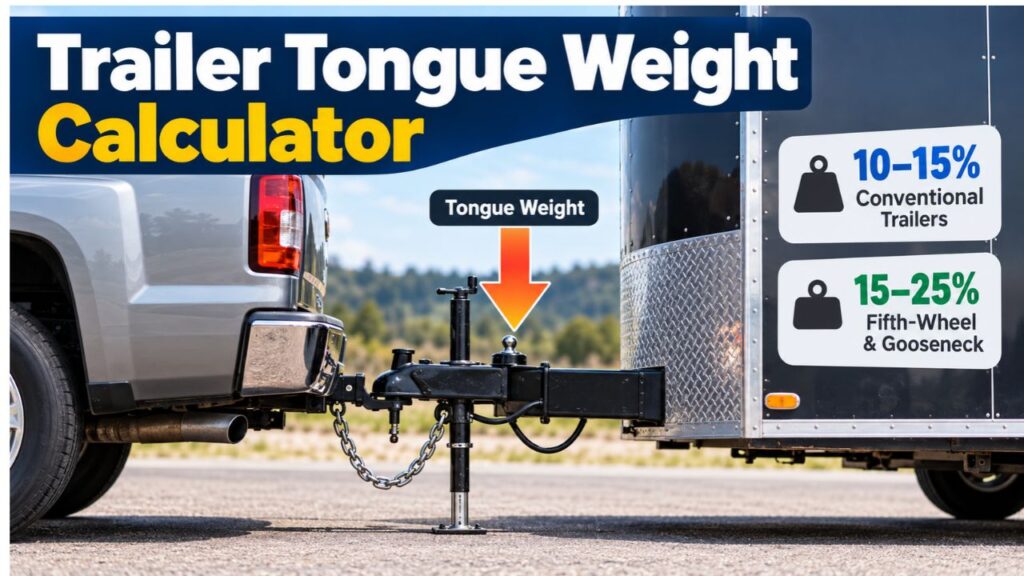
- Conventional bumper-pull trailers commonly use a tongue weight range of 10–15% of loaded trailer weight.
- Fifth-wheel and gooseneck trailers commonly use a pin weight range of 15–25%.
- Actual tongue weight changes when cargo, equipment, water, or other loads are added or repositioned.
- Too little tongue weight can contribute to trailer sway, while excessive tongue weight can overload the tow vehicle or hitch.
- Calculated values are planning estimates. A suitable scale is needed to determine actual tongue or pin weight.
- Manufacturer-specific loading instructions and weight ratings always take priority over general percentage guidelines.
How Does the Trailer Tongue Weight Calculator Work?
The Trailer Tongue Weight Calculator estimates the expected hitch load using the trailer’s loaded weight and a typical percentage range for its connection type.
It can also compare an actual measured tongue or pin weight with the entered trailer weight.
The calculator supports conventional trailers and fifth-wheel/gooseneck connections.
Trailer Connection Type
Select the connection that matches your towing setup.
Conventional Bumper-Pull Trailer: This option covers common ball-hitch trailers, including many utility trailers, travel trailers, cargo trailers, and equipment trailers. The calculator applies a general 10–15% tongue weight range.
Fifth-Wheel / Gooseneck Trailer: This option applies a general 15–25% pin-weight range. These trailers connect over or near the rear axle of a suitable towing vehicle.
The correct percentage for a specific trailer may differ. Always follow its manufacturer’s instructions.
Weight Unit
Choose your preferred measurement unit:
- Pounds (lb)
- Kilograms (kg)
Use the same unit for both loaded trailer weight and measured tongue or pin weight.
Loaded Trailer Weight
Enter the trailer’s actual total weight when loaded for travel.
Include the trailer itself and everything being transported, such as equipment, cargo, camping supplies, installed accessories, and fluids.
For the most reliable result, use the fully loaded trailer’s scale weight rather than the manufacturer’s empty or dry weight.
Measured Tongue or Pin Weight
This input is optional.
If you have already measured the load with a suitable scale, enter the actual value.
The calculator then determines the measured load percentage and indicates whether it falls within the selected general planning range.
A percentage within that range does not independently confirm that your towing setup is safe or within its rated limits.
Understanding the Calculator Results
The calculator displays:
- Typical tongue or pin weight range
- Lower planning estimate
- Upper planning estimate
- Loaded trailer weight
- Typical percentage range
- Measured tongue or pin weight, when provided
- Actual measured load percentage, when provided
The results help with initial loading decisions and comparison against manufacturer specifications.
How to Use the Trailer Tongue Weight Calculator
Follow these steps to estimate the tongue weight for your towing setup.
Step 1: Select the Trailer Connection
Choose Conventional Bumper-Pull Trailer for a standard ball-hitch setup, or Fifth-Wheel / Gooseneck Trailer for the appropriate truck-bed connection.
Step 2: Select Pounds or Kilograms
Choose the weight unit used for your trailer measurements.
For example, if the loaded trailer weighs 5,000 pounds, select pounds and enter 5000.
Step 3: Enter the Fully Loaded Trailer Weight
Enter the complete trailer weight, including cargo and equipment.
If the trailer is empty when you perform the calculation, remember that the result may change considerably after loading.
Step 4: Add the Measured Tongue Weight (Optional)
If you have used a tongue weight scale or another suitable weighing method, enter the reading.
Otherwise, leave this field blank to see only the estimated range.
Step 5: Calculate and Review the Results
Select the Calculate button.
The result will show the estimated load range and, when applicable, how your measured reading compares with the general percentage guidelines.
Review the results together with your trailer’s loading instructions and all applicable vehicle and hitch ratings before towing.
Trailer Tongue Weight Formula
The basic calculation multiplies the fully loaded trailer weight by a selected tongue weight percentage.
Tongue Weight = Loaded Trailer Weight × Tongue Weight Percentage ÷ 100
For a conventional trailer, the calculator uses 10% and 15% to produce the lower and upper planning estimates.
Example: 5,000-Pound Conventional Trailer
Assume the loaded trailer weighs 5,000 pounds.
Lower estimate:
5,000 × 0.10 = 500 lb
Upper estimate:
5,000 × 0.15 = 750 lb
The typical planning range is therefore 500–750 pounds.
A measured tongue weight of 600 pounds would represent 12% of the loaded trailer weight.
How to Calculate Tongue Weight Percentage
When an actual tongue weight measurement is available, the percentage is:
Tongue Weight Percentage = Measured Tongue Weight ÷ Loaded Trailer Weight × 100
For example:
Measured tongue weight = 580 lb
Loaded trailer weight = 5,000 lb
580 ÷ 5,000 × 100 = 11.6%
This falls within the commonly used 10–15% range for conventional trailers.
However, the trailer must still satisfy its specific manufacturer requirements, and the tow vehicle and hitch must be rated for the actual load.
Example: 12,000-Pound Fifth-Wheel Trailer
A fifth-wheel trailer has a loaded weight of 12,000 pounds.
Lower estimate:
12,000 × 0.15 = 1,800 lb
Upper estimate:
12,000 × 0.25 = 3,000 lb
The calculator shows a typical pin-weight range of 1,800–3,000 pounds.
This illustrates why a pickup truck’s available payload can become a limiting factor even when its advertised towing capacity appears sufficient.
How Much Tongue Weight Should a Trailer Have?
There is no single percentage that applies to every trailer.
The appropriate hitch load depends on the trailer’s construction, axle placement, hitch design, cargo arrangement, and manufacturer requirements.
| Trailer Connection | Typical Planning Range |
|---|---|
| Conventional bumper-pull trailer | 10–15% |
| Fifth-wheel trailer | 15–25% |
| Gooseneck trailer | 15–25% |
These ranges are general guidance rather than universal legal limits or guaranteed safe operating ranges.
Conventional Trailer Tongue Weight
Conventional trailers transfer part of their weight to the hitch ball behind the tow vehicle’s rear axle.
The 10–15% guideline is widely used for conventional travel trailers, utility trailers, and cargo trailers.
A properly balanced trailer generally has enough forward loading to reduce sway tendencies without placing excessive downward load on the tow vehicle.
Some specialized trailers, including certain boat trailers, have different manufacturer-specified loading requirements. Follow those instructions rather than assuming that one range applies to every design.
Fifth-Wheel and Gooseneck Pin Weight
Fifth-wheel and gooseneck trailers position the coupling over or near the truck’s rear axle.
These configurations generally support a larger proportion of trailer weight at the coupling point.
A 15–25% range is a useful initial planning guideline, but the actual pin weight should be measured and checked against the truck’s payload, gross vehicle weight rating, rear axle rating, hitch rating, and trailer requirements.
Trailer Tongue Weight Chart by Loaded Trailer Weight
The following charts provide quick estimates for different trailer weights.
Conventional Trailer Tongue Weight Chart
| Loaded Trailer Weight | 10% Tongue Weight | 15% Tongue Weight |
|---|---|---|
| 1,000 lb | 100 lb | 150 lb |
| 2,000 lb | 200 lb | 300 lb |
| 3,500 lb | 350 lb | 525 lb |
| 5,000 lb | 500 lb | 750 lb |
| 7,500 lb | 750 lb | 1,125 lb |
| 10,000 lb | 1,000 lb | 1,500 lb |
Fifth-Wheel and Gooseneck Pin Weight Chart
| Loaded Trailer Weight | 15% Pin Weight | 25% Pin Weight |
|---|---|---|
| 8,000 lb | 1,200 lb | 2,000 lb |
| 10,000 lb | 1,500 lb | 2,500 lb |
| 12,000 lb | 1,800 lb | 3,000 lb |
| 15,000 lb | 2,250 lb | 3,750 lb |
These values are calculated estimates, not measured loads.
The actual downward force depends on the loaded trailer’s balance and weight distribution.
Loaded Trailer Weight vs. Dry Weight vs. GVWR
One of the most important parts of calculating tongue weight correctly is understanding which trailer weight to use.
Dry Trailer Weight
Dry weight generally describes a trailer before some or all cargo, supplies, and other loads are added, according to the manufacturer’s definition.
It is useful when comparing trailers, but it may be substantially lower than the trailer’s actual traveling weight.
For example, an unloaded travel trailer may have a published hitch weight of 450 pounds. After adding propane, batteries, supplies, water, and personal belongings, its actual tongue weight may be considerably different.
Gross Trailer Weight
Gross trailer weight (GTW) is the trailer’s actual total weight in its current loaded condition.
This is the preferred input for the calculator.
Remember that trailer axle weight alone does not necessarily equal gross trailer weight. With the trailer supported by its wheels and hitch, part of its total weight is carried at the coupling point.
Gross Vehicle Weight Rating of the Trailer
A trailer’s GVWR is the maximum permitted loaded weight established by its manufacturer.
It is a rating, not a measurement of what the trailer currently weighs.
Using GVWR can help estimate a conservative upper-end planning scenario, but it will not establish the actual tongue weight of a partially loaded trailer.
For accurate calculations, weigh the loaded trailer in its intended travel configuration.
How to Measure Actual Trailer Tongue Weight
A calculator provides useful estimates, but the actual load must be determined through measurement.
There are several ways to measure tongue weight, depending on the equipment available.
Using a Trailer Tongue Weight Scale
A dedicated tongue weight scale is one of the most straightforward options for conventional trailers.
- Load the trailer as it will be used.
- Park on a firm, level surface.
- Secure the trailer and chock its wheels.
- Position a properly rated scale beneath the coupling point as directed by the scale manufacturer.
- Support the coupler on the scale at approximately its normal towing height.
- Read the measurement and record the actual tongue weight.
The scale must be rated for the expected load.
Measurements taken beneath a trailer jack rather than at the coupler may differ because the support point is in a different position.
Follow the scale manufacturer’s instructions when using an alternate measuring point.
Using a Commercial Vehicle Scale
A commercial scale can be particularly useful for larger trailers.
For a conventional trailer, one method involves measuring the tow vehicle’s axle loads without the trailer and comparing them with the loads when the trailer is attached, while the trailer axles remain off the scale.
The difference can be used to determine the load transferred to the tow vehicle under the specified weighing conditions.
For fifth-wheel trailers, separate tow-vehicle axle readings with and without the trailer can similarly help determine pin weight.
When using a weight-distribution hitch, follow the appropriate manufacturer instructions for the measurement configuration. Engaged spring bars redistribute axle loads and can affect what individual scale platforms record.
Commercial scale procedures can also be used to verify axle weights and combined weight ratings.
Using a Bathroom Scale for Small Trailers
A bathroom scale may be suitable for a lightweight trailer when its capacity is sufficient.
Some properly designed lever arrangements can measure a load greater than the scale’s direct rating, but the calculation depends on the exact lever geometry.
Do not place a heavy trailer directly onto an undersized bathroom scale or assemble an improvised support that could shift or collapse.
For larger trailers, use a suitable tongue weight scale or commercial weighing facility.
Why Trailer Tongue Weight Matters for Towing Stability
Correct trailer loading affects handling, steering, braking, and overall stability.
Both insufficient and excessive tongue weight can create problems.
What Happens When Tongue Weight Is Too Low?
When too much trailer weight is positioned behind the axle or axle group, the downward load on the hitch may become insufficient.
This can increase the trailer’s tendency to sway from side to side.
Possible contributing factors include:
- Heavy cargo loaded too far toward the rear
- Inadequate forward weight distribution
- Cargo shifting during travel
- Changes in trailer balance after unloading equipment
Trailer sway is particularly concerning at highway speeds or during sudden steering movements.
If significant sway develops, avoid abrupt steering or braking inputs. Follow the tow vehicle and trailer manufacturers’ sway-response instructions and stop in a safe location to inspect the loading arrangement.
What Happens When Tongue Weight Is Too High?
Excessive tongue weight may overload the hitch or tow vehicle and place too much load on its rear axle.
Potential consequences include rear suspension sag, reduced front-axle loading, handling changes, and exceeding component ratings.
A trailer may be within the vehicle’s advertised maximum tow rating while still exceeding its permitted tongue weight or available payload.
That is why towing capacity alone does not establish whether a trailer is appropriate for a vehicle.
How to Adjust Trailer Tongue Weight
Cargo position has a direct effect on tongue weight.
Moving weight toward the front generally increases the downward force at the hitch. Moving weight rearward generally reduces it.
However, the correct adjustment depends on the trailer’s axle position, construction, and manufacturer instructions.
How to Increase Tongue Weight
If the measured tongue weight is below the required range:
- Review the location of heavy cargo.
- Move suitable movable cargo forward in small increments.
- Keep heavy items low and securely fastened.
- Recheck the tongue weight after adjusting.
- Confirm that the change does not overload the hitch or tow vehicle.
Do not place all heavy equipment at the front without checking the resulting load.
How to Reduce Tongue Weight
If the tongue weight exceeds the applicable limits:
- Check whether heavy cargo is concentrated near the front.
- Reposition movable loads cautiously toward the axle area or farther rearward as appropriate.
- Remove unnecessary cargo if required.
- Measure the resulting tongue weight again.
- Check trailer axle ratings and left-to-right balance.
Avoid solving excessive tongue weight by moving so much cargo rearward that the trailer becomes unstable.
Why the 60/40 Loading Rule Is Only a Starting Point
A common loading suggestion is to place roughly 60% of cargo weight toward the front and 40% toward the rear.
This may be a helpful starting point for some conventional trailers, but it is not a universal formula.
Trailer geometry, axle placement, cargo concentration, and built-in equipment all affect the final load.
Measured tongue weight and the manufacturer’s loading instructions are more reliable than relying on a fixed cargo-position percentage.
Trailer Tongue Weight vs. Towing Capacity and Payload
Tongue weight is only one part of safe towing.
Before towing, several weight limits need to be checked.
Maximum Towing Capacity
This is the maximum trailer weight the vehicle manufacturer permits under specified conditions.
Actual allowable towing capacity can change with the vehicle’s engine, axle ratio, drivetrain, equipment, passengers, and cargo.
Hitch Tongue Weight Rating
The hitch and related components have their own maximum permitted vertical load ratings.
Check the receiver, ball mount, hitch ball, and applicable vehicle specifications.
The lowest applicable component or vehicle rating determines the allowable limit.
Vehicle Payload Capacity
Payload represents the weight the tow vehicle can carry in addition to its specified base weight.
It includes occupants, cargo, accessories, and the load transferred from the trailer through the hitch.
For example, suppose a truck has 1,600 pounds of available payload capacity before being loaded.
| Load | Weight |
|---|---|
| Passengers | 400 lb |
| Cargo in truck | 200 lb |
| Additional towing equipment | 80 lb |
| Measured trailer tongue weight | 750 lb |
| Total added load | 1,430 lb |
| Remaining capacity | 170 lb |
This simplified example assumes the listed items account for all added loads and that the 1,600-pound starting figure is appropriate for the truck’s actual configuration.
The remaining capacity is not proof that all axle and hitch ratings are satisfied.
GVWR, GAWR, and GCWR
Three additional ratings matter:
GVWR (Gross Vehicle Weight Rating): The maximum permitted loaded weight of a vehicle.
GAWR (Gross Axle Weight Rating): The maximum permitted weight on an individual axle.
GCWR (Gross Combined Weight Rating): The maximum permitted combined weight of the tow vehicle and trailer.
A setup must comply with all applicable limits, not just one headline towing-capacity figure.
Does a Weight Distribution Hitch Change Tongue Weight?
A weight-distribution hitch uses spring bars or another approved mechanism to redistribute some of the load between the tow vehicle’s axles and the trailer axles.
This may improve the towing vehicle’s load distribution when the system is compatible, properly rated, and correctly adjusted.
However, it does not remove the trailer’s actual mass or make an overloaded trailer acceptable.
Some vehicles and receivers have separate weight-carrying and weight-distributing ratings. The applicable ratings must be confirmed before selecting or adjusting a system.
A weight-distribution hitch should not be used as a substitute for correcting an improperly loaded trailer.
Common Trailer Tongue Weight Calculation Mistakes
Using the Empty Trailer Weight
An unloaded trailer may be much lighter than its travel-ready configuration.
Adding equipment, water, supplies, batteries, or other items changes both total weight and load distribution.
Use the actual loaded weight whenever possible.
Confusing Trailer Axle Weight With Total Trailer Weight
When a connected trailer is weighed using only its axle group, that reading excludes the load supported at the hitch.
A correct total trailer weight calculation must account for the entire trailer load.
Assuming 10% Is Always Correct
The 10% figure is the lower end of a commonly used conventional-trailer planning range.
It is not an automatic target for every trailer.
Some trailer manufacturers specify a narrower or different range.
Ignoring the Hitch’s Maximum Rating
Even a percentage within the typical range can exceed the tow vehicle or hitch’s rated capacity.
Always compare actual weight measurements with the lowest applicable rating.
Forgetting Cargo Movement
An unsecured load may shift during travel, changing trailer balance.
Secure cargo, use suitable tie-downs, and recheck weight distribution whenever the load changes substantially.
Assuming a Calculator Measures Actual Hitch Load
The estimated range comes from a percentage formula.
Only the optional measured-weight field represents a real measurement supplied by the user.
The calculator cannot verify vehicle-specific hitch ratings, tire loading, brake performance, or trailer stability.
Trailer Tongue Weight Safety Checklist
Before towing, check the following:
- Trailer is loaded in its intended travel configuration.
- Actual gross trailer weight is known or verified.
- Tongue or pin weight has been measured where practical.
- Tongue weight complies with the trailer manufacturer’s requirements.
- Tow vehicle and hitch vertical load ratings are not exceeded.
- Vehicle payload, GVWR, GAWR, and GCWR requirements are satisfied.
- Cargo is secured against shifting.
- Trailer rides at the appropriate towing attitude.
- Tires are correctly rated and inflated.
- Hitch connection, safety chains, electrical connection, and breakaway equipment are correctly installed where applicable.
- Trailer brakes and lights are functioning.
- Weight-distribution equipment, if fitted, is approved and adjusted according to its instructions.
Completing these checks helps identify common towing issues, but it does not replace the inspection and operating requirements specified by the relevant manufacturers.
References and Further Reading
For more detailed towing information, consult these established industry and manufacturer resources:
- Ford — Towing and Trailering Guide — Explains towing capacity, trailer tongue load, payload, and weight ratings.
- RV Industry Association — RV Loading and Towing Guidance — Covers travel-trailer loading, payload, and tongue weight considerations.
- CURT — How to Measure Tongue Weight — Describes trailer tongue weight measurement methods.
- Weigh Safe — How to Measure Tongue Weight — Explains scale-based measurement and load adjustment.
- etrailer — Determining Trailer Tongue Weight — Provides additional information about estimating and measuring hitch loads.
FAQs About Trailer Tongue Weight Calculator
What is the correct tongue weight for a 5,000-pound trailer?
For a conventional trailer weighing 5,000 pounds when fully loaded, a typical 10–15% range produces a tongue weight estimate of 500–750 pounds. The actual acceptable amount depends on the trailer and tow vehicle manufacturers’ requirements.
How much tongue weight should a 3,500-pound trailer have?
Using the conventional 10–15% planning range, a 3,500-pound loaded trailer would have an estimated tongue weight of 350–525 pounds. Measure the actual load and check the relevant weight limits before towing.
Is 10% tongue weight enough for a trailer?
Ten percent is commonly the lower end of the conventional-trailer planning range, but it is not sufficient for every trailer design. Follow the trailer manufacturer’s instructions and verify actual stability-related loading requirements.
Is tongue weight included in trailer weight?
Yes. The total loaded trailer weight includes the portion supported by the hitch as well as the portion supported by the trailer axles. If only the trailer axles are weighed, that reading does not represent the entire loaded trailer weight.
Does tongue weight count against vehicle payload?
Yes. The load transferred to the tow vehicle through the hitch contributes to the vehicle’s loading and must be considered when checking payload, GVWR, and axle ratings.
Can too much tongue weight damage a vehicle?
Excessive tongue weight can overload the hitch, rear axle, or suspension and adversely affect vehicle handling. Staying below the applicable manufacturer ratings is essential.
How do I calculate trailer tongue weight without a scale?
Multiply the trailer’s loaded weight by an appropriate planning percentage. For a conventional trailer, 10–15% provides a common estimate. However, this calculation cannot determine the actual hitch load, which depends on real weight distribution.
What is the difference between tongue weight and pin weight?
Tongue weight usually refers to the downward force from a conventional trailer at the hitch ball. Pin weight refers to the vertical load transferred by a fifth-wheel or similar truck-bed connection. Gooseneck trailers also apply vertical hitch load near the truck’s rear axle.
Does a weight distribution hitch reduce tongue weight?
A weight-distribution hitch redistributes some of the load across the tow vehicle and trailer axles. It does not eliminate the trailer’s actual coupling load or change the trailer’s mass. Use only compatible equipment and the appropriate manufacturer ratings.
Can I calculate tongue weight in kilograms?
Yes. The calculator supports both pounds and kilograms. Select kilograms and enter the trailer’s loaded weight in kilograms. Any optional measured tongue or pin weight should use the same unit.
Conclusion
The Trailer Tongue Weight Calculator provides a practical starting point for estimating hitch load and understanding trailer balance. It can help determine a typical tongue or pin weight range from the trailer’s fully loaded weight and compare an actual measurement with that range.
For conventional trailers, 10–15% is a widely used planning guideline, while fifth-wheel and gooseneck trailers commonly use 15–25%. These percentages are useful for initial calculations, but they are not substitutes for manufacturer instructions.
The most dependable approach is to measure the loaded trailer, verify the actual tongue or pin weight, secure the cargo, and confirm that the tow vehicle, hitch, trailer, and axles remain within their applicable ratings.
Using the calculator alongside those checks can make trailer-loading decisions more informed and help identify potential problems before a towing trip.