Ceramic and nano ceramic window tint use closely related technology, and nano ceramic is not automatically better. Both use microscopic ceramic materials to manage solar heat without relying on reflective metal layers. The term “nano ceramic” emphasizes extremely small ceramic particles, but there is no universal industry standard that makes it a separate, higher-performing category.
Many premium ceramic films already use nanoscale particles, even when their product names don’t include “nano.” What matters most is the film’s actual heat rejection, optical clarity, visible light transmission, and durability.
The confusion becomes important when tint shops offer regular ceramic and nano ceramic packages at different prices. A more expensive nano ceramic film may provide better infrared heat rejection, but a well-engineered ceramic product can outperform a lower-quality film marketed as nano ceramic.
Other differences, including UV protection, nighttime visibility, electronic signal compatibility, and warranty coverage, deserve attention before installation.
In this article, I compare ceramic and nano ceramic window tint in terms of materials, heat rejection, clarity, cost, and long-term performance. You’ll learn which specifications actually matter, how tint darkness affects visibility, and whether paying extra for nano ceramic is worthwhile for your vehicle.
Ceramic vs Nano Ceramic Window Tint: What’s the Difference?
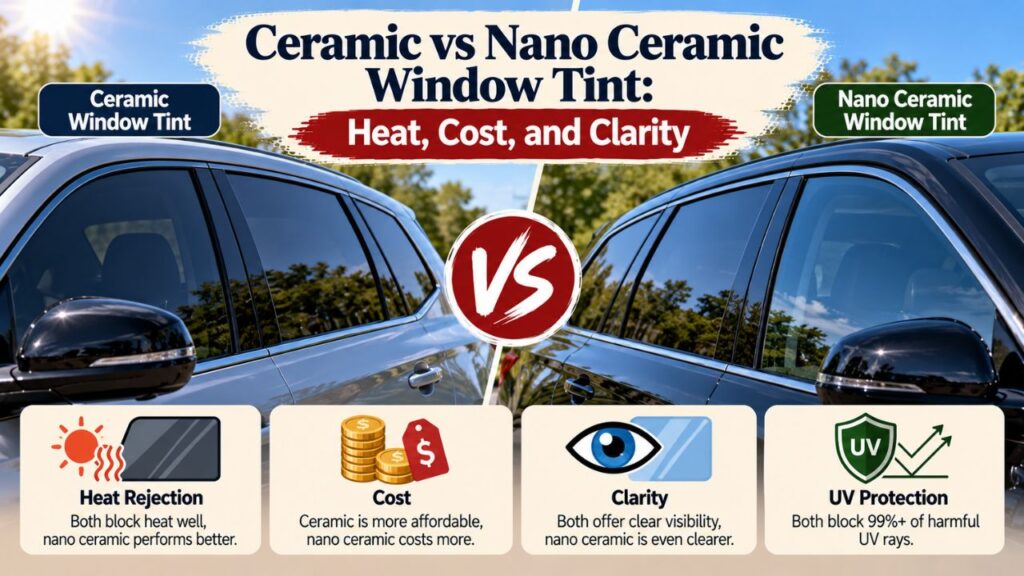
The main difference is how manufacturers describe the ceramic technology used within the film.
Ceramic window tint is the broader category. Nano ceramic describes ceramic technology involving extremely small particles or coatings engineered at the nanometer scale.
However, these terms overlap substantially in real automotive products.
What Is Ceramic Window Tint?
Ceramic window tint is a thin automotive window film containing nonconductive ceramic materials designed to manage incoming solar energy.
The ceramic components help absorb or reject portions of infrared radiation while allowing selected amounts of visible light to pass through.
A typical ceramic film may contain:
- A transparent polyester film substrate.
- Ceramic heat-management materials.
- A pressure-sensitive adhesive.
- UV-absorbing components.
- A protective, scratch-resistant surface coating.
The exact construction varies by manufacturer.
Unlike conventional metallized tint, metal-free ceramic films do not depend on conductive metallic layers for their primary solar-control performance.
This allows them to offer heat rejection without the signal-interference concerns associated with certain metallized films.
What Is Nano Ceramic Window Tint?
Nano ceramic window tint uses ceramic materials engineered at an extremely small scale.
A nanometer is one-billionth of a meter.
The small particle size can help manufacturers control infrared energy while maintaining transparency and reducing unwanted light scattering.
Depending on the formulation, nano ceramic technology may improve:
- Infrared heat rejection.
- Optical clarity.
- Haze control.
- Performance at lighter tint shades.
- Solar energy management.
However, these benefits depend on the completed film’s construction, not particle size alone.
According to Madico’s official ceramic window tint explanation, ceramic and nano ceramic describe functionally similar technologies, and no formal industry standard consistently separates the terms.
Therefore, a film advertised as nano ceramic should not automatically be considered superior to every product labeled simply ceramic.
Ceramic vs. Nano Ceramic Tint Comparison Table
| Feature | Ceramic Window Tint | Nano Ceramic Window Tint |
| Main technology | Ceramic-based solar control | Ceramic-based solar control using nanoscale materials |
| Heat rejection | Good to excellent, depending on film | Good to excellent, depending on film |
| Infrared rejection | Varies by product | Varies by product |
| UV protection | Often 99% or greater | Often 99% or greater |
| Optical clarity | High in quality films | High in quality films |
| Electronic signals | No expected interference from metal-free designs | No expected interference from metal-free designs |
| Available darkness | Multiple VLT options | Multiple VLT options |
| Color stability | Depends on film quality | Depends on film quality |
| Cost | Varies by product tier | Often marketed at a premium |
| Main buying consideration | Verified film performance | Verified film performance |
Key Takeaway: Nano ceramic is not a guaranteed upgrade over ceramic. Compare the actual product specifications rather than relying on the category name.
Ceramic vs Nano Ceramic Window Tint for Heat Rejection
Heat rejection is often the most important reason drivers upgrade from basic dyed tint to ceramic technology.
However, automotive window film controls several different parts of solar energy.
These include visible light, ultraviolet radiation, and infrared radiation.
A film can perform well in one category without rejecting the same percentage of total solar energy.
How Ceramic Tint Reduces Heat
Ceramic film uses its solar-control materials to reduce the infrared energy passing through the glass.
Depending on the film, some incoming energy may be reflected, absorbed, or prevented from reaching the cabin directly.
A portion of absorbed energy can also be released toward the vehicle interior.
This is why manufacturer specifications distinguish between different heat-rejection measurements.
A high infrared-rejection percentage does not necessarily mean an identical percentage reduction in total solar heat entering the vehicle.
Does Nano Ceramic Reject More Heat?
Some advanced nano ceramic products provide better heat rejection than entry-level ceramic films.
However, there is no fixed performance advantage that applies to every product carrying the nano ceramic label.
Manufacturers can use different ceramic materials, particle concentrations, coatings, and multilayer constructions.
These differences affect actual performance.
For example, one ceramic film may reject more total solar energy than another film labeled nano ceramic, even when their visible darkness is similar.
The correct comparison requires performance data from both products.
Understand Total Solar Energy Rejection
Total Solar Energy Rejection (TSER) describes the percentage of total solar energy rejected by the tested film-and-glass combination.
It includes the overall solar energy spectrum rather than measuring only one narrow infrared wavelength range.
For example, a film rated at 55% TSER rejects 55% of the total solar energy under the specified test conditions.
This does not mean the vehicle interior will become exactly 55% cooler.
Cabin temperature also depends on outside temperature, sunlight exposure, ventilation, vehicle insulation, glass area, and air-conditioning operation.
When comparing ceramic films, TSER is one of the most useful measurements.
Understand Infrared Rejection and IRER
Two other measurements frequently appear on automotive tint specifications.
Infrared Rejection (IRR) measures how much infrared energy is rejected within a specified wavelength range.
Infrared Energy Rejection (IRER) evaluates infrared energy over a broader range and accounts for how absorbed heat can contribute to the energy entering the vehicle.
According to 3M’s official automotive window film guidance, its IRR measurement covers the 900–1,000 nanometer wavelength range, while IRER covers 780–2,500 nanometers and considers energy that may be reradiated into the vehicle.
This distinction matters when manufacturers advertise very high infrared-rejection percentages.
A film advertised as rejecting 95% of infrared energy does not necessarily reject 95% of total solar energy.
For example, 3M lists up to 95% infrared rejection and up to 66% total solar energy rejection for its Ceramic IR Series.
Those figures describe different measurements, not conflicting results.
Which Heat-Rejection Number Should You Compare?
When choosing between two ceramic films, prioritize these specifications:
- TSER: Indicates overall solar energy rejection.
- IRER: Provides a broader measure of infrared energy control.
- VLT: Identifies how much visible light passes through the film and glass.
- IRR: Useful when the tested wavelength range is stated.
- Testing conditions: Confirm whether values describe the film alone or film installed on automotive glass.
Compare products at approximately the same visible light transmission.
A very dark ceramic film and a nearly transparent nano ceramic film may have substantially different TSER values because of differences in visible light transmission.
Comparing similar shades makes the results more meaningful.
Ceramic vs Nano Ceramic Tint for Optical Clarity
Optical clarity affects how comfortably a driver can see through tinted glass.
Both ceramic and nano ceramic films can provide excellent clarity when properly manufactured and installed.
However, differences in formulation and quality control may affect haze, distortion, and appearance.
Why Particle Size Can Affect Clarity
Particles and coatings inside window film interact with incoming light.
If a film contains particles or structures that scatter visible light, it may appear slightly cloudy or hazy.
Using appropriately engineered nanoscale materials can help reduce unwanted scattering while providing infrared control.
This is one reason advanced ceramic film manufacturers emphasize fine particle dispersion.
However, particle size is only one factor.
Adhesive quality, film construction, manufacturing defects, and installation also influence optical clarity.
A well-made ceramic film without “nano” in its product name may appear just as clear as a premium nano ceramic alternative.
Haze and Nighttime Visibility
Haze is the scattered light that can make a transparent surface appear cloudy.
Excessive haze may become especially noticeable when viewing headlights, streetlights, or other bright objects against a dark background.
When evaluating a window film, examine a sample under several lighting conditions.
Look for:
- Cloudiness.
- Distortion.
- Unusual color shifts.
- Excessive interior reflections.
- Optical imperfections.
- Poor visibility through darker shades.
Remember that tint darkness affects nighttime visibility independently of the ceramic technology.
A dark nano ceramic film will still transmit less visible light than a lighter ceramic film.
Does Nano Ceramic Tint Look Different?
Not necessarily.
Both technologies can produce a charcoal, black, or neutral appearance.
The exact shade depends on the manufacturer’s formulation.
Some films have a slightly warmer or cooler color tone, while others are designed to match factory privacy glass.
A premium appearance is not guaranteed by the word nano.
Ask to see actual installed examples instead of relying only on advertising photographs.
Ceramic vs Nano Ceramic Window Tint for UV Protection
Both ceramic and nano ceramic films can provide substantial ultraviolet protection.
Many quality automotive ceramic films advertise UV rejection of approximately 99% or greater within their tested wavelength ranges.
However, the actual figure depends on the specific product.
Does Nano Ceramic Block More UV Rays?
Not automatically.
A regular ceramic film and a nano ceramic film may offer nearly identical UV protection.
The difference in infrared performance does not necessarily create a corresponding difference in ultraviolet rejection.
UV protection can be provided through dedicated UV-absorbing components within the film construction.
For this reason, UV rejection should be evaluated separately from heat rejection.
UV Protection vs. Heat Rejection
Ultraviolet and infrared radiation are different parts of the electromagnetic spectrum.
UV radiation contributes to skin damage and the deterioration of certain interior materials.
Infrared radiation contributes to solar heat exposure.
A film may reject a very high percentage of UV radiation without offering equally high total solar heat rejection.
If your priority is protecting interior materials while maintaining a lighter appearance, compare the UV specifications of the exact film options.
If cabin comfort is the priority, examine TSER and infrared performance as well.
Does Window Tint Protect the Entire Cabin?
Window tint reduces selected radiation passing through treated glass.
It does not prevent solar energy from entering through untreated windows, nor does it eliminate heat transfer through the roof, doors, and body panels.
Protection also depends on which windows receive film.
Tint should be viewed as one part of managing sun exposure rather than complete protection against every source of cabin heat or UV radiation.
Does Nano Ceramic Tint Reduce Glare Better Than Ceramic?
Glare reduction depends strongly on how much visible light the film allows through the glass.
Both ceramic and nano ceramic films can reduce brightness from direct sunlight.
However, a darker film generally blocks more visible light than a lighter film, regardless of whether it contains nano ceramic technology.
How VLT Affects Glare
Visible Light Transmission (VLT) is the percentage of visible light that passes through the tested material or glass-and-film combination.
Common tint descriptions include:
| VLT | General appearance |
| 70% | Very light |
| 50% | Light tint |
| 35% | Medium tint |
| 20% | Dark tint |
| 5% | Very dark |
These values describe visible light transmission, not heat rejection.
A 35% ceramic tint and a 35% nano ceramic tint can provide similar visible darkness.
Their heat-rejection capabilities may still differ.
Does Darker Tint Always Reject More Heat?
No.
A darker shade often reduces more visible light, which can contribute to increased overall solar energy rejection.
However, high-performance ceramic films can reject substantial infrared energy without appearing very dark.
A lighter nano ceramic film may provide better infrared rejection than a darker, lower-performance film.
Choose the shade based on visibility, appearance, and legal requirements, then compare heat-rejection ratings at that shade.
Do Ceramic and Nano Ceramic Tints Interfere With Electronic Signals?
Metal-free ceramic and nano ceramic films generally do not create the electronic signal interference associated with certain metallized window films.
This matters for modern vehicles that rely on multiple wireless systems.
GPS, Cellular Reception, and Bluetooth
Nonconductive ceramic films do not depend on continuous metallic layers that can interfere with radio-frequency signals.
As a result, quality metal-free ceramic films are generally compatible with:
- Smartphone cellular connections.
- GPS navigation.
- Bluetooth devices.
- Satellite radio.
- Wireless communication systems.
However, the complete film construction matters.
Check the manufacturer’s specifications rather than assuming every product containing ceramic materials is entirely metal-free.
What Makes Metallized Tint Different?
Metallized window film uses metal-containing layers to manage solar energy.
Depending on the film design, these layers may affect certain wireless signals.
Ceramic films provide an alternative approach to heat rejection without relying on conventional conductive metallic layers.
Nano ceramic doesn’t automatically offer an additional signal advantage over a regular metal-free ceramic film.
For most vehicles, both are suitable when the products are genuinely nonmetallized.
Ceramic vs Nano Ceramic Window Tint: Durability and Lifespan
Both ceramic and nano ceramic tint can remain functional for many years when high-quality film is installed correctly.
However, the term nano ceramic does not establish a specific lifespan.
Long-term performance depends on the film materials, adhesive, protective coating, installation, and environmental exposure.
Color Stability and Fading
Quality ceramic films are often designed to resist the discoloration associated with certain older or inexpensive dyed films.
However, ceramic technology alone does not guarantee permanent color stability.
Different products use different color-control materials and film constructions.
When comparing two films, check the warranty coverage for:
- Unusual discoloration.
- Fading.
- Bubbling.
- Peeling.
- Adhesive failure.
- Other covered manufacturing defects.
Some warranties cover particular failures but exclude damage caused by improper cleaning or installation.
Read the written warranty instead of relying on the phrase “lifetime warranty.”
Scratch Resistance
Most automotive window films have a protective surface coating designed to resist ordinary cleaning-related abrasion.
Neither ceramic nor nano ceramic film is completely scratch-proof.
Scratches can occur from dirty cleaning tools, abrasive materials, or damaged window seals.
This is especially relevant for vehicles with roll-down windows.
Sand or debris trapped in a window channel may rub against the film repeatedly.
Does Nano Ceramic Tint Last Longer?
Not necessarily.
A high-quality ceramic film with a strong adhesive system may last longer than a poorly manufactured nano ceramic product.
Material quality and installation are more reliable indicators than the category name.
For long-term ownership, choose a film with documented performance, a clear warranty, and an established installation process.
Ceramic vs Nano Ceramic Window Tint Cost
Nano ceramic products are often sold as premium upgrades, but pricing depends on the manufacturer and installation package.
There is no universal price difference because the product categories overlap.
A film marketed simply as ceramic may cost more than another film labeled nano ceramic.
Typical Ceramic Tint Installation Costs
For professional ceramic tint installation, a broad planning range for a passenger vehicle is approximately 300–800, depending on film selection, vehicle size, location, and window coverage.
Larger SUVs, trucks, complex rear windows, and premium film packages can cost more.
These are general market estimates, not fixed installation prices.
Why Some Nano Ceramic Packages Cost More
Higher-priced tint packages may include:
- More advanced infrared-control formulations.
- Multilayer film construction.
- Improved optical characteristics.
- Additional quality-control requirements.
- More extensive warranty coverage.
- Premium branding.
- Higher installation labor charges.
However, paying more does not guarantee proportionally better performance.
The difference must be evaluated using actual specifications.
Is the Price Difference Worth Paying?
Consider two hypothetical installation quotes.
| Installation option | Ceramic package | Nano ceramic package |
| Installed price | $400 | $600 |
| Film type | Ceramic | Nano ceramic |
| Manufacturer specifications | Must be verified | Must be verified |
| Warranty | Check written terms | Check written terms |
| Best choice | Depends on performance | Depends on performance |
The $400 and $600 prices are illustrative examples, not verified quotes for specific products.
If both films provide similar TSER, IRER, clarity, and warranty protection at the same VLT, paying the additional $200 may provide little practical benefit.
If the more expensive product offers a meaningful improvement in verified solar heat rejection, the upgrade may be worthwhile for someone who drives frequently in strong sunlight.
Key Takeaway: Pay for measurable performance improvements, not simply for the nano ceramic label.
Which Is Better for Hot Weather and Daily Driving?
The better option depends on the particular film’s performance and how the vehicle is used.
Heat rejection becomes especially important in regions with intense sunshine and long periods of warm weather.
For Drivers in Hot Climates
A high-performance ceramic film with strong TSER and IRER values is generally the more useful choice.
It can reduce some of the solar energy entering the cabin and improve comfort during sunny conditions.
If a premium nano ceramic film offers substantially better verified heat rejection than a lower-tier ceramic alternative, the upgrade may be reasonable.
However, a premium ceramic film without nano branding may perform equally well or better.
The manufacturer’s test results should determine the choice.
For Daily Commuters
Drivers who spend significant time in traffic or travel during sunny afternoons may benefit from improved infrared heat rejection.
However, visibility remains important during early-morning and evening driving.
Consider a legal VLT that provides enough light transmission for the conditions in which the vehicle is used.
Don’t choose extremely dark tint solely because it looks better from outside.
For Drivers Who Want a Light Tint
A high-performance ceramic or nano ceramic film can be particularly useful when a lighter shade is preferred.
Some advanced films provide substantial infrared rejection even at relatively high VLT levels.
This allows drivers to prioritize visible light transmission without relying entirely on darkness for heat control.
However, the final tint must still satisfy local vehicle-window regulations.
For Budget-Conscious Drivers
A reputable midrange ceramic film may provide a better overall value than a premium product whose improvement is relatively small.
Prioritize reliable heat-rejection data, professional installation, and appropriate warranty coverage.
Avoid comparing packages based only on words such as premium, ultra, infrared, or nano.
How to Choose Between Ceramic and Nano Ceramic Window Tint
The most useful buying method is to compare specific film models rather than general technology labels.
Ask the installer for the full manufacturer name, series, shade, and published technical specifications.
Step 1: Compare Films at Similar VLT
Start with two films that allow approximately the same amount of visible light through the glass.
For example, compare products near 35% VLT with other products near 35% VLT.
This reduces the confusion caused by comparing films with very different darkness levels.
Remember that the final VLT of a factory-tinted window with added film can differ from the film’s standalone rating.
Step 2: Check the TSER and IRER Values
Prioritize total solar energy rejection and infrared energy rejection.
Ask whether the values were measured using:
- Film alone.
- Clear glass with film installed.
- Automotive glass with film installed.
- A specific glass thickness or test method.
Two products tested under different conditions may not be directly comparable.
Do not assume that a film advertising 95% infrared rejection is better than another advertising 60% total solar energy rejection.
Those percentages describe different measurements.
Step 3: Check Optical Clarity and Color
Examine film samples and, if possible, vehicles that already have the products installed.
Evaluate visibility in both bright sunlight and lower-light conditions.
Look for haze, color distortion, excessive reflections, and inconsistent appearance.
For newer vehicles, also consider how the tint matches existing rear privacy glass.
Step 4: Verify Your State’s Window Tint Laws
Automotive window tint laws vary across the United States.
Rules may differ based on:
- Windshield location.
- Front side windows.
- Rear side windows.
- Rear windshield.
- Vehicle classification.
- Required VLT.
- Reflectivity.
- Medical exemptions.
Certain jurisdictions also regulate where tint may be installed on windshields.
The allowable darkness for rear windows may differ from the limits for front side windows.
Ask the installer to measure the existing glass and confirm the legal final VLT.
A film’s advertised shade is not necessarily the same as the completed glass-and-film measurement.
Step 5: Review the Warranty
A strong warranty can be valuable for vehicles that will be kept for many years.
Check:
- Whether the warranty covers both material and labor.
- Which defects are included.
- Whether coverage requires an authorized installer.
- Whether the warranty transfers to a new owner.
- Whether proof of purchase is required.
- How claims are handled if the original installer closes.
A lifetime warranty may refer to the original owner’s ownership period rather than an unlimited product lifespan.
Step 6: Choose a Qualified Installer
Installation quality affects how the finished tint looks and performs.
A professional installation should minimize visible dust contamination, trapped debris, creases, lifting edges, and adhesive problems.
Ask whether the installer has experience with your vehicle’s glass shape and electronic equipment.
Modern vehicles may have cameras, sensors, antennas, and other components near the windshield or rear glass.
The installer should follow the vehicle manufacturer’s restrictions and protect sensitive electronics during the installation process.
Common Misunderstandings About Ceramic and Nano Ceramic Tint
Several claims can make the comparison more confusing than necessary.
Nano Ceramic Is Always Better Than Ceramic
This is not established.
Nano ceramic describes a construction approach, but the name alone doesn’t guarantee higher TSER, better clarity, or a longer lifespan.
Use measured specifications to identify the better film.
A 95% Infrared Rating Means 95% Less Cabin Heat
This is incorrect.
Infrared rejection may be measured over a particular wavelength range.
It does not represent the total solar energy entering the vehicle.
Compare TSER and IRER for a more meaningful understanding of overall heat control.
Darker Nano Ceramic Tint Always Blocks More Heat
Not necessarily.
Darkness determines how much visible light passes through the film.
A lighter high-performance ceramic film may reject more infrared energy than a darker film with weaker solar-control technology.
Nano Ceramic Tint Makes Air Conditioning Unnecessary
No window film eliminates the need for climate control in hot weather.
Tint reduces selected solar energy entering through treated glass, but the cabin still receives heat from other surfaces and the surrounding environment.
Performance also depends on how much glass is treated.
Ceramic Tint Never Fades or Fails
No film is immune to every form of aging, installation damage, or environmental exposure.
Quality ceramic films are designed for long-term stability, but actual durability varies.
Warranty coverage and correct maintenance remain important.
Conclusion
In the ceramic vs nano ceramic window tint comparison, the most important finding is that the terms describe closely related technologies rather than universally separate performance classes.
Nano ceramic often refers to advanced nanoscale ceramic materials, but many quality ceramic films already use similar technology.
Both can provide strong heat rejection, UV protection, good optical clarity, and compatibility with electronic devices when their construction is metal-free.
A premium nano ceramic product may be worth paying more for if its published specifications show a meaningful performance improvement.
However, a reputable ceramic film with comparable TSER, IRER, VLT, and warranty coverage can be an equally good choice.
For most drivers, I recommend comparing specific film models at the same visible darkness, confirming the legal tint limit, and choosing the product that provides the best verified performance for the price.
The right film is the one that meets your driving needs, not necessarily the one with the most advanced-sounding name.
FAQs About Ceramic vs Nano Ceramic Window Tint
Is Nano Ceramic Tint Better Than Regular Ceramic Tint?
Not automatically. Nano ceramic films may use advanced ceramic formulations, but many regular ceramic films also contain nanoscale materials. Compare TSER, IRER, VLT, optical clarity, and warranty coverage to determine which specific product is better.
Is Nano Ceramic Tint Worth the Extra Money?
It can be worthwhile when the higher-priced film provides substantially better verified heat rejection or other useful improvements. If two films have similar performance ratings and warranty coverage, the additional expense may not provide a meaningful benefit.
Does Nano Ceramic Tint Block More Heat Than Ceramic Tint?
Some nano ceramic films reject more heat than certain lower-tier ceramic products, but there is no universal advantage. Total solar energy rejection and infrared energy rejection depend on each film’s construction and tested performance.
Can You See Through Nano Ceramic Tint at Night?
Yes, but visibility depends mainly on the film’s VLT, the existing glass, and lighting conditions. Darker nano ceramic tint reduces nighttime visibility just as darker conventional ceramic tint does. Choose a legal shade suitable for your driving conditions.
Does Ceramic or Nano Ceramic Tint Last Longer?
Neither category guarantees a longer lifespan. Durability depends on film quality, adhesive construction, protective coatings, installation, and environmental exposure. Compare the manufacturer’s written warranties rather than relying on the technology label.
Does Nano Ceramic Tint Interfere With GPS or Cell Signals?
Genuinely metal-free nano ceramic film is not expected to interfere with GPS, cellular reception, Bluetooth, or satellite radio. Quality nonmetallized ceramic films generally provide the same advantage.
Is 35% Ceramic Tint Better Than 20% Nano Ceramic Tint?
It depends on your priorities. A 35% film allows more visible light through than a 20% film, which may help visibility in lower-light conditions. The 20% film provides greater darkness and privacy. Heat rejection must be compared using the specific products’ TSER and IRER ratings, and both choices must comply with local law.