20% window tint is generally the better choice for drivers who want dark windows with more usable visibility, while 5% tint provides significantly greater privacy but makes seeing outside much harder at night. A 20% tint allows approximately 20% of visible light through, compared with only 5% for the darker shade.
Both options are popular for automotive window tinting, but they create noticeably different driving experiences. A 20% film delivers a dark appearance and substantial daytime privacy, while 5% tint, commonly called limo tint, produces a nearly blacked-out appearance from outside.
The difference becomes particularly important when driving after sunset, checking side mirrors, reversing, or navigating poorly lit streets.
Heat protection and legal restrictions also deserve attention. A darker film doesn’t automatically offer better infrared rejection, and both shades may be restricted depending on the vehicle and state.
In this article, I compare 20 vs 5 window tint for darkness, privacy, nighttime visibility, heat rejection, UV protection, and cost. You’ll also learn how factory glass affects the final tint percentage, which shade works better for different vehicle windows, and what to check before installation.
20 vs 5 Window Tint: Main Differences
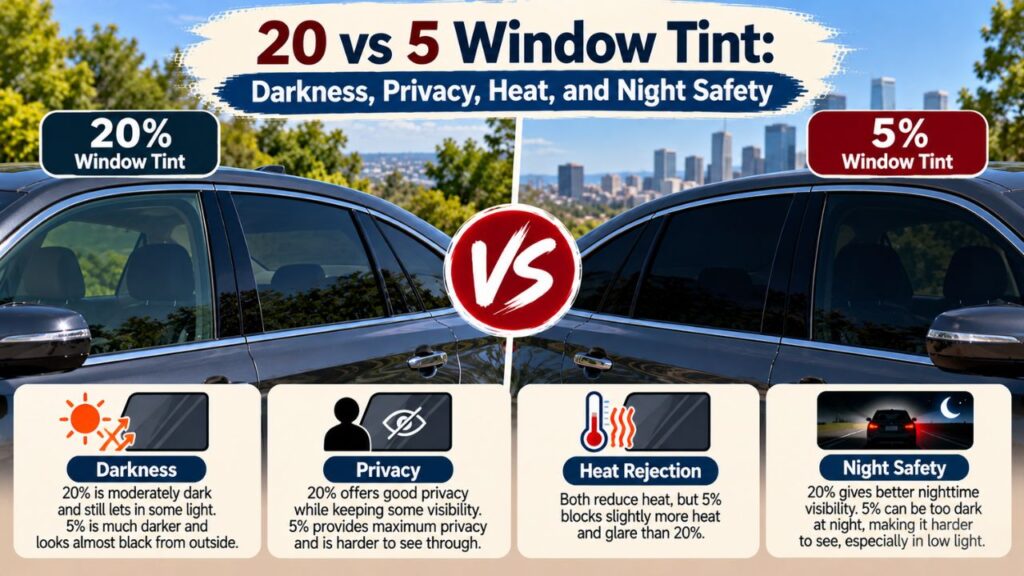
The primary difference between 20% and 5% window tint is visible light transmission (VLT).
A 20% tint allows substantially more visible light through than a 5% tint. This affects how dark the windows appear and how easily a driver can see through them.
20% vs 5% Window Tint Comparison Chart
| Feature | 20% Window Tint | 5% Window Tint |
| Nominal visible light transmission | 20% | 5% |
| Visible light blocked | Approximately 80% | Approximately 95% |
| Appearance | Dark | Extremely dark |
| Daytime privacy | High | Very high |
| Nighttime visibility | Reduced | Severely reduced |
| Looking through side windows | Easier | Much harder in low light |
| Glare reduction | Strong | Stronger for visible light |
| Heat rejection | Depends on film technology | Depends on film technology |
| UV protection | Can exceed 99% | Can exceed 99% |
| Legal restrictions | Often restricted, especially on front windows | Generally more restricted |
| Best general use | Privacy with more practical visibility | Maximum privacy where permitted |
These percentages represent nominal tint shades. Actual measured VLT can differ by product and by the original automotive glass.
Key Takeaway: A 20% tint transmits roughly four times as much visible light as a 5% tint. That difference matters much more for nighttime driving than the two numbers might initially suggest.
What Does 20% Window Tint Look Like?
A 20% window tint creates a dark, shaded appearance without making the glass as opaque-looking as 5% tint.
From outside the vehicle, the interior may be difficult to see in bright daylight, especially when the cabin is darker than the surrounding environment.
However, the glass is not completely black.
Depending on lighting conditions, someone standing close to the vehicle may still see silhouettes, movement, or interior details.
How Dark Is 20% Tint From Outside?
Twenty-percent tint is considered dark automotive window film.
It noticeably changes the appearance of clear factory glass and can create a relatively uniform, dark look across the vehicle.
Its appearance depends on several factors:
- Exterior sunlight intensity.
- Interior lighting.
- Existing factory glass tint.
- Film color and reflectivity.
- Viewing angle.
- Vehicle interior color.
For example, 20% tint may appear nearly black on a vehicle with dark interior upholstery during bright daylight.
At night, when the cabin light is switched on, the interior may become considerably easier to see from outside.
Can You See Through 20% Tint at Night?
Yes, but 20% tint substantially reduces the amount of light reaching the driver’s eyes.
On well-lit city streets, drivers may find it easier to see through than 5% film.
However, the reduction becomes more noticeable on dark rural roads, in parking lots, or when checking mirrors.
Objects that are already difficult to distinguish may become harder to see.
Twenty-percent tint should not be treated as a universally safe or legal darkness for front side windows.
Its suitability depends on visibility requirements, vehicle configuration, and applicable regulations.
What Does 5% Window Tint Look Like?
Five-percent tint is extremely dark and is commonly known as limo tint.
It allows only about 5% of visible light to pass through the film under its nominal rating.
From outside, it can create a nearly black appearance, particularly in bright daylight.
The interior often becomes very difficult to see when the cabin is not illuminated.
How Dark Is 5% Tint?
A 5% film blocks approximately 95% of visible light.
This makes it substantially darker than 20% tint.
The difference isn’t simply a slightly deeper shade of black.
A 5% film transmits approximately one-quarter as much visible light as a 20% film.
That can dramatically affect the view through the window under low-light conditions.
Can People See Inside a Car With 5% Tint?
Five-percent tint offers strong daytime privacy, but it doesn’t guarantee complete invisibility.
People may still see inside when:
- The cabin lights are turned on.
- A phone or other bright screen illuminates the interior.
- Exterior lighting conditions change.
- Someone looks through the windshield or another lighter window.
- A bright object is positioned close to the glass.
Window tint does not create true one-way visibility.
It reduces light transmission in both directions.
Although the dark appearance makes it harder for outsiders to see inside during daylight, the same film also limits the driver’s view outward.
Is 5% Tint Too Dark for Everyday Driving?
For most drivers who regularly operate their vehicles at night, 5% tint presents substantial visibility disadvantages.
It can make it difficult to identify pedestrians, curbs, bicycles, and other low-contrast objects through the affected windows.
The reduction in visibility becomes especially important when reversing or turning on poorly lit roads.
For everyday passenger vehicles, a lighter and legally compliant shade is generally more practical.
20 vs 5 Window Tint for Night Driving
Nighttime visibility is one of the most important differences between these shades.
Even when two films have similar optical quality, the amount of light they transmit can be dramatically different.
Night Visibility With 20% Tint
Twenty-percent tint reduces nighttime visibility, but it allows considerably more light through than 5%.
This can make it easier to recognize objects through the side windows in areas with streetlights or other illumination.
However, 20% is still a dark tint.
It may make the following activities more difficult:
- Checking side mirrors.
- Looking through side windows while turning.
- Identifying pedestrians in poorly lit areas.
- Reversing into dark parking spaces.
- Monitoring nearby cyclists.
- Detecting obstacles during heavy rain.
Drivers should not assume that 20% tint is safe for every window simply because it is lighter than 5%.
Night Visibility With 5% Tint
Five-percent tint produces a much greater reduction in available visible light.
On unlit roads, the outside view through a 5% tinted window may be extremely difficult to interpret.
For example, consider a driver reversing into a dark parking area.
With 20% tint, some light from nearby lamps may still help the driver recognize objects through the window.
With 5% tint, much less of that light reaches the driver’s eyes.
The vehicle may have backup cameras or parking sensors, but these systems are not substitutes for adequate direct visibility.
Safety Note: Avoid choosing 5% tint for windows needed for driving visibility. Even if a particular installation is legally permitted, reduced visibility can still create a practical safety problem.
Does Ceramic 5% Tint Improve Night Visibility?
Ceramic technology does not cancel the effect of a very low VLT.
A 5% ceramic film still transmits only a small fraction of visible light.
High-quality ceramic products may have excellent optical clarity, low haze, and effective heat rejection.
However, clarity and brightness are different properties.
A clear image viewed through extremely dark glass may still contain too little light for comfortable nighttime driving.
A lighter film is the more effective choice when maintaining visibility is the priority.
20 vs 5 Window Tint for Privacy
Both shades provide daytime privacy, but 5% tint makes the vehicle interior considerably harder to see.
Whether the additional darkness is worthwhile depends on how the vehicle is used.
Daytime Privacy With 20% Tint
Twenty-percent tint provides substantial privacy under many daylight conditions.
It can make passengers and belongings less visible to people outside.
However, someone standing close to the glass may still recognize interior shapes or movement.
Privacy also depends on which windows are tinted.
For example, dark rear side windows may provide less overall privacy when the windshield and front side windows remain relatively clear.
Daytime Privacy With 5% Tint
Five-percent tint creates a much darker appearance.
During bright daylight, the interior may be difficult to see through the tinted windows.
This is one reason limo tint is associated with vehicles where passenger privacy is a priority.
However, the extra privacy comes with a significant reduction in outward visibility.
For vehicles used mainly for everyday commuting, the tradeoff may not be worthwhile.
Which Shade Is Better for Passenger Privacy?
For rear passenger windows where a dark shade is legally permitted, 5% tint may provide greater daytime privacy.
Twenty-percent tint offers a more moderate balance between privacy and visibility.
The correct choice depends on the vehicle’s purpose and the legal requirements for those specific windows.
Important: Dark tint should not be treated as a security system. Valuables may still be visible under certain lighting conditions, and tinted windows do not prevent vehicle break-ins.
Does 5% Window Tint Block More Heat Than 20%?
Five-percent tint may reject more total solar energy than a 20% shade from the same film series, but the difference is not necessarily proportional to the difference in darkness.
Heat rejection depends on film technology, not VLT alone.
Why Darker Tint Doesn’t Always Mean Better Heat Rejection
Sunlight contains visible light, infrared radiation, and ultraviolet radiation.
Window films interact with these parts of the solar spectrum differently.
A basic dyed 5% film may block substantial visible light without rejecting as much total solar energy as a lighter premium ceramic film.
Therefore, a 20% ceramic tint can outperform a 5% conventional dyed tint in overall heat rejection.
To compare thermal performance, look for Total Solar Energy Rejection (TSER) and other verified technical ratings.
Real Manufacturer Heat Rejection Comparison
According to LLumar’s 2025 North American automotive window film performance data, the following products have these reported values when measured under specified testing conditions on clear glass.
| LLumar Film | Measured VLT | Total Solar Energy Rejected |
| ATC 05 dyed film | 5% | 44% |
| ATC 20 dyed film | 25% | 38% |
| IRX 05 ceramic film | 6% | 62% |
| IRX 15 ceramic film | 20% | 59% |
Notice that the product names do not always match the exact measured VLT.
For example, the ATC 20 product is listed at 25% VLT, while IRX 15 is listed at 20% VLT under the manufacturer’s test conditions.
The figures show that a high-performance ceramic film near 20% VLT can reject substantially more total solar energy than a basic dyed film around 5% VLT.
They also demonstrate that going much darker within the same film family may produce only a modest increase in heat rejection.
These are product-specific laboratory figures, not universal ratings for all films.
Which Tint Keeps a Car Cooler?
If you’re comparing identical film technologies, the darker shade may offer somewhat greater overall solar heat rejection.
However, if you’re comparing a 20% ceramic tint with a basic 5% dyed tint, the ceramic option may deliver better thermal performance.
For drivers mainly interested in reducing cabin heat, choosing a high-quality film with strong TSER performance is generally more useful than selecting the darkest available shade.
No automotive tint prevents a vehicle parked in direct sunlight from becoming dangerously hot.
20 vs 5 Window Tint for UV Protection
Ultraviolet protection does not necessarily improve significantly when moving from 20% to 5% tint.
A quality film in either shade can reject a high percentage of UV radiation.
Does 20% Tint Block UV Rays?
Yes, many properly formulated 20% automotive films provide substantial UV rejection.
Some premium products reject more than 99% of UV radiation over their specified testing ranges.
The actual protection depends on the film and glazing system.
A relatively lighter film can offer excellent UV protection without requiring limousine-dark windows.
Does 5% Tint Block More UV?
Not necessarily.
A 5% film may block much more visible light than a 20% film, but both can provide similar UV rejection.
The LLumar performance data cited earlier lists more than 99% UV protection for the compared ATC and IRX products.
This means UV protection alone is not a good reason to choose 5% over 20%.
Which Is Better for Protecting Car Interiors?
Both shades can help reduce UV exposure through treated windows.
However, interior fading and deterioration are influenced by additional factors, including visible sunlight, heat, material composition, and exposure duration.
For protecting leather, dashboards, and upholstery, compare the film’s verified UV protection and total solar energy rejection.
A high-performance 20% tint may be a better overall choice than a darker film with weaker solar heat control.
Is 20% or 5% Window Tint Legal?
Window tint legality depends on the state, vehicle classification, and specific window being tinted.
Neither 20% nor 5% tint should be assumed legal for every automotive window.
Front Side Window Restrictions
Front side windows have particularly important visibility requirements because drivers use them to observe traffic, pedestrians, and mirrors.
Many states restrict front side window tint more heavily than rear passenger window tint.
Twenty-percent tint may be too dark for front windows in numerous jurisdictions.
Five-percent tint is generally even more restricted.
However, laws vary, and some vehicle classifications or authorized exemptions may be treated differently.
Rear Side Windows and Rear Windshields
Some states allow significantly darker tint on rear windows than on front side windows.
This is particularly relevant to certain SUVs, trucks, and vans.
However, permitted darkness may depend on:
- Whether the vehicle is classified as a passenger car or multipurpose vehicle.
- The specific window position.
- Outside mirror requirements.
- Local reflectivity restrictions.
- Medical exemptions where applicable.
- Other state-specific conditions.
A 5% rear tint that is permitted on one vehicle in one state may not be permitted on another vehicle in a different state.
Federal and State Tint Regulations
The National Highway Traffic Safety Administration’s interpretation of federal glazing and aftermarket tint rules explains that federal safety standards establish glazing requirements and that state laws separately regulate certain modifications made by individual vehicle owners.
NHTSA also explains that vehicle manufacturers, dealers, and repair businesses are subject to federal restrictions against rendering required safety equipment inoperative.
This distinction matters because state vehicle-operation rules and federal requirements for commercial installers are not identical.
Do not assume an installer may legally apply a particular shade just because you have seen it on another vehicle.
How to Check Whether Your Tint Is Legal
Before installation:
- Identify your vehicle’s classification.
- Check the current tint requirements published by your state’s DMV, highway patrol, or other responsible authority.
- Confirm the applicable limits for each window.
- Measure the factory glass when necessary.
- Ask the installer about the final combined VLT.
- Verify any reflectivity, certification, or exemption requirements.
Key Takeaway: Legal compliance depends on the finished window, not just the shade printed on the film box.
How Factory Glass Changes 20% and 5% Window Tint
One commonly overlooked issue is that factory automotive glass may already reduce visible light transmission.
Adding aftermarket film reduces the total amount of light passing through the completed window.
Film VLT vs. Combined Window VLT
The advertised film percentage and the installed window percentage are not necessarily identical.
For a simplified calculation:
Combined VLT = Glass VLT × Film VLT
Convert the percentages to decimals before multiplying.
For example, suppose the factory glass allows 80% of visible light through.
With 20% film:
0.80 × 0.20 = 0.16
Combined VLT = approximately 16%
With 5% film:
0.80 × 0.05 = 0.04
Combined VLT = approximately 4%
These are illustrative calculations.
Actual products have manufacturing tolerances, and measured performance varies with the specific glass and film.
What Happens When You Add Film to Factory Privacy Glass?
Many SUVs, trucks, and vans have factory privacy glass on their rear windows.
That glass may already appear dark without aftermarket tint.
Adding 20% or 5% film can make the completed window substantially darker.
For example, assume a factory rear window has 25% VLT.
Applying nominal 20% film gives an approximate combined VLT of:
0.25 × 0.20 = 5%
Applying nominal 5% film gives:
0.25 × 0.05 = 1.25%
This shows why tinting already-dark factory glass requires particular caution.
A relatively dark aftermarket film can make the completed window extremely difficult to see through.
Should You Tint Over Factory Privacy Glass?
It depends on the vehicle, legal requirements, and desired performance.
If the existing glass is already dark, you may not need additional visible-light reduction.
If heat protection is your main concern, consider whether a compatible high-VLT heat-rejecting film can meet your needs without excessively reducing visibility.
Have the existing glass measured before selecting an additional film.
20 vs 5 Window Tint for Different Vehicle Windows
The best tint darkness may differ between front side windows, rear passenger windows, and the rear windshield.
Using the same shade everywhere is not always practical or legally permitted.
Front Driver and Passenger Windows
For front side windows, prioritize outward visibility and legal compliance.
Neither 20% nor 5% should automatically be considered an appropriate choice.
A lighter, legally compliant film may offer better everyday usability.
High-performance ceramic products can also provide meaningful heat rejection at lighter VLT levels.
Rear Passenger Windows
Rear passenger windows are often where drivers consider darker shades for privacy.
A 20% tint can provide substantial daytime privacy while allowing more light through.
A 5% tint offers greater privacy but significantly reduces visibility.
If passengers regularly need to see outside at night, 20% may be more practical, subject to local law.
Rear Windshield
Rear windshield tint affects the view behind the vehicle.
A very dark film can make it harder to see vehicles, pedestrians, and other objects through the rear glass in poorly lit conditions.
Rearview cameras and parking sensors may help with particular maneuvers, but they do not replace all direct visibility.
Choose a shade that complies with local regulations and supports safe operation.
Windshield
Neither 20% nor 5% full-windshield tint is an appropriate general recommendation for road-going vehicles.
Both substantially reduce visible light transmission.
Windshield tint requirements are typically more restrictive, with any permitted strips or special exceptions governed by applicable rules.
If you’re interested in reducing windshield heat, investigate legally compliant high-VLT films rather than selecting an extremely dark shade.
Ceramic 20% vs Ceramic 5% Window Tint
When comparing two shades from the same ceramic film series, the primary difference is typically visibility and privacy.
Both products may use similar infrared-control technology.
Does 5% Ceramic Reject More Heat?
It may reject somewhat more total solar energy, depending on the film.
However, the improvement is not automatically large.
As shown in LLumar’s performance data, the IRX ceramic product around 6% measured VLT has a TSER of 62%, compared with 59% for the product measured at 20% VLT.
That is a 3-percentage-point difference in TSER under those reported test conditions.
The large reduction in visible light does not necessarily produce an equally large improvement in heat rejection.
Is 20% Ceramic Better for Daily Driving?
For many drivers seeking a balance of solar heat control and visibility, 20% ceramic is more practical than 5% ceramic.
However, 20% is still a dark shade and may be inappropriate or illegal on particular windows.
If nighttime visibility is a major priority, a lighter ceramic film may provide a better balance.
Is 5% Ceramic Worth It?
Five-percent ceramic may appeal to owners who prioritize maximum privacy on windows where such darkness is legally permitted.
However, its extra darkness should not be confused with a proportionally larger heat-rejection benefit.
For heat control alone, a lighter premium ceramic product can often provide excellent performance.
Does 5% Window Tint Cost More Than 20%?
When comparing two shades from the same film series, installation costs are often similar.
A darker shade does not automatically require a more expensive manufacturing process.
However, actual pricing depends on the installer and product.
What Determines Window Tint Cost?
The most important pricing factors commonly include:
- Film manufacturer.
- Dyed, carbon, ceramic, or other film technology.
- Film series and warranty.
- Vehicle size and window count.
- Complexity of curved windows.
- Local installation labor rates.
- Removal of existing tint.
- Windshield or sunroof coverage.
For example, a 20% premium ceramic installation may cost considerably more than a 5% basic dyed installation.
The difference comes primarily from the film technology and installation requirements, not the VLT percentage alone.
Is It Worth Paying Extra for 5% Tint?
If the 5% and 20% products come from the same film series, there may be little reason to pay a substantial premium for the darker shade.
The decision should be based on privacy, visibility, legality, and verified heat-rejection specifications.
If additional heat reduction is the goal, upgrading the film technology may be more useful than choosing darker tint.
How to Choose Between 20% and 5% Window Tint
Choosing the right tint is easier when you identify your main priority before visiting an installer.
Step 1: Decide How Much Privacy You Need
If you want a dark appearance with substantial daytime privacy, 20% may be sufficient.
If maximum privacy is the priority, 5% provides greater darkness.
However, consider how the additional privacy affects your ability to see outside.
Step 2: Consider Your Night Driving Habits
If you frequently drive after sunset, especially on rural roads or poorly lit streets, visibility deserves particular attention.
Five-percent tint creates a major disadvantage in these conditions.
Twenty-percent tint is lighter but still reduces nighttime visibility.
For windows needed to operate the vehicle safely, a lighter legal shade is often the better choice.
Step 3: Compare Heat-Rejection Specifications
Ask the installer for the exact film brand and series.
Review:
- VLT: Visible light transmission.
- TSER: Total solar energy rejection.
- IRER: Infrared energy rejection.
- UV rejection: Ultraviolet protection.
- Warranty: Coverage for defects and deterioration.
Compare products using similar testing methods.
Do not select a film solely because its packaging advertises an extremely high infrared-rejection percentage over an unspecified wavelength range.
Step 4: Check the Legal Requirements
Confirm what tint darkness is permitted for the vehicle and window locations.
Have the factory glass measured when necessary.
Remember that a film advertised as 20% can produce a lower final VLT when applied to glass that already reduces light transmission.
Step 5: Inspect the Installer’s Workmanship and Warranty
A high-quality film can still perform poorly when installed incorrectly.
Choose an installer who can identify the film manufacturer, explain the specifications, and provide clear warranty terms.
Common installation defects include trapped debris, peeling edges, creases, and persistent bubbles.
Some temporary moisture haze may occur while fresh tint cures, but permanent optical defects should be assessed by the installer.
Common Mistakes When Choosing 20% or 5% Tint
The most common mistake is assuming that darker tint always provides better overall performance.
Several other issues deserve attention.
Choosing 5% Tint Only for Heat Reduction
Five-percent tint blocks more visible light, but it doesn’t automatically reject more solar heat than a lighter high-performance film.
Compare TSER rather than relying only on darkness.
Assuming 20% Tint Is Legal Everywhere
Twenty-percent tint is restricted on some vehicle windows in many jurisdictions.
Never assume it is permitted simply because local vehicles commonly use a similar-looking shade.
Check current rules for your specific vehicle.
Ignoring Factory Window Tint
Applying dark film over factory privacy glass can make the completed window much darker than expected.
Measure the existing glass before installation.
Choosing Appearance Over Night Visibility
A nearly blacked-out vehicle may look appealing in daylight, but visibility can become a serious issue after dark.
Consider the conditions in which you actually drive.
Assuming Ceramic Tint Makes 5% Safer
Ceramic film may provide better solar heat control and optical quality, but it does not restore the visible light blocked by a 5% shade.
Extremely low VLT remains a concern regardless of film technology.
Comparing Film Prices Without Checking Specifications
Two products with the same advertised darkness can have very different heat-rejection performance, warranties, and durability.
Ask for the exact product specifications before paying.
Which Is Better: 20% or 5% Window Tint?
For most everyday vehicle owners comparing only these two darkness levels, 20% tint is the more practical option because it provides substantial daytime privacy while allowing considerably more visible light through than 5% tint.
However, whether 20% is appropriate still depends on the specific window, visibility needs, and law.
| Your Main Priority | Better Choice |
| Greater daytime privacy | 5% |
| Better nighttime visibility | 20%, although a lighter legal shade is preferable |
| Dark but not nearly blacked-out appearance | 20% |
| Maximum blackout-style appearance | 5% |
| Best heat rejection | Compare film technology and TSER |
| UV protection | Either, depending on film specifications |
| Everyday driving usability | 20% between these two |
| Front side windows | Check legal limits; often neither |
| Rear windows where very dark tint is permitted | Depends on privacy and visibility needs |
| Lower cost | Usually similar within the same film series |
For many drivers, a lighter ceramic film may provide an even better overall balance of heat protection, visibility, and legal compliance.
Conclusion
In the 20 vs 5 window tint comparison, the main tradeoff is privacy versus visibility.
Twenty-percent tint blocks approximately 80% of visible light and provides a dark appearance with more usable outward visibility than 5%.
Five-percent tint blocks approximately 95% of visible light, creating a much darker, more private appearance but making nighttime visibility considerably worse.
Heat rejection is a separate consideration. A high-quality 20% ceramic film can outperform a basic 5% dyed film in overall solar heat protection.
For everyday driving, 20% is generally the more practical of these two shades, but it may still be too dark for certain windows or jurisdictions.
Choose the final shade based on your vehicle’s existing glass, local regulations, actual film specifications, and the conditions in which you drive most often.
FAQs About 20 vs 5 Window Tint
Is 5% Tint Much Darker Than 20%?
Yes. Five-percent tint allows only about one-quarter as much visible light through as 20% tint.
It creates a much darker appearance and makes the vehicle interior more difficult to see from outside during daylight.
However, it also significantly reduces visibility from inside the vehicle.
Can You See Out of 5% Tint During the Day?
Yes, it is possible to see through 5% tint during daylight, but the view is substantially darker than through 20% tint.
Visibility depends on sunlight, surroundings, and the quality of the film.
At night or in poorly lit areas, seeing through 5% tint becomes considerably more difficult.
Is 20% Window Tint Dark Enough for Privacy?
Yes. Twenty-percent tint provides substantial daytime privacy for many vehicles.
However, it does not completely prevent people from seeing inside, especially when cabin lights are on or exterior lighting conditions favor visibility.
For greater privacy, 5% is darker, but it has more serious visibility disadvantages.
Is 5% Tint Illegal in Every State?
No single statement applies to every window, vehicle type, and jurisdiction.
Some states permit very dark tint on certain rear windows while restricting front side windows and windshields much more heavily.
Check the current laws for your vehicle and the exact windows you intend to tint.
Is 20% Tint Too Dark for Night Driving?
Twenty-percent tint can noticeably reduce visibility at night.
Although it allows considerably more light through than 5%, it may still make it difficult to identify pedestrians, curbs, and low-contrast objects in poorly lit conditions.
A lighter, legally compliant shade is generally preferable for windows essential to driving visibility.
Does 5% Tint Keep a Car Cooler Than 20%?
Not necessarily.
A 5% film from the same product series may reject somewhat more total solar energy than its lighter counterpart.
However, a 20% ceramic film can provide greater heat rejection than a 5% basic dyed film.
Compare TSER specifications rather than darkness alone.
What Happens if You Put 20% Tint Over Factory Tint?
The completed window becomes darker than the aftermarket film’s nominal rating.
For example, adding 20% film to factory glass with 25% VLT produces an approximate combined VLT of 5%.
The actual result depends on the glass and film properties, so measure the completed window to verify its transmission.
Is 20% Ceramic Tint Better Than 5% Regular Tint?
For drivers who prioritize heat rejection and more practical visibility, 20% ceramic is often the better choice.
A quality ceramic product can reject more total solar energy than a darker basic dyed film while allowing significantly more visible light through.
However, neither shade should be installed on a window unless it meets the applicable legal and safety requirements.