Yes, you can physically apply window tint to the outside of a car window, but standard automotive tint is designed for installation on the inside of the glass. Exterior installation is generally not recommended because rain, road debris, windshield wipers, and repeated cleaning can damage the film and shorten its lifespan.
Most automotive window films have an adhesive layer and protective surface designed for the vehicle’s interior environment. Installing ordinary tint outside exposes it to conditions it was not intended to withstand.
You may have noticed professional installers placing film on the exterior of a window. This is usually part of the measuring, cutting, or heat-shrinking process. The film is subsequently transferred to the inside surface for permanent installation.
There are also specialized exterior automotive films, including clear windshield protection products, but these are different from conventional window tint.
In this article, I explain why automotive tint normally goes inside, what happens when regular film is installed outside, and when exterior applications are possible. I also cover correct installation methods, weather resistance, legal considerations, and how to address incorrectly installed tint.
Can You Put Tint on the Outside of a Car Window Permanently?
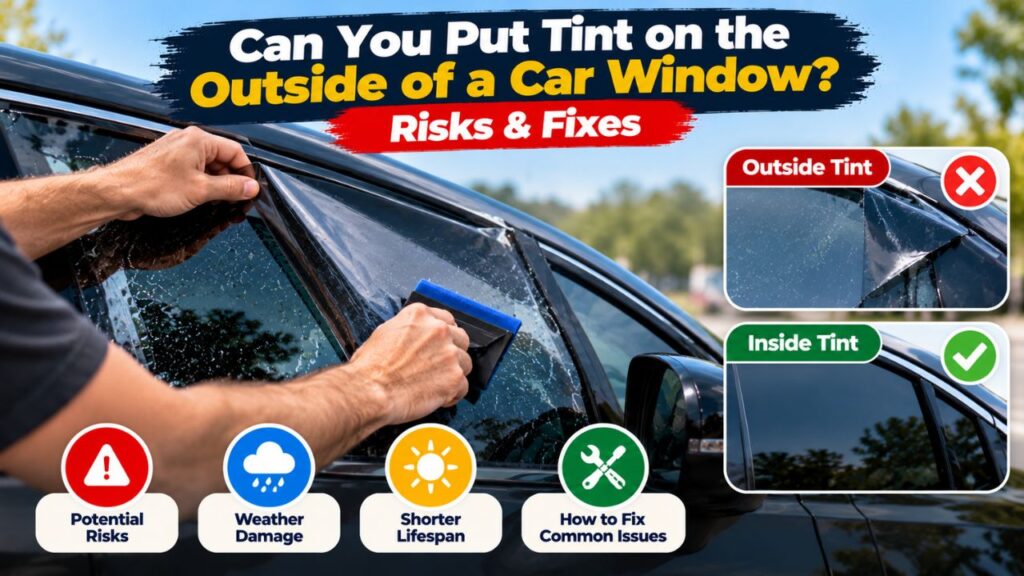
Standard automotive tint should generally not be installed permanently on the exterior surface of a car window.
Although the film may initially adhere to clean exterior glass, successful adhesion does not mean the product is suitable for long-term outdoor exposure.
Ordinary automotive window tint is engineered for the protected interior side of vehicle glass.
The International Window Film Association’s automotive installation guidance describes the standard process as applying film to the interior surface after cleaning, measuring, cutting, and positioning.
The outside of a vehicle experiences much harsher conditions than the cabin-facing glass.
These include:
- Direct rain and snow
- Road dust and grit
- Wind-driven debris
- Insect residue
- Repeated car washing
- Ice and frost
- Windshield wiper friction
- Contact with exterior window seals
Regular window tint may deteriorate when subjected to these conditions.
A purpose-built exterior automotive film is an exception, but it must be specifically approved for that application.
Does Window Tint Stick to Outside Glass?
Yes, an adhesive film may stick to clean exterior glass.
However, several factors determine whether the bond will remain reliable.
These include the adhesive formulation, film construction, surface condition, weather exposure, and maintenance.
Some regular tint films may appear acceptable immediately after installation.
Problems can emerge later as water, dirt, temperature changes, and abrasion affect the material.
A film sticking to glass initially does not establish that it will last outdoors.
Can You Install Regular Tint Outside Temporarily?
You can temporarily position ordinary automotive tint against the outside of a window during preparation.
This is common when fitting or shaping film.
However, temporary placement is different from permanent installation.
A professional installer may position film outside while its protective release liner remains attached.
The film is then prepared and transferred to the interior surface.
Do not confuse this process with applying the adhesive permanently to exterior glass.
Key Takeaway: Ordinary automotive tint may adhere to exterior glass, but it is not intended to remain there. Permanent installation should follow the film manufacturer’s approved mounting location.
Why Window Tint Goes on the Inside of Car Glass
Interior installation protects the film from direct exposure to many environmental and mechanical hazards.
It also allows the film to perform its intended solar-control functions without being constantly exposed to road conditions.
Protection From Rain and Weather
The outside of a vehicle is repeatedly exposed to water, dirt, temperature changes, and weather-related wear.
Rainwater can carry fine dirt and other particles across exterior surfaces.
Water may also remain around film edges, especially where the installation is not perfectly sealed.
Regular automotive tint is not generally engineered to tolerate this continuous exposure.
Installing the film inside places it in a more protected environment.
Less Exposure to Scratches
Exterior automotive glass regularly comes into contact with road grit, cleaning tools, insects, and other debris.
Even small particles can create abrasion when rubbed against a surface.
A conventional tint film is generally easier to scratch than the automotive glass beneath it.
The interior location reduces exposure to these abrasive conditions.
However, interior tint can still be scratched by jewelry, tools, abrasive cleaners, or careless handling.
Better Protection for the Adhesive
Automotive tint uses a pressure-sensitive adhesive system designed to bond the film to glass.
The adhesive is protected during storage by a removable release liner.
After installation, the film needs time for residual application moisture to dissipate and the adhesive to establish its intended bond.
When installed in the correct location, the adhesive and film operate under the conditions anticipated by the manufacturer.
Using the product outside may expose its edges and surface to unapproved weather and cleaning conditions.
Reduced Contact With Exterior Window Components
Roll-down side windows have rubber seals and wiping surfaces that contact the glass.
An exterior tint layer introduces another surface that these components may rub against.
This can increase the risk of scratches, edge lifting, and premature wear.
Interior tint also requires correct clearance around window seals, but it is installed using methods developed for the interior glass surface.
Key Takeaway: Automotive tint belongs inside primarily because that location protects the film and adhesive from harsh weather, abrasive debris, and unnecessary mechanical wear.
Why Professional Installers Put Tint on the Outside First
Seeing a tint installer working on the outside of a window can be confusing.
However, this is often a normal preparation technique.
The installer may use the exterior glass as a template before applying the film inside.
Measuring and Cutting the Film
Automotive windows have specific shapes and dimensions.
A film sheet must fit the glass without interfering with seals or moving components.
Installers may temporarily position film on the outside to measure and trim the pattern.
Some shops use computerized cutting systems with vehicle-specific templates.
Other installers use manual fitting methods.
Both approaches can produce good results when performed correctly.
Heat-Shrinking Tint on Curved Glass
Rear windshields and some side windows have curved surfaces.
A flat sheet of tint may develop raised sections or wrinkles when placed over these curves.
Installers often use controlled heat to shape compatible film.
During this process:
- The outside glass is cleaned.
- The film is temporarily positioned on the exterior.
- The protective liner remains in place as required.
- The film is shaped using the manufacturer’s approved technique.
- Excess material is trimmed or adjusted.
- The prepared film is removed from the exterior.
- The adhesive side is applied to the cleaned interior glass.
The film does not stay on the exterior after the installation is completed.
Why Not Shape Everything From the Inside?
The exterior glass is often easier to access for pattern preparation and heat shrinking.
It may provide more working room around curved glass.
Interior areas can contain rear defroster elements, antennas, upholstery, trim, and other components that require careful handling.
Preparing the film outside can reduce the amount of shaping work needed inside the vehicle.
However, professional installation methods vary according to the vehicle and the film.
Key Takeaway: Tint installers may use the outside glass for measuring and heat shaping, but ordinary automotive tint is normally applied permanently to the inside.
What Happens if You Install Regular Window Tint on the Outside?
Using conventional automotive film on exterior glass can produce several problems.
Some issues may appear quickly, while others develop after repeated weather exposure.
1. Window Tint May Peel at the Edges
Film edges are particularly vulnerable to mechanical contact and environmental exposure.
Wind-driven water, washing, and friction from exterior seals may contribute to edge lifting.
Once an edge separates, dirt and moisture can collect around the exposed adhesive.
The affected area may continue deteriorating.
A film that begins peeling may eventually require complete removal.
2. The Surface May Become Scratched
Exterior tint can be exposed to:
- Windshield wipers
- Road grit
- Dust
- Ice scrapers
- Car wash brushes
- Dry cleaning cloths
- Insect-removal tools
Ordinary automotive tint is not intended to replace the glass’s abrasion-resistant exterior surface.
Scratches can become especially concerning on a windshield because they may interfere with the driver’s view.
3. The Film May Develop Haze or Discoloration
Weather exposure and surface damage can affect optical appearance.
Depending on the product and conditions, an incorrectly installed film may develop haze, staining, or surface deterioration.
These changes are not guaranteed to occur immediately.
However, a film not approved for exterior use has no reliable basis for long-term outdoor performance claims.
4. Adhesion Problems May Develop
Water exposure, contamination, and incompatible surface conditions can interfere with an adhesive bond.
The film may develop visible lifting, bubbles, or damaged edges.
Some bubbling during normal interior tint curing is temporary moisture that later dissipates.
Persistent defects caused by incorrect exterior installation are a different issue and may require replacement.
5. Manufacturer Warranty Coverage May Not Apply
Window tint warranties often include installation and application requirements.
Using an interior-only film outside can fall outside the manufacturer’s approved installation conditions.
As a result, problems associated with exterior installation may not be covered.
Check the actual warranty rather than assuming all film defects qualify for free replacement.
Key Takeaway: Ordinary exterior-installed tint is more vulnerable to peeling, scratches, optical deterioration, and warranty problems because it is exposed to conditions beyond its intended application.
Can You Use Exterior Window Film on a Car?
Specialized films designed for exterior exposure do exist.
However, not every exterior window film is approved for automotive glass.
It is important to distinguish ordinary automotive tint from architectural exterior films and automotive protection films.
Exterior Automotive Windshield Protection Film
Some manufacturers produce clear films designed to protect the outside of vehicle windshields.
These products are intended primarily to reduce damage from road debris rather than darken the glass.
For example, XPEL’s official windshield protection film announcement describes a thin, clear film applied to the outside of a windshield to help resist rock chips, pitting, and cracks.
This is an exterior automotive film, but it is not equivalent to conventional tinted window film.
Its construction is developed for a different purpose and exposure environment.
Is Exterior Windshield Protection Film the Same as Tint?
No.
Window tint primarily provides benefits such as:
- Solar heat control
- UV reduction
- Glare reduction
- Privacy
- Appearance changes
Exterior windshield protection film primarily focuses on protecting glass against physical road damage.
Some specialized protection films may have additional optical properties, but these must be evaluated from the product specifications.
A clear windshield protection film should not be assumed to provide the same heat rejection as premium ceramic tint.
Can You Use Exterior Building Window Film on a Car?
Not automatically.
Exterior architectural films are designed for building glass.
They may be intended for:
- Commercial windows
- Residential glazing
- Skylights
- Large flat glass surfaces
- Certain specialized exterior applications
Automotive glass has different shapes, operating conditions, and regulatory requirements.
Vehicle side windows may move through seals, while windshields experience wiper abrasion and high-speed road exposure.
A film suitable for the exterior of an office building is not necessarily suitable for the outside of a moving vehicle.
Use an automotive-specific product only when the manufacturer explicitly approves the application.
What if a Product Is Advertised as Exterior Car Tint?
Before purchasing, request the manufacturer’s technical information.
Verify:
- That the film is approved for exterior automotive glass
- Which vehicle windows it can be applied to
- Whether it tolerates wiper contact
- Whether it is suitable for moving side windows
- Its abrasion resistance
- Its visible light transmission
- Its optical clarity
- Any restrictions involving cameras or sensors
- Warranty coverage for exterior installation
A product advertisement alone is not enough to confirm suitability.
Key Takeaway: Specialized exterior automotive films exist, particularly for windshield protection. Ordinary interior tint and exterior architectural film should not be substituted for these products.
Can You Put Tint on the Outside of Different Car Windows?
The risks differ depending on which window is being considered.
Side windows, rear windshields, and front windshields experience different operating conditions.
Outside of Front Side Windows
Exterior tint is generally a poor choice for front door windows.
These windows often move up and down through rubber weatherstripping.
Repeated movement can rub against film edges and surfaces.
The windows also receive frequent cleaning and exposure to road dirt.
For conventional automotive tint, interior installation is the appropriate method.
Outside of Rear Side Windows
Rear door windows have similar concerns.
Fixed rear quarter windows do not move through window seals, but their exterior surfaces still experience rain, sunlight, dirt, and washing.
A stationary window does not automatically make ordinary interior tint suitable for exterior installation.
Outside of the Rear Windshield
The rear windshield is often curved and may have an exterior rear wiper.
If a wiper is present, ordinary external tint could experience repeated abrasion.
Even without a wiper, the outer surface remains exposed to road grime and weather.
Standard rear-window tint is normally installed inside.
Care must be taken around interior defroster lines and antennas during installation and removal.
Outside of the Front Windshield
The front windshield is particularly sensitive because clear visibility is essential for safe driving.
It is exposed to:
- Windshield wipers
- Road debris
- Rain
- Snow and ice
- Cleaning chemicals
- Direct sunlight
Conventional tint should not be applied to the outside unless the manufacturer specifically approves that use.
Purpose-built clear exterior windshield protection films are a separate category.
These products must still meet applicable visibility requirements and the vehicle manufacturer’s compatibility guidance.
Inside vs. Outside Car Window Tint: Comparison
| Feature | Standard Tint Installed Inside | Standard Tint Installed Outside |
| Recommended application | Yes | No |
| Protected from direct rain | Yes | No |
| Protected from road debris | Mostly | No |
| Exposed to windshield wipers | No | Yes, where applicable |
| Contact with exterior weatherstripping | No | Possible |
| Designed for intended adhesive performance | Yes | Generally not |
| Expected service life | Product-dependent, often many years | Unpredictable |
| Manufacturer warranty eligibility | According to terms | May be excluded |
| Heat rejection | Based on tested product specifications | No established advantage from changing position |
| Optical clarity | Designed for normal vehicle use | More vulnerable to external surface damage |
| Best choice | Standard automotive tint | Use only if specifically approved for exterior use |
The comparison applies to conventional interior-rated automotive window film.
Purpose-built exterior automotive protection products should be evaluated separately.
Does Putting Tint on the Outside Block More Heat?
Installing ordinary window tint on the outside does not automatically provide better heat rejection than installing it inside.
A film’s solar-control performance depends on its optical properties, including how much energy it transmits, reflects, and absorbs.
Important performance measurements include:
- Total Solar Energy Rejected (TSER)
- Infrared Energy Rejection (IRER)
- Infrared Rejection (IRR)
- Visible Light Transmission (VLT)
- Ultraviolet Rejection
- Visible Light Reflectance (VLR)
The location of a solar-control coating can influence how heat moves through a glass system.
However, that does not mean an interior-rated automotive tint will perform better when installed outside.
The manufacturer’s published performance data applies to specified testing and installation conditions.
Installing the product in an unapproved location may also affect optical clarity and durability.
Does Exterior Tint Block More UV Rays?
Not simply because it is outside.
UV rejection depends primarily on the film’s construction and specified performance.
Many quality automotive films reject more than 99% of ultraviolet radiation within the manufacturer’s stated testing range.
Moving an interior film outside does not guarantee better UV protection.
The additional exposure may instead reduce the film’s useful life.
What if You Want Maximum Heat Rejection?
Choose an automotive film with strong published solar-control performance.
A premium ceramic film can provide substantial heat rejection without requiring very dark glass.
Compare products at similar VLT levels.
For example, a lighter ceramic film with higher TSER may reject more total solar energy than a darker, lower-performance dyed film.
Have the selected film installed in its approved location.
How to Install Automotive Tint on the Correct Side
If you want to tint your car windows yourself, the correct approach is to use automotive film intended for interior installation.
The following process provides a general overview.
Always follow the instructions for the specific product.
Step 1: Choose the Right Automotive Film
Select film designed for the windows you intend to cover.
Common options include:
- Dyed tint
- Carbon tint
- Ceramic tint
- Metallized tint
Compare heat rejection, UV protection, VLT, and compatibility with your vehicle.
Also verify local tint laws before choosing a shade.
Step 2: Clean Both Sides of the Glass
Cleaning the exterior helps when the film is temporarily positioned for measuring and shaping.
Cleaning the interior is essential because it is the final mounting surface.
Remove dust, grease, and other contamination using products appropriate for automotive glass.
Take care around defroster elements, factory coatings, and electronic components.
Avoid abrasive tools that could damage sensitive surfaces.
Step 3: Prepare the Film Pattern
Use a vehicle-specific precut kit or measure the film carefully.
For a manual pattern, the outside of the glass can serve as a fitting surface.
Keep the release liner attached during the appropriate preparation stages.
The pattern must fit without interfering with seals and moving window components.
Step 4: Shape the Film When Necessary
Some curved windows require heat shrinking.
Use only techniques appropriate for the film.
A heat gun can damage film if used incorrectly.
Do not overheat the glass, vehicle trim, or film.
Beginners may find curved rear windshields particularly difficult.
Step 5: Prepare the Interior Surface
Clean the inside glass again immediately before installation.
Use the recommended application solution.
Protect nearby electronics and interior trim from excess liquid.
Make sure no dirt or fibers remain in the installation area.
Step 6: Remove the Release Liner
Carefully separate the liner from the film as instructed.
This exposes the adhesive surface.
Avoid touching the adhesive with dirty hands or allowing it to contact upholstery.
Apply the recommended solution to help position the film.
Step 7: Install the Film Inside
Position the adhesive side against the interior glass.
Align the film carefully.
Use a suitable squeegee to remove application solution and air from beneath the material.
Work toward the edges without creating creases or damaging the film.
Step 8: Allow the Tint to Cure
Window tint requires time for remaining application moisture to dry.
The curing period depends on the product, weather, and installation conditions.
Temporary moisture patterns can appear during this process.
Follow the manufacturer’s guidance before lowering side windows or cleaning the film.
Do not attempt to speed up curing using uncontrolled heat.
Can You Put Ceramic Window Tint on the Outside?
Ceramic tint is still conventional automotive window film unless the manufacturer explicitly states otherwise.
Its ceramic particles are designed to control solar radiation, not necessarily to provide the abrasion resistance needed for exterior glass.
Installing ceramic tint outside may expose it to the same problems as other standard films.
These include:
- Surface scratches
- Edge lifting
- Weather exposure
- Cleaning damage
- Reduced warranty eligibility
Premium ceramic film can be relatively expensive.
Using it in an unapproved location creates an unnecessary risk of wasting the material.
Is Ceramic Tint More Weatherproof Than Dyed Tint?
Not automatically.
Ceramic and dyed films differ in their solar-control technologies.
However, their weather resistance depends on the complete film construction, surface coating, adhesive, and approved installation environment.
A high-performance ceramic tint may provide better heat rejection than basic dyed film, but that does not establish that it is suitable for exterior installation.
Is Metallic Tint Better for Outside Glass?
Not necessarily.
Metallized films contain a reflective metal layer.
This can improve solar-control performance, but it does not make standard automotive metallic tint an exterior-rated product.
Some metallic films can also interfere with wireless signals, depending on their composition and the vehicle’s antenna placement.
Choose a film based on verified automotive compatibility and the manufacturer’s approved mounting method.
Is It Legal to Put Tint on the Outside of a Car Window?
Window tint laws in the United States vary by state.
The most important rules typically concern how much visible light passes through the finished glass, where tint is permitted, and how reflective the window may be.
Placing tint outside does not automatically create an exemption from these requirements.
Visible Light Transmission Limits
Window tint darkness is measured by Visible Light Transmission (VLT).
A lower percentage means less visible light passes through.
| VLT | General Appearance |
| 70% | Very light |
| 50% | Light |
| 35% | Moderately dark |
| 20% | Dark |
| 5% | Extremely dark |
These are approximate appearance descriptions.
The actual finished VLT depends on both the film and the vehicle’s existing glass.
For example, glass transmitting 80% of visible light combined with a film transmitting 50% produces a simplified estimate of:
0.80 × 0.50 = 0.40
Approximate combined VLT = 40%
The actual result should be verified using an appropriate tint meter when legal compliance matters.
Windshield Tint Regulations
Full windshield tinting is subject to significant restrictions in many states.
Some permit only a specified upper strip, while others allow certain high-VLT films under defined conditions.
The rules may also address reflectivity, color, and medical exemptions.
Do not assume an exterior-installed film is legal simply because it is clear or lightly tinted.
Does Removable Exterior Tint Avoid Tint Laws?
Not automatically.
A removable product may still affect visibility while the vehicle is driven.
The applicable law may regulate the condition of the window rather than whether the film is permanent.
Check the current rules published by the relevant state agency before using any removable exterior tint on public roads.
Can You Fix Tint That Was Installed on the Outside?
If ordinary interior-rated tint has already been installed outside, the most dependable solution is generally to remove it and apply suitable film to the interior surface.
The condition of the existing film determines how difficult removal will be.
Should You Leave Exterior Tint in Place?
If the film is peeling, scratched, cloudy, or interfering with visibility, it should be evaluated promptly.
This is particularly important on a windshield or front side window.
Even if the film currently appears intact, regular automotive tint installed contrary to its instructions may deteriorate unpredictably.
Contact the manufacturer or an experienced installer for product-specific advice.
How to Remove Exterior Window Tint
Removal methods depend on the film and adhesive.
A general process involves:
- Park the vehicle in a protected working area.
- Identify whether the film is ordinary tint or a specialized exterior product.
- Check the manufacturer’s removal instructions.
- Warm the film gently if the approved procedure permits it.
- Lift an edge using a tool suitable for the glass surface.
- Peel the film slowly without excessive force.
- Remove adhesive residue using a compatible cleaner.
- Clean and inspect the glass before installing replacement film.
Avoid aggressive scraping, excessive heat, or harsh chemicals that could damage glass coatings, seals, or nearby trim.
Exterior windshield protection films may have their own removal requirements and should not automatically be handled like ordinary tint.
Can You Move Exterior Tint to the Inside?
Usually, reusing previously installed adhesive tint is not advisable.
Once the adhesive has bonded to glass and the film is peeled away, it may become stretched, contaminated, or damaged.
The adhesive may also lose the properties needed for a clean reinstallation.
For reliable appearance and adhesion, new film is usually the better option.
What if the Exterior Film Was Professionally Installed?
Ask the installer for the exact manufacturer and product name.
Determine whether the film is specifically approved for exterior automotive use.
If it is a purpose-built exterior product, its location may be correct.
If it is ordinary interior-rated tint, discuss removal and proper replacement.
Review any applicable workmanship warranty.
Common Mistakes When Tinting Car Windows
Understanding a few installation mistakes can prevent expensive repairs.
Installing the Adhesive on the Wrong Side
Window tint is not necessarily reversible.
The release liner protects the adhesive and must be removed according to the installation instructions.
Applying the wrong surface against the glass can prevent proper adhesion.
Assuming the Film Belongs Outside Because the Installer Worked There
Exterior fitting and heat shrinking are normal preparation methods.
The finished installation location is what matters.
Check where the adhesive is ultimately bonded.
Using Architectural Film on Automotive Glass
Building films and automotive films may have different optical, adhesive, and thermal characteristics.
Do not substitute one category for another without specific manufacturer approval.
Using Dark Tint on a Windshield
Very dark windshield film can reduce nighttime visibility and may violate state laws.
Choose a legally compliant product and application.
The fact that a film is ceramic or marketed as premium does not exempt it from visibility rules.
Removing Tint With Sharp Tools
Improper scraping can damage glass coatings or other components.
Rear-window defroster lines are especially vulnerable when film is removed from the inside.
Use appropriate methods and seek professional removal when the glass contains sensitive components.
Ignoring Manufacturer Instructions
Installation orientation, cleaning products, curing periods, and warranty requirements can vary.
Follow the instructions for the exact film rather than relying on general advice alone.
Should You Install Tint Yourself or Hire a Professional?
DIY installation is possible, but installation quality depends heavily on preparation and technique.
Small, relatively flat side windows may be manageable for beginners.
Curved rear glass and complex windshields are more difficult.
When DIY Tinting Makes Sense
DIY may be reasonable when:
- You have a clean, sheltered workspace.
- The film is intended for DIY application.
- The window shape is relatively simple.
- You understand which side of the film contains the adhesive.
- You have suitable installation tools.
- You are prepared to replace film if mistakes occur.
Using a precut kit can reduce trimming work.
However, it does not eliminate contamination, positioning, and curing challenges.
When Professional Installation Is Better
Professional installation is generally preferable for:
- Full-vehicle tinting
- Expensive ceramic film
- Highly curved rear windshields
- Vehicles with complex window seals
- Glass containing delicate electronic components
- Specialized exterior windshield protection film
- Installations requiring documented warranty coverage
Before booking, confirm the exact film series, expected finished VLT, approved application location, and warranty terms.
A reputable installer should be able to explain whether any proposed exterior film is specifically designed for the vehicle.
Conclusion
You can physically put tint on the outside of a car window, but ordinary automotive window tint should normally be installed on the inside.
Interior installation protects the film from direct weather exposure, road debris, wiper friction, and other conditions that can damage its surface and adhesive.
Professional installers sometimes place tint on the outside while measuring, cutting, or heat-shrinking it. This is temporary preparation, not the final application.
Specialized exterior automotive products do exist, particularly clear windshield protection films. However, these should not be confused with regular ceramic, carbon, dyed, or metallic window tint.
For long-lasting heat rejection, UV protection, and a clean appearance, choose a quality automotive film and install it on the manufacturer’s recommended surface.
If ordinary tint has already been installed outside, contact the manufacturer or a qualified installer to determine the safest way to remove or replace it.
FAQs About Can You Put Tint on the Outside of a Car Window
Does window tint go on the inside or outside of a car?
Standard automotive window tint goes on the inside of the glass. Installers may temporarily place it outside while measuring and heat-shrinking the material, but permanent installation is normally completed on the interior surface.
What happens if you put window tint on the outside?
Ordinary tint may initially stick, but exterior exposure can increase the risk of scratches, peeling, surface deterioration, and adhesion problems. Rain, road debris, car washing, and window seals can damage film that is not designed for outdoor automotive use.
Can you put ceramic tint on the outside of car windows?
Not unless the specific ceramic film is approved for exterior automotive installation. Most conventional ceramic window films are designed for interior application. Their heat-rejection technology does not automatically make them resistant to wiper friction or road debris.
Why do tint installers spray and work on the outside of the glass?
Installers frequently use the exterior glass as a template for measuring, cutting, and heat-shrinking the film. The prepared material is then transferred to the inside, where the adhesive is applied permanently.
Can you put tint on the outside of a windshield?
Ordinary automotive tint is generally not intended for permanent exterior windshield installation. However, certain clear windshield protection films are specifically made for outside use. Any windshield film must also meet applicable visibility requirements.
Does outside window tint last as long as inside tint?
Standard interior-rated tint is unlikely to provide the same predictable durability when installed outside because it faces greater environmental and mechanical exposure. Actual lifespan varies by product and conditions. Purpose-built exterior films have separate performance and maintenance requirements.
Can you use house window tint on the outside of a car?
Not without explicit manufacturer approval. Exterior architectural window films are designed for building glass and may not withstand vehicle movement, windshield wipers, curved automotive glass, or road conditions. Use products specifically approved for automotive applications.