Yes, you can tint Tesla windows, including the side and rear glass on Models 3, Y, S, and X, provided the film and finished window darkness comply with local law. Ceramic film is often a useful choice for reducing solar heat without relying on very dark glass, but Tesla’s glass already provides substantial UV protection, so added tint is not automatically necessary.
Tesla vehicles also have installation details that deserve special care. Frameless door windows move slightly when the doors open, some rear windows are large and curved, and the windshield contains areas used by driver-assistance cameras. Panoramic glass roofs require a separate compatibility check because not every film is approved for every glass construction.
Tinting does not automatically void the whole vehicle warranty, but damage caused by improper installation may not be covered. Leased vehicles present another consideration because added window film may need removal before return.
In this article, I explain which Tesla windows can be tinted, the differences between ceramic and other films, and precautions for roof glass and cameras. You’ll also learn how to compare prices, choose legal VLT, protect warranty coverage, and select a Tesla-experienced installer.
Can You Tint Tesla Windows on Every Model?
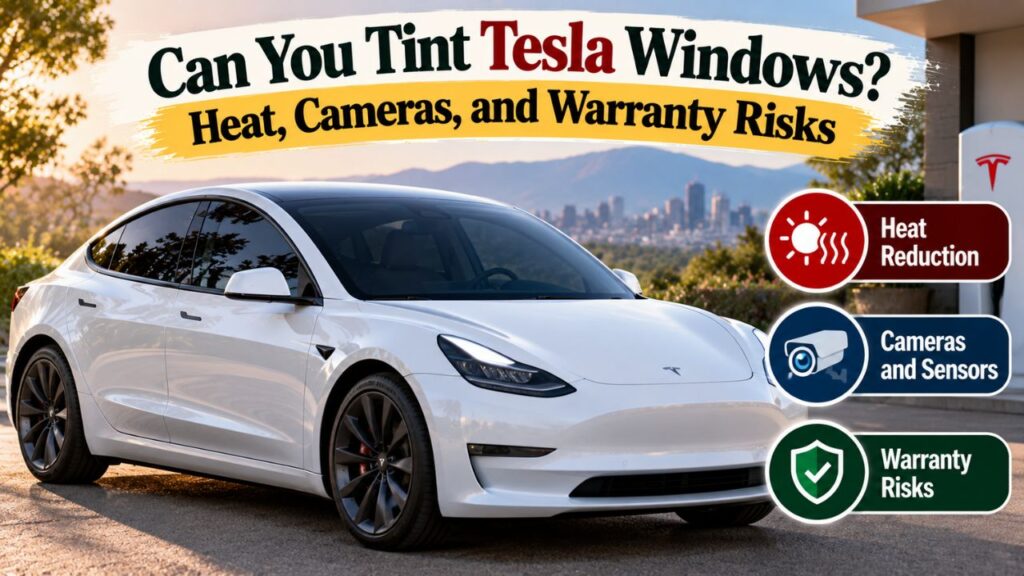
Most Tesla models can have compatible aftermarket window film installed on their side and rear windows.
However, the exact glass construction, factory tint, and window geometry vary by model and production year.
A tinting method suitable for one Tesla may require adjustments for another.
Tesla Model 3 Window Tint
The Tesla Model 3 can have aftermarket tint applied to its side windows and rear glass.
However, several design features require attention.
The Model 3 uses frameless door windows, meaning there is no surrounding upper door frame.
The glass automatically moves slightly when the door opens or closes.
This movement requires careful film-edge positioning.
The rear glass is also relatively large and curved, with its shape and relationship to the roof varying by model year.
A professional installer must select a film size and installation method suitable for the particular vehicle.
Poorly fitted film may develop:
- Lifting edges.
- Creases.
- Visible seams.
- Adhesive problems.
- Unwanted contact with window seals.
For a Model 3, choose a shop experienced with its frameless glass and large rear window.
Tesla Model Y Window Tint
The Tesla Model Y can also be tinted.
Commonly treated areas include the front side windows, rear side windows, and rear windshield.
The Model Y has a panoramic glass roof that requires additional consideration.
Some versions also have factory-colored rear glass.
Adding aftermarket film over existing privacy glass may further reduce visible light transmission.
For example, an SUV with dark rear privacy glass may need a lighter ceramic film rather than another dark layer.
The goal should be improving solar-control performance without unnecessarily reducing visibility.
Tesla Model S Window Tint
The Model S supports aftermarket window tint when the film is compatible with its glass and complies with local laws.
Its large glass areas can make heat rejection an important consideration.
Depending on the model year and configuration, the rear glass and roof construction may require specialized installation techniques.
Check the exact vehicle before choosing film coverage.
A professional installer should account for window seals, electrical components, and any existing coatings.
Tesla Model X Window Tint
The Model X can have suitable film applied to compatible windows.
However, it has an unusual windshield design and distinctive rear-door construction.
These features make installer experience especially important.
The expansive windshield provides a large forward viewing area, so windshield tint selection requires careful attention to camera visibility and legal restrictions.
Film should never obstruct the view of vehicle cameras or reduce the driver’s visibility below legal and safe limits.
Can You Tint Cybertruck Windows?
Yes, compatible window film can be installed on eligible Cybertruck glass.
However, its glass construction, dimensions, and window shapes differ from those of conventional sedans and SUVs.
Choose a film approved for the relevant glazing and an installer familiar with the Cybertruck.
Do not assume that every ordinary automotive film or precut tint kit fits all Tesla models.
Tesla Window Tint Compatibility Overview
| Tesla model | Side-window tint | Rear-window tint | Main installation consideration |
| Model 3 | Generally possible | Generally possible | Frameless glass and large curved rear window |
| Model Y | Generally possible | Generally possible | Factory privacy glass and panoramic roof |
| Model S | Generally possible | Generally possible | Glass geometry varies by model year |
| Model X | Generally possible | Generally possible | Large windshield and distinctive glass |
| Cybertruck | Generally possible | Depends on glass configuration | Specialized glass and vehicle-specific fit |
Windshield and roof installations require separate compatibility and legal checks, regardless of model.
Do Tesla Windows Already Come Tinted From the Factory?
Some Tesla windows have factory coloring or specialized solar-control properties.
However, factory glass is not the same as aftermarket tint film.
The exact appearance and performance depend on the model, year, and market.
Factory Privacy Glass vs. Aftermarket Tint
Factory privacy glass incorporates coloring into the glass construction.
It is commonly found on rear windows of certain SUVs and other vehicles.
Aftermarket tint is a separate film installed on existing glass.
Factory privacy glass can reduce visible light transmission, but its appearance alone doesn’t establish its total solar heat rejection.
Aftermarket ceramic film may provide additional infrared control.
Before adding film to factory-colored glass, have its existing visible light transmission measured.
How Much UV Protection Does Tesla Glass Provide?
Tesla glass already provides substantial ultraviolet protection.
According to Tesla’s official vehicle glass information, its vehicle glass can block up to 99% of harmful ultraviolet radiation.
Tesla also emphasizes optical clarity and compatibility with its camera and antenna systems.
However, “up to 99%” is not a guarantee that every piece of glass provides an identical level of protection across every UV wavelength.
The exact performance depends on the glass.
This means additional tint should not automatically be purchased solely for UV protection.
Other benefits, such as infrared heat rejection, privacy, and glare control, may provide stronger reasons for installing film.
Does Factory-Tinted Tesla Glass Reject Heat?
Factory glass can reduce solar energy transmission, but the amount varies by construction.
Some glass uses special coatings, coloring, or laminated layers.
A dark appearance does not necessarily mean exceptional infrared heat rejection.
To determine whether additional film is useful, consider the existing glass performance and compare it with the specifications of the proposed product.
What Is the Best Window Tint for Tesla Vehicles?
For many Tesla owners, a high-quality ceramic window film is a practical option.
However, the best film depends on your priorities.
A driver who wants privacy may choose differently from someone who wants maximum heat rejection with minimal darkening.
Ceramic Window Tint
Ceramic film uses ceramic-based materials to manage incoming solar energy.
Potential benefits include:
- Strong infrared heat rejection in premium products.
- UV protection.
- Good optical clarity.
- Several available darkness levels.
- Reduced glare.
- No expected signal interference from genuinely metal-free designs.
Ceramic film can be particularly useful for drivers who want improved heat control without very dark windows.
However, not every ceramic product provides identical performance.
Compare the actual manufacturer’s specifications.
Nano Ceramic Window Tint
Nano ceramic films use ceramic technology involving extremely small particles or coatings.
Some advanced products provide excellent infrared rejection.
However, nano ceramic is not a universal performance grade.
A film marketed as nano ceramic isn’t automatically better than every film labeled ceramic.
Compare the exact products using:
- Total Solar Energy Rejection (TSER).
- Infrared Energy Rejection (IRER).
- Visible Light Transmission (VLT).
- UV rejection.
- Optical clarity.
- Warranty coverage.
Carbon Window Tint
Carbon tint is another option for Tesla windows.
It is commonly selected for its dark appearance and solar-control properties.
However, performance varies significantly among manufacturers.
Some carbon films provide useful heat rejection, while premium ceramic films may deliver stronger infrared performance at comparable shades.
Compare published measurements before choosing.
Dyed Window Tint
Dyed film is generally a lower-cost option.
It can provide darker glass and reduce visible glare.
However, basic dyed products often offer less infrared control than premium ceramic films.
If your main objective is lowering solar heat entering the cabin, dyed film may not offer the best value.
Window Tint Types Compared
| Tint type | Heat rejection | Privacy | Typical price position |
| Dyed | Usually lower | Good with darker shades | Budget |
| Carbon | Varies by product | Good | Midrange |
| Ceramic | Good to excellent | Depends on shade | Midrange to premium |
| Nano ceramic | Good to excellent | Depends on shade | Often premium |
These are general comparisons, not guaranteed performance rankings.
For a Tesla used frequently in hot, sunny conditions, a reputable ceramic film with strong verified TSER is often a sensible choice.
Can You Tint the Tesla Glass Roof?
Some Tesla glass roofs can receive compatible window film, but roof tinting should not be treated as identical to ordinary side-window tinting.
The correct approach depends on the roof glass construction, film specifications, and manufacturer requirements.
Why Tesla Roof Glass Is Different
The glass roof on models such as the Model 3 and Model Y is a large, fixed glazing area.
It may already incorporate substantial UV protection and solar-control features.
Because the roof is exposed to direct sunlight, its temperature can become elevated.
Adding film changes how solar energy is absorbed, reflected, and transmitted.
The resulting effects depend on the glass construction and film type.
This makes compatibility particularly important.
Can Tint Cause a Tesla Glass Roof to Crack?
Incompatible window film can alter the thermal behavior of glass.
Certain combinations of film and glazing may increase thermal stress.
However, it would be inaccurate to claim that tint always cracks Tesla roof glass or that every roof tint installation creates the same risk.
The possibility depends on several factors, including:
- Glass construction.
- Existing coatings.
- Film absorption properties.
- Installation conditions.
- Temperature differences across the glass.
- Existing glass defects.
- Manufacturer compatibility requirements.
Some professional installers offer roof-film applications, while others recommend avoiding them on certain vehicles.
Before tinting a Tesla glass roof, obtain confirmation that the exact film is approved for that specific glass application.
Also ask whether the film and glass warranties cover the proposed installation.
Should You Tint a Model Y Panoramic Roof?
Not necessarily.
If the factory roof glass already provides acceptable comfort and sun protection, additional film may offer limited practical benefit.
If heat or glare remains uncomfortable, compare compatible solar-control film with a removable roof sunshade.
A removable shade can reduce direct sunlight entering the cabin without adding an adhesive film to the glass.
For many drivers, trying a sunshade first is a reasonable approach.
Should You Tint a Model 3 Rear Roof Glass?
The Model 3 rear glass design can create a more complex installation than an ordinary sedan’s rear windshield.
Depending on the model year, the rear window may extend upward toward the roof.
The installer should understand exactly which section is rear visibility glass and which section is part of the roof glazing.
Ask whether the film will be installed in one piece or multiple sections and whether the proposed material is suitable for the entire treated area.
Do not assume that a standard rear-window tint package includes panoramic roof coverage.
Can You Tint a Tesla Windshield?
Windshield tinting requires more caution than tinting side windows.
The windshield is a primary safety component and provides the forward view used by the driver and certain vehicle cameras.
Its legal treatment may be more restrictive than that of other windows.
Tesla Cameras and Windshield Film
Tesla vehicles use cameras as part of their driver-assistance systems.
The windshield must preserve a clear optical path for any cameras viewing through it.
Adding film over a camera’s viewing area can potentially introduce optical distortion, reflections, or other changes in image quality.
These issues may affect camera-dependent functions.
Do not apply film over Tesla camera viewing areas unless the exact installation is expressly compatible with the vehicle manufacturer’s requirements.
A professional installer should identify camera locations before proposing windshield film.
The film must not interfere with sensors, camera housings, or other safety equipment.
Is Clear Ceramic Windshield Tint Safe?
A nearly transparent ceramic film may reject some infrared energy while maintaining high visible light transmission.
However, a clear appearance does not automatically make the product legal or compatible with Tesla’s camera systems.
Even a light film changes the optical properties of the glass.
Check both:
- The applicable windshield tint regulations.
- The film manufacturer’s compatibility requirements for the exact Tesla model and glass.
If compatibility is uncertain, leave the windshield untreated.
What About a Windshield Tint Strip?
Some jurisdictions permit a limited tint strip near the upper windshield.
The permitted position, width, reflectivity, and darkness vary.
However, a strip still must not obstruct driver-assistance cameras or interfere with visibility.
Verify the legal requirements and vehicle-specific restrictions before installation.
Does Tinting Tesla Windows Affect Autopilot or Full Self-Driving?
Properly selected film installed on appropriate side or rear glass should not automatically interfere with Tesla’s driver-assistance functions.
However, film over camera optical paths or damage during installation can create problems.
How Window Tint Could Affect Camera Performance
Potential concerns include:
- Dark film over a camera viewing area.
- Optical distortion.
- Reflections caused by unsuitable material.
- Adhesive contamination.
- Damage to camera housings.
- Obstruction of a sensor’s field of view.
An installer should confirm that no camera or sensor opening is covered by inappropriate film.
Does Ceramic Tint Interfere With Tesla Electronics?
Genuinely metal-free ceramic films are generally chosen for compatibility with electronic signals.
They do not rely on conventional conductive metallic layers that may interfere with certain radio-frequency systems.
This can be useful for vehicles using:
- Bluetooth phone keys.
- Cellular connectivity.
- GPS navigation.
- Wi-Fi.
- Other wireless communications.
However, the entire film construction matters.
Ask the manufacturer whether the selected film contains metallic layers.
Avoid assuming that every product advertised as ceramic has identical properties.
Does Tint Affect Tesla Cameras on the Vehicle Body?
Tesla cameras mounted outside the windshield, such as cameras in exterior housings, generally do not view through the vehicle’s ordinary side windows.
Tinting the side windows therefore doesn’t automatically cover those cameras.
However, installers must still protect nearby electronic components and avoid damaging camera housings.
The exact camera layout varies between Tesla models and hardware generations.
What Tint Percentage Is Best for Tesla Windows?
The appropriate tint percentage depends on local law, visibility needs, and personal preference.
The percentage normally refers to Visible Light Transmission (VLT).
Lower numbers mean darker glass.
Common Tesla Window Tint Percentages
| Tint VLT | General appearance | Practical consideration |
| 70% | Very light | Preserves substantial visible light |
| 50% | Light | Modest darkening |
| 35% | Medium | Noticeable privacy and glare reduction |
| 20% | Dark | Reduced visibility in low light |
| 5% | Very dark | Significant visibility limitations |
These are general descriptions, not recommendations for legal installation on any particular window.
Is 35% Tint Good for a Tesla?
A 35% film provides a medium-dark appearance.
It can increase daytime privacy and reduce visible glare.
However, it may be too dark for certain front side windows under applicable state law.
Remember that the final VLT depends on both the film and the original glass.
Do not assume a film labeled 35% will produce a completed window measuring exactly 35%.
Is 20% Tint Too Dark?
A 20% film is significantly darker.
It can provide greater daytime privacy but also reduces light transmission at night.
This may make it more difficult to see pedestrians, cyclists, curbs, and other objects in poorly illuminated areas.
Whether it is legal depends on the window position, vehicle classification, and jurisdiction.
How to Calculate Final Tesla Window VLT
Suppose the original glass transmits 80% of visible light.
You install a film rated at 50% VLT.
The approximate combined transmission is:
0.80 × 0.50 = 0.40
The finished window would transmit approximately 40% of visible light.
This simplified calculation shows why existing glass darkness matters.
A tint shop should measure the original glass and verify the completed window using a suitable meter.
Is It Legal to Tint Tesla Windows in the United States?
Yes, automotive window tint is legal under various conditions throughout the United States.
However, state laws differ substantially.
Tesla vehicles are not automatically exempt from these requirements.
Front Side Window Tint Laws
Many states regulate front side-window VLT more strictly than rear-window VLT.
Some require relatively high light transmission, while others allow darker film.
A tint shade that’s legal in one state may not be permitted in another.
Rear Window Tint Laws
Some states allow darker rear side windows and rear windshields, particularly on certain SUVs and other vehicle classifications.
However, the requirements vary.
Additional restrictions may apply to reflective films, mirrors, or window markings.
Windshield Tint Laws
Windshield tint is typically subject to stricter rules.
Some jurisdictions permit only specific upper-windshield strips or particular transparent films.
Others restrict aftermarket windshield treatments more broadly.
Check the law applicable where the vehicle is registered and used.
Does Tesla’s Tint Program Guarantee Legal Tint?
No.
Tesla offers certain window tint products through participating installers, but its product information makes clear that customers must ensure the selected installation complies with applicable laws.
Before installation, ask the shop to confirm the finished VLT for each window.
Will Tinting Tesla Windows Void the Warranty?
Aftermarket tint does not automatically cancel the entire Tesla vehicle warranty.
However, an installation that causes damage may create a warranty issue for the affected component.
The distinction is between a manufacturing defect and damage resulting from a modification.
What Problems Could Affect Warranty Coverage?
Possible installation-related problems include:
- Damaged window seals.
- Scratched glass.
- Damaged rear defroster elements.
- Water intrusion into electrical components.
- Improperly functioning window mechanisms.
- Damage to camera or sensor systems.
- Glass damage associated with an incompatible treatment.
Whether a particular repair is covered depends on the cause, the warranty terms, and applicable law.
Do not assume that all glass repairs remain covered after installing an incompatible film.
Does Tesla Offer an Approved Tint Program?
Yes.
Tesla’s US storefront offers an XPEL Window Tint program with installation through certified XPEL installers.
The offering includes ceramic-based film options and a lifetime transferable XPEL warranty against specified product defects.
Tesla also states that, for this program, tint replacement is included when the underlying glass is replaced under the applicable Tesla New Vehicle or Used Vehicle Limited Warranty.
That benefit should not be assumed to apply to every independently installed film.
Check current availability, vehicle eligibility, and warranty conditions before purchasing.
What if the Tesla Is Leased?
Leased vehicles require additional care.
Tesla’s US XPEL program specifically states that window tint installed on leased vehicles must be removed before the vehicle is returned.
Lease-end requirements can differ according to the leasing company and contract.
If your Tesla is leased, review the agreement and confirm any removal obligations before installation.
Removing film later may create additional expense.
How Much Does It Cost to Tint Tesla Windows?
Tesla window tinting costs depend on the model, number of windows, film technology, and installation service.
Panoramic roof glass and complex rear windows can affect the price.
Tesla Window Tint Price Example
Tesla’s US XPEL storefront currently lists window tint options in a range of approximately 225–850, depending on the selected coverage and product.
This is a published example from a specific program, not a guaranteed marketwide price.
Independent tint shops may charge different amounts.
The final cost depends on whether the quote includes only the front side windows or a broader package.
What Affects Tesla Tint Pricing?
The main cost factors are:
- Vehicle model and model year.
- Number of windows.
- Film manufacturer.
- Dyed, carbon, or ceramic construction.
- Large curved rear glass.
- Panoramic roof coverage.
- Windshield treatment, where compatible and legal.
- Removal of old tint.
- Installer experience.
- Warranty coverage.
A full Model 3 installation may require a different amount of labor than tinting two front windows on a Model Y.
Is Ceramic Tint Worth the Extra Cost?
It can be.
If your main concern is reducing incoming solar heat, quality ceramic film may provide stronger performance than a basic dyed product.
However, the upgrade should be evaluated using verified specifications.
Compare the Total Solar Energy Rejection, Infrared Energy Rejection, and VLT at similar shades.
A higher price doesn’t automatically mean the film will keep the cabin proportionally cooler.
Does Window Tint Improve Tesla Battery Range?
Window film can reduce some of the solar energy entering a vehicle.
This may reduce cabin heat gain and, under certain conditions, influence the cooling demand placed on the air-conditioning system.
However, there is no reliable universal mileage increase that results from tinting Tesla windows.
Actual energy use depends on:
- Outside temperature.
- Sun exposure.
- Cabin temperature settings.
- Driving speed.
- Trip duration.
- Vehicle efficiency.
- Existing glass performance.
- Tint coverage and film specifications.
Some drivers may notice improved comfort even when any energy savings are too small to identify reliably.
Do not purchase tint based on unsupported claims that it will add a specific number of miles to the vehicle’s driving range.
For range efficiency, appropriate cabin preconditioning, climate settings, and parking practices may also be useful.
How to Get Tesla Windows Tinted Safely
Professional installation is generally preferable for Tesla owners, especially when working with curved rear glass, frameless windows, or specialized roof glazing.
A few checks before the appointment can prevent common problems.
Step 1: Identify the Exact Tesla Model and Year
Provide the installer with the model, year, and any relevant glass replacement history.
Glass construction and window dimensions can change between production versions.
This information helps the installer select compatible film and cutting patterns.
Step 2: Choose Compatible Automotive Film
Ask for the exact manufacturer and product series.
Check its specifications for heat rejection, VLT, UV protection, and optical clarity.
For roof or windshield applications, obtain confirmation of suitability for the specific glass.
Step 3: Confirm Which Windows Will Be Tinted
Review the proposed installation coverage.
Possible areas include:
- Front side windows.
- Rear side windows.
- Rear windshield.
- Windshield, where permitted and compatible.
- Panoramic roof, if suitable.
A package described as full-car tint may not include the windshield or glass roof.
Get the coverage in writing.
Step 4: Check Legal Tint Darkness
Have the existing glass measured.
Select a film that keeps the finished window within the applicable VLT limit.
Avoid relying solely on the film’s advertised darkness.
Step 5: Protect Cameras and Electronics
The installer should identify sensitive areas before beginning.
Use appropriate precautions to protect door electronics, window switches, seals, defroster elements, and camera-related components.
Installation solution should not be allowed to enter vulnerable electronic assemblies.
Step 6: Inspect the Installation
After the work is completed, inspect the film under suitable lighting.
Look for:
- Uneven edges.
- Creases.
- Visible contamination.
- Incorrect coverage.
- Obstruction of camera areas.
- Damage to trim or seals.
Small water pockets or slight haze may disappear during curing.
Follow the manufacturer’s guidance before deciding whether an appearance issue is permanent.
Step 7: Follow the Tint Curing Instructions
The film’s adhesive requires time to bond and release installation moisture.
Follow the installer and film manufacturer’s instructions concerning:
- When windows may be rolled down.
- Cleaning methods.
- Curing time.
- Acceptable temporary haze.
- When to report installation defects.
Tesla’s frameless windows move slightly during normal door operation, so installers should account for that movement during installation and aftercare.
Don’t force a window to operate abnormally to avoid the automatic door-glass movement.
Common Mistakes When Tinting Tesla Windows
Some problems arise because installers treat Tesla glass exactly like ordinary framed vehicle windows.
Others result from misunderstanding factory coatings or legal tint limits.
Tinting the Glass Roof Without Compatibility Checks
A glass roof may have specialized coatings or thermal characteristics.
Installing unsuitable film can create unwanted thermal behavior or warranty complications.
Confirm product compatibility before proceeding.
Covering Driver-Assistance Camera Areas
Camera visibility must remain unobstructed.
Never place unsuitable film over camera optical paths.
A darker or optically distorted camera view can affect vehicle functions.
Choosing Tint Based Only on Darkness
Darkness doesn’t measure total heat rejection.
A lighter ceramic film may provide better infrared control than a much darker basic product.
Compare TSER and related performance measurements.
Ignoring Factory Privacy Glass
Existing rear privacy glass affects the final VLT.
Applying additional dark film can reduce nighttime visibility more than expected.
Measure the glass before installation.
Using an Installer Without Frameless-Window Experience
Improperly positioned film edges may catch on seals or lift as the glass moves.
Choose an installer familiar with Tesla’s frameless window design.
Assuming Every Tint Package Has Tesla Warranty Coverage
Tesla’s specific XPEL offering has stated warranty benefits.
An unrelated aftermarket installation does not automatically receive those same benefits.
Review the actual warranty terms.
Forgetting Lease Return Requirements
Leased Tesla vehicles may require removal of added tint before return.
Check the applicable lease agreement before paying for the installation.
Is Tesla Window Tinting Worth It?
For many owners, yes—particularly when reducing solar heat, improving privacy, or limiting glare is important.
However, not every Tesla needs additional film on every window.
The factory glass already offers meaningful protection, and some owners may be satisfied with the original appearance and comfort.
A useful approach is to prioritize the windows that create the greatest concern.
For example, adding compatible ceramic film to legal side-window locations may provide a better value than immediately tinting the entire vehicle and roof.
If overhead sun exposure is the main problem, consider a removable roof shade before choosing permanent film.
The best result comes from selecting the right film for the exact glass, rather than automatically installing the darkest or most expensive package.
Conclusion
So, can you tint Tesla windows? Yes. Most Tesla models can receive compatible aftermarket film on their side and rear windows, subject to legal requirements and the vehicle’s glass specifications.
Ceramic tint is often a strong option for owners who want better heat rejection without relying on very dark shades.
However, Tesla’s existing glass already provides substantial UV protection, so additional film isn’t always necessary.
Panoramic roofs and windshields require particular care because of glass compatibility, thermal behavior, camera visibility, and legal restrictions.
Tesla also offers a professional tint program through XPEL, although the stated benefits and coverage apply to the specific program rather than every aftermarket installation.
My recommendation is to use a Tesla-experienced installer, compare verified film specifications, and check warranty and lease requirements before making any changes.
The right tint should improve comfort and appearance without compromising visibility, electronics, or glass safety.
FAQs About Can You Tint Tesla Windows
Can You Tint Tesla Model 3 Windows?
Yes. The Model 3 can have compatible tint film installed on its side and rear windows. However, its frameless door glass and large curved rear window require careful installation. Windshield and roof treatments need separate compatibility and legal checks.
Can You Tint the Tesla Model Y Glass Roof?
Some compatible film products may be suitable for particular Model Y roof-glass applications, but approval depends on the glass and film. Because the roof already has solar-control features, consider whether additional film is necessary. A removable sunshade may be a simpler alternative.
Does Tesla Window Tint Void the Warranty?
Window tint does not automatically void the entire Tesla vehicle warranty. However, damage caused by an improper installation may not be covered. Tesla’s specific XPEL program also offers certain tint-replacement benefits when covered glass is replaced, subject to its terms.
Can You Tint Tesla Windows That Are Already Tinted?
Yes, compatible film can often be added over factory privacy glass. However, the final VLT will be lower than that of the original glass. Measure the existing windows and choose a film that maintains legal darkness and adequate visibility.
Does Ceramic Tint Affect Tesla Autopilot Cameras?
Compatible ceramic film installed on ordinary side windows should not automatically interfere with Tesla cameras. However, film over a camera’s optical path may affect visibility or image quality. Do not cover camera viewing areas without confirmation of compatibility.
Is It Better to Tint a Tesla With Ceramic or Carbon Film?
Ceramic film is often preferable when high infrared heat rejection is the priority. Carbon film may be suitable for drivers primarily seeking appearance and glare reduction at a different price point. Compare specific products rather than assuming every ceramic film is superior.
How Much Does Tesla Window Tinting Cost?
The cost varies by vehicle, film type, and window coverage. Tesla’s US XPEL storefront lists options around 225–850, but independent installation prices can differ. A quote for two front windows should not be compared directly with a complete side-and-rear package.