Window tinting is the process of applying a thin, specialized film to vehicle glass to control sunlight, reduce glare, improve privacy, and give the windows a darker appearance. Depending on the film’s technology, tinting can also reduce solar heat entering the cabin and block a substantial amount of ultraviolet (UV) radiation.
Most aftermarket automotive window tints are installed on the inside surface of the glass. They are available in different shades and materials, including dyed, carbon, metallic, and ceramic films. Some advanced films provide significant heat rejection while remaining nearly transparent.
Window tinting is particularly popular in the United States, where hot summers, long commutes, and intense sunlight can make driving uncomfortable. However, darker film is not always better. Tint darkness affects nighttime visibility, and every state has its own regulations governing automotive window tint.
In this article, I explain how window tinting works, the different types of films available, and the benefits and disadvantages of tinted windows. You’ll also learn how tint percentages work, what professional installation involves, how much tinting costs, and how to choose a safe, legal film for your car.
What Is Window Tinting and How Does It Work?
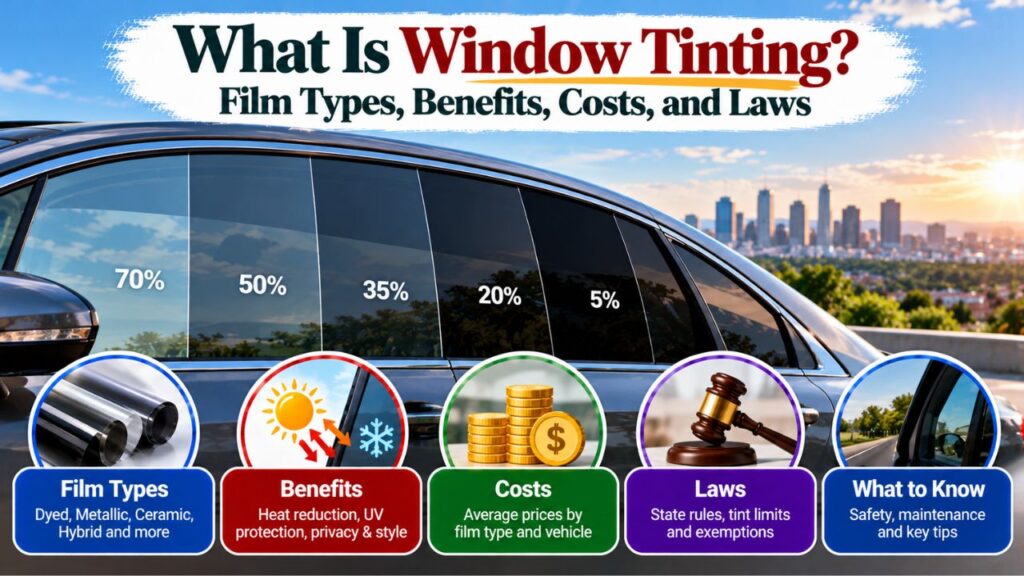
Automotive window tinting involves installing a thin film over existing vehicle glass.
The film typically contains several layers engineered to control how much visible light, ultraviolet radiation, and solar heat pass through the window.
Different film technologies accomplish this through absorption, reflection, or selective filtering of solar energy.
What Is Automotive Window Tint Film Made Of?
Most conventional automotive window films use polyester-based materials.
Depending on the product, a film may contain:
- Polyester layers that form the main film structure
- Dyes or pigments that change its appearance
- Ceramic particles or specialized coatings for heat rejection
- Metallic layers in certain reflective films
- Adhesive that bonds the film to the glass
- Scratch-resistant protective coatings
The exact construction varies considerably between manufacturers.
An inexpensive dyed film and a premium ceramic film may look similar after installation but provide very different heat-rejection performance.
How Does Window Tint Reduce Sunlight?
Window tint controls the amount and type of solar energy passing through the glass.
A darker film generally reduces more visible light, which changes the appearance of the windows and helps control glare.
Advanced films can also reject portions of infrared radiation associated with solar heat.
UV-blocking layers reduce the amount of ultraviolet radiation transmitted through the glass.
According to the International Window Film Association’s automotive window film guidance, automotive films can provide UV protection, heat control, glare reduction, and privacy benefits.
However, a film’s actual performance depends on its materials and tested specifications.
Is Window Tinting Permanent?
Window tinting is intended to remain attached to the glass for years, but most aftermarket tint films can be removed.
Removal usually requires separating the adhesive from the glass and cleaning away any residue.
The process may be more difficult when film has aged, cracked, or deteriorated.
Special care is necessary on rear windows with defroster lines and on glass containing antennas or sensitive components.
Key Takeaway: Window tinting changes the performance and appearance of existing glass by applying a specialized film. Its benefits depend on the film technology, not simply how dark it looks.
What Are the Benefits of Window Tinting?
Window tinting offers several potential advantages beyond changing a vehicle’s appearance.
The most useful benefits are reduced solar heat, UV protection, glare reduction, and increased privacy.
1. Reduces Solar Heat Inside the Car
High-performance window tint can reduce the amount of solar energy entering through treated glass.
This may make the cabin more comfortable during sunny weather and reduce the cooling demand placed on the vehicle’s air-conditioning system.
However, heat rejection varies significantly by film.
A standard dyed film generally provides less infrared heat control than a premium ceramic film.
Important: Window tint does not prevent a parked vehicle from becoming dangerously hot. Never leave children or pets unattended in a vehicle, even when its windows have premium heat-rejecting film.
2. Helps Protect Against UV Radiation
Quality window tint films can reject substantial amounts of ultraviolet radiation.
Many premium products advertise up to 99% UV rejection within specified testing ranges.
This protection can reduce UV exposure through treated glass.
It may also help slow sunlight-related fading and deterioration of upholstery, dashboards, and other interior materials.
However, tint cannot eliminate every source of UV exposure or prevent all interior aging.
3. Reduces Glare While Driving
Bright sunlight can make it difficult to see comfortably through vehicle windows.
Window tint can reduce incoming visible light and help manage glare.
This is particularly useful during:
- Early morning commutes
- Late afternoon driving
- Long highway trips
- Driving through bright, open landscapes
However, excessively dark tint can make nighttime driving more difficult.
The goal is to reduce uncomfortable brightness without sacrificing necessary visibility.
4. Improves Privacy
Darker window tint makes it harder to see inside the vehicle under many lighting conditions.
This can provide additional privacy for passengers and reduce the visibility of belongings.
However, tint is not a security guarantee.
People may still be able to see inside depending on lighting, window angle, and film shade.
Never leave valuables exposed simply because the windows are tinted.
5. Changes the Vehicle’s Appearance
Window tint can create a uniform appearance across the vehicle’s windows.
Many drivers prefer the darker, more finished look it provides.
Different film products offer different color tones, reflectivity levels, and shades.
A neutral black or charcoal finish is common, but appearance varies by product.
Key Takeaway: The main benefits of window tinting include solar heat control, UV protection, glare reduction, privacy, and appearance. The strongest thermal benefits generally come from higher-performance films.
What Are the Different Types of Window Tinting?
Automotive window tint films use several different technologies.
The most common categories include dyed, metallic, carbon, ceramic, and hybrid films.
Window Tint Types Compared
| Window Tint Type | Heat Rejection | Main Advantage | Main Limitation |
| Dyed tint | Usually low to moderate | Affordable appearance and privacy | Limited thermal performance |
| Metallic tint | Moderate to high | Reflective solar control | May interfere with electronic signals |
| Carbon tint | Moderate to high | Good color stability and heat control | Quality varies by manufacturer |
| Ceramic tint | Often high | Strong heat rejection with good clarity | Higher price |
| Hybrid tint | Varies | Combines different technologies | Performance depends on construction |
| Clear heat-rejecting film | Varies, sometimes high | Maintains a light appearance | Usually provides little privacy |
These are general characteristics. Some advanced multilayer films do not fit neatly into one category.
Dyed Window Tint
Dyed tint uses colorants to reduce visible light transmission.
It is commonly selected for its appearance, privacy, and lower price.
Dyed film can also offer good UV protection when the product includes appropriate UV-blocking layers.
However, basic dyed films often have limited infrared heat rejection.
Lower-quality dyed films may fade or develop discoloration as they age.
Modern color-stable dyed films can perform better than older inexpensive products.
Metallic Window Tint
Metallic tint uses thin metal-containing layers or coatings to reflect portions of solar energy.
It can provide effective glare and heat control.
Some metallic films have a noticeable reflective appearance.
Certain metallized constructions may also interfere with radio, cellular, GPS, or other electronic signals.
For vehicles containing glass-integrated antennas or specialized electronics, compatibility should be checked before installation.
Carbon Window Tint
Carbon tint uses carbon-containing materials to manage light and solar energy.
It is commonly marketed as a middle-ground option between basic dyed tint and premium ceramic film.
Depending on the product, it may offer:
- Better heat rejection than basic dyed tint
- Good color stability
- A nonreflective appearance
- Reduced risk of electronic interference
However, the carbon label alone does not establish a specific performance level.
Compare the manufacturer’s technical specifications.
Ceramic Window Tint
Ceramic tint uses ceramic-based particles or coatings to control solar energy.
Many premium ceramic films provide strong infrared heat rejection without requiring extremely dark glass.
They are popular for drivers who want better cabin comfort while maintaining relatively high visible light transmission.
Ceramic tint generally costs more than standard dyed tint.
However, premium films from different manufacturers can vary substantially in performance and price.
Hybrid and Specialty Window Films
Hybrid films combine technologies such as dyed and metallic layers or other specialized materials.
Some advanced films use multilayer optical constructions designed to reject specific wavelengths of solar energy.
A nearly clear film can sometimes provide better overall heat rejection than a darker basic tint.
For these products, technical measurements are more meaningful than their marketing categories.
What Do Window Tint Percentages Mean?
Window tint percentages describe Visible Light Transmission (VLT).
VLT measures the percentage of visible light passing through a film or a film-and-glass assembly.
A higher percentage means more light passes through.
A lower percentage means the window appears darker.
Common Car Window Tint Percentages
| Tint Percentage | Appearance | General Use |
| 70% VLT | Very light | Minimal appearance change |
| 50% VLT | Light | Subtle tint and glare reduction |
| 35% VLT | Medium | Noticeable tint and some privacy |
| 20% VLT | Dark | Increased privacy |
| 15% VLT | Very dark | Strongly reduced visible light |
| 5% VLT | Extremely dark | Maximum darkness, limited night visibility |
These are descriptive examples, not recommendations about legality.
Actual appearance depends on the original glass, film, interior lighting, and surrounding conditions.
Is 5% Tint Darker Than 35% Tint?
Yes.
A 5% VLT window allows approximately 5% of visible light to pass through, while a 35% VLT window allows approximately 35%.
Therefore, 5% tint is much darker.
The difference becomes particularly important at night, when dark film can significantly reduce the driver’s view of pedestrians, cyclists, road edges, and other objects.
How Factory Glass Changes the Final Tint Percentage
Vehicle windows may already contain some factory tint.
The film’s advertised VLT does not necessarily equal the finished window’s VLT.
A simplified estimate is:
Final VLT = Glass VLT × Film VLT
For example:
- Original glass: 75% VLT
- Added film: 35% VLT
0.75 × 0.35 × 100 = 26.25%
The finished window may transmit approximately 26% of visible light.
This is an estimate. Actual compliance should be checked using an appropriate light-transmission meter.
Key Takeaway: A lower tint percentage means darker glass. When checking legal limits, consider the combined VLT of the original glass and installed film.
How Is Car Window Tinting Done?
Professional window tinting involves more than placing a dark sheet against the glass.
Proper installation requires accurate fitting, clean preparation, and careful removal of trapped moisture.
Step 1: Clean the Vehicle Windows
The installer thoroughly cleans the glass to remove dirt, oil, dust, and residue.
Contamination can cause visible defects or prevent proper adhesive bonding.
Special attention is given to the glass edges and window seals.
Step 2: Measure and Cut the Film
The film is cut to match the window’s shape.
Some installers use computerized cutting equipment, while others use appropriate templates and manual cutting techniques.
Accurate sizing helps achieve clean edges and proper coverage.
Step 3: Shape the Film to Curved Glass
Many automotive windows have curved surfaces.
Installers may use controlled heat to shape certain films so they fit properly.
The process is commonly called heat shrinking.
Incorrect heating can damage the film, causing distortion or unwanted creases.
Step 4: Apply the Film to the Glass
Automotive tint is normally installed on the interior surface of the window.
The installer uses a suitable application solution to position the film and activate or manage the adhesive system.
The protective release liner is removed according to the installation procedure.
Step 5: Remove Trapped Moisture and Air
The installer uses specialized squeegees and other tools to move application liquid and trapped air toward the edges.
Proper pressure and technique help the film bond smoothly.
Excessive tool pressure or contamination can damage the film.
Step 6: Inspect the Finished Windows
Once installed, the film is inspected for alignment, contamination, creases, and other defects.
Minor moisture haze may remain temporarily.
However, large persistent bubbles, significant contamination, or peeling edges may require correction.
Step 7: Allow the Tint to Dry
Newly installed film needs time for residual installation moisture to evaporate.
Drying time varies depending on:
- Film construction
- Temperature
- Humidity
- Sunlight exposure
- Window size
- Installation method
Follow the installer’s specific instructions before lowering the windows or cleaning the film.
How Much Does Window Tinting Cost?
Professional automotive window tinting in the United States can cost a few hundred dollars or more than $1,000, depending on the vehicle, film, and installation.
Basic dyed films are generally cheaper, while premium ceramic films cost more.
According to AAA’s automotive window tinting guide, the following are useful general price estimates.
Estimated Window Tinting Prices
| Window Tint Type | Approximate Professional Cost |
| Dyed film | 250–300 |
| Carbon film | 350–500 |
| Ceramic film | 400–800 |
| Advanced specialty films | 500–1,200 |
These are broad published estimates, not guaranteed nationwide prices. The actual window coverage, vehicle type, and film quality can change the quotation substantially.
What Affects Window Tinting Prices?
The total cost depends on several factors:
- Number of windows being tinted
- Vehicle size
- Curvature and complexity of the glass
- Film brand and technology
- Installer experience
- Local labor rates
- Existing tint removal
- Warranty coverage
An SUV with several large windows may cost more than a compact sedan.
Likewise, a premium ceramic package typically costs more than a standard dyed film installation.
Is Ceramic Tint Worth the Extra Cost?
Ceramic tint may be worth the additional expense if your main priority is solar heat reduction.
A quality ceramic film can reject substantial heat while remaining relatively light.
If you mainly want privacy and a darker appearance, a good dyed or carbon film may be sufficient.
Compare the products’ actual heat-rejection measurements rather than choosing based only on price or brand.
Is Window Tinting Legal in the United States?
Yes, automotive window tinting is legal in the United States when the installation complies with applicable regulations.
However, window tint laws differ by state, vehicle type, and window position.
A shade allowed on rear side windows may be prohibited on the front side windows.
Windshield restrictions are often more specific.
How Window Tint Laws Work
State regulations commonly establish minimum visible light transmission requirements.
They may also restrict:
- Reflective or mirrored films
- Certain tint colors
- Windshield tint placement
- Noncompliant front side window tint
- Tint that obstructs the driver’s view
For example, some states permit darker rear windows when the vehicle has suitable outside mirrors.
Other states maintain stricter requirements.
Before choosing a tint percentage, check your state DMV, highway patrol, or official motor vehicle regulations.
Can You Tint the Entire Windshield?
That depends on the jurisdiction and the type of film.
Many states generally restrict darker aftermarket windshield tint to a narrow upper strip.
Some allow particular clear or nearly clear films under specified conditions.
Do not assume that 70% ceramic film is automatically legal across the entire windshield.
Even relatively clear film can alter the finished glass’s light transmission.
Vehicle cameras, head-up displays, sensors, and specialized windshield coatings may also require compatibility checks.
Does Window Tint Have to Pass Inspection?
In states that inspect automotive tint, the windows may be measured with a VLT meter.
The measurement considers the light transmission of the completed window assembly.
A tint that is too dark may lead to a failed inspection, citation, or removal requirement.
Check the current requirements before installation because rules can change.
What Is the Difference Between Window Tint and Factory Privacy Glass?
Factory privacy glass and aftermarket tint film can produce similar dark appearances, but they are not the same product.
Factory Privacy Glass
Factory privacy glass is manufactured with color or tint incorporated into the glass itself.
It is common on the rear windows of SUVs, minivans, and trucks.
Because the dark appearance is part of the glass, there is no aftermarket film layer to peel away.
However, the thermal performance of privacy glass varies by vehicle.
Darker glass does not necessarily provide the same solar heat rejection as a premium aftermarket ceramic film.
Aftermarket Window Tint
Aftermarket tint is a separate film applied to existing glass.
It can be selected in different shades and technologies.
Its benefits may include UV protection, solar heat reduction, glare control, and privacy.
Unlike factory privacy glass, aftermarket film can generally be removed or replaced without replacing the original window.
Factory Tint vs. Aftermarket Tint
| Feature | Factory Privacy Glass | Aftermarket Window Tint |
| Application | Manufactured into glass | Film attached to existing glass |
| Removable | Requires glass replacement to remove coloration | Film can generally be removed |
| Available darkness | Factory specification | Multiple film shades |
| Heat rejection | Depends on glass technology | Depends on film technology |
| UV protection | Depends on glazing | Depends on film specifications |
| Risk of peeling film | None | Possible if film or installation deteriorates |
A vehicle can also have aftermarket film installed over factory privacy glass, provided the final installation is compatible and legal.
What Are the Disadvantages of Window Tinting?
Window tinting has useful benefits, but it also introduces some tradeoffs.
Understanding them helps prevent disappointment.
Reduced Visibility at Night
Very dark tint can make it harder to see outside after sunset.
This can affect visibility when reversing, changing lanes, or driving on poorly lit roads.
For front windows, choose a film that maintains adequate visibility and complies with the law.
Potential Installation Problems
Poor installation may cause:
- Air bubbles
- Contamination spots
- Uneven edges
- Creases
- Adhesive failure
- Peeling
- Optical distortion
Professional installation reduces many of these risks but cannot eliminate every possible defect.
Added Expense
High-quality films and professional installation cost more than basic DIY tint kits.
Premium ceramic products can be expensive, particularly for vehicles with large or complex windows.
Maintenance Requirements
Tinted windows need appropriate cleaning products and careful handling.
Abrasive pads or unsuitable tools can scratch some films.
Follow the manufacturer’s recommendations rather than assuming every glass cleaner is safe for every tint product.
Possible Legal Problems
Tint that exceeds state limits can lead to fines, inspection issues, and removal costs.
Legal compliance should be checked before selecting a shade.
DIY vs. Professional Window Tinting: Which Is Better?
DIY tinting kits are available, but installing film cleanly on curved automotive glass can be difficult.
DIY Window Tinting
DIY installation may cost less initially.
However, it requires appropriate materials, a clean working area, suitable tools, and careful technique.
Common problems include trapped dust, bubbles, crooked edges, and film creases.
Removing a failed installation can create additional work and expense.
DIY tinting may be more manageable on simple, relatively flat side windows than on large curved rear windows.
Professional Window Tinting
Professional installers have experience fitting and shaping film for different vehicle windows.
They may also provide:
- Computer-cut film patterns
- Controlled installation environments
- Premium film options
- Manufacturer-backed warranties
- VLT measurements
- Guidance on applicable legal requirements
Professional installation is generally the better choice for premium ceramic films, complex rear glass, and vehicles with sensitive electronic components.
Key Takeaway: DIY tinting can reduce initial labor costs, but professional installation usually offers more predictable results and better access to quality films and warranties.
How Long Does Window Tinting Last?
Automotive window tint can remain serviceable for many years, but its lifespan varies by product and conditions.
Factors affecting durability include:
- Film technology
- Material quality
- Sun exposure
- Adhesive performance
- Installation quality
- Window maintenance
- Physical wear
Basic low-quality dyed films may discolor or deteriorate earlier than high-quality color-stable or ceramic products.
However, ceramic technology alone does not guarantee a specific lifespan.
Signs That Window Tint Needs Replacement
Common signs include:
- Persistent bubbles
- Peeling edges
- Cracked film
- Severe discoloration
- Cloudy or distorted visibility
- Adhesive failure
Temporary moisture haze shortly after installation should not automatically be confused with permanent damage.
Follow the manufacturer’s drying guidance and contact the installer if defects persist.
How to Maintain Tinted Windows
For longer-lasting results:
- Follow the installer’s instructions before lowering newly tinted windows.
- Wait for the recommended drying period before cleaning.
- Use cleaning products approved for the specific film.
- Wipe with a clean, soft microfiber cloth.
- Avoid abrasive scrapers or rough cleaning pads.
- Inspect peeling edges before damage spreads.
Care requirements vary by film brand, so use the manufacturer’s instructions when available.
How to Choose the Best Window Tint for Your Car
Choosing the right window tint involves more than selecting a percentage.
Start with the benefits you actually want.
Choose Tint Based on Your Main Goal
| Your Priority | Tint Option Worth Considering |
| Affordable darker appearance | Quality dyed film |
| Moderate heat rejection | Carbon or suitable hybrid film |
| Stronger solar heat control | High-performance ceramic film |
| Light appearance with heat protection | High-VLT heat-rejecting film |
| Privacy | Suitable darker film within legal limits |
| Long-term value | Reputable film with a strong warranty |
Compare VLT and Heat-Rejection Ratings
Two films with the same VLT can have very different heat-control performance.
When evaluating premium tint, ask for:
- VLT: Visible Light Transmission
- TSER: Total Solar Energy Rejection
- UV rejection: Ultraviolet radiation blocked
- IR rejection: Infrared radiation rejected within the specified test range
- Warranty details: Coverage for qualifying defects
For overall solar heat control, TSER is generally more useful than an isolated infrared rejection percentage.
Compare films tested under equivalent conditions and at similar VLT levels.
Check Installer Quality and Warranty
A premium film installed poorly may not provide the appearance or durability you expect.
Before booking, ask about the exact film product, warranty, total coverage, and installation experience.
Request a written quotation identifying the film series and selected shade.
Confirm that the finished window will comply with applicable law.
Conclusion
So, what is window tinting? It is the process of applying specialized film to glass to change light transmission, reduce certain types of solar radiation, and improve privacy or appearance.
Modern automotive tint offers much more than darker windows. High-quality films can provide UV protection, glare reduction, and meaningful heat rejection.
However, performance varies by film technology.
Dyed tint is often suitable for affordable privacy and appearance, while ceramic tint is generally worth considering when stronger thermal performance is the priority.
The best choice depends on your budget, desired appearance, legal VLT requirements, and how much time you spend driving in sunny conditions.
For a reliable result, choose a film with clear technical specifications, have it installed properly, and follow the manufacturer’s maintenance instructions.
FAQs About What Is Window Tinting
What Is the Purpose of Window Tinting?
Window tinting is used to reduce sunlight entering a vehicle, improve privacy, control glare, and change the appearance of the windows. Advanced films can also reduce solar heat gain and block substantial amounts of ultraviolet radiation.
Is Window Tinting the Same as Window Film?
Window tinting commonly refers to applying automotive window film, but window film is a broader product category. Some films are designed primarily for heat rejection, UV protection, privacy, decoration, or security. Not all window films are visibly dark.
Can Window Tinting Keep a Car Cooler?
Yes, quality heat-rejecting film can reduce solar heat entering through treated windows. Ceramic and other advanced films may provide stronger heat control than basic dyed products. However, tint cannot prevent a parked car from becoming dangerously hot.
Is Ceramic Window Tint Better Than Regular Tint?
Ceramic tint often offers better heat rejection than basic dyed tint at comparable darkness levels. However, it usually costs more. If privacy and appearance are your main priorities, a good dyed or carbon film may provide sufficient value.
Can You Remove Window Tinting From a Car?
Yes. Most aftermarket window tint films can be removed without replacing the glass. However, removal may require heat, adhesive-cleaning products, and specialized techniques. Extra care is necessary around rear defroster lines and other sensitive glass-mounted components.