Ceramic window tint is a type of automotive window film that uses microscopic ceramic particles to reduce solar heat, block ultraviolet (UV) radiation, and control the amount of visible light entering a vehicle. Unlike basic dyed tint, which primarily darkens windows, high-performance ceramic tint can reject substantial solar heat even in relatively light shades.
The film is typically applied to the inside surface of a car’s windows. Its ceramic components help manage infrared radiation without relying on the metallic layers found in some other window films. This makes nonmetallic ceramic films attractive for drivers concerned about heat, glare, UV exposure, and electronic signal interference.
However, ceramic tint isn’t automatically the darkest, most durable, or best-performing option. Its effectiveness depends on the film’s construction, tested specifications, installation quality, and visible light transmission.
It also costs more than many entry-level films, and darker ceramic shades can still reduce nighttime visibility.
In this article, I explain how ceramic window tint works, its benefits and disadvantages, and how it compares with dyed, carbon, and metallic films. You’ll also learn about ceramic tint percentages, heat-rejection ratings, installation costs, legal restrictions, and choosing the right film for your car.
What Is Ceramic Window Tint and How Does It Work?
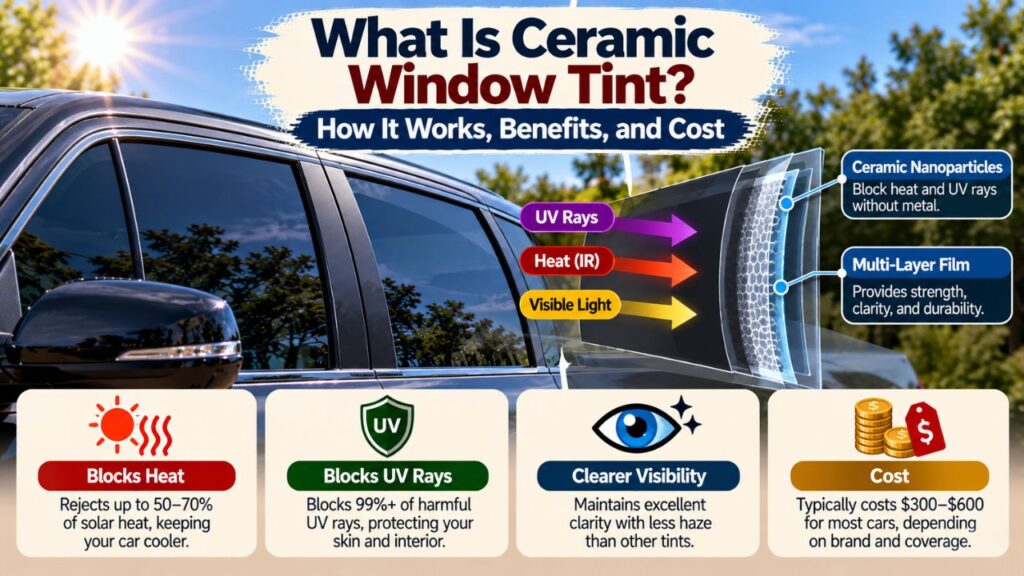
Ceramic window tint is a specialized automotive film that contains microscopic ceramic-based materials designed to control solar energy passing through vehicle glass.
These particles are incorporated into a thin film structure, typically built around durable polyester layers and a pressure-sensitive adhesive.
The film is applied to the interior side of the glass using an installation solution and specialized tools.
Once installed, the ceramic components affect how incoming solar radiation is transmitted, absorbed, and reflected.
How Nano-Ceramic Technology Controls Solar Heat
The term nano-ceramic refers to ceramic materials engineered at an extremely small scale.
In automotive window films, these materials can be formulated to interact with infrared radiation while allowing a selected amount of visible light to pass through.
Sunlight contains several forms of radiation:
- Ultraviolet (UV): Contributes to skin damage and deterioration of certain interior materials.
- Visible light: Determines how bright the surroundings appear through the window.
- Infrared (IR): Carries a significant portion of solar energy associated with heat.
Ceramic particles help reduce the amount of solar energy transmitted through the glass.
Different films accomplish this through different combinations of absorption and reflection.
A film that absorbs energy may also become warmer, with some heat transferred toward the interior or exterior.
For this reason, the film’s complete solar-energy performance matters more than one isolated infrared-rejection number.
Why Ceramic Tint Doesn’t Need Metal
Many ceramic films are nonmetallized, meaning they don’t depend on a deposited metallic layer for solar control.
Instead, their ceramic components help manage solar radiation.
This reduces the risk of the radio-frequency interference associated with certain metallic window films.
Nonmetallic ceramic films are generally compatible with:
- GPS navigation.
- Cellular communication.
- Bluetooth-connected devices.
- Satellite radio.
- Other vehicle communication systems.
This is especially relevant in modern vehicles containing numerous wireless electronic systems.
However, individual product construction still matters. Check the manufacturer’s specifications rather than assuming every product marketed as ceramic has exactly the same composition.
Is Ceramic Tint a Coating or a Film?
Ceramic automotive tint is normally a thin film, not a liquid ceramic coating applied directly to the glass.
The ceramic particles are incorporated into the film material.
During installation, the film is cut to fit the window and bonded to the glass using adhesive.
This differs from ceramic paint coatings, which are liquid products applied to exterior vehicle surfaces.
Ceramic window tint and ceramic paint protection products serve different purposes and should not be confused.
What Are the Benefits of Ceramic Window Tint?
Ceramic window tint can improve comfort, reduce glare, provide UV protection, and increase privacy.
Its most important advantage is the ability of a suitable high-performance film to control solar heat without requiring extremely dark windows.
1. Reduces Solar Heat Inside the Car
One of the main reasons drivers choose ceramic tint is its solar heat-rejection performance.
During sunny weather, radiation entering through vehicle windows warms the seats, dashboard, interior trim, and other surfaces.
Those materials release heat into the cabin.
Ceramic films can reduce some of the incoming solar energy, helping limit direct radiant heat reaching occupants.
For a verified product example, 3M’s official Ceramic IR automotive window film specifications report up to 66% total solar energy rejection across the product series, depending on the selected film.
This is a manufacturer-reported maximum, not a performance guarantee for every ceramic film or vehicle.
A high-performance ceramic tint may help reduce the discomfort associated with sunlight entering through side windows.
However, it cannot completely prevent a parked vehicle from becoming hot.
2. Blocks Harmful Ultraviolet Radiation
Many ceramic films provide substantial protection against UV radiation passing through treated windows.
UV radiation contributes to skin damage and can affect vehicle interior materials over time.
The 3M Ceramic IR series referenced above reports up to 99.9% UV rejection under the manufacturer’s stated test conditions.
This level of protection depends on the specific product and measurement range.
It is also important to recognize that factory automotive glass already provides some UV protection.
Laminated windshields often block substantial UV radiation, while the performance of side windows varies with the glass construction and any factory coatings.
A suitable ceramic film can provide additional protection where the existing glass allows more UV transmission.
3. Reduces Sunlight Glare
Ceramic tint can reduce the intensity of visible light entering through vehicle windows.
This helps manage glare from bright sunlight, especially when the sun shines directly through a side window.
Reduced glare may improve comfort during daytime driving.
However, the amount of glare reduction depends primarily on the film’s visible light transmission and other optical properties.
A nearly clear ceramic film usually reduces less visible brightness than a dark ceramic film.
Important: Darker tint may reduce daytime glare, but it also reduces visible light at night. Glare reduction should not be prioritized over safe nighttime visibility.
4. Provides Privacy Without a Highly Reflective Appearance
Ceramic tint is available in different shades.
Darker films make it more difficult for people outside the vehicle to see passengers or interior belongings during daylight.
Many ceramic films have relatively low visible-light reflectivity, allowing them to create a dark appearance without looking like highly reflective mirror film.
However, privacy depends on lighting conditions.
Even dark ceramic tint may allow people to see inside when the vehicle interior is brighter than the surroundings.
Ceramic tint does not provide guaranteed one-way privacy.
5. Can Help Protect Vehicle Interior Materials
Sunlight exposure contributes to the deterioration of certain plastics, fabrics, leather finishes, and other interior components.
By reducing UV radiation and some solar heat, ceramic tint may help limit factors associated with interior fading and aging.
However, window film doesn’t prevent every form of deterioration.
Vehicle interiors can still experience damage from temperature changes, moisture, normal wear, and sunlight entering through untreated glass.
6. Avoids Metallic Signal Interference
A properly designed nonmetallic ceramic film doesn’t introduce the metallic layer that can interfere with some wireless signals.
This makes it particularly attractive for vehicles using GPS, satellite radio, and mobile connectivity.
Still, signal compatibility is a product-specific characteristic.
Look for an explicit nonmetallized design and manufacturer documentation.
Key Takeaway: The main advantage of high-quality ceramic tint is solar heat control combined with flexible visible-light options, UV protection, and nonmetallic construction.
Does Ceramic Window Tint Have to Be Dark?
No. Ceramic window tint can be light, medium, or very dark. Its heat-rejection ability is not determined solely by the darkness of the film.
This is an important difference between choosing tint for appearance and choosing it primarily for solar performance.
Understanding Ceramic Tint Percentages
Ceramic tint percentages generally refer to Visible Light Transmission (VLT).
VLT describes how much visible light passes through the film or filmed glass.
A higher number means more visible light passes through.
| Tint shade | Light transmission | Typical appearance |
| 70% | 70% | Nearly clear |
| 50% | 50% | Light tint |
| 35% | 35% | Medium-dark |
| 20% | 20% | Dark |
| 15% | 15% | Very dark |
| 5% | 5% | Extremely dark |
These are general shade descriptions rather than exact measurements for every product.
The final darkness depends on the original glass and actual film specifications.
Can 70% Ceramic Tint Reject Heat?
Yes. A high-performance 70% ceramic film can reject meaningful solar energy while allowing most visible light through.
This makes lighter ceramic tint useful for drivers who prioritize visibility and cabin comfort over a dark appearance.
However, performance varies significantly between products.
A ceramic label and a 70% VLT rating alone do not establish how much solar heat the film rejects.
Compare the manufacturer’s total solar energy rejection specifications.
Is 35% Ceramic Tint a Good Choice?
A nominal 35% ceramic film provides a noticeably darker appearance than a 50% or 70% film.
It may offer a practical balance of daytime privacy and visibility where permitted.
However, 35% tint can still be too dark for certain windows under applicable state laws.
It can also reduce nighttime visibility compared with lighter film.
Check the combined film-and-glass VLT before making a final choice.
Is 5% Ceramic Tint Better for Heat Rejection?
A 5% ceramic film is very dark and allows approximately 5% of visible light through.
It may provide strong solar performance depending on the product.
However, it isn’t automatically the best choice for every vehicle.
Very dark tint can make it difficult to see through side or rear windows in poorly illuminated conditions.
It is also restricted on many vehicle windows.
For drivers whose main concern is heat rejection, a lighter high-performance film may be more suitable.
How Do You Measure Ceramic Window Tint Performance?
Several technical ratings help explain how effectively a ceramic film manages sunlight.
Understanding these measurements is more useful than relying only on a product’s shade or marketing description.
Ceramic Tint Performance Ratings Explained
| Rating | Meaning | Why it matters |
| VLT | Visible Light Transmission | Determines window brightness and affects legality |
| TSER | Total Solar Energy Rejection | Measures overall solar-energy rejection |
| IRR | Infrared Rejection | Measures infrared rejection over a specified wavelength range |
| IRER | Infrared Energy Rejection | Accounts for a broader infrared range and reradiated energy under the stated method |
| UV Rejection | Ultraviolet radiation blocked | Indicates protection against specified UV wavelengths |
| Visible reflectance | Percentage of visible light reflected | Influences mirror-like appearance and legal compliance |
Total Solar Energy Rejection (TSER)
TSER is one of the most useful measurements for comparing automotive heat-control films.
It represents the percentage of total solar energy rejected by the filmed glass under specified testing conditions.
A higher TSER generally indicates that less incoming solar energy passes into the vehicle through the treated glass.
For example, a film-and-glass combination with a TSER of 60% rejects 60% of the incident solar energy under the test conditions.
This doesn’t mean the vehicle’s interior temperature will fall by 60%.
Cabin temperature depends on additional factors such as sunlight exposure, ventilation, climate, and untreated windows.
Infrared Rejection (IRR)
IRR measures how much infrared radiation is rejected over a defined wavelength range.
Some manufacturers advertise very high infrared rejection percentages.
However, those percentages may apply only to a relatively narrow portion of the infrared spectrum.
A product advertised as rejecting 95% of certain infrared wavelengths does not necessarily reject 95% of all solar heat.
This distinction matters when comparing different brands.
Infrared Energy Rejection (IRER)
IRER measures infrared-energy rejection over a broader specified range and accounts for transmitted and absorbed energy that can be reradiated toward the vehicle interior.
It provides another useful way to evaluate infrared-related performance.
However, manufacturers may report measurements using different methods.
Always compare films using the same definitions and test conditions when possible.
UV Rejection
UV rejection describes how much ultraviolet radiation the film blocks.
High-quality automotive films frequently report substantial UV protection.
However, an impressive UV rejection percentage doesn’t necessarily indicate strong infrared or total solar heat rejection.
Practical Tip: If reducing cabin heat is your main goal, compare TSER first, then review IRER, VLT, and the manufacturer’s testing conditions.
Ceramic Window Tint vs. Regular, Carbon, and Metallic Tint
Ceramic tint is one of several automotive film technologies.
The differences involve the materials used, solar performance, appearance, electronic compatibility, and cost.
Ceramic vs. Regular Dyed Window Tint
Basic dyed tint uses color-absorbing materials to reduce visible light.
It is commonly chosen for privacy and appearance.
Ceramic tint uses specialized particles to manage solar radiation and may provide substantially better heat rejection.
However, this depends on the particular products being compared.
A high-quality dyed film may perform differently from a low-quality product marketed as ceramic.
Ceramic vs. Carbon Window Tint
Carbon tint contains carbon-based materials that affect visible light and solar energy transmission.
It may provide improved color stability and heat control compared with some basic dyed films.
Ceramic films often emphasize advanced infrared rejection, but carbon products vary widely.
Choose between them by comparing tested performance, price, warranty, and appearance.
Ceramic vs. Metallic Window Tint
Metallized tint uses metallic layers or particles to control solar energy.
Some metallized products provide strong heat rejection and durability.
However, certain metallic films may interfere with radio-frequency signals.
Nonmetallic ceramic tint avoids that particular construction issue.
Window Tint Technology Comparison
| Film type | Main characteristics | Common limitation |
| Dyed tint | Affordable darkening and glare reduction | Heat performance and color stability vary |
| Carbon tint | Carbon-based solar control and appearance | Performance differs by formulation |
| Metallized tint | Uses metal for solar control | Possible signal interference |
| Ceramic tint | Nonmetallic ceramic-based solar control | Often higher initial cost |
The differences are general.
Some modern films combine multiple technologies, and the terms used in product marketing are not perfectly standardized.
A quality film should be selected by its measured performance rather than its technology label alone.
What Are the Disadvantages of Ceramic Window Tint?
Ceramic tint has several useful benefits, but it isn’t the best choice for every vehicle or budget.
Higher Initial Installation Cost
Ceramic tint generally costs more than basic dyed film.
The higher price reflects the film’s materials, construction, product positioning, and sometimes the installation package.
However, expensive film is not automatically superior.
Compare product specifications and warranty coverage before paying a premium.
Dark Ceramic Tint Still Reduces Night Visibility
Ceramic technology does not eliminate the visibility limitations of dark tint.
A 15% ceramic film still allows significantly less visible light through than a 70% film.
This can make it harder to identify pedestrians, curbs, and road hazards during nighttime driving.
Optical clarity and light transmission are different properties.
Even an optically clear dark film reduces the amount of light reaching the driver.
It Doesn’t Completely Stop Solar Heating
Ceramic tint reduces certain forms of solar energy transmission, but it doesn’t block every source of heat.
Sunlight may still enter through untreated glass, and the cabin can warm through other mechanisms.
Tinted vehicles can still reach dangerous interior temperatures when parked in direct sunlight.
Do not rely on tint to make a parked vehicle safe for people or animals.
Poor Installation Can Cause Visible Defects
Ceramic film can develop installation-related problems, including:
- Trapped dust.
- Air bubbles.
- Visible adhesive contamination.
- Peeling edges.
- Wrinkles or creases.
- Uneven trimming.
- Scratches.
These problems are not unique to ceramic tint.
Professional installation reduces the risk but doesn’t guarantee a flawless result in every situation.
Not Every Ceramic Film Performs Equally
The word ceramic doesn’t identify one standardized level of performance.
Two ceramic films with similar shade names may have very different solar-energy rejection ratings.
Likewise, a high-quality multilayer nonceramic film may outperform some lower-cost ceramic products.
Check documented specifications instead of assuming the technology name proves superiority.
How Much Does Ceramic Window Tint Cost?
Ceramic window tint generally costs more than entry-level dyed or basic carbon tint.
However, there is no single installation price that applies across the United States.
The total depends on the film, installer, vehicle, and number of windows.
Main Factors That Affect Ceramic Tint Pricing
Installation costs depend on:
- Vehicle size: Larger vehicles often need more film.
- Window count: A full-car installation costs more than tinting only two windows.
- Glass curvature: Complex rear windows may require additional installation work.
- Film quality: Premium ceramic products may cost more.
- Existing tint removal: Removing old film can add labor.
- Regional pricing: Installer rates vary by location.
- Warranty coverage: Different products offer different warranty terms.
The most useful way to compare prices is to request quotes for the same vehicle and window coverage.
Is Ceramic Tint More Expensive Than Regular Tint?
Usually, yes.
Basic dyed film is often the lower-cost option.
Ceramic tint typically carries a premium because of its advanced solar-control construction and product positioning.
However, the price gap depends on the specific brands and installation packages.
How to Compare Installation Quotes
Ask each installer to identify:
- The exact film manufacturer and series.
- The shade or VLT being installed.
- The tested TSER and IRER values.
- Which windows are included.
- Whether old tint removal is included.
- The warranty coverage.
- Whether the finished windows will meet the applicable tint law.
A quote for a premium ceramic film should not be compared directly with a basic dyed film without considering those differences.
Is Ceramic Window Tint Legal in the United States?
Ceramic window tint is legal when the installed film complies with the applicable vehicle window regulations.
The law generally focuses on characteristics such as visible light transmission, reflectivity, placement, and sometimes color.
It does not automatically permit darker windows simply because the film uses ceramic technology.
Ceramic Tint Laws for Front Side Windows
U.S. states have different restrictions on how much visible light must pass through front side windows.
For example, the Texas Department of Public Safety’s official window tinting standards require the windows immediately beside the driver to transmit at least 25% of visible light when the original glass and aftermarket film are measured together.
The same guidance includes a maximum luminous reflectance of 25% for those windows.
Other states may require lighter tint or apply different rules.
Always check the requirements for your registration state and vehicle classification.
Can You Put Ceramic Tint on a Windshield?
Some ceramic films are nearly clear and are marketed for windshield applications.
However, a light appearance does not automatically make an aftermarket windshield film legal.
Windshield rules are often more restrictive than side-window rules.
Texas, for example, specifies placement limits for ordinary windshield sunscreening devices above the AS-1 line or within the permitted upper strip. Its guidance also provides a specific exception for clear, untinted UV film.
That exception should not be interpreted as automatically approving every ceramic heat-rejection product.
Confirm the exact film’s legality before installing it on a windshield.
Why the Final VLT Matters
Original automotive glass already blocks some visible light.
Adding ceramic film reduces the combined transmission.
A simplified estimate is:
Combined VLT (%) = Glass VLT (%) × Film VLT (%) ÷ 100
For example, if the original glass transmits 80% of visible light and you install a film with 50% VLT:
80 × 50 ÷ 100 = 40% combined VLT
This is an approximate calculation.
Actual results depend on the glass, film, and measurement method.
A professional installer can check the finished window using a calibrated tint meter.
Important: A ceramic film labeled 35% doesn’t necessarily result in a finished window measuring 35%. Confirm legal compliance using the combined glass-and-film measurement.
How Is Ceramic Window Tint Installed?
Ceramic tint is normally applied to the inside surface of automotive glass using a process similar to other aftermarket window films.
Proper installation is important because contamination or poor handling can affect appearance and durability.
Professional Ceramic Tint Installation Process
A typical installation involves:
- Inspecting the glass: The installer checks for existing film, damage, and contamination.
- Cleaning the surface: Dirt, dust, grease, and residue are removed.
- Cutting the film: The ceramic film is sized to fit the particular window.
- Heat-shaping when required: Curved glass may require careful film shaping.
- Applying the film: The installer uses a suitable application solution and positions the adhesive layer against the glass.
- Removing trapped solution: A squeegee helps remove liquid and air from beneath the film.
- Finishing the edges: The installer checks trimming, alignment, and visible defects.
The exact process depends on the vehicle and the selected film.
Can You Install Ceramic Tint Yourself?
Yes, but DIY ceramic tint installation requires patience, suitable tools, and a clean working environment.
Curved rear windows are particularly challenging because the film must conform to the glass without creasing.
Mistakes can waste expensive material.
For a premium film, professional installation may be more practical, especially when warranty coverage depends on using an authorized installer.
How Long Does Ceramic Tint Take to Cure?
Freshly installed tint may retain some moisture between the film and glass.
The adhesive needs time to settle and the remaining installation moisture must dissipate.
The curing period depends on the film, weather, humidity, glass construction, and installation method.
Temporary haze or small moisture patterns may be normal during the initial curing process.
Follow the installer’s instructions about rolling down windows, cleaning the glass, and inspecting the finished film.
Do not assume that every visible bubble will disappear. Persistent contamination or air pockets may require correction.
How Long Does Ceramic Window Tint Last?
High-quality ceramic window tint can remain functional for many years when properly installed and maintained.
However, no fixed lifespan applies to every ceramic film.
Durability depends on product construction, adhesive quality, installation conditions, sunlight exposure, and maintenance.
Does Ceramic Tint Fade or Turn Purple?
Quality ceramic films are often designed for improved color stability.
However, some ceramic products may also incorporate dyes or other color-control materials.
Their long-term appearance depends on the entire construction.
A low-quality film can fade, discolor, or develop adhesive problems even if it is marketed as ceramic.
Check the manufacturer’s warranty and product specifications.
Can Ceramic Tint Bubble or Peel?
Yes.
Ceramic film is still an adhesive-backed window film.
It can bubble, peel, scratch, or develop other problems if the adhesive deteriorates or the installation is damaged.
The ceramic particles themselves do not make the film immune to installation defects.
How to Maintain Ceramic Window Tint
To help preserve the film:
- Follow the manufacturer’s initial curing instructions.
- Use a soft microfiber cloth.
- Choose a nonabrasive cleaner approved for the film.
- Avoid razor blades and scraping tools against the installed film.
- Keep dirty or damaged window seals from repeatedly scratching the surface.
- Inspect peeling edges before they become worse.
Some manufacturers permit certain ammonia-containing cleaners after curing, while other products have different care instructions.
Follow the requirements for the specific film rather than assuming every ceramic tint needs identical cleaning products.
How to Choose the Best Ceramic Window Tint for Your Car
Choosing ceramic tint should begin with performance and legal requirements rather than the darkest available shade.
Step 1: Decide Whether Heat or Privacy Matters More
If reducing solar heat is your main goal, prioritize verified TSER and relevant infrared performance.
If privacy is more important, visible light transmission becomes a larger consideration.
Remember that greater privacy usually requires darker film, which can reduce nighttime visibility.
Step 2: Choose a Suitable Tint Percentage
Consider how often you drive at night and which windows will be tinted.
A lighter ceramic film can provide useful solar control while maintaining more visible light.
Darker shades may be appropriate for certain legally permitted rear windows.
Do not assume the same shade is appropriate for the windshield, front side windows, and rear glass.
Step 3: Compare Actual Film Specifications
Look for a technical data sheet showing:
- VLT.
- TSER.
- IRER or clearly defined infrared measurements.
- UV rejection.
- Visible reflectance.
- Warranty terms.
Be cautious of products advertising only a very high infrared rejection percentage without explaining the measurement range.
Step 4: Verify the Film’s Authenticity
Purchase from a reputable supplier or installer.
Request the exact film series and product information.
Avoid assuming that an inexpensive, unverified film provides the same performance as a documented premium product.
A warranty card or product identification information may help confirm what was installed.
Step 5: Confirm Legal Compliance
Have the original glass measured when necessary.
Choose a film that keeps the finished window within the applicable VLT and reflectivity requirements.
For windshield installations, verify the specific rules before proceeding.
Step 6: Review the Installer’s Work and Warranty
A reputable installer should explain the expected appearance, curing period, performance specifications, and warranty conditions.
Ask how defects are handled and whether the manufacturer covers fading, bubbling, peeling, or adhesive problems.
Professional workmanship is especially important when paying for high-performance film.
Is Ceramic Window Tint Worth It?
Ceramic window tint is often worth considering if you regularly drive in strong sunlight and want better solar heat control without choosing extremely dark windows.
Its nonmetallic construction and available VLT options make it suitable for many modern vehicles.
However, the additional expense may not be worthwhile for every driver.
When Ceramic Tint Is a Good Choice
Ceramic tint is particularly attractive when:
- You drive frequently during hot, sunny weather.
- Solar heat through the side windows causes discomfort.
- You want additional UV protection.
- You prefer a lighter shade with meaningful heat rejection.
- You want to avoid metallic film construction.
- You plan to keep the vehicle for several years.
When Regular Tint May Be Enough
A basic dyed or other lower-cost film may be sufficient when:
- Your main goal is a darker appearance.
- You want modest daytime glare reduction.
- Heat rejection is not a major priority.
- Your budget is limited.
- The vehicle is used relatively little.
Even then, compare the actual film specifications before making a decision.
A premium technology label is not a substitute for appropriate performance, legal compliance, or installation quality.
Conclusion
So, what is ceramic window tint? It is an automotive window film that uses microscopic ceramic-based materials to help control solar energy, reduce UV transmission, and provide different levels of visible light transmission without relying on metallic layers.
Its biggest advantage is the potential for strong heat rejection while keeping the windows relatively light.
High-quality ceramic tint can also provide UV protection, reduce glare, and improve daytime privacy. However, darker shades still affect nighttime visibility, and actual performance varies by product.
Ceramic tint usually costs more than basic dyed film, but the additional expense may be justified for drivers who spend considerable time in hot, sunny conditions.
For everyday driving, I recommend choosing a legally compliant ceramic film with documented TSER, UV rejection, and VLT ratings rather than selecting a product based only on its darkness or advertised infrared rejection.
A suitable ceramic tint should improve comfort while preserving enough visibility for safe driving.
FAQs About What Is Ceramic Window Tint
Is Ceramic Window Tint Better Than Regular Tint?
Ceramic tint often provides better solar heat rejection than basic dyed tint, particularly in lighter shades.
However, performance varies by product, and ceramic film isn’t automatically superior to every carbon, metallic, or multilayer film.
Compare tested solar-energy rejection, UV protection, durability, and cost before deciding.
Can You See Through Ceramic Tint at Night?
Yes, but nighttime visibility depends mainly on the film’s visible light transmission.
A light ceramic film allows more visible light through than a dark ceramic film.
Very dark shades can make it difficult to see pedestrians, curbs, and other objects in poorly illuminated conditions.
Does Ceramic Tint Really Keep Your Car Cooler?
High-performance ceramic tint can reduce the solar energy entering through treated windows and may improve cabin comfort.
However, it cannot completely prevent heat buildup.
A vehicle parked in direct sunlight can still become dangerously hot, even with premium ceramic film.
Is Ceramic Window Tint the Same as Nano-Ceramic Tint?
The terms are closely related.
Nano-ceramic describes film technology using ceramic materials engineered at a microscopic scale.
Many modern ceramic automotive films use this type of technology, but the exact formulations and performance levels vary.
The word nano does not guarantee better performance.
Can Ceramic Tint Interfere With GPS or Cell Phone Signals?
Properly designed nonmetallic ceramic tint generally avoids the radio-frequency interference associated with certain metallic films.
However, product construction can vary.
Check the manufacturer’s documentation for compatibility with GPS, cellular communication, and other vehicle electronics.
Does Ceramic Tint Block 100% of UV Rays?
Not necessarily.
Many high-performance ceramic films block a very high percentage of ultraviolet radiation, but actual ratings vary.
For example, certain products report UV rejection approaching 99.9% under specified testing conditions.
Always check the individual film’s UV rejection rating and tested wavelength range.
Can You Put Ceramic Tint on a Front Windshield?
Some nearly clear ceramic films are marketed for windshield applications, but legality depends on the applicable state regulations and the finished glass’s light transmission.
Certain jurisdictions permit only specific windshield strips or qualifying clear films.
Confirm the law for the exact product and vehicle before installation.