No, diesel engines do not use spark plugs for ignition. Instead, they operate on the principle of compression ignition, where air is intensely compressed within the cylinder, generating extreme heat. This high temperature then causes the finely atomized diesel fuel, once injected, to undergo spontaneous combustion, eliminating the need for an external spark.
Ever popped the hood of a car and seen all those wires running to the top of the engine? If you’re like most people, you probably thought, “Ah, spark plugs! Every engine needs ’em, right?” It’s a perfectly logical assumption. Gasoline engines, which are what most of us drive, absolutely rely on spark plugs to get the party started inside the combustion chamber. But here’s where things get interesting, and a little bit surprising, especially if you’ve ever wondered about those powerful, torque-heavy machines often found in trucks, buses, and some incredibly fuel-efficient cars: Do diesel engines need spark plugs?
The short, definitive answer is a resounding “No!”
That’s right. Unlike their gasoline counterparts, diesel engines operate on an entirely different principle when it comes to igniting their fuel. There’s no delicate electrical arc, no precise timing of a spark to kick off combustion. Instead, diesel powerplants use a fascinating and incredibly robust method that’s been around for over a century: compression ignition. It’s a clever bit of engineering that allows these engines to operate with incredible efficiency and power, all without a single spark plug in sight. Let’s dive into how these mechanical marvels achieve combustion and why they’ve carved out such a unique niche in the world of internal combustion.
Key Takeaways
- Diesels ignite: Through extreme air compression, not sparks.
- No spark plugs: Needed for diesel combustion cycle.
- High compression ratio: Generates ignition-ready heat.
- Glow plugs assist: Only with cold engine starting.
- Fuel auto-ignites: When injected into hot compressed air.
- Understand the difference: Diesel is compression, gasoline is spark.
📑 Table of Contents
- The Core Difference: How Gasoline Engines Ignite Fuel
- Do Diesel Engines Need Spark Plugs? The Big “No!” And Why
- If Not Spark Plugs, Then What About Cold Starts? Enter Glow Plugs!
- Key Differences and Advantages of Diesel Engine Ignition
- Beyond the Basics: Modern Diesel Engine Technology
- Gasoline vs. Diesel Ignition: A Quick Comparison
The Core Difference: How Gasoline Engines Ignite Fuel
To truly understand why diesel engines don’t need spark plugs, it helps to first grasp how a gasoline engine works. Think of your everyday car engine. It’s a fantastic piece of machinery, but it relies on a very specific sequence of events to generate power.
Understanding Spark Plug Function
In a gasoline engine, before the combustion process even begins, air and fuel are mixed together, typically in the intake manifold or directly in the cylinder. This creates a highly combustible mixture. The engine then draws this mixture into the cylinder during the intake stroke and compresses it. However, even after compression, the air-fuel mixture isn’t hot enough to ignite on its own. This is where the spark plug comes in. At just the right moment, the spark plug delivers a high-voltage electrical spark, jumping across a small gap. This spark is powerful enough to ignite the finely atomized gasoline and air mixture, causing a rapid expansion that pushes the piston down, creating power.
The Gasoline Ignition Process
- Intake: Air and fuel are drawn into the cylinder.
- Compression: The piston moves up, compressing the air-fuel mixture.
- Ignition (Spark): The spark plug fires, igniting the mixture.
- Power: The expanding gases push the piston down.
- Exhaust: The piston moves up, expelling spent gases.
The entire system is designed around getting that perfect, explosive mixture and then precisely timing that crucial spark. Without a functioning spark plug, a gasoline engine simply won’t start or run.
Do Diesel Engines Need Spark Plugs? The Big “No!” And Why
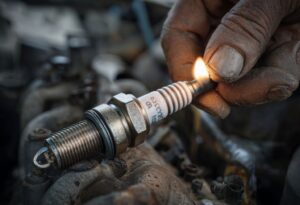
Now, let’s turn our attention to the star of our show: the diesel engine. This is where the narrative completely shifts. Remember that question, “Do diesel engines need spark plugs?” The answer is a firm and confident “No.” The way they ignite fuel is fundamentally different, relying on a principle called compression ignition.
Compression Ignition: The Diesel Engine’s Secret Weapon
Instead of compressing an air-fuel mixture, a diesel engine only compresses air. And it compresses that air to an incredibly high degree – much higher than a gasoline engine. This extreme compression causes a dramatic increase in temperature. Think of it like a bicycle pump: when you pump air into a tire, the pump gets warm, right? Now imagine that effect amplified thousands of times within the confines of an engine cylinder.
This superheated air is the key. Once the air reaches a sufficiently high temperature (often over 1000°F or 540°C), diesel fuel is injected directly into this extremely hot, compressed air. When the finely atomized diesel fuel comes into contact with the superheated air, it instantly self-ignites. No spark needed, no spark plug to generate an electrical arc.
The Diesel Ignition Process Step-by-Step
- Intake: Only fresh air is drawn into the cylinder.
- Compression: The piston moves up, compressing the air to a very high pressure, which in turn heats it to an extremely high temperature.
- Injection & Ignition: At the peak of compression, diesel fuel is precisely injected into the superheated air. The fuel immediately ignites upon contact.
- Power: The rapidly expanding combustion gases push the piston down.
- Exhaust: The piston moves up, expelling the spent gases.
This method of ignition is why diesel engines are also known as “compression-ignition engines.” It’s a beautifully simple yet powerful principle that sets them apart from gasoline engines.
If Not Spark Plugs, Then What About Cold Starts? Enter Glow Plugs!
So, if there are no spark plugs, what about those cold winter mornings? If ignition relies solely on compression heat, what happens when the engine is stone cold and can’t generate enough heat quickly enough to ignite the fuel?
The Purpose of Glow Plugs
This is where another component, often confused with spark plugs, comes into play: the glow plug. It’s important to be clear: a glow plug is NOT a spark plug. It does not create a spark. Its job is entirely different – it’s an aid for starting a cold diesel engine.
In very cold conditions, even with high compression, the initial air temperature inside the cylinder might not get hot enough quickly to reliably ignite the injected diesel fuel. The engine block itself acts like a heat sink, absorbing some of the compression heat. Glow plugs are designed to overcome this challenge by providing an initial heat source.
How Glow Plugs Work
A glow plug is essentially a small, electrically heated element, much like the heating coil in a toaster or an electric stove. When you turn the ignition key (or press the start button) in a diesel vehicle, before the engine cranks, an electrical current flows to the glow plugs. Their tips, which protrude into the combustion chamber or a pre-combustion chamber, rapidly heat up to extremely high temperatures (sometimes over 1800°F or 1000°C).
This intense heat pre-warms the air inside the cylinder, or at least the area around the fuel injector, making it much easier for the diesel fuel to ignite when it’s injected. Once the engine starts and begins to generate its own heat from compression, the glow plugs are typically turned off, as they are no longer needed. They are purely a starting aid for cold conditions, not an ignition source like a spark plug.
Practical Tip: The “Wait to Start” Light
If you’ve ever driven a diesel vehicle, you’ve probably noticed a “Wait to Start” or “Glow Plug” light on the dashboard. This light illuminates when the glow plugs are active, telling you to wait a few seconds for them to pre-heat the combustion chambers before attempting to crank the engine. Ignoring this light in cold weather can lead to hard starting or no start at all for your diesel engine.
Key Differences and Advantages of Diesel Engine Ignition
The unique ignition method of diesel engines brings with it several distinct advantages and characteristics that set them apart from gasoline engines.
Fuel Efficiency and Power
Because diesel engines rely on very high compression ratios, they are inherently more thermally efficient than gasoline engines. A higher compression ratio means more energy is extracted from the fuel during combustion. This, combined with the higher energy density of diesel fuel itself, often translates into better fuel economy and impressive torque output, making diesel engines ideal for heavy-duty applications and long-haul driving.
Reliability and Longevity
By eliminating the need for spark plugs and the associated high-voltage ignition system (coil packs, distributors, spark plug wires), diesel engines remove a potential point of failure. While they have complex fuel injection systems, the ignition process itself is robust. The strong construction required to withstand the immense compression pressures also contributes to the renowned durability and longevity of many diesel engines.
Environmental Considerations (Briefly)
Historically, diesel engines were associated with visible black smoke and strong odors. However, modern diesel engine technology, coupled with sophisticated emissions control systems (like Diesel Particulate Filters and Selective Catalytic Reduction), has drastically reduced these emissions, making today’s diesel vehicles much cleaner than their predecessors.
Beyond the Basics: Modern Diesel Engine Technology
The world of diesel engines hasn’t stood still. Engineering advancements have made these powerplants more refined, efficient, and powerful than ever before.
Common Rail Direct Injection (CRDI)
Modern diesel engines extensively use Common Rail Direct Injection (CRDI) systems. This technology precisely controls fuel injection pressure and timing, allowing for multiple, very fine injections of fuel during a single combustion cycle. This leads to more complete combustion, reduced noise, lower emissions, and improved performance, further enhancing the efficiency of the compression ignition process.
Advanced Glow Plug Systems
Even glow plugs have evolved. Modern systems can heat up almost instantly and even stay on for a short period after the engine starts (post-heating) to reduce initial emissions and improve cold running smoothness. Some even use ceramic elements for faster heating and greater durability compared to traditional metal glow plugs.
The Evolution of Diesel Power
From the early, noisy powerplants to today’s quiet, smooth, and incredibly fuel-efficient engines found in a variety of vehicles, the diesel engine has come a long way. Its unique ignition system, free from the constraints of spark plugs, has been a core reason for its enduring success and adaptability.
Gasoline vs. Diesel Ignition: A Quick Comparison
To help solidify the differences, here’s a quick look at how gasoline and diesel engines approach ignition:
| Feature | Gasoline Engine | Diesel Engine |
|---|---|---|
| Ignition Method | Spark Ignition | Compression Ignition |
| Fuel Type | Gasoline (Petrol) | Diesel Fuel |
| Compression Ratio | Lower (typically 8:1 to 12:1) | Higher (typically 16:1 to 24:1) |
| Primary Ignition Component | Spark Plug | Heat of Compression (no spark plug) |
| Cold Start Aid | None (spark plugs work fine cold) | Glow Plugs (pre-heat combustion chamber) |
| What is Compressed | Air-fuel mixture | Only air |
So, the next time someone asks you about spark plugs in a diesel, you’ll be able to confidently explain that these powerful engines harness the very physics of compression to achieve ignition. It’s a testament to clever engineering and a completely different approach to turning fuel into forward motion.
Hopefully, this deep dive has demystified the inner workings of diesel engines and answered the question about spark plugs once and for all. It’s a common misconception, but knowing the difference highlights the ingenious design behind one of the most robust and efficient power sources on the planet. From heavy-duty trucks to modern, refined passenger vehicles, the compression-ignition principle remains at the heart of every diesel engine, silently doing its work without a single spark.
Frequently Asked Questions
Do Diesel Engines Use Spark Plugs?
No, diesel engines do not use spark plugs. Unlike gasoline engines, they rely on a completely different method to ignite the fuel-air mixture within their cylinders.
If Not Spark Plugs, How Do Diesel Engines Ignite Their Fuel?
Diesel engines ignite their fuel through a process called compression ignition. Air is compressed to a very high pressure, which dramatically increases its temperature, causing the finely atomized diesel fuel to self-ignite when injected.
What is the Main Difference in Ignition Between a Diesel and a Gasoline Engine?
The primary difference lies in the ignition source. Gasoline engines are “spark ignition” engines, using spark plugs to ignite the fuel-air mixture, whereas diesel engines are “compression ignition” engines, relying on the heat generated from compressing air to ignite the fuel.
Why Don’t Diesel Engines Need Spark Plugs?
Diesel engines don’t need spark plugs because their high compression ratio generates sufficient heat within the combustion chamber. This heat, when combined with the finely sprayed diesel fuel, is enough to cause the fuel to spontaneously combust without an external spark.
What Are Glow Plugs, and Are They the Same as Spark Plugs?
Glow plugs are not the same as spark plugs and serve a different function. They are electrical heating elements that warm up the combustion chamber, primarily in cold weather, to assist in the initial startup by making it easier for the diesel fuel to ignite.
Can a Diesel Engine Ever Run with Spark Plugs?
No, a diesel engine cannot run with spark plugs. Its design and operational principles are based on compression ignition, and introducing spark plugs would not provide the necessary ignition for diesel fuel, which requires high temperatures from compression to ignite.