25 window tint is darkness: 30% tint allows more visible light through the glass, while 25% tint creates a slightly darker appearance and offers somewhat greater daytime privacy. For most drivers, 30% tint is the better choice when nighttime visibility matters, while 25% tint may appeal to those who prefer a darker appearance.
The difference is relatively small during daylight, but it can become more noticeable when driving on poorly lit roads or looking through side windows at night.
Both shades can reduce glare and improve the appearance of a vehicle. However, their heat rejection and UV protection depend on the film’s construction, not simply its darkness.
Another important consideration is legality. Some states permit these tint levels on certain windows, while others require substantially more visible light transmission. Factory-tinted glass also affects the final measurement after film installation.
In this article, I compare 30 vs 25 window tint in terms of appearance, privacy, glare, nighttime visibility, heat rejection, and legal requirements. I also explain how factory glass changes the final tint percentage and which shade makes more sense for different driving conditions.
30 vs 25 Window Tint: Main Differences
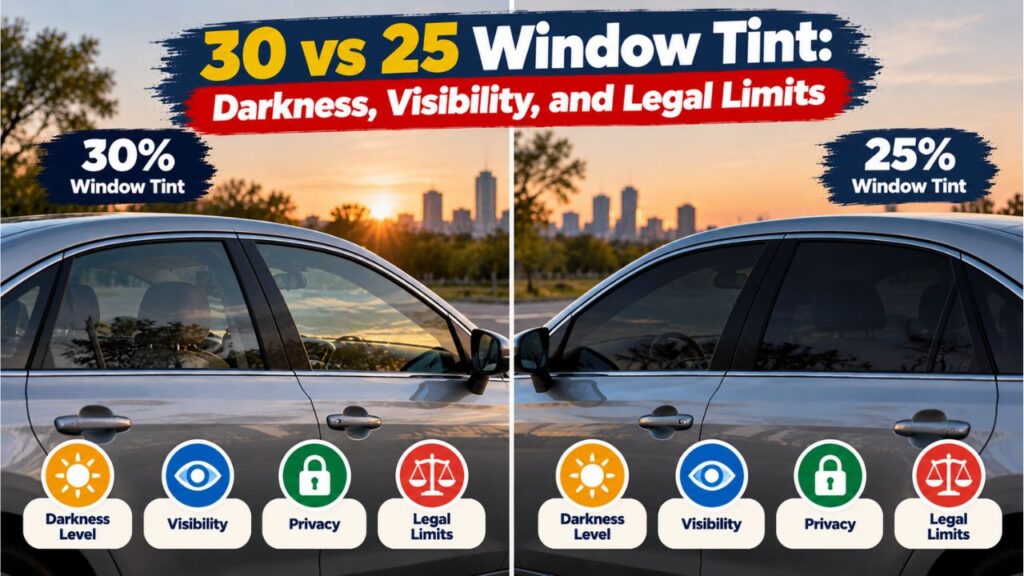
Both tint percentages describe Visible Light Transmission (VLT), which measures the percentage of visible light passing through the tinted glass or film under specified conditions.
A lower VLT means a darker tint.
A 30% VLT window transmits 30% of the incoming visible light, while a 25% VLT window transmits 25%.
The difference is five percentage points.
| Feature | 30% window tint | 25% window tint |
| Visible light transmission | 30% | 25% |
| Darkness | Moderately dark | Slightly darker |
| Daytime privacy | Good | Slightly better |
| Nighttime visibility | Better | Slightly reduced |
| Glare reduction | Good | Usually slightly stronger |
| Heat rejection | Depends on film technology | Depends on film technology |
| UV protection | Depends on film specifications | Depends on film specifications |
| Outside appearance | Dark but relatively transparent | Darker and less transparent |
| Legal status | Depends on state and installed VLT | Depends on state and installed VLT |
| Best use | Balanced visibility and appearance | Greater privacy and darker styling |
The two shades are close enough that their appearance can be similar in bright daylight.
However, the difference in transmitted light is meaningful.
A 25% VLT window transmits approximately 16.7% less visible light than a 30% VLT window, relative to the light transmitted by the 30% option.
This does not mean the vehicle interior becomes exactly 16.7% darker to the human eye. Perceived brightness depends on lighting conditions, glass characteristics, and visual adaptation.
What Does 30% Window Tint Mean?
A 30% tint rating means that approximately 30% of visible light passes through the tested film or glazing system.
The remaining visible light is absorbed or reflected rather than transmitted.
At this level, the window looks noticeably dark from outside, especially when the vehicle interior is not brightly illuminated.
However, occupants and interior details may still be visible under favorable lighting conditions.
For drivers who prefer a dark appearance without choosing an even lower VLT, 30% is a practical option where permitted.
What Does 25% Window Tint Mean?
A 25% tint rating means that approximately one-quarter of incoming visible light passes through the tested film or glazing system.
It is darker than 30% tint and generally makes the vehicle interior less visible from outside.
The difference becomes more noticeable in certain lighting conditions, particularly when the outside environment is brighter than the vehicle interior.
However, 25% tint also reduces the amount of light available to the driver when looking through the glass.
That tradeoff deserves attention when selecting tint for frequently used side windows.
How Much Darker Is 25% Tint Than 30% Tint?
25% tint is somewhat darker than 30% tint, but the difference is not dramatic.
On two otherwise identical windows, both shades can appear dark during the day.
The distinction becomes easier to identify when the films are compared side by side under consistent lighting.
Appearance During Daylight
In bright sunlight, both shades reduce the amount of visible light passing through the windows.
A vehicle with 30% tint generally allows slightly more interior detail to be seen from outside.
With 25% tint, seats, passengers, and other interior features may appear less distinct.
However, the actual appearance depends on:
- Factory glass darkness
- Interior upholstery color
- Exterior lighting conditions
- Film reflectivity
- Film color tone
- Window angle
- Interior lighting
For example, 30% tint over dark factory glass may appear darker than 25% tint installed over much clearer glass.
Comparing film labels alone may not accurately represent the finished appearance.
Appearance on a Black or Dark-Colored Car
Both shades can complement dark exterior paint.
25% tint generally provides a slightly more uniform dark-window appearance.
30% tint creates a similar look while allowing somewhat more light into the cabin.
The difference in exterior appearance is largely a matter of preference.
If possible, inspect actual installations of both shades on similar vehicles before deciding.
Will People Notice the Difference?
Some people can distinguish 25% and 30% tint when the windows are compared directly.
However, the difference may be difficult to recognize when looking at separate vehicles under different conditions.
Film color, glass tint, and interior brightness can influence the appearance as much as the nominal five-point difference.
Key Takeaway: Choose 25% for a slightly darker appearance and 30% for a similar look with somewhat better outward visibility.
30 vs 25 Window Tint for Night Driving
Nighttime visibility is one of the most important practical differences between these tint levels.
Both shades reduce visible light, including light from streetlights, surrounding vehicles, and objects along the road.
Is 30% Tint Better for Night Driving?
Yes, 30% tint generally provides better nighttime visibility than 25% tint when comparing films with similar optical quality.
The higher VLT allows more visible light to reach the driver’s eyes.
This can make a difference when:
- Turning onto poorly lit streets
- Checking for pedestrians
- Looking through side windows at intersections
- Reversing in dark parking areas
- Driving on rural roads
- Identifying cyclists near the vehicle
The difference may not feel substantial under bright streetlights.
However, reduced visibility becomes more important when ambient light is already limited.
A clear view through the windshield and side windows should take priority over obtaining a darker appearance.
Is 25% Tint Too Dark at Night?
25% tint is not automatically unsuitable for every window or driving situation.
However, it provides less outward visibility than 30% tint and can make objects harder to identify in dim conditions.
The effect also depends on the driver’s vision, surrounding lighting, and whether the tint is installed on front or rear windows.
Rear passenger windows may have different visibility requirements from front side windows.
Drivers who frequently travel at night should consider lighter shades rather than assuming that the difference between 25% and 30% is negligible.
Does Ceramic Tint Improve Night Visibility?
Ceramic films can offer good optical clarity, but ceramic technology does not eliminate the light reduction associated with a low VLT.
A 25% ceramic film still transmits less visible light than a comparable 30% ceramic film.
Film quality can affect haze and visual distortion, but higher infrared rejection does not automatically improve the ability to see objects through dark glass.
For nighttime driving, legal VLT and optical clarity are more important than choosing a film simply because it is labeled ceramic.
Which Offers Better Privacy: 25% or 30% Window Tint?
25% tint generally offers slightly more daytime privacy because it allows less visible light through the glass.
However, neither shade guarantees that people outside the vehicle cannot see inside.
Privacy With 30% Tint
30% tint reduces the visibility of the vehicle interior, particularly when the cabin is darker than the outside environment.
It can make casual viewing more difficult while maintaining slightly greater outward visibility.
Passengers may still be visible when standing close to the window or when sunlight illuminates the interior.
The privacy effect can also decrease when the windows are viewed from certain angles.
Privacy With 25% Tint
25% tint provides a modest increase in privacy compared with 30%.
It may make interior details less obvious during bright daylight.
However, it is not equivalent to very dark 5% or 15% tint.
People may still see passengers or objects inside the vehicle, particularly when lighting conditions favor visibility through the glass.
What Happens to Privacy at Night?
At night, the privacy effect can reverse when the vehicle interior is illuminated.
If cabin lights are on and the surroundings are dark, people outside may see inside despite the tint.
This applies to both 25% and 30% films.
Window tint should not be treated as a secure method of concealing valuables.
30 vs 25 Window Tint for Heat Rejection
25% tint does not automatically block substantially more solar heat than 30% tint.
Although the darker film transmits less visible light, heat rejection depends on the film’s solar-control technology.
Does 25% Tint Block More Heat?
Within the same film series, the darker option may reject slightly more total solar energy.
However, the difference can be much smaller than the difference in visible light transmission.
For example, the 3M Ceramic IR Series technical data sheet provides performance data for both its Ceramic IR 25 and Ceramic IR 30 products.
The manufacturer’s values for the specified automotive glass test conditions are shown below.
| Performance measurement | 3M Ceramic IR 30 | 3M Ceramic IR 25 |
| Visible light transmission | 30% | 25% |
| Total solar energy rejected (TSER) | 60% | 61% |
| Infrared rejection (specified wavelength range) | 88% | 90% |
| Infrared energy rejection (IRER) | 67% | 67% |
| UV blocked | 99.9% | 99.9% |
| Glare reduction | 59% | 65% |
These are product-specific manufacturer test results using the stated 73% VLT automotive glass reference. They are not universal specifications for all 25% and 30% tint films.
The key observation is that the 25% product rejects only one additional percentage point of total solar energy in this example.
That is a much smaller performance difference than some drivers may expect from choosing a darker shade.
Which Tint Keeps the Car Cooler?
The film with the higher verified total solar energy rejection generally provides better solar heat control under comparable conditions.
However, an advanced 30% ceramic film may reject more total solar energy than an inexpensive 25% dyed film.
This is because ceramic films can control infrared radiation more effectively than many basic dyed products.
When comparing products, check Total Solar Energy Rejection (TSER) rather than assuming the darker shade is always cooler.
Other factors, including windshield exposure, window area, ventilation, and outdoor temperature, also influence interior heat buildup.
Does 25% Tint Offer Better UV Protection?
Not necessarily.
UV rejection depends on the film’s materials and construction.
As the 3M data illustrates, both its 25% and 30% ceramic products can provide the same reported UV protection under the stated testing conditions.
High-quality films can offer strong UV rejection at different darkness levels.
A darker appearance does not automatically mean better UV protection.
Are 30% and 25% Window Tints Legal?
The legality of 30% and 25% tint depends on the state, the specific window, the vehicle category, and the final measured visible light transmission.
There is no single tint percentage that applies to every vehicle window throughout the United States.
Example: Texas Window Tint Requirements
According to the Texas Department of Public Safety’s window tinting standards, the front side windows immediately beside the driver must allow at least 25% visible light transmission when the film and original glass are measured together.
The same guidance specifies additional reflectivity and windshield restrictions.
This means a window measuring exactly 25% VLT may meet the transmission threshold in Texas, while a window measuring below it would not.
However, a film labeled 25% does not necessarily produce a finished window measuring 25%.
The factory glass also reduces light transmission.
Why State Tint Laws Matter
Some states require lighter front side windows than others.
Different rules may apply to:
- Front side windows
- Rear passenger windows
- Rear windshields
- Front windshields
- Passenger cars versus multipurpose vehicles
- Reflective films
- Certain film colors
Medical exemptions may exist under specific conditions.
Before installing either shade, verify the current requirements through the relevant state motor vehicle or public safety authority.
Do not rely on a national tint chart without checking the applicable jurisdiction.
Is 30% Tint Always Legal if the State Allows 30%?
No.
The installed glass-and-film combination must meet the applicable VLT requirement.
If a state’s minimum is 30%, installing a film marketed as 30% on already tinted factory glass can result in a finished window below the legal minimum.
Professional installers should measure the existing glass and recommend an appropriate film.
Important: Legal compliance should be based on the finished window’s measured light transmission, not simply the percentage printed on the film packaging.
How Factory Glass Changes 30% and 25% Tint
Most automotive glass does not transmit 100% of incoming visible light.
Factory glazing can already absorb or reflect some light before aftermarket film is applied.
When tint is added, the light transmission of the glass and film combines.
Calculating the Final VLT
A simplified calculation is:
Combined VLT = Glass VLT × Film VLT
Both values should be expressed as decimals.
For example, suppose the original window glass has 80% VLT.
If a film with 30% VLT is installed:
0.80 × 0.30 = 0.24
Approximate final VLT: 24%
If a film with 25% VLT is installed:
0.80 × 0.25 = 0.20
Approximate final VLT: 20%
The final window is darker than the film’s nominal transmission level because both materials affect light passing through the assembly.
Example With Different Factory Glass Ratings
The following table illustrates the simplified calculation.
| Original glass VLT | With 30% film | With 25% film |
| 90% | 27% | 22.5% |
| 85% | 25.5% | 21.25% |
| 80% | 24% | 20% |
| 75% | 22.5% | 18.75% |
| 70% | 21% | 17.5% |
These are mathematical estimates, not guaranteed installed measurements.
Actual finished VLT can differ because of glass properties, measurement methods, and how the film manufacturer specifies its product.
As shown in the earlier 3M example, technical data sheets may report values using particular reference glass rather than providing a simple film-only number.
For legal compliance, measure the completed window using an appropriate tint meter.
Can You Put 30% Tint Over Factory Privacy Glass?
A film can sometimes be installed over factory privacy glass, but the final darkness must be evaluated.
Many vehicles have darker rear passenger glass than front side glass.
Applying additional film can reduce transmission considerably.
Factory privacy glass may also offer different UV and infrared performance from aftermarket solar-control films.
Check the existing glazing specifications, the intended final VLT, and applicable laws before adding another layer.
Which Tint Reduces Sun Glare Better?
25% tint generally reduces slightly more visible glare than 30% tint when comparing similar films.
This is because it transmits less incoming visible light.
However, the benefit should be balanced against reduced visibility in dim conditions.
Daytime Driving
During bright daylight, both shades can reduce harsh sunlight entering through side windows.
25% tint may provide somewhat stronger shading.
This can be helpful when sunlight reaches the driver’s side window or when passengers want a darker cabin.
However, tint does not replace appropriate sunglasses or sun visors when direct glare interferes with driving.
Nighttime Headlight Glare
Although darker film reduces some light from headlights, it also reduces visibility of objects that are already difficult to see.
This matters when checking cross traffic, pedestrians, or road edges.
Using darker tint solely to reduce nighttime headlight glare can create an unfavorable tradeoff.
Drivers experiencing significant nighttime glare should prioritize clear, legal glazing and address visibility concerns rather than relying on darker film as the primary solution.
Does 25% Tint Cost More Than 30% Tint?
Usually, tint darkness alone does not create a major price difference when both shades come from the same film series.
Installation cost depends more on the film technology, vehicle, and labor requirements.
Dyed Window Tint
Dyed films are commonly available in different VLT options.
They primarily reduce visible light and provide an affordable darker appearance.
Within a product series, the 25% and 30% shades may have similar prices.
However, availability and manufacturer pricing can differ.
Ceramic Window Tint
Ceramic films generally cost more than basic dyed films because of their specialized solar-control materials.
They can provide stronger infrared heat rejection at a given VLT.
A 30% ceramic film may therefore offer better thermal performance than a 25% basic dyed film.
For drivers seeking heat reduction, spending more on better film technology may be more effective than simply selecting a darker shade.
Installation Quality Matters
Regardless of darkness, a poorly installed film can develop visible defects.
Potential issues include:
- Trapped dust
- Air bubbles
- Adhesive contamination
- Uneven film edges
- Optical distortion
- Peeling
- Discoloration
Choose an installer who identifies the film brand and product series, provides suitable warranty information, and checks legal compliance.
Which Looks Better on Different Vehicles?
Both 30% and 25% window tint can work well on sedans, SUVs, pickup trucks, and coupes.
The choice depends on the desired appearance and how the vehicle is used.
Sedans and Daily Commuter Cars
For a sedan used frequently during the day and at night, 30% tint may provide a useful balance between appearance and visibility.
It offers a darker look without reducing light transmission as much as 25%.
However, the finished VLT must still comply with local requirements.
SUVs and Family Vehicles
SUV owners may prefer 25% for its slightly darker appearance and added privacy.
However, some SUVs already have factory privacy glass on the rear windows.
Adding more film can make those windows significantly darker.
Check the existing glass before selecting a shade.
Pickup Trucks
Pickup trucks often have different factory glazing on the front and rear windows.
A uniform-looking tint installation may require different film VLT values to achieve a similar finished appearance.
For example, using identical aftermarket films on clear front glass and darker factory rear glass may create noticeably different results.
An installer can measure each window and recommend compatible products.
Sports Cars and Coupes
Both shades can complement the styling of a coupe or sports car.
25% generally provides a darker visual finish.
30% maintains a similar appearance with slightly greater light transmission.
Because some coupes have smaller rear windows or limited rearward visibility, the effect of dark tint during nighttime maneuvering deserves consideration.
How to Choose Between 30% and 25% Window Tint
The decision should be based on actual driving conditions and the finished window measurements.
Choose 30% Tint When:
- Nighttime visibility is a higher priority.
- You regularly drive on poorly lit roads.
- You want a dark but not excessively dark appearance.
- You prefer slightly better outward visibility.
- You want reasonable daytime privacy.
- The finished installed VLT meets local requirements.
30% is generally the more balanced of the two shades.
However, it may still be too dark for particular windows under applicable state laws.
Choose 25% Tint When:
- A darker appearance is your primary preference.
- You want somewhat greater daytime privacy.
- The selected window is legally permitted to have this darkness.
- You are comfortable with the additional reduction in visible light.
- You have checked the existing factory glass VLT.
- The film has suitable optical clarity and verified performance.
25% may make more sense for certain rear passenger windows than for front side windows used frequently to check traffic.
Choose a Lighter Tint When:
Neither option is necessarily appropriate for every driver or vehicle.
A lighter shade may be preferable if:
- You drive frequently on dark rural roads.
- Your state requires higher VLT.
- The vehicle already has dark factory glass.
- You have difficulty seeing through tinted windows at night.
- You want heat reduction without significantly darkening the cabin.
A high-performance lighter ceramic film may provide useful heat rejection while transmitting more visible light.
Common Mistakes When Comparing 30% and 25% Tint
A small difference in VLT can lead to incorrect assumptions about heat, safety, and legality.
Assuming 25% Is Much Darker
25% tint is darker, but the five-percentage-point difference is relatively modest.
The effect may be noticeable under controlled comparison conditions without producing a dramatic change in exterior appearance.
Assuming Darker Tint Always Blocks More Heat
VLT does not measure total solar heat rejection.
Compare the actual film specifications, especially TSER, rather than choosing a lower VLT solely for cooling.
Ignoring Factory Window Darkness
The installed window may transmit considerably less light than the aftermarket film’s nominal value.
Check the original glass before choosing the film.
Comparing Different Film Technologies
Comparing a 25% dyed film with a 30% ceramic film can confuse the effect of darkness with differences in film technology.
For a meaningful shade comparison, use the same product series whenever possible.
Choosing Tint Without Checking State Law
A shade acceptable for one rear window may not be permitted on the front side windows.
Legal limits also apply to the installed glass-and-film combination.
Check the rules before purchasing or installing the film.
Ignoring Nighttime Visibility
The difference between 25% and 30% may feel small during the day.
However, reduced visible light becomes more important when driving in poor lighting.
Consider real driving conditions rather than deciding entirely from daytime appearance.
Conclusion
The 30 vs 25 window tint comparison comes down primarily to darkness, visibility, and privacy.
30% tint transmits slightly more visible light, making it the better choice for drivers who want a balance between a dark appearance and outward visibility. 25% tint provides a modest increase in daytime privacy and glare reduction but allows less light through the windows.
The difference in heat rejection may be very small when both shades come from the same film series. Choosing a quality ceramic or other high-performance film can matter more for cabin temperature than moving from 30% to 25%.
I recommend 30% over 25% when nighttime visibility is an important consideration, provided the installed tint is legal. Choose 25% only when its darker appearance is worth the visibility tradeoff and the specific window is permitted to have that light transmission.
Before installation, measure the factory glass, compare the film’s technical specifications, and verify the finished VLT against local regulations.
FAQs About 30 vs 25 Window Tint
Is 25% Tint Noticeably Darker Than 30%?
Yes, 25% tint is slightly darker than 30%, but the difference may be subtle in bright daylight.
It becomes easier to notice when comparing identical windows under consistent lighting.
Is 30% Tint Good for Night Driving?
30% tint generally provides better nighttime visibility than 25% because it transmits more visible light.
However, both shades reduce light compared with clearer glass. Drivers who regularly travel in poorly lit areas may prefer a lighter, legally compliant tint.
Does 25% Tint Provide More Privacy Than 30%?
Yes. 25% tint generally provides somewhat greater daytime privacy because less visible light passes through the glass.
However, lighting conditions significantly influence the result, and neither shade guarantees privacy at night when the vehicle interior is illuminated.
Is 25% Tint Legal on Front Windows?
It depends on the state and the final installed VLT.
Some jurisdictions permit front side windows with 25% measured transmission, while others require lighter glass.
A 25% film installed over factory glass may produce a finished window below 25%, so compliance should be verified with a tint meter.
Is 30% Tint Much Cooler Than 25% Tint?
Not necessarily.
A 25% film may reject slightly more solar heat than a 30% film from the same series, but the difference can be small.
Film technology and verified TSER matter more than the VLT percentage alone.
What Is the Difference Between 30% Ceramic and 25% Ceramic Tint?
Within the same ceramic film series, 30% generally offers greater visible light transmission, while 25% provides a darker appearance and slightly more visible glare reduction.
Infrared and total solar heat rejection may differ only modestly. Compare the manufacturer’s technical data for the exact products.
Can You Put 25% Tint Over 30% Tint?
Layering a 25% film over an existing 30% film would produce a much darker result, not an intermediate shade.
Under a simplified calculation, the two films alone would transmit approximately 7.5% of visible light before accounting for the original glass.
Layering may also cause adhesive, appearance, and legal compliance problems.
Removing the existing film and selecting a suitable replacement is generally preferable.
Which Should I Choose for My Car: 30% or 25% Tint?
Choose 30% if you prefer slightly better outward visibility while maintaining a dark appearance.
Choose 25% if you prioritize a darker look and somewhat greater daytime privacy.
In either case, ensure the final measured light transmission complies with the laws governing the specific vehicle windows.