If you’re planning to inspect, clean, test, or replace your Mass Air Flow (MAF) sensor, the first question you’ll probably ask is: Where is the MAF sensor located? The good news is that on most modern vehicles, it’s relatively easy to find once you know what you’re looking for.
In most cars, the MAF sensor is installed in the air intake system, typically between the engine air filter housing and the throttle body. This position allows it to measure all the clean air entering the engine before it reaches the combustion chamber. However, the exact MAF sensor location can vary depending on your vehicle’s make, model, engine type, and whether it’s naturally aspirated or turbocharged.
Knowing where the MAF sensor is located is more than just useful for DIY maintenance. It also helps you correctly identify the sensor, avoid confusing it with the MAP or intake air temperature (IAT) sensor, and safely perform tasks like cleaning, testing, or replacing it.
In this guide, I’ll show you where the MAF sensor is located on most vehicles, explain why it’s installed in that position, how to identify it under the hood, how its location differs across vehicle types, and what to do once you’ve found it. Whether you’re a beginner or an experienced DIY mechanic, you’ll have everything you need to locate your MAF sensor with confidence.
Where Is the MAF Sensor Located? (Quick Answer)

On most modern gasoline-powered vehicles, the MAF sensor is located in the air intake system, between the engine air filter housing and the throttle body. This position allows the sensor to measure all the clean, filtered air entering the engine before it reaches the intake manifold.
A typical airflow path looks like this:
Air Filter → Air Filter Housing → MAF Sensor → Air Intake Tube → Throttle Body → Intake Manifold → Engine
You’ll usually find the MAF sensor mounted directly on the air intake tube or attached to the air filter housing. It’s easy to recognize because it has an electrical connector with multiple wires and is secured with screws or clips.
However, where the MAF sensor is located isn’t identical on every vehicle. While most manufacturers install it in the same general area, the exact position can vary depending on the engine size, intake design, and whether the vehicle uses a naturally aspirated or turbocharged engine.
If you’re having trouble finding it, don’t worry. In the following sections, I’ll show you exactly how to locate the MAF sensor under the hood, how to identify it, and how its location differs between different types of vehicles.
Why Is the MAF Sensor Installed There?
The MAF sensor isn’t placed between the air filter and the throttle body by accident. Its location is carefully chosen to ensure it measures the exact amount of clean air entering the engine.
By installing the sensor immediately after the air filter, manufacturers protect its delicate sensing element from dirt, dust, and other contaminants. The air has already been filtered, allowing the MAF sensor to provide more accurate airflow readings and enjoy a longer service life.
At the same time, the sensor is positioned before the throttle body so it can measure all the air entering the engine. This allows the Engine Control Unit (ECU) to calculate the correct amount of fuel needed for efficient combustion.
If the MAF sensor were installed elsewhere, it wouldn’t be able to accurately monitor the engine’s incoming airflow. Incorrect airflow data could lead to poor fuel economy, rough idling, sluggish acceleration, increased emissions, and other drivability issues.
In short, the MAF sensor’s location helps it deliver precise airflow measurements, which are essential for maintaining engine performance, fuel efficiency, and smooth operation.
Air Intake System Diagram
Before I start looking for the MAF sensor under the hood, it helps to understand where it fits within the air intake system. Every component has a specific job, and the MAF sensor sits at a key point where it can measure all the air entering the engine.
Here’s the typical airflow path in most modern vehicles:
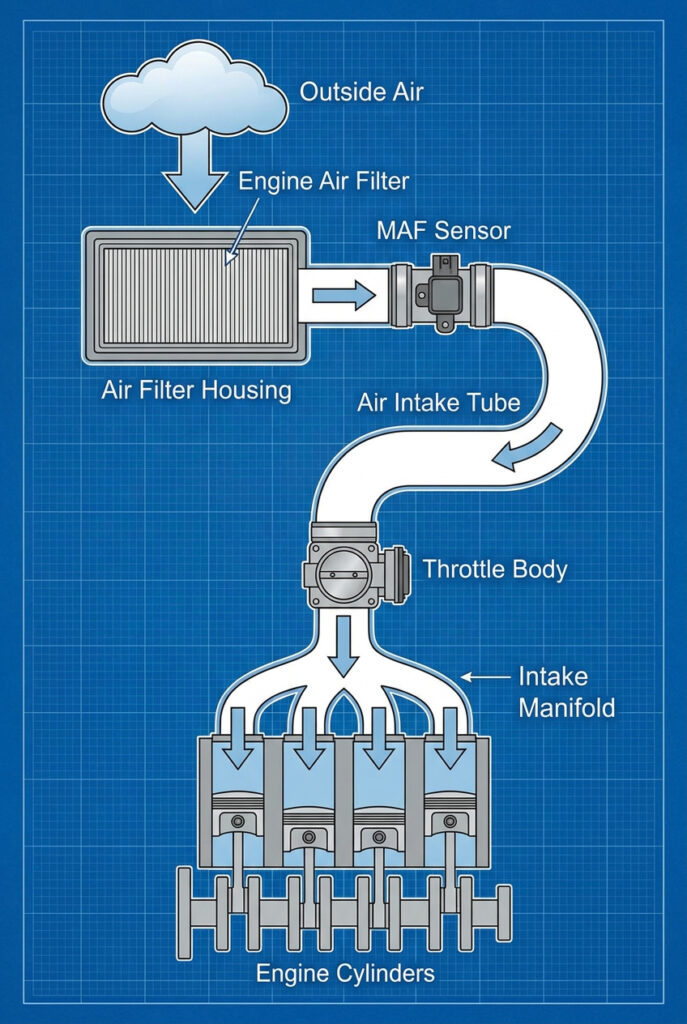
As fresh air enters the intake system, it first passes through the engine air filter, which removes dust and debris. The cleaned air then flows through the MAF sensor, where the amount of incoming air is measured. After that, the air travels through the intake tube and throttle body before entering the intake manifold and, finally, the engine cylinders.
Once I understand this airflow path, locating the MAF sensor becomes much easier because I know exactly where to look between the air filter housing and the throttle body. In the next section, I’ll walk through the process step by step.
How to Find the MAF Sensor Under the Hood
Finding the MAF sensor is usually easier than it looks. If you’re not familiar with your engine bay, don’t worry. On most modern vehicles, you can locate the sensor by following the air intake system from the air filter toward the engine.
Step 1: Locate the Air Filter Box
First, open the hood and find the engine air filter box. It’s typically a black plastic housing located near the front or side of the engine bay. Since the MAF sensor measures filtered air, it’s almost always positioned close to this component.
Step 2: Follow the Air Intake Tube
Next, follow the large plastic or rubber air intake tube that connects the air filter box to the engine. I usually find the MAF sensor mounted somewhere along this tube before the throttle body.
Step 3: Look for the Electrical Connector
The easiest way to identify the MAF sensor is by its electrical connector. You should see a small plastic sensor with a wiring harness plugged into it. Depending on your vehicle, the connector may have anywhere from two to six wires.
Step 4: Check How the Sensor Is Mounted
Finally, check how the sensor is attached. It may be:
- Mounted directly on the air intake tube
- Integrated into the air filter housing
- Secured with screws, bolts, or retaining clips
Once you’ve found the MAF sensor, you can inspect it for dirt or oil buildup, check the electrical connector for damage, or prepare it for cleaning, testing, or replacement. If you still can’t locate it, your vehicle’s owner’s manual or service manual will show its exact location.
What Does a MAF Sensor Look Like?
Once you know where the MAF sensor is located, the next step is identifying it correctly. If you’ve never looked under the hood before, it’s easy to mistake the MAF sensor for another component, especially since several sensors in the engine bay have a similar appearance.
On most vehicles, the MAF sensor is a small plastic housing installed on the air intake tube or attached to the air filter housing. It’s designed to sit directly in the path of incoming air so it can measure airflow before it reaches the engine.
Here are a few features that can help you identify it:
- A plastic sensor housing mounted on the air intake system
- An electrical connector with multiple wires plugged into it
- Two screws, bolts, or retaining clips that hold it in place
- Positioned between the air filter and the throttle body
- A sensing element (hot wire or hot film) located inside the housing
Although the shape and size may vary by manufacturer, these features remain fairly consistent across most modern vehicles.
If you’re still unsure, compare the sensor’s location with the airflow path you learned earlier. If it’s installed after the air filter and before the throttle body, you’ve likely found the correct component. In the next section, I’ll explain why the MAF sensor isn’t located in exactly the same place on every vehicle.
Is the MAF Sensor in the Same Location on Every Vehicle?
The short answer is no. While the MAF sensor is almost always installed in the air intake system, its exact location can vary depending on the vehicle’s make, model, engine size, and intake design.
On most naturally aspirated gasoline engines, you’ll find the MAF sensor between the air filter housing and the throttle body. This is the most common location because it allows the sensor to measure all the clean air entering the engine.
Turbocharged vehicles may have a slightly different intake layout. Although the MAF sensor is still positioned in the intake system, its exact placement can vary depending on the manufacturer’s design and the location of the turbocharger.
Some diesel engines also use a MAF sensor, but the intake components are often arranged differently. As a result, the sensor may not be in the exact same position as it is on a gasoline engine.
You’ll also find that some older vehicles don’t use a MAF sensor at all. Instead, they rely on a MAP (Manifold Absolute Pressure) sensor or a different airflow measurement system to calculate fuel delivery.
No matter what you drive, the easiest way to locate the MAF sensor is to follow the air intake path from the air filter toward the engine. If you can’t find it there, checking your owner’s manual or service manual will usually provide the exact location for your specific vehicle.
In the next section, I’ll show you where the MAF sensor is commonly located on some of the most popular vehicle models.
Where Is the MAF Sensor Located on Popular Vehicles?
Although the MAF sensor performs the same job on every vehicle, its exact location can vary slightly from one model to another. Below are the typical locations for some of the most popular vehicles. These descriptions are intended to help you identify the general area where the sensor is installed.
Ford F-150
On most Ford F-150 models, the MAF sensor is mounted on the air intake tube just after the air filter box and before the throttle body. It’s easy to spot thanks to its electrical connector and mounting screws.
Honda Civic
In most Honda Civic models, you’ll find the MAF sensor attached to the air intake tube near the engine air filter housing. Depending on the model year and engine, it may also be integrated into the air filter housing.
Toyota Camry
The Toyota Camry typically places the MAF sensor between the air filter box and the throttle body. It’s mounted directly in the intake tube, making it fairly accessible for inspection or cleaning.
Chevrolet Silverado
On most Chevrolet Silverado trucks, the MAF sensor is installed in the intake duct that connects the air filter housing to the engine. You can usually identify it by the wiring harness connected to the top of the sensor.
Nissan Altima
The Nissan Altima generally positions the MAF sensor near the air filter housing on the intake tube. Access is usually straightforward, requiring only the hood to be opened.
Jeep Wrangler
Most Jeep Wrangler models place the MAF sensor on the intake tube before the throttle body. Depending on the engine configuration, it may be slightly closer to the air filter housing.
Dodge Ram 1500
On the Dodge Ram 1500, the MAF sensor is commonly mounted in the air intake tube between the air filter box and the throttle body. Some engine options may have a slightly different intake layout, but the sensor remains in the same general area.
If you don’t see the MAF sensor in these locations, don’t assume your vehicle doesn’t have one. Some models use a different intake design or rely on a MAP sensor instead. Checking your owner’s manual or service manual is the best way to confirm the exact location for your specific vehicle.
MAF Sensor vs. MAP Sensor Location
One of the most common mistakes people make is confusing the MAF sensor with the MAP (Manifold Absolute Pressure) sensor. While both help the engine control unit (ECU) calculate the correct air-fuel mixture, they’re installed in different locations and perform different functions.
The easiest way to tell them apart is by looking at where they’re mounted.
| MAF Sensor | MAP Sensor |
| Located on the air intake tube | Mounted on the intake manifold |
| Positioned between the air filter and throttle body | Installed after the throttle body |
| Measures the amount of incoming air | Measures air pressure inside the intake manifold |
| Larger housing with an electrical connector | Usually smaller and mounted directly to the manifold |
If you’re trying to locate the MAF sensor, remember this simple rule:
Follow the air intake tube from the air filter toward the engine. If the sensor is mounted on that tube, you’ve likely found the MAF sensor. If it’s attached directly to the intake manifold, it’s most likely the MAP sensor.
Knowing the difference can save you time and help prevent mistakes when inspecting, cleaning, or replacing engine sensors.
Common Mistakes When Looking for the MAF Sensor
If you’re searching for the MAF sensor for the first time, it’s easy to look in the wrong place or mistake another component for it. Here are some of the most common mistakes and how you can avoid them.
Confusing It with the MAP Sensor
The most common mistake is confusing the MAF sensor with the MAP sensor. Remember, the MAF sensor is mounted on the air intake tube, while the MAP sensor is attached to the intake manifold.
Mistaking the IAT Sensor for the MAF Sensor
Some vehicles have a separate Intake Air Temperature (IAT) sensor, while others integrate it into the MAF sensor. Because both are located in the intake system, they can look similar at first glance.
Looking After the Throttle Body
The MAF sensor is designed to measure air before it enters the engine. If you’re searching beyond the throttle body or on the intake manifold, you’re looking in the wrong area.
Overlooking Integrated Designs
Not every MAF sensor is mounted directly on the intake tube. On some vehicles, it’s built into the air filter housing, making it less noticeable. If you can’t find it on the intake tube, inspect the air filter housing more closely.
Ignoring the Vehicle Manual
If you’ve checked the usual locations and still can’t find the sensor, don’t keep guessing. Your owner’s manual or a repair manual can quickly confirm the exact location for your vehicle.
Avoiding these common mistakes will help you locate the correct sensor faster and prevent unnecessary confusion when it’s time to inspect, clean, or replace it.
What to Do After Finding the MAF Sensor
Once you’ve located the MAF sensor, don’t rush to remove or replace it. A quick inspection can often tell you whether the sensor needs cleaning, testing, or simply a closer look.
Start by checking the electrical connector. Make sure it’s fully seated and that there are no broken wires, loose connections, or signs of corrosion.
Next, inspect the sensor housing and the surrounding air intake tube. Look for cracks, loose clamps, or air leaks that could affect the sensor’s readings. If you can safely see the sensing element, check for dirt or oil buildup, but avoid touching it since it’s extremely delicate.
If everything appears normal but you’re still experiencing symptoms like rough idle, poor acceleration, or a check engine light, the next step is to test the MAF sensor before replacing it. In many cases, a dirty sensor can be cleaned and reused, while an electrically faulty sensor will need to be replaced.
Taking a few minutes to inspect the sensor first can help you avoid unnecessary repairs and ensure you address the actual cause of the problem.
Conclusion
Knowing where the MAF sensor is located is the first step toward diagnosing, cleaning, or replacing it correctly. Although the exact location can vary between vehicles, you’ll find it in the same general area on most modern cars—between the engine air filter and the throttle body in the air intake system.
If you’re unsure whether you’ve found the right component, follow the air intake path, look for the electrical connector, and compare its location with the examples covered in this guide. Taking a few extra minutes to identify the sensor correctly can help you avoid confusing it with the MAP or IAT sensor.
Now that you know where the MAF sensor is located, you’re ready to move on to the next steps, whether that’s inspecting it for contamination, testing its performance, cleaning it safely, or replacing it if necessary. Understanding its location makes every maintenance task easier and helps you keep your engine running at its best.