No, you should not use brake cleaner on a MAF (Mass Air Flow) sensor. While brake cleaner is an effective product for removing grease, brake dust, and contaminants from metal brake components, it is not designed for delicate electronic sensors. Using it on a MAF sensor can damage the sensitive sensing element, affect airflow measurements, and potentially lead to permanent sensor failure.
Many DIY mechanics consider brake cleaner because it’s commonly available in garages and workshops. Since both brake cleaner and MAF sensor cleaner come in aerosol cans and evaporate quickly, it’s easy to assume they can be used interchangeably. However, their chemical formulations and intended applications are very different.
In this guide, you’ll learn why brake cleaner isn’t safe for MAF sensors, how it compares to a dedicated MAF sensor cleaner, what to do if you’ve already used it, and the safest way to clean a MAF sensor without risking unnecessary damage.
Short Answer: Can You Use Brake Cleaner?
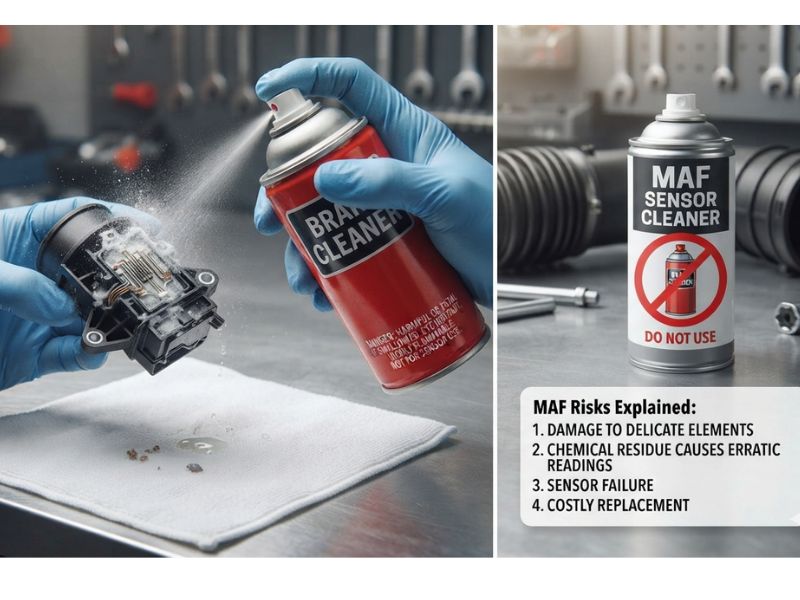
No. Brake cleaner should not be used to clean a MAF (Mass Air Flow) sensor unless the product manufacturer specifically states that it is safe for MAF sensors—which is uncommon.
Although brake cleaner is an excellent product for cleaning brake rotors, calipers, drums, and other metal components, it is formulated for an entirely different purpose than a MAF sensor cleaner. The strong solvents that make brake cleaner effective at removing grease and brake dust can be too aggressive for the delicate electronic components inside a MAF sensor.
Using brake cleaner on a MAF sensor may:
- Damage the hot-wire or hot-film sensing element
- Strip the sensor’s protective coating
- Affect the accuracy of airflow readings
- Cause drivability issues such as rough idle or hesitation
- Trigger the Check Engine Light and MAF-related trouble codes
- Shorten the sensor’s lifespan or cause permanent failure
Because a MAF sensor is responsible for measuring the amount of air entering the engine, even slight damage can result in incorrect fuel delivery and reduced engine performance.
For these reasons, automotive manufacturers and professional technicians recommend using only a dedicated MAF sensor cleaner. It’s specifically formulated to remove dirt and oil without harming the sensor or leaving residue behind.
Why Brake Cleaner Is Unsafe for MAF Sensors
At first glance, brake cleaner and MAF sensor cleaner may seem similar. Both are aerosol sprays that evaporate quickly and are used to remove contaminants. However, they are formulated for completely different applications, and those differences are important.
Designed for Brake Components, Not Electronic Sensors
Brake cleaner is engineered to remove stubborn grease, brake fluid, oil, and brake dust from durable metal components such as brake rotors, calipers, and drums. These parts can withstand aggressive solvents without being damaged.
A MAF sensor is very different. It contains a delicate hot-wire or hot-film sensing element that measures the amount of air entering the engine. This sensitive component requires a much gentler cleaning solution.
Strong Chemical Solvents
Most brake cleaners contain powerful solvents designed to dissolve heavy contaminants quickly.
While these chemicals work well on metal brake parts, they can be too harsh for a MAF sensor. Exposure to strong solvents may affect the sensor’s calibration or damage the sensing element itself.
Can Damage the Protective Coating
Many modern MAF sensors have a thin protective coating that helps ensure accurate airflow measurement and protects the sensing element from contamination.
Brake cleaner may strip or weaken this coating, reducing the sensor’s accuracy even if no visible damage is present.
May Harm Plastic and Rubber Components
Although many brake cleaners are marketed as safe for metal surfaces, some formulations can affect certain plastics and rubber seals over time.
Since MAF sensors often include plastic housings, connectors, and seals, using brake cleaner introduces an unnecessary risk of material damage.
A Small Mistake Can Be Expensive
A can of brake cleaner may seem like a convenient substitute, but damaging a MAF sensor can cost significantly more than purchasing the correct cleaner. Because a dedicated MAF sensor cleaner is specifically designed for this application, it’s the safer and more cost-effective choice.
Brake Cleaner vs. MAF Sensor Cleaner
Although both products are designed to remove contaminants, they are formulated for completely different components. Understanding these differences helps explain why one is safe for a MAF sensor while the other is not.
| Feature | Brake Cleaner | MAF Sensor Cleaner |
| Primary Purpose | Removes grease, brake fluid, and brake dust from brake components | Removes dust, dirt, and oil from MAF sensors |
| Chemical Strength | Strong solvents for heavy-duty cleaning | Mild formula designed for delicate sensors |
| Residue | Usually evaporates quickly but isn’t formulated for sensor electronics | Evaporates quickly and leaves no residue |
| Safe for MAF Sensor | No | Yes |
| Recommended Application | Brake rotors, calipers, drums, and other brake parts | Hot-wire and hot-film MAF sensors |
The key difference is that brake cleaner is designed for heavy-duty metal components, while MAF sensor cleaner is designed for precision electronic sensors. Even if both products appear to dry quickly, their chemical formulations and intended uses are very different.
What Happens If You Already Used Brake Cleaner?
If you’ve already sprayed brake cleaner on your MAF sensor, don’t assume the sensor is ruined. The outcome depends on the cleaner’s formulation, how much was applied, and the type of MAF sensor in your vehicle.
After reinstalling the sensor, pay close attention to how the engine behaves.
Watch for symptoms such as:
- Rough or unstable idle
- Hesitation during acceleration
- Reduced engine power
- Poor fuel economy
- Check Engine Light
- MAF-related diagnostic trouble codes
If the engine runs normally and no warning lights appear, the sensor may not have suffered immediate damage. However, problems can sometimes develop later if the cleaner affected the sensing element or removed its protective coating.
If you notice any new drivability issues after using brake cleaner, inspect the intake system, scan for diagnostic trouble codes, and perform additional testing before deciding whether the sensor needs replacement.
Using an OBD2 scanner to monitor live MAF readings can also help determine whether the sensor is still reporting accurate airflow data.
What Should You Use Instead?
The best and safest choice is a dedicated MAF sensor cleaner. Unlike brake cleaner, it’s specifically formulated to clean the delicate sensing element without damaging it or leaving behind residue.
A quality MAF sensor cleaner is designed to:
- Remove dust, dirt, and light oil contamination
- Be safe for hot-wire and hot-film MAF sensors
- Evaporate quickly without leaving residue
- Preserve sensor accuracy and performance
Considering that a can of MAF sensor cleaner is relatively inexpensive compared to the cost of replacing a faulty MAF sensor, using the correct product is the smarter long-term investment.
If you don’t have a MAF cleaner available, it’s better to wait until you can purchase one than to experiment with products that aren’t intended for airflow sensors.
Frequently Asked Questions
Will brake cleaner ruin a MAF sensor?
It can. While a single application doesn’t always destroy the sensor, brake cleaner contains strong solvents that may damage the sensing element, remove protective coatings, or affect sensor accuracy.
Can brake cleaner leave residue?
Many brake cleaners evaporate quickly, but they are not formulated for sensitive electronic sensors. Even if little or no visible residue remains, the chemicals may still affect the MAF sensor’s materials or calibration.
Is brake cleaner stronger than MAF cleaner?
Yes. Brake cleaner is designed to dissolve heavy grease, brake fluid, and stubborn contaminants from metal brake components. MAF sensor cleaner uses a gentler formula that’s safe for delicate electronic sensing elements.
What if I accidentally used brake cleaner?
Start the engine and monitor its performance. If you experience rough idle, hesitation, poor acceleration, or the Check Engine Light comes on, scan for diagnostic trouble codes and inspect the MAF sensor. Further testing may be needed to determine whether it has been damaged.
Can I use any cleaner instead of MAF cleaner?
No. General-purpose automotive cleaners, household solvents, and brake cleaners are not suitable substitutes. Unless a product specifically states that it is safe for MAF sensors, avoid using it.
Conclusion
So, can you use brake cleaner on a MAF sensor? The answer is no. Although brake cleaner is excellent for cleaning brake components, it isn’t designed for the sensitive electronics inside a MAF sensor. Its strong solvents can damage the sensing element, reduce measurement accuracy, and potentially lead to expensive repairs.
When cleaning a MAF sensor, always use a cleaner specifically labeled for Mass Air Flow sensors. It’s formulated to remove contamination safely while protecting the delicate components that ensure accurate airflow measurement.
Using the correct cleaner may cost a little more upfront, but it’s far less expensive than replacing a damaged MAF sensor or diagnosing problems caused by improper cleaning.