No, you generally should not use throttle body cleaner on a MAF (Mass Air Flow) sensor. Although both products are used to clean components in the air intake system, they are designed for different purposes and are not chemically interchangeable.
Many vehicle owners ask this question because they already have a can of throttle body cleaner in their garage and want to avoid buying a separate MAF sensor cleaner. While it may seem like a convenient alternative, using the wrong cleaner can damage the MAF sensor’s delicate sensing element, affect its accuracy, or even lead to permanent failure.
In this guide, you’ll learn why throttle body cleaner isn’t typically recommended for MAF sensors, how it differs from a dedicated MAF cleaner, whether there are any exceptions, and what to do if you’ve already used it. By understanding the differences, you can avoid unnecessary damage and choose the safest cleaning method for your vehicle.
Short Answer: Can You Use Throttle Body Cleaner?
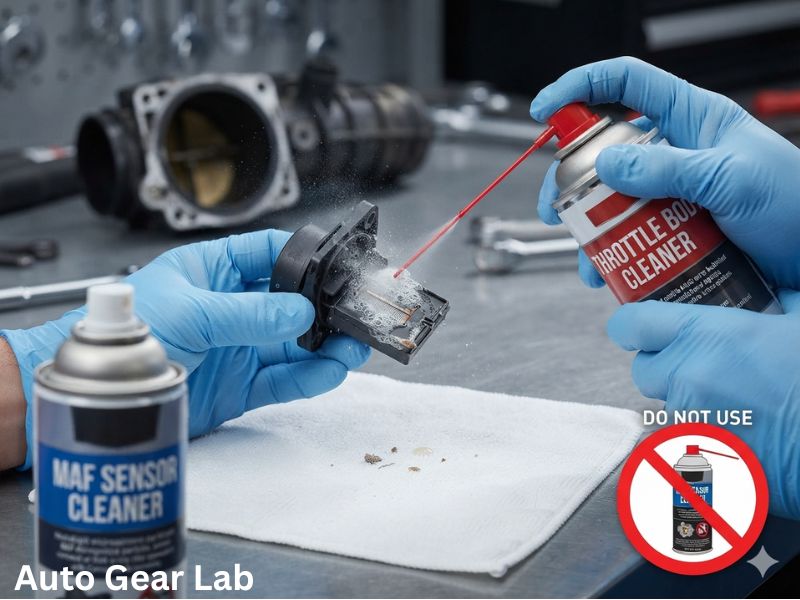
In most cases, no. A throttle body cleaner should not be used to clean a MAF sensor unless the product manufacturer specifically states that it is safe for MAF sensors.
Although both the throttle body and the MAF sensor are part of the air intake system, they are built very differently. A throttle body is a durable metal component that can withstand stronger cleaning chemicals, while a MAF sensor contains an extremely delicate hot-wire or hot-film sensing element that is easily damaged.
Throttle body cleaners are formulated to remove stubborn carbon deposits, varnish, and oily residue from the throttle plate and throttle bore. To do this effectively, they often contain more aggressive solvents than those found in dedicated MAF sensor cleaners.
Using these stronger chemicals on a MAF sensor may:
- Damage the sensing wire or hot-film element
- Strip the sensor’s protective coating
- Leave residue that affects airflow readings
- Reduce sensor accuracy
- Shorten the sensor’s lifespan
For these reasons, professional technicians and vehicle manufacturers generally recommend using only a cleaner specifically labeled for Mass Air Flow sensors.
Read Full Guide : Can You Clean a MAF Sensor Without Cleaner?
Why Throttle Body Cleaner Isn’t Recommended
At first glance, a throttle body cleaner and a MAF sensor cleaner may appear similar. Both come in aerosol cans, both evaporate quickly, and both are used on components within the intake system. However, their formulations and intended applications are quite different.
Designed for Different Components
Throttle body cleaner is made to remove heavy carbon buildup from the throttle body, a component constructed primarily from metal. It is designed to dissolve stubborn deposits that accumulate around the throttle plate over time.
A MAF sensor, on the other hand, measures incoming airflow using a highly sensitive sensing element. It doesn’t develop thick carbon deposits, so it doesn’t require such aggressive cleaning chemicals.
Stronger Chemical Formula
To remove carbon effectively, throttle body cleaners typically use more powerful solvents than MAF cleaners.
While these solvents work well on metal surfaces, they may be too harsh for the delicate sensing wire or sensing film inside a MAF sensor.
Risk of Damaging Protective Coatings
Many modern MAF sensors have protective coatings that help maintain accurate airflow measurements and extend the sensor’s lifespan.
Some throttle body cleaners can strip or weaken these coatings, causing the sensor to become less accurate even if no physical damage is visible.
Potential Residue
Dedicated MAF cleaners are formulated to evaporate without leaving residue behind.
Some throttle body cleaners may leave microscopic deposits that interfere with the sensor’s ability to measure airflow accurately. Even a small amount of residue can affect engine performance over time.
Higher Risk Than Reward
While some people report using throttle body cleaner without immediate problems, that doesn’t mean it’s safe for every sensor. Different vehicle manufacturers use different MAF sensor designs and materials, so a product that appears to work on one vehicle could damage another.
Considering that a can of MAF cleaner is inexpensive compared to the cost of replacing a MAF sensor, using the proper cleaner is the safer and more cost-effective choice.
Read More: Can You Use Brake Cleaner on a MAF Sensor?
Throttle Body Cleaner vs. MAF Sensor Cleaner
Although these products may look similar on the store shelf, they are designed for different components and should not be considered interchangeable.
| Feature | Throttle Body Cleaner | MAF Sensor Cleaner |
| Primary Purpose | Removes carbon deposits from the throttle body | Removes dust, dirt, and oil from the MAF sensor |
| Cleaning Strength | Strong, designed for heavy deposits | Gentle, designed for delicate sensors |
| Residue | May leave residue depending on the formula | Designed to evaporate without residue |
| Safe for MAF Sensor | Generally No | Yes |
| Recommended Use | Throttle body and throttle plate | Mass Air Flow (MAF) sensor |
The biggest difference is that a throttle body cleaner prioritizes cleaning power, while a MAF sensor cleaner prioritizes safety. Since a MAF sensor contains sensitive electronic components, using the correct cleaner is far more important than using the strongest one.
Are There Any Exceptions?
There are a few exceptions, but they depend entirely on the product manufacturer, not on general practice.
Some specialty cleaners are marketed as multi-purpose intake cleaners and specifically state on the label that they are safe for both throttle bodies and MAF sensors. If a product clearly lists both applications and the manufacturer confirms compatibility, it can generally be used according to the instructions.
However, if the can only says “Throttle Body Cleaner” and makes no mention of MAF sensors, you should assume it is not safe to use on the sensor.
Before using any cleaner:
- Read the product label carefully.
- Check the manufacturer’s instructions.
- Follow your vehicle manufacturer’s recommendations if available.
When in doubt, choose a dedicated MAF sensor cleaner. It’s designed for the job and eliminates unnecessary risk.
What Happens If You Already Used Throttle Body Cleaner?
If you’ve already sprayed throttle body cleaner on your MAF sensor, don’t panic. One accidental application doesn’t automatically mean the sensor is ruined.
The outcome depends on several factors, including the cleaner’s chemical formula, how much was used, and the design of your MAF sensor.
After reinstalling the sensor, monitor the vehicle for any changes in performance.
Watch for symptoms such as:
- Rough or unstable idle
- Hesitation during acceleration
- Reduced engine power
- Poor fuel economy
- Check Engine Light
- MAF-related diagnostic trouble codes
If the engine runs normally and no warning lights appear, the sensor may not have been affected. However, if new symptoms develop after cleaning, the cleaner may have damaged the sensing element or affected its calibration.
In that case, it’s a good idea to inspect the sensor, scan for fault codes with an OBD2 scanner, and perform further testing before deciding whether replacement is necessary.
What Should You Use Instead?
The safest and most effective option is a dedicated MAF sensor cleaner.
These cleaners are specifically formulated to:
- Remove dirt, dust, and oil contamination
- Protect delicate hot-wire and hot-film sensors
- Evaporate quickly without leaving residue
- Preserve sensor accuracy
A can of MAF cleaner is inexpensive and can be used multiple times, making it a much better investment than risking damage to a sensor that may cost significantly more to replace.
Frequently Asked Questions
Will throttle body cleaner damage a MAF sensor?
It can. Because throttle body cleaner contains stronger solvents, it may damage the sensing element or protective coating on some MAF sensors.
Is throttle body cleaner the same as MAF cleaner?
No. Although both are intake-system cleaners, they have different formulations and are intended for different components.
Can I clean both parts with one cleaner?
Only if the product manufacturer specifically states that the cleaner is safe for both throttle bodies and MAF sensors. Otherwise, use the appropriate cleaner for each component.
What if I accidentally sprayed throttle body cleaner?
Monitor the engine for drivability issues and scan for diagnostic trouble codes if any symptoms appear. If the vehicle runs normally, the sensor may not have been damaged.
What’s the safest cleaner for a MAF sensor?
A cleaner specifically labeled for Mass Air Flow sensors is always the safest choice because it’s formulated for delicate sensor components.
Conclusion
So, can you use throttle body cleaner on a MAF sensor? For most vehicles, the answer is no. While both products are used in the air intake system, they serve different purposes and are formulated for different components.
Using a dedicated MAF sensor cleaner is the safest approach because it’s designed to clean the sensor without damaging its sensitive sensing element or leaving residue behind. Considering the relatively low cost of a proper MAF cleaner compared to replacing a damaged sensor, there’s little benefit in taking the risk.
If you’re planning to clean your MAF sensor, always choose the product specifically intended for the job and follow the manufacturer’s instructions for the best results.