Yes, it is generally safe to keep a jump starter in your car when its manufacturer permits vehicle storage and the unit stays within its specified storage-temperature range. The main concerns are extreme summer heat, severe winter cold, physical damage, and letting the internal battery sit discharged for too long.
Keeping the booster in the vehicle also makes practical sense: it is most useful when you have it with you during a dead-battery emergency. The key is choosing a storage location that protects it from heat, impact, moisture, and loose metal objects while keeping the unit adequately charged.
Keeping a Jump Starter in the Car Is Usually Normal
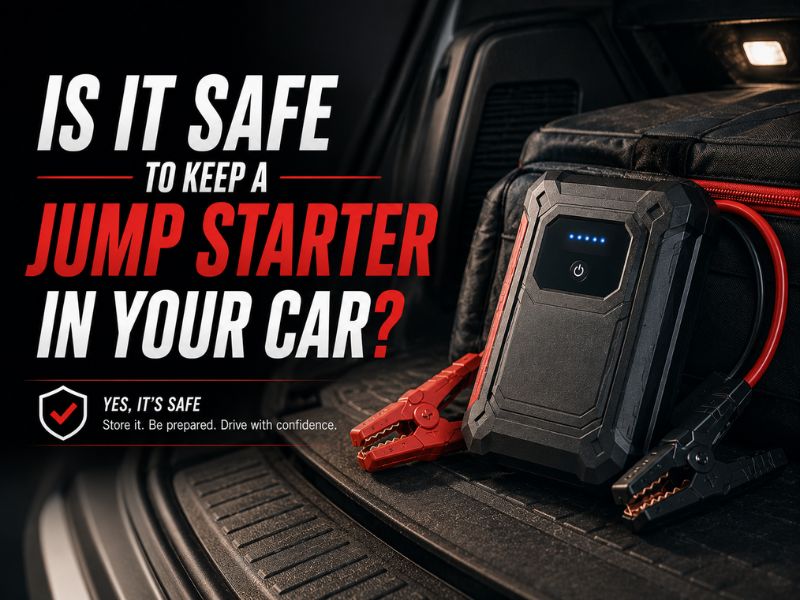
Jump starters are designed as portable emergency equipment, and several major manufacturers specifically discuss or advertise vehicle storage.
Clore Automotive says its sealed-AGM handheld jump starters are commonly stored in customers’ trunks and that trunk storage is acceptable when the unit is secured and its cables and clamps are properly stored.
Schumacher likewise sells lithium jump starters designed to fit in places such as a trunk, center console, glove compartment, or under a seat, depending on the model.
So there is nothing inherently unsafe about keeping a properly designed jump starter inside a vehicle.
The bigger issue is where inside the vehicle you keep it and what temperatures it experiences.
Summer Heat Is the Biggest Storage Concern
High temperatures are hard on rechargeable batteries.
Clore says the ideal storage temperature for jump starters is around 60–70°F, while extreme heat places additional stress on the internal battery and can shorten useful life.
Lithium jump starters deserve particular attention because manufacturers specify actual storage limits.
For example, the current NOCO GB40 manual lists a storage range of approximately -4°F to 122°F (-20°C to 50°C) under its stated conditions. NOCO also warns against allowing the unit to reach extremely high temperatures.
Schumacher’s RUGGED SL1652 lithium jump starter uses a narrower published storage range of 14°F to 113°F (-10°C to 45°C).
Those examples demonstrate an important rule:
Do not assume every lithium jump starter has the same heat tolerance.
Read the specifications for your exact model.
Is the Glove Box a Good Place for a Jump Starter?
Not necessarily.
Although some jump starter manufacturers advertise compact models as fitting in glove compartments, that does not make the glove box the best location during extreme summer weather.
Clore specifically advises against storing its lithium jump starters in a glove box during very hot conditions because the enclosed compartment can experience greater heat buildup than better-ventilated areas such as beneath a seat.
A shaded trunk location or secured area beneath a seat may be preferable when it provides better protection from direct heat.
However, you still need to consider the storage-temperature specification of your actual unit.
If the interior of your car regularly exceeds that permitted range, removing the jump starter during extreme heat is the safer approach.
Is the Trunk Safe?
For many jump starters, yes.
Clore explicitly says its sealed AGM jump starters can be and frequently are kept in vehicle trunks. It recommends securing the unit so it cannot move around and making sure the clamps and cables are stored correctly.
A trunk can be a practical location because the jump starter is:
Out of direct sunlight, protected from passengers and cargo movement, and easy to access during roadside emergencies.
But trunk storage does not make the jump starter immune to heat or cold.
If temperatures outside are severe enough to push the internal battery beyond its specified storage range, bring the unit indoors.
Can You Leave a Jump Starter in the Car All Summer?
Sometimes, but summer requires more caution than mild weather.
Clore recommends keeping a lithium jump starter in an area with reasonable air circulation during the hottest part of summer and avoiding areas where extreme heat builds up. It specifically advises avoiding the glove box in very hot weather.
The correct decision should come from the unit’s maximum storage-temperature rating.
Consider the difference between two products:
The NOCO GB40 lists storage capability up to approximately 122°F (50°C) under its specified conditions.
The Schumacher SL1652 lists a maximum storage temperature of 113°F (45°C).
If your car’s storage environment can exceed your unit’s stated limit, take the booster inside rather than repeatedly exposing it to excessive heat.
Long-term heat exposure may reduce battery longevity even before there is an obvious failure. Clore specifically notes that extreme heat stresses a jump starter battery.
What About Leaving a Jump Starter in the Car During Winter?
Winter storage is often acceptable, but the answer again depends on the product.
Schumacher says its jump starters can be stored in a vehicle during winter as long as the internal battery is kept fully charged and maintained. Schumacher recommends charging the unit once per month and after every use.
Clore also says winter vehicle storage generally should not be a problem as long as temperatures remain within the unit’s rated operating range. During unusually severe cold, Clore recommends bringing the jump starter indoors.
Cold affects performance even when it does not permanently damage the battery.
Clore notes that a jump starter has less available performance in extreme cold than at moderate temperature.
That matters because the same cold weather that weakens your vehicle battery can also reduce the jump starter’s available output.
Don’t Charge a Frozen-Cold Lithium Jump Starter Immediately
Storage temperature and charging temperature are not the same specification.
The NOCO GB40, for example, can be stored below freezing, but its listed charging temperature begins at 32°F (0°C).
Schumacher’s SL1652 also specifies a charging range beginning at 32°F (0°C) even though its operating and storage ranges extend below freezing.
Clore similarly warns that lithium jump starters should not be charged below 32°F and recommends allowing a very cold unit to warm before charging.
So if you bring a frozen jump starter in from the car, do not immediately connect it to a charger unless your specific manual says that is acceptable.
Allow it to reach an appropriate charging temperature first.
Lithium and Lead-Acid Jump Starters Need Slightly Different Treatment
Not every portable jump starter uses the same internal battery technology.
Older and larger professional jump starters often use sealed AGM lead-acid batteries, while many compact modern units use lithium-ion or lithium-polymer cells.
Clore says its sealed AGM jump starters can be stored in any physical orientation and are routinely kept in trunks.
Lithium jump starters are much more compact and energy dense, but manufacturers emphasize temperature monitoring and protection because that energy density makes damaged batteries a more serious concern. Clore recommends taking a lithium unit out of service if the case has been compromised, it has suffered a damaging impact, or its electronics behave abnormally.
For either type, temperature and state of charge matter.
For lithium units, physical damage deserves particularly close attention.
A Damaged Jump Starter Should Not Stay in Your Car
Inspect the device periodically instead of treating it like equipment that can live untouched in the trunk for years.
Clore recommends checking lithium jump starters for signs of impacts, case damage, failing buttons, abnormal electronics, damaged cables, or defective clamps. A compromised high-energy battery should be removed from service rather than kept in use.
Pay attention to warning signs such as:
- A swollen or distorted case
- Cracked housing
- Damaged or exposed cables
- Burned or badly corroded clamps
- Unusual heat
- Abnormal odor
- Erratic charging or warning indicators
If any of these appear, stop using the unit and follow the manufacturer’s service or disposal instructions.
Secure It So It Cannot Fly Around the Vehicle
Temperature is not the only concern.
A heavy jump starter sliding around in a trunk can damage its housing, cables, ports, or clamps.
Clore specifically recommends securing trunk-stored units so they cannot move around and returning the cables or clamps to their intended storage positions.
For lithium models with detachable cables, Clore recommends removing the cable assembly when storage is complete, covering ports when covers are provided, and putting the unit back into its case or storage pouch.
A dedicated protective case also keeps loose tools and metal objects away from the terminals and connectors.
That is better than throwing the jump starter into a toolbox where metal objects may contact exposed connections.
Don’t Forget to Recharge a Jump Starter Stored in the Car
A jump starter is not useful if you discover it is discharged during an emergency.
Recharge recommendations vary by manufacturer.
Clore recommends recharging after every use and about every 90 days during infrequent use for many of its jump starters.
Its lithium guidance likewise recommends charging periodically after months of inactivity and keeping the unit at a healthy state of charge.
Schumacher recommends a more frequent schedule for its jump starters stored through winter: fully charge once a month and after every use.
Neither schedule should be applied universally.
Your own manual should determine the correct recharge interval.
Extreme Temperatures May Mean Checking Charge More Often
If you leave the jump starter in a hot or cold vehicle, check it more frequently.
Clore normally recommends periodic maintenance charging but suggests shortening the interval to approximately 30–45 days during periods of extreme temperature, rather than relying on a longer 90-day schedule.
That advice makes practical sense because a booster needs to be ready during the same harsh conditions that often cause vehicle batteries to fail.
A jump starter sitting at 20% charge on a freezing morning may be considerably less useful than a fully charged unit.
Should You Leave the Jump Starter Plugged Into the Car?
Not unless the product is specifically designed and instructed to be stored that way.
Vehicle storage and continuous charging are separate issues.
Clore says whether its jump starters can remain connected to an AC charging source indefinitely depends on the specific model, because some have automatic charging circuitry while others do not.
Likewise, Schumacher notes that not all charging equipment is intended for indefinite connection.
Do not assume that leaving the unit connected continuously to your vehicle’s 12V socket is automatically the best storage method.
Charge it according to its manual, disconnect it when instructed, then store it safely.
Where Is the Best Place to Keep a Jump Starter in a Car?
For many drivers, a secured trunk location or protected area under a seat works well, assuming the temperature stays within the product’s specifications.
Avoid direct sunlight and locations that trap excessive heat.
Clore specifically discourages glove-box storage during extreme summer heat and recommends a location with more circulation.
Keep the jump starter in its supplied case or pouch whenever possible.
It should also remain accessible. Burying the booster beneath a fully loaded trunk may make it difficult to reach when the battery is dead and the trunk itself depends on electric release.
The ideal location balances temperature, protection, security, and accessibility.
Frequently Asked Questions
Is It Safe to Leave a Lithium Jump Starter in a Car?
Usually, when the manufacturer’s storage-temperature limits are observed. For example, the NOCO GB40 lists a storage range of approximately -4°F to 122°F, while Schumacher’s SL1652 lists 14°F to 113°F.
Can a Jump Starter Explode in a Hot Car?
A properly manufactured unit should be used and stored only within its specified limits. Excessive heat stresses rechargeable batteries, and a physically damaged lithium unit should be removed from service.
Is It Safe to Keep a Jump Starter in the Trunk?
Yes for many products. Clore explicitly says its sealed AGM jump starters are frequently stored in vehicle trunks and recommends securing them so they cannot move around.
Can I Keep a Jump Starter in the Glove Box?
Some products physically fit there, but it may not be the best location in extreme heat. Clore specifically recommends avoiding the glove box for lithium jump starters during hot weather because of heat buildup.
Can I Leave a Jump Starter in the Car During Winter?
Often, yes. Schumacher permits winter vehicle storage when the unit is fully charged and maintained, while Clore recommends bringing a unit indoors when temperatures are expected to fall below its rated limits.
How Often Should I Charge a Jump Starter Kept in My Car?
It depends on the model. Clore commonly recommends about every 90 days during infrequent use, while Schumacher recommends once a month for its winter-stored jump starters. Recharge after use as directed by the manufacturer.
Should I Bring My Jump Starter Inside During Extreme Heat?
Yes if vehicle temperatures may exceed the manufacturer’s storage limit. Clore also advises improving ventilation and avoiding heat-trapping compartments during extreme summer conditions.
Can I Charge a Cold Jump Starter Immediately?
Not necessarily. Many lithium models specify a minimum charging temperature of 32°F. Allow a cold unit to warm into its approved charging range first.
Does Keeping a Jump Starter in the Car Shorten Its Life?
Repeated exposure to extreme heat or cold can reduce performance and battery longevity. Clore says moderate temperatures are ideal and that extreme temperatures place additional stress on the internal battery.
Should Jump-Starter Cables Stay Connected During Storage?
If your model has detachable cables, Clore recommends disconnecting them after use before storage. Follow your exact manufacturer’s instructions.
Is It Safe to Keep a Jump Starter in Your Car Long Term?
Yes, it is generally safe to keep a jump starter in your car long term, provided the product is designed for vehicle storage, remains within its specified temperature range, stays physically undamaged, and is periodically recharged. Major manufacturers explicitly discuss trunk or vehicle storage, but they also stress that extreme temperature exposure can reduce performance and shorten battery life.
The biggest mistake is treating the jump starter as something you can throw into the glove box and forget for several years.
During hot summers, avoid direct sun and heat-trapping compartments, and remove the unit if temperatures may exceed its rated storage limit. During severe winter weather, bring it indoors if temperatures fall outside its operating range, and let a frozen-cold lithium pack warm to an approved temperature before charging.
Keep it secured in its case, inspect the housing and clamps occasionally, and recharge according to the manufacturer’s schedule.
That approach gives you the main benefit of storing a jump starter in the car—having emergency starting power available when you actually need it—without unnecessarily exposing the battery to conditions that can reduce its reliability.