An EV can have plenty of energy remaining in its traction battery and still appear completely dead when its low-voltage battery loses power. The best jump starter for EV use is therefore less about huge cranking amps and more about providing the correct external low-voltage supply safely.
That distinction matters because an automotive jump pack does not recharge an EV’s high-voltage propulsion battery. Tesla specifically describes portable jump starters as external low-voltage power sources, while Ford and Hyundai publish separate low-voltage jump procedures for their EVs.
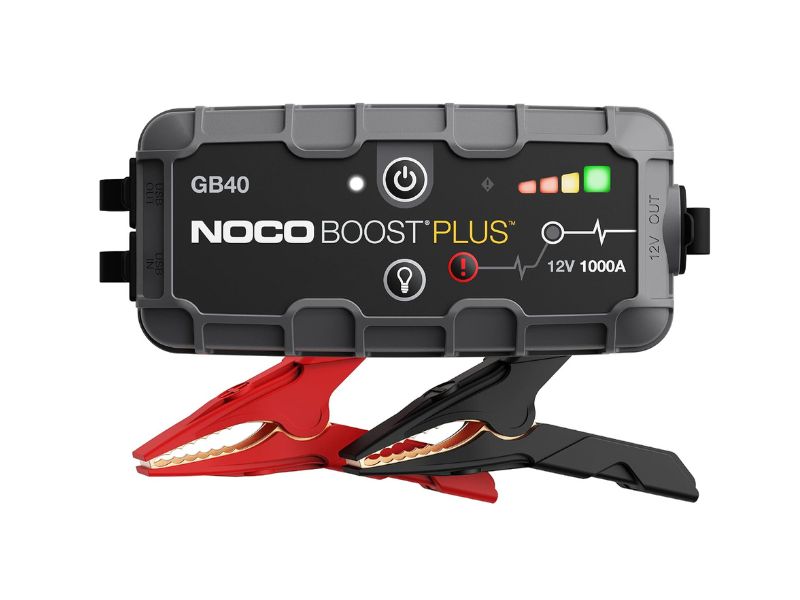
My primary recommendation is the NOCO Boost GB40 1000A UltraSafe Lithium Jump Starter. Its compact design, reverse-polarity protection, spark-resistant normal operation, and huge current Amazon rating history make it practical for an EV emergency kit when the vehicle manufacturer permits a 12V external power source. Amazon currently shows 128,561 ratings for this listing.
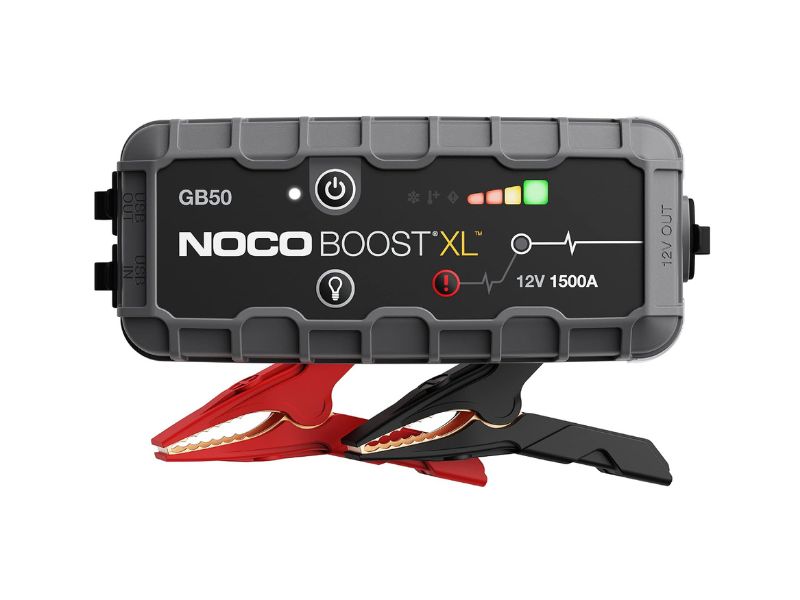
I would choose the NOCO Boost GB50 1500A UltraSafe Lithium Jump Starter when the jump starter also needs to serve conventional gasoline or diesel vehicles in the household. It provides more reserve than the GB40 while retaining a relatively portable design, and its current Amazon listing shows 16,795 ratings.
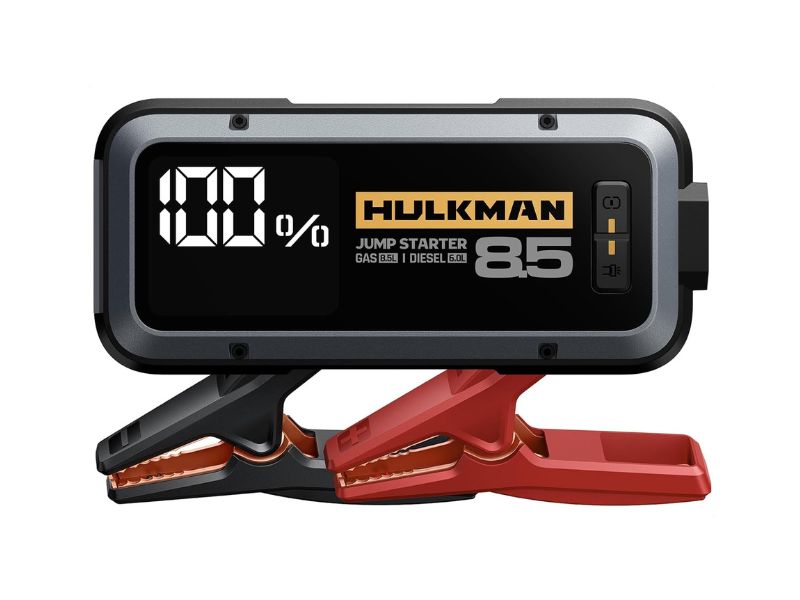
The HULKMAN Alpha85 2000A Smart Jump Starter is the better alternative when portable energy capacity and a clear display matter more than minimum size. Its established listing shows a 74Wh battery, a large status display, and 13,379 current ratings.
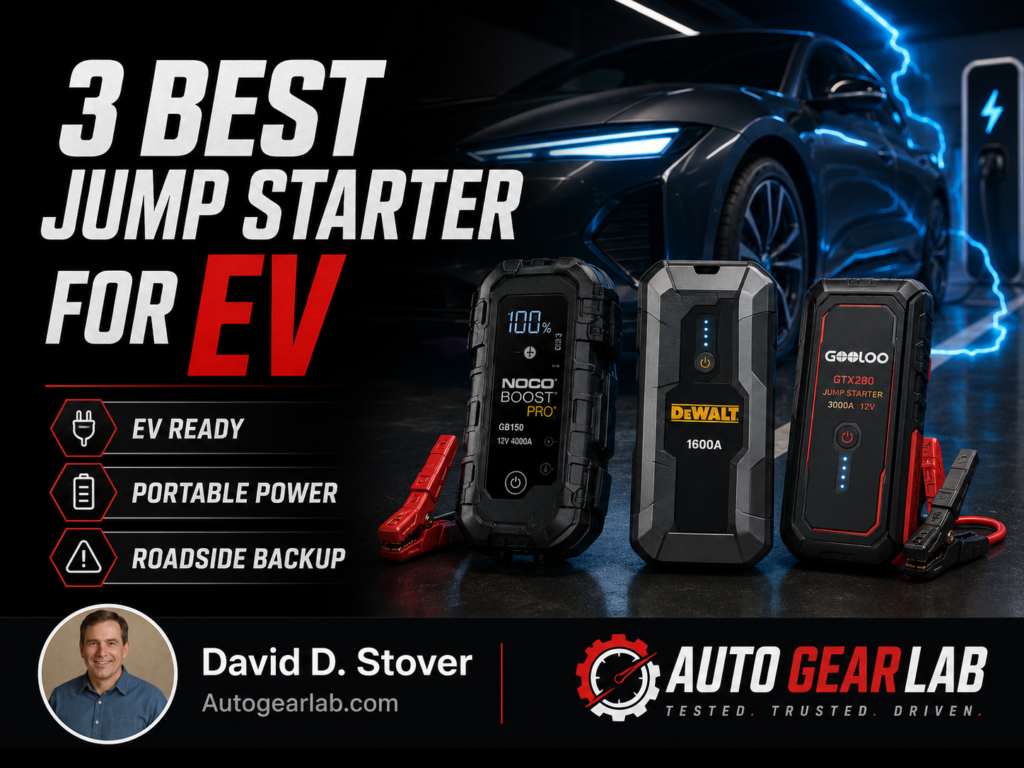
3 Jump Starters for EV Low-Voltage Emergencies Reviewed
| Image | Product Name | Check Price |
|---|---|---|
Best Choice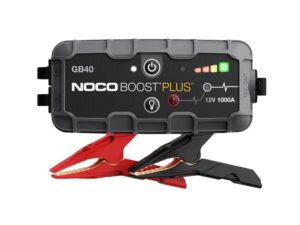 | NOCO Boost GB40 1000A UltraSafe Lithium Jump Starter | Check Price |
Second Best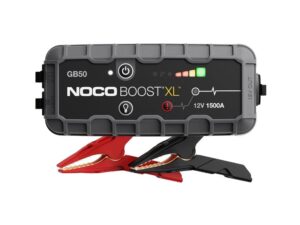 | NOCO Boost GB50 1500A UltraSafe Lithium Jump Starter | Check Price |
Third Choice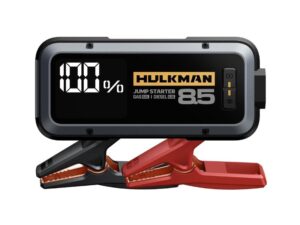 | HULKMAN Alpha85 2000A Smart Jump Starter | Check Price |
The products below are conventional 12V automotive jump starters. Whether any one of them is appropriate for your EV depends on the vehicle’s exact low-voltage architecture and manufacturer instructions.
Never connect one to orange cables, traction-battery terminals, inverter components, or any other high-voltage EV equipment.
1. NOCO Boost GB40 1000A UltraSafe Lithium Jump Starter
Key Features
- 1000A peak output
- 12V automotive design
- Reverse-polarity protection
- Spark-resistant normal connection
- Gasoline engines up to 6.0L
- Diesel engines up to 3.0L
- Portable power-bank capability
- Compact emergency-kit format
Amazon currently lists the GB40 with 128,561 customer ratings and 4K+ purchases in the past week, giving it by far the largest current Amazon ownership signal among these three products.
For EV use, however, its 1000A peak figure is not the main reason I recommend it.
A battery-electric vehicle does not need a portable booster to spin a gasoline or diesel starter motor. When an approved EV low-voltage system fails, the goal is generally to provide enough external low-voltage power for control modules, locks, displays, and high-voltage contactors to operate.
Tesla demonstrates this clearly. Its Model Y documentation specifically assumes that an owner may use an external low-voltage supply such as a portable jump starter and provides designated positive and negative jump points.
That makes the GB40’s compact size and connection protections more meaningful than its engine rating.
Reverse-polarity protection can warn when the clamps are connected incorrectly during normal operation. Spark-resistant circuitry provides another layer of protection when connecting the unit normally.
Those functions still cannot identify whether you have chosen the correct EV circuit. The vehicle manual determines where an external power source should be connected.
The GB40 is also easy to keep with the vehicle. That matters because an EV with a failed low-voltage system may lose powered door, trunk, or hood functions.
Ford notes that a Mustang Mach-E with a discharged 12V battery may first require an external 12V source just to release the front luggage compartment before accessing the vehicle’s low-voltage battery area.
A small unit that remains accessible can therefore be more useful than a much larger booster left at home.
The USB power-bank function is useful for maintaining phone power during a roadside problem. Still, I would avoid unnecessarily draining the jump pack if it is being carried primarily for emergency vehicle power.
What I Like
- Extremely large current Amazon rating history
- Compact enough for EV emergency storage
- Reverse-polarity protection
- Spark-resistant normal connection
- Useful backup phone power
- Enough capability to serve conventional cars too
What I Do Not Like
- 1000A engine-start rating is largely irrelevant to EV-only use
- Vehicle-specific EV compatibility must still be confirmed
- Does not charge the high-voltage traction battery
The GB40 is my primary choice because an EV emergency kit benefits more from compactness, availability, and safe low-voltage connection than from massive starting-current numbers.
2. NOCO Boost GB50 1500A UltraSafe Lithium Jump Starter
Key Features
- 1500A peak output
- 12V lithium jump starter
- Gasoline engines up to 7.0L
- Diesel engines up to 4.5L
- Reverse-polarity protection
- Spark-resistant normal operation
- Portable power-bank functionality
- Larger reserve than the GB40
Amazon currently shows 16,795 customer ratings for the GB50. Its listing specifies 1500A peak output and support for conventional gasoline engines up to 7.0L and diesel engines up to 4.5L.
For an EV, the larger engine rating provides almost no direct benefit.
The reason to buy the GB50 instead is additional reserve and broader household usefulness.
Suppose a household has an EV plus a gasoline SUV or pickup. A single GB50 can potentially serve as an approved low-voltage external source for the EV while also functioning as a conventional engine jump starter for the ICE vehicle.
That is a more compelling use case than buying it simply because 1500A sounds better than 1000A.
The normal UltraSafe connection approach includes reverse-polarity and spark protection. This can help reduce ordinary clamp-connection mistakes.
Again, EV owners must distinguish between correct polarity and correct connection location.
A booster could be connected red-to-positive and black-to-negative yet still be attached to a circuit the EV manufacturer did not intend for external power.
Ford’s Mustang Mach-E instructions, for example, specify both an initial external-power procedure for gaining frunk access and a separate low-voltage battery connection process.
Hyundai similarly instructs EV owners to use designated 12V jump terminals and a chassis-ground connection rather than simply choosing arbitrary points.
The GB50 therefore makes sense when you want one jump pack for EV and non-EV vehicles, rather than as a pure EV upgrade over the GB40.
What I Like
- More reserve than the GB40
- Useful for mixed EV and ICE households
- Strong normal-mode connection protections
- Still reasonably portable
- Established Amazon rating history
What I Do Not Like
- Extra engine-start power adds little to EV-only use
- Larger than necessary for many EV owners
- Still requires the exact vehicle-specific low-voltage procedure
I would choose the GB50 when the same emergency pack needs to support an EV plus conventional cars, SUVs, or light trucks. For a dedicated EV-only kit, I still prefer the smaller GB40.
3. HULKMAN Alpha85 2000A Smart Jump Starter
Key Features
- 2000A peak output
- 74Wh internal battery
- Gasoline engines up to 8.5L
- Diesel engines up to 6.0L
- Large status display
- Portable power-bank functionality
- Smart jumper-cable system
- 13,379 current Amazon ratings
The established Alpha85 listing currently carries 13,379 ratings and specifies a 74Wh battery along with a 2000A peak rating.
For EV ownership, its 74Wh capacity is substantially more interesting than its 2000A headline figure.
Stored energy gives the Alpha85 more utility as a general emergency power source. It can provide reserve for phones, lighting, and other compatible low-power electronics while still leaving capacity available for low-voltage vehicle assistance.
The large status display is another advantage.
EV owners may use their emergency jump pack very rarely. A screen that provides clear battery and connection information can therefore be easier to understand during an unexpected failure than a simple row of LEDs.
HULKMAN also rates the Alpha85 for conventional gasoline engines up to 8.5L and diesel engines up to 6.0L.
Again, that matters primarily when the unit is shared with combustion-engine vehicles.
For an EV-only buyer, the extra peak output simply adds capability that the low-voltage system usually does not need.
One important consideration is manual or force-start operation. A feature designed to energize clamps on an extremely discharged combustion-vehicle battery should not automatically be used on an EV merely because the EV does not respond.
The vehicle manufacturer’s instructions should decide whether and how an external source is applied.
Tesla, for example, specifies precise connection locations and timing depending on the low-voltage battery architecture.
What I Like
- Large 74Wh battery
- Clear status display
- Good general emergency-power capability
- Useful for EV plus conventional-vehicle households
- Strong current Amazon rating history
What I Do Not Like
- 2000A is unnecessary for most EV-only applications
- Larger than the GB40
- Force-start modes should not be improvised on an EV
The Alpha85 is the best choice among these three when portable energy reserve and a clear display matter as much as vehicle backup power.
EV Jump Starter Comparison
| Product | Voltage | Peak Output | Main EV Advantage | Conventional Vehicle Coverage | Rating Count | Best Use |
| NOCO Boost GB40 | 12V | 1000A | Compact, simple protected connection | 6.0L gas / 3.0L diesel | 128,561 | Dedicated EV emergency kit |
| NOCO Boost GB50 | 12V | 1500A | Extra reserve | 7.0L gas / 4.5L diesel | 16,795 | EV + gasoline vehicle |
| HULKMAN Alpha85 | 12V | 2000A | 74Wh capacity and large display | 8.5L gas / 6.0L diesel | 13,379 | EV + portable emergency power |
The GB40 offers the most sensible balance for EV-only emergency use because it is small enough to keep accessible while still providing conventional 12V automotive backup capability.
The GB50 makes more sense for mixed-vehicle households. The Alpha85 offers the most attractive portable-energy package because of its larger published battery capacity and status display.
What Does a Jump Starter Do on an EV?
A conventional gasoline vehicle needs a low-voltage battery to operate a starter motor.
A battery-electric vehicle works differently.
Its low-voltage electrical system powers equipment such as:
- Control modules
- Door and hood mechanisms
- Displays
- Relays
- Communications systems
- High-voltage contactors
If low-voltage power disappears, the EV may appear completely dead even though the traction battery still contains energy.
An approved external low-voltage source may allow those systems to wake.
Tesla’s Model Y instructions explicitly describe using an external low-voltage power source such as a portable jump starter.
Ford likewise states that a 12V jump box can be used as an external source when a Mustang Mach-E becomes unresponsive because of a discharged 12V battery.
A Jump Starter Does Not Charge the EV Traction Battery
A portable jump starter cannot recharge an EV’s high-voltage traction battery.
The traction battery is the large propulsion battery that powers the electric motors.
A portable automotive booster is a small low-voltage device.
If the EV has exhausted its traction battery, it requires EV charging equipment or appropriate roadside recovery—not a jump box.
A jump starter is useful only when the manufacturer permits external assistance to the low-voltage electrical system.
Why Peak Amps Matter Less for an EV
Peak amperage is important when a combustion engine needs hundreds of amps to operate its starter motor.
An EV does not need the booster to crank an engine.
This means I would prioritize:
- Correct low-voltage compatibility
- Reverse-polarity protection
- Clamp design
- Clear status information
- Stored battery capacity
- Compact storage
- State-of-charge retention
A 2000A or 4000A jump starter is not inherently twice or four times as useful for an EV as a 1000A unit.
Check the EV’s Low-Voltage Battery Type
Do not assume every EV has the same 12V lead-acid battery.
Different manufacturers—and even different production years of the same model—can use different low-voltage architectures.
Tesla’s own documentation distinguishes jump-start procedures based on the type of low-voltage battery installed.
Check the manual for the exact model and production year before purchasing or connecting an external power source.
Tesla EVs and Portable Jump Starters
Tesla explicitly refers to an external low-voltage power supply such as a portable jump starter in its Model Y instructions.
For certain low-voltage lithium configurations, Tesla directs owners to expose designated jump points, attach positive and negative leads, and apply external power according to a specified procedure.
Tesla also warns against using the Model Y itself to jump-start another vehicle.
The procedure can vary by vehicle configuration, so owners should consult the manual for their exact Tesla.
Ford Mustang Mach-E and 12V Jump Boxes
Ford specifically lists a 12V jump box as one possible external power source for an unresponsive Mustang Mach-E.
The procedure may first involve using external power to release the frunk, followed by access to the low-voltage battery and designated ground point.
This is a useful example of why storage location matters.
A jump starter hidden somewhere that cannot be accessed when the 12V system fails may not solve the problem.
Hyundai EV Jump Starting
Hyundai provides a dedicated 12V battery jump-start procedure for its EVs.
Its instructions specify identifying the positive and negative points correctly, using a 12V source, and making the final negative connection to an approved chassis ground. Hyundai also warns not to attempt a jump start on a frozen battery.
This reinforces the most important EV rule: use the vehicle-specific procedure rather than a generic automotive connection routine.
How to Choose the Best Jump Starter for EV Use
Confirm the Manufacturer Permits External Low-Voltage Power
This should be the first step.
Search the vehicle owner’s manual for terms such as:
12V battery, low-voltage battery, jump starting, external power supply, or vehicle unresponsive.
If the manufacturer does not approve the procedure, do not improvise.
Prioritize Correct Voltage
Most conventional jump packs are designed for 12V systems.
Your EV’s low-voltage architecture must be compatible with the external source.
Do not assume compatibility because the vehicle is marketed as an EV.
Choose Compact Storage
For EV-only use, a small booster often makes more sense than a large truck jump starter.
The GB40 is attractive here because its 1000A starting capacity already exceeds what an EV low-voltage wake-up task generally needs while remaining relatively compact.
Consider Battery Capacity
Stored energy matters when the device is also expected to charge a phone or function as emergency backup power.
The Alpha85’s published 74Wh capacity is therefore especially useful for buyers who want broader emergency-power capability.
Look for Polarity Protection
Reverse-polarity detection can reduce common connection errors.
It cannot protect against attaching the booster to an unapproved electrical circuit.
Correct jump points still matter.
Avoid Unnecessary Manual Override
Many jump starters include force-start modes for deeply discharged lead-acid batteries.
Do not automatically activate those modes on an EV.
The EV manufacturer’s procedure takes priority over generic jump-starter instructions.
Think About Access With No Power
Ask yourself:
Can I reach the jump starter if the EV loses all low-voltage power?
Powered trunks, frunks, and doors may not operate normally.
Ford’s Mach-E procedure demonstrates how external power may be needed before normal frunk access is restored.
Keep the emergency pack somewhere realistically accessible.
How to Use a Jump Starter on an EV Safely
1. Read the Exact Vehicle Manual
Do not use a Tesla procedure on a Ford, Hyundai, Rivian, Kia, BMW, or another EV.
Procedures vary.
2. Confirm the Low-Voltage Architecture
Identify the approved external-power voltage and battery type.
3. Locate the Designated Connection Points
Use only the positive and negative or chassis-ground points specified by the manufacturer.
4. Never Touch High-Voltage Components
Do not connect to traction-battery terminals, orange wiring, inverter connections, charging hardware, or drive-unit components.
5. Inspect the Low-Voltage Battery When Accessible
Do not apply external power to a battery that is frozen, cracked, swollen, leaking, smoking, or unusually hot.
Hyundai specifically warns against attempting to jump-start a frozen battery.
6. Connect Positive Correctly
Attach the red positive clamp to the designated positive jump point.
7. Connect the Negative Lead as Directed
Use the manufacturer-approved negative terminal or chassis ground.
8. Activate the External Source
Follow both the EV manufacturer’s procedure and the jump-starter instructions.
9. Allow the Vehicle to Wake
An EV may need time before displays or controls respond.
Tesla notes that recovery timing can depend on the vehicle’s low-voltage battery configuration.
10. Disconnect in the Specified Sequence
Use the order given by the vehicle manufacturer.
Do not assume every EV uses the same disconnection sequence.
Common EV Jump Starter Mistakes
Trying to Charge the Traction Battery
A jump starter supplies low-voltage power; it cannot restore driving range to an empty propulsion battery.
Buying Only by Peak Amps
Huge cranking-current ratings are less useful for an EV than correct voltage, reliable clamps, stored energy, and manufacturer compatibility.
Connecting to High-Voltage Equipment
A portable automotive booster belongs only on approved low-voltage jump points.
Assuming Every EV Uses 12V Lead-Acid
Low-voltage architecture varies between vehicles and production years.
Using Manual BOOST Without Instructions
Force-start modes may bypass normal detection or safety systems.
Storing the Pack Somewhere Inaccessible
A powerless EV can have electrically operated access points that no longer function normally.
Letting the Booster Discharge in Storage
Check its battery periodically and recharge it after use.
Frequently Asked Questions
What is the best jump starter for EV use?
The NOCO GB40 is my primary choice for compatible EV low-voltage emergencies.
Its compact design, reverse-polarity protection, and extremely large current Amazon rating history make it practical for emergency storage. The EV manufacturer must still confirm that an external 12V source is appropriate.
Can you jump-start an electric vehicle?
You can sometimes restore its low-voltage system, but you are not jump-starting the traction battery.
Tesla, Ford, and Hyundai all publish low-voltage external-power or jump procedures for specific EVs. The correct method varies by model.
Can a jump starter charge an EV traction battery?
No. A portable automotive booster cannot recharge the high-voltage propulsion battery.
An exhausted traction battery requires appropriate EV charging equipment or roadside recovery.
Why does an EV need a 12V or low-voltage battery?
The low-voltage system powers electronics needed to wake and control the vehicle.
Doors, computers, displays, contactors, and other control systems can stop functioning when low-voltage power is lost.
Is 1000A enough for an EV?
For approved low-voltage assistance, peak cranking amps usually are not the limiting specification.
The GB40’s 1000A rating is designed for combustion-engine starting, which is a much different task. Correct low-voltage compatibility matters more for an EV.
Is a 2000A jump starter better for an EV?
Not necessarily; the higher current rating provides little EV-specific advantage by itself.
A larger model can still be useful because it may offer more stored energy or serve conventional vehicles in the same household.
Can I use a NOCO GB40 on a Tesla?
Tesla permits portable external low-voltage sources on certain models using its designated procedure.
For example, Model Y documentation explicitly refers to an external low-voltage source such as a portable jump starter. Confirm the procedure for the exact vehicle and production year.
Can I use a jump box on a Mustang Mach-E?
Ford specifically identifies a 12V jump box as an external power source for certain Mach-E recovery procedures.
Ford provides detailed steps for gaining frunk access and restoring the low-voltage system.
Can I jump-start a Hyundai EV?
Hyundai provides a specific 12V jump-start procedure for compatible EV models.
Its instructions specify correct positive and chassis-ground connections and warn against using the procedure on a frozen battery.
Can I connect the jump starter directly to the EV battery?
Only connect where the vehicle manufacturer specifically tells you to connect.
Some EVs provide designated jump posts rather than requiring direct battery-terminal access.
Can a 12V jump starter be connected to the high-voltage battery?
No. Never connect a conventional jump starter to the traction battery or high-voltage system.
Those components require specialized equipment and procedures.
What happens when the EV low-voltage battery dies?
The vehicle may lose access, displays, control functions, or the ability to activate its high-voltage system.
An approved external low-voltage supply may restore enough power for the vehicle to wake, depending on the underlying fault.
Will a jump starter make an EV drive again?
Only if low-voltage power is the problem and the traction system is otherwise functional.
It cannot overcome an empty traction battery, damaged battery system, or unrelated vehicle fault.
Should I use manual BOOST mode on an EV?
Only when the vehicle and jump-starter instructions specifically support doing so.
Do not assume a force-start feature intended for dead combustion-vehicle batteries is appropriate for every EV low-voltage system.
Can an EV be used to jump another car?
Do not assume so; some manufacturers explicitly prohibit it.
Tesla warns that Model Y should not be used to jump-start another vehicle because damage can result.
How often should I recharge an EV jump starter?
Recharge it after use and check its state of charge every few months.
Also check it before winter, long trips, extended airport parking, and periods when the EV will remain unused.
Where should I store a jump starter in an EV?
Keep it somewhere you can still access if the vehicle’s low-voltage system completely fails.
Powered doors, trunks, or frunks may not operate normally when the low-voltage battery is discharged.
Why does my EV low-voltage battery keep dying?
Repeated failures may indicate battery aging, an electrical fault, storage issues, or a charging-system problem.
External power can solve the immediate symptom, but recurring low-voltage failure requires diagnosis.
Conclusion
The best jump starter for EV ownership is not the model with the largest amp rating. An EV does not require the booster to crank a combustion engine; the important job is providing an approved external source to the vehicle’s low-voltage system when the manufacturer permits it.
The NOCO Boost GB40 remains my primary recommendation because it is compact, easy to store, and includes useful normal-mode connection safeguards. Its current Amazon listing also has by far the largest rating history of the three products compared here.
The NOCO GB50 is the better choice when one jump starter must cover both an EV and conventional vehicles. The HULKMAN Alpha85 provides the most attractive option when larger portable-energy capacity and a clear status display matter.
Most importantly, verify the exact EV procedure before connecting anything. Tesla, Ford, and Hyundai all demonstrate that low-voltage jump procedures differ by vehicle, and none of these products should ever be connected to the high-voltage traction system.
For a dedicated EV emergency kit, I would choose the NOCO GB40, store it somewhere accessible even during total low-voltage failure, and check its charge periodically.