A dead car battery is inconvenient enough without discovering that your phone is also nearly empty. The best USB car jump starter solves both problems by combining emergency starting power with a portable USB power bank in one compact roadside device.
The important difference is how useful the USB system actually is. Some jump starters provide only basic 5V charging, while others add USB-C Power Delivery, Quick Charge, faster self-recharging, and larger stored-energy capacity. Those differences matter if you expect the same device to support phones, tablets, or other electronics as well as start the car.
My primary recommendation is the NOCO Boost GB40 1000A UltraSafe Lithium Jump Starter. I would choose it for most passenger-car owners because it combines a compact design, 6.0L gasoline-engine coverage, reverse-polarity protection, USB device charging, and straightforward operation. NOCO specifies a 5V/2.1A USB output, while the current Amazon listing shows 128,561 customer ratings.
I would choose the NOCO Boost GB50 1500A UltraSafe Lithium Jump Starter when the same USB jump starter needs to cover larger gasoline engines, SUVs, or light trucks. Its 35Wh battery, 7.0L gasoline and 4.5L diesel ratings, 5V/2.1A USB output, and larger reserve make it more versatile than the GB40 without moving into a very large jump box.
The HULKMAN Alpha85 2000A Smart Jump Starter is the model I would choose when USB charging matters almost as much as jump-starting. Its 74Wh battery, 18W USB-C PD output, 18W USB-A Quick Charge output, 65W-supported input architecture, and 150W DC output make it substantially more capable as a portable power source.
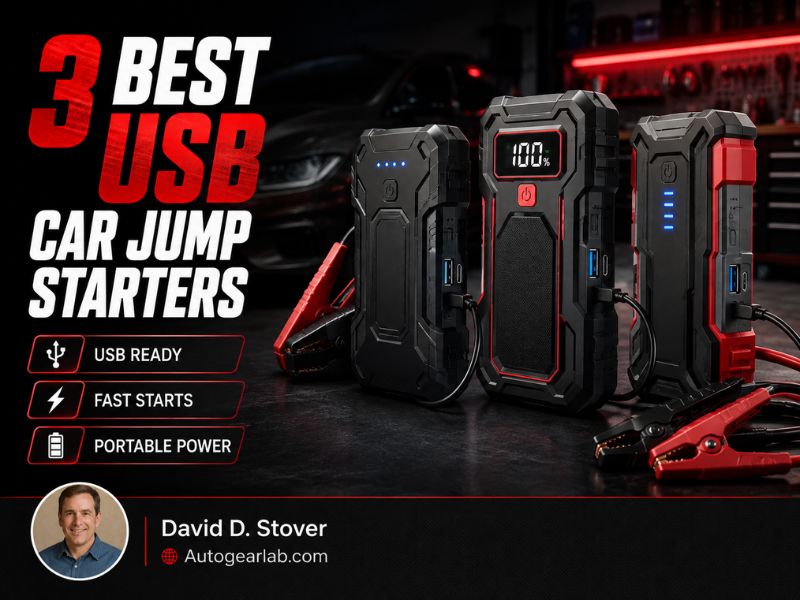
3 USB Car Jump Starters Reviewed
| Image | Product Name | Check Price |
|---|---|---|
Best Choice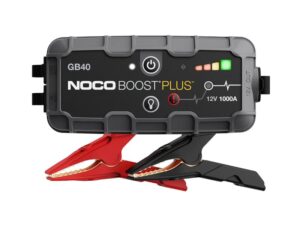 | NOCO Boost GB40 1000A UltraSafe Lithium Jump Starter | Check Price |
Second Best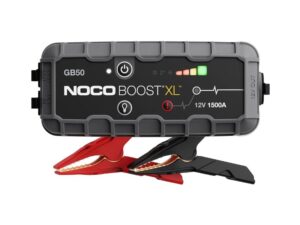 | NOCO Boost GB50 1500A UltraSafe Lithium Jump Starter | Check Price |
Third Choice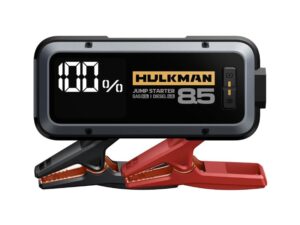 | HULKMAN Alpha85 2000A Smart Jump Starter | Check Price |
All three products are intended for 12V vehicle systems. Their USB capabilities differ considerably, so the right choice depends on whether you mainly need emergency phone charging or want a more capable portable power bank.
1. NOCO Boost GB40 1000A UltraSafe Lithium Jump Starter
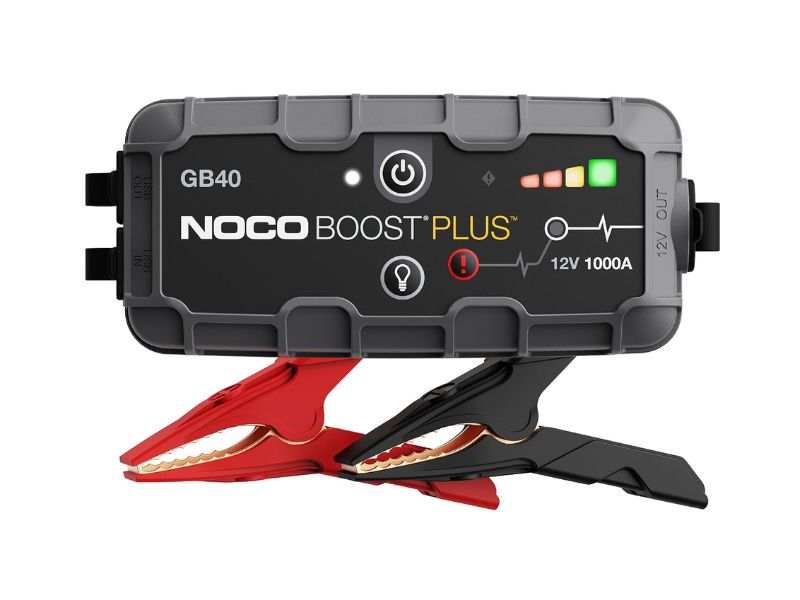
Key Features
- 1000A peak starting output
- Gasoline engines up to 6.0L
- Diesel engines up to 3.0L
- 24Wh lithium-ion battery
- 5V/2.1A USB input and output
- Reverse-polarity protection
- Spark-resistant normal connection
- IP65 housing with ports closed
- 100-lumen flashlight
The GB40 is the easiest recommendation for an ordinary car because it prioritizes the functions most drivers actually need without becoming unnecessarily large.
NOCO rates it at 1000A for gasoline engines up to 6.0 liters and diesel engines up to 3.0 liters. That covers most four-cylinder and six-cylinder passenger cars, crossovers, motorcycles, many SUVs, and numerous gasoline-powered light vehicles.
Its 24Wh lithium-ion battery is modest compared with larger jump starters, but that helps keep the complete unit around 2.4 pounds. For emergency equipment that needs to remain in a trunk or cargo organizer, portability can be more valuable than carrying maximum capacity.
The USB system is straightforward rather than cutting-edge.
NOCO specifies 5V at up to 2.1A for both USB input and output. That is enough to charge common phones, watches, cameras, and many tablets, but it does not offer modern high-wattage USB-C Power Delivery for laptops or especially fast smartphone charging.
NOCO says the GB40 can provide multiple smartphone recharges under favorable conditions. Actual phone recharge count will vary with device battery size, conversion losses, cable quality, and how much energy you reserve for starting the vehicle.
That last point matters: the USB power bank and jump starter share the same internal battery.
If you spend several hours charging electronics from the GB40, you reduce the starting reserve available for the car. I would recharge the jump starter after substantial device use rather than putting it back into the trunk partially depleted.
The GB40 also uses its USB connection for self-recharging. NOCO lists approximately three hours with a suitable 2.1A USB source. This is acceptable for overnight or at-home charging but significantly slower than the high-powered charging available on the HULKMAN Alpha85.
Connection safety is one of the strongest reasons to choose the GB40.
During normal operation, reverse-polarity detection alerts the user when the clamps are connected incorrectly, while spark-resistant technology reduces the likelihood of connection sparks.
A manual override function is available when the vehicle battery is below the normal detection threshold. NOCO warns that override disables safety protection and manually forces the output on, so polarity must be confirmed before using it.
The housing carries an IP65 rating with the ports closed, providing useful resistance to dust and water jets. It should still not be submerged or treated as waterproof.
A 100-lumen flashlight provides seven operating modes, including emergency signaling. That is enough for checking battery terminals after dark without substantially increasing the unit’s size.
What I Like
- Excellent balance of size and starting capability
- USB charging for common portable electronics
- Very large current Amazon rating history
- Reverse-polarity protection
- Spark-resistant normal connection
- Compact enough for regular trunk storage
What I Do Not Like
- USB output is limited to 5V/2.1A
- No high-wattage USB-C PD output
- 24Wh capacity is relatively small
- 3.0L diesel limit excludes larger diesel trucks
The GB40 is my primary recommendation for drivers who mainly want a dependable car jump starter with basic USB power-bank functionality. It is less impressive as a high-speed USB charger, but its compact size and balanced automotive capability make it the most practical everyday option.
2. NOCO Boost GB50 1500A UltraSafe Lithium Jump Starter
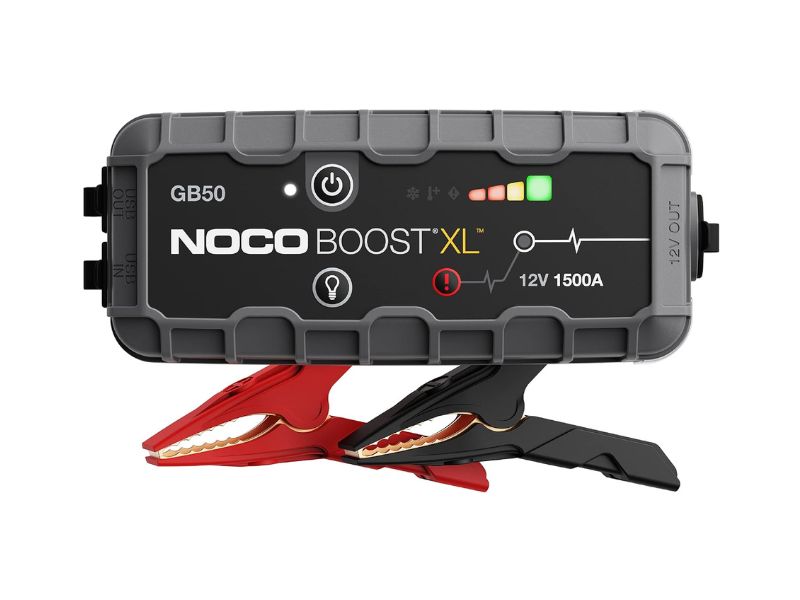
Key Features
- 1500A peak starting output
- Gasoline engines up to 7.0L
- Diesel engines up to 4.5L
- 35Wh lithium-ion battery
- 5V/2.1A USB input and output
- Reverse-polarity protection
- Spark-resistant normal operation
- IP65 housing with ports closed
- 200-lumen flashlight
The GB50 takes the basic formula of the GB40 and adds more engine capability and stored energy.
NOCO rates it for gasoline engines up to 7.0L and diesel engines up to 4.5L. That gives it more useful margin for V8-powered cars, larger SUVs, gasoline pickups, boats, and moderate diesel applications.
Its 35Wh lithium-ion battery stores about 46% more energy than the GB40’s 24Wh battery.
That does not mean it provides exactly 46% more usable starting performance, but the additional stored energy can support larger engines, repeated starting attempts, longer flashlight operation, and more USB device charging.
NOCO says the GB50 can provide multiple smartphone recharges from its internal battery. Its USB output remains 5V/2.1A, however, so the increase is mainly in available capacity rather than charging speed.
This distinction is important.
A higher-capacity power bank can run longer while still charging a phone at a relatively modest rate. If you want significantly faster USB-C charging, the Alpha85 is the more appropriate product.
The GB50 also recharges through USB. NOCO’s technical sheet lists approximately 4.5 hours from an appropriate 2A source, reflecting the larger internal battery.
For someone who charges the unit at home overnight, that may not matter. For frequent travel or repeated roadside use, a multi-hour recharge time is less convenient than a modern high-wattage input.
The 1500A engine-start capability gives the GB50 an important advantage for multi-vehicle households.
A family might own a four-cylinder commuter car, a V6 SUV, and a V8 pickup. The GB40 already handles many of those vehicles, but the GB50 adds useful displacement margin without requiring a much larger truck-focused jump pack.
The normal protection system includes reverse-polarity detection and spark-resistant connection. Like the GB40, it also offers manual override for batteries below the automatic detection threshold.
NOCO explicitly warns that manual override disables the normal protection system. It should therefore be reserved for a genuinely low-voltage battery after the user has verified the connection.
The 200-lumen flashlight doubles the stated output of the GB40’s light and can provide better engine-bay illumination.
Its closed-port IP65 rating adds useful protection for roadside storage and occasional exposure to bad weather.
What I Like
- More engine margin than the GB40
- Larger 35Wh internal battery
- Useful USB power-bank function
- Strong option for mixed vehicle sizes
- 200-lumen emergency light
- Normal-mode polarity and spark protection
What I Do Not Like
- USB charging remains limited to 5V/2.1A
- No high-wattage USB-C PD device output
- Larger battery takes longer to recharge
- More capability than many compact-car owners need
The GB50 is the better option when you want more automotive starting capability and more USB reserve, but do not specifically need fast USB-C charging. I would choose it for larger passenger vehicles and multi-car households.
3. HULKMAN Alpha85 2000A Smart Jump Starter
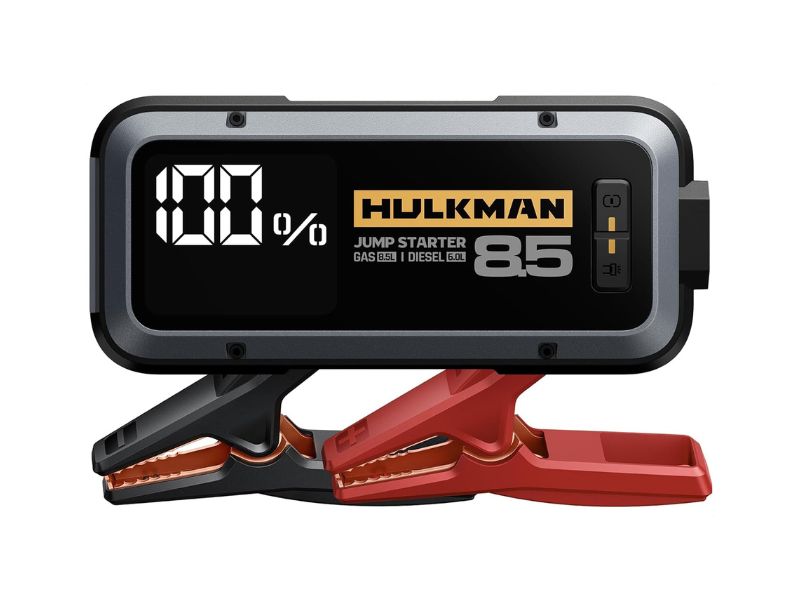
Key Features
- 2000A peak starting output
- Gasoline engines up to 8.5L
- Diesel engines up to 6.0L
- 74Wh / 20,000mAh battery
- 18W USB-C Power Delivery output
- 18W USB-A Quick Charge 3.0 output
- Up to 65W input charging
- Up to 150W DC output
- 3.3-inch status display
The Alpha85 is the most interesting option if the word USB in this search is a major part of your buying decision.
HULKMAN specifies a 74Wh lithium-polymer battery, more than twice the published capacity of the GB50 and more than three times the GB40’s 24Wh capacity.
That makes the Alpha85 a substantially more useful portable power bank.
Its USB-C output supports up to 18W Power Delivery, while its USB-A port supports Quick Charge 3.0 up to 18W. Those ports provide faster charging for compatible phones and other electronics than the basic 5V/2.1A connections on the two NOCO models.
The USB-C specification needs to be understood correctly.
HULKMAN lists up to 65W on the Alpha85’s charging input architecture, but its USB-C device output is limited to 18W. The unit therefore can recharge itself more rapidly with the appropriate supported equipment than it can charge a laptop or other high-power USB-C device.
That is still a meaningful advantage.
Fast self-recharging reduces the chance that a used jump starter remains partially empty for days because restoring its battery takes too long.
The Alpha85 also provides a 15V/10A DC output rated up to 150W for compatible accessories. That extends its usefulness to certain portable inflators and other supported DC equipment.
Again, accessory use reduces the remaining energy available for starting.
Its vehicle specifications are substantial: 2000A peak output, gasoline engines up to 8.5L, and diesel engines up to 6.0L. That puts it into full-size SUV, gasoline pickup, RV, boat, and moderate diesel territory.
The 3.3-inch display is one of its strongest usability features.
Instead of depending mainly on several status LEDs, the Alpha85 provides a larger visual interface for battery condition and operating information. That is useful for drivers who may only use a jump starter once every few years.
The main compromise is size.
At approximately 2.57 pounds for the main unit, it remains portable, but its 74Wh battery and extra power connections make it larger than a compact entry-level booster.
For someone who simply wants to jump a small sedan and occasionally charge a phone, the additional functionality may be unnecessary.
For road trips, camping, multi-vehicle households, or anyone who wants the jump starter to double as a serious portable USB power source, the Alpha85 is considerably more compelling.
What I Like
- Large 74Wh battery capacity
- 18W USB-C Power Delivery
- 18W USB-A Quick Charge
- Fast self-recharging capability
- Large 3.3-inch display
- Strong 8.5L gas / 6.0L diesel coverage
- 150W DC accessory output
What I Do Not Like
- Larger than basic emergency jump packs
- USB-C output is 18W, not the 65W input figure
- More capacity than an occasional small-car user may need
The Alpha85 is the best choice of these three when USB charging is a major priority. It combines considerably more stored energy with faster USB outputs and a more informative display while still providing strong vehicle-starting capability.
USB Car Jump Starter Comparison
| Product | Peak Output | Gas Engine Limit | Diesel Limit | Battery Capacity | USB Output | Self-Charging | Main Advantage |
| NOCO Boost GB40 | 1000A | 6.0L | 3.0L | 24Wh | 5V/2.1A | USB, about 3 hr with suitable 2.1A source | Compact everyday choice |
| NOCO Boost GB50 | 1500A | 7.0L | 4.5L | 35Wh | 5V/2.1A | USB, about 4.5 hr with suitable 2A source | More engine and power-bank reserve |
| HULKMAN Alpha85 | 2000A | 8.5L | 6.0L | 74Wh | USB-C PD 18W + USB-A QC 18W | Up to 65W supported input architecture | Best USB and portable-power capability |
The GB40 is the most practical choice for ordinary cars because its USB system is adequate for emergency phone charging without making the jump starter large.
The GB50 adds battery and engine reserve but does not materially increase USB charging speed.
The Alpha85 clearly offers the strongest USB hardware with 18W USB-C PD, 18W USB-A Quick Charge, and a much larger 74Wh battery.
How to Choose the Best USB Car Jump Starter
Start With Engine Compatibility
USB charging is useful, but the product’s primary job is still starting the vehicle.
Check the vehicle’s:
- System voltage
- Gasoline or diesel engine
- Engine displacement
- Battery-terminal location
- Expected winter conditions
A 1000A-class quality jump starter is adequate for many passenger cars.
Larger gasoline engines and moderate diesel vehicles benefit from 1500A–2000A-class products with appropriate manufacturer engine ratings.
Compare USB Output, Not Just the Connector Shape
A USB-C connector does not automatically mean fast USB-C charging.
The electrical power available from the port matters more.
The GB40 and GB50 provide approximately 10.5W at 5V/2.1A.
The Alpha85 provides up to 18W through its USB-C PD output and 18W through its QC3.0 USB-A output.
That can make a noticeable difference when charging a compatible smartphone.
Understand USB-C Input vs USB-C Output
This is one of the easiest specifications to misunderstand.
USB input describes how quickly the jump starter itself can recharge.
USB output describes how much power the jump starter can deliver to your phone or another device.
The Alpha85 can accept considerably more charging power through its supported input arrangement than it can supply from its USB-C output. HULKMAN specifies up to 65W input and 18W PD output.
Always check both numbers.
Compare Battery Capacity in Watt-Hours
Watt-hours, or Wh, provide a useful comparison of stored energy.
The three products demonstrate the difference clearly:
- GB40: 24Wh
- GB50: 35Wh
- Alpha85: 74Wh
A larger Wh rating can provide more phone charging, lighting, accessory runtime, and repeated starting attempts.
It does not automatically mean a higher-quality jump start because high-current circuitry and cable design also matter.
Be Careful Comparing Milliamp-Hours
Manufacturers sometimes emphasize numbers such as 10,000mAh or 20,000mAh.
Milliamp-hours alone do not describe total energy unless you also know the voltage at which the capacity is measured.
That is why Wh is generally easier for cross-product comparison.
HULKMAN, for example, lists the Alpha85 at 20,000mAh measured at 3.7V, corresponding to 74Wh.
Decide What You Actually Want to Charge
For emergency phone charging, 5V USB can be sufficient.
For newer smartphones that support faster charging, USB-C PD or Quick Charge is more useful.
For a laptop, even 18W may be insufficient or slow depending on the computer. Many laptops expect considerably higher USB-C power levels.
Do not assume that a jump starter described as a “power bank” can replace a full laptop power station.
Preserve Starting Reserve
USB ports and jumper clamps draw power from the same internal battery.
If the car is already showing signs of a weak battery, I would avoid using the jump starter to recharge several devices before attempting the engine start.
After significant phone or accessory charging, recharge the jump starter.
Look for Reverse-Polarity Protection
Reverse polarity occurs when the positive and negative clamps are connected incorrectly.
The GB40 and GB50 include reverse-polarity protection and spark-resistant normal operation.
These features are especially useful for drivers who rarely work with vehicle batteries.
Always confirm the connection yourself rather than relying entirely on electronics.
Check for Low-Voltage Override
A severely discharged battery can fall below the jump starter’s automatic detection threshold.
NOCO provides manual override on the GB40 and GB50 for this situation. The company warns that override disables safety protection, making correct polarity critical.
Use protected normal mode first.
Consider Weather Protection
Jump starters live in vehicles, where they may encounter dust, snow, rain, and spills.
The GB40 and GB50 carry IP65 ratings with their ports closed.
An IP rating does not make a device indestructible or submersible, but it provides a clearer level of environmental protection than no published rating.
Look at Charging Temperature
Lithium batteries have different limits for operating and charging.
NOCO specifies an operating range of approximately -4°F to 122°F for the GB40 and a narrower charging range of 32°F to 104°F.
This means a product may operate at a temperature where it should not immediately be recharged.
Always follow the specific limits for your jump starter.
USB-A vs USB-C on a Jump Starter
USB-A is the older rectangular connector widely used on chargers, vehicles, and power banks.
USB-C is reversible and can support more sophisticated charging protocols such as USB Power Delivery.
However, connector type alone does not determine speed.
A USB-C port operating at 5V/2A may deliver only about 10W.
A USB-C PD port can negotiate higher voltages and power levels with compatible devices.
For this comparison, the HULKMAN Alpha85 has the most capable USB system because it supports an 18W USB-C PD output and an 18W QC3.0 USB-A output.
The NOCO models prioritize universal basic USB charging over high-power output.
Can a USB Jump Starter Charge a Phone?
Yes. All three products can function as portable power banks.
The GB40 supplies 5V/2.1A and can charge smartphones, tablets, watches, and other suitable USB devices.
The GB50 provides the same 5V/2.1A output but has a larger internal battery.
The Alpha85 offers faster 18W USB-C PD and USB-A QC outputs for compatible devices.
Charging speed will ultimately depend on the phone, cable, port, charging protocol, battery temperature, and current state of charge.
Can a USB Jump Starter Charge a Laptop?
Sometimes, but many jump starters do not provide enough USB-C output for typical laptops.
The GB40 and GB50 are designed for basic USB electronics rather than high-powered laptops.
The Alpha85 provides up to 18W USB-C PD output. That may charge some low-power USB-C devices, but many laptops need substantially more power for normal charging.
If laptop charging is a major requirement, look for a jump starter or portable power station with 45W, 60W, 65W, or higher USB-C PD output, depending on the laptop’s specification.
How to Use a USB Jump Starter Safely
1. Check the Jump Starter Charge
A nearly empty jump pack may still charge a phone while lacking enough reserve for a difficult engine start.
Check the battery indicator before relying on it.
2. Read the Vehicle Manual
Find the approved positive terminal and negative or chassis-ground point.
Modern vehicles may use remote jump terminals even when the physical battery is located elsewhere.
3. Inspect the Vehicle Battery
Do not attempt to jump a battery that is:
- Frozen
- Cracked
- Swollen
- Leaking
- Smoking
- Unusually hot
4. Confirm 12V Compatibility
The products reviewed here are intended for compatible 12V vehicle systems.
Do not connect them across a true 24V starting system.
5. Turn Off Electrical Accessories
Switch off the lights, HVAC, audio system, heated seats, and unnecessary USB devices.
This reduces the electrical demand during the start attempt.
6. Connect the Red Clamp
Attach it to the approved positive battery or jump terminal.
7. Connect the Black Clamp
Attach it to the vehicle manufacturer’s recommended negative or chassis-ground point.
8. Check for Connection Errors
Correct any polarity or temperature warning before continuing.
9. Use Normal Protected Mode First
Do not immediately activate manual override.
10. Start the Engine Briefly
Follow the manufacturer’s cranking-time and cooldown limits.
Do not repeatedly hold the starter for long periods.
11. Disconnect After Starting
Follow the vehicle and jump-starter instructions.
12. Recharge the Jump Starter
Restore the internal battery before returning the unit to emergency storage.
How to Use the USB Power Bank Correctly
When using the jump starter only for electronic devices, keep the jumper clamps safely stored and separated.
Connect the phone or device using an appropriate cable.
For faster charging, both the jump starter and device must support the same compatible charging protocol.
An 18W PD port will not automatically force 18W into every device. The connected device controls how much compatible power it accepts.
Do not charge electronics from a jump starter that is swollen, damaged, excessively hot, wet, or behaving abnormally.
Common USB Jump Starter Buying Mistakes
Buying Because It Says USB-C
USB-C is only the connector.
Check the actual wattage and Power Delivery specification.
Confusing Input and Output Power
A unit advertised with “65W charging” may mean 65W input rather than 65W output to your laptop.
Ignoring Battery Capacity
Higher USB output is more useful when the jump starter also contains enough Wh to run for a meaningful period.
Draining the Pack on Phones
Always preserve enough battery reserve for the main emergency function: starting the vehicle.
Choosing Only by Peak Amps
USB performance, engine rating, battery capacity, cables, temperature, and safety systems also matter.
Buying Too Much Jump Starter
A massive truck-oriented booster may be unnecessary for a compact gasoline sedan.
Buying Too Little for a Diesel
Use the separate manufacturer diesel-engine limit.
Using Manual Override as Normal Mode
Override can disable important protections.
Forgetting to Recharge It
Recharge after jump-starting or substantial USB use.
Frequently Asked Questions
What is the best USB car jump starter?
The NOCO GB40 is the best practical USB jump starter for most passenger-car owners.
It combines 1000A starting capability, support for gasoline engines up to 6.0L, basic 5V/2.1A USB charging, reverse-polarity protection, and a compact 2.4-pound package.
Which USB jump starter has the best charging features?
The HULKMAN Alpha85 has the strongest USB system of these three models.
It supports 18W USB-C Power Delivery, 18W USB-A Quick Charge, and carries a 74Wh battery. Its charging-input architecture also supports substantially faster self-recharging than the basic NOCO USB systems.
Can a USB jump starter charge my phone?
Yes, these jump starters can also operate as portable USB power banks.
The GB40 and GB50 provide 5V/2.1A USB output, while the Alpha85 offers up to 18W through compatible USB-C PD or Quick Charge connections.
Does USB-C mean the jump starter charges faster?
Not automatically; the port’s supported wattage determines charging speed.
USB-C can operate at basic 5V power or support protocols such as Power Delivery. Always check the published input and output wattage.
Is 18W USB-C fast enough for a phone?
Yes, 18W can provide reasonably fast charging for many compatible smartphones.
The actual charging rate depends on the phone’s supported standard, battery temperature, state of charge, and cable.
Can a jump starter charge an iPhone?
Yes, when the appropriate USB cable and charging port are used.
Charging speed depends on the specific iPhone and whether the jump starter provides a compatible fast-charging protocol.
Can a USB jump starter charge Android phones?
Yes, provided the phone and cable are compatible with the jump starter’s USB output.
Models supporting USB-C PD or Quick Charge may charge compatible Android devices faster than a basic 5V port.
Can I charge a laptop from a USB jump starter?
Only when the USB-C output provides enough wattage for the laptop.
The Alpha85 outputs up to 18W over USB-C, while many laptops require considerably more. The GB40 and GB50 are better viewed as phone-and-tablet power banks.
Is 1000A enough for a car jump starter?
Yes, a quality 1000A model is sufficient for many passenger gasoline vehicles.
NOCO rates the GB40 for gasoline engines up to 6.0L and diesel engines up to 3.0L.
Is 1500A better than 1000A?
It provides more available starting capability, but a larger number is not always necessary.
Choose according to engine size, fuel type, climate, battery condition, and how many vehicles the pack needs to cover.
Is 2000A enough for a truck?
It can be enough for many pickups when the engine falls within the manufacturer’s specified range.
HULKMAN rates the Alpha85 for gasoline engines up to 8.5L and diesel engines up to 6.0L.
Can I charge the jump starter from my car’s USB port?
Often yes, provided the port supplies compatible voltage and sufficient current.
Charging may be slow from a low-output vehicle USB socket. Check the jump starter’s input requirements.
Can I use the USB port while jump-starting?
I would preserve the internal battery for starting rather than charging devices simultaneously.
Manufacturers may also prohibit certain operations while the unit itself is charging. Finish the vehicle start first and use the power-bank function afterward.
What does 24Wh or 74Wh mean?
Watt-hours describe how much stored energy the jump starter’s internal battery contains.
Higher Wh generally provides more reserve for repeated starts and device charging, although Wh does not directly measure peak starting current.
Is 20,000mAh better than 10,000mAh?
Only when both figures are measured at comparable voltages.
Milliamp-hours without voltage can be misleading. Watt-hours are generally better for comparing jump-starter battery capacity.
How often should I recharge a USB jump starter?
Recharge it after use and inspect the charge level every few months.
Check it more frequently before winter, long trips, towing, camping, or extended vehicle storage.
Can I leave a USB jump starter in the car?
Yes, when vehicle temperatures remain within the manufacturer’s specified storage limits.
Extreme heat accelerates lithium-battery aging, while severe cold temporarily reduces available output.
What if the jump starter will not detect my dead battery?
The battery may be below its automatic detection threshold or the connection may be poor.
Check terminal contact and polarity first. Some products provide manual override, but NOCO warns that this mode disables normal safety protection.
Conclusion
The best USB car jump starter should do more than start a dead battery. It should provide useful USB charging, enough stored energy for roadside electronics, appropriate engine compatibility, dependable clamps, and safety controls that make occasional emergency use easier.
The NOCO Boost GB40 remains my primary recommendation for most drivers. Its 1000A starting rating, 6.0L gasoline coverage, compact 24Wh design, basic USB power-bank function, and normal-mode connection protections make it the most practical option for an everyday car emergency kit.
The NOCO GB50 is better when you need additional engine and battery reserve. Its 1500A rating, 35Wh internal battery, and 7.0L gasoline-engine coverage make it better suited to larger SUVs, V8 cars, and light trucks while retaining USB device charging.
The HULKMAN Alpha85 is the strongest choice when USB capability itself is a priority. Its 74Wh battery, 18W USB-C PD, 18W Quick Charge output, fast input charging, and 2000A vehicle capability make it a much more capable portable power source.
For most drivers, I would choose the NOCO GB40 for simplicity and portability. If I expected to charge phones frequently, travel extensively, or use the same jump starter as a substantial portable power bank, I would move to the HULKMAN Alpha85.