Commercial jump-starting is different from keeping a small emergency booster in a passenger-car glovebox. The best commercial jump starter needs durable clamps, thick cables, substantial cranking capability, dependable recharging, and enough reserve for repeated work in garages, fleets, farms, dealerships, and roadside-service vehicles.
For professional use, I would pay particular attention to cranking amps, cable gauge, cable reach, 12V/24V capability, clamp construction, and recharge design rather than buying solely by the largest peak-amp number. Clore’s professional models illustrate this well by publishing both peak and cranking output alongside heavy #2 AWG cables.
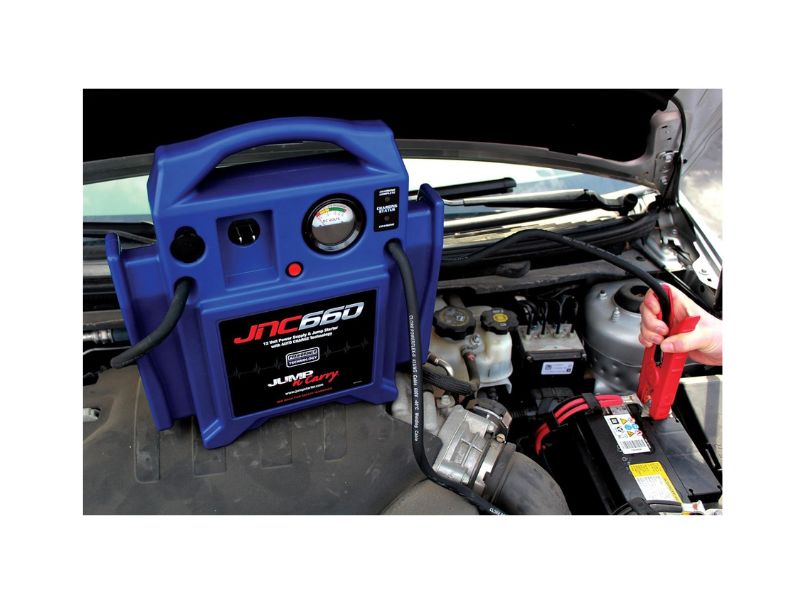
My primary recommendation is the Clore Automotive Jump-N-Carry JNC660 1700A 12V Jump Starter. I would choose it for repair shops, dealership lots, light-to-medium fleet work, service vehicles, and businesses that primarily handle 12V vehicles. It combines 1700 peak amps, 425 cranking amps, a 22Ah PROFORMER battery, 46-inch #2 AWG cables, industrial clamps, and automatic charging in an approximately 18-pound package.
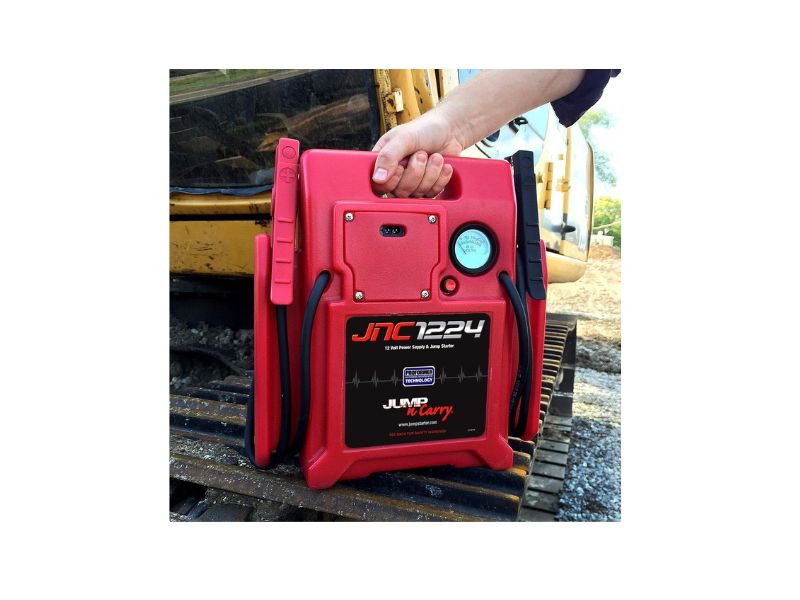
I would choose the Clore Automotive Jump-N-Carry JNC1224 12/24V Jump Starter when the shop or fleet needs genuine dual-voltage capability. It delivers 3400 peak/850 cranking amps at 12V and 1700 peak/425 cranking amps at 24V, while retaining 46-inch #2 AWG welding cables and industrial Hot Jaw clamps.
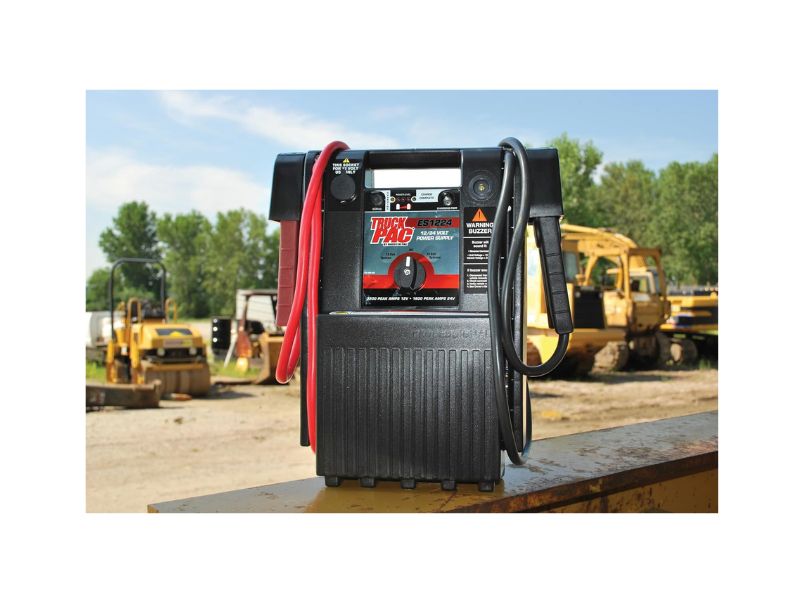
The Clore Automotive Truck PAC ES1224 12/24V Jump Starter is the heavy-duty alternative I would favor for truck fleets and commercial equipment where longer cable reach matters. It provides 3000 peak/750 cranking amps at 12V, 1500 peak/370 cranking amps at 24V, and unusually long 60-inch #2 AWG cables.
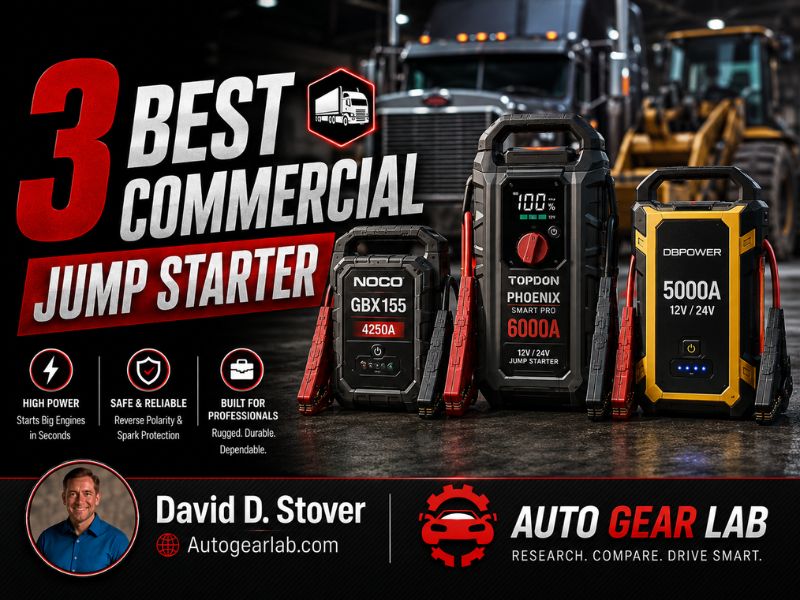
3 Commercial Jump Starters Reviewed
| Image | Product Name | Check Price |
|---|---|---|
Best Choice | Clore Automotive Jump-N-Carry JNC660 1700A 12V Jump Starter | Check Price |
Second Best | Clore Automotive Jump-N-Carry JNC1224 3400A 12/24V Jump Starter | Check Price |
Third Choice | Clore Automotive Truck PAC ES1224 3000A 12/24V Jump Starter | Check Price |
These three units use professional-style battery and cable designs rather than emphasizing pocket-size portability. The JNC660 is strictly 12V, while the JNC1224 and Truck PAC ES1224 can operate on both 12V and 24V vehicle electrical systems.
1. Clore Automotive Jump-N-Carry JNC660 1700A 12V Jump Starter
Key Features
- 1700 peak amps
- 425 cranking amps
- 12V operation
- 22Ah Clore PROFORMER battery
- 46-inch #2 AWG welding cables
- Industrial-grade clamps
- Built-in automatic charger
- Voltmeter
- 12V accessory outlet
- Approximately 18 pounds
The JNC660 is my first choice because it provides commercial-style hardware without becoming as cumbersome as a full 12/24V truck jump box.
Clore specifies 1700 peak amps and 425 cranking amps. That second number is particularly useful for commercial buyers because it provides more context about sustained starting performance than a peak-current headline alone.
The internal 22Ah PROFORMER battery is designed specifically around jump-starting duty. Amazon’s current product information also lists the 46-inch heavy-duty #2 AWG cables and onboard voltmeter.
Cable construction is one of the biggest reasons I prefer the JNC660 over many consumer lithium boosters for workshop use.
Its #2 AWG welding cables are substantially heavier than the leads supplied with many small portable jump packs. Thick conductors help reduce resistance and voltage drop when the starter motor demands substantial current.
The 46-inch reach also allows more flexibility around vans, SUVs, pickups, machinery, and vehicles where battery terminals are recessed or located away from the most convenient placement point.
For a technician moving between vehicles all day, clamp design matters too.
Commercial battery posts may be corroded, dirty, recessed, or surrounded by accessories. The JNC660 uses substantial industrial-style clamps intended to maintain strong electrical contact during high-current starting.
The built-in automatic charging system makes the JNC660 particularly convenient in a garage.
Instead of relying on someone to remember when the unit was last charged, the jump box can return to a designated charging location after use. That workflow is better suited to a professional environment than a USB-powered booster that may disappear into a technician’s toolbox partially discharged.
A voltmeter provides a quick indication of onboard battery status.
The 12V accessory outlet can also power compatible DC equipment, adding some utility around a shop or service vehicle.
Its biggest limitation is voltage.
The JNC660 is a 12V-only jump starter. That covers passenger vehicles, SUVs, light trucks, many diesel pickups, marine equipment, and plenty of commercial equipment, but it cannot simply be connected across a true 24V system.
Commercial operators working with buses, heavy trucks, construction equipment, or agricultural machinery should verify system voltage before every connection.
Another tradeoff is weight. At about 18 pounds, the JNC660 is much heavier than a compact lithium jump starter.
In a professional setting, however, that weight is reasonable for the heavy cables, large battery, strong clamps, and repeated-start capability it provides.
What I Like
- Published 425A cranking output
- Heavy #2 AWG cables
- 46-inch cable reach
- Commercial-style clamp construction
- Automatic onboard charging
- Manageable size for professional equipment
What I Do Not Like
- 12V only
- Much heavier than lithium jump packs
- Less appropriate for fleets that routinely encounter 24V equipment
The JNC660 is the commercial jump starter I would choose for the broadest group of garages and service businesses dealing primarily with 12V vehicles. It combines genuine professional hardware with a size that remains practical for everyday shop and service-truck use.
2. Clore Automotive Jump-N-Carry JNC1224 3400A 12/24V Jump Starter
Key Features
- 12V and 24V operation
- 3400 peak amps at 12V
- 850 cranking amps at 12V
- 1700 peak amps at 24V
- 425 cranking amps at 24V
- 46-inch #2 AWG welding cables
- Industrial-grade Hot Jaw clamps
- Built-in automatic charger
- Voltmeter
- Approximately 40 pounds
The JNC1224 is the model I would choose when a business cannot guarantee that every disabled vehicle will be 12V.
Clore publishes unusually useful output specifications: 3400 peak amps and 850 cranking amps in 12V mode, plus 1700 peak amps and 425 cranking amps in 24V mode.
That gives the unit considerably more commercial flexibility than the JNC660.
A repair facility may service ordinary passenger vehicles in the morning, a diesel work truck in the afternoon, and 24V equipment later in the day. Having selectable voltage in one portable unit reduces the need for separate boosters.
The voltage distinction is critical.
Two batteries under the hood do not automatically mean a vehicle uses 24V. Batteries connected in parallel can maintain a 12V system, while batteries connected in series can create approximately 24V.
A professional technician should identify the actual system architecture before selecting the JNC1224’s voltage mode.
The JNC1224 uses the same commercial-style 46-inch #2 AWG welding cable concept as the JNC660. Clore also specifies industrial-grade Hot Jaw clamps for high-current connection.
For commercial work, those details matter as much as the amp rating.
A strong internal battery is less useful if thin cables lose excessive voltage or weak clamps cannot create a low-resistance connection at the vehicle.
Its onboard automatic charger is another major professional advantage.
Clore states that the unit can remain connected to its automatic charging system, making it practical to establish a “return it to the charger” routine in a shop.
That is exactly the type of operational detail that can separate dependable commercial equipment from an emergency booster that is constantly found at half charge.
The onboard voltmeter provides a quick visual check of unit status before deployment.
A 12V DC accessory outlet adds another practical function for compatible shop or roadside equipment.
The major drawback is weight.
Clore specifies the JNC1224 at approximately 40 pounds. That is more than twice the weight of the JNC660.
I would not choose it merely because its amp figures are larger.
The reason to accept that size is genuine 12/24V capability and substantially greater cranking output.
For a passenger-car dealership, the JNC660 is easier to handle. For truck, bus, equipment, fleet, or mixed-voltage service, the JNC1224 becomes much easier to justify.
What I Like
- True 12V/24V operation
- Strong 850A 12V cranking output
- 425A cranking output at 24V
- Heavy #2 AWG cables
- Industrial clamps
- Automatic onboard charging
What I Do Not Like
- Approximately 40-pound weight
- More cumbersome for routine passenger-car work
- Requires deliberate voltage selection
The JNC1224 is the best fit when commercial versatility matters more than light weight. I would choose it for mixed fleets, heavy-equipment service, mobile technicians, and shops that routinely encounter both 12V and 24V systems.
3. Clore Automotive Truck PAC ES1224 3000A 12/24V Jump Starter
Key Features
- 12V/24V selectable operation
- 3000 peak / 750 cranking amps at 12V
- 1500 peak / 370 cranking amps at 24V
- Dual ES Series batteries
- 60-inch #2 AWG cables
- Industrial-grade Hot Jaw clamps
- AWS Advanced Warning System
- Automatic charging
- 12V DC accessory outlet
- Approximately 45 pounds
The Truck PAC ES1224 is the product I would choose when cable reach and heavy-truck-oriented construction matter most.
Clore rates it at 3000 peak and 750 cranking amps in 12V mode, plus 1500 peak and 370 cranking amps at 24V. It uses dual ES Series batteries developed specifically for vehicle jump-starting.
Those figures are slightly below the JNC1224’s published output, but the ES1224 adds one important physical advantage: 60-inch cables.
That extra reach can make a meaningful difference on commercial vehicles.
Heavy trucks, buses, agricultural equipment, construction machinery, and specialty vehicles may have starting batteries positioned farther from convenient ground-level placement.
A longer cable allows the jump box to remain in a stable location while the technician reaches the correct positive and negative points.
Clore uses #2 AWG cable despite the longer 60-inch length. That is important because increasing cable length without sufficient conductor thickness creates additional resistance and voltage drop.
The Hot Jaw clamps are designed for strong electrical transfer at battery terminals.
The ES1224 also includes Clore’s AWS Advanced Warning System, which is intended to alert the operator to unsafe jump-starting conditions.
In a commercial shop where multiple technicians may use the same tool, warning systems can add practical value.
The voltage-selection switch allows the unit to operate on both 12V and 24V systems.
That still requires the technician to verify vehicle voltage first. A selectable-voltage jump box is only safer when its operator chooses the correct setting.
The ES1224’s automatic recharging system is well suited to fleet environments. Clore says its circuitry permits continuous connection to the charger without overcharging under normal specified use.
The main disadvantage is the 45-pound weight.
This is clearly commercial equipment rather than something intended to disappear into the corner of a sedan’s trunk.
For a shop cart, service truck, fleet maintenance facility, agricultural operation, or heavy-truck garage, that bulk can be acceptable.
For a technician who carries the jump starter by hand from vehicle to vehicle all day, the lighter JNC660 may be more comfortable when 24V capability is unnecessary.
What I Like
- Genuine 12V/24V capability
- Long 60-inch cables
- Heavy #2 AWG conductors
- Published cranking specifications
- Advanced warning system
- Strong fit for truck and fleet work
What I Do Not Like
- Approximately 45 pounds
- Less portable than the JNC660
- Lower published cranking output than the JNC1224
The Truck PAC ES1224 makes the most sense for commercial operations where long cable reach, dual-voltage operation, and heavy-duty fleet work are routine requirements.
Commercial Jump Starter Comparison
| Product | Voltage | Peak Output | Cranking Output | Cable Length | Cable Gauge | Weight | Ideal Use |
| Clore JNC660 | 12V | 1700A | 425A | 46 in | #2 AWG | ~18 lb | Garages, dealerships, service vehicles |
| Clore JNC1224 | 12/24V | 3400A 12V / 1700A 24V | 850A 12V / 425A 24V | 46 in | #2 AWG | ~40 lb | Mixed-voltage fleets and equipment |
| Truck PAC ES1224 | 12/24V | 3000A 12V / 1500A 24V | 750A 12V / 370A 24V | 60 in | #2 AWG | ~45 lb | Heavy trucks, fleets, agricultural equipment |
The JNC660 offers the best balance for commercial 12V service because it delivers 425 cranking amps while remaining much easier to carry than the dual-voltage models.
The JNC1224 delivers the strongest published cranking figures here and adds full 12/24V versatility.
The Truck PAC ES1224 gives up some output relative to the JNC1224 but extends cable reach to 60 inches, which can be highly useful around large commercial vehicles.
How to Choose the Best Commercial Jump Starter
Decide Whether You Need 12V or 12/24V
This should be the first question.
Passenger cars, SUVs, vans, and many pickups use 12V starting systems.
Commercial trucks, buses, industrial machinery, and certain equipment may use 24V.
If your business only handles normal 12V vehicles, the JNC660 avoids the additional weight and complexity of a dual-voltage jump box.
If 24V systems regularly appear in the shop, I would choose a purpose-built 12/24V model.
Never Determine Voltage by Battery Count Alone
Two batteries do not automatically mean 24V.
Two 12V batteries wired in parallel still provide approximately 12V while increasing available current and capacity.
Two 12V batteries wired in series produce approximately 24V.
Technicians should verify the actual electrical system before connecting a commercial booster.
Selecting 24V on a 12V vehicle can damage expensive electronics.
Look Beyond Peak Amps
Peak current is useful but incomplete.
Commercial starting work benefits from knowing how much output a unit can deliver for a meaningful cranking interval.
That is why I value the published cranking amp figures on these Clore models:
- JNC660: 425A at 12V
- JNC1224: 850A at 12V, 425A at 24V
- ES1224: 750A at 12V, 370A at 24V
Clore publishes those figures alongside peak ratings, making the models easier to evaluate for demanding professional use.
Cable Gauge Matters
High starting current has to travel through the jumper leads.
Thin cables create greater resistance and voltage drop.
All three recommended units use #2 AWG output cable, which is appropriate for the high-current commercial role Clore targets.
Cable construction becomes even more important as cable length increases.
Cable Length Can Matter More Than You Expect
A compact car may have easily accessible under-hood jump points.
A commercial vehicle may not.
Battery locations can be:
- Behind steps
- Inside side compartments
- Under seats
- Deep in engine bays
- Mounted in equipment boxes
- Positioned on the opposite side of the vehicle from convenient jump-box placement
The ES1224’s 60-inch cable reach is a significant benefit in those situations.
Prioritize Clamp Construction
Commercial jump starters are often attached to imperfect battery terminals.
Terminals can be oxidized, corroded, dirty, greasy, or recessed.
Large spring-loaded clamps with strong conductive jaws improve the chance of establishing a low-resistance connection.
All three products emphasize industrial clamp construction rather than small consumer-style clips.
Think About Repeated Starts
A consumer jump starter may sit unused for months and perform one emergency start.
Commercial equipment can face several disabled vehicles in one day.
That changes the buying criteria.
Battery capacity, cranking duration, heat management, clamp durability, cable durability, and recharge workflow become more important than minimal size.
Professional lead-acid/AGM-style jump boxes remain relevant precisely because they are designed around repeated high-current starting work.
Set Up a Charging Routine
The strongest commercial jump starter is useless when technicians return it to storage discharged.
The JNC660, JNC1224, and ES1224 all use automatic charging systems designed around keeping the internal battery ready for service.
A simple shop rule works well:
Return the jump starter to its charging station after every significant use.
Consider Weight Before Buying Maximum Capacity
More capability often means more battery mass.
The approximate weights illustrate the tradeoff:
- JNC660: 18 lb
- JNC1224: 40 lb
- ES1224: 45 lb
Those differences are large enough to affect daily workflow.
If technicians carry the unit across large lots, the JNC660 can be far easier to live with.
If the booster normally stays on a service truck or shop cart, the heavier dual-voltage units are easier to justify.
Commercial Lithium vs AGM Jump Starters
Lithium jump starters have major advantages.
They can be:
- Much lighter
- Smaller
- Easier to carry
- Faster to recharge
- Equipped with USB-C and digital controls
Professional AGM or lead-acid jump boxes offer a different set of strengths:
- Heavy cables
- Large clamps
- Strong sustained current
- Long cranking duration
- Straightforward charging
- Proven workshop designs
For mobile technicians where every pound matters, lithium can be very attractive.
For a fixed garage or fleet facility where repeated cranking and cable durability matter more than weight, a traditional professional jump box remains a strong choice.
Commercial Jump Starter vs Battery Charger
These tools serve different purposes.
A jump starter supplies high current for a short period so the vehicle can crank or initialize.
A battery charger gradually restores the battery’s state of charge.
A commercial shop generally benefits from having both.
If a vehicle simply needs to be moved immediately, a jump starter can solve the short-term problem.
If the battery is heavily discharged but still serviceable, controlled charging is the better long-term approach.
Repeatedly jump-starting the same vehicle without diagnosing the cause is not a repair.
What Repeated Jump Starts Can Indicate
A vehicle that repeatedly needs external starting assistance may have:
- A failing battery
- Alternator or charging-system problems
- Excessive parasitic draw
- Loose battery terminals
- Corroded cables
- Starter-motor problems
- Bad grounds
- Electrical control faults
A commercial jump starter is a recovery tool, not a substitute for electrical diagnosis.
How to Use a Commercial Jump Starter Safely
1. Identify System Voltage
Confirm whether the vehicle is 12V or 24V before connecting anything.
2. Inspect the Vehicle Battery
Do not jump a battery that is visibly:
- Frozen
- Cracked
- Swollen
- Leaking
- Smoking
- Exceptionally hot
3. Turn Off Electrical Loads
Switch off unnecessary lighting, HVAC equipment, accessories, and electrical loads.
4. Select the Correct Voltage
On a dual-voltage jump starter, confirm the selector position before attaching or energizing the unit.
5. Attach the Positive Clamp
Connect to the vehicle’s approved positive terminal or designated jump point.
6. Attach the Negative Clamp
Use the manufacturer-approved negative terminal or chassis ground.
7. Verify Clamp Contact
A clamp resting loosely on corrosion can create high resistance and heat.
Ensure solid metal-to-metal contact.
8. Observe Warning Indicators
If the jump starter reports an unsafe condition, stop and investigate rather than bypassing the warning.
The ES1224 includes Clore’s AWS warning system for this purpose.
9. Attempt a Controlled Start
Crank only for the interval permitted by the jump-starter and vehicle instructions.
10. Allow Cooling Between Attempts
Repeated prolonged cranking generates heat in:
- Starter motors
- Jumper cables
- Clamps
- Vehicle wiring
- Jump-starter batteries
11. Disconnect Correctly
Remove the jump starter according to the vehicle and equipment manuals.
12. Return the Unit to Charge
A commercial booster should be ready for the next vehicle immediately.
Commercial Jump Starter Maintenance
Professional equipment deserves a routine inspection schedule.
Check the unit for:
- Damaged cable insulation
- Loose cable connections
- Burned clamp surfaces
- Weak clamp springs
- Cracked housing
- Battery swelling
- Abnormal odor
- Charger faults
- Low resting charge
Cables deserve special attention because commercial units are dragged across shop floors, doors, steps, engine bays, and equipment frames.
A damaged #2 AWG cable can carry extremely high current and should not be treated casually.
Common Commercial Jump Starter Buying Mistakes
Buying Only the Largest Peak-Amp Number
Commercial buyers should also compare cranking amps, battery architecture, cable gauge, and clamps.
Buying 24V Capability When You Never Need It
A heavier dual-voltage box can become unnecessary daily burden in a 12V-only passenger-car shop.
Buying 12V Only for a Mixed Fleet
If 24V equipment appears regularly, carrying separate equipment or improvising procedures wastes time.
Ignoring Cable Reach
A jump starter can have excellent electrical specifications yet be frustrating when its leads do not reach the vehicle’s approved connection points.
Ignoring Weight
A 45-pound jump starter behaves very differently in daily service than an 18-pound model.
Forgetting Charging Workflow
Professional equipment must be returned ready for the next job.
Treating Every Two-Battery Vehicle as 24V
Battery count and system voltage are not the same thing.
Repeatedly Jumping a Faulty Vehicle
Frequent starting assistance should trigger battery and charging-system diagnosis.
Frequently Asked Questions
What is the best commercial jump starter?
The JNC660 is my primary recommendation for most professional 12V garages and service operations.
It combines 1700 peak amps, 425 cranking amps, 46-inch #2 AWG cables, industrial clamps, an automatic charger, and an approximately 18-pound format that is easier to handle than larger dual-voltage boxes.
What commercial jump starter is best for 12V and 24V vehicles?
The JNC1224 provides the strongest published dual-voltage cranking output of these three choices.
Clore rates it at 850 cranking amps in 12V mode and 425 cranking amps in 24V mode, making it well suited to mixed commercial fleets.
What is the best jump starter for commercial trucks?
The Truck PAC ES1224 is particularly useful when 12/24V operation and long cable reach matter.
Its 60-inch #2 AWG leads provide greater reach around large truck and equipment battery locations.
Is 1700 peak amps enough for commercial work?
It can be, particularly when the unit also publishes strong sustained cranking performance.
The JNC660 provides 1700 peak amps and 425 cranking amps and is designed around professional 12V jump-starting.
Are cranking amps more important than peak amps?
Cranking amps provide valuable information about sustained starting output rather than only a brief maximum.
For professional equipment, I prefer seeing both specifications instead of judging the product entirely from a peak-current marketing figure.
Do commercial jump starters need 24V capability?
Only when your vehicles or equipment actually use 24V starting systems.
Passenger cars and many light trucks remain 12V. Heavy commercial vehicles and equipment can vary, so fleet operators should inventory their systems before buying.
Do two truck batteries mean the truck is 24V?
No. Two 12V batteries can be connected in parallel while the vehicle remains a 12V system.
Voltage depends on the wiring configuration, not merely the number of batteries.
Can a 12V jump starter be used on a 24V truck?
Do not connect a 12V-only booster across a true 24V electrical system.
Use equipment specifically designed for the system voltage and follow the vehicle manufacturer’s procedure.
Why are commercial jump-starter cables so thick?
Thicker conductors reduce resistance and voltage drop during high-current starting.
All three products reviewed here use #2 AWG output cables, reflecting their professional starting role.
How long should commercial jump-starter cables be?
Longer cables improve access, but they also need sufficient conductor thickness to control voltage drop.
The JNC660 and JNC1224 use 46-inch leads, while the ES1224 extends reach to 60 inches.
Is a lithium jump starter better for commercial use?
Lithium is better for low weight, while professional AGM-style units can excel at repeated heavy-duty starting.
The right choice depends on whether mobile portability or sustained shop-duty output matters more.
Why are professional jump starters so heavy?
Large internal batteries, heavy cables, industrial clamps, and robust cases add considerable weight.
The JNC660 is about 18 pounds, while dual-voltage models such as the JNC1224 and ES1224 weigh roughly 40 and 45 pounds respectively.
Can I leave a commercial jump starter connected to its charger?
These Clore models use automatic charging systems designed for maintaining readiness.
Follow the individual model’s manual and use the supplied or specified charging equipment. Clore specifically describes automatic charging on the JNC1224 and ES1224.
How often should a commercial jump starter be recharged?
Recharge it after significant use and maintain a regular charge-check routine.
In a professional environment, returning the unit to its charging station after use is simpler than waiting for the battery to become noticeably low.
Can a commercial jump starter start diesel trucks?
Yes, when the vehicle voltage and starting requirements fall within the unit’s intended capability.
Heavy diesel systems can vary significantly, so professional operators should use voltage, battery configuration, and manufacturer guidance rather than relying solely on engine displacement.
Can commercial jump starters be used on agricultural equipment?
Yes, compatible models are commonly positioned for fleet and agricultural starting applications.
Clore specifically describes its ES1224 platform for demanding automotive, fleet, and agricultural use.
What happens if I select 24V on a 12V vehicle?
Incorrect voltage can damage vehicle electronics, batteries, wiring, and connected equipment.
Always confirm vehicle system voltage before operating a selectable 12/24V booster.
Why does my commercial jump starter get hot?
High current, long crank attempts, poor connections, or repeated starts can create substantial heat.
Stop when the unit or cables become abnormally hot and follow the manufacturer’s duty-cycle and cooldown instructions.
Should a shop own more than one jump starter?
Often yes, especially when several technicians or multiple voltage systems are involved.
A 12V JNC660 can handle routine passenger-vehicle work while a dedicated 12/24V unit remains available for heavy trucks and equipment.
Conclusion
The best commercial jump starter is not simply the model with the largest peak-current number. Professional users should look at cranking output, voltage capability, cable gauge, cable reach, clamp quality, charging design, and daily portability.
The Clore Jump-N-Carry JNC660 remains my primary recommendation for most 12V commercial operations. Its 1700 peak amps, 425 cranking amps, 46-inch #2 AWG cables, industrial clamp design, automatic charger, and approximately 18-pound weight create an excellent balance for garages, dealership lots, service trucks, and light-to-medium fleet maintenance.
The JNC1224 is the stronger choice for mixed-voltage work. Its 850 cranking amps at 12V and 425 cranking amps at 24V make it particularly compelling when passenger vehicles, trucks, and equipment all pass through the same facility.
The Truck PAC ES1224 is especially attractive for heavy-truck and equipment work because its 60-inch #2 AWG cables provide additional reach while maintaining full 12/24V capability.
For a normal automotive repair shop, I would choose the JNC660. For a mixed commercial fleet that includes true 24V equipment, I would move to the JNC1224, while operations that prioritize maximum cable reach should strongly consider the Truck PAC ES1224.