Yes, 750 peak amps can be good for a jump starter used with many small and midsize gasoline vehicles, provided the manufacturer rates the unit for your engine. It offers more starting reserve than basic low-output boosters, but 750 peak amps may be limiting for large V8s, bigger diesel engines, or demanding cold-weather starts.
The key word is peak. A 750A label tells you something about the jump starter’s maximum short-duration output, but it does not tell you exactly how much usable current reaches the starter motor during an actual engine start.
Where Does a 750A Jump Starter Fit?
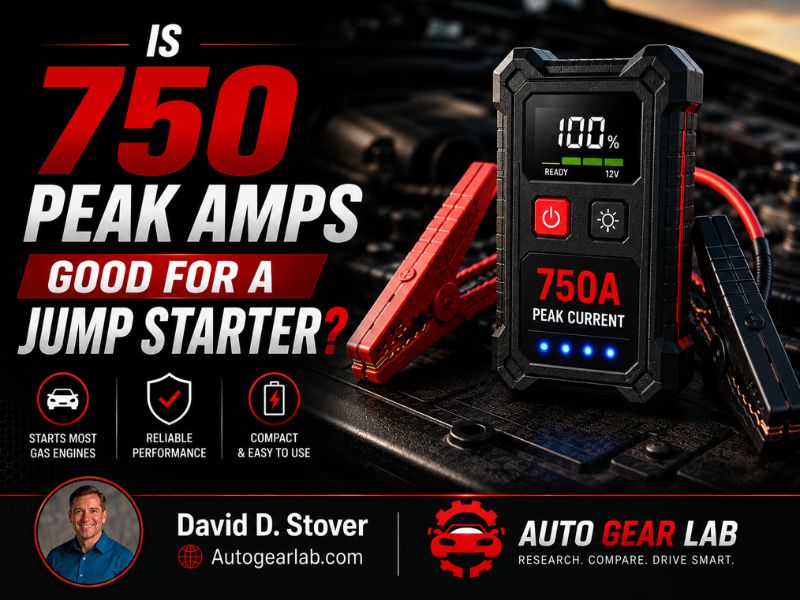
A 750A jump starter falls between lightweight entry-level boosters and the increasingly common 1000A–2000A portable models.
That makes it potentially well suited to drivers who own an ordinary passenger car and want something compact for emergency use without buying a much larger booster.
As a general guide:
| Vehicle/Application | 750 Peak Amps |
| Motorcycle or ATV | Usually plenty |
| Small 4-cylinder gas car | Usually a good fit |
| Midsize 4-cylinder sedan | Usually suitable |
| Small crossover | Often suitable |
| V6 gasoline vehicle | Depends on engine and unit |
| Large SUV | Check manufacturer rating carefully |
| V8 truck | More reserve is usually preferable |
| Small diesel | May work if specifically rated |
| Large diesel pickup | Generally choose a stronger unit |
| Severe winter use | Extra capacity is beneficial |
These are not universal engine limits. The correct answer for a particular jump starter comes from its manufacturer-rated engine displacement, not simply the 750A figure.
What Does 750 Peak Amps Actually Mean?
Most compact jump starters use a peak amp rating as their most prominent power specification.
Peak amps refer to a brief maximum-current capability. They are different from cranking amps (CA), cold cranking amps (CCA), or other sustained starting-current measurements.
This distinction matters because peak amp claims are not standardized consistently among all jump starter manufacturers. Clore Automotive notes that peak amps have no single industry-agreed definition, making cross-brand comparisons based solely on the headline number unreliable.
In other words, you cannot safely conclude that one 750A jump starter is exactly 50% stronger than a 500A unit from another manufacturer.
The complete starting system matters, including the internal battery cells, battery management system, cables, clamps, electrical resistance, temperature, and condition of the vehicle battery.
Is 750 Peak Amps Enough for a 4-Cylinder Car?
For many four-cylinder gasoline vehicles, 750 peak amps can provide adequate starting power.
A small 1.5L, 2.0L, or 2.5L gasoline engine normally demands less starting assistance than a large-displacement truck engine.
For context, Battery Tender currently recommends about 600 peak amps for most passenger cars and smaller gasoline engines, while suggesting higher-output models as vehicle size increases.
That places 750A in a reasonable range for many normal passenger-car applications.
However, a 750A jump starter should still be rated specifically for your engine. A good product may provide comfortable reserve for a 2.0L engine, while another poorly specified 750A model might perform less consistently.
If you are buying rather than evaluating a jump starter you already own, engine-size compatibility is more valuable than peak amps alone.
Can 750 Peak Amps Start a V6?
Possibly, and many 750A-class jump starters have historically been marketed toward four-, six-, and even some eight-cylinder applications.
A currently listed Duracell 750A jump starter, for example, is described as capable of starting four-, six-, and eight-cylinder gasoline and diesel engines.
That does not mean every 750A product can reliably handle every V6.
A compact 2.7L V6 and a larger SUV engine can create different cranking demands. The state of charge of the vehicle battery, starter condition, ambient temperature, and cable connection also change the workload.
If you have a V6 and the jump starter manufacturer clearly rates the product for your engine displacement, 750A can be sufficient.
If your vehicle sits near the unit’s stated maximum rating, a 1000A or 1200A model can provide a more comfortable margin.
What About a V8?
This is where 750 peak amps becomes more situational.
Some 750A jump starters may successfully start a gasoline V8, particularly when the vehicle battery is only moderately discharged and temperatures are mild.
But if you are choosing a new jump starter specifically for a large V8 SUV or pickup, more capacity is generally a better approach.
A bigger engine usually places greater demand on the starting system, while the exact requirements depend on displacement, starter design, compression, oil viscosity, and battery condition.
The difference is especially noticeable when a V8 must start in freezing weather with a deeply discharged battery.
For that application, choosing a jump starter whose manufacturer gives you generous engine-size headroom is more dependable than buying one operating at the edge of its rating.
Is 750A Enough for a Diesel?
Diesel engines deserve extra caution.
A diesel engine generally requires greater cranking effort than a comparable gasoline engine because of its higher compression and cold-start characteristics.
Manufacturers therefore commonly give lower diesel displacement limits for the same jump starter.
Battery Tender’s current sizing guidance illustrates this progression: its lower-output products are intended primarily for passenger cars and smaller engines, while increasingly powerful models are recommended for larger gas engines and diesels.
A 750A jump starter may be suitable for some small diesel engines, particularly if the product specifically says so.
It would not be my default choice for a large diesel pickup.
For diesel use, ignore generic phrases such as “works on trucks” and find the manufacturer’s exact maximum diesel engine displacement.
Battery Condition Changes How Much Power You Need
Jump starting is not always the same electrical challenge.
Imagine two identical cars.
The first has a battery that is only slightly discharged after the headlights were left on for an hour. The battery can still contribute significant current, so the jump starter only needs to supplement it.
The second car has a battery that has been deeply discharged overnight. The portable booster must contribute much more of the starting energy.
The same 750A unit can therefore feel strong in one situation and marginal in another.
A battery can also be physically or electrically failed rather than merely discharged. A shorted cell, severe internal degradation, damaged terminal, or frozen battery cannot necessarily be overcome by adding more peak amps.
A jump starter assists a serviceable starting system; it does not repair a failed battery.
Cold Weather Is the Biggest Challenge for 750A
A 750A booster becomes less comfortable when temperatures drop significantly below freezing.
Cold weather affects the entire starting system.
The vehicle battery provides less available current. The portable jump starter’s battery can also lose performance. Meanwhile, the engine becomes harder to turn because lubricants thicken and mechanical resistance increases.
That combination increases the required cranking power.
If you live in a warm or moderate climate and drive a small gasoline car, 750A may provide plenty of practical capacity.
If you expect winter starts at very low temperatures, additional reserve from a quality 1000A–1500A model may be worthwhile.
The jump starter’s published operating-temperature range should also be checked. A high amp number does not guarantee excellent subzero performance.
Does 750A Mean It Will Damage a Small Car?
No.
A jump starter does not automatically push its entire maximum current into the vehicle.
The starter circuit draws the current it requires according to its electrical characteristics.
As long as the booster has the correct voltage, is intended for automotive jump starting, and is connected correctly, having 750A of available peak current is not inherently excessive for a small car.
Voltage compatibility matters far more.
Most passenger vehicles use a 12V electrical system, so they require an appropriate 12V jump starter. Never use a higher-voltage booster simply because you want more starting power.
Is 750A Better Than 600A?
Assuming two similarly designed products from the same manufacturer, 750A should provide some additional starting reserve over 600A.
That reserve can help with a slightly larger engine, colder weather, or a more deeply discharged battery.
However, the difference between 600 and 750 peak amps should not dominate the buying decision.
Battery Tender currently positions roughly 600A as suitable for most passenger cars and smaller gas engines, with higher amp categories recommended as engine demand increases.
A well-engineered 600A unit could therefore be a better purchase than a poorly built 750A product.
Focus on verified engine capacity, manufacturer reputation, cables, clamps, battery chemistry, and safety protections.
750A vs. 1000A: Is Stepping Up Worth It?
For someone purchasing a new jump starter today, 1000A can be appealing because it gives you additional flexibility without necessarily adding much size.
That additional reserve becomes useful if you have a V6, drive in cold weather, occasionally help other vehicles, or expect to keep the same jump starter after changing cars.
A 750A unit still makes sense when it comfortably covers your current engine and portability is a priority.
You do not need to replace a perfectly functional 750A booster solely because modern models have larger advertised numbers.
If it reliably starts your vehicle, holds its charge, and is safely rated for the application, it is doing its job.
What Makes a Good 750A Jump Starter?
Peak current should only be the beginning of your evaluation.
A good jump starter should have strong battery clamps that create reliable electrical contact. Weak clamps increase resistance and voltage drop, potentially making the booster seem less powerful than it actually is.
Cable construction matters for the same reason.
Safety electronics are also important. Useful protections include reverse-polarity protection, short-circuit protection, overload protection, and temperature protection.
Battery Tender’s current jump-starter lineup, for example, emphasizes spark-proof clamp technology and reverse-polarity protection.
For occasional DIY use, these protections can matter more than gaining another few hundred advertised peak amps.
Don’t Confuse Battery Capacity With Peak Amps
You may also see a jump starter rated in mAh, Ah, or watt-hours (Wh).
These numbers describe stored battery energy rather than maximum starting current.
A large Wh rating can allow more repeated starting attempts or longer power-bank use, but it does not automatically mean the jump starter produces stronger cranking output.
Conversely, a booster may provide strong short-duration starting performance without having enormous stored capacity.
Recent independent testing has reinforced the limitations of comparing portable jump starters by amp ratings alone and found watt-hour capacity more directly useful for comparing how much stored energy different units contain.
For a good buying decision, consider both starting capability and battery capacity.
When Should You Choose More Than 750A?
Move to a higher-output model when your engine is close to the 750A unit’s published limit.
It also makes sense to size up for large V6 or V8 engines, diesel vehicles, severe winter climates, frequent jump starting, or multiple vehicles.
If your household contains a compact sedan and a full-size pickup, choose enough booster capacity for the pickup.
The extra reserve costs little when unused but can be valuable during a difficult start.
What you do not need is the highest amp number available simply for its own sake.
A quality 1000A or 1500A booster with realistic specifications may be a better choice than an inexpensive product advertising several thousand poorly defined peak amps.
Frequently Asked Questions
Is 750 Peak Amps Enough to Jump-Start a Car?
Yes, it can be enough for many passenger cars, particularly smaller gasoline engines. Verify the specific jump starter’s manufacturer-rated maximum engine size.
Is 750A Enough for a 4-Cylinder Engine?
Usually. A good 750A jump starter should provide useful reserve for many four-cylinder gasoline vehicles, although actual capability varies by product.
Can a 750 Amp Jump Starter Start a V6?
Many can, depending on engine displacement and battery condition. Choose a unit whose published gas-engine rating comfortably exceeds your engine size.
Can 750A Start a V8?
Some 750A products may start certain V8s, but a higher-capacity booster is generally more appropriate for large V8 pickups and SUVs, especially in cold weather.
Is 750 Peak Amps Enough for a Diesel?
It may be enough for certain small diesels if the manufacturer specifically rates the unit for them. Large diesel engines generally need more starting reserve.
Is 750A Good for Cold Weather?
It can work well with a small gasoline engine, but freezing temperatures reduce available battery performance and increase cranking demand. Additional capacity provides more useful winter margin.
Will 750 Amps Damage a Small Car?
No, not simply because the jump starter has 750 peak amps available. Correct 12V compatibility, polarity, and connection procedure are the more important considerations.
Does 750 Peak Amps Mean 750 Cranking Amps?
No. Peak amps and cranking amps are different ratings, and peak amps may represent only a very brief current capability.
Should I Buy a 750A or 1000A Jump Starter?
Choose 750A if it comfortably exceeds your engine’s requirements and you value compact size. A 1000A model provides more reserve for larger vehicles, deeply discharged batteries, and cold weather.
Is Peak Amps the Most Important Jump Starter Specification?
No. Engine-size compatibility, sustained starting capability, battery capacity, clamps, cables, temperature range, and protection electronics can all matter more than peak amps alone.
Is 750 Peak Amps Good for a Jump Starter Overall?
Yes, 750 peak amps is a good jump starter rating for many small and midsize gasoline vehicles, especially when the product has a credible engine-size rating and quality starting hardware. It offers useful reserve above basic low-power boosters without necessarily adding the bulk of a much larger unit.
Its limitations become clearer with large V8 engines, bigger diesels, deeply discharged batteries, and severe cold-weather starting. In those situations, moving to a 1000A, 1200A, 1500A, or higher-capacity product can provide more dependable margin.
Most importantly, do not treat 750 peak amps as a complete measurement of performance. Peak ratings are not consistently standardized across manufacturers, and the quality of the internal battery, clamps, cables, safety electronics, and manufacturer-rated engine capacity all affect real starting ability.
For an ordinary four-cylinder gasoline car, a reputable 750A unit can be a sensible emergency tool. Choose by verified vehicle compatibility first and peak amps second.