Yes, a 600 amp jump starter can be enough for many small and midsize gasoline cars, especially when the vehicle battery is weak rather than completely failed. However, larger gasoline engines, most demanding diesel applications, and severe cold-weather starts may benefit from a more powerful jump starter.
The most important detail is what the manufacturer means by 600 amps. If it is a 600 peak amp rating, you should also check the stated engine-size limit, gasoline or diesel compatibility, battery voltage, temperature range, and starting performance before deciding whether the unit is sufficient.
What Can a 600 Amp Jump Starter Actually Start?
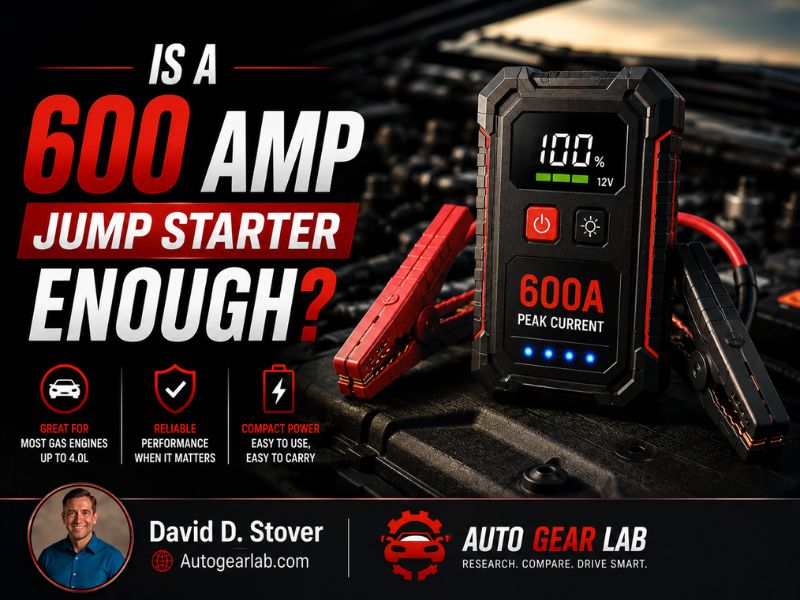
A quality 600A portable jump starter is generally aimed at compact cars, sedans, crossovers, motorcycles, powersports equipment, and smaller engines rather than large diesel trucks.
Current manufacturer guidance demonstrates the general capability of this category. Battery Tender rates its 600A Jump N Start for gasoline engines up to approximately 4.0L and small diesel engines up to 2.0L. Schumacher describes one of its 600A lithium jump starters as suitable for 4- to 6-cylinder cars, motorcycles, and powersports vehicles.
That does not mean every product displaying “600A” will handle the same engines. Internal battery quality, clamp design, cables, electronics, and testing methods vary significantly between manufacturers.
A practical way to view 600A is:
| Vehicle | Is 600A Usually Enough? |
| Motorcycle or ATV | Usually |
| Small 4-cylinder gasoline car | Usually |
| Midsize 4-cylinder sedan | Often |
| Small crossover | Often |
| V6 gasoline car | Depends on the unit |
| Large V6 SUV | May be marginal |
| V8 gasoline truck | Usually better to go larger |
| Small diesel | Only if specifically rated |
| Large diesel truck | Generally no |
| Severe winter use | More reserve is preferable |
The manufacturer’s actual engine-displacement rating should always take priority over a general chart.
600 Peak Amps Is Not the Same as 600 Cranking Amps
This distinction can completely change how powerful the jump starter really is.
Most compact lithium boosters advertise peak amps, which represent a brief maximum-current output. Peak amps are useful for categorizing the product, but they do not describe how much current the device can sustain throughout an engine-cranking event.
This is why you should not assume that a 600 peak amp booster delivers 600 amps continuously.
The same issue appears when comparing brands. A product with a smaller advertised number may perform better than another product with a larger marketing figure if it has stronger battery cells, lower internal resistance, better cables, and a more meaningful sustained starting rating.
Clore Automotive emphasizes that peak amp ratings do not tell the whole story and recommends considering more useful starting-performance information where available.
The number you want to prioritize as a normal buyer is often the maximum gasoline and diesel engine size the manufacturer says the jump starter can handle.
Is 600A Enough for a 4-Cylinder Car?
For many four-cylinder gasoline vehicles, yes.
A compact gasoline engine usually places less demand on a jump starter than a large V6, V8, or diesel engine.
Battery Tender’s current 600A model, for example, is positioned for gasoline engines up to approximately 4.0 liters, while NOCO’s even lower-rated 500A GB20 is designed for gasoline engines up to 4.0L.
That means a well-designed 600A unit can be a reasonable match for common 1.5L, 2.0L, 2.4L, or similar gasoline engines.
You still want some reserve.
If your vehicle has a 4.0L engine and your jump starter is rated for “up to 4.0L,” you are operating near the manufacturer’s stated limit. A higher-capacity unit may provide more confidence when the battery is deeply discharged or temperatures are very low.
For a 1.5L or 2.0L gasoline commuter car, 600A can offer much more comfortable headroom.
What About a V6 Engine?
A 600 amp jump starter may handle a V6, but this is where cylinder count becomes less useful than displacement.
Schumacher currently describes one of its 600A units as capable of emergency jump starting V6 engines, showing that at least some products in this class are designed for that workload.
However, V6 engines vary considerably.
A 2.7L gasoline V6 and a much larger V6 do not necessarily have the same starting demand. Battery condition, starter-motor design, temperature, and engine oil viscosity also affect how difficult the engine is to crank.
If you own a larger V6 SUV or pickup, a 1000A or 1200A-class jump starter may give you more useful reserve, particularly in winter.
Is 600A Enough for a V8?
A 600 peak amp portable jump starter is generally not the power category I would target for a large V8.
It might successfully start some V8 engines when the vehicle battery still has useful charge and conditions are favorable, but that is different from choosing a booster you can confidently depend on during a difficult emergency.
Large-displacement gasoline engines typically justify a unit with greater starting-current reserve.
Battery Tender’s current sizing guidance moves from its 600A model for engines up to about 4.0L gasoline to higher-output models as engine displacement increases, reinforcing the idea that larger engines should be paired with stronger boosters.
If you drive a V8 truck or large SUV, use the manufacturer’s engine-size recommendation instead of hoping a 600A unit will be enough.
Diesel Is Where 600A Becomes More Limited
A diesel engine generally creates a more demanding starting load than a similarly sized gasoline engine.
That is why portable jump starter specifications commonly provide a lower maximum diesel displacement.
Battery Tender, for example, rates its 600A model for small diesels up to roughly 2.0L, while its higher-output products are intended for progressively larger diesel engines.
This makes a 600A booster potentially useful for a small diesel passenger vehicle, but it is not the category I would choose for a large diesel pickup.
If you drive something like a heavy-duty truck with a large diesel engine, choose a booster specifically rated for that displacement and operating environment.
Never use a gasoline engine rating to size a jump starter for a diesel.
Battery Condition Can Make 600A Feel Strong or Weak
The vehicle battery does not disappear from the circuit when you attach a portable booster.
If the battery is only moderately discharged, it may still contribute significant current. The jump starter supplements the battery and helps the starter motor receive enough power to crank the engine.
That is an easier situation for a 600A unit.
A deeply discharged battery can demand much more assistance.
And if the battery has an internal short, failed cell, serious physical damage, or another internal fault, even a much larger jump starter may not solve the problem.
This explains why the same 600A booster can start one vehicle easily one day but struggle with the same engine under different battery conditions.
A jump starter should be considered a starting aid—not a repair for a failed automotive battery.
Cold Weather Is the Biggest Reason to Size Up
Cold weather reduces your starting margin from several directions at the same time.
The vehicle battery produces less effective power, the internal battery inside the jump starter may also deliver less output, and the engine itself becomes harder to crank as lubricants thicken and mechanical resistance increases.
Battery Tender specifically recommends considering the next jump-starter tier for cold climates because low temperatures can reduce available output from both the booster and the vehicle battery.
So a 600A unit that comfortably starts a 2.0L gasoline car during summer may have to work significantly harder on a freezing winter morning.
For drivers in severe winter climates, more reserve is usually worthwhile.
That does not necessarily mean jumping straight to 3000A. A quality 800A, 1000A, or 1200A model may provide the additional margin you need without becoming unnecessarily large.
Is 600A Too Much for a Motorcycle?
Usually not, assuming the booster is designed for the motorcycle’s 12V battery system.
The vehicle does not automatically receive the jump starter’s full peak-current rating. Electrical current is drawn according to the starting circuit’s demand.
Many compact jump starters are intentionally marketed for a combination of motorcycles, ATVs, cars, lawn equipment, and other small engines. NOCO’s 500A GB20 and Schumacher’s 600A lithium unit are current examples.
The more important concern is correct voltage and connection procedure.
Do not use a 12V jump starter on equipment that requires a different voltage simply because the amp rating appears suitable.
600A vs. 300A: Is 600A Significantly Better?
If both numbers are comparable peak amp ratings, 600A provides substantially more available starting reserve than 300A.
That can make a meaningful difference when dealing with a larger gasoline engine, colder conditions, or a more deeply discharged battery.
However, the comparison only works if both manufacturers are describing their amperage in roughly the same way.
A professional unit rated at 300 cranking amps or Start Assist Amps may outperform a lightweight product that advertises only 600 peak amps.
This is why verified engine compatibility remains a better decision tool than comparing numbers without understanding how they were measured.
600A vs. 1000A: Which Should You Choose?
For a small gasoline car, either can be appropriate.
A quality 600A unit has advantages in size, weight, and portability. If your engine sits comfortably below its published maximum and you live in a moderate climate, additional power may not be necessary.
A 1000A unit provides more flexibility.
The extra reserve becomes useful when you have a larger engine, winter temperatures, multiple vehicles, or simply want greater margin when the automotive battery is deeply discharged.
If the price and physical size are close, choosing the higher-capacity reputable unit can be worthwhile.
If the 600A model is much more compact and already comfortably covers your vehicle, there is no requirement to buy a much larger jump starter merely for the bigger number.
Safety Features Can Matter More Than Another Few Hundred Amps
For normal drivers, reverse-polarity protection and short-circuit protection are extremely valuable features.
Schumacher’s 600A lithium model includes smart cables designed to protect against conditions such as sparks, overcurrent, short circuits, overload, overcharging, and excessive voltage. NOCO’s 500A unit includes spark-proof technology and reverse-polarity protection.
These protections can be more valuable than moving from 600A to an unknown 800A product with questionable electronics.
Also consider clamp construction.
A jump starter can have enough internal power but fail to deliver it effectively if corroded battery terminals, weak clamps, or poor cable connections create excessive resistance.
A clean, secure connection matters during any high-current starting event.
When Should You Choose More Than 600A?
A stronger jump starter makes sense when your vehicle is approaching or exceeding the 600A model’s engine-size limit.
Large gasoline engines, most substantial diesels, very cold climates, and vehicles that are difficult to crank are obvious reasons.
Another good reason is owning several vehicles.
If your household includes a small sedan and a large SUV, it makes more sense to size the booster for the largest engine rather than buying something that only covers the small car.
More reserve can also be useful if the unit will be used for roadside assistance or frequent jump starts.
A consumer 600A booster designed for occasional emergencies is doing a different job from a professional booster expected to start multiple vehicles every day.
Frequently Asked Questions
Is a 600 Amp Jump Starter Enough for Most Cars?
It can be enough for many small and midsize gasoline cars. Current manufacturer examples in this category are designed around compact and passenger-vehicle use, with some 600A products supporting gasoline engines around 4.0L.
Is 600A Enough for a 4-Cylinder Car?
Usually, yes, particularly for a small or midsize gasoline four-cylinder. Verify that the manufacturer’s stated engine-size rating comfortably exceeds your engine displacement.
Can a 600 Amp Jump Starter Start a V6?
Some can. Schumacher specifically describes a 600A portable power model as capable of jump starting V6 engines in emergencies. Actual capability still depends on engine size and battery condition.
Is 600A Enough for a V8?
It is not the power category I would normally choose for a large V8. A higher-output jump starter with a published engine rating comfortably above the vehicle’s displacement provides better reserve.
Can a 600 Amp Jump Starter Start a Diesel?
Some 600A units can start small diesels. Battery Tender currently rates its 600A model for small diesel engines up to approximately 2.0L.
Is 600A Good for Cold Weather?
It can work well for smaller engines, but cold weather reduces starting margin. If your engine is close to the unit’s maximum rating, choosing the next capacity tier is generally more sensible.
Will a 600 Amp Jump Starter Damage a Small Car?
Not simply because it can provide up to 600 peak amps. Use a jump starter with the correct system voltage, connect it with proper polarity, and follow the vehicle and booster instructions.
Does 600 Peak Amps Mean 600 Cranking Amps?
No. Peak amps and cranking amps describe different performance characteristics and should not be treated as equivalent.
Should I Buy a 600A or 1000A Jump Starter?
Choose 600A when it comfortably covers your small gasoline vehicle and portability is important. Consider 1000A when you want additional cold-weather reserve, own a larger engine, or want one booster for several vehicles.
Is a 600A Jump Starter Better Than Jumper Cables?
A portable jump starter has the advantage of not requiring a second vehicle. Jumper cables can still be effective when connected correctly to a suitable donor vehicle, so one is not universally better in every situation.
Is a 600 Amp Jump Starter Enough Overall?
A 600 amp jump starter is enough for many small and midsize gasoline vehicles, especially four-cylinder cars with batteries that are discharged rather than internally failed. Current manufacturer guidance places quality 600A products around compact cars, sedans, crossovers, powersports equipment, and roughly 4.0L gasoline applications, although exact ratings vary.
The main limitation appears as engine demand increases. Large V6 and V8 engines, diesel trucks, severe cold weather, and deeply discharged batteries can require more reserve than a small 600 peak amp booster comfortably provides.
Before buying, check the actual peak-versus-cranking rating, engine displacement limit, gasoline or diesel compatibility, 12V system requirement, clamp quality, and safety protections.
For a small gasoline commuter car, 600A can be a practical and highly portable emergency option. For larger vehicles or harsh winter use, stepping up to a stronger unit gives you more confidence precisely when the jump starter has to work hardest.