Most boat trailers should have a tongue weight of approximately 5–10% of their total loaded weight, although the correct range depends on the trailer manufacturer’s specifications. Some boat trailer manufacturers recommend 5–7%, while others specify 7–10%. The percentage must be calculated using the combined weight of the boat, trailer, engine, fuel, batteries, and equipment carried during towing.
Tongue weight is the downward force the trailer’s coupler applies to the tow vehicle’s hitch ball. Maintaining the correct amount helps keep the trailer stable and prevents excessive loading on the rear of the tow vehicle.
Too little tongue weight can cause dangerous trailer sway or fishtailing, especially at highway speeds. Excessive tongue weight can overload the hitch or rear axle, reduce front-wheel traction, and negatively affect steering and braking.
Boat trailers also have different weight distribution characteristics from many conventional utility and travel trailers, so a general towing percentage may not apply to every boat trailer.
In this article, I explain the recommended tongue weight percentages, how to calculate and measure the actual load, the differences between single- and tandem-axle trailers, how to correct excessive or insufficient tongue weight, and the safety limits to check before towing.
How Much Tongue Weight Should a Boat Trailer Have?
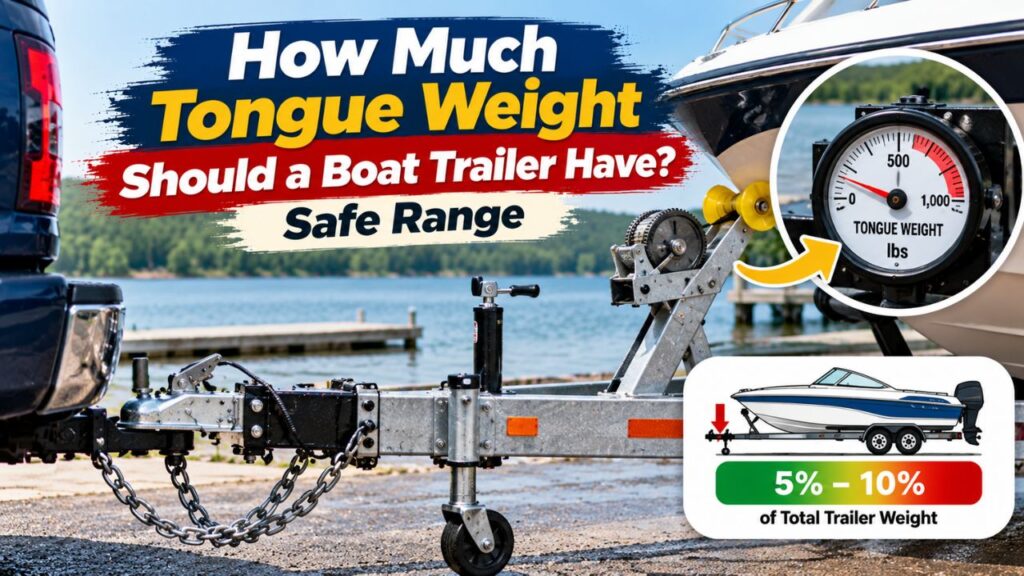
For many conventional boat trailers, tongue weight falls within approximately 5–10% of the actual loaded trailer weight. However, that is a broad reference range, not a universal specification.
The correct percentage depends on the trailer’s design, axle arrangement, boat positioning, and manufacturer requirements.
For example, Venture Trailers’ official axle adjustment guidance identifies 5–7% of total loaded trailer weight as its recommended tongue-weight range when the trailer is level.
Other manufacturers may specify a higher percentage.
The safest approach is to check the trailer owner’s manual and the tow vehicle’s towing instructions before selecting a target.
Recommended Tongue Weight for Common Boat Trailer Loads
The following table shows what different tongue-weight percentages mean for several loaded trailer weights.
| Loaded boat trailer weight | 5% tongue weight | 7% tongue weight | 10% tongue weight |
| 1,000 lbs | 50 lbs | 70 lbs | 100 lbs |
| 1,500 lbs | 75 lbs | 105 lbs | 150 lbs |
| 2,000 lbs | 100 lbs | 140 lbs | 200 lbs |
| 2,500 lbs | 125 lbs | 175 lbs | 250 lbs |
| 3,000 lbs | 150 lbs | 210 lbs | 300 lbs |
| 4,000 lbs | 200 lbs | 280 lbs | 400 lbs |
| 5,000 lbs | 250 lbs | 350 lbs | 500 lbs |
| 6,000 lbs | 300 lbs | 420 lbs | 600 lbs |
These values are calculated examples, not approved tongue-weight ranges for every trailer.
A 3,000-pound boat trailer, for instance, would have 150 pounds of tongue weight at 5%, 210 pounds at 7%, and 300 pounds at 10%.
If the trailer manufacturer specifies 5–7%, the applicable range would be 150–210 pounds.
If the manufacturer specifies 7–10%, the range would instead be 210–300 pounds.
Always confirm that the recommended load also meets the tow vehicle’s and hitch equipment’s requirements.
Why Boat Trailer Tongue Weight Recommendations Differ
Boat trailers often have long tongues and axle positions designed around the weight distribution of a particular boat.
The location of the engine, fuel tank, batteries, and other equipment affects the boat’s center of gravity.
Small changes in that center of gravity can change how much weight presses down on the hitch ball.
For comparison, Boston Whaler’s boat trailering guidance recommends tongue weight of approximately 7–10% of the combined boat and trailer weight.
This illustrates why one percentage should not be applied to every boat-and-trailer combination.
Key Takeaway: The trailer manufacturer’s specified range takes priority over a general rule of thumb, provided it is also compatible with the tow vehicle’s towing requirements.
How to Calculate Boat Trailer Tongue Weight
Boat trailer tongue weight is calculated by multiplying the actual loaded trailer weight by the intended tongue-weight percentage.
The formula is:
Tongue Weight (lbs) = Total Loaded Trailer Weight (lbs) × Tongue Weight Percentage
Convert the percentage into decimal form before multiplying.
For example:
- 5% = 0.05
- 6% = 0.06
- 7% = 0.07
- 10% = 0.10
This calculation provides a target. It does not measure the actual downward force at the coupler.
A scale is necessary to confirm the actual tongue weight.
Example: Calculating Tongue Weight for a 2,500-Pound Boat Trailer
Suppose a boat and its fully loaded trailer weigh 2,500 pounds.
If the trailer manufacturer specifies 5–7% tongue weight:
Minimum:
2,500 × 0.05 = 125 pounds
Maximum:
2,500 × 0.07 = 175 pounds
The recommended range for this example is 125–175 pounds.
If the target is 6%:
2,500 × 0.06 = 150 pounds
The calculated target would be 150 pounds.
However, the actual tongue weight must still be measured to verify that the boat is positioned correctly.
Example: Calculating Tongue Weight for a 5,000-Pound Boat Trailer
Consider a loaded boat trailer weighing 5,000 pounds.
At 5%:
5,000 × 0.05 = 250 pounds
At 7%:
5,000 × 0.07 = 350 pounds
At 10%:
5,000 × 0.10 = 500 pounds
This means the tongue weight would be 250–350 pounds for a trailer requiring 5–7%, or 350–500 pounds for one requiring 7–10%.
The correct target must come from the specific trailer and tow vehicle requirements, not simply from the total weight.
What Weight Should Be Included in the Calculation?
Use the actual fully loaded trailer weight, not just the boat’s advertised dry weight.
Include:
- Boat hull
- Outboard or inboard engine
- Trailer frame and running gear
- Fuel in the boat’s tank
- Batteries
- Fishing equipment
- Anchors and ropes
- Safety equipment
- Onboard water and other fluids
- Permanently installed accessories
- Other equipment carried on the trailer
For example, a boat advertised with a 2,000-pound dry weight will generally weigh more when it is equipped with an engine, fuel, batteries, and accessories.
The trailer’s own weight must also be included.
The most accurate approach is to weigh the loaded boat and trailer rather than relying entirely on published dry weights.
How to Measure Tongue Weight on a Boat Trailer
A tongue-weight scale is one of the most direct ways to measure the downward force at the trailer coupler.
The measurement should be taken with the boat fully loaded and positioned as it will be during towing.
The trailer also needs to be at its normal towing attitude.
Method 1: Use a Dedicated Trailer Tongue Weight Scale
A purpose-built tongue-weight scale is designed to measure the vertical force applied at the trailer’s hitch connection.
Choose a scale with sufficient capacity for the expected load.
Follow these steps:
- Park on firm, level ground. Make sure the tow vehicle and trailer are not positioned on a slope.
- Load the boat normally. Include the fuel, batteries, gear, and accessories that will travel with the boat.
- Secure the boat. Confirm that the bow is positioned correctly and the required tie-downs are attached.
- Chock the trailer wheels. Prevent the trailer from rolling while it is disconnected.
- Set up the scale beneath the coupler. Use the manufacturer’s approved support arrangement and position it at the normal hitch-ball height.
- Transfer the tongue load onto the scale. Lower the coupler carefully until its vertical load is supported by the scale.
- Read and record the weight. Compare the result with the trailer’s specified tongue-weight range.
The trailer should be supported securely throughout the process.
Never place hands or feet beneath an unsupported coupler or trailer frame.
After measuring, reconnect the trailer correctly and secure the coupler, safety chains, and electrical connection.
Method 2: Measure With a Household Scale
A suitable household scale may be used for some lightweight trailers when the expected tongue load is within the scale’s rated capacity.
However, the arrangement must remain stable and the scale must be able to support the force safely.
The coupler should be positioned at normal towing height.
Do not place a heavy trailer tongue onto an underrated bathroom scale or use unstable stacks of blocks to raise the scale.
For heavier trailers, use a purpose-built tongue scale or professional weighing equipment.
Important: A measurement taken directly beneath the tongue jack may differ from the actual coupler load because the jack is located at a different distance from the trailer axles.
For an accurate reading, measure at the coupler or use an appropriate correction method.
Method 3: Use a Commercial Vehicle Scale
A commercial scale can be useful for larger boat trailers or when the total trailer weight is uncertain.
One approach is to obtain two tow-vehicle weight readings under controlled conditions.
- Load the boat and trailer exactly as they will be towed.
- Weigh the tow vehicle with the trailer connected, keeping the trailer wheels off the weighing platform.
- Disconnect and safely park the trailer.
- Weigh the tow vehicle alone with the same passengers, fuel, and cargo.
- Subtract the tow vehicle’s unhitched weight from its hitched weight.
The difference represents the vertical load transferred from the trailer to the tow vehicle, provided the measurements are taken correctly.
A commercial weighing service can help ensure that the platform arrangement and procedures produce reliable readings.
To calculate tongue-weight percentage, obtain the actual total loaded trailer weight as well.
Single-Axle vs. Tandem-Axle Boat Trailer Tongue Weight
The number of trailer axles influences weight distribution, but it does not establish one universal tongue-weight percentage.
Single-axle and tandem-axle boat trailers can have different recommendations depending on their design.
Single-Axle Boat Trailer Tongue Weight
A single-axle trailer supports its load primarily through one axle assembly and the hitch connection.
The boat’s position relative to that axle has a strong effect on tongue weight.
Moving the boat forward increases the load supported by the coupler.
Moving it rearward decreases the load.
Some single-axle boat trailers use a recommended range near 5–7%, while other designs require more.
A single-axle trailer should never be assumed safe at 5% without checking its specifications.
Tandem-Axle Boat Trailer Tongue Weight
A tandem-axle trailer uses two axles to support the load.
Larger boats commonly use tandem-axle trailers because the total weight exceeds what a suitable single-axle configuration can carry.
Some tandem-axle designs specify relatively low tongue-weight percentages, but this is not a universal rule.
Axle spacing, suspension design, hitch geometry, and boat position all affect the required load.
Also, tandem axles must share weight appropriately.
A trailer that is excessively nose-high or nose-low can distribute weight unevenly between axle groups.
Does a Tandem-Axle Trailer Need Less Tongue Weight?
Sometimes, but not always.
The proper tongue weight depends on the trailer’s engineered loading requirements.
Do not automatically reduce the tongue-weight percentage simply because the trailer has two axles.
Check the manufacturer specifications and measure the actual load with the trailer positioned at its intended towing height.
What Happens if Boat Trailer Tongue Weight Is Too Low?
Insufficient tongue weight can make a boat trailer unstable.
A trailer needs adequate downward force at the hitch to help maintain controlled movement behind the tow vehicle.
When too much of the load is carried behind the trailer axles, the trailer becomes more susceptible to side-to-side oscillation.
Trailer Sway and Fishtailing
Trailer sway describes unwanted side-to-side movement of the trailer.
Fishtailing is a more pronounced form of this movement that can become dangerous if the oscillations increase.
Possible contributing conditions include:
- Tongue weight below the specified range
- Excessive weight positioned behind the trailer axles
- Improper boat placement
- Incorrect tire pressures
- Unbalanced loading
- Excessive towing speed
- Crosswinds or passing traffic
Low tongue weight is a significant risk factor, but it is not the only possible cause of trailer sway.
If a trailer begins swaying while driving, avoid sudden steering corrections and abrupt acceleration. Gradually reduce speed while maintaining control, follow the tow vehicle manufacturer’s sway-recovery instructions, and stop in a safe location to inspect the setup.
Do not continue highway towing with a trailer that repeatedly fishtails.
Why Loading Gear at the Rear Can Cause Problems
Heavy equipment stored near the stern can move the boat’s combined center of gravity rearward.
This can reduce the load carried by the hitch.
Examples include large removable equipment boxes, heavy fishing gear, and other substantial items placed behind the trailer’s axle group.
Even if the boat was correctly positioned when the trailer was initially adjusted, changes in cargo placement may affect the balance.
Secure equipment and measure tongue weight again after significant loading changes.
What Happens if Boat Trailer Tongue Weight Is Too High?
Excessive tongue weight places additional downward force on the back of the tow vehicle.
This can affect vehicle handling and may overload one or more towing components.
Excessive Rear Suspension Compression
A trailer with too much tongue weight may cause the tow vehicle’s rear suspension to compress noticeably.
However, visible rear-end sag is not a reliable measurement of tongue weight.
Some vehicles have stiffer suspension systems than others, and ride-height changes depend on suspension design.
A vehicle may exceed its hitch or axle rating without looking severely overloaded.
Reduced Front-Wheel Traction and Steering Control
An excessive load behind the vehicle’s rear axle can shift weight away from the front axle.
This may reduce steering response and front-wheel traction.
It can also affect braking behavior and vehicle stability.
The severity depends on the tow vehicle’s wheelbase, suspension, load distribution, and towing configuration.
Overloading the Hitch or Rear Axle
Every tow vehicle and hitch receiver has specific weight limits.
Excess tongue weight can overload:
- Hitch receiver
- Ball mount
- Hitch ball
- Rear axle
- Suspension components
- Tires
- Vehicle payload capacity
These limits apply even when the trailer’s total weight is below the vehicle’s advertised towing capacity.
Safety Note: Never increase tongue weight beyond the lowest applicable equipment or vehicle rating simply to make the trailer feel more stable.
How to Adjust Boat Trailer Tongue Weight Safely
Tongue weight can sometimes be corrected by changing the distribution of movable equipment.
Other situations require adjustments to the position of the boat or trailer axles.
Start with the least disruptive solution and measure the result after each change.
1. Move Securely Stored Gear Forward or Backward
For small corrections, adjust the position of movable cargo while keeping it properly secured.
To increase tongue weight, moving suitable equipment forward may help.
To decrease tongue weight, moving it rearward may help.
However, avoid placing heavy cargo at the extreme ends of the boat merely to change the hitch reading.
Weight should remain appropriately distributed from side to side and as low as practical.
Do not relocate permanently installed fuel tanks, batteries, or other equipment without considering manufacturer requirements, electrical connections, ventilation, and safety.
2. Check the Boat’s Position on the Trailer
The position of the hull relative to the axles influences the tongue load.
Moving the boat forward generally increases tongue weight.
Moving the boat backward generally reduces it.
However, boat positioning must also satisfy the hull-support requirements.
The transom, bunks, rollers, bow stop, and winch post should be positioned according to the boat and trailer manufacturer’s instructions.
Moving the boat backward too far can leave the transom inadequately supported.
Likewise, moving it forward without checking the bow support can create excessive pressure on the hull.
Small position changes should be verified with a scale, and significant adjustments are best handled by a trailer dealer.
3. Adjust the Trailer Axle Position
Some boat trailers use adjustable axle assemblies.
Changing axle position affects how much weight is carried by the coupler.
The general relationship is:
- Moving the axle assembly backward increases tongue weight.
- Moving the axle assembly forward decreases tongue weight.
This works because the boat’s center of gravity shifts relative to the axle support point.
However, moving a trailer axle is a mechanical adjustment that affects alignment and suspension geometry.
It may also affect brake lines, electrical wiring, fender clearance, and load distribution.
For tandem-axle trailers, the axle group must remain properly aligned.
Axle repositioning should follow the trailer manufacturer’s procedures and is generally best performed by a qualified trailer technician.
Do not loosen axle mounting hardware on a loaded or unsupported trailer.
4. Check the Trailer’s Towing Height
A trailer that is substantially nose-high or nose-low may not distribute its load as intended.
This is particularly important for tandem-axle trailers.
Use a ball mount with the correct rise or drop so the loaded trailer sits at the attitude specified by its manufacturer.
Verify the hitch ball size and all component weight ratings.
Do not assume that changing hitch height is a substitute for correcting improperly positioned cargo or axles.
After making an appropriate height adjustment, recheck the actual tongue weight.
5. Measure Again After Every Adjustment
Never assume that moving a boat or axle by a particular distance will change tongue weight by a predictable number of pounds.
The result depends on the trailer’s dimensions, boat weight, and center of gravity.
Use the scale again after each significant adjustment.
Continue only when the tongue weight falls within the specified range and all towing equipment ratings are satisfied.
Boat Trailer Tongue Weight vs. Hitch and Vehicle Capacity
Correct tongue-weight percentage is only one part of safe towing.
The loaded boat trailer must also remain within the limits of the tow vehicle and towing equipment.
Tongue Weight Is Not the Same as Towing Capacity
Towing capacity generally refers to the maximum trailer weight a properly equipped vehicle is rated to tow under specified conditions.
Tongue weight is the downward force applied at the hitch connection.
For example, a vehicle rated to tow 5,000 pounds is not automatically approved to carry 500 pounds of tongue weight.
The vehicle may have a separate maximum tongue-weight rating.
Always check both limits.
Check Every Applicable Weight Rating
Before towing, verify the following:
| Rating | What it limits |
| Maximum trailer weight | Loaded trailer weight the vehicle can tow |
| Maximum tongue weight | Permitted vertical load at the hitch |
| Trailer GVWR | Maximum allowable loaded trailer weight |
| Trailer GAWR | Maximum weight carried by the rated axle or axle group |
| Vehicle GVWR | Maximum allowable loaded tow vehicle weight |
| Vehicle GCWR | Maximum combined weight of vehicle and trailer |
| Hitch and ball ratings | Loads supported by individual towing components |
| Vehicle payload capacity | Weight of occupants, cargo, and trailer tongue load |
The trailer’s gross vehicle weight rating (GVWR) is a maximum rating, not necessarily its actual loaded weight.
Use actual loaded weight when calculating the tongue-weight percentage.
The trailer tongue load also contributes to the load carried by the tow vehicle and must be considered when checking vehicle payload and axle limits.
If the trailer manufacturer and tow vehicle specify incompatible loading requirements, do not simply choose one range and ignore the other.
Consult the manufacturers or a qualified towing specialist to determine whether the combination is suitable.
Common Boat Trailer Tongue Weight Mistakes
Several measurement and loading errors can produce an incorrect tongue-weight target.
| Mistake | Why it causes problems | Better approach |
| Using only the boat’s dry weight | Excludes fuel, equipment, and trailer weight | Use actual loaded trailer weight |
| Using trailer GVWR in the formula | A rating may be higher than the actual load | Weigh the loaded trailer |
| Assuming every boat trailer needs 10–15% | Some boat trailer manufacturers specify lower ranges | Follow model-specific instructions |
| Measuring at the wrong height | May change the trailer’s loading geometry | Measure at normal towing height |
| Measuring only at the tongue jack | Jack location differs from the coupler | Measure at the coupler or use a valid correction |
| Ignoring heavy stern equipment | Can reduce hitch load | Include normal cargo placement |
| Adjusting axles without checking alignment | Can affect handling and component wear | Use manufacturer procedures |
| Ignoring hitch limits | Tongue load may exceed component ratings | Check every applicable rating |
Why You Should Not Rely on Rear Suspension Sag
Some boat owners estimate tongue weight by observing how much the tow vehicle’s rear end drops after connecting the trailer.
This is not an accurate measurement method.
Suspension stiffness, spring design, additional cargo, and vehicle wheelbase all influence ride height.
A dedicated scale provides a more useful measurement.
Why Trailer GVWR Should Not Be Used as Actual Weight
Suppose a trailer has a GVWR of 5,000 pounds but actually weighs 3,200 pounds with the boat and equipment loaded.
Calculating 7% of the GVWR gives:
5,000 × 0.07 = 350 pounds
Calculating 7% of the actual loaded weight gives:
3,200 × 0.07 = 224 pounds
The difference is 126 pounds.
That is enough to demonstrate why actual loaded trailer weight matters.
The GVWR remains important for confirming that the trailer is not overloaded, but it should not be substituted for actual weight when calculating tongue-weight percentage.
When Should You Recheck Boat Trailer Tongue Weight?
Tongue weight should be checked after changes that may affect the boat’s weight distribution.
It is particularly important when:
- A different boat is placed on the trailer.
- The trailer axle position is changed.
- The winch post or hull support arrangement is adjusted.
- Heavy accessories are installed or removed.
- Batteries or other equipment are relocated.
- Significant cargo is added or moved.
- The towing setup changes.
- The trailer begins showing unexplained handling problems.
Fuel and onboard water levels can also affect the load distribution, depending on tank locations.
A trailer that was correctly balanced while empty of fuel may carry a different tongue load after the boat is fully prepared for a trip.
For normal towing, check that the boat is secured, the hitch is locked, the safety chains are attached, and the tires and brakes are in suitable condition.
Any unexpected sway, severe rear sag, or change in handling should be investigated before continuing the trip.
Conclusion
How much tongue weight should a boat trailer have? A commonly referenced range is approximately 5–10% of the fully loaded trailer weight, but the correct target depends on the trailer’s specific requirements. Some manufacturers recommend 5–7%, while others specify 7–10%.
For example, a 3,000-pound loaded boat trailer would carry 150–210 pounds at 5–7%, or 210–300 pounds at 7–10%.
The most reliable approach is to weigh the complete boat-and-trailer combination, calculate the manufacturer’s recommended range, and verify the actual hitch load with a suitable scale.
Keep the boat properly supported, avoid excessive rear-heavy loading, and confirm that the tow vehicle, hitch, and trailer remain within their weight ratings.
Correct tongue weight helps reduce trailer sway and supports stable, predictable towing.
FAQs About How Much Tongue Weight Should a Boat Trailer Have
Is 5% Tongue Weight Enough for a Boat Trailer?
It can be sufficient for a boat trailer whose manufacturer specifies a range beginning at 5%, provided all other towing requirements are satisfied.
However, 5% is too low for trailers that require a higher minimum. Always use the specified range for the trailer and tow vehicle.
Is 10% Tongue Weight Too Much for a Boat Trailer?
Not necessarily. Some boat trailer manufacturers recommend tongue weight up to approximately 10%.
However, 10% would exceed the specified range for a trailer designed to carry only 5–7%. It may also overload a tow vehicle or hitch with a lower tongue-weight limit.
How Much Tongue Weight Should a 3,000-Pound Boat Trailer Have?
At 5–7%, a 3,000-pound loaded boat trailer would have 150–210 pounds of tongue weight.
At 7–10%, the corresponding range would be 210–300 pounds.
Use the range specified for the actual trailer model and confirm it does not exceed towing equipment limits.
How Much Tongue Weight Should a 5,000-Pound Boat Trailer Have?
A 5,000-pound loaded boat trailer would carry 250–350 pounds at 5–7%, or 350–500 pounds at 7–10%.
These are mathematical examples. The manufacturer determines which percentage range is appropriate for the trailer.
Does Moving a Boat Forward Increase Tongue Weight?
Yes. Moving the boat forward relative to the trailer axles generally increases tongue weight.
However, the hull must remain properly positioned on its bunks or rollers, with adequate support at the transom and bow.
Do not move the boat beyond its approved support positions simply to change the hitch load.
Does Moving the Trailer Axle Forward Reduce Tongue Weight?
Yes. Moving an adjustable axle assembly forward generally decreases tongue weight.
Moving it backward generally increases tongue weight.
Because axle repositioning affects alignment and other components, follow manufacturer instructions and use qualified assistance when necessary.
Can Too Little Tongue Weight Cause Trailer Sway?
Yes. Insufficient tongue weight is a recognized cause of trailer sway and fishtailing.
However, other factors such as excessive speed, improper tire inflation, and unbalanced cargo can also contribute.
If the trailer sways repeatedly, stop towing until the cause has been identified and corrected.