To adjust tongue weight on a boat trailer, move properly secured gear forward or backward, reposition the boat within its approved support limits, or adjust the axle assembly if the trailer manufacturer allows it. Moving weight toward the trailer’s front generally increases tongue weight, while moving weight toward the rear decreases it.
Correct tongue weight helps keep a boat trailer stable during towing. Too little weight on the hitch can contribute to trailer sway or fishtailing, especially at highway speeds. Excessive tongue weight can overload the hitch or tow vehicle and negatively affect steering and handling.
Unlike many conventional cargo trailers, boat trailers may have different manufacturer-recommended tongue weight percentages. Some specify 5–7% of the fully loaded trailer weight, while others recommend 7–10%.
Adjusting the trailer without measuring its actual weight can create additional problems. Even a small change in boat position or axle location can affect the balance.
In this article, I explain how to measure boat trailer tongue weight, calculate the appropriate range, and make adjustments using cargo placement, the winch stand, or adjustable axles. You’ll also learn how to recognize incorrect weight distribution, protect the boat’s hull supports, and verify that the trailer is safe before towing.
How to Adjust Tongue Weight on Boat Trailer Step by Step
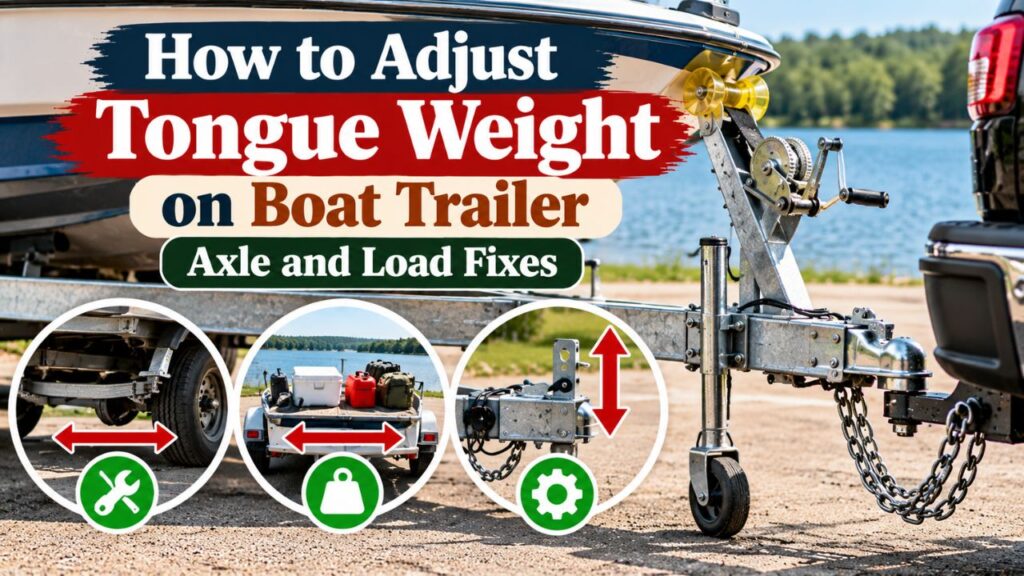
Start with the least invasive adjustment and verify the result before making additional changes.
The goal is to achieve the manufacturer’s specified tongue weight without compromising boat support, trailer capacity, or towing safety.
Step 1: Park the Boat Trailer on Level Ground
Move the boat trailer to a firm, level surface with enough room to inspect the frame, hitch, and axle assembly.
Before making any adjustments:
- Park the tow vehicle and trailer on level ground.
- Apply the tow vehicle’s parking brake.
- Chock the trailer wheels securely.
- Verify that the boat is correctly seated on its bunks or rollers.
- Check the bow stop, winch strap, safety chain, and transom tie-downs.
- Confirm that the trailer’s tires are properly inflated.
Don’t begin adjusting the axle or winch stand on a steep driveway or unstable surface.
The boat and trailer must remain safely supported throughout the process.
Step 2: Measure the Fully Loaded Trailer Weight
Determine the actual weight of the boat and trailer together.
Include everything normally transported:
- Boat hull
- Outboard or inboard engine
- Trailer
- Normal fuel load
- Batteries
- Anchors and fishing equipment
- Coolers and other secured gear
- Permanently installed accessories
A commercial vehicle scale is a practical way to obtain the actual loaded weight.
For an accurate measurement, weigh the trailer in its normal towing configuration.
Important: Gross trailer weight is the actual weight of the loaded trailer. Gross Vehicle Weight Rating (GVWR) is the manufacturer’s maximum permitted trailer weight, not necessarily what the trailer currently weighs.
Don’t exceed the trailer’s GVWR or its axle and tire ratings.
Step 3: Calculate the Recommended Tongue Weight
Check the trailer manufacturer’s instructions before selecting a target percentage.
Boat trailer manufacturers don’t all specify the same range.
For example, ShoreLand’r’s boat-to-trailer measuring guide identifies a 5–7% acceptable tongue weight range and provides model-specific guidance for single- and tandem-axle trailers.
By comparison, Load Rite’s official trailering guidance discusses a 7–10% ideal range for many trailers while also referencing 5–7% for certain models.
These differences make the manufacturer-specific recommendation particularly important.
Use this formula:
Tongue weight (lb.) = Loaded trailer weight (lb.) × Target percentage
For example, if the loaded boat trailer weighs 3,000 pounds:
| Target Percentage | Tongue Weight |
| 5% | 150 lb. |
| 6% | 180 lb. |
| 7% | 210 lb. |
| 8% | 240 lb. |
| 9% | 270 lb. |
| 10% | 300 lb. |
If your trailer manufacturer specifies 5–7%, the target range would be 150–210 pounds.
If it specifies 7–10%, the range would be 210–300 pounds.
These are examples, not universal requirements. Always follow the applicable trailer guidance and the limits of your tow vehicle, hitch receiver, ball mount, and coupler.
Step 4: Measure the Current Tongue Weight
Use a dedicated tongue weight scale or another properly rated weighing method.
The measurement should represent the downward load at the trailer coupler when it is positioned at normal towing height.
For a dedicated scale:
- Park on a firm, level surface and chock the trailer wheels.
- Keep the boat loaded as it will be during normal towing.
- Set the coupler to its normal towing height.
- Support the trailer securely according to the scale manufacturer’s instructions.
- Place the scale at the specified coupler measurement point.
- Transfer the tongue load onto the scale carefully.
- Record the reading.
A suitably rated bathroom scale may work for some lightweight trailers, but don’t exceed its capacity.
For heavier trailers, use equipment rated for the load or arrange professional weighing.
Important: A reading taken under the trailer jack at a point behind the coupler isn’t automatically the same as the true coupler tongue weight. The distance from the axle changes the force measured at that point.
Step 5: Adjust the Weight Distribution
Compare the measured tongue weight with the required range.
If it is too low, you generally need to shift some load forward relative to the axle or move an adjustable axle assembly rearward.
If it is too high, shift some load rearward or move an adjustable axle assembly forward.
| Problem | Possible Adjustment |
| Tongue weight too low | Move secured movable gear forward |
| Tongue weight too high | Move secured movable gear rearward |
| Boat positioned too far rearward | Move boat forward only if proper hull support is maintained |
| Boat positioned too far forward | Move boat rearward only if support geometry allows |
| Adjustable axle needs more tongue load | Move axle assembly backward |
| Adjustable axle needs less tongue load | Move axle assembly forward |
Moving the boat or axle involves greater mechanical and safety risks than relocating portable gear.
Only make structural adjustments permitted by the trailer manufacturer. When the correct procedure or equipment is uncertain, have a qualified boat trailer dealer perform the work.
Step 6: Recheck Tongue Weight and Trailer Setup
After each adjustment, measure the tongue weight again.
Don’t assume that moving an axle or boat a certain distance will produce a fixed change in pounds.
The result depends on the trailer’s geometry, total load, and center of gravity.
Once the reading meets the specified range, inspect the trailer for:
- Proper hull support
- Correct bow stop contact
- Secure winch and safety chain
- Properly installed transom tie-downs
- Tightened mounting hardware
- Safe brake-line and wiring clearance
- Adequate tire and fender clearance
Don’t tow the trailer until all adjustments are complete and the rig meets the applicable weight and equipment limits.
How to Increase Tongue Weight on a Boat Trailer
Increasing tongue weight transfers more of the loaded trailer’s downward force to the hitch.
This is commonly necessary when the trailer has insufficient weight ahead of its axle or axle group.
Move Portable Gear Toward the Bow
For a small adjustment, reposition suitable portable equipment toward the front of the boat.
Examples include:
- Anchors and associated gear
- Fishing tackle
- Secured coolers
- Removable equipment stored in approved compartments
Keep the load low, close to the boat’s centerline, and properly secured.
Don’t move gear into areas that aren’t designed to carry it.
Avoid relocating permanently installed batteries, engines, or fuel systems without evaluating the boat manufacturer’s requirements.
Shifting unsecured equipment forward is not a reliable correction because it may move again during braking or travel.
Move the Boat Forward When Its Support Position Allows
Moving the boat forward relative to the trailer axle generally increases tongue weight.
However, the boat must remain properly supported.
Check the trailer’s bunk or roller arrangement and the boat manufacturer’s recommendations for transom support.
Moving the boat can require repositioning the winch stand and possibly other supports.
Do not simply pull the boat forward until the scale shows a desirable number.
The hull could become improperly supported, particularly near the transom.
A boat that needs substantial repositioning should be adjusted using the manufacturer’s loading procedure or by a qualified trailer specialist.
Move an Adjustable Axle Backward
On trailers designed with an adjustable axle assembly, moving the axle rearward generally increases tongue weight.
The change shifts the axle support farther behind the loaded trailer’s center of gravity.
However, axle movement affects more than tongue weight.
It can change:
- Axle alignment
- Wheel and fender clearances
- Brake-line routing
- Wiring harness clearance
- Suspension mounting positions
- Trailer stability
Axle adjustment requires proper support equipment and the manufacturer’s fastening and alignment procedures.
Don’t loosen suspension mounting hardware on an improperly supported or loaded trailer.
For most owners, significant axle repositioning is best handled by a trailer service professional.
How to Decrease Tongue Weight on a Boat Trailer
Excessive tongue weight places more downward load on the hitch and tow vehicle.
If the reading exceeds the permitted range, identify the source of the forward-heavy balance.
Move Secured Gear Toward the Stern
Relocating some movable gear rearward can reduce tongue weight.
Start with items that can be safely repositioned without affecting the boat’s systems or structural loading limits.
For example, moving a properly secured cooler or anchor may make a measurable difference.
However, don’t pile heavy equipment at the transom.
Excessive rear loading can create a different balance problem, increase trailer sway risk, or exceed compartment and support limits.
Reweigh after every meaningful change.
Reposition the Boat Rearward if Permitted
Moving the boat rearward generally decreases tongue weight.
This should only be done when the trailer’s support system and boat manufacturer allow the resulting hull position.
Pay special attention to the transom.
Excessive overhang beyond the rear bunks or rollers can leave the hull improperly supported and may lead to structural damage.
The bow stop, winch stand, and tie-down geometry must also remain correct.
If the boat is already properly positioned on its supports, moving the axle may be the more appropriate adjustment.
Move an Adjustable Axle Forward
Moving an adjustable axle toward the trailer tongue generally decreases tongue weight.
The axle takes a greater share of the load as its position moves closer to the loaded trailer’s center of gravity.
However, moving it too far forward can reduce tongue weight below the safe range.
This may cause unstable towing behavior.
Use the manufacturer-approved adjustment procedure and verify the final weight using a scale.
If the trailer has nonadjustable axles, don’t attempt to modify their mounting arrangement without manufacturer approval.
How to Adjust Boat Trailer Tongue Weight Using the Winch Stand
Many boat trailers have an adjustable winch stand mounted on the tongue.
The winch stand supports the bow stop and provides a winch for loading and securing the boat.
Its position can influence where the boat sits on the trailer, but there is an important distinction.
Moving the winch stand alone doesn’t meaningfully change tongue weight if the boat stays in the same position.
The tongue weight changes when the boat’s center of gravity moves relative to the axle.
Moving the Winch Stand Forward
On a compatible adjustable trailer, repositioning the winch stand forward may allow the boat to sit farther forward.
That generally increases tongue weight.
However, the winch stand must be positioned to maintain proper bow roller contact and the manufacturer’s required bow-eye arrangement.
Don’t loosen the winch stand while it is supporting an unsecured boat.
On roller trailers, the boat can move unexpectedly if the restraint system is disturbed.
Use the manufacturer’s procedure for unloading, supporting, repositioning, and securing the boat.
Moving the Winch Stand Backward
Moving the winch stand backward may allow the boat to be positioned farther rearward, reducing tongue weight.
But rearward boat movement is limited by hull support requirements.
If moving the boat creates excessive transom overhang, the adjustment isn’t acceptable even if the tongue weight becomes correct.
Check the Bow Stop and Winch Strap
After any winch stand adjustment, verify:
- Bow stop contact with the hull
- Correct bow-eye position
- Winch strap alignment
- Secure mounting hardware
- Proper bow-eye safety chain attachment
- Adequate clearance during launching and retrieval
The winch strap shouldn’t be treated as the only restraint holding the boat on the trailer.
Use the required bow and stern securement systems.
How to Adjust Tongue Weight on Single-Axle and Tandem-Axle Boat Trailers
The basic balance principle is the same, but the adjustment process can differ significantly.
Single-Axle Boat Trailers
A single-axle trailer has one axle supporting the majority of its weight.
Tongue weight changes when the loaded center of gravity moves forward or backward relative to that axle.
If the axle is adjustable, moving it rearward generally increases tongue weight.
Moving it forward decreases tongue weight.
Many small boat trailers have fixed axle positions.
In those cases, properly secured gear placement or approved boat repositioning may be the available methods.
Tandem-Axle Boat Trailers
A tandem-axle trailer uses two axles.
The relationship between the boat’s center of gravity and the effective axle-group support position determines tongue weight.
When the manufacturer permits axle-group adjustment, the assemblies generally need to remain correctly aligned and spaced.
Don’t move only one axle independently unless the manufacturer specifically prescribes that adjustment.
Improper tandem-axle positioning can affect suspension load sharing, tire wear, and braking behavior.
For tandem-axle boat trailers, professional axle adjustment is strongly recommended.
How to Tell if Boat Trailer Tongue Weight Is Too Low or Too High
Incorrect tongue weight can affect towing stability, although similar symptoms may also result from tire, suspension, hitch, or loading problems.
A scale measurement is necessary to confirm the actual tongue load.
Signs of Too Little Tongue Weight
A trailer with insufficient tongue weight may show:
- Side-to-side sway
- Fishtailing tendencies
- Increased sensitivity to passing vehicles or crosswinds
- Unstable tracking at highway speeds
- Excessive movement after steering corrections
Insufficient tongue weight can make a trailer difficult to control.
If sway begins while towing, avoid abrupt steering or braking. Reduce speed smoothly, stop somewhere safe, and identify the cause before continuing.
Do not accelerate in an attempt to stabilize the trailer.
Signs of Too Much Tongue Weight
Excessive tongue weight can create:
- Significant rear suspension compression on the tow vehicle
- Reduced front-axle loading and affected steering
- Headlights pointing unusually high
- Reduced ground clearance at the hitch
- Excessive hitch or receiver loading
These symptoms don’t prove that tongue weight is the only problem.
Vehicle suspension condition, cargo placement, and hitch height can produce similar effects.
Measure the actual tongue weight and check all relevant ratings.
How Much Should Boat Trailer Tongue Weight Be?
The correct percentage depends on the particular trailer.
Unlike a generic towing recommendation, boat-trailer tongue weight should be established using the manufacturer’s specification.
A range commonly encountered in boat-trailer guidance is approximately 5–10%, but individual manufacturers may prescribe a narrower range.
Tongue Weight Examples by Loaded Trailer Weight
| Loaded Trailer Weight | 5–7% Range | 7–10% Range |
| 1,000 lb. | 50–70 lb. | 70–100 lb. |
| 1,500 lb. | 75–105 lb. | 105–150 lb. |
| 2,000 lb. | 100–140 lb. | 140–200 lb. |
| 3,000 lb. | 150–210 lb. | 210–300 lb. |
| 4,000 lb. | 200–280 lb. | 280–400 lb. |
| 5,000 lb. | 250–350 lb. | 350–500 lb. |
Use the column corresponding to your trailer manufacturer’s instructions, not whichever value seems easier to achieve.
The percentage alone doesn’t establish whether the combination is safe.
The resulting tongue weight must also remain within the rated limits of the tow vehicle and every applicable hitch component.
Why Tongue Weight Percentage Matters
Tongue weight is one part of the trailer’s overall weight distribution.
When the loaded center of gravity is too far rearward relative to the axle, the hitch carries less downward load.
If the center of gravity moves farther forward, tongue weight generally increases.
The correct balance provides sufficient hitch loading while avoiding excessive stress on the towing system.
Changing the coupler height alone is not a substitute for correcting actual weight distribution.
How Much Does Moving the Boat Trailer Axle Change Tongue Weight?
There isn’t one universal answer.
The effect depends on:
- Total loaded trailer weight
- Distance between the axle and coupler
- Position of the boat’s center of gravity
- Existing tongue weight
- Distance the axle is moved
- Trailer suspension and geometry
On some trailers, a small axle movement creates a meaningful tongue weight change.
On others, the same movement produces a different result.
Don’t assume that moving an axle 1 inch will always change tongue weight by a specific number of pounds.
Use small, manufacturer-approved adjustments where appropriate and measure the result after each change.
If significant repositioning is required, contact the trailer manufacturer or a qualified dealer.
Boat Trailer Tongue Weight Adjustment Mistakes to Avoid
Several mistakes can create serious towing or boat-support problems.
Guessing Tongue Weight Without a Scale
A trailer may appear level while carrying an incorrect amount of weight at the hitch.
Vehicle suspension sag isn’t an accurate tongue weight measurement.
Use a scale rather than judging the load by appearance.
Using the Wrong Tongue Weight Percentage
Don’t automatically apply a 10–15% conventional-trailer guideline to every boat trailer.
Boat trailer manufacturers may specify different ranges.
Use the requirement for your model and verify compatibility with the tow vehicle.
Moving the Boat Beyond Its Proper Bunk Support
A boat must remain supported according to its hull and trailer requirements.
Moving it too far rearward can leave the transom inadequately supported.
Moving it too far forward can also create interference or incorrect support contact.
Correct tongue weight cannot compensate for improper hull support.
Moving Axles Without Checking Brake Lines
Adjustable axle systems may have hydraulic brake lines, electrical cables, and suspension components that restrict movement.
Stretching or damaging these parts can create brake failures or other hazards.
Don’t move the axle without following the manufacturer’s procedure.
Forgetting to Secure Relocated Gear
Movable equipment must stay in place during acceleration, braking, and turns.
A heavy item that slides toward the stern can change weight distribution while traveling.
Secure equipment in approved storage locations.
Ignoring Hitch and Vehicle Ratings
A mathematically correct tongue weight percentage doesn’t make an overloaded towing setup safe.
Check the maximum tongue weight ratings of the receiver, ball mount, hitch ball, and other relevant components.
Also consider the tow vehicle’s payload, rear-axle rating, towing capacity, and gross combined weight rating.
The lowest applicable rating controls.
What to Check After Adjusting Boat Trailer Tongue Weight
Before towing, complete a final inspection.
Verify the Tongue Weight
Reweigh the trailer in its normal loaded condition and at the correct coupler height.
Confirm that the final reading falls within the manufacturer’s specified range.
Check Boat and Trailer Position
Confirm that:
- The hull is properly supported by bunks or rollers.
- Transom support meets the boat and trailer manufacturer’s instructions.
- The bow stop is correctly positioned.
- The winch strap and safety chain are secured.
- Stern tie-downs are properly attached.
- No parts interfere with the hull or engine.
Inspect Mechanical Components
Check the axle mounting hardware, suspension, brake lines, wiring, tires, and fender clearance.
Any hardware that was loosened must be tightened to the manufacturer’s specified torque.
If axle alignment or braking components were disturbed, have the installation inspected before road use.
Check the Tow Vehicle Connection
Verify that the hitch ball matches the coupler and that the coupler is fully latched.
Connect the safety chains and trailer electrical connector correctly.
If equipped, check the trailer breakaway cable and brake operation.
The trailer should ride at the height intended by its manufacturer.
Perform a Controlled Towing Check
After confirming the measured tongue weight and completing the mechanical inspection, begin with a cautious low-speed check in a suitable area.
Pay attention to:
- Trailer tracking
- Unusual noises
- Brake performance
- Steering response
- Abnormal movement
- Loose or shifting equipment
Stop and investigate any concerning behavior.
Do not treat a short road test as a replacement for correct scale measurements or manufacturer-approved adjustments.
When Should You Have a Boat Trailer Specialist Adjust Tongue Weight?
Some adjustments are relatively simple, such as moving a properly secured tackle box.
Others affect the trailer’s structural and mechanical systems.
Professional assistance is appropriate when:
- The trailer has tandem or triple axles requiring repositioning.
- Axle movement affects braking components.
- The boat must be significantly repositioned.
- Bunks or rollers need major adjustment.
- The trailer continues to sway despite correct measured tongue weight.
- The hitch or vehicle rating is insufficient.
- Suspension or mounting hardware is damaged.
- The manufacturer doesn’t provide a supported adjustment procedure.
A dealer familiar with the trailer model can assess boat position, support geometry, axle alignment, and actual tongue weight together.
This is particularly important for heavy boats, surge-brake trailers, and installations where an incorrect adjustment could damage the hull or compromise towing control.
Conclusion
Understanding how to adjust tongue weight on boat trailer setups starts with measuring the actual loaded trailer weight and checking the manufacturer’s specified tongue weight range.
For small corrections, moving properly secured portable gear forward or backward may be sufficient. Larger corrections may require approved boat repositioning or axle adjustment.
Moving an adjustable axle rearward generally increases tongue weight, while moving it forward decreases tongue weight. These changes must be made without compromising suspension alignment, braking systems, or hull support.
Never rely on estimates or visual inspection alone.
The safest approach is to measure the load, make an appropriate adjustment, reweigh the coupler, and inspect the complete towing setup before returning to the road.
FAQs About How to Adjust Tongue Weight on Boat Trailer
Can I Adjust Boat Trailer Tongue Weight Without Moving the Axle?
Yes. Small changes can often be made by moving properly secured portable gear forward or backward inside the boat.
On some trailers, approved boat repositioning can also change tongue weight. However, the boat must remain correctly supported by its bunks or rollers.
Does Moving a Boat Forward Increase Tongue Weight?
Yes. Moving the boat forward relative to the trailer axle generally increases tongue weight.
The boat’s center of gravity moves closer to the tongue, transferring more downward load to the hitch.
Only make the change when the resulting hull and transom support remain within the manufacturer’s requirements.
Does Moving the Trailer Axle Back Increase Tongue Weight?
Yes. On a trailer with an adjustable axle, moving the axle rearward generally increases tongue weight.
The axle moves farther behind the loaded center of gravity, increasing the load carried by the coupler.
Use the manufacturer’s approved procedure and remeasure afterward.
Can I Measure Boat Trailer Tongue Weight With a Bathroom Scale?
Yes, for some lightweight trailers when the expected load is safely within the scale’s rated capacity.
The measurement must be taken at the appropriate coupler position and normal towing height.
For heavier trailers, a dedicated tongue weight scale or professional weighing service is more appropriate.
Should Boat Trailer Tongue Weight Be 5% or 10%?
It depends on the trailer manufacturer and model.
Some boat trailers specify approximately 5–7%, while others recommend 7–10%.
Follow the manufacturer’s requirements and ensure the resulting load doesn’t exceed the tow vehicle or hitch limits.
Can Incorrect Tongue Weight Cause Boat Trailer Sway?
Yes. Insufficient tongue weight can contribute to sway or fishtailing.
However, sway can also result from tire problems, excessive speed, improper loading, suspension defects, or unsuitable trailer geometry.
Measure tongue weight and inspect the complete towing setup before determining the cause.
Should I Adjust Tongue Weight After Installing a Heavier Outboard Motor?
You should recheck the loaded trailer weight and tongue weight after installing a heavier outboard motor.
Additional weight at the stern can shift the loaded center of gravity rearward and reduce tongue weight.
The trailer must also remain within its weight ratings, and the boat must be correctly supported. If the modification substantially changes the load, consult the trailer manufacturer or a qualified dealer.