To increase tongue weight on a trailer, move cargo forward of the trailer axle, positioning heavier items low and slightly ahead of the axle when possible. This shifts more of the trailer’s weight onto the hitch. For most conventional ball-hitch trailers, the recommended tongue weight is approximately 10–15% of the total loaded trailer weight.
Insufficient tongue weight can cause trailer sway, poor tracking, and unstable handling, especially at highway speeds. However, moving too much weight forward can overload the tow vehicle’s rear axle, hitch receiver, or suspension.
The goal isn’t simply to make the trailer tongue heavier. It’s to establish a safe balance between the trailer and tow vehicle without exceeding their weight ratings.
Cargo placement, trailer design, axle position, and equipment mounted near the tongue can all influence the amount of downward force applied to the hitch.
In this article, I explain how to increase trailer tongue weight through proper cargo positioning, calculate the correct weight range, measure changes accurately, and identify situations where trailer adjustments or professional assistance may be necessary.
How to Increase Tongue Weight on a Trailer With Cargo
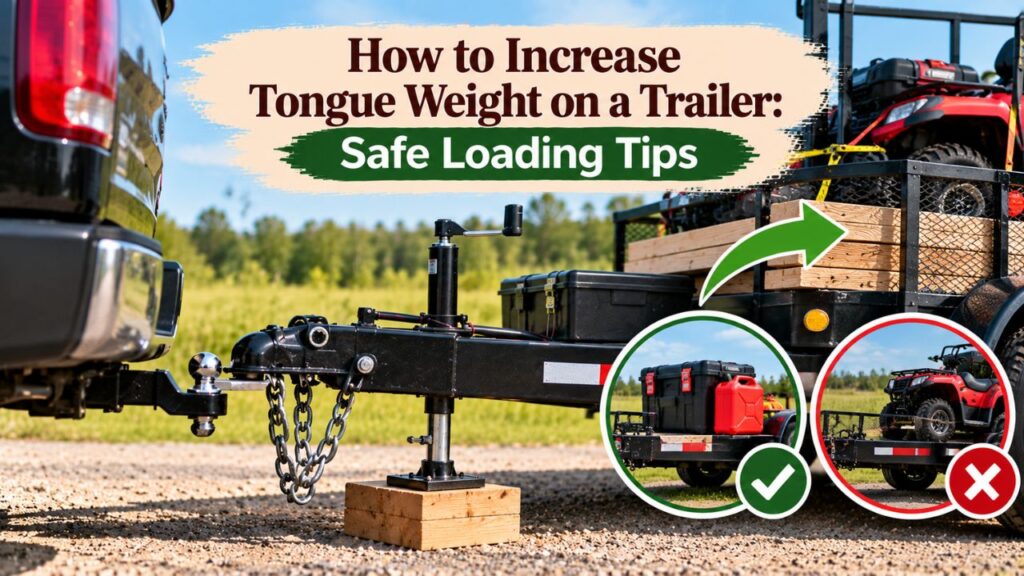
The simplest way to increase trailer tongue weight is to redistribute existing cargo toward the front of the trailer.
This changes the load’s position relative to the axle without necessarily increasing the total trailer weight.
Step 1: Measure the Current Tongue Weight
Before moving cargo, determine how much tongue weight the trailer currently has.
You need two measurements:
- The trailer’s actual loaded weight.
- The downward load applied at the trailer coupler.
For example, consider a utility trailer weighing 3,000 pounds with its cargo included.
If the measured tongue weight is 180 pounds:
180 ÷ 3,000 × 100 = 6% tongue weight
That is below the commonly recommended range for conventional trailers.
For this example, a 10–15% range would be 300–450 pounds, provided the towing equipment and vehicle can safely support it.
Knowing the starting measurement helps determine whether adjustments are necessary.
Step 2: Move Heavy Cargo Forward of the Axle
Move suitable heavy items from behind the trailer axle toward the front.
Examples include:
- Toolboxes.
- Lawn equipment.
- Building materials.
- Camping supplies.
- Secured machinery attachments.
- Other movable cargo.
Place the heaviest items low, centered from left to right, and near or slightly ahead of the axle whenever practical.
Moving a load farther forward generally produces a larger change in tongue weight than moving the same load a short distance.
However, avoid placing every heavy object against the trailer’s front wall.
Too much forward loading can create excessive hitch weight and overload the tow vehicle.
Step 3: Reduce Excess Weight Behind the Axle
Cargo concentrated behind the axle reduces the load carried by the trailer tongue.
If the trailer is rear-heavy, move some of that cargo forward.
For example, a utility trailer transporting lawn equipment may have a heavy mower positioned close to the rear ramp.
Moving the mower toward the axle, or slightly ahead of it, can increase tongue weight.
Similarly, moving toolboxes or other equipment from the rear storage area toward the front can improve the balance.
Removing unnecessary rear-mounted cargo can also change the tongue load, but the trailer’s total loaded weight must then be recalculated.
Step 4: Keep the Load Balanced From Side to Side
Increasing tongue weight shouldn’t create an uneven load across the trailer’s width.
Position heavy cargo close to the trailer’s centerline whenever possible.
Uneven side-to-side loading can place excessive weight on one wheel or suspension assembly and affect handling.
Check that:
- Heavy items are not concentrated along one side.
- Cargo doesn’t interfere with trailer tires or suspension.
- The load remains within individual axle and tire ratings.
- Equipment has adequate clearance from the trailer structure.
The ideal arrangement balances the trailer both front-to-back and side-to-side.
Step 5: Secure Every Item Before Rechecking
Cargo must remain in its intended position during transportation.
Use properly rated tie-down straps, chains, or other securement equipment appropriate for the load.
Attach them to suitable anchor points.
Avoid relying on friction or the cargo’s weight to keep it from moving.
A heavy object sliding backward during braking, acceleration, or travel can change the tongue weight and affect trailer stability.
Step 6: Measure the Tongue Weight Again
After repositioning cargo, measure the tongue weight again.
Compare the result with the recommended range and the actual equipment ratings.
Continue making controlled adjustments until the trailer has an appropriate balance.
Don’t assume that moving a certain amount of cargo forward will increase tongue weight by an identical amount.
Moving 100 pounds of cargo forward does not necessarily add 100 pounds to the tongue. The change depends on the cargo’s movement relative to the axle and coupler.
What Should Trailer Tongue Weight Be?
For most conventional bumper-pull trailers using a ball hitch, a tongue weight of approximately 10–15% of the loaded trailer weight is a common recommendation.
This range helps maintain stable towing while limiting excessive downward load on the hitch.
However, certain trailer designs require different values, so the manufacturer’s specifications take priority.
Recommended Tongue Weight by Trailer Weight
| Loaded Trailer Weight | 10% Tongue Weight | 15% Tongue Weight |
| 1,000 lbs | 100 lbs | 150 lbs |
| 1,500 lbs | 150 lbs | 225 lbs |
| 2,000 lbs | 200 lbs | 300 lbs |
| 3,000 lbs | 300 lbs | 450 lbs |
| 4,000 lbs | 400 lbs | 600 lbs |
| 5,000 lbs | 500 lbs | 750 lbs |
| 7,000 lbs | 700 lbs | 1,050 lbs |
These figures are general calculation examples for conventional trailers, not permission to exceed a vehicle’s or hitch’s rated capacity.
According to Ford’s official towing and trailering guidance, conventional trailer tongue weight should generally be around 10–15% of the total loaded trailer weight, while the vehicle and hitch limits must never be exceeded.
How to Calculate the Required Tongue Weight
Use this formula:
Target Tongue Weight = Loaded Trailer Weight × Target Percentage
For example, a loaded trailer weighing 3,500 pounds has the following range:
Minimum general target:
3,500 × 0.10 = 350 pounds
Upper general target:
3,500 × 0.15 = 525 pounds
Therefore, the common recommended range is 350–525 pounds.
The exact operating target should follow the trailer and tow vehicle manufacturer’s instructions.
How to Calculate Your Current Tongue Weight Percentage
If you already know the tongue weight, calculate its percentage with:
Tongue Weight Percentage = (Measured Tongue Weight ÷ Loaded Trailer Weight) × 100
For example:
- Loaded trailer weight: 4,000 pounds.
- Measured tongue weight: 280 pounds.
280 ÷ 4,000 × 100 = 7%
This indicates that the trailer is below the usual 10–15% range for conventional towing.
Repositioning cargo toward the front may help correct the imbalance.
Does Every Trailer Need 10–15% Tongue Weight?
No.
The 10–15% guideline primarily applies to conventional ball-hitch trailers.
Fifth-wheel and gooseneck trailers typically use higher pin-weight percentages because their coupling arrangements and load distribution differ.
Some specialty trailers may also have manufacturer-specific requirements.
Always confirm the recommended weight distribution for the actual trailer before making adjustments.
How to Measure Tongue Weight After Adjusting the Load
Accurate measurement is necessary because cargo position alone cannot establish the actual tongue weight.
Several methods are available depending on the trailer’s size and the equipment you have.
Use a Dedicated Tongue Weight Scale
A dedicated tongue weight scale is one of the most convenient ways to measure conventional trailer tongue weight.
For a typical coupler-scale setup:
- Park the trailer on firm, level ground.
- Chock the trailer wheels.
- Secure the trailer and support it using appropriately rated equipment.
- Position the scale according to the manufacturer’s instructions, preferably at the coupler support point.
- Set the coupler at its normal towing height.
- Carefully transfer the tongue load onto the scale.
- Read and record the measurement.
Do not place hands, feet, or other body parts beneath an unsupported trailer tongue.
If the scale measures the load at the tongue jack rather than the coupler, the reading may differ because the jack is positioned at a different distance from the axle.
Follow the scale manufacturer’s procedure for obtaining the intended measurement.
Use a Bathroom Scale for a Small Trailer
A bathroom scale may work for a lightweight trailer when the expected tongue weight remains within the scale’s capacity.
The setup must be stable and properly supported.
For larger tongue loads, specialized lever arrangements can be used with appropriate instructions and equipment.
The CURT guide to measuring trailer tongue weight describes dedicated tongue weight scales, bathroom-scale methods, and vehicle-scale measurements.
Avoid improvising an unstable lever or support arrangement.
For heavy trailers, a properly rated tongue weight scale or professional weighing service is the more practical choice.
Use a Public Vehicle Scale
A public vehicle scale can help determine both total trailer weight and axle loads.
Truck stops, commercial weighing facilities, and some other locations provide suitable scales.
To assess the towing combination, obtain measurements according to the scale operator’s instructions.
A suitable weighing procedure may include:
- The tow vehicle alone.
- The tow vehicle with the loaded trailer connected.
- The trailer’s loaded axle weight.
- The complete loaded towing combination.
Tongue weight can be determined by comparing appropriate measurements, provided the weighing method accounts correctly for the coupling arrangement and any weight-distribution system.
For a straightforward comparison using the tow vehicle’s total axle loads, the difference between hitched and unhitched readings can represent the vertical hitch load when no weight-distribution system is engaged and the setup is otherwise comparable.
If using a weight-distribution hitch, follow its manufacturer’s measurement procedure because engaged spring bars change how weight is distributed across the axles.
Why Does Moving Cargo Forward Increase Tongue Weight?
A trailer’s axle supports much of its weight, while the coupler transfers some weight to the tow vehicle.
The location of the cargo determines how the total load is shared between these supports.
How Weight Distribution Works
Consider a conventional single-axle trailer.
When heavy cargo sits behind the axle, it creates a turning effect that tends to reduce downward force at the tongue.
Moving that cargo forward reduces the rearward turning effect.
If the cargo moves ahead of the axle, it contributes more downward force to the coupling point.
The farther the load is moved relative to the axle, the greater its potential effect on tongue weight.
This relationship explains why relatively small changes in cargo placement can sometimes create noticeable differences at the hitch.
Why Cargo Near the Axle Has Less Effect
Weight placed directly over the trailer axle contributes relatively little additional turning force around that axle.
It increases the trailer’s overall weight, but it may cause a smaller change in tongue weight than cargo positioned farther forward.
This is one reason manufacturers commonly recommend placing heavy objects low and around the axle area, with the final distribution adjusted to achieve the appropriate tongue load.
Is the 60/40 Loading Rule Reliable?
A commonly used starting guideline is to place roughly 60% of the load forward of the axle area and 40% behind it.
However, this is not an exact formula that guarantees proper tongue weight.
The actual result depends on:
- Trailer dimensions.
- Axle position.
- Empty trailer weight distribution.
- Distance between cargo and axle.
- Location of permanently installed equipment.
- Cargo height and placement.
Use the guideline only as a starting point.
The final tongue weight must be measured.
Other Ways to Increase Trailer Tongue Weight
Repositioning cargo is usually the first solution, but some trailers have limited cargo movement or fixed equipment.
Other adjustments may be possible depending on the design.
Move Existing Accessories Toward the Front
Some trailers carry accessories that can be repositioned.
Examples include spare tires, storage boxes, or other equipment mounted to approved attachment points.
Moving suitable accessories forward may increase tongue weight.
However, any new mounting position must be structurally appropriate.
Do not mount heavy equipment onto thin trailer components or use unrated brackets.
Also consider clearance for turns, the coupler, safety chains, and trailer wiring.
Add Necessary Cargo Ahead of the Axle
If additional cargo is genuinely required for the trip, placing it appropriately ahead of the axle may increase tongue weight.
However, adding cargo also increases the trailer’s total loaded weight.
That means the recommended tongue weight range must be recalculated.
For example, increasing a trailer’s loaded weight from 3,000 to 3,200 pounds changes the conventional 10–15% range from 300–450 pounds to 320–480 pounds.
Don’t add unnecessary ballast simply to increase tongue weight without confirming every relevant weight rating.
The safer approach is usually to redistribute existing cargo first.
Adjust Equipment Position on a Utility Trailer
Trailers transporting lawn tractors, compact equipment, or other machinery may allow some adjustment to the equipment’s loading position.
Moving a machine slightly forward can increase the tongue load.
However, heavy equipment should be positioned according to both the trailer manufacturer’s instructions and the equipment’s securement requirements.
Check that the machine does not overload the front of the trailer or create insufficient axle loading.
Use suitable restraints to prevent movement during transportation.
Consider Professional Axle Position Adjustment
On some trailer designs, axle position affects the amount of weight carried by the tongue.
Moving an axle assembly rearward can increase tongue weight under otherwise comparable loading conditions.
However, this is a significant structural modification.
Changing axle position can affect:
- Frame loading.
- Suspension geometry.
- Brake wiring.
- Tire and fender clearance.
- Load ratings.
- Trailer handling and stability.
Do not relocate a trailer axle as an improvised adjustment.
Contact the trailer manufacturer or a qualified trailer fabrication and repair specialist to determine whether modification is permitted and appropriate.
For an existing trailer, cargo redistribution is usually the preferable first step.
How to Increase Tongue Weight on Different Trailer Types
The available adjustments depend on what the trailer carries and how its load is supported.
Utility Trailers
Utility trailers often provide considerable freedom to reposition cargo.
The most effective approach is usually to move heavy items toward the axle or slightly forward of it.
For example, a utility trailer carrying lawn equipment may need the mower positioned differently from a trailer transporting loose building materials.
Secure each load independently and verify tongue weight after changing its position.
Travel Trailers and Campers
Travel trailers contain permanent equipment, furniture, appliances, and storage compartments.
These components influence the trailer’s unloaded tongue weight.
To increase tongue weight, you may be able to move suitable portable items from rear storage compartments toward approved forward storage locations.
However, avoid concentrating heavy equipment in compartments with limited load capacity.
Pay particular attention to:
- Battery and propane storage arrangements.
- Freshwater and wastewater tank levels.
- Front storage compartment ratings.
- Cargo carrying capacity.
- Weight-distribution hitch requirements.
Water tanks can significantly change trailer weight distribution, but filling or transferring water should not be treated as a general tongue-weight correction.
Tank locations, fluid movement, and trailer ratings must be considered.
Boat Trailers
Boat trailer tongue weight is influenced by the position of the boat relative to the trailer axle assembly.
On some adjustable designs, the winch stand or boat position may be changed according to the trailer manufacturer’s instructions.
However, the hull must remain properly supported.
Moving a boat forward without considering bunks, rollers, transom support, and securement can create serious problems.
Some boat trailers also use tongue-weight recommendations different from the conventional 10–15% guideline.
Consult the boat and trailer manufacturers before making structural or boat-position adjustments.
Flatbed and Equipment Trailers
Flatbed and equipment trailers can carry heavy loads with concentrated weight.
A compact machine positioned only a short distance away from its intended loading location may significantly affect axle and tongue loads.
Follow equipment-loading instructions and use an appropriate scale.
For heavy machinery, weight distribution should account for both trailer axle ratings and the tow vehicle’s hitch capacity.
Do not rely on the trailer appearing level as proof that the load is balanced correctly.
Can You Increase Tongue Weight Without Overloading the Tow Vehicle?
Yes, provided the final tongue weight and all other loads remain within the equipment’s ratings.
Increasing tongue weight transfers additional downward load to the towing connection.
That load affects the tow vehicle.
Check the Tow Vehicle’s Maximum Tongue Weight
Every tow vehicle has towing limitations based on its equipment and configuration.
Consult the owner’s manual for the permitted tongue weight and towing setup.
The hitch receiver, ball mount, hitch ball, and related components may have separate ratings.
The maximum allowable load is limited by the applicable lowest-rated component and vehicle requirements.
A higher-rated aftermarket hitch does not automatically increase the vehicle manufacturer’s towing or payload limits.
Account for Tongue Weight in Vehicle Payload
Trailer tongue weight contributes to the load carried by the tow vehicle.
The vehicle must also support:
- Passengers.
- Cargo.
- Installed accessories.
- Other equipment.
- The trailer’s imposed hitch load.
For example, a tow vehicle with 700 pounds of remaining payload capacity cannot necessarily carry a 700-pound tongue load while also adding passengers or equipment.
Check the vehicle’s gross vehicle weight rating and axle ratings using the actual loaded configuration.
Tongue weight can also produce additional rear-axle load because the hitch is usually positioned behind the rear axle.
Check the Trailer’s GVWR and Axle Ratings
Increasing tongue weight does not eliminate the need to comply with the trailer’s gross vehicle weight rating.
The trailer’s total loaded weight must remain within its GVWR.
Its individual axle, wheel, and tire capacities must also be respected.
Because shifting cargo forward changes the distribution of forces, verify the resulting loads rather than relying only on the total trailer weight.
Does a Weight-Distribution Hitch Increase Tongue Weight?
A weight-distribution hitch does not directly increase the tongue weight created by the trailer’s cargo arrangement.
Instead, it uses spring bars or another mechanism to redistribute load between the tow vehicle’s axles and the trailer axles.
This can improve the towing combination’s loading and handling when the system is properly matched and adjusted.
However, it does not correct an improperly rear-heavy trailer.
If tongue weight is too low, redistribute the trailer’s cargo before relying on weight-distribution or sway-control equipment.
A weight-distribution hitch also cannot override the tow vehicle’s overall weight ratings.
Why Is My Trailer Tongue Weight Too Low?
Low tongue weight can result from several different conditions.
Identifying the cause helps determine whether cargo movement is enough to correct the problem.
| Possible Cause | Effect on Tongue Weight | Appropriate Response |
| Heavy cargo behind axle | Reduces downward hitch load | Move cargo forward |
| Rear-mounted equipment | Shifts weight toward back | Reposition if permitted |
| Too little forward cargo | May leave trailer rear-heavy | Adjust existing load distribution |
| Axle position unsuitable for trailer design | Changes load balance | Consult manufacturer or specialist |
| Incorrect weighing setup | Produces misleading readings | Reweigh at correct height and point |
| Changed tank or equipment loading | Alters center of gravity | Measure in actual travel condition |
| Cargo shifts during travel | Changes hitch and axle loads | Secure cargo properly |
Trailer Sway Can Indicate Low Tongue Weight
An improperly rear-heavy trailer may be more likely to sway.
Sway describes repeated side-to-side trailer movement that can become dangerous at road speeds.
However, low tongue weight is not the only possible cause.
Other contributing factors include:
- Excessive speed.
- Strong crosswinds.
- Incorrect tire pressures.
- Overloaded or damaged tires.
- Suspension problems.
- Improper hitch setup.
- Uneven cargo distribution.
- Mechanical defects.
If significant sway develops during towing, avoid sudden steering movements or abrupt braking.
Reduce speed smoothly and stop at a safe location to inspect the trailer and towing setup.
Do not resume highway travel with unresolved instability.
Can Low Tongue Weight Cause Trailer Fishtailing?
Yes.
Insufficient downward load at the coupling point can make a conventional trailer more susceptible to fishtailing.
The trailer may begin oscillating from side to side, especially when disturbed by passing vehicles, wind, or steering inputs.
Proper loading can reduce the risk, but stable towing also requires appropriate tires, suspension, hitch equipment, and driving conditions.
Mistakes to Avoid When Increasing Tongue Weight
Some adjustments may increase hitch load while creating other handling or structural problems.
Adding Too Much Weight to the Trailer Front
Moving excessive cargo toward the tongue can overload the hitch and tow vehicle.
It may also contribute to poor steering, braking, and vehicle handling.
Measure the final load and check every applicable rating.
Using Loose Sandbags as Ballast
Adding unsecured sandbags, weights, or other objects to the front of a trailer is not a safe correction.
Loose ballast can shift during travel.
Even secured ballast adds unnecessary total weight and may overload the trailer or vehicle.
Redistribute the existing load whenever possible.
Ignoring Trailer Axle and Tire Loads
A trailer can have an acceptable tongue-weight percentage while exceeding an axle or tire rating.
Use scale measurements when necessary to verify the actual loads.
Pay particular attention to trailers carrying concentrated machinery or other heavy equipment.
Assuming Hitch Height Fixes Cargo Balance
Using an appropriate ball mount helps the trailer tow at the intended attitude.
However, raising or lowering the hitch is not a substitute for establishing correct tongue weight.
A trailer that appears level can still be loaded incorrectly.
Follow the towing equipment manufacturer’s specified hitch-height requirements.
Relying on Airbags or Sway Control Alone
Suspension airbags may help manage vehicle ride height when used appropriately, but they do not increase the manufacturer’s load ratings.
Similarly, sway-control equipment is not a replacement for correct cargo distribution.
Fix the underlying load imbalance rather than attempting to conceal it with accessories.
Failing to Reweigh After Changing Cargo
The tongue weight changes when the trailer’s loading changes.
A trailer balanced correctly for one trip may not remain correctly balanced after equipment is moved or removed.
Recheck the loaded configuration whenever significant changes occur.
How to Confirm the Trailer Is Ready for Safe Towing
After adjusting the tongue weight, complete a final inspection before traveling.
Check the following:
- Tongue weight: Confirm it meets the trailer manufacturer’s recommendation.
- Loaded trailer weight: Verify it remains within the trailer’s GVWR.
- Tow vehicle capacity: Check payload, axle ratings, towing limits, and hitch ratings.
- Cargo securement: Make sure all items are restrained against movement.
- Tire condition: Check pressure and load capacity according to the manufacturer’s instructions.
- Hitch connection: Confirm the coupler, latch, and safety connections are properly secured.
- Braking and lighting: Verify trailer brakes, lights, and the breakaway system where equipped.
- Trailer attitude: Confirm the trailer sits at the appropriate towing height.
For heavy or unfamiliar towing combinations, a public scale provides more useful information than estimating weight from the trailer’s appearance.
If the correct tongue-weight range cannot be achieved without exceeding another rating, do not tow the combination until the loading or equipment problem is resolved.
Conclusion
Understanding how to increase tongue weight on a trailer starts with correcting the position of the load.
The most practical method is to move suitable heavy cargo forward, keep it low and centered, and reduce unnecessary weight behind the axle.
For most conventional trailers, the target is approximately 10–15% of the actual loaded trailer weight, provided the trailer and tow vehicle manufacturers allow that range.
Use an appropriate scale to verify the results rather than relying on visual estimates.
If cargo repositioning cannot achieve a safe balance, investigate trailer design, axle positioning, and equipment limitations with qualified assistance.
The goal is stable, predictable towing without overloading the hitch, vehicle, or trailer.
FAQs About How to Increase Tongue Weight on a Trailer
Does Moving the Trailer Axle Back Increase Tongue Weight?
Yes, moving the axle rearward can increase tongue weight because it changes the load’s position relative to the trailer’s supporting points.
However, axle relocation affects trailer structure, suspension, braking equipment, and handling.
Only consider this modification with appropriate manufacturer approval and qualified professional assistance.
Can You Increase Tongue Weight Without Adding More Weight?
Yes. Moving existing cargo forward can increase tongue weight without increasing the trailer’s total loaded weight.
This is generally preferable to adding unnecessary ballast.
The final tongue weight and axle loads must still be measured.
How Much Tongue Weight Is Too Little for a Trailer?
For most conventional ball-hitch trailers, tongue weight below approximately 10% of the loaded trailer weight is generally considered insufficient.
However, the proper range depends on the trailer design and manufacturer’s specifications.
Low tongue weight can increase susceptibility to trailer sway.
Will Adding a Spare Tire to the Trailer Tongue Increase Tongue Weight?
Yes, installing a spare tire at an approved forward mounting location can increase tongue weight.
However, the actual increase depends on the tire’s weight and mounting position.
The mounting hardware and trailer structure must be suitable, and the final load must remain within the applicable ratings.
Does a Weight-Distribution Hitch Fix Low Tongue Weight?
No. A weight-distribution hitch redistributes loads among the tow vehicle and trailer axles, but it does not correct the trailer’s underlying cargo imbalance.
If tongue weight is too low, reposition the cargo and verify the actual tongue load.
Can Too Much Tongue Weight Damage a Tow Vehicle?
Yes. Excessive tongue weight can overload the hitch, rear axle, suspension, or tires.
It can also affect steering and braking performance.
Always check the manufacturer’s vehicle and towing equipment limits before increasing tongue weight.
How Do I Know if I Increased Tongue Weight Enough?
Measure the actual tongue weight and compare it with the loaded trailer weight.
For a conventional trailer, approximately 10–15% is a common target, subject to the manufacturer’s specific requirements.
Confirm that the result stays within every applicable hitch, tow vehicle, and trailer rating before towing.