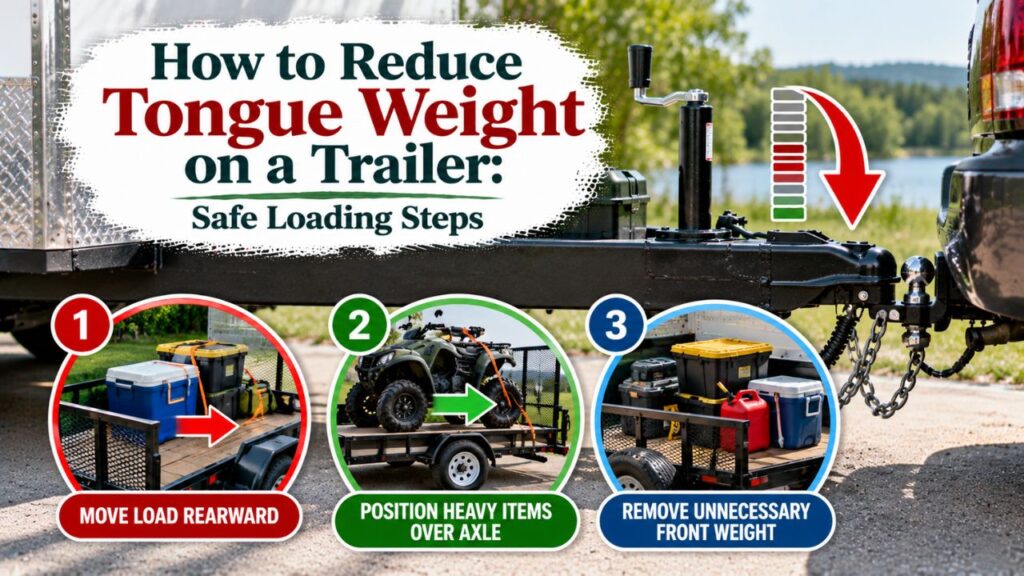
To reduce tongue weight on a trailer, move some heavy cargo from the front toward the trailer axle, remove unnecessary front-loaded items, and measure the tongue weight after each adjustment. The goal is to reduce excessive downward pressure on the hitch without making the trailer dangerously rear-heavy.
For most conventional bumper-pull trailers, tongue weight should generally be around 10–15% of the total loaded trailer weight, unless the manufacturer specifies otherwise. Too much tongue weight can overload the tow vehicle’s rear axle, suspension, or hitch. Too little can increase trailer sway and make the combination difficult to control.
The challenge is that shifting cargo changes how weight is distributed between the hitch and trailer axles. Moving heavy equipment too far behind the axle may reduce the tongue reading but create a more serious stability problem.
The safest solution depends on the trailer’s loaded weight, axle position, cargo arrangement, and towing limits.
In this article, I explain how to measure and reduce excessive tongue weight, reposition cargo correctly, calculate safe weight percentages, and check whether your trailer and tow vehicle remain within their ratings. I also cover weight distribution hitches, common loading mistakes, and trailer-specific adjustments.
Why Is Tongue Weight Too High on a Trailer?
Tongue weight is the downward force that a trailer’s coupler applies to the tow vehicle’s hitch ball.
It represents the portion of the trailer’s weight supported by the towing vehicle rather than the trailer axles.
When a trailer carries too much weight toward its front, the coupler supports a greater share of the load.
Several conditions can contribute to excessive tongue weight.
Too Much Cargo Loaded in Front of the Axle
Front-heavy cargo placement is one of the most common causes of excessive tongue weight.
Examples include:
- Heavy toolboxes near the trailer tongue
- Construction materials stacked against the front wall
- Machinery positioned too far forward
- Multiple batteries installed near the front
- Camping equipment concentrated in front storage compartments
- Heavy spare parts or accessories mounted near the coupler
The farther a heavy item sits forward of the axle group, the greater its potential contribution to tongue weight.
Moving that item closer to the axle can reduce its effect on the hitch.
However, moving everything toward the rear is not the correct solution.
The trailer still needs adequate positive tongue weight for stable towing.
Heavy Equipment Mounted Near the Trailer Tongue
Some trailers carry substantial permanent weight at the front.
Examples include propane cylinders, batteries, generators, tongue-mounted storage boxes, and other equipment.
These components may contribute considerably to the tongue weight even when the cargo area is empty.
However, permanent equipment should not be relocated casually.
Batteries, propane systems, electrical wiring, and mounted equipment have installation and safety requirements.
If the trailer is front-heavy even when empty, consult the manufacturer or a qualified trailer service professional before modifying its layout.
Incorrect Cargo Position on a Utility Trailer
A utility trailer may become front-heavy when a lawn mower, compact tractor, motorcycle, or other equipment is positioned too far forward.
Moving the equipment slightly toward the axle can change the tongue weight significantly.
However, the proper position depends on the equipment’s center of gravity, trailer axle location, and available tie-down points.
Do not position equipment solely by estimating where its wheels should sit.
Measure the actual tongue weight after loading.
Trailer Design and Axle Placement
The location of the axle relative to the trailer’s center of gravity affects how much weight the coupler supports.
An axle positioned farther toward the rear generally increases tongue weight for the same cargo arrangement.
However, axle placement is a structural design decision.
Moving trailer axles is not a normal DIY weight-adjustment method. It can change handling, frame loading, brake system requirements, and structural integrity.
If the trailer cannot maintain acceptable tongue weight with a suitable load, professional assessment may be necessary.
How to Reduce Tongue Weight on a Trailer Step by Step
The safest method is to measure the current weight, identify the source of excessive forward loading, and make controlled adjustments.
Do not begin moving cargo until you know the trailer’s loaded weight and the tongue-weight range required for that trailer.
Step 1: Measure the Current Tongue Weight
Start by parking the trailer on a firm, level surface.
Chock the wheels securely and prepare the trailer in its normal traveling condition.
Include the equipment, cargo, supplies, and other items that will be carried during the trip.
Use a properly rated tongue-weight scale to measure the downward load at the coupler.
The measurement should be taken at the manufacturer’s specified measurement point, with the coupler supported at approximately its normal towing height.
According to CURT’s guide to measuring trailer tongue weight, tongue weight can be measured using a dedicated tongue-weight scale, a properly arranged household-scale method, or suitable vehicle-scale measurements.
A dedicated scale with sufficient capacity is often the most straightforward option.
Safety Note: Never place yourself beneath an unsupported trailer tongue. Use correctly rated lifting and supporting equipment, and keep the trailer wheels chocked during measurement.
Record the tongue weight before changing the load.
Step 2: Check the Trailer’s Total Loaded Weight
Tongue weight must be evaluated as a percentage of the complete loaded trailer weight.
Use a suitable commercial vehicle scale to establish the actual trailer weight.
For a conventional trailer without an engaged weight distribution system, the gross trailer weight can also be determined by adding the measured trailer axle load to the measured coupler load, provided both readings represent the same level, loaded condition.
Use this formula:
Tongue Weight Percentage = (Tongue Weight ÷ Gross Trailer Weight) × 100
Suppose your trailer weighs 4,000 pounds when loaded and has a tongue weight of 640 pounds.
640 ÷ 4,000 × 100 = 16%
This is above the commonly recommended 10–15% range for many conventional bumper-pull trailers.
However, always check the trailer manufacturer’s requirements before deciding that a particular percentage is excessive.
Step 3: Move Heavy Cargo Closer to the Trailer Axle
If the trailer is excessively front-heavy, move appropriate cargo from the front toward the axle.
This changes the load’s leverage around the axle and reduces the share supported by the coupler.
For example, suppose a utility trailer contains a heavy toolbox near its front wall.
Moving the toolbox closer to the axle can reduce tongue weight without changing the trailer’s total weight.
Follow these precautions:
- Move one heavy item or a small group of items at a time.
- Keep heavy cargo low to maintain a suitable center of gravity.
- Maintain balanced loading from left to right.
- Secure the cargo using properly rated tie-downs.
- Measure the tongue weight after each meaningful adjustment.
The amount of tongue-weight reduction depends on the item’s weight, how far it moves, and the trailer’s geometry.
Moving a 100-pound item does not necessarily reduce tongue weight by 100 pounds.
Key Takeaway: Moving heavy cargo closer to the axle is often safer than placing large amounts of weight at the extreme rear of the trailer. Every adjustment still needs to be verified by measurement.
Step 4: Remove Unnecessary Front-Loaded Cargo
Sometimes the easiest solution is to remove items that do not need to travel.
For example, a trailer may contain spare tools, unused equipment, or storage containers that add unnecessary weight near the tongue.
Removing them can reduce both tongue weight and total trailer weight.
However, the effect depends on the location of the removed material.
Removing 100 pounds from the front does not necessarily lower tongue weight by exactly 100 pounds.
Also remember that removing cargo changes the trailer’s total weight, so the tongue-weight percentage must be recalculated.
If the tow vehicle or hitch is overloaded, removing cargo may be more appropriate than simply shifting it to another part of the trailer.
Step 5: Adjust the Load Without Making the Trailer Rear-Heavy
If shifting cargo closer to the axle does not provide enough reduction, a modest further rearward adjustment may be considered where the trailer manufacturer’s loading instructions allow it.
However, placing large amounts of cargo behind the axle can reduce tongue weight too far.
This increases the risk of trailer sway.
In its official trailer loading instructions, U-Haul directs users of its trailers to place approximately 60% of cargo weight in the front half and 40% in the rear half.
That recommendation is specific to U-Haul’s trailer loading procedures. It should not replace the manufacturer instructions for a different trailer design.
The general principle is that conventional trailers usually need a suitable forward weight bias.
Do not deliberately load the rear heavily just to reduce the number on a tongue-weight scale.
Step 6: Recheck the Tongue Weight
After repositioning cargo, measure the tongue weight again.
Compare the result with the trailer’s required range.
For a conventional trailer where the manufacturer specifies 10–15%, the adjusted tongue weight should remain within that range.
If the trailer originally weighed 4,000 pounds and the cargo was only repositioned, the total weight remains 4,000 pounds.
A new tongue weight of 520 pounds gives:
520 ÷ 4,000 × 100 = 13%
That falls within the commonly recommended range.
This example illustrates the calculation. It does not mean every trailer should be adjusted to exactly 13%.
Check that the revised loading also keeps the trailer axles and tires within their ratings.
Step 7: Secure the Cargo and Confirm All Weight Limits
Once the trailer has a suitable tongue weight, secure every movable item.
Check that:
- Heavy items are positioned low and cannot shift.
- Cargo restraints are properly rated and attached.
- The trailer remains balanced from side to side.
- The hitch and coupler are correctly connected.
- Safety chains and trailer electrical connections are secure.
- Trailer tires have suitable load ratings and inflation.
- The tow vehicle and trailer remain within all applicable weight limits.
Recheck cargo restraints after the trailer has traveled a short distance, following the applicable equipment instructions.
Do not begin a trip if the trailer is overloaded or its stability remains uncertain.
What Is the Correct Tongue Weight After Adjustment?
The appropriate tongue weight depends on the trailer’s coupling design and manufacturer requirements.
For many conventional bumper-pull trailers, 10–15% of the loaded trailer weight is a common guideline.
Other trailers may require different loading percentages.
Tongue Weight Chart for Conventional Trailers
The following table shows the commonly used 10–15% range for conventional bumper-pull trailers.
| Loaded Trailer Weight | 10% Tongue Weight | 15% Tongue Weight |
| 1,000 lb | 100 lb | 150 lb |
| 2,000 lb | 200 lb | 300 lb |
| 3,000 lb | 300 lb | 450 lb |
| 4,000 lb | 400 lb | 600 lb |
| 5,000 lb | 500 lb | 750 lb |
| 6,000 lb | 600 lb | 900 lb |
| 7,000 lb | 700 lb | 1,050 lb |
| 8,000 lb | 800 lb | 1,200 lb |
| 10,000 lb | 1,000 lb | 1,500 lb |
These figures are calculation examples, not universal towing limits.
The tow vehicle’s allowable tongue load may be lower than the calculated upper value.
For example, a 5,000-pound trailer might have a tongue weight of 600 pounds, which equals 12%.
However, that combination is not acceptable if the vehicle or hitch has a maximum permitted tongue load below 600 pounds.
The trailer’s loading requirements and the tow vehicle’s weight limits must both be satisfied.
Can Tongue Weight Be Lower Than 10%?
Some specialized trailers have manufacturer-approved loading requirements that differ from the conventional 10–15% guideline.
However, reducing a typical bumper-pull trailer below its specified minimum can create serious stability problems.
Insufficient tongue weight can contribute to side-to-side sway, which may become increasingly difficult to control.
Do not target a low tongue-weight percentage simply because the tow vehicle appears to sit more level.
The manufacturer’s required range takes priority.
Is Fifth-Wheel Pin Weight the Same as Trailer Tongue Weight?
No. Fifth-wheel and gooseneck trailers use a different coupling arrangement from conventional bumper-pull trailers.
The downward force at their coupling point is commonly called pin weight or hitch load.
Fifth-wheel trailers often carry a substantially larger percentage of their loaded weight at the hitch, commonly around 20–25%, although the correct value depends on the trailer’s design and manufacturer.
Do not apply a conventional 10–15% bumper-pull guideline to a fifth-wheel trailer.
Reducing fifth-wheel pin weight requires following the specific manufacturer’s recommendations and checking the tow vehicle’s payload and axle ratings.
How Cargo Placement Changes Trailer Tongue Weight
Understanding the relationship between cargo location and the axle helps explain why some adjustments are more effective than others.
A trailer’s axle group supports much of its weight, while the hitch supports a portion determined by the load’s position.
Moving Cargo Forward Increases Tongue Weight
When cargo moves farther ahead of the axle, it generally increases the downward force at the hitch.
This can be useful when a trailer has insufficient tongue weight.
However, excessive forward loading can overload the tow vehicle.
Moving Cargo Toward the Axle Reduces Tongue Weight
Moving an item from the front toward the axle generally reduces its contribution to tongue weight.
The axle supports a greater portion of the item’s weight.
This is often the preferred adjustment when a conventional trailer is too front-heavy.
However, it may increase the load carried by the trailer axles, so their weight ratings must still be checked.
Moving Cargo Behind the Axle Can Reduce Tongue Weight Too Much
Cargo placed behind the axle creates an opposing leverage effect that can reduce the downward load at the hitch.
A small adjustment may be appropriate in some loading situations.
However, large rearward movements can make the trailer unstable.
In extreme cases, a badly unbalanced trailer can develop very little positive tongue weight or even upward force at the coupler under static conditions.
Such loading is unsafe for ordinary towing.
Keep Heavy Cargo Low and Balanced Side to Side
Front-to-rear weight distribution is not the only concern.
Heavy cargo placed high above the trailer floor can raise the center of gravity and affect stability.
Concentrating cargo on one side can also create unequal tire and suspension loading.
Keep heavy equipment low and near the intended loading area, and balance the cargo laterally.
Use restraints designed for the weight and type of cargo being carried.
How to Reduce Tongue Weight on Different Trailer Types
The best adjustment depends on the trailer’s design and how its cargo is arranged.
Some trailers have movable loads, while others contain permanently installed equipment.
Utility and Equipment Trailers
For a utility trailer, start by examining the position of heavy equipment.
A lawn mower, compact tractor, ATV, or other machine can substantially affect tongue weight.
Move the equipment slightly toward the axle when excessive forward loading is confirmed.
However, secure it only at appropriate tie-down points, and maintain suitable weight on all axles.
Do not position equipment beyond the trailer’s designated loading area or weaken its tie-down arrangement to achieve a particular reading.
Enclosed Cargo Trailers
Enclosed trailers may contain heavy boxes, appliances, tools, or machinery.
Moving dense items closer to the axle can reduce excessive tongue weight.
Avoid stacking heavy items high or placing all the weight behind the axle.
Secure the load to prevent movement during braking, acceleration, or cornering.
If the trailer has a long cargo area, several small adjustments may provide better control than relocating one heavy item to the rear wall.
Travel Trailers and Campers
Travel trailers may have substantial tongue weight because of their floor plans and installed equipment.
Possible contributors include:
- Front storage compartments
- Batteries
- Propane cylinders
- Freshwater tanks
- Generators
- Heavy camping equipment
Start by relocating movable supplies from front compartments toward approved storage areas nearer the axle.
However, be careful with water tanks.
Water is heavy, and the position of the tanks can affect tongue weight. Partially filled tanks may also allow water movement during travel.
Follow the RV manufacturer’s travel recommendations for tank levels.
Do not relocate permanent tanks, propane equipment, batteries, or electrical components without professional guidance.
Boat Trailers
Boat trailers require special attention because the boat’s position and trailer geometry influence tongue weight.
Some boat trailers have adjustable winch stands or axle assemblies.
However, these adjustments must follow the trailer and boat manufacturer’s instructions.
Moving a boat or axle can affect hull support, launching, braking, and trailer stability.
For substantial adjustments, consult a qualified marine trailer service professional rather than making structural changes based only on a tongue-weight reading.
Can a Weight Distribution Hitch Reduce Tongue Weight?
A weight distribution hitch does not remove the trailer’s actual tongue weight. Instead, it changes how the load is distributed among the tow vehicle’s axles and the trailer axles.
This distinction matters when trying to correct excessive tongue weight.
How a Weight Distribution Hitch Works
A weight distribution hitch uses spring bars or another designed mechanism to redistribute some of the load that would otherwise be concentrated at the tow vehicle’s rear axle.
When properly adjusted, it can help restore some front-axle loading and improve the tow vehicle’s stance and handling.
However, the trailer still has its original static tongue weight based on the trailer’s loaded configuration.
The hitch does not make overloaded cargo disappear.
When a Weight Distribution Hitch May Help
A weight distribution hitch may be appropriate when the tow vehicle and trailer manufacturers allow or require one for the particular combination.
It may help manage axle loading and handling when used within its rated limits.
Some receivers have separate weight-carrying and weight-distributing ratings.
Use the ratings applicable to the installed equipment and the tow vehicle’s approved towing configuration.
A weight distribution system is not permission to exceed the vehicle’s payload, axle ratings, hitch ratings, or towing capacity.
Why a Weight Distribution Hitch Is Not a Substitute for Proper Loading
If the trailer is dangerously front-heavy, a weight distribution hitch does not correct the underlying cargo imbalance.
The appropriate solution may still involve moving cargo, removing excess weight, or changing to a tow vehicle with sufficient capacity.
Similarly, a sway-control device cannot make a dangerously rear-heavy trailer safe.
Proper load distribution must come before relying on hitch accessories to improve handling.
Can Changing Hitch Height or Suspension Reduce Tongue Weight?
Some towing problems are mistaken for excessive tongue weight because the rear of the tow vehicle sits lower after the trailer is connected.
However, vehicle squat and actual tongue weight are not the same measurement.
Adjusting Hitch Height
Changing hitch height can alter the trailer’s attitude and, especially on multi-axle trailers, may affect how loads are shared between axles.
However, hitch height should not be used as an improvised method of reducing tongue weight.
The trailer should be towed at the attitude specified by its manufacturer, generally close to level for conventional designs.
An incorrect hitch height may create axle-loading, handling, and clearance problems.
Use a properly rated ball mount or hitch adjustment system to achieve the required towing position.
Installing Airbags or Helper Springs
Airbags and helper springs can sometimes reduce visible rear suspension sag.
However, they do not eliminate the load applied by the trailer.
A tow vehicle may appear level while still exceeding its rear axle, payload, or hitch capacity.
Suspension accessories do not automatically increase the manufacturer’s certified vehicle weight ratings.
Moving Trailer Axles
Changing axle position alters the trailer’s load distribution and its handling characteristics.
However, it also affects the frame, suspension geometry, braking system, and structural loading.
Axle relocation should not be treated as a routine cargo adjustment.
If a trailer cannot achieve the required tongue weight with an appropriate load, consult its manufacturer or a qualified trailer engineering professional.
What If Tongue Weight Exceeds the Tow Vehicle’s Hitch Rating?
A safe tongue-weight percentage does not automatically mean the towing combination is within its limits.
You must also check the ratings of the vehicle, hitch, and trailer.
Check the Tow Vehicle’s Maximum Tongue Load
The tow vehicle manufacturer’s towing information may specify a maximum allowable tongue load.
This can depend on the vehicle model, towing package, hitch type, and weight distribution equipment.
Do not assume the hitch receiver’s rating alone determines what the vehicle can safely carry.
Use the lowest applicable limit for the complete towing setup.
Check Vehicle Payload and Rear Axle Capacity
Tongue weight contributes to the load carried by the tow vehicle.
Passengers, luggage, tools, and other cargo also use available payload capacity.
For example, suppose a tow vehicle has 1,200 pounds of available payload before loading.
If its trailer applies 500 pounds of tongue weight, approximately 700 pounds remain for occupants, cargo, and other applicable loads.
This is a simplified calculation. Actual vehicle and axle loading, including any weight distribution system, must still be checked.
The rear axle can reach its rating before the vehicle reaches its overall gross vehicle weight rating.
Check Trailer Axle and Tire Ratings
When cargo moves closer to the trailer axle, more of the load may be supported by the trailer’s wheels.
That can reduce tongue weight while increasing axle loading.
Therefore, measure the trailer axle weight after significant changes.
Check the combined and individual axle ratings, tire capacities, and trailer gross vehicle weight rating.
A trailer is not safe simply because its tongue weight is within the recommended percentage.
Remove Cargo When Redistribution Is Not Enough
If the trailer or towing combination cannot meet every applicable rating with an acceptable load balance, remove cargo.
Moving excess weight from one overloaded component to another is not a solution.
If safe loading is not possible within the vehicle’s limits, the appropriate choice may be a more capable tow vehicle or a different trailer.
Common Mistakes When Reducing Trailer Tongue Weight
Several adjustments can make the scale reading look better while increasing towing risks.
Moving All Heavy Cargo to the Rear
This is one of the most dangerous approaches.
Moving substantial weight behind the axle can create insufficient tongue weight and increase sway.
Use measured adjustments and maintain the manufacturer-required loading range.
Estimating Tongue Weight From Vehicle Squat
A tow vehicle’s rear suspension may compress visibly even when tongue weight is within an acceptable range.
Conversely, stiff suspension or helper springs may conceal excessive loading.
Vehicle height is not a substitute for a calibrated weight measurement.
Ignoring the Trailer’s Loaded Weight
A 500-pound tongue weight has different implications on a 3,000-pound trailer than on a 5,000-pound trailer.
On a 3,000-pound trailer, it represents approximately 16.7%.
On a 5,000-pound trailer, it represents 10%.
Always calculate the percentage using the trailer’s actual loaded weight.
Forgetting Cargo That Changes During a Trip
Tongue weight may change when cargo is added, removed, or moved.
Travel trailers may also experience weight changes due to water use or tank contents.
Recheck the loading whenever significant changes occur.
Using Hitch Accessories to Hide Overloading
A weight distribution hitch, helper springs, or airbags may improve the vehicle’s stance or load distribution.
However, these accessories do not automatically increase the vehicle’s approved weight capacities.
Check actual scale weights and manufacturer ratings instead of relying on appearance.
Failing to Secure Relocated Cargo
Moving cargo closer to the axle is ineffective if it can slide during travel.
Heavy objects must remain in their intended positions during braking, acceleration, and cornering.
Use correctly rated straps, chains, or other restraints suitable for the equipment.
How to Confirm Your Trailer Is Ready for Safe Towing
After reducing tongue weight, perform a final loading and equipment check before traveling.
- Confirm that tongue weight is within the trailer manufacturer’s required range.
- Verify that the gross trailer weight does not exceed its rating.
- Check trailer axle and tire loading.
- Verify tow vehicle payload, axle, and hitch limits.
- Confirm proper coupler engagement and safety-chain attachment.
- Check trailer lights, brakes, and breakaway equipment where fitted.
- Make sure the trailer is at its required towing attitude.
- Secure all cargo and storage compartments.
- Check tire pressures according to the appropriate manufacturer instructions.
- Reweigh if the load has changed significantly.
If the trailer begins to sway while traveling, reduce speed smoothly and find a safe place to stop.
Do not attempt to overcome a significant loading problem simply by continuing to drive.
Inspect the cargo arrangement, tongue weight, tires, and hitch setup before resuming travel.
If the cause cannot be identified or corrected, seek qualified assistance.
Conclusion
Knowing how to reduce tongue weight on a trailer starts with measuring the actual load and understanding how cargo position affects the hitch.
The most practical approach is to move suitable heavy cargo from the front toward the trailer axle, remove unnecessary items, and recheck the tongue weight after each adjustment.
For many conventional bumper-pull trailers, the commonly recommended tongue-weight range is 10–15% of the loaded trailer weight. However, manufacturer specifications and equipment ratings always take priority.
Avoid shifting excessive weight behind the axle simply to reduce hitch pressure. A trailer with insufficient tongue weight can become unstable.
Weight distribution hitches and suspension accessories may help manage towing loads, but they do not replace correct cargo placement or increase every component’s weight rating.
The safest result is not the lowest possible tongue weight. It is a properly balanced trailer that meets all applicable ratings and remains stable during towing.
FAQs About How to Reduce Tongue Weight on a Trailer
Can You Reduce Tongue Weight by Moving Cargo Backward?
Yes. Moving cargo toward the axle or farther rearward generally reduces the downward load on the hitch. However, moving too much weight behind the axle can cause insufficient tongue weight and trailer sway. Make small adjustments and measure the results.
Will Moving 100 Pounds to the Back Reduce Tongue Weight by 100 Pounds?
Not necessarily. The change depends on the cargo’s original position, its new location, the axle position, and the trailer’s geometry. A 100-pound item moved closer to the axle may reduce tongue weight by considerably less than 100 pounds. Measure the actual change rather than assuming a one-to-one reduction.
Does a Weight Distribution Hitch Lower Actual Tongue Weight?
No. A weight distribution hitch changes how loads are distributed among the tow vehicle and trailer axles, but it does not eliminate the trailer’s underlying static tongue weight. Use it only when compatible with the towing setup and within the applicable manufacturer ratings.
Can Too Little Tongue Weight Cause Trailer Sway?
Yes. Insufficient tongue weight can contribute to side-to-side trailer sway and unstable handling. Most conventional bumper-pull trailers require a suitable forward weight bias. Follow the trailer manufacturer’s minimum tongue-weight recommendation rather than attempting to reduce the hitch load as much as possible.
Will Adding Weight Behind the Trailer Axle Reduce Tongue Weight?
Adding weight behind the axle can reduce the coupler’s downward load through leverage, but it also increases total trailer weight and may worsen stability. This is generally not a good way to correct an overloaded hitch. Reposition existing cargo appropriately or remove unnecessary weight instead.
Can You Reduce Tongue Weight Without Removing Cargo?
Yes. Repositioning movable cargo closer to the trailer axle can reduce tongue weight without changing the overall trailer weight. However, trailer axle loads may increase, and the new arrangement must remain within all applicable limits.
What Should I Do If My Trailer Is Still Tongue-Heavy After Moving Cargo?
Recheck the measurements and compare them with the trailer and tow vehicle ratings. If movable cargo cannot be positioned to achieve a safe load balance, remove unnecessary weight. If the trailer remains excessively tongue-heavy even when appropriately loaded, consult the manufacturer or a qualified trailer service professional before attempting structural modifications.