An acceptable trailer tongue weight for a Jeep is generally 10% to 15% of the fully loaded trailer weight, provided it doesn’t exceed the Jeep’s maximum tongue weight rating, hitch capacity, or available payload. For example, a 2,000-pound loaded trailer typically needs 200–300 pounds of tongue weight, but some Jeep models have limits that prevent using the upper part of that range.
The exact limit depends on the Jeep’s model, year, engine, drivetrain, towing package, and hitch configuration. A two-door Wrangler may have a much lower tongue weight rating than a properly equipped Grand Cherokee or Gladiator.
Getting the weight right is important because the trailer tongue applies downward force to the rear of the vehicle. Too little tongue weight can increase trailer sway, while excessive weight can overload the rear axle, affect steering, and reduce stability.
The common 10%–15% guideline is a starting point, not permission to exceed the manufacturer’s limits.
In this article, I explain acceptable trailer tongue weight for Jeep vehicles, compare manufacturer-rated limits, show how to calculate and measure tongue weight, and cover the loading mistakes that can affect towing safety. You’ll also learn how passengers, cargo, hitch ratings, and trailer balance influence the amount your Jeep can safely handle.
How Much Trailer Tongue Weight Is Acceptable for a Jeep?
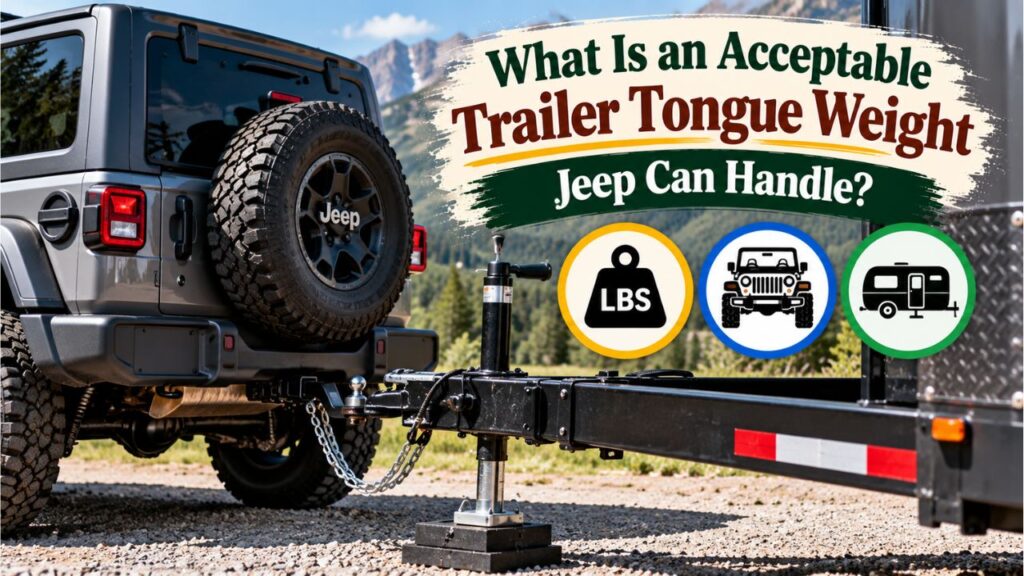
For most conventional trailers connected with a ball hitch, the usual target is approximately 10%–15% of the trailer’s actual loaded weight.
This percentage describes the downward load that the trailer coupler applies to the hitch.
The U-Haul hitch selection guide identifies 10%–15% of gross trailer weight as the typical tongue weight range for conventional trailers.
However, a Jeep’s manufacturer-rated tongue weight limit takes priority over that general recommendation.
Acceptable Tongue Weight by Loaded Trailer Weight
The following table shows the typical 10%–15% calculation for different trailer weights.
| Loaded Trailer Weight | 10% Tongue Weight | 15% Tongue Weight |
| 1,000 lbs | 100 lbs | 150 lbs |
| 1,500 lbs | 150 lbs | 225 lbs |
| 2,000 lbs | 200 lbs | 300 lbs |
| 2,500 lbs | 250 lbs | 375 lbs |
| 3,000 lbs | 300 lbs | 450 lbs |
| 3,500 lbs | 350 lbs | 525 lbs |
| 4,000 lbs | 400 lbs | 600 lbs |
| 5,000 lbs | 500 lbs | 750 lbs |
These values are general trailer-balance targets, not approved tongue weight capacities for every Jeep.
For example, a Jeep with a maximum tongue weight rating of 350 pounds cannot safely use a 450-pound tongue load simply because that represents 15% of a 3,000-pound trailer.
The acceptable range would need to remain within the vehicle’s 350-pound limit and all other applicable ratings.
Why the 10%–15% Range Matters
Tongue weight influences how the trailer responds to steering, braking, and road disturbances.
When too little weight rests on the hitch, the trailer may become more likely to sway.
When too much weight rests on the hitch, it can overload the tow vehicle’s rear axle and reduce the load carried by its front axle.
A correctly balanced trailer generally tracks more predictably behind the Jeep.
However, the percentage alone doesn’t guarantee safe towing. Vehicle ratings, trailer design, tire condition, suspension, speed, and loading all matter.
Key Takeaway: Aim for the trailer manufacturer’s recommended tongue weight range while staying below every applicable Jeep and towing-equipment limit.
What Is an Acceptable Trailer Tongue Weight Jeep Can Handle by Model?
Jeep vehicles don’t share one universal maximum tongue weight rating.
The allowable load varies by model year, powertrain, towing equipment, and vehicle configuration.
Jeep Wrangler Tongue Weight Limits
The Wrangler’s towing specifications can differ substantially between two-door and four-door models.
For example, the official 2024 Jeep Wrangler owner’s manual lists the following limits for its specified configurations.
| 2024 Wrangler Configuration | Maximum Trailer Weight | Maximum Tongue Weight |
| 2-door, 2.0L engine | 2,000 lbs | 200 lbs |
| 2-door, 3.6L engine | 2,000 lbs | 200 lbs |
| 4-door, 2.0L engine | 3,500 lbs | 350 lbs |
| 4-door, 3.6L engine | 3,500 lbs | 350 lbs |
| 4xe Sport/Sahara or Rubicon | 3,500 lbs | 350 lbs |
| 4-door, 6.4L engine | 3,500 lbs | 350 lbs |
These figures apply to the listed 2024 U.S. configurations, not every Wrangler ever manufactured.
Some newer or differently equipped Wranglers have different towing ratings.
Always check the specifications for your exact vehicle.
For a Wrangler rated at 200 pounds of maximum tongue weight, a 250-pound tongue load is excessive even when the trailer itself is below the Jeep’s maximum towing capacity.
Jeep Grand Cherokee Tongue Weight
The Grand Cherokee generally offers more towing capability in certain configurations, but its maximum tongue weight still depends on the model year, engine, and towing equipment.
A Grand Cherokee equipped with a factory towing package may have a higher tongue weight rating than an otherwise similar vehicle without that package.
Don’t calculate the maximum tongue weight by simply assuming every Grand Cherokee can support 15% of its advertised maximum towing capacity.
Instead, check the vehicle’s official towing specifications and the installed hitch rating.
Jeep Gladiator Tongue Weight
The Gladiator is designed with pickup-truck functionality and is available in configurations with substantial towing capability.
However, its acceptable tongue weight isn’t determined by its pickup body style alone.
The exact rating depends on the engine, axle configuration, towing package, model year, and installed equipment.
A Gladiator with a higher trailer towing rating may support more tongue weight than certain Wrangler configurations, but that capacity must be verified.
Jeep Cherokee, Compass, and Other Models
Smaller Jeep SUVs may have lower trailer towing and tongue weight limits than larger models.
Some configurations may also have specific requirements regarding trailer brakes or towing equipment.
Never assume a hitch receiver installed on a Jeep automatically gives the vehicle the maximum capacity advertised for that hitch.
The vehicle’s towing rating remains a separate limit.
Important: The correct tongue weight limit is the lowest applicable capacity among the Jeep, receiver, ball mount, hitch ball, and any other required towing equipment.
How to Calculate Acceptable Trailer Tongue Weight for a Jeep
Calculating an initial tongue weight target is simple, but you need to know the trailer’s actual loaded weight.
Step 1: Determine the Loaded Trailer Weight
Start with the trailer’s total weight in its ready-to-tow condition.
Include:
- Empty trailer weight.
- Cargo and equipment.
- Water and other carried liquids.
- Batteries and installed accessories.
- Propane cylinders and contents.
- Spare tires and mounted equipment.
- Any other items carried by the trailer.
This is the gross trailer weight (GTW).
Don’t confuse GTW with the trailer’s gross vehicle weight rating (GVWR).
The GVWR is a maximum permitted weight, while GTW is what the trailer actually weighs when loaded.
For accurate calculations, weigh the loaded trailer at a suitable vehicle scale.
Step 2: Calculate 10% of the Trailer Weight
Multiply the loaded trailer weight by 0.10.
Minimum guideline = Loaded trailer weight × 0.10
For a 2,200-pound trailer:
2,200 × 0.10 = 220 pounds
This gives the lower end of the general conventional trailer tongue weight range.
Step 3: Calculate 15% of the Trailer Weight
Multiply the same loaded trailer weight by 0.15.
Upper guideline = Loaded trailer weight × 0.15
For a 2,200-pound trailer:
2,200 × 0.15 = 330 pounds
The typical target range is therefore 220–330 pounds.
Step 4: Compare the Result With the Jeep’s Ratings
Suppose your Jeep has a manufacturer-rated maximum tongue weight of 350 pounds.
The calculated 220–330-pound target range is below that limit.
However, suppose your Jeep’s remaining payload capacity after passengers and cargo is only 280 pounds.
In that situation, the allowable tongue weight may be further restricted, and rear axle loading must also be checked.
You can’t assume the full 330 pounds is acceptable just because the hitch is rated for more.
If no tongue weight within the trailer’s required balance range fits the Jeep’s ratings, reduce the trailer weight or use a more capable tow vehicle.
Why Jeep Payload Capacity Affects Tongue Weight
Tongue weight counts toward the load carried by the Jeep.
That means passengers, luggage, accessories, and the trailer’s downward hitch load all compete for the available vehicle capacity.
Understanding the Jeep’s Payload Rating
Payload capacity is the amount of additional weight the vehicle can carry within its rated limits.
It generally includes passengers, cargo, and added equipment, along with trailer tongue weight when towing.
Consider a hypothetical Jeep with the following values:
| Load Component | Weight |
| Available payload rating | 900 lbs |
| Driver and passengers | 300 lbs |
| Cargo and equipment | 200 lbs |
| Remaining payload allowance | 400 lbs |
The remaining 400 pounds must accommodate tongue weight and any other additional load not yet included.
However, that doesn’t automatically mean the Jeep can accept 400 pounds on the hitch.
If the manufacturer’s maximum tongue weight is 350 pounds, that lower rating applies.
How Rear Axle Limits Affect Towing
The gross axle weight rating (GAWR) is the maximum weight an axle is designed to carry.
Tongue weight adds load near the rear of the Jeep.
Because the hitch sits behind the rear axle, the load distribution can also shift between the front and rear axles.
The actual rear axle load increase may differ from the tongue weight measured at the coupler.
This is why checking only the payload number isn’t always sufficient.
When towing near the vehicle’s limits, weighing the loaded Jeep’s axles can help confirm that neither axle rating is exceeded.
What Happens When Passengers and Cargo Are Added?
Adding passengers and cargo reduces the remaining load capacity available for trailer tongue weight.
For example, a Jeep that can accommodate a particular trailer when carrying only the driver may have less available capacity when loaded with several passengers and luggage.
This doesn’t mean the trailer’s tongue weight automatically changes.
Instead, the Jeep has less remaining capacity to support it.
Before towing, consider the complete loaded vehicle rather than the trailer alone.
How to Measure Trailer Tongue Weight on a Jeep
Calculating 10%–15% gives you a target, but measuring the actual tongue weight tells you whether the trailer is loaded correctly.
The best method depends on the weight involved and the equipment available.
Method 1: Use a Dedicated Trailer Tongue Weight Scale
A purpose-built tongue weight scale is one of the most straightforward options.
- Park the loaded trailer on firm, level ground.
- Securely chock the trailer wheels.
- Confirm the scale is rated for the expected tongue weight.
- Position the scale beneath the trailer coupler using the manufacturer’s instructions.
- Support the coupler at its normal towing height.
- Lower the coupler load onto the scale.
- Record the measurement.
- Compare it with the target range and vehicle limits.
The trailer should contain the same cargo and equipment it will carry during the trip.
If the trailer is measured empty and then loaded afterward, the original reading may no longer be accurate.
Safety Note: Never place hands or feet beneath an unsupported trailer tongue. Use properly rated lifting and supporting equipment, and keep the wheels securely chocked.
Method 2: Measure With a Suitable Household Scale
Some lightweight trailer tongue loads can be measured using a household scale.
The scale must be rated for the load and positioned on a firm, stable support.
The coupler should be supported at approximately its normal towing height.
For heavier tongue weights, specialized equipment or a professionally performed measurement is safer and more practical than improvising a support arrangement.
Don’t exceed a household scale’s capacity.
Method 3: Use a Commercial Vehicle Scale
A vehicle scale can help determine the loaded trailer weight and actual vehicle axle loads.
Depending on the scale’s design, a separate measurement arrangement can also help determine the tongue load.
For example, weighing the loaded trailer’s axle load and comparing it with the total loaded trailer weight can identify the difference supported by the coupler, provided the measurements are made correctly and the load hasn’t changed.
A scale operator or towing specialist can help with the appropriate procedure.
Commercial weighing is especially useful when the Jeep is towing close to its rated limits.
How to Adjust Trailer Tongue Weight for a Jeep
If the measured tongue weight is outside the required range, the load distribution may need adjustment.
Make changes gradually and measure again.
Increase Tongue Weight by Moving Cargo Forward
If the tongue weight is too low, move suitable cargo slightly forward toward the trailer tongue.
Keep the cargo low and distribute it evenly from side to side.
Moving the load forward generally increases the downward force at the hitch.
However, don’t place all heavy items at the very front.
Excessive forward loading can overload the Jeep’s hitch or rear axle.
Reduce Tongue Weight by Moving Cargo Rearward
If tongue weight is too high, moving some cargo rearward may reduce it.
The adjustment should be gradual.
Moving too much weight behind the trailer axle can make the trailer unstable.
Don’t attempt to solve an overloaded Jeep by creating a rear-heavy trailer with insufficient tongue weight.
If an appropriate tongue weight cannot be achieved within the Jeep’s limits, the safer solution is to reduce the trailer’s total load or use a different tow vehicle.
Secure Cargo After Every Adjustment
Cargo must remain in position during braking, cornering, and acceleration.
Use suitable tie-downs, straps, and anchor points.
A load that shifts during travel can change tongue weight and trailer handling unexpectedly.
Recheck the tongue weight after major cargo changes.
What Happens if Trailer Tongue Weight Is Too Low?
Insufficient tongue weight may cause the trailer to become unstable.
This can be especially dangerous at highway speeds or during sudden steering maneuvers.
Increased Trailer Sway
A trailer with too little weight pressing on the hitch may be more likely to oscillate from side to side.
Wind, road disturbances, passing vehicles, and steering inputs can trigger or worsen this movement.
A rear-heavy trailer can be particularly difficult to control.
Trailer sway control systems may help respond to some instability, but they don’t correct an improperly loaded trailer.
Reduced Trailer Stability
A poorly balanced trailer may not follow the tow vehicle predictably.
The risk can increase when traveling at higher speeds.
If significant sway develops while driving, avoid abrupt steering corrections and sudden acceleration.
Follow the trailer and vehicle manufacturers’ emergency handling guidance, reduce speed smoothly when safe, and stop to inspect the loading arrangement before continuing.
What Happens if Trailer Tongue Weight Is Too High?
Excessive tongue weight can overload the hitch and place too much weight on the Jeep’s rear suspension and axle.
Rear Suspension Sagging
One visible symptom may be the Jeep sitting noticeably lower at the rear after the trailer is connected.
However, suspension sag alone isn’t an accurate way to measure tongue weight.
A Jeep may appear relatively level while still exceeding a weight limit.
Changes in Steering and Braking
Excessive rear loading can reduce the weight supported by the Jeep’s front axle.
This may affect steering response and braking behavior.
The exact effect depends on vehicle design and loading.
The solution is to measure and correct the load rather than relying only on visual appearance.
Hitch and Component Overloading
Every towing component has a specified capacity.
Exceeding the rating of a receiver, ball mount, hitch ball, or other component can create a serious safety risk.
A higher-rated aftermarket receiver doesn’t automatically increase the Jeep manufacturer’s tongue weight limit.
Important: Suspension helper springs, air bags, or load-leveling devices also don’t increase the vehicle’s factory GVWR, GAWR, or maximum tongue weight rating.
Does a Weight-Distribution Hitch Increase Jeep Tongue Weight Capacity?
No. A weight-distribution hitch doesn’t automatically increase the manufacturer’s allowable tongue weight.
A weight-distribution system uses spring bars and leverage to redistribute some of the load among the tow vehicle’s axles and the trailer axles.
When properly selected and adjusted, it may help manage vehicle loading and handling.
However, compatibility depends on the specific Jeep model, frame, receiver, and trailer.
Some vehicles or hitch configurations may restrict or prohibit particular weight-distribution systems.
Before installing one:
- Check the Jeep owner’s manual.
- Verify the receiver’s weight-distribution rating.
- Confirm compatibility with the trailer coupler.
- Follow the hitch manufacturer’s installation requirements.
- Check loaded axle weights after adjustment.
Never assume a weight-distribution hitch allows you to exceed the Jeep’s factory towing or tongue weight limits.
Common Mistakes When Checking Jeep Trailer Tongue Weight
Using the Trailer’s Empty Weight
The trailer’s unloaded weight doesn’t reflect its condition when carrying tools, camping equipment, water, or other cargo.
Calculate and measure tongue weight using the fully loaded trailer.
Assuming 15% Is Always Acceptable
Although 10%–15% is a common conventional trailer guideline, the upper end may exceed the Jeep’s rated tongue weight.
For example, 15% of a 3,000-pound trailer is 450 pounds.
That exceeds a Jeep hitch or vehicle rating limited to 350 pounds.
Ignoring the Hitch’s Rating
A Jeep may have adequate towing capability while an installed hitch or ball mount has a lower rating.
Check every component.
The lowest applicable rating controls the maximum permitted load.
Ignoring Passengers and Cargo
A trailer that fits the Jeep’s ratings under light vehicle loading may create an overload once passengers and equipment are added.
Check the actual loaded vehicle weight and axle loads.
Using Suspension Sag to Estimate Tongue Weight
A Jeep sitting low at the rear doesn’t tell you precisely how much weight the trailer applies to the hitch.
Likewise, a level appearance doesn’t prove the setup is within its limits.
Use an appropriate scale.
Moving Too Much Cargo Behind the Trailer Axle
Shifting cargo rearward reduces tongue weight, but excessive rear loading can increase trailer sway.
Maintain the trailer’s required balance range.
Assuming a Trailer’s GVWR Is Its Actual Weight
The gross vehicle weight rating printed on a trailer is its maximum allowable loaded weight.
It doesn’t necessarily equal what the trailer weighs during a particular trip.
Use the actual loaded trailer weight for tongue weight calculations.
How to Check Your Jeep Before Towing a Trailer
Once the tongue weight has been measured, complete a basic towing inspection before driving.
- Verify the towing ratings. Confirm the Jeep, trailer, hitch, and ball mount are all rated for the intended load.
- Check payload and axle limits. Account for passengers, luggage, accessories, and tongue weight.
- Inspect the trailer coupler. Make sure it is correctly seated and locked onto the properly sized hitch ball.
- Connect safety chains. Attach them to approved connection points, crossing them beneath the tongue where required, with enough slack for turning.
- Check the electrical connections. Test the trailer’s lights, brake lights, and turn signals.
- Inspect tires. Check tire condition and inflation using the appropriate recommendations for the Jeep and trailer.
- Check trailer brakes. Confirm the braking system and brake controller, if fitted, operate correctly.
- Secure the cargo. Make sure nothing can shift during travel.
- Check trailer attitude. Verify the loaded trailer sits at the appropriate towing angle specified by the trailer and hitch manufacturers.
- Recheck after loading changes. If cargo is added, removed, or moved, reassess weight distribution before departure.
Pay particular attention to the combined weight of the Jeep and trailer.
A setup can remain below the trailer’s rated capacity while exceeding the Jeep’s gross combined weight rating or another load limit.
Conclusion
For anyone asking what is an acceptable trailer tongue weight Jeep owners can use, the general answer is 10%–15% of the fully loaded conventional trailer weight, subject to the Jeep’s specific towing and tongue weight ratings.
For example, the 2024 Wrangler owner’s manual lists a maximum tongue weight of 200 pounds for specified two-door models and 350 pounds for the listed four-door configurations. Other Jeep models and years may have different limits.
The most reliable approach is to check the exact manufacturer’s specifications, weigh the trailer in its loaded condition, measure tongue weight, and confirm that the Jeep’s payload and axle ratings remain within their limits.
Don’t rely on a percentage alone. Proper trailer balance and compliance with the vehicle’s weight ratings are both necessary for safe, predictable towing.
FAQs About What Is an Acceptable Trailer Tongue Weight Jeep
Is 200 Pounds of Tongue Weight Too Much for a Jeep Wrangler?
Not necessarily. The 2024 Jeep Wrangler owner’s manual lists 200 pounds as the maximum tongue weight for the specified two-door configurations.
However, that doesn’t mean 200 pounds is acceptable for every trailer or every Wrangler model year.
Check the exact vehicle and hitch ratings, along with the loaded trailer’s required tongue weight.
Can a Jeep Handle 500 Pounds of Trailer Tongue Weight?
Some properly equipped Jeep models may have tongue weight ratings of 500 pounds or more, but others are rated for considerably less.
Don’t assume a Jeep can support 500 pounds based solely on its towing capacity or receiver size.
Consult the specifications for the exact model, year, and towing configuration.
Is 10% Tongue Weight Enough for a Jeep?
Ten percent is within the usual guideline for many conventional trailers.
However, the appropriate percentage depends on the trailer manufacturer’s recommendations and the trailer’s handling characteristics.
The resulting tongue weight must also remain within the Jeep’s ratings.
Does Trailer Tongue Weight Count Against Jeep Payload?
Yes. Trailer tongue weight contributes to the load carried by the Jeep.
Passengers, cargo, accessories, and tongue weight must all be considered when checking available payload and vehicle weight limits.
Can Too Much Tongue Weight Damage a Jeep?
Yes. Excessive tongue weight can overload the hitch, rear axle, suspension, or other vehicle components.
It may also affect steering and handling.
Use actual weight measurements rather than judging the load only by how far the rear suspension compresses.
Can I Increase My Jeep’s Tongue Weight Capacity With a Stronger Hitch?
Installing a higher-rated hitch doesn’t automatically increase the Jeep manufacturer’s tongue weight limit.
The vehicle’s structural, suspension, axle, and weight ratings remain applicable.
A replacement hitch must also be compatible with the Jeep and installed according to the relevant instructions.
How Often Should I Measure Trailer Tongue Weight?
Measure tongue weight when setting up a trailer and after meaningful changes to cargo, equipment, or load distribution.
If you tow the same trailer with a consistent, verified loading arrangement, frequent recalculation may be less necessary.
However, always confirm that the load remains correctly secured and within the applicable ratings before traveling.