Most conventional trailers should have a tongue weight equal to 10–15% of their total loaded trailer weight. For example, a trailer weighing 5,000 pounds with all its cargo should typically place 500–750 pounds of downward force on the tow vehicle’s hitch.
The correct tongue weight helps keep the trailer stable while driving, braking, and turning. Too little weight on the hitch can increase trailer sway, while excessive tongue weight can overload the rear suspension, reduce steering control, or exceed the hitch’s rated capacity.
Trailer type also matters. Conventional utility trailers, enclosed cargo trailers, and travel trailers generally follow the 10–15% guideline. Fifth-wheel and gooseneck trailers typically require a higher percentage of their loaded weight on the truck’s hitch.
However, the percentage alone does not establish whether a towing setup is safe. The vehicle’s payload rating, receiver capacity, trailer loading, and axle limits must also be considered.
In this article, I explain the recommended tongue weight for different trailer sizes, how to calculate and measure it, and how to adjust cargo placement. You’ll also learn how tongue weight affects trailer sway, towing capacity, and safe loading.
How Much Tongue Weight Should a Trailer Have?
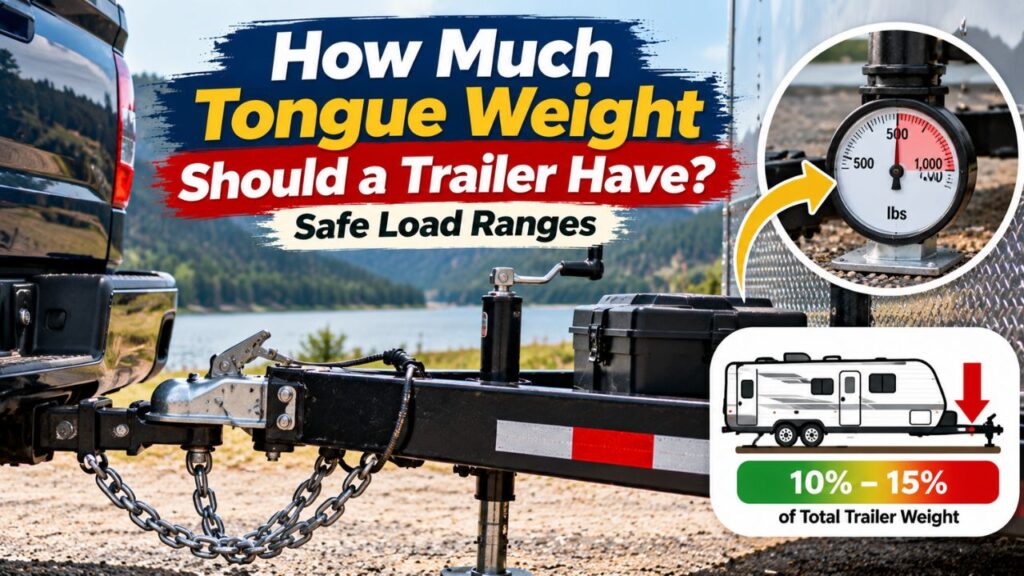
For most conventional trailers equipped with a ball-type hitch, the recommended tongue weight is approximately 10–15% of the fully loaded trailer weight.
This range is a starting point rather than a universal requirement. Always follow the specifications provided by the tow vehicle, trailer, and hitch manufacturers.
According to Ford’s official towing and trailering guidance, conventional trailer tongue weight should generally remain within 10–15% of loaded trailer weight, while fifth-wheel and gooseneck trailers commonly require 15–25%.
Recommended Trailer Tongue Weight Chart
The following chart shows the typical tongue weight range for conventional trailers at different loaded weights.
| Loaded trailer weight | Minimum at 10% | Maximum at 15% |
| 1,000 lbs | 100 lbs | 150 lbs |
| 1,500 lbs | 150 lbs | 225 lbs |
| 2,000 lbs | 200 lbs | 300 lbs |
| 3,000 lbs | 300 lbs | 450 lbs |
| 3,500 lbs | 350 lbs | 525 lbs |
| 4,000 lbs | 400 lbs | 600 lbs |
| 5,000 lbs | 500 lbs | 750 lbs |
| 6,000 lbs | 600 lbs | 900 lbs |
| 7,000 lbs | 700 lbs | 1,050 lbs |
| 8,000 lbs | 800 lbs | 1,200 lbs |
| 10,000 lbs | 1,000 lbs | 1,500 lbs |
These figures are calculated examples, not approved tongue weight ratings for specific vehicles.
A towing setup must remain within the manufacturer’s limits even when the tongue weight falls inside the recommended percentage range.
For example, a 3,500-pound trailer might have an acceptable calculated range of 350–525 pounds. However, if the tow vehicle and hitch permit only 350 pounds of tongue weight, that lower limit still applies.
Key Takeaway: Aim for 10–15% tongue weight on a conventional trailer, but never exceed the lowest applicable rating of the tow vehicle, hitch, or towing components.
What Is Trailer Tongue Weight?
Trailer tongue weight (TW) is the downward force that the trailer’s coupler applies to the tow vehicle’s hitch.
For a conventional bumper-pull trailer, this force acts through the hitch ball and ball mount into the vehicle’s receiver.
Tongue weight is not the same as the trailer’s total weight.
For example, a 5,000-pound loaded trailer might place 600 pounds on the hitch while the remaining 4,400 pounds are supported by its tires.
The amount of weight carried at the hitch changes according to the trailer’s design and how cargo is distributed around its axles.
Tongue Weight vs. Gross Trailer Weight
Two measurements are important:
- Gross Trailer Weight (GTW): The actual weight of the trailer, including installed equipment, cargo, fluids, and other items carried during towing.
- Tongue Weight (TW): The downward load applied by the trailer coupler to the hitch.
A trailer’s Gross Vehicle Weight Rating (GVWR) is different. It represents the manufacturer’s maximum permitted loaded trailer weight, not necessarily the amount the trailer currently weighs.
For calculating the correct tongue weight percentage, use the trailer’s actual loaded weight, not simply the GVWR printed on its identification label.
How to Calculate the Correct Trailer Tongue Weight
Calculating tongue weight requires the trailer’s loaded weight and the recommended percentage.
The formula is:
Tongue Weight = Loaded Trailer Weight × Recommended Tongue Weight Percentage
For most conventional trailers:
- Minimum target = Loaded trailer weight × 0.10
- Maximum target = Loaded trailer weight × 0.15
These calculations help establish a target range, but an actual measurement is still needed to confirm the load at the hitch.
Example: Tongue Weight for a 3,500-Pound Trailer
Suppose a utility trailer weighs 3,500 pounds with cargo.
Minimum tongue weight:
3,500 × 0.10 = 350 pounds
Maximum tongue weight:
3,500 × 0.15 = 525 pounds
The general recommended range is 350–525 pounds.
If its measured tongue weight is 420 pounds, the percentage is:
(420 ÷ 3,500) × 100 = 12%
That falls within the conventional trailer guideline, provided the vehicle and hitch are rated to handle the load.
Example: Tongue Weight for a 5,000-Pound Trailer
For a loaded trailer weighing 5,000 pounds:
- 10% tongue weight = 500 pounds
- 12% tongue weight = 600 pounds
- 15% tongue weight = 750 pounds
A measured tongue weight of 600 pounds represents 12% of the trailer’s loaded weight.
However, that doesn’t automatically mean the combination is safe. The vehicle must still have sufficient remaining payload and allowable hitch capacity.
Example: Tongue Weight for a 7,000-Pound Trailer
A conventional trailer weighing 7,000 pounds has a general tongue weight range of:
7,000 × 0.10 = 700 pounds
7,000 × 0.15 = 1,050 pounds
That means the typical range is 700–1,050 pounds.
For a trailer this heavy, the hitch configuration, rear axle rating, payload, and any manufacturer-required weight-distribution equipment deserve particular attention.
The percentage should never be used as permission to exceed a vehicle’s specified limits.
Why Is Proper Trailer Tongue Weight Important?
Trailer tongue weight directly affects the balance between the trailer and tow vehicle.
The weight must be distributed so the trailer tracks predictably without placing excessive downward load on the hitch.
What Happens if Trailer Tongue Weight Is Too Low?
Insufficient tongue weight can make a trailer unstable because too much of its mass is positioned toward the rear.
This can increase the likelihood of trailer sway, where the trailer oscillates from side to side behind the tow vehicle.
Possible warning signs include:
- The trailer begins moving from side to side at highway speeds.
- Small steering corrections produce noticeable trailer movement.
- Passing trucks or crosswinds trigger repeated oscillations.
- The trailer feels unstable despite normal road conditions.
Sway can worsen rapidly if the underlying balance problem isn’t corrected.
If significant sway occurs, ease off the accelerator, keep steering inputs smooth, and follow the trailer and brake-controller manufacturers’ emergency guidance. Avoid abrupt steering or braking that could destabilize the combination.
Once safely stopped, inspect the load distribution, hitch setup, tires, and other possible causes before continuing.
Important: Sway-control equipment doesn’t replace correct tongue weight or secure cargo placement.
What Happens if Tongue Weight Is Too High?
Excessive tongue weight places additional downward force on the rear of the towing vehicle.
Depending on the vehicle and suspension, this can cause:
- Excessive rear suspension compression.
- Reduced load on the front axle.
- Poor steering response.
- Changes in braking and vehicle handling.
- Excessive stress on hitch components.
- Overloading of the rear axle or tires.
A vehicle that sits noticeably lower at the rear may be carrying too much tongue weight or may have an improperly adjusted hitch system.
However, visual appearance alone cannot confirm the actual load.
Measure the tongue weight and relevant axle weights before deciding how to correct the problem.
Can Trailer Tongue Weight Be Too Heavy Even at 10%?
Yes.
A 10% tongue weight can still exceed the tow vehicle’s or hitch’s maximum rating.
For example, a 6,000-pound trailer places 600 pounds on the hitch at 10%.
If the vehicle’s maximum permitted tongue weight is only 500 pounds, the setup exceeds that limit even though the percentage looks appropriate.
The manufacturer ratings always take priority over general percentage recommendations.
Recommended Tongue Weight for Different Trailer Types
The correct tongue weight varies according to the hitch system and trailer design.
A conventional ball-hitch trailer should not be evaluated using the same loading percentage as a fifth-wheel trailer.
Utility Trailer Tongue Weight
Most conventional utility trailers follow the 10–15% guideline.
For a 2,000-pound loaded utility trailer, that corresponds to approximately 200–300 pounds.
Cargo such as lawn equipment, furniture, building supplies, or machinery can shift the weight distribution substantially.
Heavy objects should generally be positioned low, centered from side to side, and arranged so the final measured tongue weight falls within the approved range.
Travel Trailer Tongue Weight
Travel trailers commonly follow the conventional 10–15% tongue weight recommendation.
However, their actual hitch weight can change considerably between empty and loaded conditions.
Items affecting tongue weight include:
- Propane cylinders.
- Batteries mounted near the tongue.
- Freshwater and wastewater tank contents.
- Food, luggage, and camping equipment.
- Storage compartments located ahead of or behind the axles.
A travel trailer’s advertised dry tongue weight is not necessarily the weight it will place on the hitch during a trip.
Measure the trailer after loading it for travel, including the relevant fluids and installed equipment.
Enclosed Cargo Trailer Tongue Weight
Enclosed cargo trailers also commonly use the 10–15% range.
Their enclosed design can make it harder to judge where the load is concentrated.
Heavy items stored close to the front wall may increase tongue weight considerably.
Likewise, placing dense cargo behind the axles may leave the hitch too lightly loaded.
Secure cargo against movement and recheck the tongue weight after significant loading changes.
Boat Trailer Tongue Weight
Boat trailers may have different tongue weight recommendations depending on the trailer and hitch design.
Certain boat trailer configurations have manufacturer-specified requirements that differ from the usual conventional trailer guideline.
Follow the boat trailer manufacturer’s instructions rather than assuming the same percentage applies to every design.
Also account for:
- Outboard motor weight.
- Fuel and onboard equipment.
- Battery location.
- Boat positioning on the trailer.
- Trailer axle configuration.
Moving the boat forward or backward can significantly change the load on the coupler.
Never reposition a boat or trailer axle without following suitable manufacturer instructions.
Fifth-Wheel and Gooseneck Trailer Pin Weight
Fifth-wheel and gooseneck trailers transfer their vertical hitch load into the pickup bed rather than to a conventional rear receiver.
This load is generally called pin weight, although gooseneck trailers may also be described as having vertical hitch or ball load.
A common range is approximately 15–25% of loaded trailer weight, subject to the manufacturer’s specifications.
For example, a fifth-wheel trailer weighing 12,000 pounds may place approximately:
- 1,800 pounds on the truck at 15%.
- 2,400 pounds at 20%.
- 3,000 pounds at 25%.
These weights can consume a substantial portion of a pickup truck’s available payload.
Check the truck’s actual payload and axle ratings before selecting or loading a fifth-wheel or gooseneck trailer.
How to Measure Trailer Tongue Weight Accurately
Calculations provide a target range, but measuring the actual tongue weight is necessary to confirm whether the trailer is loaded correctly.
The most reliable method depends on the trailer’s size and the measuring equipment available.
The towing equipment manufacturer CURT describes several options in its official guide to measuring trailer tongue weight, including dedicated tongue weight scales, bathroom scales, and vehicle scales.
Method 1: Use a Trailer Tongue Weight Scale
A dedicated tongue weight scale is designed to measure the downward force applied at the trailer coupler.
For a compatible conventional trailer:
- Load the trailer exactly as it will be towed.
- Park on a firm, level surface.
- Chock the trailer wheels securely.
- Confirm that the measuring scale has adequate capacity.
- Position the scale beneath the coupler according to its instructions.
- Support the coupler at approximately its normal towing height.
- Transfer the tongue load onto the scale gradually.
- Read and record the measurement.
Keep the trailer stable throughout the process.
Do not place any part of your body underneath an unsupported tongue or coupler.
A scale positioned under the tongue jack may provide a slightly different reading from one positioned directly beneath the coupler because the supporting locations are different.
For the most representative measurement, follow the scale manufacturer’s setup procedure.
Method 2: Measure Light Tongue Weight With a Bathroom Scale
A suitable bathroom scale can sometimes measure tongue weight on a small, lightweight trailer.
However, its capacity must exceed the expected load.
Use a stable, load-rated support beneath the coupler at normal towing height and follow a verified weighing method.
Do not place a load on a household scale beyond its rated capacity.
For heavier trailers, a properly constructed lever arrangement can multiply the scale’s effective measuring capacity, but the leverage ratio depends on the exact support locations.
Improvised arrangements can slip or collapse, so a dedicated tongue weight scale is generally the safer and simpler choice.
Method 3: Measure Tongue Weight at a Public Vehicle Scale
A certified public scale is useful for heavier trailers.
One method compares the loaded towing vehicle’s weight with and without the trailer attached.
- Load the tow vehicle and trailer for the intended trip.
- Weigh the tow vehicle without the trailer attached.
- Couple the trailer and position only the tow vehicle’s axles on the scale.
- Keep the trailer’s wheels off the scale platform.
- Maintain the same occupants, cargo, and other vehicle loads.
- Subtract the unhitched vehicle weight from the hitched vehicle weight.
For a conventional ball-hitch setup measured without weight-distribution tension, the difference represents the tongue load transferred to the vehicle.
If a weight-distribution hitch is engaged, its spring bars redistribute axle loads and can affect the result. Follow the hitch manufacturer’s weighing procedure to determine actual tongue weight correctly.
A public scale can also help verify whether the tow vehicle’s front and rear axles remain within their ratings.
How to Calculate Tongue Weight Percentage From Measurements
Once you know the actual loaded trailer weight and measured tongue weight, use:
Tongue Weight Percentage = (Measured Tongue Weight ÷ Loaded Trailer Weight) × 100
For example:
- Loaded trailer weight: 4,000 pounds.
- Measured tongue weight: 480 pounds.
480 ÷ 4,000 × 100 = 12%
This falls within the typical 10–15% range for conventional trailers.
Remember that total loaded trailer weight includes both the weight supported by the trailer axles and the weight supported at the hitch.
Do not use trailer axle weight alone as the denominator.
How to Adjust Trailer Tongue Weight
If the measured tongue weight falls outside the recommended range, cargo placement is usually the first thing to examine.
Small changes in the position of heavy objects can alter the amount of force applied to the hitch.
How to Increase Tongue Weight
When tongue weight is too low, move suitable cargo toward the front of the trailer.
Follow these steps:
- Park the trailer on level ground and chock its wheels.
- Identify heavy items positioned behind the trailer axles.
- Move appropriate cargo forward in controlled increments.
- Keep the heaviest items low and centered from side to side.
- Secure everything with suitable tie-downs.
- Measure tongue weight again.
- Repeat until the load falls within the approved range.
Avoid placing all heavy cargo directly against the front wall.
The purpose is to achieve the correct load distribution without exceeding the tongue weight or axle ratings.
How to Reduce Excessive Tongue Weight
If tongue weight is too high, move some cargo rearward, closer to the trailer axles, while maintaining safe load distribution.
Start with heavy items positioned unnecessarily far forward.
Redistribute the load gradually and measure again after each significant adjustment.
Do not move so much weight behind the axles that the tongue becomes too light.
Also check whether tanks, batteries, equipment, or permanent accessories near the tongue are contributing to the load.
If proper tongue weight cannot be achieved within all applicable ratings, reduce the trailer’s total load or use appropriately rated towing equipment rather than forcing an unsafe arrangement.
Keep Cargo Low and Secure
Trailer stability depends on more than the front-to-rear balance.
Cargo should also be distributed across the trailer’s width.
Avoid concentrating heavy items on one side.
Secure equipment so it cannot roll, slide, or move during braking and cornering.
A load that shifts during travel can change tongue weight and axle loading unexpectedly.
How Tongue Weight Affects Vehicle Payload and Towing Capacity
A trailer can be within its allowable loaded weight and still overload the tow vehicle.
This happens because tongue weight contributes to the load the vehicle must carry.
Does Trailer Tongue Weight Count Toward Payload?
Yes. Conventional trailer tongue weight uses part of the tow vehicle’s available payload capacity.
The vehicle must support that weight along with passengers, luggage, cargo, and other accessories.
For example, suppose a vehicle has 900 pounds of remaining payload capacity before adding passengers or trailer tongue weight.
If the trailer places 600 pounds on the hitch, only 300 pounds remain for passengers, cargo, and other applicable loads.
That could be insufficient for the planned trip even when the trailer itself is below the vehicle’s maximum tow rating.
Understand Hitch and Receiver Weight Limits
A towing setup includes several components with their own weight ratings.
Check the limits of the:
- Tow vehicle.
- Hitch receiver.
- Ball mount.
- Hitch ball.
- Trailer coupler.
- Weight-distribution equipment, when used.
Some receivers list separate ratings for weight-carrying and weight-distributing configurations.
The allowable tongue weight depends on the installed equipment and manufacturer specifications.
The lowest applicable component rating establishes the limit.
A higher-rated hitch ball does not increase the capacity of the receiver or tow vehicle.
Does a Weight-Distribution Hitch Reduce Tongue Weight?
A weight-distribution hitch redistributes some of the load among the tow vehicle’s axles and the trailer’s axles.
This can help restore front-axle loading and improve handling when the equipment is properly selected and adjusted.
However, it does not eliminate the trailer’s actual tongue weight or create additional vehicle payload capacity.
Use a weight-distribution system only when compatible with the tow vehicle and trailer, and follow the manufacturers’ specifications.
Do not assume installing one automatically increases every towing rating.
Common Trailer Tongue Weight Mistakes to Avoid
Incorrect measurements and loading assumptions can produce misleading results even when the percentage calculation is correct.
Using Empty Trailer Weight Instead of Loaded Weight
Trailer weight changes when cargo, tools, supplies, and equipment are added.
A tongue weight calculated from an empty trailer may no longer be appropriate after loading.
Always use the actual weight for the intended trip.
Relying Only on the Trailer’s GVWR
The trailer’s GVWR is its maximum rated weight, not its actual weight during every trip.
Using GVWR to estimate a target can be useful during planning, but it doesn’t replace measuring the loaded trailer.
Assuming More Tongue Weight Is Always Safer
Increasing tongue weight can help correct a rear-heavy trailer, but excessive downward load creates different safety problems.
More is not always better.
Remain within the approved tongue weight percentage and every applicable component rating.
Ignoring Changes After Loading
Tongue weight can change when:
- Equipment is added or removed.
- Cargo is moved inside the trailer.
- Travel trailer tanks are filled or emptied.
- Heavy supplies are stored near the rear.
- Batteries or accessories are relocated.
Recheck the balance when the loaded configuration changes significantly.
Trying to Fix Every Sway Problem With Cargo Placement
Improper tongue weight is a common contributor to trailer sway, but it isn’t the only possible cause.
Other issues may include incorrect tire inflation, worn suspension components, poor hitch adjustment, excessive speed, or unsuitable towing equipment.
If sway continues after the trailer is correctly loaded, inspect the complete towing setup before traveling again.
Trailer Tongue Weight Safety Checklist Before Towing
Before a trip, verify the following:
- The trailer’s actual loaded weight is within its GVWR and the vehicle’s towing limit.
- Tongue weight is within the trailer and tow vehicle manufacturers’ requirements.
- The hitch receiver, ball mount, hitch ball, and coupler have adequate ratings.
- Vehicle payload, GVWR, and axle ratings are not exceeded.
- Cargo is secured and balanced from front to rear and side to side.
- The trailer sits at the intended towing attitude.
- Tires are correctly inflated for the load.
- Safety chains, coupler latch, electrical connections, lights, and trailer brakes are functioning correctly.
- Any weight-distribution system is properly adjusted.
- No unusual suspension sag or instability remains unexplained.
A weight measurement is especially important before towing a trailer with a new cargo arrangement or equipment configuration.
Conclusion
So, how much tongue weight should a trailer have? Most conventional trailers should carry approximately 10–15% of their fully loaded weight on the hitch. Fifth-wheel and gooseneck trailers generally require a higher percentage, commonly around 15–25%, depending on manufacturer specifications.
For a 5,000-pound conventional trailer, the typical tongue weight range is 500–750 pounds. However, that entire range is usable only if the tow vehicle and all hitch components are rated for it.
The most dependable approach is to measure the fully loaded trailer, calculate the target range, and verify the actual downward force at the hitch.
If the tongue weight is too low or too high, adjust cargo placement gradually and measure again.
Correct tongue weight, adequate vehicle capacity, and secure load distribution work together to support stable, predictable towing. Never rely on a percentage alone when evaluating the safety of a trailer setup.
FAQs About How Much Tongue Weight Should a Trailer Have
Is 10% Tongue Weight Enough for a Trailer?
Yes, 10% is within the typical recommended range for many conventional trailers.
However, the trailer and tow vehicle manufacturers may specify different requirements.
The actual measured weight must also stay within the hitch and vehicle ratings.
What Is the Ideal Tongue Weight for a 2,000-Pound Trailer?
A conventional trailer weighing 2,000 pounds when loaded generally has a target tongue weight of approximately 200–300 pounds.
The appropriate amount depends on the trailer design and manufacturer specifications.
A tongue weight of 200 pounds represents 10% of the loaded trailer weight.
Can Tongue Weight Be Less Than 10%?
Some specialized trailers may have manufacturer-approved requirements below the general 10% guideline.
However, less than 10% tongue weight on a conventional trailer can increase instability and trailer sway.
Do not intentionally use a lower percentage unless the manufacturer specifies it for that trailer and towing configuration.
Is 500 Pounds of Tongue Weight Too Much?
It depends on the trailer, tow vehicle, and hitch ratings.
Five hundred pounds is 10% of a 5,000-pound trailer, which is within the usual conventional trailer range.
However, the same 500-pound load could exceed the rating of a smaller tow vehicle or receiver.
Does a Trailer’s Tongue Weight Change While Driving?
Yes. Tongue load can vary dynamically as the trailer moves over bumps, accelerates, brakes, or experiences shifting cargo.
The measured static tongue weight provides a baseline for proper loading.
Keeping cargo securely fastened and following manufacturer ratings helps account for the demands of normal towing.
Can Too Much Tongue Weight Damage a Tow Vehicle?
Yes. Excessive tongue weight can overload hitch components, suspension parts, rear tires, or the rear axle.
It may also reduce front-axle loading and negatively affect steering and braking.
Correct the loading problem before towing rather than relying on suspension sag or vehicle appearance as the only indication of excessive weight.
Should You Measure Trailer Tongue Weight Before Every Trip?
Check tongue weight whenever you significantly change the trailer’s load or configuration.
If you regularly tow with an identical, previously measured setup, confirming that cargo remains in the same position may be sufficient between full measurements.
A new trailer, major cargo change, or unexplained handling problem warrants another measurement before traveling.