Tongue weight on a trailer is the downward force the trailer’s coupler places on the tow vehicle’s hitch. For most conventional bumper-pull trailers, the usual target is about 10%–15% of the trailer’s actual loaded weight, provided that amount stays within the ratings of the vehicle and hitch.
A trailer weighing 4,000 pounds when loaded would typically need about 400–600 pounds of tongue weight. That doesn’t mean the whole trailer weighs only 400–600 pounds; most of its weight rests on its own axle or axles. The portion pressing down on the hitch affects how steadily the trailer follows the tow vehicle.
Too little tongue weight can make a trailer more likely to sway. Too much can overload the hitch or rear axle, reduce steering control, and exceed the vehicle’s available payload. Cargo placement, water tanks, and equipment mounted near the trailer’s front or rear can change the number even when total trailer weight stays the same.
In this article, I explain what tongue weight means, how it differs from towing capacity, how much is typical for different hitches, how to measure it, and how to correct an unsafe load balance before driving.
What Is Tongue Weight on a Trailer and How Does It Work?
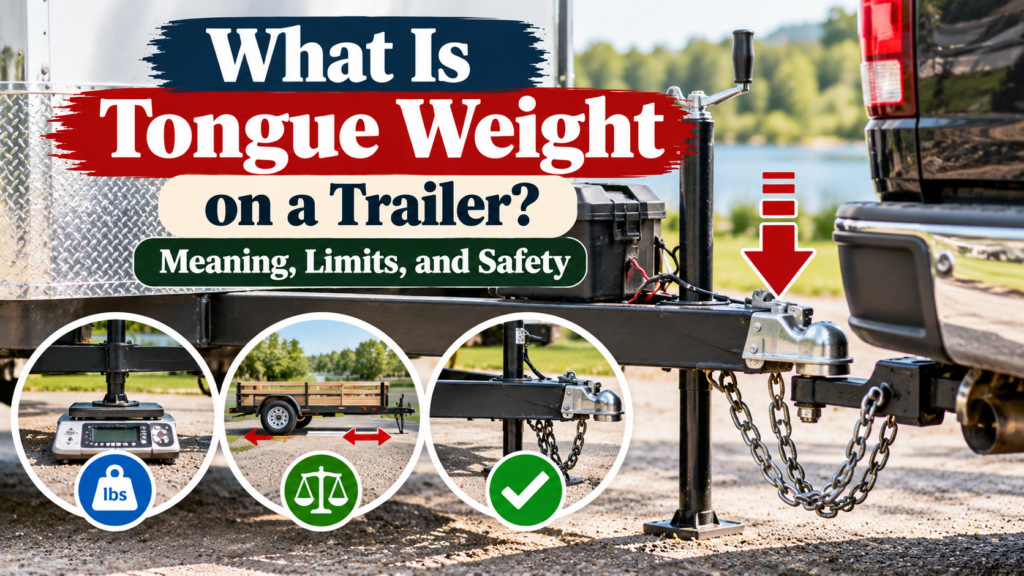
Trailer tongue weight (TW) is the vertical load transferred from a trailer to the towing vehicle through the trailer’s hitch connection.
On a conventional trailer, the tongue is the forward structure that connects the trailer frame to its coupler.
When you lower the coupler onto the hitch ball, part of the trailer’s weight presses downward on the towing vehicle.
The remaining weight is primarily supported by the trailer’s axle or axles.
Where Is Tongue Weight Applied?
On a conventional bumper-pull trailer, tongue weight acts at the point where the coupler connects to the hitch ball.
That downward force travels through the ball mount and hitch receiver into the tow vehicle’s frame.
Because the hitch is usually behind the rear axle, tongue weight also affects how the load is distributed between the vehicle’s front and rear axles.
A heavy tongue can increase rear-axle loading while reducing some of the load carried by the front axle.
This is why tongue weight matters for steering, braking, suspension behavior, and trailer stability.
Tongue Weight Example
Suppose you have a utility trailer with the following weights:
- Empty trailer: 1,500 pounds
- Loaded equipment: 2,500 pounds
- Total loaded trailer weight: 4,000 pounds
If the tongue weight measures 500 pounds, the hitch supports approximately 500 pounds of downward load.
With the trailer level and stationary, the trailer axles support the remaining approximately 3,500 pounds.
The tongue weight percentage is:
500 ÷ 4,000 × 100 = 12.5%
This falls within the commonly recommended 10%–15% range for conventional trailers.
Key Takeaway: Tongue weight is not the trailer’s total weight. It is the portion transferred vertically to the tow vehicle through the coupling.
How Much Tongue Weight Should a Trailer Have?
For most conventional ball-hitch trailers, tongue weight should generally be approximately 10%–15% of the fully loaded trailer weight.
This range helps maintain stable trailer handling when the tow vehicle, hitch, and trailer are properly matched.
According to Ford’s official towing and trailering guidance, conventional trailers generally need 10%–15% tongue weight, while fifth-wheel and gooseneck trailers commonly place 15%–25% of their loaded weight on the towing vehicle.
These percentages are general guidelines, not universal requirements. Always follow the specific trailer and vehicle manufacturers’ limits.
Recommended Tongue Weight by Trailer Weight
The following table shows the typical 10%–15% range for conventional bumper-pull trailers.
| Loaded Trailer Weight | 10% Tongue Weight | 15% Tongue Weight |
| 1,000 lbs | 100 lbs | 150 lbs |
| 2,000 lbs | 200 lbs | 300 lbs |
| 3,000 lbs | 300 lbs | 450 lbs |
| 4,000 lbs | 400 lbs | 600 lbs |
| 5,000 lbs | 500 lbs | 750 lbs |
| 6,000 lbs | 600 lbs | 900 lbs |
| 8,000 lbs | 800 lbs | 1,200 lbs |
| 10,000 lbs | 1,000 lbs | 1,500 lbs |
These values are calculated guidelines rather than guaranteed safe loads for every vehicle.
For example, a 5,000-pound trailer may fall within the typical range at 600 pounds of tongue weight, but that load is unacceptable if the tow vehicle’s permitted tongue weight is only 500 pounds.
The ratings of the towing equipment always take priority.
Tongue Weight for Travel Trailers
Conventional travel trailers commonly use the 10%–15% guideline.
However, travel trailers can have changing tongue weights because of:
- Freshwater and wastewater tank levels
- Propane cylinders
- Batteries mounted near the tongue
- Front storage compartments
- Rear cargo storage
- Added accessories and equipment
For example, loading heavy camping equipment into a front storage compartment can increase tongue weight without changing the trailer’s overall weight by very much.
Measure the trailer in its actual travel configuration rather than relying only on the manufacturer’s unloaded hitch weight.
Tongue Weight for Utility and Equipment Trailers
Utility trailers commonly carry lawn equipment, motorcycles, furniture, building supplies, and other cargo.
Their tongue weight depends heavily on where that cargo is positioned relative to the trailer axles.
A heavy mower loaded too far behind the axle can reduce tongue weight and increase the possibility of sway.
The same mower positioned too far forward may overload the hitch.
Secure the equipment near the intended loading position and verify tongue weight before towing.
Tongue Weight for Boat Trailers
Some boat trailers have different tongue weight recommendations because of their design and load distribution.
A lower percentage may be specified for certain boat trailer configurations.
Don’t automatically use the same percentage for every boat trailer.
Follow the boat trailer manufacturer’s recommendations and verify the hitch and tow vehicle ratings.
Fifth-Wheel and Gooseneck Trailer Weight
Fifth-wheel and gooseneck trailers connect to hitches mounted in the truck bed rather than a conventional hitch ball behind the bumper.
They generally place a greater percentage of their weight on the towing vehicle.
For fifth-wheel trailers, this vertical load is commonly called pin weight.
A typical planning range is approximately 15%–25% of the fully loaded trailer weight, although the required amount depends on the particular trailer.
Because these loads can be substantial, truck payload, rear-axle ratings, tire capacity, and hitch specifications must all be checked.
Why Is Tongue Weight Important for Safe Towing?
Tongue weight influences how a trailer responds to steering inputs, wind, road conditions, and changes in speed.
An improperly balanced trailer can become difficult to control even when its total weight is below the tow vehicle’s maximum towing capacity.
What Happens if Tongue Weight Is Too Low?
Insufficient tongue weight can make a conventional trailer more prone to sway.
Trailer sway is an unwanted side-to-side movement that may develop or increase while driving.
Possible contributing factors include:
- Too much cargo positioned behind the trailer axle
- Heavy rear-mounted accessories
- Improper load distribution
- Incorrect trailer loading
- Other towing setup or operating problems
When the tongue weight is too low, the trailer may respond less predictably to crosswinds, passing vehicles, and steering movements.
Severe sway can lead to loss of control.
If a trailer begins swaying, avoid abrupt steering or braking inputs. Gradually reduce speed using the method recommended by the vehicle and trailer manufacturers, and stop in a safe location to inspect the setup.
Do not continue towing an unstable trailer at highway speed.
What Happens if Tongue Weight Is Too High?
Excessive tongue weight places additional load on the towing vehicle.
Possible consequences include:
- Overloading the hitch receiver or ball mount
- Exceeding the vehicle’s available payload
- Excessive rear suspension compression
- Increased rear-axle loading
- Reduced front-axle loading
- Less responsive steering
- Changes in braking and handling
A vehicle may appear capable of towing the trailer’s total weight while still being unable to support its actual tongue weight.
For example, a truck rated to tow 7,000 pounds does not automatically have enough payload or hitch capacity for every 7,000-pound trailer.
The specific vehicle configuration and equipment ratings determine the allowable load.
Can Too Much Tongue Weight Damage a Trailer Hitch?
Yes. Exceeding the rated tongue load can overstress hitch components.
Depending on the setup, excessive loading may contribute to deformation or damage involving the hitch receiver, ball mount, coupler connection, or supporting vehicle structure.
Never assume that a heavy-duty-looking hitch can support more weight than its stated rating.
If the hitch or mounting components show damage, stop towing until they have been inspected and repaired or replaced as appropriate.
How to Calculate Tongue Weight on a Trailer
You can estimate a suitable tongue weight range using the trailer’s total loaded weight.
However, calculating a target range does not measure the actual tongue weight. Actual tongue weight must be checked with an appropriate scale or approved onboard measuring system.
Tongue Weight Formula
For a conventional trailer:
Target Tongue Weight = Loaded Trailer Weight × Recommended Percentage
Use the trailer manufacturer’s recommended percentage when available.
For the general 10%–15% range, calculate both ends.
Example: Tongue Weight for a 3,500-Pound Trailer
Suppose your trailer weighs 3,500 pounds after loading.
At 10%:
3,500 × 0.10 = 350 pounds
At 15%:
3,500 × 0.15 = 525 pounds
The general target range is approximately 350–525 pounds.
The actual measured tongue weight must also remain within the towing equipment’s limits.
How to Calculate Tongue Weight Percentage
If you already know the actual tongue weight and loaded trailer weight, use:
Tongue Weight Percentage = (Actual Tongue Weight ÷ Loaded Trailer Weight) × 100
For example, a loaded trailer weighs 5,000 pounds, and its measured tongue weight is 650 pounds.
650 ÷ 5,000 × 100 = 13%
The trailer has a tongue weight equal to 13% of its loaded weight.
This is within the typical conventional trailer guideline, assuming the equipment can safely support the load.
How to Measure Actual Trailer Tongue Weight
Tongue weight should be measured with the trailer loaded as it will be during travel.
That includes cargo, equipment, accessories, and fluids that affect the trailer’s weight distribution.
You can use a dedicated tongue weight scale, an appropriate public vehicle scale, or certain manufacturer-approved onboard weighing systems.
Method 1: Use a Tongue Weight Scale
A dedicated tongue weight scale is one of the most straightforward measurement methods for a conventional trailer.
It is designed to support and measure the downward force at the trailer’s tongue.
Follow these steps:
- Park the trailer on a firm, level surface.
- Apply the trailer’s parking brake if equipped and securely chock the wheels.
- Load the trailer as it will be during travel.
- Position a properly rated tongue weight scale beneath the coupler using the scale manufacturer’s support arrangement.
- Adjust the trailer so the coupler is at its normal towing height.
- Transfer the tongue load onto the scale gradually.
- Read and record the measurement.
Use a scale with enough capacity for the expected tongue weight.
Safety Note: Never place hands, feet, or other body parts beneath an unsupported trailer tongue. Use properly rated equipment and keep the trailer secured against movement.
Method 2: Measure Tongue Weight at a Public Scale
A public vehicle scale can help determine tongue weight when appropriate weighing procedures are followed.
The basic method compares the tow vehicle’s weight with and without the trailer’s vertical load.
- Load the tow vehicle as it will be for the trip.
- Weigh the tow vehicle without the trailer attached.
- Connect the loaded trailer using the appropriate hitch arrangement.
- Position only the tow vehicle’s wheels on the scale, keeping the trailer’s wheels off it.
- Record the tow vehicle’s new total weight.
- Subtract the first measurement from the second.
For a conventional hitch without weight distribution engaged, the difference approximates the trailer’s tongue weight.
For example:
- Tow vehicle alone: 5,200 pounds
- Tow vehicle with trailer attached: 5,800 pounds
5,800 − 5,200 = 600 pounds
The tongue weight is approximately 600 pounds.
This method requires consistent loading between weighings.
Weight-distribution hitches can alter the load readings across the vehicle and trailer axles. For an accurate measurement, follow the hitch manufacturer’s procedures rather than assuming an engaged weight-distribution system produces the same scale result as a conventional hitch.
Method 3: Use a Bathroom Scale for a Small Trailer
For relatively light trailers, a properly rated bathroom scale may be used with a suitable support arrangement.
However, many household scales cannot safely support the direct tongue load of larger trailers.
Trailer hitch manufacturer CURT provides official instructions for measuring tongue weight, including methods using dedicated scales, bathroom scales, and public vehicle scales.
Its guidance includes a mechanical-leverage arrangement for loads beyond the direct capacity of a bathroom scale.
That method requires accurate distances, secure supports, and correctly positioned components.
For heavier trailers, a dedicated tongue weight scale or professional weighing service is generally the safer and simpler choice.
What Is the Difference Between Tongue Weight and Towing Capacity?
Tongue weight and towing capacity are related, but they describe different limits.
Towing capacity is the maximum trailer weight a vehicle is permitted to tow under specified conditions.
Tongue weight is the vertical force the trailer places on the hitch.
A vehicle must have sufficient capacity for both.
Tongue Weight vs. Trailer Weight vs. Payload
| Term | Meaning | Why It Matters |
| Tongue weight | Downward load at the hitch | Affects stability and vehicle loading |
| Loaded trailer weight | Actual weight of the trailer and its contents | Must stay within towing and trailer limits |
| Towing capacity | Maximum permitted trailer weight for the vehicle configuration | Limits how much the vehicle may tow |
| Payload capacity | Available capacity for occupants, cargo, accessories, and applicable hitch loads | Tongue weight uses part of this capacity |
| GVWR | Maximum permitted loaded weight of the vehicle or trailer | Must not be exceeded |
| GAWR | Maximum rated load on an individual axle | Protects axle, suspension, and tire loading |
| GCWR | Maximum permitted combined loaded weight of tow vehicle and trailer | Limits the towing combination |
A trailer’s GVWR is a rating, not necessarily its actual loaded weight. Use actual measured weight for tongue weight calculations.
Does Tongue Weight Count Toward Vehicle Payload?
Yes. On a conventional trailer, the tongue’s downward load generally counts against the tow vehicle’s available payload.
For example, suppose a truck has 1,500 pounds of available payload capacity before additional occupants and cargo are added.
You load:
- Passengers: 400 pounds
- Tools and luggage: 250 pounds
- Trailer tongue weight: 600 pounds
The additional load totals:
400 + 250 + 600 = 1,250 pounds
That leaves 250 pounds of the original payload allowance.
This example assumes the stated capacity is appropriate for the vehicle as configured and that no other accessories or loads need to be counted.
Actual safe towing also requires checking GVWR, axle ratings, tire limits, and the manufacturer’s towing instructions.
Can a Vehicle Tow a Trailer if Tongue Weight Exceeds the Hitch Rating?
No. The hitch’s specified maximum tongue weight must not be exceeded.
You must also remain within the tow vehicle’s maximum permitted hitch load.
If the receiver is rated for 500 pounds of tongue weight and the trailer applies 650 pounds, that setup exceeds the receiver’s limit, even if the vehicle has enough engine power to pull the trailer.
Upgrading a hitch component does not automatically increase the vehicle manufacturer’s permitted tongue load.
How Does Cargo Placement Affect Trailer Tongue Weight?
Cargo placement changes the balance between the load carried by the trailer axles and the load transferred to the hitch.
Even when the total trailer weight remains unchanged, moving cargo forward or backward can change tongue weight significantly.
Moving Cargo Toward the Front
Moving cargo forward of the axle generally increases tongue weight.
This may help correct a trailer that has insufficient tongue load.
However, placing too much weight near the front can overload the hitch or tow vehicle.
Moving Cargo Toward the Rear
Moving cargo behind the axle generally reduces tongue weight.
This may help correct an excessively front-heavy trailer.
However, moving too much weight rearward can make the trailer unstable.
Never place heavy cargo at the very back simply to make the trailer easier to connect to the hitch.
Positioning Heavy Cargo Near the Axles
Heavy cargo is generally best kept low and near the trailer axles, with enough weight positioned forward to achieve the required tongue load.
This helps avoid unnecessarily large changes in trailer balance.
Distribute cargo evenly from left to right and secure it against movement.
Key Takeaway: Adjust cargo positions based on measured tongue weight, not appearance. A trailer that looks level may still be improperly loaded.
How to Correct Tongue Weight That Is Too High or Too Low
If the measured tongue weight falls outside the trailer manufacturer’s recommended range, correct the load before traveling.
How to Increase Low Tongue Weight
If tongue weight is below the recommended range:
- Confirm the trailer’s actual loaded weight.
- Move suitable cargo slightly forward of the axle.
- Keep heavy items low and securely fastened.
- Avoid placing excessive weight at the rear.
- Measure the tongue weight again.
- Verify the hitch and vehicle loading limits.
Make gradual adjustments instead of moving all the cargo forward at once.
A small repositioning of a heavy item can produce a noticeable change.
How to Reduce Excessive Tongue Weight
If tongue weight exceeds the recommended range or equipment rating:
- Check whether heavy cargo is concentrated at the front.
- Reposition suitable cargo closer to the axles or slightly rearward.
- Remove unnecessary equipment or cargo if needed.
- Check that the trailer remains evenly loaded from side to side.
- Measure the tongue weight again.
- Confirm that the final load meets all ratings.
If the trailer cannot be loaded within its required tongue weight range without exceeding another limit, the towing combination may be unsuitable.
Do not attempt to compensate for an overloaded hitch by changing tire pressure or adding suspension accessories.
Does a Weight-Distribution Hitch Reduce Tongue Weight?
A weight-distribution hitch uses spring bars or another designed mechanism to redistribute part of the load effect among the tow vehicle’s axles and the trailer’s axles.
It can help restore front-axle loading and improve towing behavior when properly selected and adjusted.
However, it doesn’t eliminate the trailer’s actual tongue weight or increase the tow vehicle’s payload, GVWR, or axle ratings.
Some hitch receivers have different permitted ratings for weight-carrying and weight-distributing operation.
Use the ratings approved for the specific vehicle, receiver, and hitch configuration.
A weight-distribution hitch should never be used as a workaround for exceeding the towing vehicle’s structural or weight limits.
Common Mistakes When Checking Trailer Tongue Weight
Several common errors can produce misleading measurements or unsafe towing conditions.
Using Empty Trailer Weight Instead of Loaded Weight
The tongue weight percentage should be calculated using the trailer’s actual loaded weight.
Cargo, water, propane, tools, and accessories can change both total weight and balance.
Manufacturer-listed dry tongue weight may not reflect the trailer’s condition when you’re ready to travel.
Assuming 10%–15% Applies to Every Trailer
The 10%–15% range is a general guideline for conventional trailers.
Specialized trailers, boat trailers, fifth-wheel trailers, and gooseneck trailers may have different manufacturer recommendations.
Always prioritize the specifications for your equipment.
Ignoring Tow Vehicle Payload
A vehicle may have sufficient towing capacity but insufficient remaining payload for the trailer’s tongue weight.
Account for passengers, cargo, installed accessories, and other vehicle loads.
Measuring With the Trailer at the Wrong Height
A trailer’s vertical angle can affect the load distribution and the measurement.
When measuring tongue weight, support the coupler at approximately its normal towing height.
Follow the measuring equipment manufacturer’s instructions.
Relying on Suspension Sag to Estimate Weight
Rear suspension sag is not a reliable substitute for measuring tongue weight.
Different vehicles have different spring rates, suspension designs, and load-leveling systems.
A truck may appear nearly level while carrying an excessive load.
Use a suitable scale and verify the vehicle’s actual weight ratings.
Conclusion
The question “what is tongue weight on a trailer?” comes down to one measurement: the downward force the trailer transfers to the towing vehicle through its hitch connection.
For most conventional trailers, a typical target is approximately 10%–15% of the total loaded trailer weight.
Proper tongue weight helps support stable towing, while too little can contribute to trailer sway and too much can overload the hitch or towing vehicle.
The safest approach is to load the trailer as it will be used, measure its actual tongue weight, and compare the result with the trailer, hitch, and vehicle manufacturers’ specifications.
Before every trip involving significantly changed cargo, verify that the load is properly balanced and secured. Staying within every applicable weight rating matters more than simply reaching a suggested percentage.
FAQs About What Is Tongue Weight on a Trailer
Is Tongue Weight the Same as Hitch Weight?
For conventional bumper-pull trailers, tongue weight and hitch weight generally refer to the same downward load at the coupling. Fifth-wheel trailers commonly use the term pin weight instead.
What Is the Tongue Weight of a 5,000-Pound Trailer?
A conventional trailer weighing 5,000 pounds when fully loaded typically has a target tongue weight of approximately 500–750 pounds. The correct amount depends on the manufacturer’s recommendations and the towing equipment’s limits.
Does Trailer Tongue Weight Include the Weight of the Hitch?
Tongue weight refers to the trailer’s downward load at the coupling. The weight of the ball mount, weight-distribution hardware, and other hitch equipment must also be accounted for in the tow vehicle’s overall loading, as applicable.
Can Tongue Weight Be Too Light Even if the Trailer Is Under Its Weight Limit?
Yes. A trailer can remain below its maximum permitted weight but still have insufficient tongue weight. Cargo loaded too far behind the axle can reduce the vertical load at the hitch and increase the risk of trailer sway.
Does Adding Water to a Travel Trailer Change Tongue Weight?
Yes. Water stored in freshwater, gray-water, or black-water tanks can change both total trailer weight and tongue weight. The effect depends on each tank’s location relative to the trailer axles. Measure the trailer in the configuration used for travel.
Can You Measure Tongue Weight Without Disconnecting the Trailer?
Yes, certain vehicle scales and manufacturer-approved onboard weighing systems can help determine tongue load while the trailer is connected. The correct procedure depends on the equipment and hitch configuration. For a dedicated tongue weight scale, the trailer generally needs to be supported separately at the coupling.
Does Tongue Weight Change When You Move Cargo?
Yes. Moving cargo forward of the axle generally increases tongue weight, while moving it behind the axle generally decreases tongue weight. After significant changes, secure the load and measure again before towing.