To determine tongue weight of a travel trailer, load the trailer as you would for a trip, park on level ground, and measure the downward force at the hitch coupler using a properly rated tongue weight scale. A public vehicle scale or a carefully arranged lever-and-scale setup can also measure tongue weight when suitable equipment is available.
For most conventional travel trailers, tongue weight commonly falls between 10% and 15% of the trailer’s actual loaded weight. However, the correct target must also satisfy the trailer manufacturer’s recommendations and the tow vehicle’s hitch and weight ratings.
Incorrect tongue weight can create serious towing problems. Too little weight on the hitch may contribute to trailer sway, while excessive tongue weight can overload the tow vehicle, reduce steering control, and strain suspension components.
Factory dry hitch weight isn’t necessarily accurate once propane tanks, batteries, water, and camping gear are added.
In this article, I explain three methods for measuring travel trailer tongue weight, the formulas for calculating its percentage, how to check towing limits, and how to adjust cargo placement when the measured weight is too high or too low.
What Is Travel Trailer Tongue Weight?
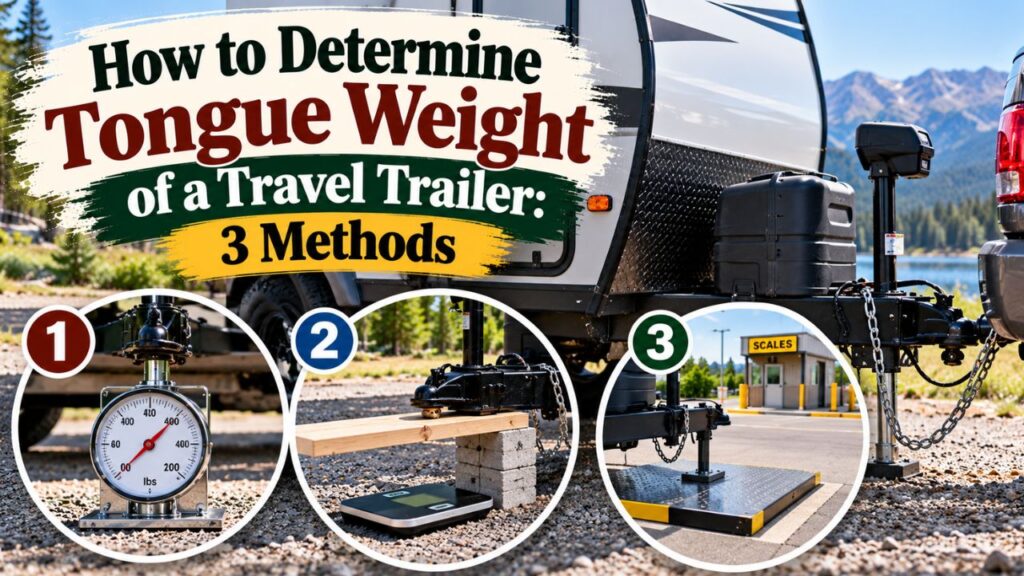
Tongue weight (TW) is the downward force that a conventional travel trailer applies to the tow vehicle’s hitch ball through its coupler.
When a travel trailer is connected to a tow vehicle, part of the trailer’s weight rests on the trailer’s own tires, while the remaining portion is supported through the hitch connection.
For example, a travel trailer weighing 6,000 pounds might apply 780 pounds of downward force at the hitch.
That means:
- Total loaded trailer weight: 6,000 pounds.
- Tongue weight: 780 pounds.
- Weight supported by trailer tires before weight distribution: 5,220 pounds.
- Tongue weight percentage: 13%.
Tongue weight directly influences the balance between the trailer and tow vehicle.
It’s different from the weight of the trailer’s tongue assembly alone. The measurement represents the actual downward load at the coupling point.
Why Tongue Weight Matters for Safe Towing
A travel trailer needs enough tongue weight to remain stable behind the tow vehicle.
If too much weight is concentrated behind the trailer axles, the hitch load may become too light.
This can contribute to trailer sway, especially during highway driving, crosswinds, and sudden maneuvers.
Excessive tongue weight creates a different problem.
The tow vehicle may experience:
- Excessive rear suspension compression.
- Reduced load on the front axle.
- Changes in steering response.
- Longer or less predictable braking behavior.
- Overloaded tires or rear axle components.
- Exceeded hitch or vehicle weight ratings.
A properly balanced trailer helps maintain stable handling without overloading the towing equipment.
However, correct tongue weight alone doesn’t guarantee safe towing. Tire condition, hitch setup, trailer brakes, loading, and driving conditions also matter.
How Much Tongue Weight Should a Travel Trailer Have?
A common target for a conventional travel trailer is 10%–15% of its total loaded trailer weight.
This is a general operating range, not permission to exceed any manufacturer-specified limit.
According to Ford’s official towing guidance, conventional trailer tongue weight generally should be approximately 10%–15% of the trailer’s loaded weight, while remaining within the vehicle and hitch limits.
Some manufacturers specify particular loading targets or requirements for individual vehicles and trailers.
Always follow the applicable owner’s manuals when their instructions differ from a general rule.
Travel Trailer Tongue Weight Chart
The following table shows a typical 10%–15% tongue weight range for different loaded trailer weights.
| Loaded trailer weight | 10% tongue weight | 15% tongue weight |
| 3,000 lbs. | 300 lbs. | 450 lbs. |
| 4,000 lbs. | 400 lbs. | 600 lbs. |
| 5,000 lbs. | 500 lbs. | 750 lbs. |
| 6,000 lbs. | 600 lbs. | 900 lbs. |
| 7,000 lbs. | 700 lbs. | 1,050 lbs. |
| 8,000 lbs. | 800 lbs. | 1,200 lbs. |
| 9,000 lbs. | 900 lbs. | 1,350 lbs. |
| 10,000 lbs. | 1,000 lbs. | 1,500 lbs. |
These values are calculations, not equipment ratings.
For example, a trailer weighing 8,000 pounds might have a tongue weight of 1,120 pounds, or 14%.
That percentage falls within the general range, but the combination is unsuitable if the tow vehicle or hitch is rated to handle only 1,000 pounds of tongue weight.
Important: The manufacturer’s maximum tongue weight rating takes priority over a percentage calculation.
How to Determine Tongue Weight of a Travel Trailer With a Scale
A dedicated tongue weight scale is one of the simplest ways to measure the actual hitch load.
These scales are designed to measure substantial vertical loads and are available in different capacities.
For a travel trailer, choose a scale rated above the expected tongue weight.
Step 1: Load the Travel Trailer for Towing
Measure the trailer as it will actually travel, not just when it’s empty.
Include the equipment and supplies you normally carry:
- Camping gear and personal belongings.
- Propane cylinders and their contents.
- Installed batteries.
- Food and kitchen supplies.
- Tools and spare parts.
- Outdoor chairs and other equipment.
- Fresh water and waste tank contents at the levels expected during travel.
Water weight can make a substantial difference.
For example, 40 gallons of fresh water weigh approximately 334 pounds, excluding the tank itself.
Where that tank sits relative to the trailer axles determines how much the added water changes tongue weight.
Also account for any cargo stored in a front pass-through compartment.
Step 2: Park on a Level, Stable Surface
Position the loaded travel trailer on firm, level ground.
A concrete surface is often suitable if it can support the equipment and trailer load.
Chock the trailer wheels securely on both sides to prevent movement.
Make sure the trailer’s frame is approximately level in its normal towing position.
A significant front-to-back angle can change the tongue weight measurement.
Avoid measuring on an incline, soft soil, or unstable blocks.
Step 3: Disconnect the Trailer From the Tow Vehicle
Follow the trailer and hitch manufacturer’s uncoupling instructions.
If a weight-distribution hitch is installed, release its spring-bar tension using the specified procedure before separating the trailer.
These components can contain substantial stored force.
Use the tongue jack to support the trailer and carefully disconnect the coupler from the hitch ball.
Keep the trailer wheels securely chocked.
Don’t use stabilizer jacks to lift the trailer or support its tongue weight unless the equipment is expressly designed for that purpose.
Step 4: Position the Tongue Weight Scale
Place the properly rated scale on a stable, level support directly beneath the coupler’s normal hitch-ball load point.
Use the scale’s approved adapter or contact piece if needed.
The scale must remain upright and properly supported throughout the measurement.
Measure at the coupler whenever possible. A reading taken beneath the tongue jack can differ because the jack is generally positioned closer to the trailer axles than the hitch ball.
Some scale systems are specifically designed for jack-position measurements or provide correction instructions. Follow the product’s requirements.
Step 5: Lower the Coupler Onto the Scale
Slowly operate the tongue jack until the coupler’s load transfers to the scale.
The trailer should remain at approximately its normal towing height.
Make sure:
- The scale is carrying the intended tongue load.
- The tongue jack isn’t sharing the measured load.
- The trailer wheels remain chocked.
- No stabilizers or other supports are carrying unintended weight.
- The scale is stable and within its rated capacity.
Never place your hands, feet, or body underneath an unsupported trailer tongue.
Step 6: Record the Tongue Weight
Read the value displayed by the scale.
For example, suppose the scale shows:
Tongue weight = 875 pounds
Record the measurement and compare it with the trailer’s actual loaded weight.
If the travel trailer weighs 7,000 pounds, its tongue weight percentage is:
875 ÷ 7,000 × 100 = 12.5%
This is within the common 10%–15% range, provided the tow vehicle, hitch, and trailer ratings are also satisfied.
How to Measure Travel Trailer Tongue Weight at a Truck Scale
A commercial vehicle scale is another practical option, especially for travel trailers with heavy tongue loads.
Public scales at some truck stops, recycling centers, and commercial weighing facilities can measure vehicle weights.
The method requires comparing the tow vehicle’s weight with and without the trailer attached.
Step 1: Weigh the Loaded Tow Vehicle Alone
Load the tow vehicle as it will be for the trip.
Include passengers, luggage, fuel, and equipment.
Drive onto the vehicle scale without the trailer attached.
Record the total weight of the tow vehicle.
For example:
Tow vehicle alone = 6,200 pounds
Keep the passengers and cargo consistent between measurements.
Step 2: Weigh the Tow Vehicle With the Trailer Attached
Connect the travel trailer and follow all applicable hitching instructions.
For a conventional tongue weight comparison, the weight-distribution spring bars must not be applying redistribution force during the measurement.
If the trailer requires weight distribution for travel, don’t tow it without the required system merely to make this measurement. Ask the scale operator whether the bars can be safely disengaged at the scale, following the hitch manufacturer’s procedures.
Position the tow vehicle so that all its tires are on the weighing platform while the trailer tires remain off it.
Record the combined weight supported by the tow vehicle’s front and rear axles.
For example:
Tow vehicle with attached trailer = 7,050 pounds
Step 3: Subtract the Tow Vehicle’s Weight
Use the following formula:
Tongue weight = Tow vehicle weight with trailer attached − Tow vehicle weight alone
7,050 − 6,200 = 850 pounds
The measured tongue weight is approximately 850 pounds.
This method assumes the same vehicle loading during both weighings, no engaged weight-distribution spring bars, and the correct positioning of the tires on the scale.
The CURT Manufacturing tongue weight measurement guide describes the dedicated-scale, bathroom-scale, and vehicle-scale methods for measuring trailer tongue load.
Why You Must Account for Weight Distribution
A weight-distribution hitch transfers some load between the tow vehicle’s front axle, rear axle, and trailer axles.
If you weigh the tow vehicle with the spring bars engaged, the change in total vehicle axle weight may not equal the trailer’s actual unassisted tongue weight.
For this reason, a direct coupler measurement is usually more straightforward when you need to know the actual tongue load.
A commercial scale is still valuable for verifying axle loads with the weight-distribution hitch engaged in its normal towing configuration.
How to Measure Tongue Weight With a Bathroom Scale
A household bathroom scale can sometimes be used for light trailer tongues, but most travel trailer tongue weights exceed the capacity of an ordinary bathroom scale.
For heavier loads, a properly constructed lever system can reduce the force applied to the scale.
This method requires caution because an unstable setup can collapse under the trailer tongue.
For a heavy travel trailer, a rated tongue weight scale or commercial weighing service is the safer and more practical option.
The Three-to-One Lever Method
A traditional lever arrangement uses:
- A suitable, strong board.
- A bathroom scale with adequate capacity.
- Two stable support points.
- Proper load-contact hardware.
- A firm, level surface.
In a three-to-one arrangement, the coupler load is positioned between two supports.
One support is 1 foot from the load point, while the scale support is 2 feet from that point on the opposite side.
When the geometry is correct, the scale carries approximately one-third of the tongue load.
Tongue weight = Scale reading × 3
For example:
275 pounds × 3 = 825 pounds
The tongue weight would be approximately 825 pounds.
This formula applies only to the described lever geometry.
Changing the support distances changes the multiplier.
Important Limitations of a Bathroom Scale
Do not attempt this method unless every component can safely handle its applied load.
A household scale may be damaged or give an inaccurate reading if the load is concentrated on a small area.
Boards, blocks, and contact points can also fail or move.
The trailer must remain securely chocked, and no one should be positioned beneath the tongue.
For a full-size travel trailer, a purpose-built scale is generally the better choice.
How to Calculate Travel Trailer Tongue Weight Percentage
After measuring tongue weight, determine what percentage of the loaded trailer’s total weight it represents.
Use:
Tongue weight percentage = (Measured tongue weight ÷ Actual loaded trailer weight) × 100
For example:
- Loaded travel trailer weight: 6,800 pounds.
- Measured tongue weight: 900 pounds.
Calculation:
900 ÷ 6,800 × 100 = 13.24%
The tongue weight is approximately 13.2% of the trailer’s loaded weight.
This falls within the common 10%–15% range.
However, the result still needs to be checked against the equipment ratings.
How to Find the Trailer’s Actual Loaded Weight
A commercial vehicle scale is useful for determining the trailer’s gross loaded weight.
One method is to weigh the entire loaded tow vehicle and trailer combination, then subtract the tow vehicle’s separately measured weight.
Loaded trailer weight = Combined vehicle-and-trailer weight − Tow vehicle weight alone
For example:
- Total combination weight: 13,500 pounds.
- Loaded tow vehicle alone: 6,500 pounds.
13,500 − 6,500 = 7,000 pounds
The trailer’s gross loaded weight is 7,000 pounds.
The passengers, cargo, and other tow vehicle loading should remain consistent between measurements.
The combined weighing must account for all axles on the scale.
Do Not Confuse Trailer Axle Weight With Total Trailer Weight
When a conventional trailer is hitched without weight distribution engaged, some of its weight rests on the tow vehicle.
Therefore:
Loaded trailer weight = Trailer axle weight + Tongue weight
For example:
- Trailer axle weight: 6,100 pounds.
- Tongue weight: 900 pounds.
Total loaded trailer weight:
6,100 + 900 = 7,000 pounds
The tongue weight percentage is:
900 ÷ 7,000 × 100 = 12.86%
Do not divide tongue weight only by the trailer axle reading.
Also, axle readings taken with a weight-distribution hitch engaged may include redistributed loading, so they should not be combined with an unassisted tongue reading without accounting for that difference.
How to Check Travel Trailer Tongue Weight Against Towing Limits
A tongue weight measurement is useful only when compared with the tow vehicle’s actual weight limits.
A trailer can have a reasonable tongue weight percentage and still overload the towing equipment.
Check the Tow Vehicle’s Maximum Tongue Weight
Consult the tow vehicle owner’s manual and towing specifications for the exact model and configuration.
Look for the maximum allowable trailer tongue weight.
Some vehicles specify different limits depending on whether an approved weight-distribution hitch is installed.
The hitch receiver, ball mount, hitch ball, and other components also have their own ratings.
The lowest applicable capacity within the towing system must not be exceeded.
For example, suppose:
- Measured tongue weight: 950 pounds.
- Vehicle maximum permitted tongue weight: 1,000 pounds.
- Hitch receiver rated tongue weight: 900 pounds.
The setup exceeds the receiver’s 900-pound limit even though the vehicle’s stated maximum is higher.
The towing configuration must be changed before travel.
Check Tow Vehicle Payload Capacity
Tongue weight consumes part of the tow vehicle’s available carrying capacity.
The same vehicle must also support passengers, cargo, accessories, and the applicable weight of towing equipment.
For example, suppose the available payload is 1,500 pounds.
| Payload item | Weight |
| Trailer tongue weight | 800 lbs. |
| Passengers | 350 lbs. |
| Cargo in tow vehicle | 200 lbs. |
| Weight-distribution hitch hardware | 100 lbs. |
| Total assumed payload use | 1,450 lbs. |
This illustrative calculation leaves only 50 pounds against the stated payload figure.
Actual compliance must be verified using the vehicle’s weight ratings and scale measurements.
Vehicle-specific equipment and installed accessories may already be accounted for in the payload label, so avoid double-counting those items.
Check GVWR, GAWR, and GCWR
Three ratings are especially important.
Gross Vehicle Weight Rating (GVWR): The maximum permitted loaded weight of the tow vehicle.
Gross Axle Weight Rating (GAWR): The maximum permitted load on an individual axle.
Gross Combination Weight Rating (GCWR): The maximum permitted combined weight of the tow vehicle and loaded trailer.
Compare actual scale measurements with the applicable manufacturer ratings.
Even if the tongue weight is within the desired percentage, the rear axle or entire vehicle could still be overloaded.
Also verify the trailer’s GVWR and axle ratings.
Does a Weight-Distribution Hitch Change Actual Tongue Weight?
A weight-distribution hitch changes how loads are carried by the axles, but it doesn’t remove the trailer’s underlying tongue load.
The spring bars apply forces that help transfer some load away from the tow vehicle’s rear axle.
This can improve axle loading and handling when the system is correctly selected and adjusted.
Actual Tongue Weight vs. Distributed Axle Loads
Suppose a travel trailer has an unassisted tongue weight of 900 pounds.
After engaging a weight-distribution hitch, the load measured on the tow vehicle’s rear axle may decrease.
Some load is transferred toward the tow vehicle’s front axle and trailer axles.
However, that doesn’t mean the trailer’s actual tongue weight has become 600 or 700 pounds.
The underlying trailer loading and its unassisted hitch load remain essentially determined by the trailer’s mass distribution.
A weight-distribution hitch doesn’t make an overloaded towing combination safe.
Selecting a Weight-Distribution Hitch
Use the trailer’s loaded tongue weight when selecting an appropriate weight-distribution system.
Some manufacturers also require considering cargo carried behind the tow vehicle’s rear axle when determining the spring-bar rating.
Follow the specific hitch manufacturer’s sizing instructions.
Using bars that are significantly undersized or oversized for the application can interfere with proper adjustment and handling.
After installing or adjusting the system, verify the axle loads and follow the manufacturer’s setup procedure.
How Loading Changes Travel Trailer Tongue Weight
Cargo placement affects the trailer’s center of gravity and the amount of weight supported by the hitch.
Understanding this relationship helps when a tongue weight measurement falls outside the desired range.
Cargo Loaded Ahead of the Trailer Axles
Placing additional weight forward of the trailer axles generally increases tongue weight.
Examples include:
- Front pass-through storage contents.
- Additional equipment stored near the front.
- Batteries mounted on the tongue.
- Propane cylinders.
- Cargo carried in a forward storage compartment.
The effect depends on how much weight is added and how far it is positioned from the axle group.
Adding 100 pounds near the front of the trailer doesn’t necessarily increase tongue weight by exactly 100 pounds.
Cargo Loaded Behind the Trailer Axles
Moving cargo behind the axle group generally reduces tongue weight.
However, placing too much weight near the rear can create an unstable trailer.
Heavy cargo at the back can increase the tendency toward sway and may affect the trailer’s handling.
Avoid trying to correct excessive tongue weight simply by loading a large amount of equipment onto a rear bumper or cargo rack.
Rear-mounted equipment must also remain within the trailer manufacturer’s structural and load limits.
How Water Tanks Affect Tongue Weight
Freshwater, gray-water, and black-water tanks can change trailer balance.
Their effects depend on tank location.
A full freshwater tank positioned ahead of the axles may increase tongue weight.
A tank located behind the axles may have the opposite effect.
For perspective, 30 gallons of water weigh approximately 250 pounds.
That is enough to change trailer loading noticeably.
Measure the trailer under realistic travel conditions, particularly if tank levels will change significantly during a trip.
What to Do if Travel Trailer Tongue Weight Is Too High
Excessive tongue weight may overload the hitch or tow vehicle even when the trailer’s total weight remains within towing capacity.
Correct the problem before traveling.
Remove Unnecessary Front Cargo
Begin by inspecting the front storage compartments.
Remove items that aren’t needed for the trip.
Heavy tools, spare equipment, and other gear can contribute considerably to tongue weight.
Don’t remove necessary safety equipment or make changes that violate the trailer manufacturer’s loading requirements.
Redistribute Cargo Carefully
Where appropriate, move some cargo from the front toward a more central location near the trailer axles.
This may reduce tongue weight without creating excessive rear loading.
Keep heavy items low and securely restrained.
Reweigh the trailer after moving cargo.
Don’t assume that a visually level tow vehicle means the tongue weight is acceptable.
Check the Tow Vehicle and Hitch Capacity
If the trailer cannot be loaded within the applicable tongue weight limits while maintaining proper balance, the towing setup may be unsuitable.
A compatible higher-rated tow vehicle or approved towing equipment may be required.
Never exceed the vehicle manufacturer’s limits or rely on suspension accessories to increase the permitted weight ratings.
What to Do if Travel Trailer Tongue Weight Is Too Low
Insufficient tongue weight can reduce trailer stability and increase the risk of sway.
The correct response is to improve the trailer’s loading balance while staying within all equipment ratings.
Move Suitable Cargo Forward
Reposition appropriate cargo from behind the axle group toward the front or center of the trailer.
Move equipment in manageable amounts rather than shifting everything at once.
Secure each item so it cannot move while driving.
Then measure the tongue weight again.
Remove Excessive Rear Loading
Inspect rear cargo racks, bumper-mounted equipment, and storage compartments.
Heavy accessories mounted far behind the axle group can significantly influence trailer balance.
Check the trailer manufacturer’s limits for carrying such equipment.
Reducing unnecessary rear weight may improve the tongue weight percentage.
Recheck Trailer Balance Before Driving
Once the cargo has been redistributed:
- Measure the tongue weight again.
- Confirm the loaded trailer weight.
- Calculate the tongue weight percentage.
- Check hitch and tow vehicle ratings.
- Inspect cargo restraints.
- Verify the weight-distribution hitch setup where applicable.
If the trailer continues to exhibit sway despite correct measured loading, investigate tires, suspension, hitch setup, and other mechanical causes rather than assuming tongue weight is the only issue.
Common Travel Trailer Tongue Weight Measurement Mistakes
Incorrect measurement methods can produce misleading values.
The following mistakes are especially relevant when measuring RVs.
Using Factory Dry Hitch Weight
The dry hitch weight listed in an RV brochure typically represents a particular unloaded factory configuration.
It may not account for installed batteries, full propane tanks, optional equipment, camping supplies, or water.
Use the dry value only as a preliminary estimate.
Actual tongue weight should be measured after loading.
Using Trailer GVWR as the Actual Weight
Trailer GVWR represents the maximum allowable loaded weight, not what the trailer currently weighs.
For example, a trailer with a 9,000-pound GVWR may weigh only 7,200 pounds when loaded for a trip.
Calculating 12% of 9,000 pounds produces 1,080 pounds.
But 12% of the actual 7,200-pound weight is 864 pounds.
These are different estimates.
A scale measurement provides the actual value.
Measuring With the Trailer at the Wrong Height
Tongue weight can change when the trailer is pitched noticeably upward or downward.
Measure with the trailer approximately level and at its normal towing height.
This is especially important for tandem-axle travel trailers, where pitch can affect axle load distribution.
Measuring With Weight Distribution Engaged
A commercial scale comparison with the weight-distribution system engaged may not show the actual unassisted tongue weight.
Use an appropriate direct measurement or a correctly performed vehicle-scale procedure with the spring bars disengaged.
Follow the manufacturer’s safety instructions whenever changing hitch tension.
Ignoring the Location of the Tongue Jack
A tongue jack is commonly located behind the trailer coupler.
Since the load-support point differs from the hitch-ball position, measuring at the jack can give a different result.
Use the coupler position whenever possible, or follow the scale manufacturer’s specific jack-position procedure.
Forgetting to Reweigh After Loading Changes
Tongue weight isn’t a fixed number.
Adding a generator, extra batteries, a bike rack, or other cargo can change the hitch load.
Recheck the measurement after significant changes to trailer equipment or loading.
When Should You Measure Travel Trailer Tongue Weight?
Tongue weight should be checked whenever the trailer’s loading or towing configuration changes enough to affect balance.
Useful times include:
- Before the first trip with a newly purchased trailer.
- After adding batteries or other tongue-mounted accessories.
- After installing heavy equipment.
- Before a trip with unusually heavy cargo.
- After changing storage arrangements.
- When carrying substantially different water loads.
- After making changes to the hitch configuration.
- When towing behavior suggests a possible loading problem.
You don’t necessarily need a new measurement before every short trip if the trailer’s configuration remains consistent.
However, verifying loaded weights periodically is a useful part of responsible RV ownership.
Conclusion
Knowing how to determine tongue weight of a travel trailer is essential for maintaining proper trailer balance and staying within towing equipment limits.
The most straightforward method is to measure the fully loaded trailer’s downward force at the coupler with a properly rated tongue weight scale. A commercial vehicle scale is also useful when the measurements are performed correctly.
For most conventional travel trailers, a common starting target is 10%–15% of the actual loaded trailer weight. However, the correct measurement must also comply with the trailer manufacturer’s recommendations and the tow vehicle’s payload, hitch, axle, and overall weight limits.
Avoid relying solely on dry hitch weight, trailer GVWR, or estimates based on an unloaded trailer.
Measure the trailer as it will travel, calculate the percentage, adjust cargo placement when necessary, and verify the result before towing.
FAQs About How to Determine Tongue Weight of a Travel Trailer
Can You Determine Travel Trailer Tongue Weight Without a Scale?
You can estimate tongue weight using a percentage of the trailer’s loaded weight, but you cannot reliably determine the actual tongue load without measuring it.
A dedicated scale or public weighing facility provides a more dependable result than an estimate based on dry hitch weight.
Is 12% Tongue Weight Good for a Travel Trailer?
Yes, 12% is generally within the commonly recommended 10%–15% range for conventional travel trailers.
However, it must also satisfy the trailer manufacturer’s instructions and the tow vehicle’s hitch and weight ratings.
Does Tongue Weight Include Propane and Batteries?
Yes. When propane cylinders and batteries are installed on the trailer, their weight contributes to the trailer’s total loading and affects the actual tongue weight.
Their location near the front of many travel trailers can make their influence significant.
Can You Measure Tongue Weight With a Weight-Distribution Hitch Attached?
You can evaluate vehicle and trailer axle weights with the weight-distribution hitch engaged, but that doesn’t directly reveal the actual unassisted tongue weight.
For a true tongue load measurement, use an appropriate coupler scale or a correctly performed procedure with the weight-distribution spring bars disengaged.
Does Tongue Weight Count Toward Vehicle Payload?
Yes. The tongue load consumes part of the tow vehicle’s available carrying capacity.
Passengers, cargo, accessories, and applicable hitch equipment also contribute to vehicle loading. Verify the actual GVWR and axle limits rather than relying only on the advertised maximum towing capacity.
What Happens if Travel Trailer Tongue Weight Is Below 10%?
Tongue weight below the common recommended range may contribute to sway and unstable trailer handling.
The appropriate response depends on the trailer manufacturer’s instructions. Inspect loading and consider moving suitable cargo forward while staying within all applicable limits.
Does Adding a Weight-Distribution Hitch Reduce Tongue Weight?
No. A weight-distribution hitch redistributes loading among the tow vehicle and trailer axles but doesn’t eliminate the trailer’s underlying tongue load.
It must be properly rated and adjusted, and it cannot be used to exceed manufacturer towing limits.