To calculate tongue weight on a gooseneck trailer, subtract your truck’s weight without the trailer from the weight carried by the truck’s axles with the loaded trailer attached. The difference is the downward load transferred through the gooseneck hitch, often called pin weight. You can estimate this weight using a percentage of the loaded trailer weight, but an actual scale measurement is more reliable.
Gooseneck trailers typically place a larger percentage of their weight on the tow vehicle than conventional bumper-pull trailers. This additional weight affects the truck’s payload, rear axle loading, suspension, and towing stability. Even if the trailer is within the truck’s advertised towing capacity, excessive hitch weight can overload the truck.
The calculation also changes depending on how much cargo the trailer carries and where that cargo is positioned relative to its axles.
In this article, I explain how to calculate gooseneck tongue weight using a certified scale, estimate it with a formula, and determine the correct pin-weight percentage. I also cover truck weight limits, cargo distribution, and important mistakes to avoid before towing.
What Is Tongue Weight on a Gooseneck Trailer?
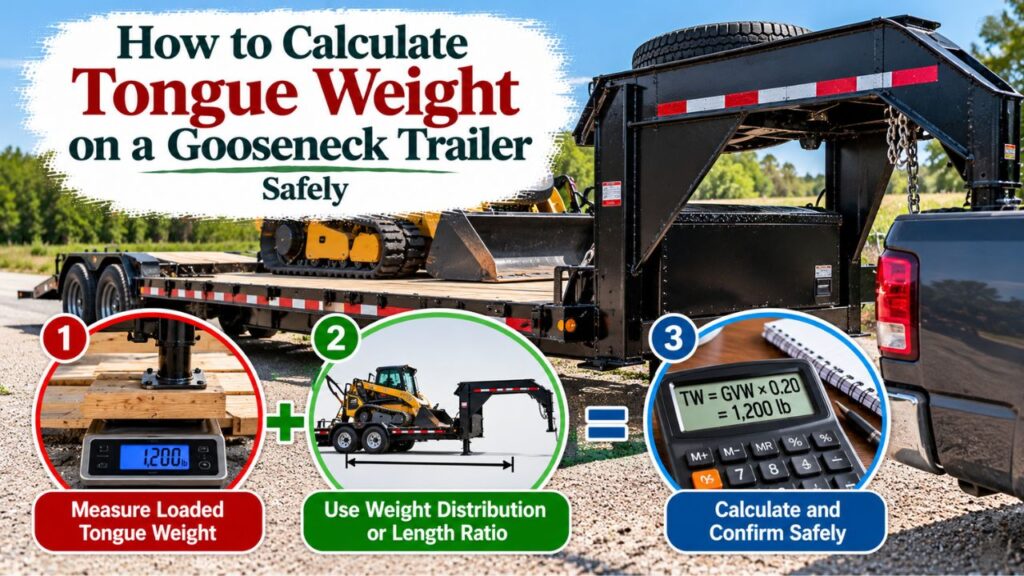
Gooseneck tongue weight is the amount of vertical weight a loaded trailer transfers to the towing vehicle through its gooseneck ball and coupler.
It is commonly called gooseneck pin weight, although a true kingpin is used on a fifth-wheel connection rather than a standard gooseneck ball.
Unlike conventional trailers, which connect to a hitch behind the rear bumper, a gooseneck trailer connects to a ball mounted in the pickup bed, generally over or slightly ahead of the rear axle.
This arrangement allows the truck to support a substantial portion of the trailer’s loaded weight.
Two main components support a loaded gooseneck trailer:
- Trailer axle weight: The portion of the trailer’s weight carried by its own wheels and axles.
- Gooseneck tongue weight: The portion transferred vertically through the hitch to the towing truck.
Together, these equal the trailer’s total loaded weight.
For example, suppose a loaded gooseneck trailer weighs 14,000 pounds. If its axles support 11,200 pounds, the remaining 2,800 pounds are supported through the gooseneck hitch.
That 2,800-pound load counts toward the towing truck’s weight limits.
How to Calculate Tongue Weight on a Gooseneck Trailer Using a Scale
Using a certified truck scale is one of the most practical ways to determine actual gooseneck tongue weight.
The process requires weighing the truck with the loaded trailer connected and weighing the same truck without the trailer.
The difference between the truck’s two axle-weight totals represents the weight transferred through the hitch.
Step 1: Load the Gooseneck Trailer for Travel
Before weighing, prepare the trailer as it will be used on the road.
Include the normal cargo, equipment, tools, and other materials that contribute to its operating weight.
If the trailer carries vehicles, machinery, livestock, or water tanks, account for their actual loaded condition.
Make sure:
- Cargo is positioned as intended for travel.
- Heavy equipment is properly secured.
- The trailer is connected at its normal towing height.
- Tires are inflated according to applicable load requirements.
- The truck contains its normal passengers, fuel, and equipment.
Do not calculate actual loaded tongue weight using only the trailer’s empty weight. Adding cargo can change both the total weight and its distribution.
Step 2: Weigh the Truck With the Gooseneck Trailer Attached
Drive the loaded truck and trailer onto a suitable certified vehicle scale.
According to CAT Scale’s official weighing instructions, a truck-and-trailer combination is normally positioned with the truck’s front axle on the first platform, rear axle on the second, and trailer axles on the third.
Record the following measurements:
- Truck front axle weight
- Truck rear axle weight
- Trailer axle group weight
- Total combined weight
Add the truck’s front and rear axle readings together.
Loaded truck axle weight = Front axle weight + Rear axle weight
This is the weight supported by the truck while the gooseneck trailer is connected.
Make sure the weighing arrangement accommodates your trailer’s axle configuration, particularly if it has widely spaced axles.
Step 3: Disconnect the Trailer and Weigh the Truck Alone
After completing the first measurement, drive to a designated safe parking area and disconnect the trailer.
Never attempt to unhitch a loaded gooseneck trailer directly on an active scale platform unless the facility has specifically arranged and approved a suitable procedure.
Return to the scale with the truck alone.
Keep the truck’s loading conditions as consistent as possible between measurements.
Ideally, the same passengers, equipment, cargo, and approximately the same fuel quantity should remain in the truck.
Record the front and rear axle weights again.
Truck-alone weight = Front axle weight + Rear axle weight
This measurement provides the baseline needed to calculate the trailer’s actual hitch load.
Step 4: Subtract the Two Truck Weights
Use the following formula:
Gooseneck tongue weight = Truck axle weight with trailer attached − Truck axle weight without trailer
Suppose the truck weighs:
- 8,200 pounds without the trailer
- 11,000 pounds with the trailer attached
The calculation becomes:
11,000 − 8,200 = 2,800 pounds
The gooseneck trailer is transferring approximately 2,800 pounds of vertical load to the truck.
This is the actual hitch load under the measured conditions.
Important: Use the combined front and rear truck axle weights, not simply the difference between rear axle readings. Depending on the gooseneck ball’s position relative to the rear axle, some load may also transfer to the front axle.
Step 5: Calculate the Trailer’s Total Loaded Weight
The scale ticket for the connected combination also shows the weight supported by the trailer axles.
To determine the trailer’s complete loaded weight, add the measured tongue weight to the trailer axle weight.
Loaded trailer weight = Trailer axle weight + Gooseneck tongue weight
For example:
11,200 + 2,800 = 14,000 pounds
You can also calculate loaded trailer weight by subtracting the truck-alone weight from the complete truck-and-trailer combination weight.
Both methods should give the same result when the measurements are consistent.
Step 6: Calculate the Gooseneck Tongue Weight Percentage
Once you know the hitch load and trailer’s total loaded weight, calculate the tongue weight percentage.
Use this formula:
Tongue weight percentage = (Tongue weight ÷ Total loaded trailer weight) × 100
For the example:
(2,800 ÷ 14,000) × 100 = 20%
The trailer has a 20% gooseneck tongue weight.
This percentage helps you evaluate the load distribution against the trailer manufacturer’s recommendations.
Gooseneck Tongue Weight Calculation Example
The following example shows how the measurements work together.
Assume a pickup truck is towing a loaded equipment trailer with a gooseneck connection.
| Measurement | Weight |
| Truck front axle, unhitched | 4,500 lb |
| Truck rear axle, unhitched | 3,700 lb |
| Total truck-alone weight | 8,200 lb |
| Truck front axle, hitched | 4,600 lb |
| Truck rear axle, hitched | 6,400 lb |
| Total hitched truck weight | 11,000 lb |
| Trailer axle group weight | 11,200 lb |
| Combined truck and trailer weight | 22,200 lb |
Calculate the Actual Pin Weight
Subtract the truck-alone weight from the weight carried by the hitched truck.
11,000 − 8,200 = 2,800 lb
Calculate the Gross Trailer Weight
Subtract the truck-alone weight from the combined weight.
22,200 − 8,200 = 14,000 lb
Alternatively:
11,200 + 2,800 = 14,000 lb
Determine the Pin Weight Percentage
Divide the pin weight by the complete trailer weight.
2,800 ÷ 14,000 × 100 = 20%
The calculation shows that 20% of the loaded trailer’s weight is transferred to the truck through the gooseneck hitch.
Notice that the rear axle increased by 2,700 pounds, while the front axle increased by 100 pounds.
Using only the rear axle increase would have underestimated the actual hitch load.
The truck and trailer ratings must still be checked before deciding whether this loading arrangement is acceptable.
How to Estimate Gooseneck Tongue Weight Without a Scale
If you cannot immediately access a certified scale, you can calculate an estimated tongue weight using the loaded trailer weight and an appropriate percentage.
This approach is helpful when planning cargo loads, selecting towing equipment, or evaluating truck payload requirements.
However, a percentage calculation is an estimate, not proof of actual hitch weight.
Gooseneck Tongue Weight Formula
The basic formula is:
Estimated tongue weight = Total loaded trailer weight × Expected tongue weight percentage
For example, if a loaded gooseneck trailer weighs 12,000 pounds and the expected tongue weight is 20%:
12,000 × 0.20 = 2,400 pounds
The estimated tongue weight is 2,400 pounds.
The actual value may differ depending on the trailer design, axle placement, and cargo distribution.
What Percentage of Gooseneck Trailer Weight Should Be on the Hitch?
A commonly used planning range for gooseneck trailers is approximately 15% to 25% of the total loaded trailer weight.
Ford’s official towing guidance identifies a 15%–25% range for fifth-wheel and gooseneck applications while emphasizing vehicle and hitch weight limits.
Some trailer manufacturers recommend a narrower range, often near 20%–25%, depending on the trailer design.
The correct target should come from the specific trailer manufacturer’s loading instructions.
Do not assume that every gooseneck trailer is designed to operate safely anywhere within the entire general range.
The following table shows estimated tongue weights at three different percentages.
| Loaded Trailer Weight | 15% Pin Weight | 20% Pin Weight | 25% Pin Weight |
| 10,000 lb | 1,500 lb | 2,000 lb | 2,500 lb |
| 12,000 lb | 1,800 lb | 2,400 lb | 3,000 lb |
| 14,000 lb | 2,100 lb | 2,800 lb | 3,500 lb |
| 16,000 lb | 2,400 lb | 3,200 lb | 4,000 lb |
| 20,000 lb | 3,000 lb | 4,000 lb | 5,000 lb |
These figures are mathematical estimates, not universal required or permitted hitch loads.
For example, a 16,000-pound trailer carrying 3,200 pounds on the gooseneck has a 20% hitch load.
That percentage may be appropriate for a particular trailer, but the truck must also have enough available payload and axle capacity to support the load.
Why Trailer GVWR Should Not Be Used as the Actual Loaded Weight
The Gross Vehicle Weight Rating (GVWR) of a trailer represents its maximum permitted loaded weight according to its manufacturer.
It does not tell you what the trailer currently weighs.
For example, a gooseneck trailer rated for 20,000 pounds might weigh only 15,000 pounds with its current cargo.
Using 20,000 pounds in the formula would estimate hitch weight at the trailer’s maximum rated load rather than its actual load.
GVWR-based calculations can help with maximum-load planning, but they cannot replace weighing the loaded trailer.
How to Measure Gooseneck Pin Weight With a Dedicated Scale
A properly rated pin-weight measuring device provides another way to determine the vertical load directly.
This method can be useful for trailer operators who regularly change cargo loads and need repeated measurements.
However, gooseneck hitch loads can reach several thousand pounds. Equipment intended for light bumper-pull trailers may not have adequate capacity.
Use a scale or weighing setup specifically rated for the expected vertical load and compatible with the trailer’s coupler arrangement.
The trailer must be supported securely at the manufacturer’s specified measurement height, with appropriate equipment and procedures.
Improvised setups involving household bathroom scales, unstable blocks, or ordinary automotive jacks are unsuitable for heavy gooseneck trailers.
If a safe, properly rated direct-weighing arrangement isn’t available, use a certified truck scale.
How Gooseneck Tongue Weight Affects Truck Payload Capacity
Calculating tongue weight is only part of determining whether a gooseneck trailer can be towed safely.
The truck must be capable of supporting the measured hitch load in addition to its passengers, fuel, equipment, and other cargo.
A truck’s maximum advertised trailer towing capacity does not guarantee that it can carry every possible gooseneck pin load.
Check the Truck’s Gross Vehicle Weight Rating
The GVWR is the maximum allowable weight of the fully loaded truck.
This includes the vehicle itself, passengers, cargo, equipment, and weight transferred through the gooseneck hitch.
For example, if a truck’s GVWR is 11,500 pounds and its actual hitched scale weight is 11,000 pounds, it is 500 pounds below that particular limit.
However, remaining below GVWR does not automatically mean the towing combination is safe.
Axle, tire, hitch, and other ratings must also be satisfied.
Check the Rear Gross Axle Weight Rating
The Rear Gross Axle Weight Rating (Rear GAWR) identifies the maximum permitted weight supported by the truck’s rear axle.
Gooseneck hitch loading typically places substantial additional weight on this axle.
Check the vehicle certification label, commonly located on the driver’s door jamb.
Compare the actual loaded rear axle weight from the scale ticket against the truck’s Rear GAWR.
Use the complete measured rear axle load, not just the amount added by the trailer.
For example, if the rear axle weighs 6,400 pounds while hitched, compare 6,400 pounds directly with the manufacturer’s rear axle rating.
The difference between the empty and loaded rear axle weights is not the number used for this rating comparison.
Check Gross Combined Weight Rating
The Gross Combined Weight Rating (GCWR) is the maximum allowable combined weight specified for the towing vehicle and trailer.
Compare the entire truck-and-trailer scale weight with the applicable truck GCWR.
In the previous example, the combination weighs 22,200 pounds.
That figure must be within the rating for the specific truck configuration.
Do not add the full loaded trailer weight to the hitched truck’s weight when checking GCWR. Doing so would count the gooseneck hitch load twice.
Verify the Gooseneck Hitch and Trailer Ratings
The gooseneck ball, coupler, hitch structure, mounting system, and trailer must also be suitable for the load.
Check their applicable ratings, including maximum vertical load and allowable gross trailer weight.
A high-capacity truck cannot compensate for an underrated gooseneck coupler or hitch assembly.
Use the lowest applicable capacity limit when evaluating the complete towing setup.
The following table summarizes the main ratings to check.
| Rating | What It Limits |
| Truck GVWR | Total loaded weight supported by the truck |
| Rear GAWR | Maximum load supported by the rear axle |
| Front GAWR | Maximum load supported by the front axle |
| GCWR | Total allowable truck-and-trailer combination weight |
| Truck towing capacity | Maximum trailer weight for the configuration |
| Trailer GVWR | Maximum loaded weight of the trailer |
| Trailer axle GAWR | Maximum permitted load on each trailer axle |
| Hitch vertical load rating | Maximum downward load supported by the hitch |
| Tire load ratings | Permitted load supported by the tires |
Key Takeaway: A suitable tongue weight percentage does not mean the towing setup is within its rated limits. Both the percentage and all applicable weight capacities must be checked.
How Cargo Position Changes Gooseneck Tongue Weight
Gooseneck trailer tongue weight changes when cargo moves forward or backward relative to the trailer axles.
The trailer’s overall weight may remain the same, but the distribution between the hitch and axles can change substantially.
This is particularly important for equipment trailers carrying tractors, skid steers, vehicles, or other heavy machinery.
Moving Cargo Forward Increases Tongue Weight
Moving a load toward the front of a gooseneck trailer generally increases the weight transferred to the truck.
For example, positioning heavy machinery farther ahead of the trailer axles usually increases the downward force on the hitch.
This adjustment may be useful when the measured tongue weight is below the trailer manufacturer’s recommended range.
However, moving too much weight forward can overload the truck, hitch, or rear axle.
Always secure the cargo and recheck actual axle and hitch loads after making significant adjustments.
Moving Cargo Backward Reduces Tongue Weight
Moving heavy cargo closer to the trailer’s rear generally decreases the load supported by the gooseneck hitch.
This can help when the tongue weight exceeds the recommended range or truck capacity.
However, moving equipment too far backward can create an excessively light hitch load and increase trailer instability.
The load should remain properly balanced and secured.
Avoid making large adjustments based only on how level the truck appears.
Why Load Placement Matters More Than Total Weight Alone
Consider two gooseneck trailers carrying identical cargo weights.
One trailer has its heaviest equipment positioned well ahead of the axles.
The other carries the same equipment farther toward the rear.
Both trailers may have the same gross weight, but their hitch loads can be significantly different.
This occurs because the location of the combined center of gravity affects how the load is distributed between the hitch and axles.
The precise change depends on the trailer’s dimensions and the distance the cargo moves.
For this reason, tongue weight should be verified whenever the cargo arrangement changes significantly.
What Happens if Gooseneck Tongue Weight Is Too High or Too Low?
Incorrect hitch loading can affect the towing vehicle and trailer differently depending on whether the tongue weight is excessive or insufficient.
Problems Caused by Excessive Gooseneck Tongue Weight
Too much downward hitch load can overload the truck even if the trailer is within its rated gross weight.
Possible consequences include:
- Exceeding the truck’s GVWR or rear GAWR
- Overloading rear tires
- Excessive suspension compression
- Reduced steering or braking performance when axle loading is unfavorable
- Overstressing an underrated hitch or mounting system
If the hitch weight is too high, determine whether the cargo can be repositioned safely.
If the trailer cannot be loaded within both its recommended tongue weight range and the truck’s capacity, use a more suitable towing vehicle or reduce the load.
Problems Caused by Insufficient Gooseneck Tongue Weight
Too little hitch weight can also create a dangerous towing condition.
Possible effects include:
- Reduced towing stability
- Increased susceptibility to trailer sway or oscillation
- Unfavorable weight distribution
- Reduced rear-axle traction under some conditions
The specific behavior depends on trailer geometry, speed, suspension, tires, and operating conditions.
If the measured tongue weight is below the manufacturer’s recommendation, review the load placement and reposition cargo as appropriate.
Reweigh the trailer before towing.
Can You Fix Tongue Weight by Adjusting the Gooseneck Coupler Height?
Adjusting the coupler changes the trailer’s towing attitude, but it is not a substitute for proper cargo distribution.
The trailer should be connected at the height recommended by its manufacturer and generally tow level.
An incorrect coupler height can affect trailer axle loading, suspension geometry, and available clearances.
For trailers with multiple axles, this may also influence how weight is shared between axles.
Adjust coupler height according to the manufacturer’s instructions, then verify the loaded axle weights.
Do not use an improper trailer angle to compensate for excessive or insufficient hitch weight.
Common Gooseneck Tongue Weight Calculation Mistakes
Even a correct formula can give a misleading result when the measurements are taken incorrectly.
Using Only the Trailer Axle Weight
The trailer axle reading excludes the portion supported by the gooseneck hitch.
If the trailer axles carry 11,200 pounds and the hitch supports 2,800 pounds, the total loaded trailer weight is 14,000 pounds.
Dividing the hitch load by 11,200 would produce an incorrect pin-weight percentage.
Always calculate the percentage using the complete loaded trailer weight.
Subtracting Rear Axle Weights Only
The trailer may change the load supported by both truck axles.
Although the rear axle usually receives most of the gooseneck hitch load, the front axle reading can change too.
For an accurate scale-based calculation, compare the combined front and rear truck axle weights before and after coupling.
Measuring With Different Truck Loads
Suppose you weigh the truck alone without cargo, then add a heavy toolbox before weighing the connected combination.
The additional toolbox weight would be included in the calculated difference.
That would make the apparent tongue weight higher than the actual hitch load.
Keep the truck’s passengers, equipment, and other loading conditions consistent.
Assuming an Empty Trailer’s Pin Weight Percentage Never Changes
The tongue weight percentage of an empty gooseneck trailer may differ from its percentage when fully loaded.
Cargo can change the center of gravity substantially.
Do not assume that the empty trailer’s measured percentage remains accurate after loading heavy equipment.
Ignoring Individual Axle and Tire Ratings
A truck-and-trailer combination can remain below GCWR while still overloading an axle or tire.
Check all applicable ratings separately.
Also remember that a platform scale generally measures axle or axle-group weights, not the load on every individual tire.
Uneven side-to-side loading can remain a concern even when an axle-group total appears acceptable.
When Should You Recalculate Gooseneck Tongue Weight?
Recheck the hitch load whenever a meaningful change could affect weight distribution.
Examples include:
- Loading different equipment
- Moving heavy machinery on the trailer
- Adding or removing cargo
- Changing the location of large water or material loads
- Switching towing vehicles
- Installing equipment that changes truck weight
- Making significant changes to the trailer’s configuration
For trailers that regularly carry identical loads in the same positions, previous scale readings can provide useful reference information.
However, those readings should not be treated as permanent measurements when loading conditions change.
Commercial operators should also account for any applicable operating weight restrictions and regulatory requirements.
Conclusion
Understanding how to calculate tongue weight on a gooseneck trailer helps you evaluate hitch loading, truck capacity, and trailer stability before towing.
The most reliable practical method is to weigh the truck with the loaded trailer attached, weigh the same truck without the trailer, and subtract the two truck axle-weight totals.
You can then divide the measured hitch load by the trailer’s complete loaded weight to determine the tongue weight percentage.
A general 15%–25% range can help with initial estimates, but the trailer manufacturer’s specific requirements take priority. Check the truck’s GVWR, axle ratings, GCWR, hitch limits, and trailer ratings before towing.
Use actual scale measurements whenever possible, especially when carrying heavy equipment or operating near the truck’s capacity limits.
FAQs About How to Calculate Tongue Weight on a Gooseneck Trailer
What Is the Ideal Tongue Weight for a Gooseneck Trailer?
Many gooseneck trailers operate with approximately 15%–25% of their loaded weight supported by the hitch, although individual manufacturers may specify a narrower range.
The ideal percentage depends on the trailer’s design, axle placement, and cargo distribution.
Always follow the trailer manufacturer’s recommended loading requirements and stay within the truck’s weight ratings.
How Much Tongue Weight Does a 20,000-Pound Gooseneck Trailer Have?
At an estimated 15%–25% hitch load, a fully loaded 20,000-pound gooseneck trailer would transfer approximately 3,000–5,000 pounds to the truck.
At 20%, the estimated hitch load would be 4,000 pounds.
These numbers are estimates. Actual tongue weight must be measured, and the trailer’s recommended range and truck capacities must be respected.
Can a Gooseneck Trailer Have Too Much Tongue Weight?
Yes. Excessive tongue weight can overload the towing truck’s rear axle, suspension, tires, or hitch system.
A trailer can remain below its rated maximum weight while transferring more hitch load than the truck can safely support.
Check the actual loaded truck weight and rear axle reading against the manufacturer’s ratings.
Is Gooseneck Tongue Weight the Same as Pin Weight?
In everyday towing discussions, gooseneck tongue weight is often called pin weight because it describes the vertical load transferred from the trailer to the truck.
Technically, a conventional gooseneck trailer attaches through a ball and coupler, while a fifth-wheel trailer uses a kingpin connection.
Both systems transfer a portion of the trailer’s weight to the tow vehicle.
Can I Calculate Gooseneck Tongue Weight Without Disconnecting the Trailer?
You can estimate tongue weight using the trailer’s loaded weight and an assumed hitch-load percentage.
However, determining the actual load from truck axle readings generally requires a comparable truck-alone measurement.
A properly rated direct hitch-load measuring system may provide another option without the standard two-pass scale procedure.
Does Gooseneck Tongue Weight Count Against Truck Payload?
Yes. The downward load transferred through the gooseneck hitch counts toward the weight carried by the towing truck.
It must be considered alongside passengers, cargo, installed equipment, and other loads.
The truck must remain within its GVWR, axle ratings, and other applicable limits.
Does Moving a Load Backward Reduce Gooseneck Tongue Weight?
Generally, yes. Moving cargo toward the trailer’s rear reduces the portion of weight transferred to the gooseneck hitch.
However, moving cargo too far backward can result in insufficient hitch weight and unstable towing behavior.
Make adjustments according to the trailer manufacturer’s recommendations, secure the cargo, and verify the new weight distribution using a scale.