Yes, trailer GVWR includes tongue weight because it represents the maximum allowable weight of the entire loaded trailer, including the portion supported by the tow vehicle’s hitch. Tongue weight is not an additional allowance above the trailer’s Gross Vehicle Weight Rating (GVWR).
For example, if a trailer has a 7,000-pound GVWR, its total loaded weight cannot exceed 7,000 pounds. That limit includes the trailer itself, cargo, equipment, and the portion of its weight transferred through the coupler.
Confusion often comes from weighing a trailer while it is connected to a truck. A scale placed beneath the trailer axles measures only the weight supported by those axles. It does not directly include the weight resting on the hitch.
Tongue weight also contributes to the tow vehicle’s load, so both vehicles’ ratings must be checked before towing.
In this article, I explain how trailer GVWR accounts for tongue weight, how it differs from axle ratings, how to calculate actual loaded trailer weight, and how to check trailer payload, hitch capacity, and tow vehicle limits without counting the same weight twice.
Does Trailer GVWR Include Tongue Weight in the Total Rating?
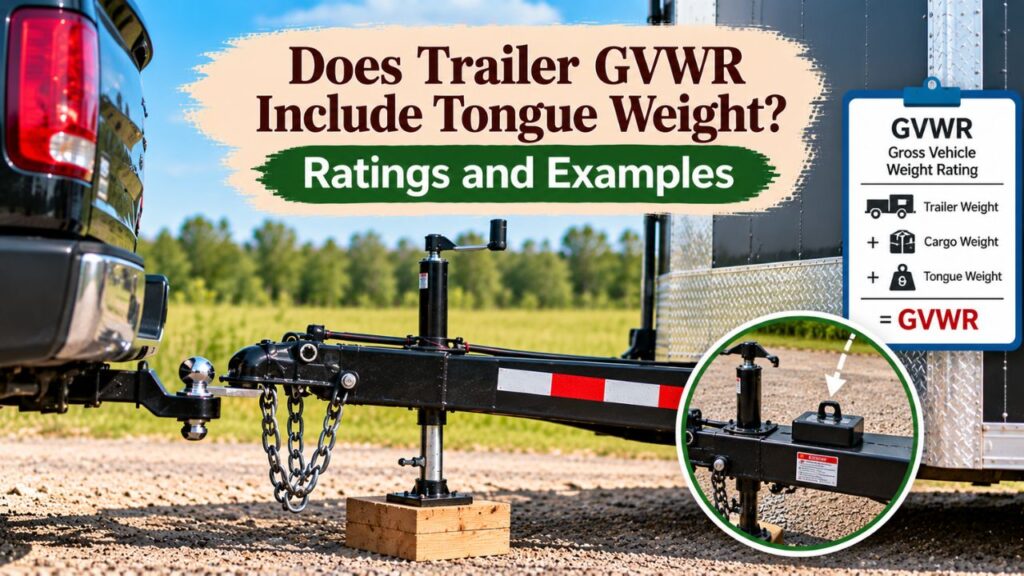
Trailer GVWR includes the entire trailer’s weight, whether that weight is supported by its own axles or transferred to the tow vehicle through the hitch.
The trailer manufacturer establishes GVWR as the maximum permitted loaded weight of the trailer.
It includes:
- The trailer’s empty weight
- Cargo and transported equipment
- Factory-installed and aftermarket accessories
- Batteries and propane equipment
- Water and other fluids carried in the trailer
- The portion of trailer weight supported by the hitch
The PJ Trailers’ official towing FAQ defines trailer GVWR as the maximum total weight of the fully loaded trailer, including cargo. It separately identifies tongue weight as the load that the trailer applies at the hitch connection.
The important distinction is between the trailer’s total weight and the portion carried by its axles.
When the trailer is hitched, some weight rests on the tow vehicle. That weight still belongs to the trailer when determining whether its GVWR has been exceeded.
Example: A Trailer With a 7,000-Pound GVWR
Suppose a utility trailer has the following specifications and measured loads:
| Measurement | Weight |
| Manufacturer’s trailer GVWR | 7,000 lb |
| Actual loaded trailer weight | 6,800 lb |
| Weight supported by trailer axles | 6,000 lb |
| Tongue weight supported by hitch | 800 lb |
| Remaining capacity below GVWR | 200 lb |
The total loaded trailer weight is:
6,000 + 800 = 6,800 pounds
The trailer is 200 pounds below its 7,000-pound GVWR.
The 800-pound tongue weight is already included in the 6,800-pound total.
It should not be added again when comparing the trailer’s actual gross weight with its GVWR.
However, the 800-pound load must also be considered when checking the tow vehicle and hitch ratings.
Trailer GVWR vs. Tongue Weight vs. Axle Weight
Understanding the difference between these measurements is essential because they describe different parts of the same towing setup.
Trailer GVWR
Gross Vehicle Weight Rating (GVWR) is the maximum allowable loaded weight established by the trailer manufacturer.
It is a rating, not an actual scale measurement.
A trailer with a 10,000-pound GVWR does not necessarily weigh 10,000 pounds.
It might weigh 7,500 pounds on a particular trip, depending on its cargo and equipment.
The trailer must remain within its GVWR regardless of how the weight is distributed between the axles and hitch.
Trailer Tongue Weight
Tongue weight (TW) is the vertical downward force applied by a conventional trailer’s coupler to the tow vehicle’s hitch.
It is only a portion of the trailer’s loaded weight.
For example, a 5,000-pound trailer might apply 600 pounds of tongue weight.
The other 4,400 pounds would be supported by the trailer axles in a simple static, weight-carrying setup.
Tongue weight changes when cargo is moved forward or backward relative to the trailer’s axles.
Gross Axle Weight Rating
Gross Axle Weight Rating (GAWR) is the maximum weight that an individual axle is rated to support.
It is different from GVWR.
The trailer’s axle ratings apply to the loads carried by the trailer axles, while its GVWR applies to the entire loaded trailer.
A trailer can be within its GVWR and still overload an axle if the cargo is distributed improperly.
Likewise, staying within the combined axle ratings does not mean the entire trailer is below its GVWR.
Comparison of Trailer Weight Terms
| Term | Meaning | Includes Tongue Weight? |
| Trailer GVWR | Maximum permitted total loaded trailer weight | Yes |
| Actual gross trailer weight | Actual total trailer weight, including cargo | Yes |
| Trailer GAWR | Maximum load rating of an individual axle | No, it applies to the axle’s supported load |
| Actual trailer axle weight | Weight currently resting on the trailer axles | No, not the hitch-supported portion |
| Tongue weight | Vertical load transferred through the coupler | This is the hitch-supported portion |
| Trailer payload capacity | Maximum permitted cargo based on trailer weight and ratings | Cargo capacity is calculated from the total trailer weight limit |
| Tow vehicle GVWR | Maximum permitted loaded weight of the tow vehicle | Includes the tongue load it supports |
How to Calculate Total Trailer Weight Including Tongue Weight
For a conventional trailer with a weight-carrying hitch, the loaded trailer’s gross weight can be calculated by adding the weight supported by its axles to the tongue weight.
Gross Trailer Weight = Trailer Axle Weight + Tongue Weight
This calculation assumes the trailer is stationary, properly supported, and measured under consistent conditions without an engaged weight-distribution system changing the load transfers.
Example 1: A 5,000-Pound Trailer
Suppose a scale shows:
- Trailer axle weight: 4,400 pounds
- Measured tongue weight: 600 pounds
Calculate the total:
4,400 + 600 = 5,000 pounds
Actual loaded trailer weight = 5,000 pounds
If the manufacturer’s GVWR is 6,000 pounds, the trailer has 1,000 pounds of remaining gross weight capacity.
That remaining capacity is not automatically available for cargo if another component, such as an axle, tire, or hitch, would exceed its rating first.
Example 2: A 10,000-Pound GVWR Trailer
Consider a trailer with these measurements:
- GVWR: 10,000 pounds
- Trailer axle weight: 8,200 pounds
- Tongue weight: 1,000 pounds
Actual gross trailer weight:
8,200 + 1,000 = 9,200 pounds
Remaining capacity:
10,000 − 9,200 = 800 pounds
The trailer is below its GVWR.
However, you must also verify that the axle load, tires, hitch, and tow vehicle remain within their respective ratings.
Why You Cannot Use Axle Weight Alone
A trailer scale reading can be misleading when only the trailer’s wheels are on the platform.
If the hitch is connected to the tow vehicle, the truck supports a portion of the trailer’s weight.
For example, a trailer with a 7,000-pound GVWR might show only 6,200 pounds on its axles.
That does not necessarily mean it has 800 pounds of remaining cargo capacity.
If its tongue weight is 900 pounds, the actual loaded trailer weight is:
6,200 + 900 = 7,100 pounds
The trailer would exceed its GVWR by 100 pounds, even though the axle scale reading is below 7,000 pounds.
Always account for the hitch-supported weight when calculating the trailer’s total loaded weight.
Does Tongue Weight Also Count Toward the Tow Vehicle’s GVWR?
Yes. Trailer tongue weight also contributes to the tow vehicle’s actual gross weight because the hitch transfers a downward load onto the vehicle.
This does not mean the trailer becomes lighter for GVWR purposes.
It means the same physical load must satisfy two different sets of limits.
For the trailer, tongue weight remains part of its total loaded weight.
For the tow vehicle, that vertical load contributes to the weight being carried.
Example: Checking Tow Vehicle Payload
Suppose a pickup truck has:
| Vehicle Measurement | Weight |
| Available payload capacity | 1,500 lb |
| Driver and passengers | 350 lb |
| Cargo in truck | 200 lb |
| Hitch equipment | 75 lb |
| Trailer tongue weight | 750 lb |
| Total payload used | 1,375 lb |
| Remaining payload | 125 lb |
The calculation is:
350 + 200 + 75 + 750 = 1,375 pounds
Remaining payload:
1,500 − 1,375 = 125 pounds
In this example, the truck remains within the stated payload allowance.
However, this does not establish that every towing limit is satisfied.
Its rear axle rating, receiver capacity, towing rating, and gross combined weight rating must also be checked.
Why Tongue Weight Reduces Available Payload
Tongue weight uses part of the load capacity that would otherwise be available for passengers and cargo.
For example, a truck with 1,200 pounds of available payload cannot necessarily carry 1,000 pounds of passengers and equipment while supporting an additional 700 pounds of trailer tongue weight.
That combination would exceed the available payload allowance.
A truck’s advertised maximum towing capacity does not eliminate its payload restrictions.
Does Tongue Weight Count Twice?
Tongue weight is considered under both the trailer’s GVWR and the tow vehicle’s GVWR, but it must not be counted twice when calculating the actual combined weight.
For example, suppose:
- Tow vehicle weight without trailer: 5,700 pounds
- Actual gross trailer weight: 6,800 pounds
- Tongue weight: 800 pounds
When hitched, the tow vehicle supports approximately:
5,700 + 800 = 6,500 pounds
The trailer axles support:
6,800 − 800 = 6,000 pounds
The combined weight is:
6,500 + 6,000 = 12,500 pounds
This equals:
5,700 + 6,800 = 12,500 pounds
Adding the complete 6,800-pound trailer weight to the already hitched truck weight of 6,500 pounds would count the tongue weight twice.
Why Trailer GVWR Can Be Higher Than Its Combined Axle Ratings
Some trailers have a GVWR greater than the sum of their axle ratings.
This can be confusing because it may appear that the manufacturer is permitting more weight than the axles can support.
However, part of the trailer weight may be supported by the tow vehicle through the hitch.
Example: Two 3,500-Pound Trailer Axles
Imagine a manufacturer-rated trailer with:
- Trailer GVWR: 8,000 pounds
- Two axle ratings: 3,500 pounds each
- Combined axle capacity: 7,000 pounds
At the full 8,000-pound loaded weight, the axles could support 7,000 pounds while the hitch supports 1,000 pounds.
The arithmetic is:
7,000 + 1,000 = 8,000 pounds
The tongue weight percentage would be:
(1,000 ÷ 8,000) × 100 = 12.5%
This is an example of how a manufacturer’s trailer GVWR can exceed its combined axle ratings.
It does not mean you can assign a higher GVWR to an existing trailer by adding its axle ratings and tongue weight.
The manufacturer determines GVWR based on the complete trailer design, including the frame, running gear, coupler, tires, and other applicable components.
Can You Add Tongue Weight to the Axle Rating to Increase GVWR?
No.
Suppose a trailer has a manufacturer-assigned GVWR of 7,000 pounds and two axles rated at 3,500 pounds each.
You cannot automatically increase the allowable trailer weight to 8,000 pounds by assuming the hitch can support another 1,000 pounds.
The manufacturer-assigned 7,000-pound GVWR remains the maximum.
Tongue weight is already included in that rating.
If the trailer is overloaded, redistributing cargo between the hitch and axles does not change its total gross weight.
How to Calculate Trailer Payload Capacity From GVWR
Trailer payload capacity is the amount of cargo that can be added without exceeding the manufacturer’s maximum loaded weight.
The basic calculation is:
Trailer Payload Capacity = Trailer GVWR − Actual Empty Trailer Weight
The empty weight must represent the trailer as equipped, including permanently installed accessories and the tongue-supported portion of its weight.
Example: Utility Trailer Payload
Suppose a utility trailer has:
- GVWR: 7,000 pounds
- Actual empty trailer weight: 2,000 pounds
Payload capacity:
7,000 − 2,000 = 5,000 pounds
The maximum calculated cargo capacity is 5,000 pounds.
This capacity includes cargo placed throughout the trailer, regardless of whether that cargo ultimately increases the axle load or tongue weight.
It is not an additional amount above the trailer’s GVWR.
Does Trailer Payload Include Tongue Weight?
Tongue weight is not a separate type of cargo.
It is the portion of the trailer’s total loaded weight supported through the hitch.
When calculating the trailer’s payload capacity, the trailer’s complete empty weight is deducted from GVWR.
You do not subtract a second tongue weight allowance from GVWR after the empty trailer weight and cargo are already accounted for.
However, cargo placement affects tongue weight, so the loaded configuration must remain within both trailer and tow vehicle limits.
Why Published Empty Weight Can Be Misleading
A trailer’s published empty weight may not reflect all equipment installed after manufacturing.
Additional items can include:
- Spare tires
- Toolboxes
- Batteries
- Winches
- Hydraulic equipment
- Storage compartments
- Custom ramps
- Aftermarket accessories
Travel trailers may also carry propane, fresh water, and other supplies not included in certain published unloaded-weight figures.
For the most accurate payload calculation, use an actual scale weight for the empty trailer in its current configuration.
How to Weigh a Trailer and Account for Tongue Weight
A commercial vehicle scale can help determine whether the trailer and tow vehicle are within their ratings.
The weighing procedure should account for the portion supported by the hitch.
Method 1: Measure Trailer Axle Weight and Tongue Weight Separately
For a conventional trailer, this is a straightforward approach.
- Load the trailer as it will be towed.
- Secure the cargo and check the tire pressures.
- Measure the trailer axle load at a suitable vehicle scale.
- Measure the tongue weight using an appropriately rated tongue weight scale.
- Add the two measurements.
- Compare the total with the trailer’s GVWR.
For example:
Trailer axle weight = 5,400 pounds
Tongue weight = 700 pounds
Total loaded trailer weight = 6,100 pounds
If the trailer GVWR is 7,000 pounds, the total weight is below its maximum rating.
For accuracy, use comparable loading conditions and normal towing height. If the trailer has a weight-distribution hitch, follow the manufacturer’s procedure for measuring its undistributed tongue weight.
Method 2: Compare Tow Vehicle and Combined Scale Weights
A commercial scale can also be used to determine the gross loaded trailer weight.
First, weigh the loaded tow vehicle without the trailer.
Then weigh the complete combination with the trailer attached.
Keep the passengers, cargo, and hitch equipment consistent between measurements.
Calculate:
Actual Trailer Weight = Combined Vehicle and Trailer Weight − Tow Vehicle Weight Alone
For example:
Combined weight = 13,000 pounds
Tow vehicle alone = 6,000 pounds
Actual trailer weight:
13,000 − 6,000 = 7,000 pounds
This gives the trailer’s actual gross weight, including the hitch-supported portion.
A multi-platform scale can also show individual axle loads so they can be compared with the applicable GAWR values.
Method 3: Measure Tongue Weight Directly
A dedicated tongue weight scale can measure the downward force at the coupler.
Park the loaded trailer on firm, level ground and chock its wheels.
Use the trailer jack and an appropriately rated scale to support the tongue at the normal hitch height.
Follow the scale manufacturer’s instructions.
For most conventional ball-hitch trailers, tongue weight commonly falls around 10–15% of the loaded trailer weight.
Ford’s official towing guidance identifies that general range for conventional trailers and notes that fifth-wheel and gooseneck trailers typically have different loading requirements.
The correct range must still come from the trailer and tow vehicle manufacturers.
Trailer GVWR vs. Towing Capacity and GCWR
A trailer can be within its own GVWR while still being too heavy for the tow vehicle.
This happens because the trailer rating and towing capacity describe different limits.
Trailer GVWR
Trailer GVWR is the maximum loaded weight permitted for the trailer.
It includes cargo and tongue weight.
Exceeding it means the trailer is overloaded, regardless of whether the tow vehicle has enough power to pull it.
Tow Vehicle Towing Capacity
Towing capacity is the maximum loaded trailer weight the tow vehicle is permitted to pull under specified conditions.
For example, a trailer with a 10,000-pound GVWR might be loaded to only 6,000 pounds.
Whether a particular truck can tow it depends on the trailer’s actual weight and the truck manufacturer’s ratings, along with any applicable regulatory restrictions.
The trailer’s GVWR does not automatically establish the truck’s towing capacity.
Gross Combined Weight Rating
Gross Combined Weight Rating (GCWR) is the maximum permitted combined loaded weight of the tow vehicle and trailer.
It includes the vehicle, trailer, passengers, cargo, equipment, and fluids.
For example:
- Loaded tow vehicle before attaching trailer: 6,000 pounds
- Actual loaded trailer weight: 7,000 pounds
- Gross combined weight: 13,000 pounds
The combination must remain within the manufacturer’s GCWR.
The trailer tongue weight must not be added again because it is already part of the loaded trailer’s total weight.
Which Towing Weight Ratings Must Be Checked?
| Rating | What It Limits |
| Trailer GVWR | Maximum loaded trailer weight |
| Trailer GAWR | Maximum weight on each trailer axle |
| Tow vehicle GVWR | Maximum loaded tow vehicle weight |
| Tow vehicle GAWR | Maximum load on each vehicle axle |
| GCWR | Maximum combined vehicle and trailer weight |
| Tow rating | Maximum permitted trailer weight for the towing configuration |
| Hitch tongue weight rating | Maximum permitted vertical hitch load |
| Tire load rating | Maximum permitted tire load under specified conditions |
All applicable ratings must be respected.
The fact that one measurement is below its limit does not mean the entire towing combination is approved.
Does Trailer GVWR Work Differently for Gooseneck and Fifth-Wheel Trailers?
No. The basic definition of trailer GVWR remains the same.
It includes the full loaded trailer weight, including the portion supported through the hitch connection.
However, gooseneck and fifth-wheel trailers transfer their vertical loads differently from conventional bumper-pull trailers.
Gooseneck Trailer GVWR
A gooseneck trailer connects to a ball mounted in or near the pickup truck bed.
The vertical load at this connection is still part of the trailer’s gross weight.
For example:
- Gooseneck trailer GVWR: 20,000 pounds
- Actual load on trailer axles: 15,500 pounds
- Vertical hitch load: 3,500 pounds
Actual loaded trailer weight:
15,500 + 3,500 = 19,000 pounds
The trailer is 1,000 pounds below its GVWR.
However, the 3,500-pound hitch load must also be within the truck’s payload, axle, and hitch limits.
Fifth-Wheel Trailer GVWR
A fifth-wheel trailer uses a kingpin connection instead of a conventional ball-hitch coupler.
The vertical load transferred through the kingpin is called pin weight.
Pin weight is part of the trailer’s total loaded weight.
A fifth-wheel trailer with a 15,000-pound GVWR cannot exceed 15,000 pounds simply because part of its weight is supported by the pickup truck.
Why the Loading Percentage Is Different
Conventional trailers commonly use a tongue weight target of approximately 10–15% of loaded trailer weight.
Fifth-wheel and gooseneck trailers typically carry a higher percentage through their hitch connections.
Ford’s published towing guidance identifies approximately 15–25% for fifth-wheel and gooseneck configurations.
These are general ranges.
Actual acceptable loading depends on the trailer’s design, the manufacturer’s instructions, and the truck’s available carrying capacity.
Trailer GVWR and Tongue Weight Mistakes to Avoid
Understanding the weight ratings helps prevent several common towing errors.
Adding Tongue Weight on Top of GVWR
A trailer with a 7,000-pound GVWR is not automatically allowed to weigh 7,700 pounds because 700 pounds rests on the hitch.
The 7,000-pound rating already includes that load.
Checking Only the Trailer Axles
An axle-only scale reading omits the hitch-supported portion.
Add properly measured tongue weight to obtain the actual loaded trailer weight in a conventional weight-carrying setup.
Assuming Axle Capacity Determines GVWR
The manufacturer assigns the trailer GVWR.
It should not be recalculated by adding the axle ratings and an estimated tongue load.
Forgetting the Tow Vehicle’s Payload Limit
Tongue weight increases the load carried by the tow vehicle.
A trailer may be within its GVWR while pushing the truck over its payload, GVWR, or rear axle rating.
Counting Tongue Weight Twice in GCWR Calculations
When calculating combined weight, use the complete loaded trailer weight plus the tow vehicle’s weight without that tongue load.
Alternatively, add the measured weights supported by all axles of the coupled combination.
Do not add the entire trailer weight to a truck scale reading that already includes the tongue load.
Using GVWR Instead of Actual Weight for Load Calculations
GVWR is a maximum rating, not the trailer’s current weight.
Use the actual loaded weight for tongue weight percentage calculations and for determining the current gross combined weight.
Do not assume a trailer is loaded to its full GVWR unless its measured weight confirms it.
Ignoring Cargo Movement
Moving cargo changes how weight is divided between the trailer axles and hitch.
It does not change the trailer’s overall weight unless cargo is added or removed.
After significant cargo adjustments, recheck the tongue weight and axle loads.
Conclusion
Yes, trailer GVWR includes tongue weight. It represents the maximum weight of the complete loaded trailer, including the portion carried by its axles and the portion transferred to the tow vehicle through the hitch.
When calculating actual trailer weight, add the measured trailer axle load and tongue weight under appropriate weighing conditions.
Do not add tongue weight again when comparing that total with GVWR.
The tongue load must also be considered when checking the tow vehicle’s payload, GVWR, axle ratings, and hitch capacity. For combined weight calculations, count each part of the trailer’s weight only once.
The safest approach is to use the manufacturer’s trailer GVWR, measure actual loaded weights, and verify every applicable limit before towing.
FAQs About Does Trailer GVWR Include Tongue Weight
If my trailer has a 7,000-pound GVWR, can I add 700 pounds of tongue weight?
No. The 7,000-pound GVWR already includes the trailer’s tongue weight. If the fully loaded trailer weighs 7,000 pounds, adding another 700 pounds would exceed its maximum rating regardless of where the weight is supported.
Does tongue weight count toward trailer payload?
Tongue weight is part of the trailer’s total weight, not an extra cargo allowance. Trailer payload capacity is generally calculated by subtracting the complete empty trailer weight from GVWR. Cargo must remain within that capacity regardless of how it changes tongue weight.
Does trailer GVWR include the weight of the trailer itself?
Yes. GVWR includes the trailer’s empty weight plus its cargo, equipment, fluids, and other carried loads. It represents the maximum total weight, not the amount of cargo that can be added.
Can trailer GVWR be higher than its axle ratings?
Yes. A manufacturer may assign a trailer GVWR above the combined axle ratings when part of the loaded weight is intended to be supported through the hitch. However, this does not allow an owner to increase the trailer’s rated GVWR independently.
Is tongue weight included when weighing only the trailer axles?
No. When the trailer is connected to a tow vehicle, the axle scale reading does not directly include the weight supported at the hitch. For a conventional weight-carrying setup, adding the measured tongue weight to the axle load gives the trailer’s total static loaded weight.
Does tongue weight count toward the truck’s GVWR?
Yes. The downward hitch load contributes to the truck’s actual weight and must be considered alongside passengers, cargo, and equipment. It must not cause the truck to exceed its GVWR or axle ratings.
Does a weight-distribution hitch remove tongue weight from GVWR?
No. A weight-distribution hitch changes how the load is shared among the tow vehicle and trailer axles. It does not remove trailer weight or increase the trailer’s manufacturer-assigned GVWR. The trailer’s complete loaded weight remains subject to its original rating.