Ceramic window tint is generally the better choice for drivers who want strong heat rejection without potential interference with GPS, cellular signals, or other wireless electronics. Metallic window tint is often more affordable and uses a thin metal layer to reflect solar energy, but it can create signal interference in some vehicles. Both types can provide effective UV protection, glare reduction, and improved privacy.
The most important difference is how the films manage sunlight. Ceramic tint uses advanced particles that absorb selected wavelengths of solar energy, while metallic tint uses a reflective metal layer. However, the quality of the individual film matters more than its category alone.
Some premium ceramic films reject substantial amounts of heat even at relatively light shades. High-quality metallic films can also perform well, although their reflective appearance and possible compatibility issues may influence the decision.
Cost, darkness, legal restrictions, and professional installation quality should also be considered before choosing.
In this article, I compare ceramic and metallic window tint for heat rejection, UV protection, signal interference, visibility, appearance, and durability. I also cover installation costs, legal tint percentages, and which option offers better value for different driving conditions.
Ceramic vs Metallic Window Tint: Main Differences
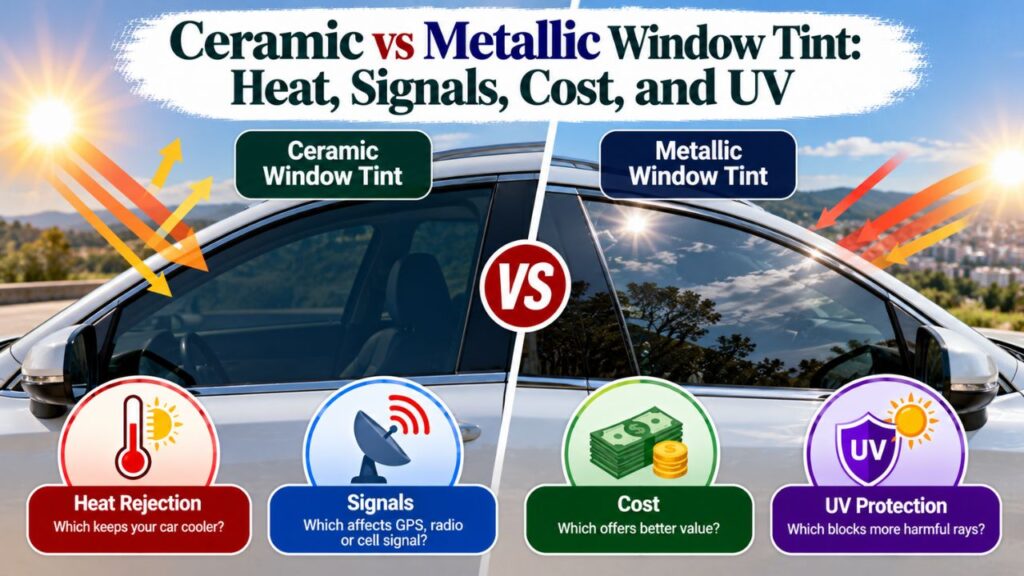
Ceramic and metallic window films are both designed to improve comfort inside a vehicle.
However, their materials and performance characteristics differ.
| Feature | Ceramic Window Tint | Metallic Window Tint |
| Main technology | Ceramic-based particles within the film | Thin metallic layer or metal particles |
| Heat control | Primarily absorbs selected solar energy | Primarily reflects solar energy |
| Infrared rejection | Often excellent in premium products | Varies; can be effective |
| UV protection | Commonly 99% or higher in quality films | Commonly 99% or higher in quality films |
| GPS and cellular signals | Metal-free versions avoid metallic signal interference | May interfere with certain wireless signals |
| Exterior appearance | Usually neutral and low-reflective | Often slightly reflective |
| Glare reduction | Depends mainly on tint shade | Depends mainly on tint shade |
| Color stability | Generally good in quality products | Generally good in quality products |
| Durability | Long-lasting with proper installation | Long-lasting with proper installation |
| Installation cost | Usually higher | Usually lower |
| Best application | Drivers prioritizing heat control and connectivity | Budget-conscious drivers wanting reflective heat control |
These are general differences, not guaranteed specifications for every product.
For example, a high-quality metallic film can outperform a basic ceramic film in certain heat-rejection measurements.
The best comparison uses two actual products with similar visible light transmission and published performance data.
What Is Ceramic Window Tint?
Ceramic window tint is a multilayer automotive film containing microscopic ceramic-based particles designed to control incoming solar radiation.
The ceramic components are engineered to reduce selected wavelengths of sunlight, particularly near-infrared energy that contributes to interior heating.
Many ceramic window films are manufactured without conductive metallic layers.
This allows them to reduce heat without introducing the radio-frequency shielding associated with some metallized films.
How Ceramic Window Tint Works
Sunlight contains visible light, ultraviolet radiation, and infrared radiation.
A ceramic tint uses specially engineered particles that interact with these wavelengths.
Depending on the formulation, the ceramic components absorb and reduce transmission of selected solar energy.
The absorbed energy is eventually transferred through the film and glass toward the surrounding environment.
As a result, the actual heat entering the cabin depends on more than a single infrared-rejection number.
A well-designed ceramic film can offer substantial solar control without becoming extremely dark.
This makes ceramic tint attractive for drivers who want a relatively light appearance with improved thermal comfort.
Benefits of Ceramic Window Tint
Ceramic films commonly offer:
- Strong infrared heat rejection
- Good total solar energy rejection
- High UV protection
- Low exterior reflectivity
- Minimal effect on wireless signals when genuinely metal-free
- Multiple darkness options
- Good optical clarity in quality products
- Long-term color stability when properly manufactured
These advantages are particularly useful in vehicles containing GPS receivers, wireless communication systems, and other electronic equipment.
Disadvantages of Ceramic Window Tint
The most noticeable disadvantage is its higher initial cost.
Premium ceramic products can cost substantially more than conventional metallic or dyed films.
Other limitations include:
- Performance varies considerably between ceramic products.
- Some inexpensive films use the ceramic label without providing strong heat rejection.
- Very dark ceramic shades can still reduce nighttime visibility.
- Incorrect installation can cause bubbles, contamination, or peeling.
- Ceramic tint does not eliminate all solar heating.
A ceramic label alone does not guarantee premium performance.
Key Takeaway: Ceramic window tint is a strong option for heat control and signal compatibility, but shoppers should compare measured performance instead of assuming every ceramic film performs equally well.
What Is Metallic Window Tint?
Metallic window tint, also called metallized window tint, contains a thin layer of metal within the film.
Manufacturers use metallic materials to reflect part of the incoming solar radiation.
The reflective layer helps reduce heat transmission and gives some metallic films a slightly shiny appearance.
How Metallic Window Tint Works
Many metallic films use vacuum deposition or sputtering processes to apply a thin metallic layer.
The layer reflects selected wavelengths of sunlight away from the glass.
Some products combine metallized layers with dyes to control the final color and darkness.
For example, LLumar’s ATR series combines dyed and metallized technologies to provide solar heat rejection with a mildly reflective finish.
The exact properties depend on which metals are used, how thick the deposited layer is, and how the film is constructed.
Benefits of Metallic Window Tint
Metallic tint offers several practical advantages:
- Effective solar heat reflection
- Better thermal performance than many basic dyed films
- High UV rejection in quality products
- Good glare reduction at suitable tint levels
- Long-lasting color in properly manufactured films
- A distinctive, slightly reflective appearance
- Generally lower installation cost than premium ceramic
For drivers who want heat protection without paying for the highest-priced tint category, metallized film can offer good value.
Disadvantages of Metallic Window Tint
The main concern is possible interference with wireless signals.
Because metallic films contain conductive layers, certain products may weaken or disrupt radio-frequency transmission.
Potentially affected systems include:
- GPS reception
- Cellular communication
- Satellite radio
- Some radio antennas
- Electronic toll tags
- Certain remote communication devices
Interference is not guaranteed.
The outcome depends on the film’s construction, antenna location, vehicle glass, and frequency being used.
Metallic film may also have higher visible reflectivity than ceramic film.
This matters because some states restrict mirror-like or excessively reflective automotive window treatments.
Key Takeaway: Metallic tint provides useful heat reflection at a generally lower price, but signal compatibility and reflectivity should be checked before installation.
Ceramic vs Metallic Window Tint for Heat Rejection
Heat rejection is one of the most important reasons drivers install window tint.
Both technologies can reduce incoming solar energy, but they use different approaches.
Does Ceramic Tint Block More Heat?
Premium ceramic films often provide stronger overall heat rejection than conventional metallic films at comparable darkness levels.
However, this is not true for every possible product comparison.
A high-performance metallic film can outperform a low-end ceramic film.
The correct approach is to compare Total Solar Energy Rejected (TSER) values for products with similar Visible Light Transmission (VLT).
For example, 3M’s Ceramic IR series advertises up to 66% total solar energy rejection and up to 95% infrared rejection.
These figures describe different measurements and should not be treated as equivalent.
The official 3M Ceramic IR product specifications explain the film’s heat, UV, and infrared performance measurements.
The stated maximum figures also depend on the selected product and testing conditions.
Does Metallic Tint Reflect Heat Better?
Metallic films can be effective at reflecting incoming solar energy.
Reflection is one method of reducing how much heat enters the vehicle.
Ceramic films often rely more heavily on absorption.
However, the fact that a metallic film reflects energy does not automatically make it the better overall heat-control product.
The thickness and composition of the metallic layer affect its performance.
Similarly, advanced ceramic formulations can reject substantial solar energy without producing a strong mirror-like appearance.
Why Ceramic Tint Can Work Well at Lighter Shades
Visible darkness and solar heat rejection are not the same measurement.
A film can allow substantial visible light through the glass while rejecting selected infrared wavelengths.
This is especially useful for drivers who need to maintain a relatively high VLT.
For example, a high-performance ceramic film may offer better heat control than a darker, lower-performing film.
However, the exact result must be confirmed from the products’ technical specifications.
What Do TSER and IR Rejection Actually Mean?
Window tint manufacturers often advertise several performance measurements.
| Measurement | Meaning | What It Tells You |
| TSER | Total Solar Energy Rejected | Overall solar heat rejection |
| IRR | Infrared Rejection | Rejection within a specified infrared wavelength range |
| IRER | Infrared Energy Rejection | Broader infrared performance, accounting for absorbed energy reradiated inward |
| VLT | Visible Light Transmission | Percentage of visible light passing through |
| UV Rejection | Ultraviolet radiation blocked | UV protection performance |
| VLR | Visible Light Reflectance | How much visible light the surface reflects |
The International Window Film Association’s 2026 Automotive Education Guide recommends comparing TSER when evaluating overall solar heat rejection.
Its guidance explains that very high infrared-rejection claims can be misleading when measured over only a narrow portion of the infrared spectrum.
For example, a film advertised with 95% infrared rejection does not necessarily reject 95% of the sun’s total heat energy.
Which Film Is Better for Hot Weather?
For drivers in very hot climates, a premium ceramic film is often the preferred option.
It can provide strong solar heat rejection with a neutral appearance and no metallic signal-interference concern when the film is metal-free.
However, a quality metallic film may still provide substantial comfort improvement at a lower price.
If cooling performance matters most, compare TSER at similar VLT levels rather than choosing solely by film category.
Key Takeaway: Premium ceramic tint often has the advantage for heat rejection, but TSER and VLT are more reliable comparison tools than the ceramic or metallic label alone.
Ceramic vs Metallic Window Tint for GPS and Phone Signals
Electronic signal compatibility is one of the clearest practical differences between the two film types.
Modern vehicles rely on wireless systems for navigation, communication, entertainment, and other functions.
Can Metallic Tint Interfere With GPS?
Yes, some metallized films can weaken GPS reception.
Metallic layers can reflect or attenuate radio-frequency signals, depending on their construction and the placement of the vehicle’s antennas.
However, the effect varies.
A vehicle with an external GPS antenna may experience little noticeable change, while another vehicle may depend on signals passing through treated glass.
The film’s thickness and metal composition also matter.
Not every metallic tint causes a measurable GPS problem.
Does Metallic Window Tint Affect Cell Phone Reception?
It can.
A metallic layer may reduce radio-frequency transmission through treated windows.
The practical effect depends on the signal strength, antenna placement, and vehicle construction.
Some drivers may experience little or no difference.
Others may notice reduced connectivity in areas where reception is already weak.
The safest approach is to ask the manufacturer or installer whether the specific film has documented wireless compatibility limitations.
Does Ceramic Window Tint Block GPS Signals?
A genuinely metal-free ceramic film does not create the same conductive metallic barrier.
For example, 3M describes its Ceramic IR series as a metal-free film designed to avoid interference with GPS, cellular devices, and satellite radio.
However, vehicles can have other factors affecting reception, including factory-installed metallic glass coatings.
It is important to distinguish signal interference caused by aftermarket tint from interference associated with existing vehicle glass or antenna placement.
What About Bluetooth, Keyless Entry, and Electronic Toll Tags?
Bluetooth and keyless entry systems use radio-frequency communication.
Certain metallic coatings may affect transmission depending on the vehicle’s design.
Electronic toll tags can also be sensitive to placement behind certain treated glass surfaces.
However, not all such devices depend on signals passing through tinted windows.
Some vehicles include designated areas for electronic transponders.
Check the vehicle owner’s manual and the toll tag provider’s installation instructions.
Key Takeaway: Metal-free ceramic film is the more predictable choice for wireless connectivity. Metallic tint may work without problems, but compatibility depends on the vehicle and specific film.
Ceramic vs Metallic Window Tint for UV Protection
Both ceramic and metallic tint can provide excellent ultraviolet protection.
Neither technology automatically has a major advantage simply because of its material type.
How Much UV Does Ceramic Tint Block?
Many quality ceramic window films block more than 99% of ultraviolet radiation within their specified testing range.
This helps reduce UV exposure through vehicle windows.
It also helps limit UV-related fading of interior materials.
However, check the actual manufacturer’s UV specifications rather than assuming every ceramic product has identical protection.
Does Metallic Tint Block UV Rays?
Yes.
Premium metallic tint can also reject more than 99% of ultraviolet radiation.
Its protective properties depend on the complete film construction, including UV-absorbing layers.
This means an appropriately manufactured metallic film may offer UV protection comparable to a premium ceramic film.
Which Tint Is Better for Protecting Car Interiors?
Both can help reduce damage caused by sunlight.
UV radiation contributes to the deterioration of:
- Upholstery
- Interior plastics
- Leather surfaces
- Dashboard materials
- Trim and decorative finishes
However, fading and material deterioration are also affected by visible light, temperature, and environmental conditions.
For maximum interior protection, compare UV rejection and total solar energy rejection together.
Do not assume that a film offering 99% UV rejection will eliminate all fading or heat-related deterioration.
Key Takeaway: Ceramic and metallic films can both provide strong UV protection. Compare their actual UV specifications and solar heat performance rather than assuming ceramic always blocks more UV radiation.
Ceramic vs Metallic Window Tint for Glare and Night Visibility
Window tint reduces some of the visible light passing through automotive glass.
This can help with daytime glare, but overly dark film can make nighttime driving more difficult.
Which Tint Reduces Sun Glare Better?
Both types can reduce glare effectively.
Glare reduction depends largely on the amount of visible light the film allows through.
A darker metallic tint will generally reduce more visible glare than a much lighter ceramic tint.
Likewise, a darker ceramic shade may reduce more visible glare than a lighter metallic product.
At similar VLT levels, the difference may be relatively small.
The color and reflectivity of the film can also affect perceived visual comfort.
Is Ceramic Tint Easier to See Through?
High-quality ceramic film often provides a neutral appearance with relatively low visible reflectivity.
This can be desirable for drivers who prefer less mirror-like glass.
However, optical clarity depends on the quality of the individual product and installation.
A premium metallic tint can also provide excellent clarity.
A poorly manufactured ceramic film may produce haze, distortion, or other visual defects.
Film category alone does not determine how clearly you can see.
Which Tint Is Better for Night Driving?
For nighttime visibility, VLT is generally more important than whether the film is ceramic or metallic.
A 20% VLT ceramic film will transmit far less visible light than a 50% VLT metallic film.
This difference matters when viewing dark roads, pedestrians, cyclists, and objects through tinted side windows.
The best choice is a legally compliant VLT that preserves adequate visibility for your driving conditions.
Do not select an extremely dark shade simply because the film offers premium heat rejection.
Key Takeaway: Both film types can reduce glare, but darkness and optical quality determine visibility. Ceramic tint does not make an excessively dark window safe for nighttime driving.
Ceramic vs Metallic Window Tint Appearance and Reflectivity
The visual difference between ceramic and metallic tint is often noticeable in direct sunlight.
Ceramic films generally aim for a neutral or understated appearance.
Metallic films may have a slightly reflective finish.
How Ceramic Tint Looks
Ceramic tint is available in several shades, ranging from very light to dark.
Common appearances include:
- Neutral charcoal
- Soft gray
- Dark gray
- Low-reflective black
- Nearly clear finishes in selected product lines
The exact appearance varies by manufacturer.
Premium ceramic products are often chosen by drivers who want the glass to look clean and understated rather than mirrored.
How Metallic Tint Looks
Metallic film may produce a reflective or slightly shiny finish.
The amount of reflection depends on the film.
Some metallized products have a subtle charcoal appearance, while others look more reflective.
Not every metallic tint has a strong silver or mirror finish.
The actual result also depends on the color of the existing automotive glass.
Does Metallic Tint Look More Reflective Than Ceramic?
Often, yes.
Metallized films are designed to reflect incoming solar energy, and some reflect more visible light than typical ceramic products.
However, a manufacturer’s visible light reflectance specification provides a more accurate comparison.
This is important because state laws may limit excessive window reflectivity in addition to regulating darkness.
Key Takeaway: Ceramic tint generally offers a more neutral appearance, while metallic tint may have a slightly reflective look. Check the actual film sample and reflectivity specification before choosing.
Ceramic vs Metallic Window Tint Cost
Ceramic window tint usually costs more than metallic tint because premium ceramic films often use more advanced materials and manufacturing methods.
However, the installed price depends on the vehicle, film brand, installer, and coverage.
Typical Installation Costs in the United States
For a standard sedan, broad 2026 U.S. planning estimates for professionally installed side and rear window tint are:
| Film Type | Approximate Installed Price |
| Metallic window tint | 200–350 |
| Ceramic window tint | 350–800 |
| Premium infrared-focused ceramic | May exceed $800 |
These are general estimates, not guaranteed quotes or standardized national averages.
Larger SUVs, minivans, trucks, panoramic roofs, and unusually shaped windows may cost more.
Windshield tint, where legally permitted, is frequently quoted separately.
Removing old film can also increase the total price.
Why Ceramic Tint Costs More
Premium ceramic films often use engineered particles and specialized coating processes.
Their pricing may also reflect higher solar heat performance, warranty coverage, and manufacturer research.
However, a higher price does not automatically guarantee that the product is better.
Ask for published performance data before accepting a premium quote.
Is Metallic Tint a Better Budget Option?
Metallic tint can offer good value when you want:
- Better heat rejection than basic dyed tint
- High UV protection
- A reflective appearance
- Lower initial cost
- A reputable film with a written warranty
The potential tradeoff is compatibility with certain wireless systems.
For a vehicle without affected antennas or devices, that limitation may not be significant.
Is Ceramic Tint Worth the Extra Money?
Ceramic tint can justify its higher cost if you drive frequently in strong sunlight, value improved heat rejection, or want to avoid metallic signal-interference concerns.
However, the value depends on the actual performance difference between the selected products.
If a metallic film offers nearly the same TSER at the same VLT and causes no compatibility problems, the ceramic upgrade may offer less practical benefit.
Key Takeaway: Metallic tint generally has the lower initial price. Ceramic can provide better value when its heat performance, neutral appearance, and electronic compatibility matter to the driver.
Ceramic vs Metallic Window Tint Durability and Lifespan
Both premium ceramic and metallic films can remain serviceable for many years.
The lifespan depends heavily on manufacturing quality, installation, exposure conditions, and maintenance.
Neither type is automatically immune to deterioration.
How Long Does Ceramic Tint Last?
Quality ceramic tint is commonly sold with long-term or limited lifetime warranty coverage.
However, warranty duration is not the same as a guaranteed service life.
Ceramic films may experience problems if the adhesive deteriorates or the film is damaged.
Possible failures include:
- Bubbling
- Peeling
- Edge lifting
- Scratches
- Haze
- Adhesive failure
These problems can affect many types of window film.
Premium ceramic products are often engineered for strong color stability, but the actual warranty should be checked.
How Long Does Metallic Tint Last?
High-quality metallized film can also provide many years of service.
Some manufacturers offer limited lifetime warranties on their metallized automotive product lines.
Modern metallized films are not necessarily prone to the rapid purple discoloration associated with some older, inexpensive dyed films.
However, long-term appearance and performance depend on the full construction and adhesive system.
Poor installation can cause a good metallic film to fail prematurely.
Does Ceramic Tint Fade Less Than Metallic Tint?
Not necessarily.
Both technologies can provide long-term color stability when manufactured correctly.
Color fading is more closely associated with certain dye formulations and UV exposure than with a simple ceramic-versus-metallic distinction.
Some metallic films include dyed layers, while other formulations rely on different color-stable components.
Check the manufacturer’s warranty for color changes rather than relying on general claims about film technology.
Can Either Tint Bubble or Peel?
Yes.
Bubbling and peeling often relate to installation quality, adhesive performance, contamination, or environmental exposure.
Professional preparation and correct installation reduce these risks.
However, even premium films can develop problems if installed incorrectly.
Key Takeaway: Both ceramic and metallic tint can be durable. Product quality, professional installation, and warranty terms are more reliable indicators of long-term performance than film category alone.
Ceramic vs Metallic Window Tint: Which Is Legal?
Both ceramic and metallic tint can be legal when their installed darkness and other properties comply with applicable laws.
The material technology itself does not determine legality.
In the United States, tint regulations vary by state.
The rules may also differ according to the vehicle type and the window being tinted.
Understanding Visible Light Transmission
Visible Light Transmission (VLT) measures how much visible light passes through the glass and film.
A higher VLT percentage means more light passes through.
| VLT | General Appearance |
| 70% | Very light |
| 50% | Light |
| 35% | Moderately dark |
| 20% | Dark |
| 5% | Very dark |
These appearance descriptions are approximate.
The actual look depends on factory glass, film color, interior lighting, and viewing conditions.
Does Ceramic Tint Have Different Legal Limits?
No.
The same applicable VLT requirements generally apply whether the film uses ceramic or metallic technology.
For example, if a state requires a particular minimum VLT for front side windows, selecting ceramic tint does not create an exemption from that limit.
A high-performance ceramic film may provide useful heat rejection at a lighter, compliant shade.
However, that does not make every ceramic shade legal.
Does Factory Glass Affect the Final VLT?
Yes.
Most automotive glass already reduces some visible light.
The final VLT depends on the combination of the glass and the installed film.
For example, suppose:
- Factory glass VLT: 80%
- Added film VLT: 50%
A simplified calculation gives:
0.80 × 0.50 = 0.40
Approximate combined VLT = 40%
The actual result can vary from this simplified calculation, so a calibrated tint meter is preferable for confirming legal compliance.
Do not assume that a film labeled 50% will produce a finished window with exactly 50% VLT.
Are Reflective Metallic Tints Restricted?
Some states regulate window reflectivity as well as darkness.
This can be relevant for metallic films that produce a visible reflective finish.
However, not every metallic film exceeds those limits.
Check the state’s current requirements for:
- Front side windows
- Rear side windows
- Rear windshield
- Front windshield
- Reflectivity
- Restricted colors
- Medical exemptions, where applicable
A professional installer should be able to explain the relevant regulations, but vehicle owners should verify the requirements independently when necessary.
Key Takeaway: Ceramic and metallic tint must meet the same applicable visibility rules. Metallic films may require additional attention to reflectivity restrictions, while both must be checked for legal combined VLT.
Which Tint Is Better for Different Vehicles and Driving Conditions?
The most suitable tint depends on the vehicle’s equipment and how it is used.
A daily commuter in a hot climate may value different features from a driver who primarily wants appearance and privacy.
Best Tint for Hot-Climate Daily Driving
A premium ceramic film is often the better choice.
Strong solar heat rejection can improve comfort during sunny driving conditions.
Select an appropriate legal shade and compare TSER values.
Do not assume that the darkest film is automatically the most effective heat-control option.
Best Tint for Cars With Advanced Electronics
Metal-free ceramic tint is generally the safer choice when avoiding potential wireless interference is a priority.
This may be especially relevant for vehicles using GPS, cellular connectivity, satellite radio, or glass-mounted antennas.
However, confirm compatibility with the particular vehicle because factory glass and antenna placement also matter.
Best Tint for Budget-Conscious Drivers
A reputable metallic tint can offer good heat control and UV protection at a lower price.
If wireless compatibility is not a concern and the film meets legal reflectivity limits, metallic tint can be a reasonable choice.
Avoid assuming that the least expensive available product is the best value.
Best Tint for Luxury Cars
Premium ceramic films are often attractive for luxury vehicles because of their neutral appearance, solar-control performance, and electronic compatibility.
However, professional installation quality should be a major priority.
Complex rear windows, integrated antennas, and sensitive interior trim require careful handling.
Best Tint for SUVs and Family Vehicles
For SUVs and family vehicles, both technologies can provide good protection.
Ceramic may be worth the extra cost when the vehicle has large windows and is used frequently in sunny weather.
However, the total price can rise because SUVs often have more glass area.
Compare complete installation quotes covering the same windows.
Best Tint for Nighttime Driving
Choose a legal film shade that preserves adequate visibility.
A lighter ceramic tint with good heat rejection may be attractive, but a lighter metallic tint can also maintain good visibility.
Avoid overly dark side-window tint that makes it difficult to detect hazards after sunset.
Key Takeaway: Ceramic is often preferable for heat-sensitive drivers and vehicles with advanced electronics. Metallic remains a practical alternative when price and effective heat reflection are the main priorities.
How to Compare Ceramic and Metallic Tint Before Buying
The best purchasing decision comes from comparing actual specifications rather than marketing descriptions.
Two films with similar names or darkness can perform differently.
Compare Films at Similar VLT
Start by selecting a legally compliant VLT range.
Then compare ceramic and metallic products at approximately the same darkness.
This helps prevent misleading comparisons.
For example, comparing a 5% metallic tint with a 50% ceramic tint would not be a fair test of their glare or privacy performance.
Ask for Total Solar Energy Rejection
TSER is one of the most useful measurements for comparing overall heat reduction.
Request the technical data sheet for each film.
If one film has a higher TSER at a similar VLT, it generally provides better total solar heat rejection under the stated test conditions.
Check the Infrared Testing Range
A very high infrared-rejection percentage can look impressive.
However, the number may describe a narrow wavelength range.
Ask whether the manufacturer reports IRR, IRER, or another measurement.
Do not compare percentages measured using different methods as though they represent the same result.
Verify Signal Compatibility
For metallic films, ask whether the manufacturer has documented compatibility with GPS, cellular, and other wireless equipment.
Consider whether the vehicle uses antennas integrated into the glass.
For ceramic products, confirm whether the specific film is metal-free.
Compare Installation and Warranty Terms
Before accepting a quote, ask:
- What is the exact manufacturer and film series?
- What is the finished VLT expected to be?
- What is the film’s published TSER?
- Does the film contain a conductive metallic layer?
- What windows are included in the installation price?
- Does the quote include old tint removal?
- What does the warranty cover?
- Are installation labor costs covered by the warranty?
- Is the installer authorized to register the warranty?
A reputable installation shop should be able to provide clear answers.
Inspect Film Samples
View samples against actual automotive glass when possible.
Check their appearance from inside and outside the vehicle.
Look for differences in:
- Neutrality of color
- Visible reflectivity
- Optical clarity
- Haze
- Daytime privacy
- Visibility in lower light
Small samples cannot fully reproduce every driving condition, but they can help identify appearance preferences.
Key Takeaway: Compare VLT, TSER, infrared measurements, signal compatibility, and warranty terms. These details provide a stronger basis for choosing than brand names or claims about ceramic technology alone.
Ceramic vs Metallic Window Tint: Final Comparison
Both types can improve a vehicle’s comfort and appearance.
The better option depends on which features you value most.
| Your Priority | Better Starting Choice | Reason |
| Strong heat rejection | Premium ceramic | Often higher TSER at comparable VLT |
| Lowest installation cost | Metallic | Generally more affordable |
| GPS and cellular compatibility | Metal-free ceramic | Avoids conductive metallic layers |
| High UV protection | Either | Both can offer 99%+ UV rejection |
| Neutral, nonreflective look | Ceramic | Usually lower visible reflectivity |
| Reflective exterior appearance | Metallic | Metallic layer can create a sheen |
| Night driving visibility | Either at appropriate VLT | Darkness matters more than film type |
| Long-term durability | Either quality product | Material, adhesive, and installation matter |
| Vehicles with glass-mounted antennas | Metal-free ceramic | Reduces compatibility concerns |
| Best budget heat protection | Quality metallic | Can provide useful solar control at a lower price |
For most drivers willing to pay more for thermal comfort and connectivity, a well-specified ceramic tint is the stronger overall choice.
However, metallic tint should not be dismissed as outdated or ineffective.
A quality metallized film may provide plenty of heat reduction and UV protection for drivers whose vehicles do not experience signal problems.
Conclusion
The ceramic vs metallic window tint comparison mainly comes down to heat-rejection performance, electronic compatibility, appearance, and cost.
Ceramic tint is generally preferable when you want strong solar heat rejection without the potential signal interference associated with conductive metallic layers. It also tends to provide a neutral, low-reflective appearance.
Metallic tint uses a reflective metal layer to control solar energy and often costs less. It can provide excellent UV protection and useful heat reduction, but possible wireless interference and reflectivity restrictions deserve consideration.
Neither film category guarantees superior performance in every product comparison.
Before buying, compare films at similar VLT levels, review their TSER figures, check applicable tint laws, and examine the manufacturer’s warranty.
For drivers prioritizing comfort and electronic compatibility, premium ceramic is usually worth considering first. For drivers seeking effective heat protection at a lower initial price, a reputable metallic film can still be a sensible investment.
FAQs About Ceramic vs Metallic Window Tint
Is ceramic tint better than metallic tint?
Ceramic is generally better for drivers who prioritize strong heat rejection, neutral appearance, and avoiding potential wireless signal interference. However, a high-quality metallic film may outperform a lower-quality ceramic product in specific measurements. Compare actual film specifications before deciding.
Does metallic window tint interfere with GPS?
It can. Some metallic films may weaken GPS, cellular, satellite radio, or other wireless signals. The effect depends on the metallic coating, antenna placement, and vehicle construction. Interference is not guaranteed for every vehicle.
Does ceramic tint block more heat than metallic tint?
Premium ceramic films often reject more total solar energy than conventional metallic films at similar VLT levels. However, this varies by product. TSER is a more useful metric than a single advertised infrared-rejection percentage.
Is ceramic window tint worth the extra cost?
It can be worth the extra cost if you drive frequently in hot weather, want strong heat protection at a lighter shade, or prefer a metal-free film. If a quality metallic product meets your needs at a lower price, the additional ceramic expense may not be necessary.
Which window tint lasts longer, ceramic or metallic?
Both can last many years when properly manufactured and installed. Premium products in either category may include long-term warranty coverage. Adhesive quality, exposure conditions, and installation workmanship often matter more than whether the film is ceramic or metallic.
Does metallic tint provide the same UV protection as ceramic?
It can. High-quality metallic and ceramic films commonly offer more than 99% UV rejection within their specified testing ranges. Compare manufacturer data because UV protection depends on the individual film rather than the technology category alone.
Is ceramic tint easier to see through at night?
Not automatically. Night visibility depends mainly on VLT and optical clarity. A very dark ceramic tint can restrict nighttime visibility more than a lighter metallic tint. Choose an appropriate legal shade instead of assuming that ceramic technology compensates for excessive darkness.