Ceramic and infrared window tint are not necessarily two different materials. Ceramic describes a film’s construction, while infrared (IR) refers to the solar heat radiation a film is designed to reject. Advanced infrared-rejecting window tint can itself be ceramic. The better choice depends on the film’s measured performance, visibility, and compatibility with your vehicle.
Many drivers see ceramic tint offered as a premium upgrade and infrared tint advertised as an even higher-performance option. These names can make the products seem like completely different technologies, but they often overlap.
A standard ceramic film may provide good heat rejection, while an infrared-focused nano-ceramic film may offer stronger heat control at a similar darkness level. However, a higher infrared rejection percentage doesn’t automatically mean a proportionally cooler interior.
Understanding the specifications matters more than relying on marketing labels.
In this article, I compare ceramic and infrared window tint construction, heat rejection, UV protection, visibility, electronic compatibility, pricing, and durability. I also explain which performance ratings matter most and how to choose the right film for your vehicle.
Ceramic vs Infrared Window Tint: What’s the Main Difference?
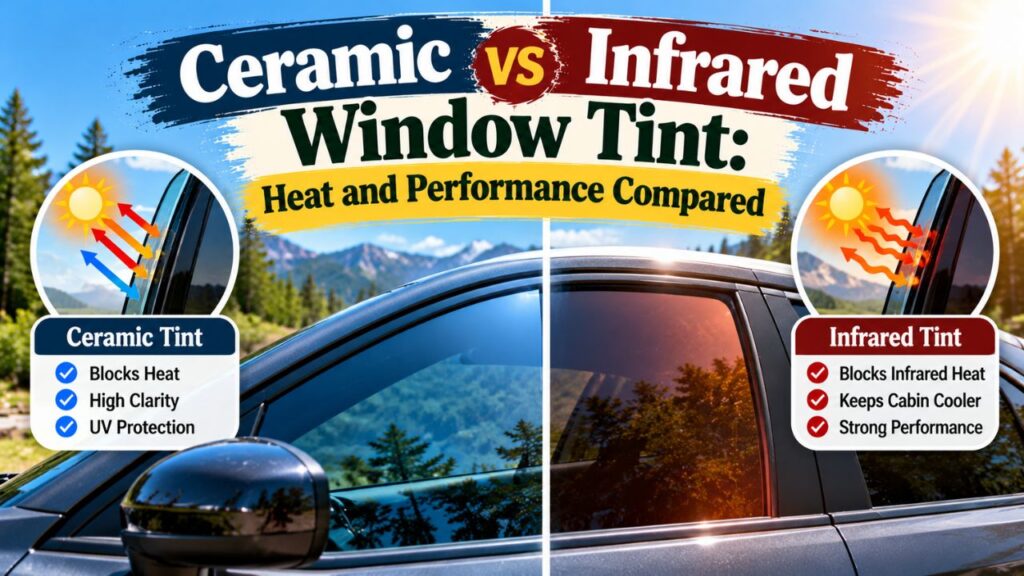
The main difference is that ceramic describes the technology used in a window film, while infrared describes a particular part of sunlight that the film blocks or absorbs.
This distinction is important because some products marketed as infrared tint use ceramic nanoparticles.
What Is Ceramic Window Tint?
Ceramic window tint is an automotive film that uses microscopic ceramic particles to reduce solar heat transmission.
These particles help manage solar energy while allowing a controlled amount of visible light through the glass.
Unlike conventional metallized films, metal-free ceramic films generally avoid the radio-frequency interference associated with certain metallic window tint constructions.
Ceramic films are available in different shades and performance levels.
Their common characteristics include:
- Solar heat rejection
- Ultraviolet protection
- Reduced glare
- Different visible light transmission options
- Low-reflectivity appearances in many product lines
- Compatibility with wireless signals when the film is metal-free
However, not all ceramic films deliver identical heat rejection.
Particle composition, film construction, optical coatings, and manufacturing quality can affect performance.
What Is Infrared Window Tint?
Infrared window tint is a marketing description commonly used for films engineered to reject a substantial amount of solar infrared energy.
Infrared radiation is an invisible portion of sunlight that contributes to solar heating.
Some infrared-focused films use advanced ceramic particles, while others may incorporate different materials or multilayer technologies.
Infrared tint is not one universally defined material category.
For example, 3M’s Ceramic IR automotive window film uses absorptive nano-ceramic technology to reduce infrared heat transmission.
That product is both ceramic window tint and infrared-rejecting window tint.
Therefore, the names cannot always be treated as mutually exclusive alternatives.
Ceramic vs Infrared Tint Comparison Table
| Feature | Standard Ceramic Tint | Infrared-Focused Tint |
| Main description | Film construction | Heat-rejection performance focus |
| Common technology | Ceramic particles | Ceramic or other IR-rejecting technologies |
| Heat rejection | Good to excellent | Often designed for higher IR rejection |
| UV protection | Often high | Often high |
| Visible darkness | Multiple shades available | Multiple shades available |
| Electronic interference | Generally low when metal-free | Depends on film construction |
| Glare reduction | Depends on VLT | Depends on VLT |
| Durability | Depends on film quality | Depends on film quality |
| Typical pricing | Midrange to premium | Often premium for advanced products |
| Best use | Balanced comfort and protection | Prioritizing heat reduction |
Key Takeaway: Infrared tint is not automatically better than ceramic tint. Compare specific products using verified performance data rather than their names.
Which Blocks More Heat: Ceramic or Infrared Window Tint?
An infrared-focused ceramic film may block more solar heat than a standard ceramic film, particularly when the two products have similar visible light transmission.
However, infrared rejection alone does not describe the complete thermal performance of automotive glass.
Sunlight contains ultraviolet, visible, and infrared energy. All of these can contribute to heating when absorbed by the vehicle’s interior or glass.
A window film’s overall heat performance depends on how it transmits, reflects, and absorbs energy across the solar spectrum.
Standard Ceramic Tint Heat Rejection
Standard ceramic films use ceramic-based technology to reduce solar energy entering the vehicle.
Their performance varies across brands, product lines, and shades.
Some ceramic films prioritize balanced heat control, low reflectivity, and visual clarity.
Others use more advanced formulations to increase infrared rejection.
A ceramic label alone does not establish a specific heat rejection percentage.
Infrared-Focused Tint Heat Rejection
Infrared-focused films are often developed to provide stronger protection against infrared solar radiation.
Higher-performing products may use advanced nanoparticle formulations or additional optical layers to manage heat.
However, a film advertising 95% infrared rejection does not necessarily block 95% of all solar energy.
The infrared measurement may represent only a particular wavelength range.
This is why Total Solar Energy Rejected (TSER) is an important comparison metric.
Real Ceramic vs Infrared Tint Performance Example
The following figures come from LLumar’s official automotive window film performance data, published in March 2026.
It compares the CTX ceramic series with the more infrared-focused IRX ceramic series.
| Performance Metric | LLumar CTX 35 | LLumar IRX 35 |
| Visible Light Transmission | 37% | 39% |
| Total Solar Energy Rejected | 48% | 54% |
| Infrared Energy Rejection | 48% | 60% |
| Selective Infrared Rejection | 69% | 87% |
| UV Protection | Greater than 99% | Greater than 99% |
| Glare Reduction | 58% | 56% |
These manufacturer figures were measured using specified clear-glass testing conditions. Actual results can vary with the vehicle’s glass.
The comparison reveals several useful differences.
The IRX 35 film rejects six percentage points more total solar energy than CTX 35, despite having slightly higher visible light transmission.
It also achieves a higher infrared energy rejection rating.
Both products provide high UV protection.
This demonstrates that an advanced infrared-focused ceramic film can deliver better heat rejection without necessarily requiring a darker appearance.
However, the result applies to these particular products. It doesn’t establish that every film labeled infrared will outperform every standard ceramic tint.
Understanding Window Tint Heat Rejection Ratings
Window tint performance sheets contain several different percentages.
Some describe visible darkness, while others measure specific forms of solar energy.
Comparing these ratings correctly is essential when choosing between ceramic and infrared tint.
Total Solar Energy Rejected (TSER)
TSER measures the percentage of total incident solar energy rejected by the tested film-and-glass combination.
It considers solar energy across the broader spectrum rather than focusing on infrared wavelengths alone.
For example, a film with 54% TSER rejects 54% of the total solar energy under its specified test conditions.
Higher TSER generally indicates stronger overall solar heat control when comparing products under equivalent conditions.
However, TSER is not a direct measurement of how many degrees cooler a parked vehicle will become.
Interior temperature depends on ventilation, outside temperature, sunlight intensity, vehicle color, and other conditions.
Infrared Rejection (IRR)
IRR indicates how much infrared radiation a film rejects within a specified wavelength range.
The measurement range matters.
Some manufacturers report infrared rejection over a relatively narrow part of the infrared spectrum.
A film may therefore advertise an impressive infrared rejection percentage without rejecting an equally high percentage of total solar energy.
Always check what wavelengths the manufacturer measured.
Infrared Energy Rejection (IRER)
IRER is intended to provide a more complete measurement of infrared heat rejection.
In LLumar’s specifications, it covers solar infrared radiation from 780 to 2,500 nanometers and accounts for absorbed energy that may be reradiated toward the vehicle interior.
This makes it useful when evaluating how a film manages infrared heat.
However, IRER still does not replace TSER because it focuses on infrared rather than the complete solar spectrum.
Visible Light Transmission (VLT)
VLT measures how much visible light passes through the tested window.
A lower percentage means darker glass.
For example:
- 70% VLT allows relatively high visible light transmission.
- 50% VLT provides a moderate reduction in visible light.
- 35% VLT produces a noticeably darker appearance.
- 20% VLT substantially reduces visible light transmission.
- 5% VLT creates a very dark appearance.
These percentages refer to light transmission, not heat rejection.
A high-quality, relatively light ceramic or infrared-focused film can sometimes reject more solar heat than a darker, lower-performing film.
Remember that the vehicle’s existing glass also affects the final VLT.
UV Rejection
UV rejection measures the film’s ability to reduce ultraviolet radiation passing through the glass.
Many premium ceramic and infrared-focused films provide very high UV protection.
However, UV rejection and infrared rejection are different measurements.
A film with excellent UV blocking is not automatically the best at reducing solar heat.
Ceramic vs Infrared Window Tint for Visibility and Glare
Window tint affects more than cabin temperature.
The amount of visible light passing through the glass influences privacy, glare, and nighttime visibility.
Daytime Visibility
Both ceramic and infrared-focused films can provide good daytime visibility when properly manufactured and installed.
A lighter film typically allows more visible light through the window.
Film quality also affects optical clarity.
Poorly manufactured products or incorrect installation can introduce haze, distortion, or visual defects.
Higher infrared rejection does not automatically improve optical clarity.
Compare products at similar VLT levels whenever possible.
Nighttime Driving Visibility
Darker tint reduces the amount of visible light reaching the driver’s eyes.
This can make pedestrians, road markings, and other objects more difficult to see in low-light conditions.
A film designed for strong infrared rejection does not eliminate the visibility limitations associated with dark glass.
For drivers who regularly travel at night, a lighter, high-performance film may offer a better balance of heat control and visibility.
Pay particular attention to the front side windows and windshield, where legal restrictions and safe visibility are especially important.
Glare Reduction
Both ceramic and infrared tint can reduce glare by limiting visible light transmission.
However, infrared rejection itself does not determine glare reduction.
Two films may have very different infrared performance but similar glare ratings when their VLT levels are close.
Darker films generally reduce more visible light, but excessively dark tint may create nighttime visibility problems.
Choose the shade based on driving conditions and legal limits rather than maximizing darkness.
Ceramic vs Infrared Tint for UV Protection and Interior Fading
Both standard ceramic and advanced infrared-focused films can provide substantial UV protection.
Ultraviolet radiation contributes to deterioration and discoloration of some vehicle interior materials.
Tint can reduce the amount of UV radiation passing through treated windows.
However, UV protection varies by product and should be verified through the manufacturer’s specifications.
Which Tint Provides Better UV Protection?
Neither category automatically wins.
Many high-quality films in both groups reject more than 99% of UV radiation within their specified testing ranges.
The LLumar CTX and IRX comparison demonstrates this: both provide greater than 99% UV protection despite their different infrared performance.
If two films provide similar verified UV blocking, paying more for advanced infrared rejection may improve heat comfort without meaningfully changing their stated UV protection.
Does Infrared Rejection Prevent Dashboard Fading?
Infrared rejection can help reduce solar heating, but it is not a direct measurement of fading protection.
UV radiation, visible light, heat, and material characteristics can all contribute to interior aging.
A film with strong UV protection and good overall solar energy rejection can help reduce these exposures.
However, no window tint can guarantee that leather, plastics, or upholstery will never fade or deteriorate.
Do Ceramic and Infrared Window Tints Interfere With Electronics?
Metal-free ceramic window films generally avoid the signal interference that some metallized films can cause.
This matters for drivers using:
- GPS navigation
- Cellular connections
- Satellite radio
- Wireless devices
- Other vehicle communication systems
However, infrared-focused tint is not necessarily metal-free.
The word infrared describes the radiation being managed, not the exact materials used in the film.
Before purchasing, confirm whether the product contains metallic layers and whether the manufacturer identifies any electronic compatibility limitations.
For vehicles with multiple wireless systems, a verified metal-free ceramic film is often a practical choice.
Key Takeaway: Don’t assume all infrared-labeled tint is metal-free. Check the manufacturer’s construction details and electronic compatibility claims.
Ceramic vs Infrared Window Tint: Durability and Lifespan
Durability depends more on film construction, adhesive quality, installation, and environmental exposure than on the ceramic or infrared label alone.
High-quality automotive films are designed to withstand normal vehicle use, temperature changes, and sunlight exposure.
However, performance and appearance can vary between manufacturers and product lines.
Does Ceramic Tint Last Longer?
Premium ceramic films are often designed for long-term color stability and durability.
However, ceramic construction does not automatically establish a longer lifespan than every infrared-focused film.
An advanced infrared product may use the same underlying ceramic technology.
Compare warranties, material specifications, and manufacturer reputation rather than assuming one category lasts longer.
Can Infrared Tint Fade or Bubble?
Yes. Infrared-focused films can develop problems if their materials or adhesives deteriorate.
Potential issues include:
- Bubbling
- Peeling edges
- Adhesive failure
- Haze
- Discoloration
- Visible distortion
Poor surface preparation and improper installation can also create defects.
These problems are not unique to infrared tint.
Professional installation and appropriate film maintenance help protect the finished result.
Which Tint Has Better Warranty Coverage?
Warranty coverage varies by manufacturer, product series, installer, and purchase conditions.
Some premium automotive films have limited lifetime warranties.
However, warranty terms may differ regarding:
- Bubbling or peeling
- Color changes
- Adhesive defects
- Transferability
- Commercial vehicle use
- Installation workmanship
Read the actual warranty before purchasing.
A lifetime warranty does not necessarily mean every type of damage is covered without restrictions.
Ceramic vs Infrared Window Tint Cost: Which Is More Expensive?
Infrared-focused tint is often priced above entry-level ceramic tint when it belongs to a manufacturer’s higher-performance product series.
However, this is not a universal pricing rule.
Some high-end ceramic films may cost more than products marketed as infrared tint.
The actual price depends on the film and installation.
What Affects Window Tint Installation Cost?
Several factors influence the final quote:
- Vehicle size and body style
- Number of windows
- Window shape and curvature
- Selected film brand and series
- Film performance specifications
- Installer labor rates
- Local market pricing
- Removal of existing window film
- Warranty coverage
For example, installing film on a coupe with fewer windows may require a different amount of material and labor than tinting a large SUV.
A vehicle with existing damaged tint may also require additional removal and cleaning work.
Is Infrared Tint Worth the Extra Money?
Infrared-focused tint can be worth the additional cost when it provides meaningfully better measured heat rejection at the shade you want.
It may be especially appealing for drivers who spend considerable time in direct sunlight.
However, the added value becomes less clear when the two products have similar TSER ratings.
For example, paying substantially more for a product with a slightly higher narrow-band IRR rating may not produce a noticeable improvement in everyday comfort.
Compare the installed price against measurable performance differences.
If your primary goals are UV protection, moderate heat reduction, and improved appearance, a reputable standard ceramic film may already meet your needs.
Which Is Better for Different Driving Conditions?
The better film depends on how and where you drive.
Consider both the performance specifications and the conditions in which the vehicle is used.
Best for Hot and Sunny Climates
For drivers in regions with intense sunlight and long hot summers, an infrared-focused ceramic film with strong TSER performance may be worthwhile.
The higher heat rejection can help reduce solar heat entering through the treated windows.
However, parked vehicles can still become dangerously hot.
Window film is not a substitute for ventilation, air conditioning, or safe precautions involving children and pets.
Best for Daily Commuting
A good-quality standard ceramic tint can be a practical choice for everyday commuting.
It may provide sufficient heat rejection, UV protection, and glare reduction without requiring the highest-priced film series.
Consider upgrading to an infrared-focused product if you frequently experience uncomfortable direct sunlight through side windows.
Best for Night Driving
For frequent nighttime driving, prioritize adequate visible light transmission and optical clarity.
A lighter ceramic or infrared-focused film may be more suitable than a very dark film.
The important factor is the combined VLT of the glass and film, not which name appears on the packaging.
Best for Privacy
Privacy depends primarily on visible light transmission and lighting conditions.
A dark ceramic film can provide more daytime privacy than a very light infrared-focused film.
Likewise, an infrared-focused film with a low VLT can provide substantial privacy.
Do not pay more for infrared technology solely because you expect it to create greater privacy.
Best for Modern Vehicles With Electronic Features
A verified metal-free ceramic product is often a suitable option for vehicles relying on wireless connectivity.
Many premium infrared-focused ceramic films also meet this requirement.
Check the manufacturer’s technical details rather than relying on the installer calling a product infrared or ceramic.
How to Choose Between Ceramic and Infrared Window Tint
Selecting the right film requires comparing the actual products available from a reputable installer.
The following steps help prevent unnecessary upgrades and misleading performance comparisons.
Step 1: Identify Your Main Goal
Decide whether your priority is:
- Reducing solar heat
- Maintaining nighttime visibility
- Limiting UV exposure
- Improving privacy
- Reducing daytime glare
- Keeping installation costs manageable
A product that performs well in one category may not lead in every category.
Step 2: Compare Films at Similar VLT Levels
Choose a suitable legal shade before comparing heat rejection.
For example, compare two films with approximately 35% VLT rather than a 5% film against a 70% film.
This provides a more meaningful evaluation of heat performance at a similar visible darkness.
Remember that manufacturer shade labels and actual measured VLT values may differ.
Step 3: Check TSER and IRER Ratings
Request the manufacturer’s technical performance sheet.
Compare:
- Total Solar Energy Rejected
- Infrared Energy Rejection
- Visible Light Transmission
- UV Protection
- Visible Light Reflectance
Give particular attention to TSER when overall solar heat control is the primary goal.
Check whether the figures were measured on film alone or on a specific film-and-glass combination.
Specifications obtained under different testing conditions may not be directly comparable.
Step 4: Confirm Your State’s Window Tint Laws
Automotive window tint regulations vary across the United States.
States may have different restrictions for:
- Windshields
- Front side windows
- Rear side windows
- Rear windows
- Reflectivity
- Medical exemptions
Some rules also depend on vehicle classification.
A film advertised as 35% VLT does not necessarily produce a legal 35% reading once applied to the vehicle’s existing glass.
Ask the installer to verify the final glass-and-film transmission and check current requirements with the appropriate state authority.
Important: A lighter-looking infrared film is not automatically legal for windshield installation.
Step 5: Compare Installed Pricing and Warranties
Request quotes using specific product names, not simply ceramic or infrared tint.
For example, an estimate should identify the manufacturer, film series, shade, and windows included.
Confirm whether the price includes removal of old film, taxes, and installation labor.
Review the manufacturer’s warranty and the installer’s workmanship coverage separately.
Step 6: Inspect Samples Before Installation
A reputable tint shop may offer demonstration samples or display vehicles.
Inspect the film for:
- Color neutrality
- Reflectivity
- Visible haze
- Optical clarity
- Appearance from inside the vehicle
A heat demonstration can illustrate how different films handle a particular heat source.
However, a small infrared-lamp demonstration does not replace standardized solar performance measurements across the full spectrum.
Common Mistakes When Comparing Ceramic and Infrared Window Tint
Several misconceptions can lead drivers to choose expensive film without receiving the expected benefits.
Assuming Infrared Tint Is Always Better Than Ceramic
Many advanced infrared films are ceramic-based.
The terms describe overlapping characteristics rather than a universal quality ranking.
Compare specific products instead of assuming one label guarantees better performance.
Comparing IRR Without Checking Its Wavelength Range
Two infrared rejection percentages may use different measurement methods.
A high percentage measured across a narrow wavelength band does not necessarily indicate stronger overall solar heat rejection.
Review TSER and the manufacturer’s definition of each infrared metric.
Choosing the Darkest Film for Maximum Heat Rejection
A darker film does not automatically provide the best heat performance.
Advanced films can reject substantial solar energy while maintaining relatively high visible light transmission.
Choose a legal shade that also provides suitable nighttime visibility.
Assuming UV Blocking and Heat Rejection Are Identical
UV protection and heat rejection measure different performance characteristics.
Two films may provide similar UV protection while having substantially different TSER values.
Ignoring the Existing Factory Glass
Vehicle glazing affects the final tint appearance, VLT, and solar performance.
A specification measured on clear reference glass may not exactly match the result on factory-colored or coated automotive glass.
Ask for information relevant to your vehicle’s window type.
Paying Extra Without Comparing Actual Specifications
An infrared product may cost more because it belongs to a premium film series.
That upgrade can be worthwhile when measurable performance improves enough to justify the price.
However, a higher price alone does not prove better heat rejection.
Always request comparable technical data.
Conclusion
The ceramic vs infrared window tint comparison is ultimately about construction technology versus measured heat-rejection performance.
Ceramic tint uses ceramic-based materials to manage solar energy, while infrared tint emphasizes the ability to reject infrared radiation. Many premium infrared films are themselves advanced ceramic products.
An infrared-focused ceramic film may provide better heat rejection than a standard ceramic film at a similar VLT. However, its actual advantage must be verified through performance specifications.
For drivers prioritizing strong heat control, I recommend comparing reputable films using TSER, IRER, and VLT instead of relying on marketing descriptions.
If a standard ceramic film offers suitable heat rejection, UV protection, and visibility at a lower cost, it may be the better value. If an infrared-focused film delivers a meaningful improvement in total solar energy rejection, the upgrade may be justified.
FAQs About Ceramic vs Infrared Window Tint
Is Infrared Window Tint the Same as Ceramic Tint?
Not necessarily. Ceramic describes a window film’s materials and construction, while infrared refers to a type of solar radiation that the film rejects.
Many infrared-focused automotive films use ceramic technology, so a product can belong to both categories.
Check the manufacturer’s specifications to understand its actual construction.
Is Infrared Tint Better Than Regular Ceramic Tint?
An advanced infrared-focused film may reject more solar heat than a standard ceramic product.
However, this depends on the specific films being compared.
Use TSER and IRER ratings at similar VLT levels to determine whether the infrared-focused product offers a meaningful improvement.
Does Ceramic Window Tint Block Infrared Heat?
Yes. Ceramic window tint can reduce infrared solar energy transmission.
The amount depends on the film’s formulation and performance characteristics.
Some advanced ceramic films are specifically designed for higher infrared rejection than standard ceramic products.
Does 95% Infrared Rejection Mean 95% Less Heat Inside the Car?
No. A 95% infrared rejection claim refers to infrared radiation measured within a specified wavelength range.
It does not mean the film rejects 95% of all solar energy or reduces the cabin temperature by 95%.
TSER provides a more complete measure of overall solar energy rejection under specified test conditions.
Is Infrared Tint Darker Than Ceramic Tint?
No. Infrared performance and visible darkness are separate characteristics.
Both types can be offered in light and dark shades.
A lighter infrared-focused ceramic film may provide strong heat rejection while allowing more visible light through the glass.
Which Tint Is Better for Hot Weather?
A film with higher verified total solar energy rejection is generally the better choice for reducing solar heat entering through treated windows.
Advanced infrared-focused ceramic films often target this performance.
However, the actual benefit depends on the product, glazing, exposure conditions, and other vehicle characteristics.
Does Infrared Window Tint Block UV Rays?
Many infrared-focused window films also provide substantial UV protection, but infrared rejection does not automatically establish UV performance.
Check the product’s separate UV rejection rating.
High-quality standard ceramic and infrared-focused films can both provide very high UV protection.