The main difference between 20 vs 30 window tint is darkness: 20% tint allows approximately 20% of visible light to pass through, while 30% tint allows approximately 30%. This makes 20% tint noticeably darker and better for privacy, while 30% tint provides clearer outward visibility, particularly at night.
Both shades are popular for automotive side and rear windows, but they serve different priorities. Drivers who prefer a darker appearance and reduced visibility into the cabin may favor 20% tint. Those who regularly drive after sunset or want a less restrictive view through their windows may find 30% more practical.
However, darkness does not automatically determine heat rejection. The film’s construction, infrared-blocking performance, and total solar energy rejection also affect how well it reduces heat entering the vehicle.
Legal restrictions are another concern because state laws regulate window tint differently, especially on front side windows.
In this article, I compare 20% and 30% window tint for appearance, privacy, daytime and nighttime visibility, heat rejection, and driving safety. I also explain how factory glass affects the final tint percentage, what to check before installation, and which shade makes more sense for different driving conditions.
20 vs 30 Window Tint: Main Differences
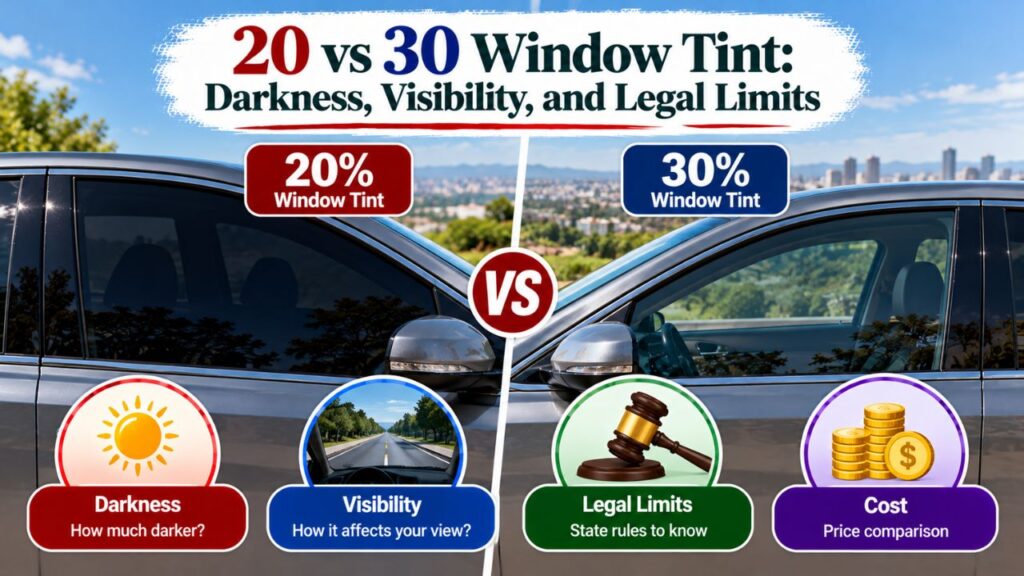
The most important difference between 20% and 30% window tint is visible light transmission (VLT).
VLT measures the percentage of visible light passing through a window film or completed window assembly.
A lower VLT percentage means less light passes through the window, resulting in a darker appearance.
| Feature | 20% Window Tint | 30% Window Tint |
| Nominal visible light transmission | 20% | 30% |
| Darkness | Darker | Lighter |
| Exterior appearance | Stronger darkened appearance | Moderately dark appearance |
| Daytime privacy | Greater | Moderate |
| Nighttime outward visibility | More restricted | Less restricted |
| Glare reduction | Usually greater within the same film series | Usually less than 20% |
| Heat rejection | Depends on film technology | Depends on film technology |
| UV protection | Depends on product specifications | Depends on product specifications |
| Legal considerations | More likely to exceed certain tint limits | Still restricted in many jurisdictions |
| Best suited for | Privacy and darker styling | Better visibility and everyday usability |
These comparisons assume films of comparable quality applied to similar automotive glass.
The actual appearance and performance depend on the film manufacturer, existing glass, vehicle interior, and lighting conditions.
What Does 20% Window Tint Mean?
A nominal 20% VLT window film allows approximately one-fifth of incoming visible light to pass through the film under its specified measurement conditions.
It restricts the remaining visible light through absorption, reflection, and other optical behavior.
This produces a darker appearance than 30% tint.
From outside the vehicle, occupants and interior objects become more difficult to see, particularly when the surroundings are bright.
However, 20% tint is not completely opaque.
Someone standing close to the window may still see through it depending on lighting, reflections, and viewing angle.
What Does 30% Window Tint Mean?
A nominal 30% VLT film allows approximately three-tenths of incoming visible light to pass through.
It provides a noticeable darkened appearance but allows more visible light through than 20% tint.
This difference is useful when checking side mirrors, navigating poorly lit streets, or looking through the windows while parking.
The interior remains more visible from outside than it would with a comparable 20% film.
However, 30% tint still reduces incoming visible light substantially compared with clear automotive glass.
Key Takeaway: Twenty-percent tint prioritizes darkness and privacy, while 30% tint provides a less restrictive balance between appearance and visibility.
How Much Darker Is 20% Tint Than 30% Tint?
Twenty-percent tint transmits 10 percentage points less visible light than 30% tint.
That difference may sound small, but the relative change is meaningful.
Using nominal film VLT ratings:
- 20% tint transmits 20 units of visible light out of 100.
- 30% tint transmits 30 units of visible light out of 100.
Therefore, 30% tint transmits 50% more visible light than 20% tint, relative to the 20% transmission level.
Conversely, 20% tint transmits approximately one-third less visible light than 30% tint.
These calculations compare light transmission, not human perception of darkness. Perceived brightness also depends on lighting and visual adaptation.
What Does 20% Tint Look Like From Outside?
Twenty-percent tint gives vehicle windows a distinctly dark appearance.
During bright daylight, reflections from the exterior glass can make it difficult to identify objects or occupants inside the vehicle.
This effect is often more noticeable when the vehicle has a dark interior.
However, the appearance changes with lighting.
If the interior is brightly illuminated while the surroundings are dark, objects inside may become easier to see.
Window tint does not provide guaranteed privacy under every lighting condition.
What Does 30% Tint Look Like From Outside?
Thirty-percent tint provides a moderate-to-dark appearance without reducing visible light as much as 20%.
It can make a vehicle look more uniformly tinted while allowing better visibility through the glass.
The cabin generally remains easier to see from outside, especially when the interior is brightly lit.
For drivers who prefer a noticeable tint without an extremely dark appearance, 30% is often the more balanced option.
Does Vehicle Interior Color Affect Tint Appearance?
Yes. Interior color can noticeably affect how dark the windows appear.
A black or dark gray interior absorbs more light and can make tinted windows appear darker from outside.
Light-colored upholstery and trim reflect more light within the cabin, potentially making the interior easier to see.
Other factors include:
- Exterior lighting conditions
- Window angle
- Glass reflectivity
- Film color
- Factory glass tint
- Interior illumination
For this reason, the same tint shade may appear different on two vehicles.
Is 20% or 30% Window Tint Better for Privacy?
Twenty-percent window tint generally provides better daytime privacy than 30% tint.
Because it transmits less visible light, it becomes more difficult for people outside the vehicle to see occupants or personal items.
However, neither shade makes the windows completely private.
Privacy With 20% Window Tint
Twenty-percent tint creates a stronger visual barrier between the vehicle interior and its surroundings.
During sunny conditions, exterior reflections combined with the darker film can limit visibility into the cabin.
This is useful for drivers who prefer a discreet appearance or want belongings to be less noticeable.
However, the effect is conditional.
At night, interior lighting can make people and objects visible through dark tint.
Avoid treating window tint as a substitute for removing valuables from an unattended vehicle.
Privacy With 30% Window Tint
Thirty-percent tint provides some privacy, especially during daylight.
It reduces the amount of light passing through the windows, making interior details less apparent than through untinted glass.
However, people standing close to the vehicle may still see occupants and objects relatively easily.
The lighter shade is more appropriate when visibility and a moderately tinted appearance matter more than maximum privacy.
Which Tint Looks Better on a Car?
Appearance is subjective.
Twenty-percent tint suits drivers who prefer a darker, more uniform window appearance.
Thirty-percent tint is better suited to those who want noticeable tinting without making the windows look as dark.
Film color also matters.
Two films with the same VLT percentage may have different charcoal, gray, or neutral tones.
For the most accurate comparison, examine actual installed samples rather than relying only on digital pictures.
20 vs 30 Window Tint for Night Driving
Nighttime visibility is one of the most important differences between these two tint shades.
Both reduce the amount of visible light reaching the driver’s eyes through the tinted window.
However, 20% tint restricts more light than 30%.
Nighttime Visibility With 20% Tint
Twenty-percent tint can make the surroundings noticeably darker when viewed through the side windows.
This becomes more important when driving through areas with limited street lighting.
Potential difficulties include:
- Seeing pedestrians near intersections
- Identifying cyclists approaching from the side
- Checking side mirrors
- Looking through windows while reversing
- Judging nearby objects in dark parking areas
- Navigating poorly illuminated roads
The extent of the reduction depends on the driver’s vision, lighting conditions, and the glass-film combination.
Even a high-quality film with excellent optical clarity cannot make a 20% VLT window transmit as much visible light as a comparable 30% window.
Nighttime Visibility With 30% Tint
Thirty-percent tint allows more light into the cabin through the treated windows.
This can make it easier to recognize objects outside the vehicle when ambient lighting is limited.
The difference is particularly relevant for drivers who regularly travel at night.
However, 30% tint still reduces visibility compared with much lighter films.
It should not automatically be considered suitable for every driver or every window position.
Which Is Safer for Night Driving?
Between otherwise comparable 20% and 30% films, 30% generally offers the visibility advantage for nighttime driving.
This does not mean 30% tint guarantees safe visibility.
Weather, road lighting, eyesight, glass condition, and windshield visibility all matter.
For front side windows, a lighter, legally compliant film may be more appropriate than either shade.
Drivers should not rely entirely on backup cameras or parking sensors to compensate for reduced direct visibility.
Does 20% Tint Block More Heat Than 30% Tint?
Not necessarily.
Although 20% tint blocks more visible light, visible light transmission is not the same as solar heat rejection.
The amount of heat a window film rejects depends on its materials and optical properties.
A high-performance 30% ceramic or multilayer film may reject more solar heat than a basic 20% dyed film.
Understanding VLT and Heat Rejection
The main measurements to understand are:
- VLT (Visible Light Transmission): The percentage of visible light passing through the film or glass-film assembly.
- TSER (Total Solar Energy Rejected): The percentage of total solar energy rejected by the filmed glass.
- IRER (Infrared Energy Rejection): A measurement of how much solar infrared energy is rejected over a specified wavelength range, including the effects of absorbed energy that can be reradiated.
- UV rejection: The amount of ultraviolet radiation blocked by the product.
According to 3M’s official automotive window film technical guidance, higher TSER means less total solar heat passes through the filmed glass.
The manufacturer also distinguishes visible light transmission from infrared rejection.
This is why comparing tint percentages alone is insufficient when reducing cabin heat is your main priority.
Heat Rejection With 20% Tint
Within the same product series, a darker 20% film may reject somewhat more solar energy than a comparable 30% film.
However, the difference varies by product.
A basic dyed film can reduce visible brightness without providing the same infrared-blocking performance as a more advanced ceramic product.
The film’s specifications are therefore more useful than shade alone.
Heat Rejection With 30% Tint
Thirty-percent tint can provide substantial heat rejection when manufactured with suitable solar-control technology.
A ceramic or multilayer film can reject significant solar energy while allowing more visible light to pass through.
This can be valuable for drivers who want improved visibility without giving up effective heat control.
Compare actual TSER and IRER values under equivalent testing conditions.
Which Tint Is Better for Keeping a Car Cool?
Choose based on the film’s measured performance rather than assuming the darker option must be cooler.
For example, consider two hypothetical films:
| Feature | Film A | Film B |
| VLT | 20% | 30% |
| Film construction | Basic dyed film | Advanced ceramic film |
| Darkness | Darker | Lighter |
| Heat rejection | Depends on specifications | Depends on specifications |
The 30% ceramic film could outperform the 20% dyed film in total solar heat rejection.
This is an illustrative comparison, not a measured result for specific products.
For heat control, TSER is usually a more useful comparison than VLT alone.
Is 20% or 30% Ceramic Tint Better?
If both films use comparable ceramic technology, the choice mainly depends on your preferred darkness, visibility, and the specific product’s measured performance.
Ceramic window films use nonmetallic ceramic materials to help manage solar energy.
However, the term ceramic does not guarantee identical performance across manufacturers.
Benefits of 20% Ceramic Tint
A high-quality 20% ceramic film can offer:
- A darker appearance
- Greater daytime privacy
- Reduced visible glare
- Infrared heat rejection based on the product design
- UV protection according to the manufacturer’s specifications
It is attractive when privacy and dark styling are priorities.
However, the darker shade still restricts nighttime visibility.
Benefits of 30% Ceramic Tint
A comparable 30% ceramic film offers:
- A moderately dark appearance
- Better outward visibility
- Useful daytime privacy
- Heat rejection without needing extremely dark glass
- Less restriction on light transmission than 20%
For everyday driving, 30% ceramic tint is generally the more flexible choice when both shades are legally permitted.
Does Ceramic Tint Improve Night Visibility?
High-quality ceramic film may offer good optical clarity, reduced haze, and consistent color.
However, ceramic construction does not eliminate the effect of a low VLT percentage.
A 20% ceramic film still transmits less visible light than a comparable 30% ceramic film.
For drivers who frequently operate in dark environments, choosing a higher VLT remains important.
Is 20% or 30% Window Tint Legal?
Neither 20% nor 30% tint is universally legal across the United States.
Tint laws vary by state, window location, vehicle classification, and sometimes other conditions.
A shade allowed on rear passenger windows may be prohibited on front side windows.
Windshields usually have more restrictive requirements.
Front Side Window Tint Laws
Front side windows are subject to visibility requirements that vary among states.
Some jurisdictions require substantially more visible light transmission than either 20% or 30% tint provides.
Consequently, neither shade should be assumed legal for the driver’s or front passenger’s window.
Check the current law for the state where the vehicle is registered and operated.
Rear Side and Back Window Tint Laws
Some states permit darker tint on rear side windows than on front side windows.
Vehicle classification may also affect the requirements.
For example, certain passenger cars, SUVs, vans, and multipurpose passenger vehicles may be treated differently under relevant rules.
Rear-window tint requirements may also involve side mirrors or other conditions.
Do not assume that the same percentage can legally be installed on every window.
Windshield Tint Restrictions
Windshields are particularly important for forward visibility.
Many jurisdictions prohibit dark films across the main viewing area, allowing only specific upper windshield strips or other narrowly defined treatments.
Neither 20% nor 30% film should be installed across the windshield without confirming that the exact application is legally permitted.
The darker the windshield, the more it can restrict visibility in low-light conditions.
Check Current State Tint Requirements
The International Window Film Association’s automotive tint law resources provide access to state-by-state tint law information.
However, official state statutes and regulatory agencies remain the final authority.
Before installation, verify:
- Minimum permitted VLT for each window
- Whether the rule applies to film alone or the finished glass-film combination
- Vehicle-classification differences
- Windshield restrictions
- Reflectivity and color restrictions
- Applicable exemptions
- Required stickers or documentation, where relevant
A professional installer should be able to measure your current glass and discuss applicable restrictions, but you should independently verify legal requirements when necessary.
How Factory Glass Changes 20% and 30% Tint
One frequently overlooked issue is that most automotive glass does not transmit 100% of visible light before film installation.
Some glass already contains a degree of factory tint or absorbs part of the incoming light.
This means the completed window may measure darker than the nominal film percentage.
Film VLT vs. Combined Window VLT
Combined VLT refers to the visible light transmission of the complete glass-film assembly.
A simplified estimate is:
Estimated Combined VLT = Glass VLT × Film VLT
Convert the percentages to decimals before multiplying.
Suppose the original automotive glass transmits 80% of visible light.
With nominal 20% film:
0.80 × 0.20 = 0.16
Estimated combined VLT = 16%
With nominal 30% film:
0.80 × 0.30 = 0.24
Estimated combined VLT = 24%
These calculations are idealized estimates. Actual measurements can differ because of film specifications, glass properties, reflections, and measurement methods.
Example Combined VLT Chart
| Original Glass VLT | With 20% Film | With 30% Film |
| 90% | 18% | 27% |
| 85% | 17% | 25.5% |
| 80% | 16% | 24% |
| 75% | 15% | 22.5% |
| 70% | 14% | 21% |
The chart uses simple multiplication for illustration rather than laboratory-measured glass-film performance.
Actual values depend on the specific film and glass.
Why a Tint Meter Matters
A tint meter measures visible light transmission through the installed window assembly.
This is important because legal limits often apply to the finished window rather than the film’s advertised percentage.
For example, a film labeled 30% may produce an installed reading below 30% when applied to automotive glass.
If your state’s minimum requirement is near the selected film’s nominal rating, there may be insufficient room to account for the existing glass tint.
Have the window measured before and after installation when compliance is important.
Can You Put 30% Tint Over Factory-Tinted Glass?
It may be physically possible to apply aftermarket film over certain factory-tinted glass, provided the glass and film are compatible.
However, the completed window will generally be darker than the nominal film shade.
Factory privacy glass on rear windows can already have relatively low VLT.
Adding 30% film over it could reduce visible light transmission substantially.
Check the existing glass with a tint meter and confirm the legal requirements before adding another layer.
20 vs 30 Window Tint for Different Vehicle Windows
The best tint shade may differ according to the window’s location.
Front side windows, rear side windows, and back glass serve different visibility purposes.
Front Driver and Passenger Windows
For front side windows, visibility and legal compliance should take priority over darkness.
Thirty-percent tint provides better visibility than 20%, but neither is automatically legal.
A lighter film may be the more appropriate option.
If heat rejection is your main concern, consider a high-performance film with greater visible light transmission and suitable TSER performance.
Rear Passenger Windows
Rear passenger windows offer more flexibility in jurisdictions that permit darker rear tint.
Twenty-percent tint may be appealing for stronger privacy.
Thirty-percent tint may be preferable when you want a consistent appearance without making the rear cabin overly dark.
The best option depends on your preferences, existing factory glass, and local law.
Rear Windshield or Back Glass
Rear-window visibility matters for reversing, parking, and checking traffic behind the vehicle.
Twenty-percent tint provides a darker appearance but can make rearward viewing more difficult in poorly lit conditions.
Thirty-percent tint allows more light through.
Vehicles with heavily tinted factory rear glass may not need additional dark film.
Rear cameras and parking sensors are useful aids, but they do not replace the need for appropriate direct visibility.
Does 20% Window Tint Reduce Glare More Than 30%?
Within the same film series, 20% tint generally reduces more visible sunlight than 30%.
This can make bright daytime conditions more comfortable.
However, glare reduction should not be confused with total heat rejection.
Daytime Glare With 20% Tint
Darker tint can reduce the intensity of sunlight entering through side windows.
This may help with bright reflections and direct sunlight entering the cabin from the side.
However, reducing visible light is not always beneficial.
The same film that reduces daytime brightness also restricts visibility after sunset.
Daytime Glare With 30% Tint
Thirty-percent tint still reduces a substantial amount of incoming visible light compared with clear glass.
It may provide enough glare reduction for drivers who want a more moderate shade.
Because more light passes through, it generally offers a better compromise between glare control and nighttime visibility.
What About Glare From Headlights?
Dark tint can reduce some incoming light from headlights viewed through tinted windows, but it also reduces light from pedestrians, road signs, and other objects.
That tradeoff becomes more significant at night.
Do not select an excessively dark film as a solution for poor nighttime visibility or headlight discomfort.
If glare is a persistent problem, also check the cleanliness and condition of the glass and whether an eye examination is appropriate.
Does 20% or 30% Tint Provide Better UV Protection?
UV protection is not determined by visible light transmission alone.
A high-quality 30% film may provide UV rejection comparable to a darker 20% film from the same manufacturer.
Many premium automotive films are designed to block a high percentage of ultraviolet radiation.
However, performance should be verified using the specific product’s technical data.
UV Rejection vs. Tint Darkness
VLT measures visible light.
UV rejection measures how much ultraviolet radiation the film blocks.
These are different parts of the electromagnetic spectrum.
A visibly lighter film can still provide strong UV protection when it uses suitable UV-blocking technology.
Which Tint Helps Protect the Interior?
Both shades can help reduce light exposure inside the vehicle.
However, protection against fading depends on more than darkness.
Ultraviolet radiation, visible light, and heat can all contribute to deterioration of interior materials.
Compare UV rejection and solar performance specifications when protecting upholstery, dashboards, or trim is a major goal.
Does 20% Tint Cost More Than 30% Tint?
The shade percentage alone usually does not determine the main installation cost.
Film technology, product grade, installer labor, vehicle design, and warranty coverage are generally more significant factors.
A shop may charge the same amount for 20% and 30% film within the same product series.
However, pricing is not standardized.
Factors That Affect Window Tint Cost
Common factors include:
- Vehicle size
- Number of windows
- Window shape and curvature
- Film brand
- Dyed, ceramic, or multilayer construction
- Removal of existing tint
- Installation complexity
- Warranty coverage
- Local labor costs
For example, a premium ceramic 30% film may cost more than a basic dyed 20% film.
That additional cost reflects the product and installation rather than the lighter shade.
Is Premium Tint Worth the Extra Cost?
A premium film may be worthwhile when it provides verified improvements in solar energy rejection, optical quality, color stability, or warranty coverage.
However, brand reputation alone does not establish performance.
Review the specific film’s technical data sheet.
Compare TSER, VLT, UV rejection, and relevant infrared measurements using the same testing basis.
This provides a more meaningful comparison than selecting the darkest available film.
How to Choose Between 20% and 30% Window Tint
Before selecting either shade, identify what matters most in your driving conditions.
A useful decision should consider more than appearance.
Choose 20% Window Tint If:
- You prefer a noticeably darker appearance.
- Daytime privacy is a major priority.
- You want more visible-light reduction.
- The intended window location legally permits the installed VLT.
- You understand the additional nighttime visibility limitations.
Twenty-percent tint is often more suitable for permitted rear-window applications than for front side windows.
Choose 30% Window Tint If:
- You want a moderately dark appearance.
- Nighttime visibility matters more than maximum privacy.
- You frequently use side mirrors in poorly lit areas.
- You prefer a less restrictive view from inside the vehicle.
- The completed glass-film combination meets local legal requirements.
For drivers choosing solely between these two shades, 30% is generally the more versatile option.
Check the Tint Before Installation
A professional tint shop should be able to help compare physical film samples and review the manufacturer’s specifications.
Before installation:
- Check the legal VLT requirement for the intended window.
- Measure the original glass transmission.
- Compare actual 20% and 30% samples.
- Review the film’s TSER and UV specifications.
- Consider nighttime driving and parking conditions.
- Confirm the expected installed VLT.
- Review warranty and installation details.
Avoid deciding entirely from photos because camera exposure, reflections, and display settings can make tint appear lighter or darker than it is.
Conclusion
The 20 vs 30 window tint comparison comes down primarily to visibility, privacy, and appearance.
Twenty-percent tint is darker, provides greater daytime privacy, and generally reduces more visible glare when compared with a similar 30% film.
Thirty-percent tint allows more light through, making it the more practical option for drivers who value outward visibility, particularly after sunset.
However, the darker shade does not automatically provide better heat rejection or UV protection. Those benefits depend on the specific film’s technology and tested performance.
Neither percentage is universally legal, and factory glass can make the finished window darker than the advertised film rating.
For everyday driving, I recommend 30% over 20% when both are legally permitted and visibility is a priority. Choose 20% only when stronger privacy is worth the additional visibility restriction and the installation meets the applicable regulations.
For front side windows, a lighter legal shade may be preferable to either option.
FAQs About 20 vs 30 window tint
Is 20% Tint Much Darker Than 30%?
Yes. Twenty-percent tint transmits approximately one-third less visible light than 30% tint when comparing their nominal VLT values. The visual difference is noticeable, especially when looking into a vehicle during daylight or looking outward in dim conditions.
Is 30% Tint Dark Enough for Privacy?
Thirty-percent tint provides moderate privacy during daylight, but it does not completely hide the vehicle interior. People may still see occupants and belongings, particularly when standing close to the window or when the cabin is brightly illuminated.
Is 20% Tint Too Dark for Driving at Night?
Twenty-percent tint can significantly restrict visibility through side and rear windows in low-light conditions. Some drivers may find it difficult to identify pedestrians, obstacles, or objects while parking. A lighter tint is generally preferable when nighttime visibility is a priority.
Does 30% Ceramic Tint Block More Heat Than 20% Regular Tint?
It can. A high-performance 30% ceramic film may reject more solar heat than a basic 20% dyed film. The result depends on the specific products, so compare their tested TSER and infrared performance rather than relying on tint darkness.
Can You See Inside a Car With 20% Tint?
Yes, under certain lighting conditions. Twenty-percent tint makes it harder to see through the glass during bright daylight, but it does not make the window opaque. Interior lighting, exterior reflections, and viewing angle affect how much remains visible.
Is 30% Tint Legal on Front Windows?
It depends on the state, vehicle classification, and finished glass-film VLT. Some jurisdictions require front side windows to transmit more light than a 30% film allows. Verify the current legal requirement and have the completed window measured before assuming compliance.
Is 20% or 30% Tint Better for a Windshield?
Neither should be selected for a full windshield without confirming the specific legal requirements. Most jurisdictions impose strict windshield tint limitations because forward visibility is essential. Where permitted, a much lighter, compliant film may offer heat or UV control with less restriction on visibility.