The main difference between 20% and 35% window tint is how much visible light passes through the glass. A 20% tint is darker, allowing approximately 20% of visible light through, while a 35% tint allows approximately 35%. If both ratings describe the same type of measurement, 35% tint transmits 75% more visible light than 20% tint.
For drivers who prefer a dark appearance and greater daytime privacy, 20% tint is often more appealing. However, the additional darkness can make it harder to see through side windows at night, especially on poorly lit roads.
A 35% tint offers a more balanced appearance, allowing better outward visibility while still reducing sunlight and some glare. Neither shade is automatically legal for every vehicle window, and darker tint doesn’t necessarily provide better heat rejection.
The right choice depends on how often you drive at night, your privacy expectations, the type of window film, and your state’s tint regulations.
In this article, I compare 20 vs 35 window tint in terms of darkness, daytime and nighttime visibility, privacy, glare reduction, and heat rejection. I also explain how ceramic films affect performance, how factory glass changes the final tint percentage, and which shade makes more sense for different driving situations.
20 vs 35 Window Tint: Key Differences at a Glance
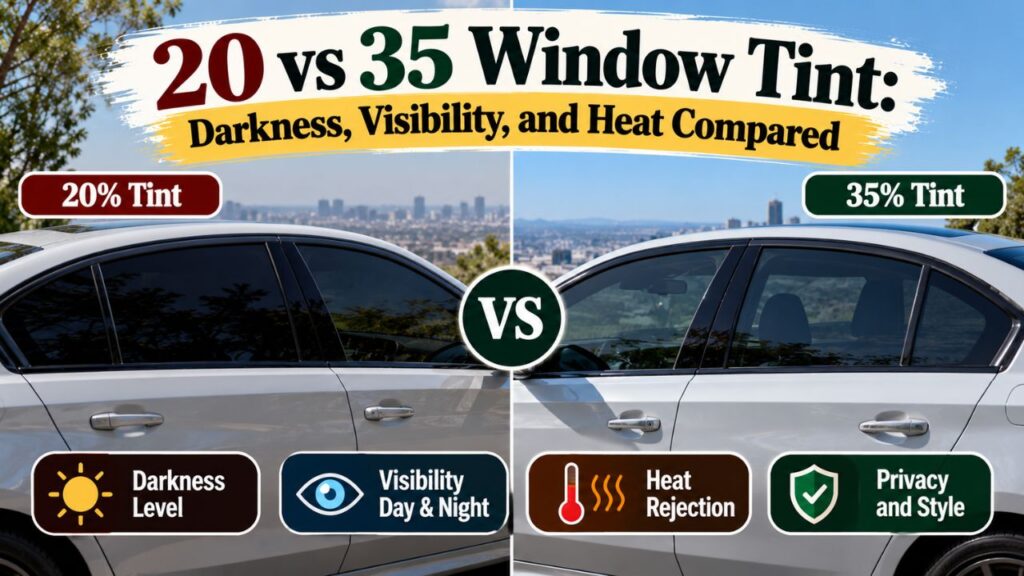
Both 20% and 35% tint reduce the amount of visible light entering your vehicle, but the difference is noticeable from inside and outside the car.
The percentage refers to Visible Light Transmission (VLT), which measures how much visible light passes through a window film or a completed window assembly.
A lower VLT percentage means darker tint.
| Feature | 20% Window Tint | 35% Window Tint |
| Nominal visible light transmission | 20% | 35% |
| Nominal visible light blocked | 80% | 65% |
| Appearance | Dark | Moderately dark |
| Daytime privacy | Greater | Moderate |
| Nighttime visibility | More restricted | Better |
| Glare reduction | Generally greater | Generally less |
| Visibility in parking areas | More difficult in low light | Easier in low light |
| Heat rejection | Depends on film technology | Depends on film technology |
| UV protection | Depends on film specifications | Depends on film specifications |
| Legal suitability | Depends on state and window | Depends on state and window |
| Best suited for | Dark appearance and privacy | Balance of appearance and visibility |
These comparisons assume films with similar optical quality and construction.
Actual appearance can vary because of the original glass, interior lighting, film color, and manufacturer.
Key Takeaway: Choose 20% tint if a darker appearance and privacy are your priorities. Choose 35% tint if outward visibility, particularly at night, matters more.
What Does 20% Window Tint Look Like?
A 20% window tint creates a noticeably dark appearance.
From outside the vehicle during daylight, it can make the interior difficult to see, especially when the interior is darker than the surrounding environment.
However, 20% tint isn’t completely opaque.
People may still see silhouettes, movement, or objects inside the vehicle depending on lighting conditions.
Appearance of 20% Tint During the Day
In bright sunlight, 20% tint generally gives vehicle windows a deep charcoal or smoked appearance.
It is often selected by drivers who prefer:
- A darker vehicle appearance.
- Less visibility into the cabin.
- Reduced visible sunlight entering the car.
- Greater daytime privacy for passengers.
- A more uniform dark-window appearance where legally permitted.
The exact color depends on the film.
Some products have a neutral gray or charcoal appearance, while others may show different color tones or reflectivity.
A high-quality carbon or ceramic tint may also look different from an inexpensive dyed film with the same nominal VLT.
Visibility From Inside With 20% Tint
Looking outward through 20% tint is generally easier during bright daylight than at night.
Sunlight provides enough illumination for many outdoor objects to remain visible.
However, the film still reduces incoming light.
Objects in shadows may appear darker, and visual detail can become harder to distinguish as outdoor lighting decreases.
The effect becomes particularly noticeable around dusk.
Does 20% Tint Provide Complete Privacy?
No. A 20% tint improves daytime privacy but doesn’t guarantee that people outside cannot see into the vehicle.
Visibility depends partly on the brightness difference between the interior and exterior.
For example, a dark vehicle interior may be difficult to see during a sunny afternoon.
At night, if the cabin light is switched on, people standing outside may be able to see inside much more easily.
20% tint provides greater privacy than 35% tint under comparable conditions, but neither is a true one-way privacy barrier.
What Does 35% Window Tint Look Like?
A 35% tint provides a noticeably tinted appearance without being as dark as 20%.
It allows more sunlight into the cabin and generally offers better outward visibility.
This makes it appealing to drivers who want a visible tint without choosing a particularly dark shade.
Appearance of 35% Tint During the Day
A 35% window tint usually gives the glass a medium-dark smoked appearance.
From outside, the vehicle interior remains partly visible, especially in strong sunlight.
Dark upholstery and shaded interiors may still provide some privacy.
The overall appearance is generally more subtle than 20%.
A 35% tint is often preferred for:
- A moderate tinted appearance.
- Better visibility through side windows.
- Reduced daytime glare.
- Everyday commuting.
- Drivers who regularly travel after sunset.
The finished appearance still depends on the factory glass and the selected film.
Visibility From Inside With 35% Tint
A 35% tint generally provides a clearer view of the outside environment than 20% tint.
Because it transmits more visible light, it makes it easier to distinguish objects in moderately lit conditions.
This difference can matter when:
- Changing lanes after sunset.
- Looking through side windows.
- Checking for pedestrians near intersections.
- Reversing into parking spaces.
- Driving through poorly lit neighborhoods.
However, 35% tint still reduces available light compared with untinted glass.
It shouldn’t be treated as equivalent to clear windows during nighttime driving.
Is 35% Tint Dark Enough for Privacy?
A 35% tint provides moderate privacy during daylight.
It makes the cabin less exposed than clear glass, but people outside may still see passengers and objects inside.
If privacy is the main priority, 20% generally performs better.
If visibility matters more, 35% offers a more comfortable compromise.
How Much Darker Is 20% Tint Than 35% Tint?
The difference between the two shades is 15 percentage points of visible light transmission.
That may sound small, but the relative difference is substantial.
Consider the nominal VLT values:
- 20% tint transmits 20 units of visible light out of 100.
- 35% tint transmits 35 units of visible light out of 100.
Comparing the transmitted light:
35 ÷ 20 = 1.75
This means 35% tint transmits 75% more visible light than 20% tint, assuming both percentages are measured on the same basis.
Viewed another way, 20% tint transmits approximately 43% less visible light than 35% tint.
Why Tint Percentages Can Be Confusing
Window tint percentages describe how much light passes through, not how much light is blocked.
For example:
| Tint Rating | Visible Light Passing Through | Visible Light Blocked |
| 5% | 5% | 95% |
| 15% | 15% | 85% |
| 20% | 20% | 80% |
| 35% | 35% | 65% |
| 50% | 50% | 50% |
| 70% | 70% | 30% |
These are simplified nominal figures, not guaranteed final readings after installation on existing automotive glass.
A lower percentage produces a darker result.
The 3M automotive window film terminology guide defines VLT as the percentage of visible light transmitted through filmed glass and distinguishes it from measurements of heat and UV rejection.
Understanding that distinction helps prevent confusing darkness with overall film performance.
20 vs 35 Window Tint for Night Driving
Nighttime visibility is one of the most important differences between these two shades.
Both reduce the light entering the vehicle, but 20% tint creates a more noticeable restriction.
Is 20% Tint Too Dark at Night?
A 20% tint can make nighttime visibility more difficult, particularly through the front side windows.
The effect may be most noticeable when:
- Driving on rural roads without streetlights.
- Looking for pedestrians near the roadside.
- Turning at poorly lit intersections.
- Checking mirrors through tinted side windows.
- Backing into dim parking areas.
- Driving in rain or other low-visibility conditions.
Even when the driver can see reasonably well during the day, nighttime conditions can reveal limitations.
For example, a vehicle approaching from the side may be harder to recognize against a dark background when less light reaches the driver’s eyes.
The exact difficulty depends on the driver’s vision, available lighting, film quality, and window location.
Is 35% Tint Better for Night Driving?
Yes. Between otherwise comparable 20% and 35% films, 35% generally provides better nighttime visibility.
It allows more visible light through the window, making objects easier to distinguish in low-light conditions.
However, it still reduces incoming light compared with clear glass.
Drivers who frequently travel at night may prefer an even lighter, legally compliant film.
Which Shade Is Better for Rainy Nights?
A lighter shade is generally preferable when visibility is already reduced by rain, darkness, or poor roadway illumination.
Rain adds reflections and visual distractions, particularly around headlights and streetlights.
A 20% film further reduces the visible light reaching the driver.
A 35% film permits more light through, although it cannot eliminate visibility problems caused by weather.
Safety Note: Never select a dark tint for driver-critical windows without confirming legal requirements and considering nighttime visibility. Extra daytime privacy isn’t worth reducing the ability to detect road hazards.
20 vs 35 Window Tint for Privacy
Privacy is a major reason drivers choose darker window film.
A 20% tint generally offers greater privacy than 35%, but the benefit depends on lighting conditions and window placement.
Daytime Privacy Comparison
During bright daylight, 20% tint can make passengers and objects inside the vehicle harder to see.
A 35% tint still reduces visibility into the cabin, but interior details may remain easier to recognize.
For drivers who regularly carry passengers in the rear seats, darker legally permitted rear-window tint may be appealing.
However, neither shade prevents someone from seeing into the cabin under every condition.
Nighttime Privacy Comparison
Tint behaves differently when the vehicle’s interior is brighter than the surrounding environment.
For example, turning on a cabin light at night may make occupants more visible from outside.
Even a darker tint cannot guarantee privacy in this situation.
The same effect can occur in covered parking areas when the interior lighting is strong.
Does 20% Tint Hide Valuables Better?
A darker tint may make objects less noticeable from outside under some conditions.
However, it shouldn’t be relied upon as a security measure.
Valuables may still be visible at certain angles or under particular lighting conditions.
Keep valuable belongings out of sight regardless of the window tint percentage.
20 vs 35 Window Tint for Heat Rejection
A 20% tint doesn’t automatically reject more heat than a 35% tint.
This is one of the most common misunderstandings when comparing window films.
VLT measures visible light transmission, but solar heat includes energy outside the visible spectrum.
Film construction plays an important role in heat rejection.
Why Darker Tint Isn’t Always Cooler
Traditional dyed films often reduce visible sunlight effectively, but their solar heat rejection may differ substantially from advanced films.
Modern window films can use specialized layers to manage infrared energy and other parts of the solar spectrum.
As a result, a high-performance 35% ceramic or multilayer film may reject more total solar energy than a lower-performing 20% dyed film.
This doesn’t mean every 35% ceramic film outperforms every 20% film.
Actual performance depends on the product.
Total Solar Energy Rejection (TSER)
Total Solar Energy Rejection (TSER) describes the percentage of total solar energy rejected by the filmed glass under specified test conditions.
It is more directly useful for comparing overall solar heat rejection than VLT alone.
For example, consider two hypothetical films:
| Film | VLT | Illustrative TSER |
| Film A | 20% | 45% |
| Film B | 35% | 55% |
These numbers are hypothetical examples, not verified specifications for particular products.
They demonstrate how a lighter film could reject more solar energy than a darker one.
When comparing actual products, use the manufacturer’s tested specifications for the same glass and measurement conditions.
Infrared Rejection (IRR and IRER)
Infrared rejection is another performance measure commonly advertised for automotive window films.
However, not all infrared specifications use the same wavelength range or testing method.
Some manufacturers report infrared rejection over a narrow portion of the spectrum.
Others report infrared energy rejection across a wider range and account for additional heat-transfer effects.
A high advertised infrared percentage doesn’t automatically indicate superior total solar heat rejection.
Compare TSER and the relevant infrared measurements together.
Which Tint Keeps a Car Cooler?
If you’re comparing two films from the same product line, check their measured heat-rejection specifications.
The darker film may perform differently, but the VLT percentage alone doesn’t determine the result.
For drivers primarily interested in keeping the cabin cooler, film technology and verified TSER are generally more useful comparison factors than darkness.
20% vs 35% Ceramic Window Tint
Ceramic window tint uses specialized ceramic-containing technology to manage solar energy.
It is commonly selected by drivers who want heat rejection without relying only on dark glass.
However, ceramic films vary in quality and construction.
Advantages of 20% Ceramic Tint
A 20% ceramic film combines a darker appearance with the heat-management properties of its particular formulation.
Potential advantages include:
- Greater daytime privacy.
- A darker exterior appearance.
- Reduced visible glare.
- Infrared rejection according to the product’s specifications.
- UV protection when provided by the film.
Its main drawback remains reduced outward visibility, especially after sunset.
Ceramic technology doesn’t eliminate the visibility loss created by a low VLT percentage.
Advantages of 35% Ceramic Tint
A 35% ceramic film allows more visible light while still offering the solar-control performance of its particular product.
This can make it an attractive choice for drivers who prioritize comfort and visibility.
Potential benefits include:
- Better outward visibility than comparable 20% film.
- Moderate privacy.
- Reduced visible glare.
- Heat rejection without requiring an extremely dark appearance.
- A more balanced look for everyday driving.
A high-performance 35% ceramic film may be a better choice than an inexpensive 20% dyed film when heat rejection matters more than privacy.
Is Ceramic Tint Worth It at 20% or 35%?
Ceramic films are often more expensive than basic dyed films.
Whether the additional cost is worthwhile depends on the film’s actual heat-rejection performance, optical clarity, durability, and warranty.
Compare the manufacturer’s specifications rather than assuming every product labeled ceramic provides identical benefits.
For both shades, the most useful specifications are VLT, TSER, infrared performance, UV rejection, and visible reflectance.
Does 20% Tint Block More UV Rays Than 35% Tint?
Not necessarily.
A darker tint doesn’t automatically provide substantially better ultraviolet protection.
UV rejection depends on the film’s materials and construction.
Many automotive films are designed to reject high percentages of ultraviolet radiation even when their visible light transmission is relatively high.
For example, a lighter film may provide strong UV rejection while allowing much more visible light into the vehicle.
UV Protection vs. Visible Light Reduction
These two properties measure different things.
VLT measures how much visible light passes through a film or window.
UV rejection measures how much ultraviolet radiation the film or window blocks under specified conditions.
A 20% tint can block more visible light than a 35% tint without necessarily offering better UV protection.
Check the manufacturer’s UV rejection specifications for the actual film being installed.
Does Dark Tint Protect Car Interiors Better?
Window films can help reduce solar exposure associated with fading and interior deterioration.
However, interior protection depends on the film’s UV rejection, visible light transmission, solar heat performance, and the materials inside the vehicle.
A darker appearance alone doesn’t guarantee the greatest protection.
If protecting upholstery, dashboards, and interior trim is a priority, compare the full performance data rather than just VLT.
How Factory Glass Changes 20% and 35% Tint
One important detail is that a film’s advertised VLT may not equal the final VLT of the window after installation.
Many vehicle windows already reduce some visible light before aftermarket film is applied.
The finished window includes both the original glass and the added film.
Calculating Combined Window Tint VLT
A simplified estimate uses:
Final VLT (%) ≈ Glass VLT (%) × Film VLT (%) ÷ 100
For example, suppose a vehicle’s original glass transmits 80% of visible light.
Adding a 35% film gives:
80 × 35 ÷ 100 = 28% estimated final VLT
Adding a 20% film gives:
80 × 20 ÷ 100 = 16% estimated final VLT
The results are:
| Original Glass VLT | Film VLT | Estimated Final VLT |
| 80% | 35% | 28% |
| 80% | 20% | 16% |
| 75% | 35% | 26.25% |
| 75% | 20% | 15% |
These examples use hypothetical original-glass values.
Actual results can differ because of glass coatings, reflections, manufacturing tolerances, and how the film rating is specified.
A professional tint meter provides a more reliable measurement of the completed window.
Why 35% Film May Not Measure 35% After Installation
If the original automotive glass is already slightly tinted, adding film reduces the total visible light transmission.
A 35% film applied to existing glass may therefore produce a completed window with a VLT lower than 35%.
Some manufacturers publish performance values for film applied to a standard reference glass rather than an isolated film.
Check whether the published VLT describes the film alone or the completed film-and-glass assembly.
This distinction is especially important for legal compliance.
Does Factory Privacy Glass Work the Same Way?
Factory privacy glass is often darkened during manufacturing rather than by adding aftermarket film.
Its actual VLT depends on the vehicle and glass specification.
Installing additional tint over factory privacy glass can make the completed window substantially darker.
For example, a rear window that already has a low VLT may become extremely dark after applying another 20% film.
Before adding aftermarket tint, measure the original glass and verify the applicable legal requirements.
Is 20% or 35% Window Tint Legal?
The legality of either shade depends on the state, vehicle classification, and window being tinted.
In the United States, window tint rules are not uniform across all states.
Front side windows, rear side windows, rear windshields, and front windshields can have different requirements.
Are 20% and 35% Tint Legal on Front Windows?
Neither shade is universally legal on front side windows.
Some jurisdictions require significantly higher visible light transmission.
For example, the New York Department of Motor Vehicles’ window tint guidance states that front side windows must allow at least 70% of outside light to pass through.
Under that requirement, neither 20% nor 35% final VLT would be permitted on ordinary front side windows without an applicable exemption.
Other states have different requirements.
Don’t assume 35% tint is legal everywhere simply because it’s lighter than 20%.
Are Darker Rear Windows Legal?
Some states permit darker tint on rear side windows or rear windshields, particularly for certain SUVs, vans, and other vehicle classifications.
However, those allowances vary.
A state may treat a passenger sedan differently from an SUV or multipurpose vehicle.
Rear-window requirements may also depend on the presence of suitable side mirrors.
Check the specific requirements for your vehicle and registration jurisdiction.
Can You Put 20% or 35% Tint on a Windshield?
Windshield tinting is subject to particularly restrictive rules.
Many states allow only certain tint strips along the upper portion of the windshield or require high light transmission for the main viewing area.
Don’t assume that installing 35% tint across an entire windshield is acceptable.
Even when a dark film improves daytime glare reduction, it may substantially reduce nighttime visibility.
Check the applicable windshield requirements before installation.
How to Check Whether a Tint Is Legal
Before purchasing film:
- Identify the state where the vehicle is registered.
- Check the official state DMV or vehicle-code requirements.
- Confirm the rules for each window location.
- Determine whether your vehicle classification changes the limit.
- Measure the original glass VLT.
- Ask the installer to estimate the completed window’s VLT.
- Verify the result with an appropriate tint meter after installation.
Remember that a 35%-rated film may produce a completed window darker than 35%.
Key Takeaway: Legal compliance depends on the measured glass-and-film combination, not simply the shade printed on the film package.
20 vs 35 Tint for Sedans, SUVs, and Trucks
The better tint shade can depend on the vehicle’s window layout and the driver’s priorities.
Sedans
A sedan generally has front and rear side windows, a rear windshield, and relatively clear sightlines through the cabin.
A 35% tint may be appealing for drivers who want a moderate appearance and better nighttime visibility.
A 20% tint may provide greater privacy on windows where it’s legally permitted.
However, some states impose strict limits on both front and rear side windows of passenger cars.
SUVs
Many SUVs already have dark factory privacy glass on rear passenger windows.
Adding another dark film may significantly reduce the finished VLT.
Before choosing 20% tint for the rear, check the existing glass.
A lighter film may provide the desired heat rejection without making the windows excessively dark.
Pickup Trucks
Pickup trucks often have different window configurations, including rear cab windows and optional factory privacy glass.
A 20% tint may give a dark rear-cabin appearance, while 35% provides more outward visibility.
If the truck is used for towing, nighttime driving, or maneuvering trailers, maintaining good visibility through mirrors and side windows deserves particular attention.
Vehicles Used Frequently at Night
For vehicles used regularly on poorly lit roads, prioritize outward visibility.
A 35% tint generally allows better visibility than 20%, but a lighter legal tint may be preferable for front side windows.
Consider the conditions in which the vehicle is actually driven rather than choosing solely by appearance.
Does 20% Tint Cost More Than 35% Tint?
The shade percentage alone usually isn’t the main factor determining installation cost.
If both shades belong to the same product series, their prices may be similar.
However, the final quote depends on the installer and vehicle.
What Affects Window Tint Pricing?
Common pricing factors include:
- Film brand and product series.
- Dyed, carbon, ceramic, or multilayer construction.
- Number of windows.
- Window size and shape.
- Vehicle type.
- Removal of existing film.
- Installation complexity.
- Installer labor rates.
- Warranty coverage.
A premium 35% ceramic film may cost more than a basic 20% dyed film.
The difference comes from the film’s construction and performance rather than simply its lighter appearance.
Is Premium Film Worth Paying More For?
A premium film may be worthwhile when you value documented heat rejection, optical quality, color stability, and warranty coverage.
However, a higher price doesn’t automatically prove better performance.
Ask for the manufacturer’s technical specifications and compare the same metrics.
A reputable installation also matters because contamination, creases, bubbles, and poor edge finishing can reduce the quality of the result.
Common Mistakes When Choosing Between 20% and 35% Tint
Choosing the Darkest Tint for Maximum Cooling
A dark film isn’t automatically the best heat-rejection film.
Compare total solar energy rejection and other verified performance measurements.
Ignoring Nighttime Visibility
Tint that looks comfortable during a sunny afternoon may appear much darker on an unlit road.
Consider the driving conditions before selecting 20%.
Assuming 35% Tint Is Legal Everywhere
A 35% film may still violate the front-window tint limits in some states.
The original glass can also reduce the completed window’s VLT below the film’s advertised value.
Comparing Different Film Technologies by Darkness Alone
A 20% dyed film and a 35% ceramic film aren’t directly comparable based only on VLT.
Their heat rejection, reflectivity, UV protection, and durability may differ.
Applying Dark Film Over Factory Privacy Glass
Additional tint on already-dark glass can produce a much lower final VLT than expected.
Measure the existing window before installation.
Assuming Dark Tint Provides Complete Privacy
Interior lighting can make passengers and objects visible from outside, even through dark film.
Don’t rely on tint alone to conceal valuables.
Ignoring Film Quality and Installation
Low-quality film or poor installation can create distracting haze, distortion, bubbles, or peeling.
Choose film with appropriate specifications and have it installed correctly.
Which Is Better: 20% or 35% Window Tint?
The better shade depends on your priorities and where the film will be installed.
Choose 20% Tint If:
- You prefer a noticeably darker appearance.
- Greater daytime privacy is a priority.
- The selected window location legally permits that darkness.
- The window is not essential to maintaining adequate nighttime visibility.
- You’re comfortable with reduced outward light transmission.
A 20% tint may be appealing for legally permitted rear passenger windows where privacy is important.
However, it shouldn’t be selected without checking night-driving visibility and local regulations.
Choose 35% Tint If:
- You want a noticeable but less aggressive tinted appearance.
- Better nighttime visibility is important.
- You regularly drive in low-light conditions.
- You prefer moderate daytime privacy.
- You want to reduce visible sunlight without choosing a very dark shade.
A 35% tint generally offers a better balance between appearance and visibility.
However, it isn’t automatically legal for front windows in every state.
Choose a Lighter Film If:
Neither 20% nor 35% may be appropriate when:
- Local law requires higher VLT.
- Nighttime visibility is a major concern.
- The vehicle already has dark factory glass.
- You want strong heat rejection with minimal darkening.
- The window is especially important for recognizing road hazards.
In these situations, a high-performance lighter film may be more practical.
For most drivers who are deciding purely between these two shades, 35% is the more balanced visibility choice, while 20% is the darker privacy-focused choice.
Conclusion
The 20 vs 35 window tint comparison comes down to darkness, visibility, privacy, and the performance of the specific film.
A 20% tint allows less visible light through and generally provides greater daytime privacy. However, it can make nighttime driving and low-light maneuvering more difficult.
A 35% tint allows 75% more visible light through than a 20% tint when comparing equivalent VLT measurements, making it the more comfortable option for drivers who prioritize outward visibility.
For heat rejection, don’t judge performance by darkness alone. A properly selected 35% ceramic film may outperform a lower-quality 20% film.
My recommendation is to choose 35% over 20% when both are legally permitted and visibility is an important priority. Choose 20% primarily when you want darker legally permitted windows and can maintain adequate visibility.
Before installation, verify your state’s regulations and have the finished glass-and-film VLT checked.
FAQs About 20 vs 35 Window Tint
Is 20% Tint Much Darker Than 35%?
Yes. A 20% tint transmits 20% of visible light, while a 35% tint transmits 35%, assuming comparable rating methods.
The difference is noticeable, particularly when looking through the windows in low-light conditions.
Can You See Through 20% Tint at Night?
Yes, but visibility is more restricted than through 35% tint or clear glass.
Poor street lighting, rain, and dark surroundings can make objects harder to distinguish through 20% tint.
For driver-critical windows, a lighter legally compliant film may be safer.
Is 35% Tint Dark Enough to Look Good?
Yes. A 35% tint creates a noticeable smoked or charcoal appearance without being as dark as 20%.
It is a practical option for drivers who want a moderate tinted look.
The final appearance depends on the film color, original glass, and vehicle interior.
Does 20% Tint Reject More Heat Than 35%?
Not necessarily. Heat rejection depends on the film’s construction and tested performance.
A high-performance 35% ceramic film may reject more total solar energy than an inexpensive 20% dyed film.
Compare TSER rather than relying on VLT alone.
Is 20% or 35% Tint Better for Privacy?
A 20% tint generally provides better daytime privacy because it transmits less visible light.
However, interior lighting can make occupants visible at night through either shade.
Neither tint guarantees complete privacy.
Is 35% Tint Legal on Front Windows?
It depends on the state and the completed window’s measured VLT.
Some states permit relatively dark front side windows, while others require substantially lighter glass.
Always verify the applicable state regulations before installation.
Is 20% Tint Too Dark for a Windshield?
A 20% tint across the primary viewing area of a windshield would significantly restrict visible light and is generally inappropriate for normal road use.
Windshield tint laws are usually more restrictive than those for rear windows.
Use a film and application that meet the applicable legal requirements.
Is 20% Tint Better Than 35% for SUVs?
Not automatically.
A 20% tint may offer greater rear-cabin privacy where legally permitted, while 35% allows better outward visibility.
Many SUVs already have factory privacy glass, so check the existing VLT before applying additional film.
Does 35% Ceramic Tint Block UV Rays?
Many high-quality 35% ceramic films provide substantial UV rejection.
However, the exact percentage depends on the product.
Check the manufacturer’s UV specifications rather than assuming that every ceramic film performs identically.
Can You Put 35% Tint Over 20% Tint?
Physically, additional film may be applied over existing tint, but doing so can make the completed window extremely dark.
Under a simplified calculation, stacking nominal 35% film over nominal 20% film would transmit approximately 7% of the light reaching those films, before accounting for the original glass.
Layering film can also introduce optical, adhesion, and warranty concerns.
It is generally better to remove the old film and install one suitable, legally compliant product.