The main difference between 20% and 15% window tint is darkness: 20% tint allows approximately 20% of visible light through, while 15% tint allows approximately 15%. This makes 15% tint darker and better for daytime privacy, while 20% tint provides slightly better visibility, especially when driving at night.
Both shades create a dark appearance and can reduce sunlight glare. However, the five-percentage-point difference in visible light transmission can become more noticeable in low-light conditions, particularly when looking through side windows or reversing.
The darker option isn’t automatically better at blocking heat. Window film technology, infrared rejection, and total solar energy rejection are more useful measurements when comparing temperature-control performance.
Legal restrictions also influence the decision. Many U.S. states limit how dark front side windows can be, and the percentage printed on a film package may differ from the final light transmission measured through the installed window.
In this article, I compare 20 vs 15 window tint for darkness, privacy, nighttime driving, glare reduction, and heat rejection. You’ll also learn how factory glass affects tint percentages, which windows may legally use these shades, and how to choose the better option for everyday driving.
20 vs 15 Window Tint: What Is the Actual Difference?
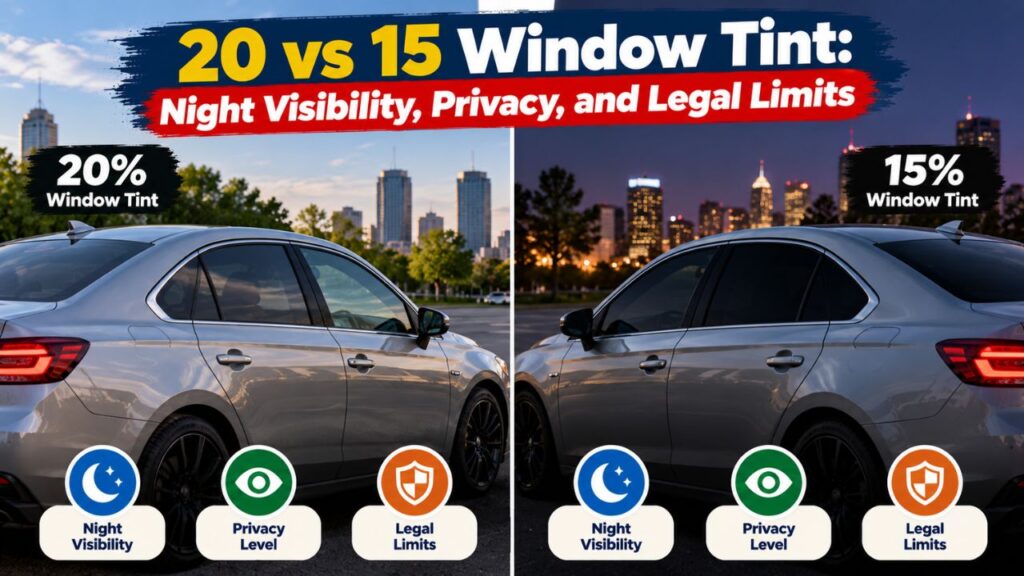
The difference between 20% and 15% window tint is the amount of visible light each shade allows through the glass.
A 20% tint is slightly lighter, while a 15% tint produces a darker appearance and reduces outward visibility more.
Both are considered dark tint shades compared with lighter options such as 35%, 50%, and 70%.
20% vs. 15% Window Tint Comparison Chart
| Feature | 20% Window Tint | 15% Window Tint |
| Nominal visible light transmission | 20% | 15% |
| Darkness | Dark | Darker |
| Daytime privacy | High | Higher |
| Nighttime visibility | Better of the two | More restricted |
| Sunlight glare | Reduced | Reduced further |
| Exterior appearance | Dark, some interior visibility | Darker, interior harder to see |
| Heat rejection | Depends on film technology | Depends on film technology |
| UV protection | Depends on product | Depends on product |
| Front-window legality | Restricted in many states | Restricted in many states |
| Best suited for | Balance of privacy and visibility | Greater daytime privacy |
These are general differences based on nominal tint percentages. Actual appearance and performance depend on the specific film and vehicle glass.
Key Takeaway: If privacy is the priority, 15% has the advantage. If you regularly drive after sunset, 20% is the more visibility-friendly choice, although both shades are dark.
What Does 20% Window Tint Mean?
A film with 20% Visible Light Transmission (VLT) allows approximately one-fifth of the visible light reaching it to pass through.
The remaining visible light is absorbed or reflected.
From outside the vehicle, 20% tint usually appears quite dark during daylight.
However, people may still see some interior details depending on:
- The direction of sunlight.
- The brightness inside the vehicle.
- The angle of observation.
- The color and reflectivity of the film.
- The vehicle’s original glass.
From inside, the windows appear darker than untreated glass, but visibility is generally better than with 15% tint of otherwise similar optical quality.
What Does 15% Window Tint Mean?
A film with 15% VLT allows approximately 15% of visible light to pass through.
It produces a deeper shade than 20% tint.
During bright daylight, a vehicle with 15% tint may appear more private because less light passes through the windows.
However, the darker film also reduces the amount of available light reaching the driver’s eyes.
This becomes more important at dusk, at night, and in poorly illuminated areas.
Is 15% Tint Only 5% Darker Than 20%?
The numerical difference is five percentage points, but the proportional difference in transmitted light is larger.
Using the nominal values:
20% − 15% = 5 percentage points
Compared with 20% tint, 15% tint transmits:
(20 − 15) ÷ 20 × 100 = 25% less visible light
Conversely, 20% tint transmits approximately 33% more visible light than 15% tint.
This does not mean the difference will always appear equally dramatic to human vision. Perceived brightness depends on lighting conditions and how the eyes adapt.
Still, the difference is more meaningful than simply saying one shade is five percent darker.
How Much Darker Does 15% Tint Look Than 20%?
The visual difference between 15% and 20% tint can be subtle under bright sunlight but more noticeable when the lighting becomes weaker.
Both shades create a dark appearance on typical vehicle windows.
However, 15% tint makes it more difficult to see through the glass from either direction.
How They Look From Outside the Vehicle
In bright daylight, 20% tint typically gives the windows a dark, somewhat transparent appearance.
An observer may still see the outline of seats, passengers, or objects inside, particularly when sunlight enters through the windshield.
With 15% tint, those details are generally less visible.
However, neither shade guarantees complete privacy.
For example, a brightly illuminated interior can remain visible through dark tint when the surrounding environment is much darker.
How They Look From Inside the Vehicle
From inside, 20% tint generally allows a brighter view of the surroundings.
With 15% tint, the outside scene appears darker.
This can affect how easily the driver sees details such as:
- Curbs and sidewalks.
- Pedestrians beside the vehicle.
- Road markings.
- Vehicles approaching from the side.
- Objects in parking areas.
- Obstacles when reversing.
The difference depends on ambient light, eyesight, and glass quality.
A high-quality film may have better optical clarity than a poorly manufactured film, but excellent clarity cannot replace the light blocked by a darker VLT.
Do Film Names Always Match Their Actual Darkness?
No. The number in a product’s shade name does not always equal its measured light transmission.
According to Solar Gard’s official Solstice window film specifications, the Solstice 20 film has a listed visible light transmission of 21%, while Solstice 15 measures 13% under the manufacturer’s stated test conditions.
On the representative automotive glass used in that manufacturer’s testing, their combined light transmission values are approximately 18% and 11%, respectively.
This shows why a film labeled 15 or 20 may not produce exactly that percentage after installation.
Important: Compare the actual VLT specifications for the films you’re considering, not just the shade names.
20 vs 15 Window Tint for Night Driving
20% tint is generally better than 15% tint for nighttime visibility because it allows more visible light through the window.
However, both shades substantially darken the view compared with untreated glass.
The difference matters most where there is limited street lighting or where drivers need to identify objects through tinted side and rear windows.
Is 20% Window Tint Too Dark at Night?
20% tint can make nighttime driving more difficult, especially in poorly lit conditions.
Possible challenges include seeing through side windows while:
- Turning at intersections.
- Checking cross traffic.
- Looking for pedestrians.
- Parking beside curbs.
- Backing into dark driveways.
- Driving through areas without streetlights.
Some drivers may find 20% tint manageable under certain conditions, but that doesn’t mean it provides adequate visibility for everyone.
Drivers who frequently travel at night should carefully consider whether a lighter, legally compliant shade would be preferable.
Is 15% Window Tint Too Dark at Night?
15% tint allows even less light through than 20%, making low-light visibility more difficult.
This difference can become noticeable when reversing, checking for objects outside the side windows, or driving along dark residential streets.
Bright headlights and streetlights may remain visible through the glass, but dimmer objects can be harder to distinguish.
Rain, glare, dirty windows, and poorly illuminated roads can make the situation more challenging.
If nighttime driving represents a significant portion of your daily travel, 15% tint is generally not the preferable choice for windows used for direct driving visibility.
Which Tint Is Better for Driving in Rain?
20% tint has a visibility advantage over 15% tint in rainy conditions because it transmits more visible light.
Rain can reduce contrast and make objects less distinct.
When the surrounding environment is already dim, a darker film further reduces the amount of light reaching the driver’s eyes.
The difference may be particularly noticeable during evening rain or when looking through side windows covered with water droplets.
For regular night and wet-weather driving, a lighter tint can be more practical than either 15% or 20%.
Safety Note: Do not choose a window tint solely based on its daytime appearance. Check legal requirements and consider how much light must pass through the windows during nighttime driving.
Which Is Better for Privacy: 20% or 15% Window Tint?
15% tint generally offers more daytime privacy than 20% because it reduces the amount of visible light entering and leaving the vehicle.
However, privacy is affected by the brightness difference between the vehicle interior and its surroundings.
Privacy During Daylight
During bright sunlight, both shades can make the interior harder to see.
20% tint provides noticeable privacy, particularly on rear passenger windows.
15% tint creates a darker appearance and may conceal interior details more effectively.
For someone prioritizing passenger privacy or a darker exterior appearance, 15% has an advantage.
Privacy After Dark
Neither 20% nor 15% tint provides guaranteed nighttime privacy.
For example, if the interior dome light is switched on while the vehicle is parked in a dark location, occupants may still be visible from outside.
The brighter interior makes it easier for observers to see through the film.
This applies even to relatively dark window tint.
Which Tint Is Better for Rear Passenger Privacy?
For rear passenger windows, 15% tint is worth considering when the applicable law permits it and greater privacy is important.
20% tint is a useful alternative when you want a dark appearance without reducing visibility quite as much.
However, rear passenger privacy should not come at the expense of necessary visibility during reversing, parking, or checking surrounding traffic.
Does 15% Window Tint Block More Heat Than 20%?
Not necessarily. A darker window tint does not automatically reject more solar heat than a lighter film.
Heat rejection depends on the film’s materials, coatings, and ability to manage different parts of the solar spectrum.
Visible light transmission measures brightness, not total heat rejection.
The Difference Between VLT and Heat Rejection
Several measurements appear on automotive window tint specification sheets.
Visible Light Transmission (VLT): Measures how much visible light passes through the film or filmed glass.
Total Solar Energy Rejection (TSER): Describes the percentage of total solar energy rejected by the filmed glass under specified test conditions.
Infrared Energy Rejection (IRER): Describes rejection of infrared energy over a specified wavelength range, including the treatment of absorbed and reradiated energy.
UV Rejection: Measures how much ultraviolet radiation the film blocks over its specified test range.
These measurements describe different properties.
A film can have a relatively high VLT while still providing substantial heat rejection.
Real Example: 20% vs. 15% Heat Rejection
Solar Gard’s Solstice product specifications provide a useful comparison within the same film series.
| Performance measurement | Solstice 20 | Solstice 15 |
| Listed film VLT | 21% | 13% |
| Total solar energy rejection | 48% | 52% |
| Infrared energy rejection (IRER) | 42% | 45% |
| UV light blocked (300–380 nm) | Over 99% | Over 99% |
In this particular film series, the darker 15 variant rejects slightly more total solar energy.
However, the difference is specific to the product and its test conditions.
You cannot assume every 15% tint will reject more heat than every 20% tint.
Is 20% Ceramic Tint Better Than 15% Dyed Tint?
A high-performance 20% ceramic tint can provide better heat rejection than a basic 15% dyed film.
Ceramic automotive films use specialized materials designed to reduce solar heat transmission while maintaining a particular visible light transmission.
Dyed films primarily control visible light through absorption and may have different solar performance characteristics.
The correct comparison requires actual product specifications.
For example, compare the films’ TSER values under comparable test conditions rather than relying only on marketing claims about infrared rejection.
If cabin temperature reduction is your priority, choosing the better-performing film technology may be more useful than selecting the darker shade.
Does 15% Tint Provide Better UV Protection?
Not automatically.
UV protection depends on the film’s formulation rather than simply its visible darkness.
As the Solar Gard example shows, both the 20 and 15 variants can block more than 99% of ultraviolet radiation within the manufacturer’s specified range.
A lighter film may also provide substantial UV protection if it is designed for that purpose.
Don’t assume that darker film always provides superior UV blocking.
Are 20% and 15% Window Tints Legal in the United States?
The legality of 20% and 15% tint depends on the state, vehicle classification, window position, and final measured light transmission.
There is no single aftermarket window tint percentage that is legal for every window on every vehicle throughout the United States.
Many states apply stricter requirements to front side windows and windshields than to rear windows.
Are 20% and 15% Tints Legal on Front Side Windows?
Both shades are too dark for the ordinary front side window limits in many states.
For example, the Texas Department of Public Safety’s window tinting standards specify that the windows immediately beside the driver must transmit at least 25% of visible light when the film and original glass are measured together.
Under that ordinary Texas requirement:
- A front side window measuring 20% VLT would be below the limit.
- A front side window measuring 15% VLT would also be below the limit.
Texas has provisions for qualifying medical exceptions, but those should not be assumed to apply automatically.
Other states have different limits and exemption procedures.
Always verify the current rules for your registration state, vehicle type, and intended windows before installation.
Are These Shades Legal on Rear Side Windows?
Rear side windows may have more flexible tint regulations.
For example, Texas exempts side windows behind the driver from its ordinary VLT restriction.
However, another state may impose a minimum light transmission requirement.
Vehicle classification can matter as well. Rules sometimes distinguish passenger cars from multipurpose vehicles such as SUVs and vans.
Don’t assume 15% or 20% tint is universally legal on rear windows.
What About the Rear Windshield?
Rear-window regulations vary.
In Texas, the rear window has no ordinary tint darkness restriction when the vehicle has outside mirrors on both sides meeting the state’s specified rear-view requirements.
Without those mirrors, different requirements apply.
This is one example of why rear-window legality cannot be determined from the tint percentage alone.
Even where a dark rear window is permitted, consider whether it provides adequate visibility for reversing and other maneuvers.
Can You Put 20% or 15% Tint on the Front Windshield?
Neither shade should be applied across the main windshield viewing area under ordinary U.S. tint rules.
Many jurisdictions permit only limited tinting near the top of the windshield, subject to placement, reflectivity, color, and other requirements.
A windshield tint strip and a full-windshield application are not the same thing.
Check the applicable law before installing any windshield film.
Important: Tint legality is generally determined using the final window’s light transmission, not just the percentage printed on the film package.
How Does Factory Glass Affect 20% and 15% Tint?
Factory automotive glass is not always perfectly transparent.
Some glass already absorbs or reflects part of the visible light reaching it.
When aftermarket tint is added, the final window usually transmits less light than the film’s nominal standalone VLT.
How to Calculate the Combined Window Tint Percentage
For a simplified estimate:
Combined VLT (%) = Glass VLT (%) × Film VLT (%) ÷ 100
Suppose the original vehicle glass allows 75% of visible light through.
Adding nominal 20% film produces:
75 × 20 ÷ 100 = 15% combined VLT
Adding nominal 15% film produces:
75 × 15 ÷ 100 = 11.25% combined VLT
These are approximate calculations assuming the stated transmissions are applicable and ignoring certain optical interactions.
Actual installed readings depend on the glass, film, and measurement method.
Combined Tint Percentage Examples
| Original glass VLT | With 20% film | With 15% film |
| 90% | 18% | 13.5% |
| 85% | 17% | 12.75% |
| 80% | 16% | 12% |
| 75% | 15% | 11.25% |
The table contains mathematical examples, not measured specifications for particular vehicles.
The important point is that 20% film does not necessarily result in a window measuring 20% VLT.
A professional tint installer can use a suitable calibrated light meter to check the original glass and the completed installation.
What Happens if You Tint Over Factory Privacy Glass?
Factory privacy glass is often found on rear passenger and cargo-area windows.
It may already have relatively low visible light transmission.
Adding another dark film can make those windows substantially darker.
For example, if an existing window transmits 25% of visible light, applying nominal 20% film would produce an approximate combined VLT of 5%.
That is much darker than 20% film on relatively clear glass.
Before adding aftermarket film to factory-tinted rear windows, measure the existing glass and consider the effect on nighttime visibility.
20% vs. 15% Tint for Different Vehicle Windows
The best option can differ depending on which window you are tinting.
Front side windows are directly involved in driving visibility, while rear passenger windows often have a greater privacy role.
Front Driver and Passenger Windows
For front side windows, I would prioritize a legally compliant VLT with adequate nighttime visibility over choosing between these two dark shades.
In many states, neither 20% nor 15% will meet the ordinary front-window requirement once installed.
Even where one is permitted, 20% allows more light through than 15%.
Check the original glass and the applicable minimum before selecting either.
Rear Passenger Windows
For rear passenger windows, both shades can be practical where permitted.
Choose 20% when you want:
- A dark appearance with somewhat better visibility.
- Less darkening than 15%.
- Easier viewing through the rear side windows.
Choose 15% when you want:
- Greater daytime passenger privacy.
- A darker exterior appearance.
- Less visible light entering through the rear windows.
Check whether existing factory privacy glass already provides the appearance you want.
Rear Windshield
20% is generally more favorable for rear visibility because it allows more light through.
15% may provide additional privacy, but it can make objects harder to see through the rear glass in low-light conditions.
A backup camera can help with reversing, but it doesn’t replace the need to observe the surrounding area through appropriate windows and mirrors.
Consider nighttime parking and reversing before choosing a very dark rear-window film.
Does 20% or 15% Tint Reduce More Glare?
15% tint generally reduces more transmitted visible light and therefore can reduce bright-light glare more than an otherwise comparable 20% film.
However, reducing brightness is not always the same as improving driving visibility.
Daytime Sunlight Glare
During bright daytime conditions, both shades can reduce the intensity of sunlight entering through the windows.
15% tint may feel darker and provide additional reduction in transmitted visible light.
However, glare reduction depends on the sun’s direction and which window the light enters through.
Tinting the side windows doesn’t eliminate sunlight entering through an untreated windshield.
Headlight Glare at Night
Dark tint may reduce the brightness of headlights seen through the treated windows.
However, it also reduces light from pedestrians, road edges, and other objects.
This tradeoff is especially important at night.
Choosing a darker tint solely to reduce headlight brightness may make it harder to see less illuminated hazards.
If nighttime glare is a frequent problem, first check the cleanliness and condition of the glass and confirm that the vehicle’s mirrors are adjusted correctly.
Is There a Price Difference Between 20% and 15% Window Tint?
When both shades belong to the same film series, their installed prices are often similar.
The film technology, vehicle design, installation labor, and shop pricing usually influence the total cost more than a five-percentage-point shade difference.
However, prices are not standardized.
What Actually Affects Window Tint Cost?
Common pricing factors include:
- Dyed, carbon, ceramic, or other film technology.
- Number and size of windows.
- Difficulty of the glass shape.
- Required installation labor.
- Film brand and warranty.
- Removal of existing tint.
- Regional installer pricing.
A premium 20% ceramic film may cost more than a basic 15% dyed film while providing different heat-rejection performance.
For a useful comparison, ask for quotations using the same film series and vehicle configuration.
Is Paying More for Ceramic Tint Worth It?
Ceramic film can be worth considering when solar heat rejection is an important goal.
However, the word ceramic alone doesn’t establish performance.
Compare the manufacturer’s TSER, IRER, UV rejection, and warranty information.
A lighter premium film with strong heat rejection may suit everyday driving better than a darker basic film selected only for its appearance.
How to Choose Between 20% and 15% Window Tint
Before installation, consider the following steps to avoid choosing a shade that looks good in daylight but causes problems afterward.
Step 1: Check the Window Tint Laws
Find the current rules for your state and vehicle classification.
Check the requirements for the specific windows you’re tinting.
Don’t rely on a general statement that a certain percentage is legal in the United States.
Step 2: Measure the Existing Glass
Ask the installer to measure the original glass with a suitable tint meter.
This helps determine how dark the finished window may become.
It is especially important on vehicles with factory privacy glass or existing aftermarket film.
Step 3: Compare Samples in Different Lighting
Look at actual film samples on glass under daylight conditions.
If possible, examine the shades in low-light conditions as well.
A sample displayed against a brightly illuminated wall may not reflect how the film will appear on your vehicle at night.
Step 4: Compare Heat-Rejection Specifications
If cooling performance matters, compare the actual product data.
Look at:
- TSER.
- IRER.
- UV rejection.
- Measured VLT.
- Warranty coverage.
Choose films tested under comparable conditions.
Step 5: Consider How Often You Drive at Night
Think about your regular driving environment.
If you frequently travel on rural roads, park in dark areas, or drive in rainy conditions, the additional visible light transmitted by 20% tint is an advantage over 15%.
A lighter legal option may be more appropriate still.
Step 6: Confirm the Final Installed VLT
Before completing the installation, discuss the expected combined glass-and-film percentage.
Where needed, have the installer verify it using an appropriate calibrated meter.
This helps avoid assuming that a film labeled 20% will produce a finished window with exactly 20% VLT.
Which Is Better: 20% or 15% Window Tint?
For general use, 20% is the more practical choice of these two shades when both are legal for the intended windows.
It provides substantial darkening and privacy while allowing more light through than 15%.
Choose 15% when greater daytime privacy and a darker appearance are more important, and when that shade is legal and appropriate for the particular glass.
| Your priority | Better choice |
| Greater nighttime visibility | 20%, or a lighter legal shade |
| Darker appearance | 15% |
| More daytime privacy | 15% |
| Better low-light visibility | 20% |
| Maximum heat rejection | Compare film specifications |
| UV protection | Compare product ratings |
| Front side window compliance | Check state law and combined VLT |
| Factory-tinted rear windows | Measure existing glass first |
The decision should not depend only on which tint looks darker.
Consider legal compliance, visibility, heat rejection, and the vehicle’s existing glass together.
Conclusion
In the 20 vs 15 window tint comparison, the main difference is visible light transmission. A nominal 20% tint allows more light through, while 15% creates a darker appearance and generally offers greater daytime privacy.
For nighttime driving and low-light visibility, 20% has the advantage. However, both are dark shades, and neither is automatically suitable or legal for front side windows.
Heat rejection is a separate consideration. A lighter ceramic film can outperform a darker basic film depending on its actual specifications.
For everyday use, I recommend choosing the lighter of these two shades when both meet the applicable requirements and provide sufficient visibility. If you prioritize a darker appearance on legally permitted rear windows, 15% may be worth considering.
Check your state’s tint laws, measure the original glass, and compare actual film specifications before installation. These steps are more dependable than selecting a shade based on appearance alone.
FAQs About 20 vs 15 window tint
Is 15% Tint Noticeably Darker Than 20%?
Yes, 15% tint is darker than 20%, although the difference may look relatively subtle in bright daylight.
The nominal 15% film transmits 25% less visible light than nominal 20% film.
The difference can become more noticeable in low-light conditions.
Can You See Out of 15% Window Tint at Night?
You can see through 15% tint, but it substantially reduces the light available for viewing the surroundings.
Dimly illuminated objects, pedestrians, and road edges may be more difficult to distinguish.
For frequent nighttime driving, a lighter legally compliant tint is generally preferable.
Does 20% Window Tint Look Almost Black?
20% tint can appear very dark from outside, especially during bright daylight when the vehicle interior is relatively dim.
However, it isn’t completely opaque.
Interior lighting, sunlight direction, glass color, and film reflectivity all influence its appearance.
Can You Put 20% Tint on the Front and 15% on the Back?
You can use different tint shades on different windows if the combination complies with the applicable law and is suitable for safe driving.
However, 20% film may be too dark for front side windows in many U.S. states.
Confirm the final combined VLT and the specific rules for each window before installation.
Does 15% Tint Keep a Car Cooler Than 20%?
Not necessarily.
The darker shade may reduce more visible light, but total heat rejection depends on the film’s technology and solar performance.
Compare TSER and other relevant manufacturer specifications to determine which film provides better heat control.
Will 20% Tint Over Factory Tint Be Too Dark?
It can be, depending on the original glass.
For example, adding nominal 20% film over glass that already transmits 25% of visible light produces an approximate combined VLT of 5%.
Measure the factory glass before adding another layer, especially on rear passenger or cargo-area windows.
Is 20% Tint Better Than 15% for Daily Driving?
20% is generally more practical than 15% when both shades are legally permitted because it allows more light through while still creating a dark appearance.
For drivers who frequently travel at night or in poor weather, a lighter shade may be more appropriate than either option.