The main difference between 25 vs 20 window tint is darkness: 25% tint allows more visible light through, while 20% tint creates a darker appearance and greater privacy. Both are relatively dark shades, but 25% offers slightly better outward visibility, especially during nighttime driving.
The numbers represent Visible Light Transmission (VLT), which measures how much visible light passes through a window film or glass-and-film system. A nominal 25% tint transmits 25% of visible light, while a 20% tint transmits 20% under the stated measurement conditions.
Although the difference is only five percentage points, it can influence how easily you see pedestrians, road edges, and other vehicles in low-light conditions.
Both shades can provide a sleek appearance and reduce glare, but darker tint doesn’t automatically provide better heat or UV protection. Film technology and construction also matter.
In this article, I compare 25% and 20% window tint for darkness, daytime privacy, nighttime visibility, heat rejection, and appearance. You’ll also learn how the shades compare legally, whether ceramic tint changes their performance, and which percentage makes more sense for different driving needs.
25 vs 20 Window Tint: Key Differences at a Glance
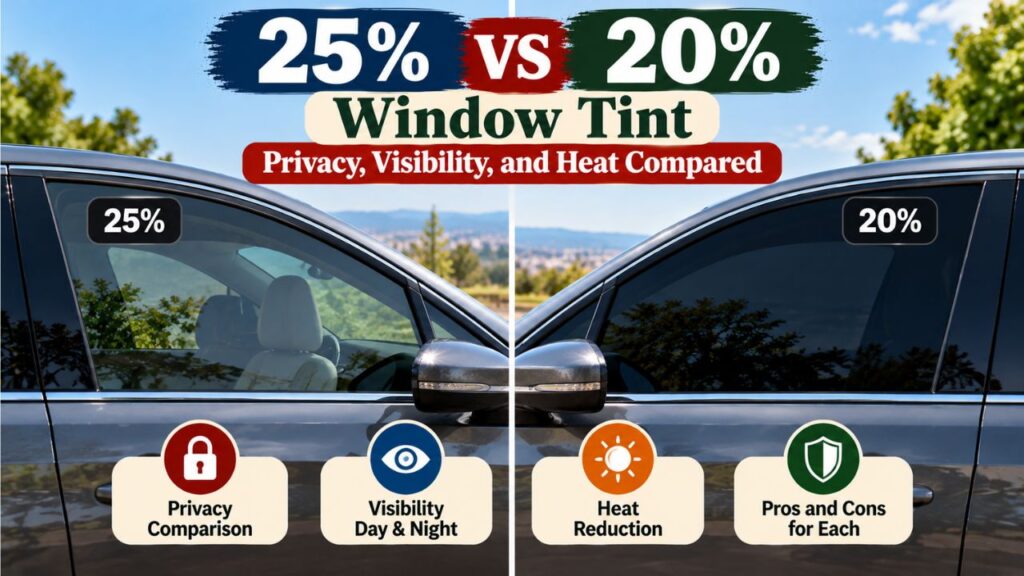
The main differences are visible light transmission, privacy, and visibility in low-light conditions.
| Feature | 25% Window Tint | 20% Window Tint |
| Visible light transmission | 25% | 20% |
| Approximate visible light blocked | 75% | 80% |
| Exterior appearance | Dark | Slightly darker |
| Daytime privacy | High | Higher |
| Nighttime visibility | Slightly better | More restricted |
| Daytime glare reduction | Strong | Slightly stronger |
| Heat rejection | Depends on film technology | Depends on film technology |
| UV protection | Depends on film specifications | Depends on film specifications |
| Price | Usually similar within the same series | Usually similar within the same series |
| Front-window legality | Depends on state and final VLT | Depends on state and final VLT |
These percentages describe nominal light transmission. The actual amount of light passing through an installed vehicle window also depends on the factory glass.
Key Takeaway: Choose 25% tint when slightly better visibility is the priority. Consider 20% when you prefer a darker appearance and more privacy, provided the finished installation is legal.
What Does 25% Window Tint Look Like?
A 25% window tint has a dark appearance while allowing a little more visible light through than 20% tint.
From outside the vehicle, the windows usually appear dark enough to reduce visibility into the cabin during daylight.
However, the interior isn’t completely hidden.
The actual appearance depends on sunlight, film color, window angle, and the brightness of the vehicle’s interior.
Appearance of 25 Tint During the Day
Under bright daylight, 25% tint typically creates a dark charcoal or black appearance when using a neutral-colored film.
Someone standing outside may still see silhouettes, movement, or interior details under favorable lighting.
Visibility into the cabin becomes easier when sunlight illuminates the interior.
A light-colored interior may also be more noticeable than a dark interior.
Visibility From Inside With 25 Tint
From inside the vehicle, 25% tint reduces sunlight and glare while allowing more visible light through than 20%.
During daytime driving, the difference may feel modest.
At night, however, the extra light can be helpful when checking mirrors, identifying pedestrians, or observing poorly illuminated areas.
That doesn’t make 25% tint suitable for every window or legal in every state.
It remains a dark shade that can reduce nighttime visibility.
What Does 20% Window Tint Look Like?
A 20% window tint is darker than 25% tint.
It allows only one-fifth of visible light through under its rated conditions.
This gives the windows a deeper, more private appearance.
Appearance of 20 Tint During the Day
From outside, 20% tint usually appears dark charcoal or nearly black.
It can make the vehicle’s interior more difficult to see during bright conditions.
However, 20% tint doesn’t provide complete privacy.
If the cabin is brightly lit or someone stands close to the glass, occupants and objects may still be visible.
Reflectivity and the difference between exterior and interior lighting also affect privacy.
Visibility From Inside With 20 Tint
During bright daylight, many drivers can see through 20% tint without noticing a dramatic difference compared with 25%.
The limitation becomes more important when available light decreases.
On poorly illuminated streets, in parking garages, or during rainy nights, 20% tint can make objects outside the window harder to distinguish.
This is particularly relevant for front side windows that drivers use to check cross traffic, mirrors, and nearby pedestrians.
Is There a Big Difference Between 25 and 20 Window Tint?
The difference is noticeable but not dramatic under every lighting condition.
Mathematically, 25% tint transmits five percentage points more visible light than 20%.
That also means 25% tint transmits 25% more visible light relative to a 20% tint rating.
Conversely, 20% tint transmits 20% less visible light than 25% tint.
Difference in Window Darkness
Both shades belong to the darker range of automotive window films.
When installed side by side using the same film series, 20% typically looks slightly darker.
The difference may be subtle when viewed from a distance.
Under bright sunlight, the two shades can appear quite similar.
Under certain lighting conditions, however, the difference becomes more obvious.
Difference in Outward Visibility
The additional light transmitted by 25% tint may help drivers distinguish objects in low-light conditions.
For example, consider checking a side mirror on a poorly lit road.
With 20% tint, the lower light transmission can make already dark surroundings more difficult to observe.
With 25%, slightly more light reaches the driver’s eyes.
Neither tint creates additional illumination, and both reduce visibility compared with lighter glass.
Does Film Color Affect the Comparison?
Yes.
A charcoal film and a bronze-colored film may appear different even when they have similar VLT ratings.
Reflectivity, haze, color neutrality, and glass characteristics also influence perceived darkness.
For an accurate comparison, evaluate 25% and 20% samples from the same manufacturer’s film series.
Comparing two unrelated products may exaggerate or hide the difference caused by VLT alone.
25 vs 20 Window Tint for Night Driving
25% tint is generally the better choice of these two shades for nighttime outward visibility.
Both reduce available light, but the 25% option allows more of it through.
The difference can matter when driving in conditions where visibility is already limited.
Night Driving With 25% Tint
A 25% film can make the outside environment appear darker than it would through untinted glass.
However, it allows more visible light through than a comparable 20% film.
That additional light can be useful when:
- Checking side mirrors
- Looking for pedestrians
- Entering dark intersections
- Reversing into parking spaces
- Driving in rural areas
- Traveling during rain or fog
Still, a 25% tint may be too dark for the front side windows under local regulations.
Night Driving With 20% Tint
A 20% film restricts more incoming visible light.
This can make low-contrast objects harder to identify.
For example, a pedestrian wearing dark clothing may be more difficult to see through a dark side window when the surrounding road has poor lighting.
The difference is especially relevant when the driver must look through the tinted glass rather than through the windshield.
Which Tint Is Better for Frequent Night Driving?
If you regularly drive at night, 25% is the better option between these two shades for visibility.
However, a lighter legal tint such as 35%, 50%, or another permitted percentage may be more appropriate for front side windows.
Safety Note: Don’t choose a dark front-window tint based only on its appearance during daylight. Consider nighttime visibility and verify the legal requirements before installation.
Which Offers More Privacy: 25 or 20 Window Tint?
20% tint generally offers greater daytime privacy because it allows less visible light through.
However, neither shade guarantees that people outside cannot see inside.
Daytime Privacy Comparison
A darker film reduces the amount of light passing through the glass.
During bright daylight, 20% tint can make the interior less visible than 25%.
This can be useful when the goal is reducing casual visibility into rear passenger areas.
However, someone standing close to the window may still be able to see occupants or objects.
Tint shouldn’t be treated as a security measure that makes valuables invisible.
Nighttime Privacy Comparison
Window tint privacy behaves differently at night.
If the interior is brighter than the surroundings, people outside may be able to see into the vehicle even through dark film.
Interior dome lights, phone screens, and other light sources can make occupants more visible.
The darker 20% shade may reduce some visibility, but it doesn’t create one-way privacy under all lighting conditions.
Is 25 Tint Private Enough?
For drivers who want a dark appearance without choosing the darker of these two options, 25% may provide sufficient privacy.
The difference between 20% and 25% is relatively small compared with the difference between either shade and clear glass.
If privacy is your priority, evaluate physical samples under realistic lighting conditions.
Does 20% Window Tint Block More Heat Than 25%?
Not necessarily.
Window tint darkness and solar heat rejection are different measurements.
A darker film reduces more visible light, but it doesn’t automatically reject substantially more heat.
Heat rejection depends on the film’s technology, layers, and ability to control solar radiation.
How Window Tint Controls Heat
Sunlight carries energy in different portions of the spectrum, including visible light, ultraviolet radiation, and infrared radiation.
Automotive window films reduce solar energy transmission through different mechanisms.
Basic dyed films primarily absorb light, while advanced ceramic and other solar-control films can provide stronger infrared rejection.
For example, 3M’s Ceramic IR 25 film specifications identify a nominal 25% VLT product designed for significant solar heat rejection. The manufacturer states that the Ceramic IR series can reject up to 66% of total solar energy and up to 95% of infrared radiation under specified testing conditions.
Those maximum figures describe the product series, not guaranteed performance for every tint shade.
Can 25% Ceramic Tint Reject More Heat Than 20% Dyed Tint?
Yes.
A quality 25% ceramic film can provide better heat rejection than a basic 20% dyed film despite appearing lighter.
This happens because ceramic film technology is designed to manage solar energy beyond simply reducing visible light.
The exact performance depends on the products being compared.
What Is Total Solar Energy Rejection?
Total Solar Energy Rejection (TSER) measures the percentage of total solar energy rejected by a glass-and-film system.
It provides a broader indication of heat-control performance than VLT alone.
When choosing between tint films, compare their TSER specifications under equivalent test conditions.
A 20% film with higher TSER may reject more heat than a 25% film with lower TSER, but this must be established through product data.
Does the 5% Darkness Difference Affect Heat?
When comparing two shades within the same film series, there may be a small difference in heat rejection.
However, the relationship isn’t necessarily proportional to the five-percentage-point VLT difference.
A film that’s 20% darker in relative light transmission terms doesn’t automatically provide 20% more heat rejection.
For hot-weather driving, film performance specifications are more useful than tint darkness alone.
25 vs 20 Window Tint for UV Protection
Both shades can provide substantial UV protection when manufactured using suitable UV-blocking materials.
However, the 20% shade doesn’t automatically block more UV radiation simply because it is darker.
Does 25% Tint Block UV Rays?
Many high-quality 25% films provide strong ultraviolet protection.
For example, 3M identifies up to 99.9% UV rejection across its Ceramic IR film series.
However, UV performance varies among manufacturers and products.
A 25% VLT rating alone doesn’t tell you how much UV radiation is blocked.
Does 20% Tint Block More UV?
Not necessarily.
A high-quality 20% film and a 25% film from the same series may have similar UV rejection performance.
The main difference between these shades is visible light transmission.
If UV protection is your primary goal, compare the actual ultraviolet rejection ratings rather than choosing the darker tint automatically.
Is 25% or 20% Window Tint Legal?
The legality of either shade depends on the state, vehicle classification, window location, and final visible light transmission.
Neither 25% nor 20% tint is automatically legal for all vehicle windows throughout the United States.
Many states require front side windows to transmit more light than either of these dark shades.
Front Side Window Tint Laws
Front side windows are generally subject to stricter visibility requirements than rear passenger windows.
Some states permit relatively dark tint, while others require much lighter glass.
The applicable rule may also depend on vehicle type and approved exemptions.
The International Window Film Association’s state-by-state tint law resource provides information about window tint regulations for passenger cars and multipurpose vehicles.
Always confirm the applicable requirements through current state law or the appropriate motor vehicle authority before installation.
Rear Side Window Tint Laws
Rear side windows may be allowed to have darker tint than front side windows.
However, the rules vary.
A 20% shade may be permitted on certain rear windows even when it isn’t legal on the front.
Don’t assume that factory privacy glass or a vehicle’s SUV classification automatically allows any aftermarket darkness.
Rear Windshield Tint Laws
Some states permit darker rear windshield tint when the vehicle has appropriate side mirrors.
Other states impose minimum light-transmission requirements.
Visibility while reversing is also important.
If you frequently back up in poorly lit areas, consider whether a darker rear window will make the task more difficult.
Windshield Tint Laws
Full-windshield tinting is subject to substantially different restrictions from rear window tinting.
Many states allow only a limited strip along the upper portion of the windshield, while certain transparent or medical-exemption films may be treated differently.
Neither 20% nor 25% tint should be assumed suitable for full-windshield installation.
Check both federal glazing requirements and applicable state regulations.
Does Factory Glass Make 25% or 20% Tint Darker?
Yes.
Vehicle glass usually blocks some visible light before aftermarket film is applied.
Installing film reduces the combined amount of light passing through the window.
The actual finished VLT can therefore be lower than the film’s standalone VLT rating.
Understanding Combined VLT
A simplified estimate is:
Final VLT ≈ Factory Glass VLT × Film VLT
Convert each percentage to a decimal when calculating.
For example, suppose the existing glass transmits 80% of visible light.
With a film rated at 25% VLT:
0.80 × 0.25 = 0.20
Estimated final VLT: 20%
With a film rated at 20% VLT:
0.80 × 0.20 = 0.16
Estimated final VLT: 16%
| Existing Glass VLT | Film VLT | Estimated Combined VLT |
| 80% | 25% | 20% |
| 80% | 20% | 16% |
| 75% | 25% | 18.75% |
| 75% | 20% | 15% |
These are simplified mathematical estimates for film ratings measured separately from the glass.
Actual measurements depend on the product, glass, optical characteristics, and test method.
Some manufacturers report VLT for a film applied to specified automotive glass rather than the film alone.
Always check the technical data sheet to understand what the advertised percentage represents.
Why Combined VLT Matters Legally
A state that requires a minimum of 25% light transmission may not permit a 25%-VLT film installed over glass that is already tinted.
The completed window could measure below the legal minimum.
Ask the installer to measure the factory glass and verify the finished result using an appropriate tint meter.
The number printed on the film box alone isn’t sufficient proof of legal compliance.
25 vs 20 Window Tint for Different Vehicle Types
The best tint percentage can depend on vehicle design and which windows you’re treating.
Sedans
For sedans, consider visibility through the front and rear side windows separately.
A 25% tint may be preferable for windows used frequently during nighttime driving, provided it meets legal requirements.
A 20% tint may offer greater privacy for rear passengers where permitted.
However, different shades can create a noticeable mismatch in appearance.
SUVs
Many SUVs already have darker factory privacy glass on the rear windows.
Adding another dark film can significantly reduce the combined VLT.
If you’re trying to match front windows to the rear, measure the existing glass rather than relying on visual comparison.
A film that appears close to the factory rear shade may still be too dark for legal use on the front side windows.
Pickup Trucks
Pickup trucks often have factory privacy glass behind the front seats.
Some drivers prefer a consistent dark appearance across the cab.
However, a dark front tint may make mirror checks and nighttime maneuvering more difficult.
For work trucks frequently used after dark, prioritize visibility and legal compliance over matching every window perfectly.
Vehicles Used for Frequent Night Driving
Drivers who regularly use poorly lit roads may benefit from lighter side-window film.
Between 25% and 20%, choose 25% for greater visible light transmission.
If visibility is a significant concern, consider a substantially lighter film rather than treating 25% as automatically safe enough.
Does 25% or 20% Window Tint Cost More?
Within the same film series, 25% and 20% tint usually have similar installation prices.
Most of the cost comes from the film type, vehicle size, and labor required.
Film Technology Matters More Than Shade
Installation prices differ among:
- Basic dyed tint
- Carbon tint
- Ceramic tint
- Premium multilayer solar-control films
A 20% ceramic tint may cost considerably more than a 25% basic dyed tint, but the price difference comes mainly from product technology and quality.
Vehicle Size and Installation Difficulty
Larger windows require more film.
Complex curved rear glass and additional quarter windows can increase installation time.
If old tint needs removal, that may add another charge.
When comparing 25% and 20%, request quotes for the same brand, film series, vehicle, and window coverage.
Does a Darker Film Last Longer?
No.
A darker VLT doesn’t automatically increase film lifespan.
Durability depends on the film construction, adhesive quality, installation, and environmental exposure.
A quality 25% film may last longer than a poorly manufactured 20% film.
Compare warranty terms and product specifications instead of assuming darkness determines durability.
Which Is Better: 25% Ceramic Tint or 20% Ceramic Tint?
If both shades come from the same ceramic film series, the main practical difference is the amount of visible light allowed through.
Choose 25% Ceramic Tint for Better Visibility
A 25% ceramic film offers a useful balance for drivers who want:
- A dark appearance
- Strong solar-control potential
- Slightly better outward visibility
- Less reduction in light than 20%
- A more moderate privacy tint
However, legal restrictions still apply.
Ceramic construction doesn’t make a dark VLT legal on a window where that darkness is prohibited.
Choose 20% Ceramic Tint for More Privacy
A 20% ceramic film may suit drivers who prefer:
- A darker exterior appearance
- Greater daytime privacy
- Reduced visible sunlight
- A closer match to some factory privacy glass
It may be appropriate for certain rear passenger windows where local regulations permit it.
However, its reduced nighttime visibility should be considered.
Which Ceramic Shade Rejects More Heat?
Compare the two products’ TSER ratings.
A 20% ceramic film may offer slightly more solar rejection than the 25% shade in some product lines.
However, the difference depends on the manufacturer’s formulation.
Don’t rely on the VLT percentage to predict the exact heat-rejection difference.
How to Choose Between 25 and 20 Window Tint
Rather than choosing by darkness alone, evaluate the way you use your vehicle.
Step 1: Check Your State’s Tint Laws
Verify the minimum legal VLT for each window.
Don’t purchase film until you understand the permitted darkness of the installed glass-and-film combination.
Step 2: Consider How Often You Drive at Night
Frequent nighttime driving favors better outward visibility.
Between the two shades, 25% transmits more visible light.
However, a lighter tint may be a more appropriate choice for windows needed for driving visibility.
Step 3: Decide How Much Privacy You Need
If you want a darker exterior appearance, 20% generally offers more privacy.
If a slightly lighter appearance is acceptable, 25% may be sufficient.
Remember that tint privacy changes with lighting conditions.
Step 4: Compare Heat Rejection Specifications
Look at TSER and relevant infrared rejection data.
If the goal is a cooler-feeling cabin, a quality ceramic film may be more useful than simply choosing a darker dyed film.
Step 5: View Physical Tint Samples
Ask the installer to demonstrate both shades.
Evaluate them from inside and outside the vehicle when possible.
Check how they appear under different lighting conditions.
A showroom display under bright lights may not accurately represent nighttime visibility.
Step 6: Verify the Final VLT
Have the installer measure the existing glass and confirm the expected finished transmission.
Where appropriate, measure the installed film after application and curing according to the relevant test procedure.
This is particularly important when the selected shade is near a legal threshold.
Common Mistakes When Comparing 25 and 20 Window Tint
Several misunderstandings can lead to choosing the wrong shade.
Assuming 20% Tint Blocks 5% More Heat
A five-percentage-point difference in visible light transmission doesn’t establish a five-percentage-point difference in heat rejection.
Compare the actual solar-control specifications.
Choosing Tint Based Only on Exterior Appearance
A film can look attractive from outside while making nighttime driving more difficult.
Evaluate outward visibility as well as appearance.
Ignoring the Original Glass Tint
The installed window can be darker than the film’s nominal rating.
Measure the glass before choosing a shade near the legal limit.
Assuming Ceramic Tint Is Always Legal
Ceramic refers to film technology, not legal darkness.
A 20% ceramic film remains subject to the same VLT requirements as another film with the same finished light transmission.
Assuming Dark Tint Provides Complete Privacy
People may still see through dark windows under favorable lighting conditions.
Tint isn’t a substitute for securing valuables or using appropriate vehicle security measures.
Conclusion
The 25 vs 20 window tint comparison comes down mainly to darkness, privacy, and visible light transmission.
A 25% tint provides slightly better outward visibility and is generally the more practical choice for drivers concerned about nighttime visibility. A 20% tint gives the windows a darker appearance and offers somewhat greater daytime privacy.
For heat rejection, the film’s construction matters more than the small difference in shade. A quality 25% ceramic film may outperform a basic 20% dyed film in solar heat control.
Neither shade is automatically legal for front side windows across the United States, and installed VLT may be lower than the film’s advertised percentage.
Between these two options, I recommend 25% tint when visibility matters more and 20% tint when privacy is the main priority—only where legally permitted. For frequent night driving or stricter front-window laws, a lighter film is the better choice.
FAQs About 25 vs 20 window tint
Is 25% Tint Much Lighter Than 20%?
No. The appearance difference is relatively modest because both are dark shades.
However, 25% tint transmits 25% more visible light relative to 20% tint, based on their nominal VLT ratings. The difference can become more noticeable during nighttime driving.
Can You See Through 20% Tint at Night?
Yes, some objects can still be seen through 20% tint at night, but visibility is significantly reduced compared with lighter glass.
Poor street lighting, rain, and dark surroundings can make the reduction more concerning. A lighter legal film is preferable when nighttime outward visibility is important.
Is 25% Window Tint Dark Enough for Privacy?
Yes. A 25% tint can provide substantial daytime privacy.
However, occupants and interior objects may still be visible depending on lighting conditions and the viewing angle.
It doesn’t make the cabin completely invisible from outside.
Does 20% Tint Look Black From Outside?
A neutral-colored 20% tint often appears very dark charcoal or nearly black from outside.
Its appearance depends on the film, glass, sunlight, and interior lighting.
It isn’t the same as 5% tint, which allows much less visible light through.
Is 25% Tint Legal on Front Windows?
It depends on the state, vehicle type, and measured VLT of the complete window.
Some states allow relatively dark tint, while others require substantially lighter front side windows.
A film labeled 25% may produce a finished window below 25% VLT, so always verify the applicable limit and installed measurement.
Is 20% Ceramic Tint Better Than 25% Regular Tint?
For heat rejection, a quality 20% ceramic film may perform better than a basic 25% dyed tint.
However, the 25% film allows more visible light through at comparable rated conditions.
The better choice depends on heat-control performance, nighttime visibility, product quality, and legal compliance.
Will 25% Tint Match Factory 20% Privacy Glass?
It may look reasonably close under some lighting conditions, but an exact match isn’t guaranteed.
Factory privacy glass and aftermarket window films can have different colors, reflectivity, and light-transmission characteristics.
Have the glass measured and compare actual samples before choosing a film intended to match the factory appearance.