AS-1 window tint refers to the shaded strip at the top of a vehicle’s windshield, commonly installed above a marking known as the AS-1 line. This marking identifies the boundary associated with the windshield’s designated clear viewing area. In many U.S. states, aftermarket windshield tint strips must stay above the AS-1 line or comply with another specific height restriction.
The AS-1 marking comes from automotive safety glazing standards, not from a particular window tint brand or shade percentage. It is associated with Federal Motor Vehicle Safety Standard (FMVSS) No. 205 and the ANSI/SAE Z26.1 safety glazing requirements.
Many drivers confuse AS-1 with tint darkness, assuming it means 1% visible light transmission. Others believe every windshield can legally have a dark strip extending exactly five inches from the top. Neither assumption is correct.
The actual permitted area depends on the windshield design, applicable state laws, and whether the vehicle has a factory shade band.
In this article, I explain what AS-1 means, how to find the marking on your windshield, where a legal tint strip may end, and how AS-1 differs from ordinary tint percentages. I also cover windshield tint laws, installation considerations, visibility risks, and common mistakes to avoid.
What Is AS 1 Window Tint and What Does It Mean?
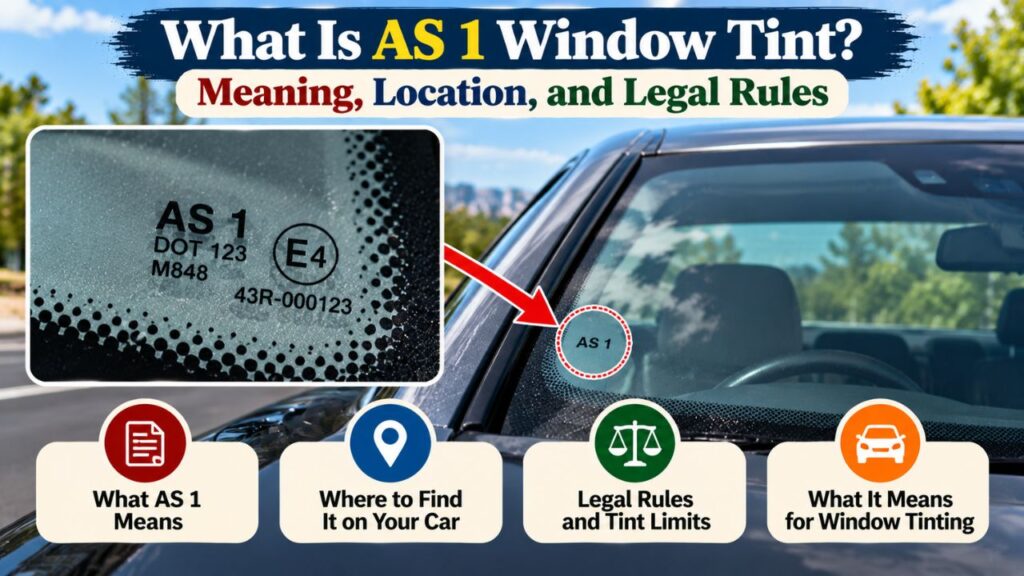
AS-1 is a safety glazing designation used on automotive glass, while the AS-1 line identifies a boundary associated with a windshield’s shaded area and clear viewing portion.
These related markings serve different purposes.
The AS-1 glass designation indicates that the glazing meets the applicable requirements for a category of automotive safety glass.
The AS-1 line is a specific marking associated with the boundary between a shaded area and the part of the windshield that meets the required light-transmission standard.
What Does AS-1 Stand For?
The letters AS are used in the American safety glazing classification system.
The number 1 identifies a particular category of safety glazing under ANSI/SAE Z26.1.
AS-1 glazing is suitable for automotive windshields when it meets the applicable requirements.
The designation is related to glass safety and optical performance.
It doesn’t mean the glass has a darkness level of 1%.
For example, a windshield marked AS-1 may still appear almost completely clear.
What Is the AS-1 Line on a Windshield?
The AS-1 line refers to a marking that helps identify the permitted boundary of a factory-designed windshield shade band.
It may appear near the upper left or upper right portion of the windshield.
The marking often includes:
- The letters AS.
- The number 1.
- A small arrow or other specified marking detail.
- A short line associated with the marking.
The arrow indicates the portion of the glass that meets the applicable light-transmission requirement.
The marking isn’t necessarily a continuous line extending across the entire windshield.
According to the National Highway Traffic Safety Administration’s official interpretation of windshield shade bands, the AS-1 marking identifies the relevant boundary when part of the windshield has less than 70% light transmission.
The agency also explains that the arrow identifies the portion meeting the required transmission standard.
Key Takeaway: AS-1 identifies a glazing classification or a shade-band boundary. It is not a tint darkness percentage.
Where Is the AS-1 Line Located on a Windshield?
The AS-1 line is generally associated with the upper portion of the windshield.
However, its exact location varies depending on the vehicle and glass manufacturer.
Check the Upper Windshield Corners
Begin by inspecting the upper left and upper right edges of the windshield.
Look carefully at the glass near the factory shading.
The marking may be small and difficult to notice.
On some vehicles, the mark is positioned near the windshield’s outer edge rather than in the center.
It may be more visible from outside the vehicle.
A flashlight can help reveal small etched markings.
Avoid confusing the AS-1 line with unrelated manufacturing symbols.
Look Near the Factory Shade Band
Some vehicles have a factory-installed shade band at the top of the windshield.
This is often a blue, gray, or green-tinted area that gradually becomes clearer toward the bottom.
The AS-1 marking may identify the relevant lower boundary of that shaded area.
However, the visible color transition isn’t always an accurate guide to the legal boundary.
Use the actual marking and applicable rules instead of estimating the location from the color gradient.
Check Both Sides of the Glass
If the marking isn’t immediately visible, inspect both upper corners.
Different windshield manufacturers may position their markings differently.
Small etched characters can be difficult to recognize against dark trim or a shaded background.
Don’t scratch the glass or remove windshield components to search for the marking.
If you still can’t locate it, consult a qualified automotive glass technician.
What if Your Windshield Has No AS-1 Line?
Not every windshield has a separately identifiable AS-1 shade-band line.
Some windshields have no factory shade band requiring that specific boundary marking.
Others may have markings that aren’t immediately recognizable to a vehicle owner.
The absence of an AS-1 line doesn’t automatically mean you can install a five-inch dark tint strip.
Certain states provide a fixed-height allowance when the marking is absent, while others apply different requirements.
Check the applicable law before deciding how far a tint strip may extend.
AS-1 Line vs. AS-1 Glass Marking: What’s the Difference?
An AS-1 glass marking and an AS-1 shade-band line are related but aren’t interchangeable.
This distinction is important when preparing to tint a windshield.
| Feature | AS-1 glass marking | AS-1 shade-band line |
| Main purpose | Identifies a safety glazing category | Identifies a shade-band boundary |
| Typical location | Often near a lower corner or edge of the glass | Usually associated with the upper windshield |
| Indicates tint percentage | No | No |
| Indicates glass standard | Yes | Associated with the glazing standard |
| Determines aftermarket tint allowance | Not by itself | May be used by state tint laws |
| Found on every windshield | Depends on the glass and applicable marking requirements | Not necessarily present as a separate mark |
Why the AS-1 Glass Stamp Matters
Automotive glass manufacturers use standardized markings to identify the glass and its compliance category.
These may include:
- Manufacturer name or trademark.
- DOT identification information.
- AS-1 designation.
- Additional product or manufacturing codes.
Maryland’s official vehicle glazing regulations distinguish these markings and explain that AS-1 glass is suitable for windshield use.
The Maryland vehicle glazing inspection regulations also distinguish AS-1 from other categories, including AS-2 glass, which generally isn’t suitable for ordinary windshields.
An AS-1 stamp near the lower windshield corner doesn’t establish that dark tint may extend down to that location.
Why the AS-1 Shade-Band Mark Matters
The shade-band marking helps identify the boundary associated with a windshield’s shaded upper area.
Some state laws refer directly to this line when regulating aftermarket windshield tint.
For that reason, finding the correct marking is important.
If the windshield only has a general AS-1 glass designation, don’t treat it as a shade-band boundary.
A professional installer should verify the permitted installation area before applying film.
How Far Down Can an AS-1 Window Tint Strip Go?
There is no single distance that applies to every vehicle in every U.S. state.
The legal limit may depend on the AS-1 line, a specified distance from the top of the windshield, or another state-defined viewing-area requirement.
Understanding the Upper Windshield Tint Area
A windshield tint strip is installed across the upper portion of the glass.
Its main purpose is to reduce glare from overhead sunlight.
Depending on the applicable law, the strip may need to remain entirely above the AS-1 line.
Other states may use a fixed-distance limit or additional restrictions.
The bottom edge of the film must not extend farther than permitted.
Is the AS-1 Line Always Five Inches From the Top?
No.
The AS-1 line isn’t universally positioned exactly five inches below the windshield’s upper edge.
Its location depends on the windshield design.
The distance can vary between vehicles.
For example, a compact car and a large pickup truck may have different windshield heights, shapes, and factory shading arrangements.
A five-inch measurement on one vehicle may not correspond to the AS-1 line on another.
Never assume that a tint strip becomes legal merely because it measures five inches tall.
Can Windshield Tint Go Below the AS-1 Line?
A dark aftermarket strip extending below the permitted boundary may violate applicable tint laws.
For ordinary vehicles, many jurisdictions restrict darker windshield tint to the uppermost portion.
Some laws also provide separate rules for clear, high-transmission films or authorized medical exemptions.
However, those exceptions aren’t universal.
Check the current law for the state where the vehicle will be operated.
Is AS-1 Window Tint Legal in the United States?
AS-1 windshield tint strips may be legal when their placement, darkness, and other characteristics comply with the applicable state regulations.
However, the AS-1 designation itself doesn’t guarantee legality.
Federal glazing standards and state window tint laws address related but different requirements.
Federal Windshield Glazing Requirements
Federal Motor Vehicle Safety Standard No. 205 establishes requirements for automotive glazing materials.
The standard incorporates ANSI/SAE Z26.1, which includes optical performance and light-transmission requirements.
Areas of windshield glazing required for driving visibility generally must transmit at least 70% of visible light under the applicable glazing standard.
Permitted factory shade-band areas can have different optical characteristics.
NHTSA’s interpretation explains that the federal glazing rules recognize shaded upper windshield areas that meet the standard’s applicable design requirements.
However, that doesn’t mean every aftermarket tint installation is legal in every state.
State Window Tint Laws
States regulate vehicle operation with tinted windows.
Their rules may specify:
- Maximum windshield tint strip height.
- Whether the AS-1 line defines the allowable boundary.
- Minimum visible light transmission.
- Reflectivity restrictions.
- Prohibited film colors.
- Medical exemptions.
- Vehicle classification requirements.
These restrictions can change over time.
A tint strip allowed in one state might not comply with the requirements of another.
Florida AS-1 Windshield Tint Rules
Florida provides an example of how a state incorporates federal glazing concepts.
Under Florida Statutes Section 316.2952, transparent sunscreening material may be placed along a strip at the top of the windshield if it doesn’t encroach upon the driver’s direct forward viewing area as defined by the referenced federal glazing standard.
This isn’t a blanket authorization to apply dark film across the entire windshield.
The specific installation must comply with the statute and applicable standards.
What About Other States?
Some states use the AS-1 line as a placement boundary.
Others specify an upper strip measurement, sometimes with an alternative when no AS-1 line is present.
A few jurisdictions apply additional restrictions concerning the windshield’s shaded area or the type of film permitted.
The practical approach is to verify the current state statute or official motor vehicle agency guidance.
Avoid relying exclusively on a general tint-law chart that may not reflect recent changes.
Is AS-1 Tint the Same as a Windshield Sun Strip?
The terms are closely related, but they aren’t technically identical.
A windshield sun strip is the tinted band installed across the top of the windshield.
The AS-1 line is a marking used to identify a boundary associated with the windshield’s approved shade-band area.
People often use the phrase AS-1 tint to describe a windshield sun strip installed within the permitted upper area.
What Does a Windshield Sun Strip Do?
A windshield sun strip reduces direct sunlight entering through the upper part of the glass.
It can be useful when the sun is relatively high in the sky.
Potential benefits include:
- Reduced overhead glare.
- Improved comfort in bright sunlight.
- Less direct sunlight reaching the driver’s eyes.
- Some reduction in solar energy entering through the treated area.
- A darker visual appearance along the windshield top.
However, a narrow strip doesn’t provide the same coverage as full-windshield film.
Its effect on overall cabin temperature is therefore limited by its smaller coverage area.
Does AS-1 Tint Replace a Sun Visor?
No.
A sun strip can provide supplemental glare reduction, but it doesn’t replace the vehicle’s sun visor.
The visor can be adjusted to help block sunlight from different directions.
The tint strip remains in a fixed position.
Both can be useful, but neither should obscure the driver’s necessary forward view.
What Tint Percentage Can You Use Above the AS-1 Line?
The AS-1 line doesn’t specify a universal film darkness.
The allowable visible light transmission depends on the applicable laws and the windshield’s approved shade-band area.
Some jurisdictions regulate placement more directly, while others impose additional restrictions on film darkness or appearance.
Understanding Visible Light Transmission
Visible Light Transmission (VLT) measures how much visible light passes through a film or glazing system.
A higher percentage indicates a lighter tint.
| Film VLT | General appearance | Typical consideration |
| 70% | Very light | Preserves substantial visibility |
| 50% | Light tint | Moderate glare reduction |
| 35% | Moderately dark | Noticeable shading |
| 20% | Dark | Strong reduction in visible light |
| 5% | Extremely dark | Severe visibility reduction through the treated area |
These are film darkness values, not AS-1 classifications.
A windshield marked AS-1 doesn’t automatically have 70% VLT throughout every portion.
The factory shade band may transmit less light than the primary viewing area.
Can You Use 5% Tint Above the AS-1 Line?
A 5% film is extremely dark.
Whether it can legally be used as an upper windshield strip depends on the jurisdiction and placement requirements.
Even when a very dark shade is permitted in a designated upper area, it shouldn’t obstruct traffic signals, pedestrians, overhead signs, or other information the driver needs.
Don’t assume the AS-1 line grants unrestricted permission for 5% tint.
Is 20% or 35% Tint Better for a Windshield Strip?
A 35% film allows more visible light through than a 20% film.
That can improve visibility through the tinted area.
However, the best choice isn’t determined by darkness alone.
Consider:
- Applicable state requirements.
- Windshield geometry.
- Driver seating position.
- Glare conditions.
- Film reflectivity.
- Visibility of overhead traffic signals and signs.
The tint strip should remain within the legally permitted area regardless of the selected shade.
How to Find the AS-1 Line Before Tinting Your Windshield
Finding the correct marking can prevent an installation mistake.
Use the following inspection process before ordering a pre-cut tint strip or trimming film.
Step 1: Clean the Upper Windshield
Begin with clean glass.
Remove dust and residue from the upper corners using an appropriate automotive glass cleaner.
Avoid aggressive scraping near windshield coatings, camera housings, or other delicate components.
Clean glass makes small markings easier to identify.
Step 2: Inspect the Upper Corners
Look near the windshield’s upper edges.
Search for a small marking containing AS-1 or a similar specified arrangement with an arrow.
The symbol may be etched or otherwise permanently applied to the glass.
Check from both inside and outside the vehicle.
Use a flashlight if necessary.
Step 3: Identify the Correct Marking
Make sure you have found the shade-band boundary marking rather than an ordinary glass certification stamp.
An AS-1 label near the bottom corner commonly identifies the glass category.
It shouldn’t be used as the lower edge of a windshield tint strip.
If the markings are unclear, consult a qualified automotive glass professional.
Step 4: Check the Applicable Legal Boundary
After identifying the windshield marking, verify the state’s current tint placement rule.
Some states use the AS-1 line directly.
Others apply different height limits or additional conditions.
Use the stricter applicable boundary when required by law.
Don’t rely on measurements taken from another vehicle.
Step 5: Confirm the Tint Strip Design
Before installation, check whether the proposed film:
- Remains within the legal upper area.
- Avoids the driver’s required forward viewing zone.
- Interferes with windshield-mounted cameras or sensors.
- Covers prohibited glass markings or equipment.
- Meets applicable reflectivity requirements.
- Is compatible with the windshield construction.
If any point is uncertain, have the installation reviewed by an experienced tint professional.
Can You Install AS-1 Windshield Tint Yourself?
A windshield sun strip can be simpler to install than full-windshield film, but the process still requires accurate preparation and cutting.
The most important issue is ensuring the proposed placement and film comply with the vehicle’s legal and safety requirements.
Tools Needed for a Windshield Tint Strip
A basic installation may require:
- Automotive window tint film.
- Approved film application solution.
- Clean spray bottle.
- Soft squeegee.
- Hard card with suitable edge protection.
- Low-lint cleaning cloths.
- Measuring tape.
- Suitable cutting tools.
- A vehicle-specific pre-cut strip, if available.
Some film products and curved glass designs may require additional installation tools.
Follow the manufacturer’s instructions for the selected film.
Basic Installation Process
For a conventional wet-applied automotive sun strip, the general process involves:
- Confirming the permitted installation area.
- Cleaning the upper windshield thoroughly.
- Measuring and preparing the film.
- Checking the film’s orientation and fit.
- Applying the approved installation solution.
- Positioning the film within the permitted upper area.
- Removing trapped liquid with a suitable squeegee.
- Inspecting the edges and finished appearance.
- Allowing the adhesive to cure according to the manufacturer’s instructions.
Keep excess application liquid away from electrical equipment, camera housings, and sensitive interior components.
Avoid cutting directly against vulnerable windshield surfaces.
A professional installation may be preferable when the windshield contains advanced driver-assistance sensors or when the boundary is difficult to identify.
AS-1 Tint vs. Full Windshield Tint
AS-1 tint strips and full-windshield tint cover different portions of the glass.
They also have different legal and functional considerations.
| Feature | AS-1 windshield tint strip | Full windshield tint |
| Coverage | Upper portion of windshield | Most or all of windshield |
| Main purpose | Reduce overhead glare | Broader solar and UV control |
| Visibility effect | Primarily upper viewing area | Affects the entire treated area |
| Legal requirements | Placement and other state restrictions | Usually stricter light-transmission requirements |
| Film darkness | Depends on state law | Typically requires high transmission where permitted |
| Installation difficulty | Often simpler | Generally more complex |
| Potential sensor concerns | Depends on placement | Greater coverage requires careful compatibility checks |
Does Full Windshield Tint Need to Be 70%?
Federal glazing standards generally require at least 70% visible light transmission in the areas necessary for driving visibility.
However, the legality of aftermarket windshield film is more complicated than selecting a package labeled 70%.
The original glass already absorbs or reflects some light.
Adding film reduces the combined transmission.
For example:
Combined VLT = Glass VLT × Film VLT
If the original glass transmits 80% of visible light and the film transmits 90%, the approximate combined transmission is:
0.80 × 0.90 = 0.72
That equals 72% VLT.
This simplified calculation illustrates why the finished window must be considered.
Actual light transmission should be verified using suitable measurement equipment where necessary.
A 70% film applied over glass transmitting 80% of visible light would produce an approximate combined VLT of 56%, not 70%.
Applicable state law and other requirements may prohibit that result.
Does AS-1 Tint Block More Heat?
Not necessarily.
A windshield strip covers only a portion of the glass.
Its contribution to cabin heat control depends on the strip’s area, film technology, solar exposure, and vehicle conditions.
A high-performance light film applied over a larger legally permitted area may provide greater overall solar control than a narrow dark strip.
However, this doesn’t justify using full-windshield film that violates applicable laws or interferes with visibility.
For an AS-1 strip, glare control is usually the main consideration.
What Happens if Windshield Tint Goes Below the AS-1 Line?
Installing dark tint below the permitted windshield boundary may create legal and safety problems.
Possible Traffic Violations
If the film exceeds the applicable legal limit, the vehicle may be subject to enforcement or inspection consequences.
Depending on the jurisdiction, consequences may include a citation, required removal, or failure to meet inspection requirements.
Exact penalties vary.
A windshield tint strip sold as “universal” isn’t automatically legal for every vehicle.
Reduced Forward Visibility
Dark film extending into the primary viewing area can reduce the driver’s ability to see important details.
Potential concerns include:
- Pedestrians crossing near intersections.
- Cyclists.
- Overhead traffic signals.
- Road signs.
- Vehicles in low-light conditions.
- Hazards during rain or nighttime driving.
A tint strip that blocks necessary information isn’t a good installation, even if it appears visually attractive.
Vehicle Inspection Problems
Some vehicle inspection programs evaluate windshield tint placement and visibility.
A strip extending beyond the permitted area may need to be removed or replaced.
Check state inspection standards before installing dark windshield film.
Correct placement from the beginning is generally easier than removing an incorrectly installed strip.
Common AS-1 Window Tint Mistakes to Avoid
Confusing AS-1 With 1% Tint
AS-1 is a safety glazing designation, not a VLT percentage.
A 1% tint would be extremely dark and has no direct relationship to the AS-1 classification.
Assuming Every State Allows Five Inches
Some states use a fixed upper strip limit, but that isn’t a universal U.S. rule.
Other jurisdictions refer to the AS-1 line or use different criteria.
Check the specific law before cutting the film.
Using the Wrong AS-1 Mark
An ordinary AS-1 glass certification stamp may appear near a lower corner.
It doesn’t identify how far down dark windshield tint may extend.
Find the proper shade-band boundary marking when applicable.
Extending Film Below the Legal Boundary
Even a small amount of film below the permitted area can create compliance problems.
Use accurate measurements and confirm the lower edge before installation.
Choosing Tint Only by Darkness
A darker strip isn’t necessarily better.
Extremely dark film can interfere with visibility through the upper windshield area.
Choose a shade that balances glare control with driving safety and legal requirements.
Ignoring Cameras and Sensors
Modern vehicles may have cameras, rain sensors, or other equipment near the rearview mirror.
Film placement, reflectivity, and compatibility can affect some systems.
Follow the vehicle manufacturer’s restrictions and avoid covering required optical areas.
Is an AS-1 Windshield Tint Strip Worth Installing?
A properly positioned windshield tint strip can be useful for drivers who frequently encounter strong overhead sunlight.
It may improve comfort without covering the main windshield viewing area.
However, its benefits depend on the driving environment and selected film.
When an AS-1 Tint Strip May Be Helpful
A legal upper strip may be useful for:
- Daytime commuting in sunny climates.
- Reducing overhead glare.
- Providing supplemental sunlight control.
- Creating a uniform tinted appearance.
- Drivers who prefer a fixed sunshade in addition to factory visors.
The strip should complement normal visibility and sun-control equipment rather than obstructing the road.
When You Might Not Need One
An additional strip may provide limited benefit when:
- The windshield already has an effective factory shade band.
- Your driving conditions involve little overhead sunlight.
- The strip would interfere with required visibility.
- Vehicle sensors restrict film placement.
- Applicable law doesn’t permit the intended installation.
For some vehicles, the factory sun visor and existing windshield shading may be sufficient.
Conclusion
Understanding what is AS 1 window tint begins with recognizing that AS-1 is part of the automotive safety glazing system, not a window tint darkness percentage.
The AS-1 line is associated with the boundary of a windshield’s shaded upper area. Some U.S. states use this marking to determine how far an aftermarket windshield tint strip may extend.
However, an AS-1 glass certification stamp and the AS-1 shade-band boundary are different markings.
The correct installation area depends on the windshield design, applicable state laws, and the type of film being installed.
Before adding a sun strip, identify the relevant marking, verify legal placement, and choose a tint that doesn’t obstruct necessary visibility.
I recommend using an experienced installer if the marking is unclear or the vehicle has windshield-mounted cameras and other sensitive equipment.
A properly selected AS-1 windshield tint strip can reduce overhead glare while preserving the clear viewing area needed for safe driving.
FAQs About What Is AS 1 Window Tint
What Does AS-1 Mean on a Car Windshield?
AS-1 identifies a category of automotive safety glazing under the ANSI/SAE Z26.1 standard.
It indicates that the glass is suitable for applications including windshields when it meets the applicable requirements.
It does not indicate a tint darkness percentage.
Is the AS-1 Line Always Five Inches From the Top?
No. The AS-1 line’s location depends on the windshield design.
Some states use a five-inch limit in certain situations, but other states use the AS-1 line or different requirements. The two measurements aren’t automatically identical.
Can You Tint a Windshield Below the AS-1 Line?
Dark aftermarket windshield tint below the permitted upper boundary may violate state law.
Some jurisdictions permit certain clear or high-transmission films under specific conditions. Check the current legal requirements for the vehicle and state before installation.
What if My Windshield Doesn’t Have an AS-1 Line?
A windshield may lack a separate shade-band marking.
Some state laws specify an alternative upper tint limit when no AS-1 line is present, while others use different requirements.
Don’t assume the absence of a marking automatically permits a dark five-inch strip.
Is AS-1 Tint the Same as 5% Tint?
No. AS-1 is associated with safety glazing and windshield shade-band boundaries.
A 5% tint is a film that transmits approximately 5% of visible light.
They describe entirely different characteristics.
Can You Install Ceramic Tint Above the AS-1 Line?
Yes, a ceramic windshield strip may be installed when the film and its placement comply with the applicable laws and vehicle requirements.
Ceramic technology doesn’t create an exemption from tint restrictions.
The strip must remain within the permitted area and preserve safe visibility.
Does the AS-1 Line Apply to Rear and Side Windows?
The AS-1 shade-band line is primarily relevant to the windshield’s upper shaded area.
Side and rear windows have their own glazing classifications and state tint restrictions.
An AS-1 marking on safety glass doesn’t establish the allowable darkness for every vehicle window.