A good window tint is a high-quality automotive film that reduces solar heat, blocks UV radiation, controls glare, and provides privacy without compromising safe driving visibility. For many drivers, ceramic window tint is an excellent choice because it can reject substantial solar heat without requiring extremely dark windows. Quality carbon and color-stable dyed films can also be good options, particularly for drivers with smaller budgets.
Choosing window tint involves more than selecting a darkness percentage. A film that looks attractive may offer limited heat rejection, while a nearly clear premium film can provide effective solar protection.
The ideal tint also depends on where it will be installed. Front side windows need suitable visibility for nighttime driving, while rear passenger windows may allow more flexibility in darkness. State laws can also limit which shades are permitted.
Film quality, installation, and warranty coverage all affect long-term performance.
In this article, I explain what makes a good window tint, compare ceramic, carbon, dyed, and metallic films, and examine the best tint percentages for different driving needs. I also cover heat rejection, UV protection, legal limits, installation quality, costs, and how to choose a film that provides lasting value.
What Is a Good Window Tint for Most Cars?
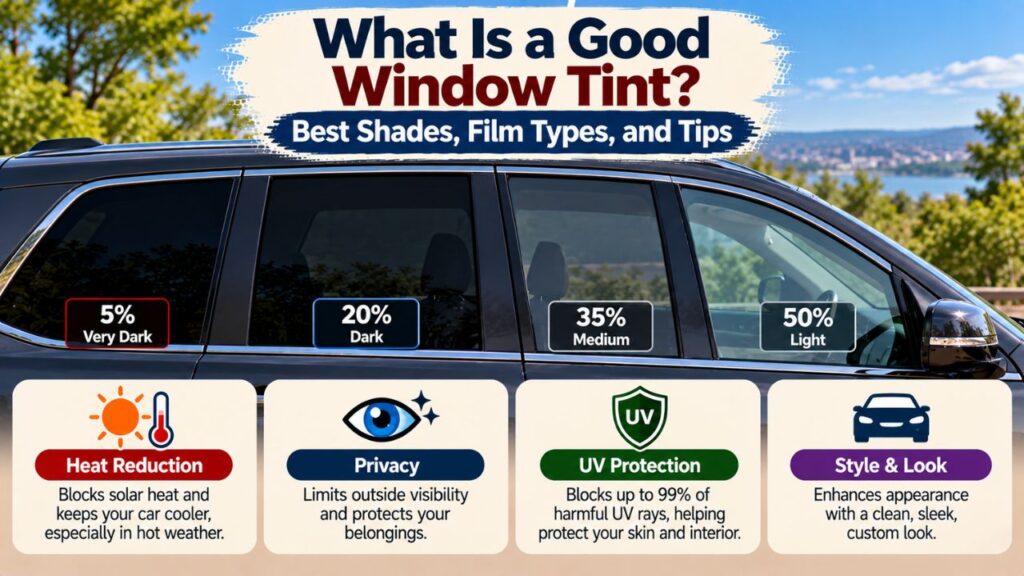
For most everyday drivers, a good window tint combines legal visible light transmission, effective UV protection, useful solar heat rejection, clear outward visibility, and durable construction.
There is no single tint percentage or film technology that works best for every vehicle.
The right choice depends on the climate, driving habits, privacy preferences, and applicable regulations.
For example, someone driving daily in a hot, sunny region may benefit more from ceramic film than someone who primarily wants a darker appearance.
Likewise, a driver who frequently travels on unlit roads should prioritize visibility rather than choosing the darkest available shade.
Best Overall Window Tint for Daily Driving
A reputable ceramic film with a legally compliant visible light transmission level is a strong all-around option.
It can provide:
- Effective solar heat rejection
- Strong UV protection
- Reduced daytime glare
- Good optical clarity
- Multiple darkness options
- Durable color performance
- Low risk of electronic signal interference in nonmetallic designs
However, ceramic film is usually more expensive than basic alternatives.
A quality color-stable dyed or carbon film may be sufficient when heat control is less important.
Best Window Tint for Hot Weather
In hot climates, prioritize Total Solar Energy Rejection (TSER) rather than choosing film based only on darkness.
Higher TSER generally means less total solar energy enters through the tested glass-and-film combination.
Modern ceramic and other advanced solar-control films often perform well in this area.
For example, the 3M Ceramic IR Series offers up to 66% total solar energy rejection and up to 99.9% UV rejection across its product range, according to the manufacturer’s published specifications.
These are maximum values for the series, not performance figures for every available shade.
A lighter film with strong TSER may provide greater heat control than a much darker basic dyed film.
Best Window Tint for Privacy
Privacy depends primarily on visible light transmission and surrounding lighting conditions.
A darker tint generally makes the interior less visible during daylight.
However, privacy comes with a tradeoff: darker windows also reduce the driver’s ability to see outside in low-light conditions.
For front side windows, visibility and legal compliance should take priority.
Darker rear-window shades may be appropriate where local regulations permit them.
Key Takeaway: A good tint is not necessarily the darkest or most expensive film. It is one that meets your needs while maintaining suitable visibility and legal compliance.
What Window Tint Percentage Is Good?
A tint percentage describes how much visible light passes through the glass or film.
This measurement is called Visible Light Transmission (VLT).
Higher percentages indicate lighter tint.
Lower percentages indicate darker tint.
Common Window Tint Percentages Compared
| Tint percentage | General appearance | Main advantages | Considerations |
| 70% | Very light, nearly clear | Maintains high visibility; suitable for discreet solar protection | Limited privacy |
| 50% | Light tint | Balanced appearance, glare reduction, and visibility | May not satisfy every front-window law after installation |
| 35% | Moderately dark | Noticeable privacy and darker styling | Can reduce night visibility; illegal on some front windows |
| 30% | Dark | Stronger shading and privacy | Greater visibility reduction |
| 20% | Very dark | Substantial daytime privacy | Poorer low-light visibility |
| 15% | Very dark | Strong dark-window appearance | Significant visibility limitations |
| 5% | Extremely dark | Maximum darkness among these examples | Severe nighttime visibility limitations and frequent legal restrictions |
These percentages describe nominal tint darkness. The actual appearance and final light transmission depend on the film and existing automotive glass.
Is 70% Window Tint Good?
70% tint is a good option for drivers who want minimal change in appearance while maintaining relatively high visible light transmission.
It can be particularly useful when choosing a high-performance film for solar protection.
A quality light ceramic film may reject meaningful amounts of heat and UV radiation while leaving the glass close to its original appearance.
However, even a light aftermarket film can reduce the combined VLT of the window below a legal threshold.
Always check the finished glass-and-film measurement.
Is 50% Window Tint Good?
50% tint offers a useful middle ground for drivers who prefer a light appearance.
It reduces incoming visible light without creating the much darker appearance of 20% or 15% tint.
Potential benefits include:
- Relatively good outward visibility
- Moderate glare reduction
- Subtle styling
- Less nighttime light reduction than darker shades
- Good solar performance when paired with suitable film technology
However, a 50% film may still be too dark for front side windows in states requiring higher installed VLT.
It should not be treated as universally legal.
Is 35% Window Tint Good?
35% tint is a reasonable cosmetic choice for drivers who want visibly darker windows.
It provides more daytime privacy than 50% tint.
However, it also reduces light transmission more substantially.
This matters when checking pedestrians, cyclists, and traffic through side windows at night.
For daily driving, 35% may be suitable on windows where permitted and where the visibility reduction is acceptable.
It is not the safest default for every driver.
Is 20% Window Tint Good?
20% tint creates a dark appearance and offers substantial daytime privacy.
It may be attractive for rear passenger windows, depending on local laws.
However, it can make nighttime visibility noticeably more difficult.
Drivers may struggle to see through the glass in poorly lit parking areas or when reversing.
For front side windows, a lighter shade is generally preferable unless the driver has confirmed that the darker film is legal and suitable for the intended use.
Is 5% Window Tint Too Dark?
5% tint allows only a small portion of visible light through the glass.
It is commonly associated with an extremely dark appearance.
Although it offers substantial daytime privacy, it can severely restrict visibility at night.
It may be inappropriate for windows used to check surrounding traffic or maneuver the vehicle.
The legal restrictions are also significant in many jurisdictions.
For normal daily driving, especially on front windows, I would prioritize a lighter shade.
Which Type of Window Tint Is Best?
Different film technologies provide different combinations of appearance, heat rejection, longevity, and cost.
The main categories include dyed, carbon, ceramic, and metallized films.
Some manufacturers also combine technologies in hybrid or multilayer products.
Comparison of Window Tint Types
| Film type | Typical heat performance | Appearance | General cost level | Best suited for |
| Basic dyed | Usually modest | Dark, nonreflective | Lower | Affordable styling |
| Color-stable dyed | Varies by formulation | Neutral, fade-resistant | Low to moderate | Appearance and value |
| Carbon-based | Varies by product | Often neutral or matte | Moderate | Balanced appearance and performance |
| Ceramic | Usually strong in premium products | Neutral, low-reflective options | Higher | Solar heat reduction |
| Metallized | Can provide effective solar control | May be more reflective | Moderate | Heat control where reflectivity and compatibility are acceptable |
| Hybrid or multilayer | Highly product-dependent | Various finishes | Moderate to premium | Specialized combinations of benefits |
These are broad categories, not universal performance rankings. The actual product data sheet is more reliable than a technology label.
Ceramic Window Tint
Ceramic films use specialized particles or coatings to manage solar energy.
Their main advantage is the potential to reject more infrared heat while maintaining a selected visible light transmission level.
Quality ceramic products may provide strong UV rejection and good optical clarity.
Many nonmetallic ceramic films also avoid the electronic interference concerns associated with certain metallized products.
Ceramic tint is a particularly attractive choice for drivers who spend substantial time in direct sunlight.
Its main disadvantage is the higher purchase and installation cost.
Carbon Window Tint
Carbon-based films are commonly marketed as an upgrade from basic dyed tint.
They can offer an attractive neutral appearance and useful solar-control performance.
However, carbon tint is not one standardized technology with identical specifications across brands.
Some products marketed as carbon use additional dyes, coatings, or other materials.
Performance can vary considerably.
When comparing carbon films, check their documented TSER, VLT, UV rejection, warranty, and color-stability information.
Do not assume every carbon film performs better than every dyed film.
Dyed Window Tint
Dyed tint is commonly chosen for affordability.
Its primary benefits are reducing visible light, creating a darker appearance, and improving daytime privacy.
Quality dyed films can also provide strong UV protection.
However, basic dyed products generally offer less advanced infrared heat control than premium ceramic films.
Low-quality dyed tint may fade or discolor over time.
A reputable color-stable dyed film can be a better investment than the least expensive option.
Metallized Window Tint
Metallized film uses thin metallic layers to reflect or control portions of incoming solar energy.
It can provide useful heat rejection and distinctive reflective appearances.
However, some metallized films may interfere with certain radio-frequency signals or vehicle electronics.
The actual risk depends on the film construction and equipment involved.
Reflectivity can also be restricted by state tint regulations.
Check product compatibility and legal requirements before choosing a metallic film.
Hybrid Window Tint
Hybrid films combine materials or technologies to achieve specific performance characteristics.
For example, a manufacturer may combine dyes, ceramics, or multiple optical layers.
A hybrid product may offer useful heat rejection and color stability without using a conventional single-layer film construction.
However, the term hybrid does not guarantee a specific level of performance.
Compare measurable specifications rather than relying on the category name.
Key Takeaway: For strong heat rejection, premium ceramic film is an excellent starting point. For lower cost, evaluate quality color-stable dyed or carbon films using their actual specifications.
How to Tell Whether a Window Tint Is Good Quality
A good window tint should have documented performance ratings.
The most useful measurements are VLT, TSER, ultraviolet rejection, infrared performance, and optical properties.
Visible Light Transmission (VLT)
VLT measures the percentage of visible light transmitted through the film or glazing system.
It determines much of the window’s perceived darkness.
For example:
- 70% VLT is relatively light.
- 50% VLT provides moderate shading.
- 35% VLT is noticeably darker.
- 20% VLT creates a very dark appearance.
However, VLT does not measure total heat rejection.
A darker film is not automatically a better solar-control product.
Total Solar Energy Rejection (TSER)
TSER measures the percentage of incoming total solar energy rejected by the tested glass-and-film combination.
This includes energy across different portions of the solar spectrum.
The International Window Film Association’s guidance on window film benefits identifies stronger TSER as an important indicator of better heat-control performance.
For example, consider two hypothetical films tested under identical conditions:
- Film A: 40% TSER
- Film B: 60% TSER
Film B rejects a larger proportion of the measured total solar energy.
These are illustrative figures rather than ratings for particular products.
When shopping, compare TSER values at similar VLT levels and under comparable testing conditions.
Infrared Rejection (IRR and IRER)
Infrared rejection ratings describe how a film manages infrared radiation.
However, different infrared measurements are not interchangeable.
IRR may be reported over a particular wavelength range.
IRER accounts for infrared energy rejection over a broader range and considers how absorbed energy affects heat transfer.
A film advertised with extremely high infrared rejection may still have a much lower total solar energy rejection value.
Ask which wavelengths and test procedures were used.
For overall cabin heat control, TSER is generally the more useful starting measurement.
UV Rejection
Ultraviolet radiation can contribute to skin damage and interior fading.
Many quality automotive films are rated to block approximately 99% or more of UV radiation within the manufacturer’s stated test range.
However, the protection depends on the specific product.
A basic dyed film can provide excellent UV rejection even if its infrared heat rejection is relatively modest.
Do not assume that darker tint automatically blocks more UV radiation.
Optical Clarity and Haze
Good film should provide clear vision without distracting haze or noticeable distortion after proper curing.
Potential optical defects include:
- Excessive haze
- Visual distortion
- Unusual reflected colors
- Persistent streaks
- Film waviness
- Uneven tint appearance
Optical clarity matters especially on windows used to monitor traffic.
A slightly more expensive film with better clarity can be more useful than a darker film with distracting visual defects.
What Is a Good Window Tint for Different Vehicles?
Vehicle type affects glass area, visibility needs, and factory tint characteristics.
The same aftermarket film can produce different results on different vehicles.
Good Window Tint for Sedans
A sedan used for everyday commuting benefits from tint that balances solar protection with outward visibility.
For a typical daily driver, a lighter high-performance film is worth considering on front side windows.
A darker shade may be suitable for rear windows where local regulations permit it.
When selecting the product, prioritize:
- Legal installed VLT
- Clear nighttime visibility
- Adequate UV protection
- Documented solar heat rejection
- Good optical quality
Good Window Tint for SUVs
SUVs often have larger windows and may already include factory privacy glass on the rear passenger windows.
Adding aftermarket film can make those windows considerably darker.
Before installation, measure the existing VLT.
A quality ceramic film may provide useful solar protection without requiring the darkest available shade.
For family vehicles, nighttime visibility and passenger comfort should both be considered.
Good Window Tint for Pickup Trucks
Pickup trucks may have clear front windows and darker rear factory glass.
Applying identical film to every window can produce noticeably different finished VLT levels.
An installer may recommend different film shades to achieve a coordinated appearance while complying with the law.
For trucks used frequently at night or in rural areas, avoid unnecessarily reducing visibility through side windows.
Good Window Tint for Hot-Climate Vehicles
Vehicles regularly exposed to intense sunlight may benefit from high-performance ceramic or multilayer solar-control film.
Focus on TSER and suitable infrared performance rather than VLT alone.
A lighter film with strong thermal performance may be more practical than an extremely dark film with limited heat rejection.
Keep in mind that window tint reduces solar heat entering through treated glass; it cannot eliminate heat buildup inside a parked vehicle.
Is Darker Window Tint Always Better?
No. Darker tint can improve daytime privacy and reduce visible glare, but it also limits outward visibility.
A lower VLT may be useful for certain rear windows.
However, the same level of darkness may be inappropriate for front side windows.
Dark Tint and Nighttime Visibility
At night, less ambient light is available.
Dark window film further reduces the light reaching the driver’s eyes.
This can make it harder to detect pedestrians, cyclists, road edges, and other objects.
Even a premium ceramic film does not eliminate this effect.
A film with strong infrared rejection can still be difficult to see through if its visible light transmission is very low.
Dark Tint and Heat Rejection
A dark basic dyed film may block more visible light than a light ceramic film.
However, it does not necessarily reject more total solar energy.
The actual result depends on the film’s absorption, reflection, and spectral-control characteristics.
Choose heat performance based on TSER rather than appearance.
Dark Tint and Privacy
Darker tint generally improves privacy when the outside environment is brighter than the vehicle interior.
However, this effect changes at night.
If the cabin lights are on, people outside may still see occupants and belongings through dark windows.
Tint should not be treated as a guarantee that valuables cannot be seen.
How to Choose a Legal Window Tint
Window tint laws vary across the United States.
The allowable VLT can depend on the state, window location, vehicle classification, and certain exemptions.
A shade that is permitted on a rear passenger window may not be legal on the front side window.
Check State Tint Requirements First
Before choosing a film, verify the rules published by the appropriate state agency.
Requirements may address:
- Front side window VLT
- Rear side window VLT
- Rear windshield tint
- Front windshield restrictions
- Reflectivity
- Prohibited film colors
- Medical exemptions
- Required labels or certification
For example, the Texas Department of Public Safety’s tint standards require the front side windows immediately beside the driver to transmit at least 25% of visible light when measured together with the original glass.
Other states may require much higher transmission.
This Texas example should not be used as a nationwide standard.
Understand Combined Glass and Film VLT
Factory glass already affects visible light transmission.
Adding film reduces the total amount of light passing through the window.
A simplified calculation is:
Combined VLT = Original Glass VLT × Film VLT
Suppose the original glass transmits 80% of visible light and the applied film transmits 50%.
0.80 × 0.50 = 0.40
The estimated combined VLT is 40%.
This demonstrates why a film advertised as 50% can produce a darker finished window.
Actual legal compliance should be verified with an appropriate tint meter because published film ratings and measurement methods can differ.
What Is a Good Windshield Tint?
For the front windshield, the safest general approach is to preserve high visible light transmission and comply with the applicable law and vehicle manufacturer’s requirements.
Many jurisdictions restrict aftermarket tint over the main viewing area.
Some allow a limited strip near the top or specific clear UV films.
Never assume that a light-looking film is automatically legal across the entire windshield.
Also consider cameras, sensors, heads-up displays, and other vehicle systems that may be affected by aftermarket films.
Check film compatibility and the vehicle manufacturer’s instructions before installing windshield tint.
Key Takeaway: Select the legally permitted finished VLT first, then compare film technologies for heat rejection, UV protection, and appearance.
How Much Does Good Window Tint Cost?
The price depends on the film type, vehicle size, number of windows, and installation requirements.
A basic dyed film is generally less expensive than a high-performance ceramic product.
However, the lowest initial price does not always represent the best long-term value.
What Affects Window Tint Installation Cost?
Major pricing factors include:
- Film manufacturer and product series
- Dyed, carbon, ceramic, or other film construction
- Number of windows
- Window size and curvature
- Vehicle body style
- Existing tint removal
- Installer experience
- Warranty coverage
- Local labor rates
A large SUV may require more material and labor than a compact two-door car.
Complex curved rear glass can also increase installation difficulty.
Is Expensive Ceramic Tint Worth It?
Ceramic tint may justify the additional cost when solar heat reduction is a priority.
Drivers who spend considerable time in strong sunlight may notice improved comfort through treated windows.
However, a premium product is not automatically necessary for every vehicle.
If the main goals are a darker appearance and basic glare reduction, a reputable lower-cost film may provide adequate results.
Compare the actual film performance rather than paying more solely for the ceramic label.
Can Cheap Window Tint Be Good?
An affordable tint can be a reasonable choice when it is manufactured by a reputable company and installed correctly.
However, very inexpensive films may have limited warranties, poor optical properties, or inadequate color stability.
The right comparison is not simply cheap versus expensive.
It is whether the product meets your needs for visibility, durability, UV protection, and solar performance.
How Long Should a Good Window Tint Last?
Quality automotive window film can remain serviceable for many years when properly installed and maintained.
However, there is no single lifespan that applies to every film.
Durability depends on the product construction, climate, window exposure, adhesive quality, and installation.
Signs of Good Long-Term Durability
A durable film should maintain its appearance without premature:
- Purple discoloration
- Excessive fading
- Peeling
- Persistent bubbling
- Adhesive failure
- Clouding
- Delamination
These defects may result from material deterioration, installation problems, or physical damage.
A high-quality film from a reputable manufacturer is generally preferable to an unidentified product with no meaningful warranty.
Does Ceramic Tint Last Longer?
Premium ceramic films often have good color stability and durability.
However, ceramic construction alone does not guarantee a longer lifespan than every dyed or carbon product.
Some quality dyed films use advanced color-stable materials.
The specific manufacturer’s warranty and product testing provide more useful information than the film category alone.
What Does a Lifetime Warranty Mean?
Lifetime warranties vary.
Some cover manufacturing defects for the original vehicle owner.
Others may include limitations related to fading, bubbling, peeling, or installer workmanship.
A warranty may also exclude accidental scratches, improper cleaning, or damage from vehicle modifications.
Ask whether labor and replacement materials are included.
Review the written warranty before making a purchase.
What Makes a Good Window Tint Installation?
Even premium film can perform poorly when installed incorrectly.
Installation quality affects optical clarity, appearance, adhesion, and durability.
Thorough Glass Preparation
The installer should clean the glass and surrounding seals carefully.
Dust, hair, and other particles can become trapped beneath the adhesive.
Proper preparation reduces the risk of visible contamination.
Accurate Film Cutting and Positioning
The film should fit the window without uneven gaps or improperly finished edges.
For curved rear glass, installers may need to shape the film using suitable heat-shrinking techniques.
Poor trimming can leave exposed edges or damage nearby components.
The rear windshield requires particular caution because it may contain defroster lines and integrated antennas.
Proper Adhesive Application
Automotive tint is normally applied to the interior glass surface.
The installation solution allows positioning before the adhesive bonds.
A suitable squeegee removes excess water and air.
Some residual moisture or slight haze may remain temporarily during curing.
Follow the manufacturer’s curing instructions before judging the final appearance.
Choosing a Qualified Installer
The International Window Film Association’s advice for window film buyers recommends asking about installer experience, references, product suitability, and expected service life.
Before booking an installation, ask:
- What exact brand and film series will be installed?
- What are its TSER, UV rejection, and VLT ratings?
- Will the finished tint comply with local law?
- Does the installation include a written warranty?
- What defects are covered by the warranty?
- How long should the film cure before cleaning or operating windows?
- Will the film affect any factory glass features or vehicle electronics?
A good installer should be able to explain the product without relying solely on claims that it blocks nearly all heat.
How to Pick the Best Window Tint for Your Needs
The most effective selection process begins with your actual priorities.
A driver seeking maximum heat reduction may need a different film from someone who simply wants privacy.
Window Tint Recommendations by Priority
| Your main priority | What to look for |
| Heat reduction | High-TSER ceramic or comparable advanced solar-control film |
| Affordable appearance | Quality color-stable dyed film |
| Moderate cost and balanced performance | Well-documented carbon or hybrid film |
| Strong UV protection | Verified high UV rejection |
| Nighttime visibility | Higher legally compliant VLT and good optical clarity |
| Daytime privacy | Lower legally permitted VLT |
| Minimal appearance change | Light, high-performance film |
| Long-term ownership | Durable film with a clear written warranty |
| Electronic compatibility | Nonmetallic construction and manufacturer compatibility information |
Step 1: Decide What Matters Most
Determine whether the priority is:
- Heat rejection
- Privacy
- Glare reduction
- UV protection
- Exterior appearance
- Nighttime visibility
- Long-term durability
- Initial cost
A clear priority helps narrow the options.
Step 2: Determine the Legal VLT
Check the applicable state laws.
Measure the original glass when necessary.
Select a film that provides a compliant finished VLT.
Do not rely only on the percentage printed on the package.
Step 3: Compare Films at Similar Darkness Levels
When comparing products for heat performance, use films with approximately similar VLT.
For example, compare a light ceramic film with another light film rather than comparing it only with a very dark dyed product.
This helps separate the effects of darkness from the benefits of solar-control technology.
Step 4: Read the Technical Specifications
Review:
- VLT
- TSER
- UV rejection
- Infrared performance and testing method
- Visible light reflectance
- Optical clarity
- Warranty terms
Avoid choosing a film based on a single impressive infrared percentage.
Step 5: Check the Installer and Warranty
Ask for the full product name, warranty details, and examples of recent installations.
A reputable installation shop should be able to identify the exact film and explain the differences between available options.
Step 6: Choose Based on Everyday Driving
Consider how the vehicle is actually used.
For example, a driver who regularly travels at night may be better served by a lighter film even if darker tint provides more privacy.
A driver in a hot climate may gain more from upgrading film technology than simply choosing a lower VLT.
The best tint should perform well under the conditions you encounter most often.
Common Mistakes When Choosing Window Tint
Several assumptions can lead to poor performance or unnecessary expense.
Choosing the Darkest Film for Maximum Heat Rejection
Darkness does not directly measure total solar heat rejection.
A high-performance light film can reject more solar energy than a darker basic film.
Compare TSER instead.
Ignoring Nighttime Visibility
A tint that looks attractive during the day may make low-light driving more difficult.
Consider the windows used for turning, parking, and checking cross traffic.
Assuming All Ceramic Films Are Equal
Ceramic films differ in construction, heat performance, optical clarity, and durability.
Compare product-specific specifications.
Buying Film Without Checking Local Laws
A film sold online may not be legal on every window of your vehicle.
Confirm the applicable rules and final combined VLT.
Ignoring Factory Privacy Glass
Some vehicles already have dark rear passenger windows.
Additional aftermarket film may reduce visibility more than expected.
Measure the original glass before installation.
Choosing an Installer Based Only on Price
Poor installation can cause bubbling, dust contamination, peeling, and uneven edges.
Evaluate experience, product authenticity, and warranty coverage alongside price.
Assuming Tint Makes a Parked Vehicle Safe From Heat
Window tint can reduce solar energy entering through treated glass, but a parked vehicle can still become dangerously hot.
Never leave children or pets unattended in a parked vehicle, regardless of the tint’s advertised performance.
Conclusion
So, what is a good window tint? A good automotive tint provides useful heat and UV protection, maintains suitable driving visibility, meets legal requirements, and remains durable over time.
For drivers who prioritize comfort in hot weather, a reputable ceramic film with strong documented TSER is an excellent option. Quality carbon and color-stable dyed films can also provide good value when the budget is more limited.
The right darkness depends on the vehicle, the specific window, nighttime driving needs, and state laws. A lighter tint is generally preferable when visibility is the main concern, while darker shades may be appropriate for permitted rear windows.
I recommend choosing the legal VLT first, comparing products using their actual performance specifications, and selecting a qualified installer with clear warranty coverage.
The best result comes from matching the film to your driving conditions rather than assuming the darkest or most expensive option is automatically better.
FAQs About What Is a Good Window Tint
What Is a Good Window Tint Percentage for a Car?
A good percentage depends on legal requirements, visibility needs, and personal preferences.
For drivers who want a relatively light appearance and better nighttime visibility, 50–70% VLT may be worth considering where legally permitted.
35% provides a darker appearance, while 20% offers substantially more privacy but reduces low-light visibility.
Always verify the finished installed VLT.
Is 35% Window Tint a Good Choice?
35% tint can be a good choice for drivers who want noticeable darkness and moderate daytime privacy.
However, it reduces nighttime visibility more than lighter shades and may be illegal on certain windows.
Check local regulations before installation.
What Is the Best Window Tint for Heat Reduction?
A high-performance ceramic or comparable advanced solar-control film with strong verified TSER is generally a good choice.
Compare films with similar VLT and use manufacturer testing data rather than relying only on infrared rejection claims.
Is Ceramic Tint Better Than Regular Tint?
Ceramic tint usually offers better solar heat rejection than basic dyed tint.
However, it also costs more.
For affordable styling and glare reduction, quality dyed tint may be sufficient.
The better choice depends on the desired benefits and product specifications.
Is 50% Tint Dark Enough for Privacy?
50% tint provides some reduction in interior visibility but does not create strong privacy.
It is suitable for drivers who prefer a relatively light appearance.
Darker shades generally provide more daytime privacy but also reduce outward visibility.
What Window Tint Lasts the Longest?
Durable films from reputable manufacturers with strong adhesive systems, good color stability, and appropriate warranties are the best starting point.
Premium ceramic and color-stable products often offer long service life, but actual durability depends on the specific film and installation quality.
Does Good Window Tint Block 99% of UV Rays?
Many quality automotive films are rated to reject approximately 99% or more of UV radiation within their specified test range.
However, this does not mean they block 99% of total solar heat.
Check UV rejection and TSER separately.
Is Professional Window Tint Better Than DIY Tint?
Professional installation generally provides more predictable results, especially for curved glass and premium film.
An experienced installer has specialized cutting, cleaning, and application equipment.
DIY tinting can be less expensive, but mistakes may require replacement film and additional work.