50% window tint looks like a light, slightly smoky shade that darkens car windows without making them appear black. It allows approximately half of visible light to pass through, giving the glass a subtle charcoal appearance while keeping the vehicle’s interior relatively easy to see from outside.
Compared with darker options like 35%, 20%, or 5% tint, 50% tint looks much closer to factory-clear glass. During daylight, it reduces brightness and glare while maintaining relatively good outward visibility. At night, the difference from untinted glass becomes more noticeable, although it remains lighter than most privacy-focused tint shades.
Many drivers choose 50% tint because they want a clean appearance without making their windows extremely dark. When paired with quality ceramic film, this shade can also provide substantial solar heat rejection.
In this article, I explain what 50 window tint looks like from inside and outside a vehicle, how its appearance changes between day and night, and how much privacy it provides. You’ll also learn how it compares with darker shades, whether ceramic film changes its appearance, and what to check before installation.
What Does 50 Window Tint Look Like in Daylight and at Night?
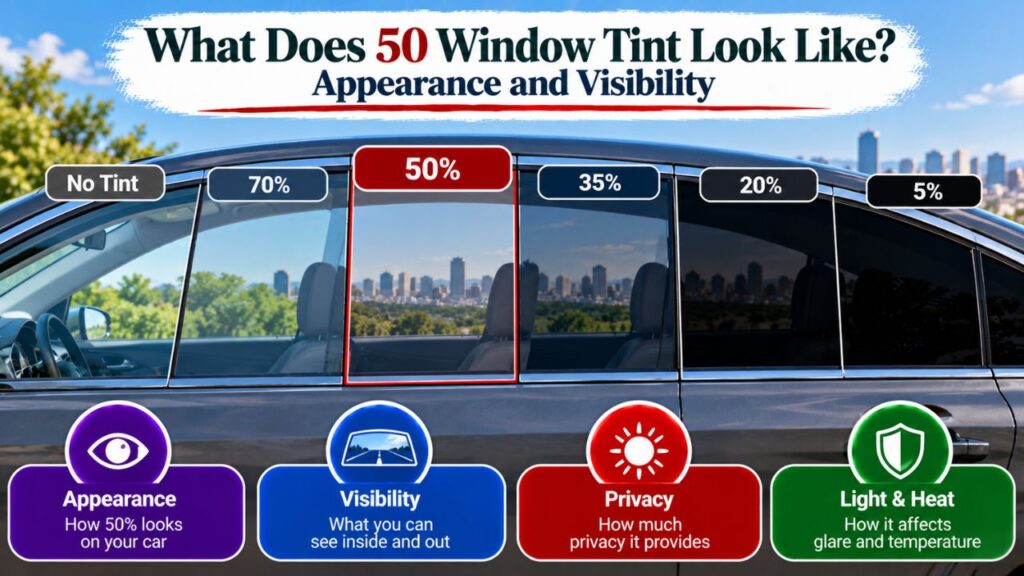
A 50% window tint has a noticeably lighter appearance than traditional dark privacy tint.
Its appearance changes depending on sunlight, interior lighting, viewing angle, and the original glass.
What 50 Window Tint Looks Like During the Day
In bright daylight, 50% tint generally appears as a light charcoal or smoky gray layer over the window.
From outside, you’ll usually notice that the glass looks darker than an untinted window.
However, the difference isn’t extreme.
You can often still see:
- The front seats
- The steering wheel
- The dashboard
- The driver’s silhouette
- Passengers sitting inside
- Light-colored interior surfaces
If direct sunlight enters the cabin, interior details may become even easier to see.
A black interior can make the glass appear darker, while a beige or light-gray interior may make the tint look more transparent.
The surrounding environment also affects appearance.
For example, a vehicle parked in shade may look more heavily tinted than the same vehicle parked in direct sunlight.
What 50 Window Tint Looks Like at Night
At night, 50% tint still allows a relatively large amount of visible light through compared with darker shades.
From inside, streetlights, headlights, and illuminated signs generally remain visible.
However, dark objects and poorly lit surroundings can become harder to distinguish than through clear glass.
From outside, the window may look darker if the vehicle’s cabin lights are off.
If the interior lights are on, occupants and interior details can become easily visible.
50% tint doesn’t provide complete nighttime privacy.
The difference in brightness between the inside and outside of the vehicle often matters more than the tint shade alone.
What 50 Tint Looks Like in Cloudy Weather
Under overcast skies, 50% tint may appear slightly darker than it does in bright sunshine.
Because less light reaches the vehicle’s interior, the cabin can look more shaded from outside.
However, the windows generally don’t develop the deep black appearance associated with 5% or 15% tint.
From the driver’s seat, the outside environment remains comparatively bright, although the film still reduces visible light.
What 50 Tint Looks Like in a Parking Garage
A parking garage provides a useful example of how lighting affects tint appearance.
In a dim garage, 50% tint may look noticeably darker from outside because the vehicle’s interior receives less light.
From inside, the film reduces the available light further.
Although 50% is considered a light tint, it’s still important to consider nighttime and low-light visibility before applying it to windows used for driving.
Key Takeaway: In bright daylight, 50% tint looks lightly smoked and relatively transparent. In darker environments, the same film can appear more shaded, but it doesn’t provide the privacy of substantially darker tint.
What Does 50 Window Tint Look Like From Outside?
From outside the vehicle, 50% tint creates a subtle change in the window’s color and transparency.
The glass may appear charcoal, gray, or slightly reflective depending on the selected film.
Does 50% Tint Look Dark?
50% tint is generally classified as a light window tint.
It looks darker than clear glass but considerably lighter than common privacy shades.
The International Window Film Association’s automotive tint guidance describes 50% VLT film as nearly clear to the naked eye compared with substantially darker films.
That doesn’t mean the tint is invisible.
Side-by-side with an untinted window, the difference is usually noticeable.
However, from a distance, a vehicle with 50% tint may look like it has slightly darker factory glass rather than heavily modified windows.
Can People See Inside a Car With 50% Tint?
Yes.
People outside can generally see into a car with 50% tint during daylight.
The exact visibility depends on the lighting conditions.
For example:
- Bright exterior sunlight with a dark cabin can make the interior less visible.
- Direct sunlight entering the cabin can make passengers easier to see.
- Light-colored seats may stand out more clearly.
- Interior lighting at night can make occupants visible from outside.
If your primary goal is hiding the interior from view, 50% tint may not provide enough privacy.
Does 50 Tint Look Black or Gray?
Most neutral-colored 50% films produce a light charcoal or gray appearance.
However, some films have slightly different color characteristics.
Depending on the manufacturer and product, the glass may look:
- Neutral charcoal
- Smoky gray
- Slightly blue-gray
- Slightly greenish
- Mildly reflective
These differences come from film construction, reflectivity, and the original glass color.
A quality neutral ceramic film may look different from a lower-cost dyed film, even when both have similar visible light transmission.
What Does 50 Window Tint Look Like From Inside the Car?
From inside, 50% tint typically creates a moderately shaded view without the heavy darkness of lower-VLT films.
It’s a popular choice for drivers who want some glare reduction while preserving a relatively bright cabin.
Daytime Visibility With 50% Tint
During daylight, the outside view remains fairly clear.
You can generally distinguish road signs, vehicles, pedestrians, and surrounding objects without the darkened appearance caused by much heavier tint.
The glass reduces incoming brightness and may make direct sunlight feel less harsh.
However, it doesn’t improve the sharpness of objects.
Film quality, optical distortion, glare, and the condition of the glass still affect visibility.
Nighttime Visibility With 50% Tint
50% tint allows more light through than 35%, 20%, or 5% tint.
That makes it a more visibility-friendly choice among these shades.
However, it still reduces incoming light.
When driving through poorly lit areas, the difference can matter when checking:
- Side mirrors
- Cross traffic
- Pedestrians
- Road edges
- Parking spaces
- Dark driveways
For drivers who frequently travel at night, a lighter film such as 70% may be preferable, particularly for front side windows.
Does 50 Tint Affect Rearward Visibility?
Yes, although the effect is generally less pronounced than with darker films.
A 50% tint on the rear windshield reduces visible light entering through that glass.
This can affect the view when reversing in dark areas.
Backup cameras and parking sensors may help with maneuvering, but they don’t eliminate the need for adequate direct visibility.
Choose a legal shade that suits the vehicle and driving conditions.
How Dark Is 50% Window Tint Compared With Other Shades?
The difference becomes easier to understand when comparing 50% with other common window tint percentages.
Visible Light Transmission (VLT) describes the amount of visible light that passes through the measured film or glass-and-film system.
A lower VLT means a darker tint.
Window Tint Darkness Comparison
| Tint Shade | Visible Light Transmitted | General Appearance | Privacy Level |
| 70% | 70% | Nearly clear | Very low |
| 50% | 50% | Light smoky gray | Low |
| 35% | 35% | Medium-dark charcoal | Moderate |
| 20% | 20% | Dark charcoal | High |
| 15% | 15% | Very dark | Very high |
| 5% | 5% | Nearly black | Extremely high |
These descriptions are approximate.
Actual appearance depends on the film, factory glass, and lighting conditions.
50% vs. 70% Window Tint
70% tint looks much closer to clear glass.
It allows 20 percentage points more visible light through than 50% tint.
From outside, 70% film may be difficult to notice without a side-by-side comparison.
50% tint has a more visible smoky appearance.
Both can be suitable for drivers who prefer a relatively natural window appearance, but 70% generally provides better outward visibility.
50% vs. 35% Window Tint
35% tint is noticeably darker than 50%.
From outside, 35% often produces a more obvious tinted appearance.
It also provides more daytime privacy.
With 50% tint, the interior remains easier to see.
From inside, 50% offers better visibility, particularly under low-light conditions.
If your goal is a noticeable darker look, 35% may be more appealing where legally permitted.
If you prefer a subtle appearance, 50% is generally the better choice.
50% vs. 20% Window Tint
20% tint has a much darker appearance than 50%.
It allows only one-fifth of visible light through under its rated conditions.
From outside, 20% often appears dark charcoal or nearly black.
It can make passengers and interior objects harder to see during daylight.
In comparison, 50% looks significantly lighter.
For drivers prioritizing visibility rather than privacy, 50% is the more practical of these two shades.
50% vs. 5% Window Tint
5% tint is commonly called limo tint.
It blocks approximately 95% of visible light and provides an extremely dark appearance.
50% tint is much lighter.
At their nominal ratings, 50% tint transmits ten times as much visible light as 5% tint.
The difference is especially substantial when looking out of the vehicle at night.
5% tint can severely limit outward visibility and may be illegal on many vehicle windows.
Key Takeaway: 50% tint offers a subtle shaded appearance, while 35% provides a more noticeable tint. Shades such as 20% and 5% are primarily chosen for substantially darker appearance and privacy where permitted.
Is 50% Window Tint Noticeable on a Car?
Yes, but the change is relatively subtle.
A vehicle with 50% tint often looks like it has slightly darker factory glass rather than heavily tinted windows.
On a White Car
A white car with 50% tint usually shows a soft contrast between the light paint and smoky windows.
The glass appears darker than the body, but the effect is less dramatic than 20% tint.
This can create a clean, understated appearance.
On a Black Car
On a black car, 50% tint may look relatively light compared with the body color.
The windows often retain a transparent appearance.
If the goal is an almost-black window finish, 50% won’t create that effect.
On a Silver or Gray Car
On a silver or gray vehicle, a neutral 50% tint can blend naturally with the exterior.
The result is usually subtle rather than dramatic.
The exact appearance depends on whether the film has a charcoal, bronze, or reflective finish.
With a Dark Interior
A dark cabin can make 50% tint appear deeper from outside.
Black seats, a dark dashboard, and reduced interior lighting absorb or reflect less light toward the viewer.
As a result, the windows may look more private than the same film installed on a vehicle with light upholstery.
With a Light Interior
A beige, white, or light-gray interior can make 50% tint appear more transparent.
Seats and interior trim may remain clearly visible through the glass.
If you’re choosing 50% tint for privacy, the cabin color should be part of your decision.
Does 50% Window Tint Provide Enough Privacy?
50% tint provides limited privacy compared with darker automotive films.
It can reduce how clearly people see inside under certain lighting conditions, but it doesn’t reliably hide occupants or valuables.
Daytime Privacy
During the day, the window’s reflectivity and difference between interior and exterior brightness influence visibility.
From some angles, reflections on the glass may partially obscure the cabin.
However, people standing close to the vehicle can often see the seats, dashboard, and passengers.
A 50% tint shouldn’t be treated as a security measure for concealing valuable items.
Nighttime Privacy
At night, interior lighting has a major effect.
If a dome light is switched on, people outside may see through 50% tint quite easily.
Even much darker tint can lose some of its privacy advantage when the cabin is brightly illuminated.
Is 50 Tint Good for Privacy?
It provides a small amount of visual separation, but privacy isn’t its strongest advantage.
For many drivers, the main reasons to choose 50% are:
- Subtle appearance
- Reduced glare
- Greater visibility than dark tint
- Solar heat control with suitable film
- A relatively natural-looking finish
If privacy is the primary goal, a darker legally permitted film may be more effective.
Does 50% Window Tint Block Heat?
Yes, a quality 50% automotive film can reduce solar heat transmission.
However, the amount of heat rejected depends more on film technology than on how dark the tint looks.
A light ceramic film can provide stronger solar heat rejection than a dark basic dyed film.
How 50% Ceramic Tint Controls Heat
Ceramic automotive films use specialized materials designed to reduce solar infrared energy.
For example, 3M’s Ceramic IR 50 automotive film is listed at 50% visible light transmittance.
The manufacturer also describes infrared-rejecting technology designed to reduce the sun’s heat.
This shows why film specifications matter.
Two 50% films can look similar while providing different levels of solar heat control.
Does 50% Dyed Tint Block Heat?
Basic dyed film primarily reduces visible light and glare.
It may reject some solar energy, but its heat-rejection performance is often lower than that of higher-performing ceramic products.
A 50% dyed tint can therefore look similar to a 50% ceramic tint while providing a different level of thermal comfort.
What Is TSER?
Total Solar Energy Rejection (TSER) measures the percentage of total solar energy rejected by a film-and-glass system.
This is a useful specification when comparing heat-control performance.
For example, a film with 50% TSER rejects more total solar energy than a film with 30% TSER under comparable measurement conditions.
However, TSER doesn’t translate directly into a guaranteed cabin temperature reduction.
Air temperature, direct sunlight, windshield area, insulation, and ventilation also influence how hot a vehicle becomes.
Can 50% Tint Keep a Parked Car Cool?
It can reduce some solar heat entering through treated windows.
However, it cannot prevent a parked vehicle from becoming dangerously hot.
Heat continues entering through other glass surfaces, and the cabin can reach unsafe temperatures even with high-performance tint.
Never rely on automotive window film to make a parked vehicle safe for children or pets.
Does 50% Window Tint Block UV Rays?
Many high-quality 50% films block a substantial portion of ultraviolet radiation.
However, visible light transmission and UV rejection are separate measurements.
A film with 50% VLT doesn’t automatically block 50% of ultraviolet radiation.
Some products provide much stronger UV protection.
UV Protection With Ceramic Tint
Premium ceramic films often block a very high percentage of UV radiation.
This can help reduce UV exposure through treated side and rear windows.
It may also reduce some UV-related fading of interior materials.
However, the exact protection depends on the particular film.
UV Protection With Regular Tint
Non-ceramic films can also offer substantial UV rejection.
Therefore, ceramic film isn’t always necessary if your only priority is ultraviolet protection.
Compare the product’s documented UV rejection rating rather than judging protection from darkness.
Is 50% Window Tint Legal?
50% tint may be legal on some vehicle windows in certain U.S. states, but it isn’t universally permitted.
The applicable law can depend on the window location, vehicle classification, final VLT, and other conditions.
Is 50 Tint Legal on Front Side Windows?
Some states allow front side windows to have a finished VLT near 50%.
Other states require greater light transmission.
For example, states with a 70% minimum finished VLT wouldn’t permit a standard 50% tint installation on front side windows.
Check the current law for your state before selecting the film.
Is 50 Tint Legal on Rear Side Windows?
Rear side windows may have different tint requirements from front windows.
Some states permit much darker rear glass.
However, requirements can also vary according to whether the vehicle is classified as a passenger car or multipurpose vehicle.
Don’t assume that every SUV or pickup truck qualifies for the same tint exemptions.
Is 50 Tint Legal on the Rear Windshield?
It depends on the state and vehicle.
Some jurisdictions allow darker rear windshields when appropriate side mirrors are installed.
Others impose minimum light-transmission requirements.
Even where 50% is permitted, consider whether the shade provides adequate visibility for nighttime reversing.
Is 50% Tint Legal on the Windshield?
A 50% windshield tint is generally too dark for ordinary full-windshield use in many U.S. jurisdictions.
Windshield restrictions are often substantially stricter than rear-window rules.
Some states permit a limited upper windshield strip or certain highly transparent films under specified conditions.
Check the applicable law before installing any film across the windshield.
Does 50% Film Make Factory-Tinted Glass Darker?
Yes.
A film labeled 50% VLT may produce a finished window that transmits considerably less than 50% of visible light.
This happens because the original glass already blocks some light.
How to Calculate Combined Window Tint
For film and glass with separately measured light-transmission values, a simplified estimate is:
Combined VLT = Factory Glass VLT × Film VLT
Convert the percentages to decimals before multiplying.
For example, suppose the original vehicle glass transmits 80% of visible light.
Adding a film rated at 50% VLT gives:
0.80 × 0.50 = 0.40
Estimated finished VLT: 40%
50% Film on Different Factory Glass
| Original Glass VLT | Added Film VLT | Estimated Combined VLT |
| 90% | 50% | 45% |
| 85% | 50% | 42.5% |
| 80% | 50% | 40% |
| 75% | 50% | 37.5% |
| 70% | 50% | 35% |
| 20% | 50% | 10% |
These are simplified estimates, not certified tint-meter readings.
Some manufacturer’s published VLT figures already represent performance on a specified type of test glass.
Check whether the technical specifications refer to the film alone or the completed film-and-glass system before using the formula.
Why 50% Film Can Look Like 35% Tint
If the factory glass has a VLT of 70%, adding 50% film produces an estimated combined VLT of 35%.
That means the finished appearance can resemble a darker tint than you expected.
This is especially important when applying aftermarket film to front side windows.
A film marketed as 50% doesn’t guarantee the completed window will remain at 50% VLT.
What Happens on Factory Privacy Glass?
Some SUVs, minivans, and pickup trucks already have dark rear privacy glass.
If the existing glass measures 20% VLT, adding film that separately transmits 50% produces an estimated combined VLT of 10%.
That is much darker than an ordinary 50% film installation over clear glass.
If you’re only interested in additional heat rejection, a lighter high-performance film may be more appropriate.
Key Takeaway: Measure the existing glass before choosing a film. The finished appearance and legal light-transmission reading can be substantially darker than the advertised film percentage.
What Does 50% Ceramic Window Tint Look Like?
50% ceramic tint generally looks like a light charcoal or smoky shade, similar to other films with comparable VLT.
Ceramic doesn’t automatically mean darker or more reflective.
Its main advantage is the ability to reduce solar heat using advanced film construction.
50% Ceramic Tint From Outside
From outside, a neutral ceramic film at 50% VLT typically has an understated appearance.
The vehicle’s cabin remains visible under many daylight conditions.
Some premium ceramic films have low reflectivity, helping them maintain a natural glass appearance.
However, exact color and reflectivity vary by product.
50% Ceramic Tint From Inside
The view through a quality 50% ceramic film is generally light compared with darker tint shades.
The film reduces visible brightness while allowing useful outward visibility.
Its performance can make it attractive for drivers who want solar heat control without the appearance of dark privacy glass.
50% Ceramic vs. 50% Regular Tint
| Feature | 50% Ceramic Tint | 50% Regular Dyed Tint |
| Darkness | Light | Light |
| General appearance | Often neutral charcoal | Often charcoal or gray |
| Daytime privacy | Limited | Limited |
| Nighttime visibility | Similar at equivalent VLT and clarity | Similar at equivalent VLT and clarity |
| Heat rejection | Generally stronger | Usually lower |
| UV protection | Product-dependent, often high | Product-dependent |
| Initial cost | Higher | Lower |
| Color stability | Often better | Depends on product quality |
Choose ceramic film when additional solar heat rejection is worth the higher price.
Choose regular tint when your main goals are basic glare reduction and a slightly darker appearance.
Is 50% Window Tint Too Light?
That depends on your expectations.
50% tint is usually too light for someone who wants a strong blacked-out appearance.
However, it’s a practical option for drivers who prefer subtle styling and better visibility than darker films provide.
When 50% Tint May Feel Too Light
You may find 50% tint too light if you want:
- Strong daytime privacy
- A dark, blacked-out appearance
- A close match to very dark rear privacy glass
- Passengers to be difficult to see from outside
A darker legally permitted film may better match these goals.
When 50% Tint Is a Good Choice
50% tint can be suitable when you want:
- A clean factory-style appearance
- Modest glare reduction
- Better nighttime visibility than dark tint
- A subtle change in window color
- Strong heat rejection with an appropriate ceramic product
- A relatively bright vehicle interior
It’s also worth considering if you dislike heavily tinted windows but still want some solar-control benefits.
How Much Does 50% Window Tint Cost?
The installation price depends more on film quality, vehicle size, and labor than on the 50% shade itself.
A standard 50% dyed film is generally less expensive than a premium 50% ceramic film.
The following factors affect the total cost:
- Film brand and series
- Ceramic or dyed construction
- Number of windows
- Vehicle dimensions
- Rear glass curvature
- Existing tint removal
- Installation labor
- Warranty coverage
Many shops charge the same price for several VLT shades within one product series.
For example, a shop may charge the same amount for 35% and 50% ceramic tint when both films belong to the same line.
Ask the installer for a quote specifying the exact film product and windows included.
How to Decide if 50% Window Tint Is Right for Your Car
Before choosing 50%, consider appearance, visibility, heat rejection, and legality together.
Step 1: Decide How Dark You Want the Windows
If you prefer a natural appearance, 50% tint may suit your vehicle.
If you’re expecting dark privacy glass, the result may be too light.
Compare samples from the same film series before purchasing.
Step 2: Check Visibility in Different Lighting
Don’t judge the shade only in bright sunlight.
View film samples under indoor lighting and, where possible, in low-light conditions.
A film that looks almost clear during the day may feel noticeably darker at night.
Step 3: Choose the Appropriate Film Technology
For privacy and basic styling, dyed film may be sufficient.
For better solar heat control at a light VLT, consider a ceramic or another high-performance film.
Compare published TSER and infrared energy rejection values.
Step 4: Measure the Original Window Glass
Ask the installer to check the existing VLT.
This helps estimate the finished darkness and determine whether the combination can meet legal requirements.
Step 5: Confirm State Tint Regulations
Review the legal requirements for each window.
A shade that is permitted on the rear side windows may not be allowed on the front side windows or windshield.
Step 6: Preview the Tint on Your Vehicle
A small sample on your own vehicle is generally more useful than viewing a generic online photograph.
Look at the film from both inside and outside.
Check how it appears with your vehicle’s paint color, interior, and factory glass.
Common Mistakes When Choosing 50% Window Tint
Avoid these misunderstandings before installing the film.
Assuming 50% Tint Means Complete Privacy
50% tint allows a substantial amount of visible light through.
Passengers and interior details often remain visible during daylight.
Choose it for a subtle appearance rather than maximum privacy.
Assuming 50% Tint Is Completely Clear
Although 50% is considered light, it still reduces visible light compared with clear glass.
Its effect can be particularly noticeable during nighttime driving.
Assuming Darker Tint Always Blocks More Heat
A dark dyed film doesn’t automatically reject more solar heat than a lighter ceramic film.
Compare the actual film specifications.
Ignoring Factory Glass VLT
Adding 50% film to existing glass can produce a much darker final window.
Measure the original glass and verify the completed VLT.
Assuming 50% Tint Is Legal Everywhere
Tint laws vary by state and window position.
A 50% film may still produce an illegal installation if the finished glass is too dark.
Choosing Film Based Only on Online Pictures
Photographs and digital previews can be misleading because of camera exposure, screen brightness, reflections, and lighting conditions.
Use them as approximate references rather than exact representations.
Viewing samples on your own vehicle provides a more reliable comparison.
Conclusion
What does 50 window tint look like? It creates a light, smoky appearance that darkens car windows without the nearly black finish of 20% or 5% tint.
From outside, the interior usually remains visible during daylight. From inside, the glass maintains relatively good outward visibility compared with darker film options.
50% tint is a practical choice for drivers who prefer subtle styling, some glare reduction, and a relatively bright cabin.
When combined with high-quality ceramic film, it can also offer substantial heat rejection without requiring a dark appearance.
However, it isn’t the best choice for maximum privacy, and adding it to factory-tinted glass may result in a much darker finished window than expected.
For the best result, compare real film samples, check the existing glass VLT, review the manufacturer’s heat-rejection specifications, and confirm that the finished installation complies with local law.
FAQs About What Does 50 Window Tint Look Like
Can You See Inside a Car With 50% Tint?
Yes. People can generally see into a vehicle with 50% tint during daylight.
The film creates a slightly darker appearance but doesn’t provide strong privacy. Interior lighting, seat color, and viewing angle affect how clearly occupants are visible.
Is 50% Tint Dark Enough to Notice?
Yes. Compared with untinted glass, 50% tint usually looks slightly smoky or charcoal-colored.
However, it’s much lighter than 35%, 20%, or 5% tint and often maintains a subtle factory-style appearance.
Does 50% Tint Look Dark at Night?
It can appear darker from outside when the vehicle’s interior is unlit.
From inside, 50% tint reduces available light but remains lighter than darker privacy films. Visibility can still be affected on poorly lit roads.
Is 50% Tint Good for Night Driving?
50% tint generally provides better outward visibility than 35%, 20%, or 5% film.
However, it still reduces visible light compared with clear glass. Drivers who frequently travel at night may prefer a lighter legal shade.
Is 50% Tint Better Than 35%?
50% tint is better for drivers who prioritize a lighter appearance and greater outward visibility.
35% tint provides a darker look and more daytime privacy.
The better choice depends on driving habits, appearance preferences, and applicable tint laws.
Does 50% Ceramic Tint Look Darker Than 50% Regular Tint?
Not necessarily.
Two films with the same measured VLT generally transmit similar amounts of visible light, although differences in color, reflectivity, and optical properties can affect their appearance.
Ceramic’s main advantage is usually improved solar heat rejection rather than increased darkness.
Will 50% Tint Look Like 35% on Factory Glass?
It can.
For example, installing a film that transmits 50% of visible light over glass that transmits 70% produces an estimated combined VLT of 35%.
The actual result depends on how the manufacturer’s VLT rating was measured and the original glass.
Is 50% Window Tint Legal on Front Windows?
It depends on the state and finished VLT.
Some states permit front side windows with light transmission near 50%, while others require substantially lighter glass.
Check the current regulations and measure the final glass-and-film combination before installation.