Window tint percentages work by measuring how much visible light passes through the tint. A higher percentage means a lighter tint, while a lower percentage means a darker tint. For example, 50% window tint allows approximately half of visible light to pass through, while 5% tint allows only 5%, creating a much darker appearance.
This measurement is called Visible Light Transmission (VLT), and it is one of the most important specifications to understand before tinting car windows.
Many drivers assume that higher tint percentages mean darker windows or that darker tint automatically provides better heat rejection. Neither assumption is correct. Window darkness, solar heat control, and ultraviolet protection are different performance characteristics.
Factory automotive glass also affects the final tint percentage. Installing 35% film on a window that already blocks some visible light can produce a finished window considerably darker than 35%.
In this article, I explain how window tint percentages are calculated, compare common tint shades from 5% to 70%, and show how factory glass changes the final VLT. I also cover nighttime visibility, privacy, heat rejection, legal limits, and how to choose an appropriate tint percentage for your vehicle.
How Do Window Tint Percentages Work?
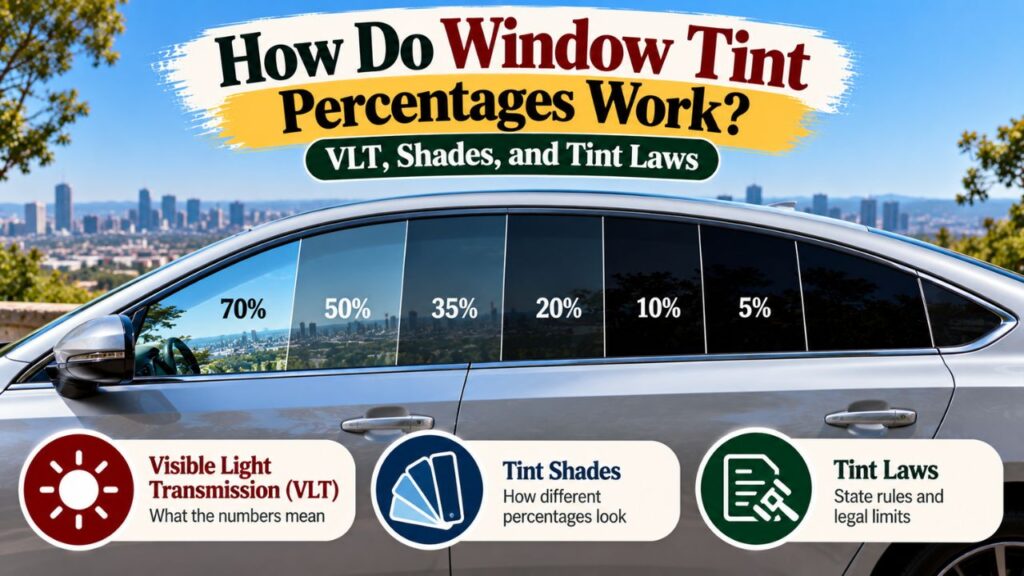
Window tint percentages represent Visible Light Transmission (VLT), which measures the percentage of visible light passing through a material.
For automotive tint, the percentage may describe the film itself or the complete glass-and-film combination, depending on the specification.
The basic principle is simple:
- Higher VLT = More visible light passes through.
- Lower VLT = Less visible light passes through.
- More transmitted visible light = Generally lighter appearance.
- Less transmitted visible light = Generally darker appearance.
For example, 70% tint looks relatively light because it allows most visible light through.
A 20% tint appears substantially darker because it transmits only about one-fifth of the visible light.
What Does VLT Mean in Window Tint?
VLT stands for Visible Light Transmission.
It measures the visible portion of light that travels through glass or window film.
The percentage does not directly measure how much infrared heat or ultraviolet radiation the material rejects.
According to 3M’s official automotive window film guide, VLT describes the visible light passing through filmed glass, while Total Solar Energy Rejection (TSER) measures the overall solar energy rejected by the glazing system.
These two specifications serve different purposes.
VLT helps describe darkness and visibility, while TSER helps evaluate solar heat control.
Does a Higher Tint Percentage Mean Darker Windows?
No. A higher tint percentage means lighter windows.
This is one of the most common misunderstandings about automotive window film.
For example:
- 70% tint is much lighter than 35%.
- 35% tint is lighter than 20%.
- 20% tint is lighter than 5%.
- 5% tint is one of the darkest commonly advertised shades.
The number describes the light transmitted, not the light blocked.
What Percentage of Light Does Window Tint Block?
You can calculate the approximate visible light blocked using:
Visible Light Blocked (%) = 100 − VLT (%)
For example, with 35% tint:
100 − 35 = 65% visible light blocked
With 5% tint:
100 − 5 = 95% visible light blocked
This calculation refers to visible light reduction, not total solar heat rejection.
Key Takeaway: The tint number tells you how much visible light passes through the material, not how dark the film is on a scale from 0 to 100.
Window Tint Percentage Chart: 5% to 70%
Different tint percentages create noticeably different appearances and visibility levels.
The following chart explains common automotive window tint shades.
| Tint Percentage | Visible Light Allowed | Visible Light Blocked | General Appearance |
| 70% | 70% | 30% | Very light |
| 50% | 50% | 50% | Light |
| 35% | 35% | 65% | Medium-dark |
| 30% | 30% | 70% | Moderately dark |
| 25% | 25% | 75% | Dark |
| 20% | 20% | 80% | Very dark |
| 15% | 15% | 85% | Very dark |
| 5% | 5% | 95% | Extremely dark |
These are nominal percentages for comparing shades.
Actual measurements can vary depending on the film product, original glass, and testing method.
70% Window Tint
Seventy-percent tint is relatively light.
It allows most visible light to pass through, so the window may appear nearly clear under many lighting conditions.
This shade is commonly considered by drivers who want solar-control performance without a dramatic change in appearance.
Potential advantages include:
- Relatively high outward visibility.
- Minimal darkening compared with lower-VLT films.
- Compatibility with some high-performance ceramic film options.
- Less visual impact on the vehicle’s appearance.
However, 70% film installed over factory glass does not necessarily produce a finished window with 70% VLT.
Legal compliance must be determined using the actual completed glass.
50% Window Tint
Fifty-percent tint allows approximately half of visible light through.
It creates a noticeable but relatively light appearance.
Compared with darker shades, it generally provides better outward visibility in low-light conditions.
This shade may appeal to drivers who want reduced glare without substantially darkening the windows.
However, a 50% film still reduces visible light and may not be permitted on every vehicle window.
35% Window Tint
Thirty-five-percent tint is a common choice among drivers who prefer a moderately dark appearance.
It allows approximately 35% of visible light through.
At this level, the windows appear distinctly tinted, but the interior may still be visible from outside depending on lighting conditions.
A 35% tint offers a balance between appearance and visibility compared with extremely dark shades.
However, it can still reduce nighttime visibility noticeably.
It is also not automatically legal for front side windows in every state.
20% Window Tint
Twenty-percent tint is a dark automotive shade.
It allows approximately one-fifth of visible light to pass through.
From outside, the windows may appear nearly black during bright daylight, especially when the interior is dark.
This shade offers substantial daytime privacy.
However, the reduction in visible light can make nighttime driving more difficult.
Checking side mirrors, identifying pedestrians, and observing objects through side windows may require greater care.
15% Window Tint
Fifteen-percent tint is darker than 20% and allows only 15% of visible light through.
It creates a strongly shaded appearance and provides considerable daytime privacy.
However, it further reduces outward visibility in low-light conditions.
The difference between 15% and 20% may appear relatively small during bright daylight, but the lower transmission still matters when available light is limited.
5% Window Tint
Five-percent tint is commonly called limo tint.
It allows only approximately 5% of visible light through.
This produces an extremely dark appearance and makes the interior difficult to see from outside during many daylight conditions.
However, 5% tint also greatly restricts the driver’s view through the glass.
It can make reversing, checking mirrors, and observing poorly lit surroundings particularly difficult.
Five-percent tint is not a practical general recommendation for windows used for driving visibility.
How Window Tint Percentages Affect Privacy
Lower VLT generally provides greater daytime privacy because less visible light travels through the glass.
However, window tint does not provide guaranteed one-way privacy.
Why Dark Tint Looks Private During the Day
During daylight, the outside environment is often much brighter than the vehicle’s interior.
This difference can make the interior difficult to see through dark glass.
For example, a vehicle with 20% tint may appear much darker from outside than one with 50% tint.
A 5% tint can make the cabin even harder to see.
However, the actual appearance depends on the sunlight, viewing angle, interior color, and film reflectivity.
Why Window Tint Doesn’t Guarantee Nighttime Privacy
At night, the lighting conditions may reverse.
If the vehicle’s interior lights are on while the outside environment is dark, people outside may be able to see into the cabin.
Even very dark tint can reveal passengers or objects when strong interior lighting is present.
Window film reduces light transmission in both directions.
It is not a one-way mirror.
Which Tint Percentage Provides the Best Privacy?
The darkest legally permitted and safely usable tint generally provides the greatest daytime privacy.
However, maximum privacy should not automatically be the only consideration.
For example:
- 50% offers light shading.
- 35% provides moderate privacy.
- 20% provides strong daytime privacy.
- 5% provides greater privacy but severely reduces outward visibility.
For everyday driving, choose a shade that meets legal requirements and preserves adequate visibility.
How Do Window Tint Percentages Affect Night Driving?
Darker tint reduces the amount of visible light reaching the driver’s eyes.
This becomes particularly important after sunset because the outside environment already provides limited illumination.
Is 35% Tint Dark at Night?
Thirty-five-percent tint can noticeably reduce nighttime visibility.
Although it allows more light through than 20% or 5%, it still blocks approximately 65% of visible light under its nominal rating.
On well-lit roads, the reduction may be less noticeable.
On rural roads or during heavy rain, objects outside may become harder to distinguish.
Is 20% Tint Safe for Night Driving?
Twenty-percent tint allows considerably less visible light through than 35% tint.
This can make it difficult to see through side windows in poorly lit conditions.
Drivers may have more trouble identifying curbs, pedestrians, and nearby vehicles.
Even if a particular installation is legally permitted, practical visibility remains important.
Can You See Through 5% Tint at Night?
Seeing through 5% tint at night can be extremely difficult, especially where there are few streetlights.
It allows only about one-quarter as much visible light through as a 20% film.
Cameras, mirrors, and electronic driving aids do not eliminate the importance of adequate direct visibility.
For windows essential to driving, a lighter, legally compliant shade is generally preferable.
Does Ceramic Tint Improve Visibility at the Same Percentage?
A high-quality ceramic film may offer excellent optical clarity and low haze.
However, ceramic technology does not change the basic meaning of VLT.
A 20% ceramic film still transmits roughly 20% of visible light under its stated rating.
Likewise, a 5% ceramic film remains extremely dark.
Ceramic film may improve heat control, but it cannot restore the visible light blocked by an excessively dark shade.
How Factory Glass Changes Window Tint Percentages
The number printed on a window tint film does not always equal the final VLT after installation.
Automotive glass can already reduce visible light transmission before aftermarket film is added.
Why Factory Windows Are Not Completely Transparent
Automotive glass is designed to meet requirements related to visibility, safety, and other performance characteristics.
Even glass that looks clear does not necessarily transmit 100% of visible light.
Factory privacy glass may transmit substantially less light than ordinary clear-looking automotive glass.
Adding aftermarket film reduces the total light transmission further.
How to Calculate Combined Window Tint Percentage
For a simplified estimate, use this formula:
Combined VLT (%) = Factory Glass VLT (%) × Film-Only VLT (%) ÷ 100
For example, suppose your vehicle’s glass has a measured VLT of 80%.
You install film rated at 35% VLT.
The calculation is:
80 × 35 ÷ 100 = 28%
The finished window would have an estimated VLT of approximately 28%.
This is darker than the advertised 35% film shade.
Important: This multiplication is only an estimate when the film percentage represents film-only transmission. Some manufacturer data sheets already report performance on reference glass. Do not multiply a glass-inclusive VLT rating by the factory-glass VLT again.
A tint meter reading of the completed window is more reliable for checking its actual transmission.
Combined Window Tint Percentage Chart
The table below uses example factory glass that transmits 80% of visible light.
| Film-Only VLT | Factory Glass VLT | Estimated Combined VLT |
| 70% | 80% | 56% |
| 50% | 80% | 40% |
| 35% | 80% | 28% |
| 30% | 80% | 24% |
| 20% | 80% | 16% |
| 15% | 80% | 12% |
| 5% | 80% | 4% |
This illustrates why selecting a legal film percentage requires knowing the original glass transmission.
These values are examples, not measurements of every factory window.
What Happens When You Tint Factory Privacy Glass?
Some SUVs, trucks, and vans have dark rear privacy glass.
For example, suppose a rear passenger window already has 25% VLT.
Applying nominal 20% film produces:
25 × 20 ÷ 100 = 5% combined VLT
Adding 5% film produces:
25 × 5 ÷ 100 = 1.25% combined VLT
The resulting window can be extremely dark.
Before adding film to factory privacy glass, have the glass measured and consider whether additional visible-light reduction is actually necessary.
How to Measure Window Tint Percentage
A window tint meter is commonly used to measure the visible light transmission of automotive glass.
It provides an objective reading rather than relying on how dark the window looks.
How a Window Tint Meter Works
A suitable tint meter uses a light source and sensor to measure visible light transmitted through the glass.
The device displays a percentage representing the measured VLT.
Depending on the model, it may use separate components placed on opposite sides of the window or a configuration designed for other measurement conditions.
Follow the specific meter manufacturer’s instructions.
How to Check the Tint Percentage on Your Car
For a typical accessible side window:
- Clean the glass where the measurement will be taken.
- Use a meter suitable for the glass and application.
- Check the instrument’s calibration or reference procedure.
- Position the measuring components as directed.
- Record the displayed VLT.
- Repeat if the instructions recommend multiple readings.
Some meter designs cannot measure certain fixed windows or windshields easily.
If the window has unusual glass construction, use an appropriate instrument or professional testing service.
Can You Determine Tint Percentage by Looking at It?
Not accurately.
Two windows with different VLT readings may appear similar because of variations in lighting, glass color, film reflectivity, and interior brightness.
A dark interior can make relatively light tint appear darker from outside.
Likewise, a brightly illuminated cabin can make a dark film appear more transparent.
Visual comparisons may help you choose an appearance, but they are not a dependable way to verify legal compliance.
Do Darker Tint Percentages Block More Heat?
Not necessarily.
A lower VLT blocks more visible light, but visible-light transmission is not the same as total solar energy rejection.
Window tint performance depends on the materials and technologies used in the film.
Difference Between VLT and Heat Rejection
VLT measures visible light passing through the glazing.
TSER measures the proportion of total solar energy rejected by the filmed glass.
This distinction matters because sunlight includes visible light, infrared radiation, and ultraviolet radiation.
A film can be relatively light while using specialized materials to reduce infrared heat transmission.
For example, a 50% ceramic film may reject more total solar energy than a much darker basic dyed film.
The actual performance depends on the products being compared.
Ceramic vs. Regular Tint Percentages
Ceramic and regular dyed films can have the same VLT while providing different levels of heat rejection.
Consider two hypothetical films:
| Film | VLT | Main Difference |
| Basic dyed tint | 35% | Primarily darkens glass and reduces visible glare |
| Ceramic tint | 35% | Can provide greater infrared heat rejection |
| High-performance light ceramic | 70% | May offer useful heat control while remaining relatively light |
These examples describe general film capabilities, not guaranteed performance values.
Always check the actual manufacturer specifications.
What Is IR Rejection?
Infrared rejection describes how effectively a film reduces transmission of infrared radiation within a specified wavelength range.
Some products advertise very high infrared rejection percentages measured over relatively narrow bands.
Those figures should not be confused with total solar energy rejection.
For evaluating overall heat control, TSER is generally a more useful comparison metric when products are tested under comparable conditions.
Do Window Tint Percentages Affect UV Protection?
Window tint darkness does not reliably indicate ultraviolet protection.
Both dark and light automotive films can provide high UV rejection.
Can 70% Tint Block UV Rays?
Yes.
A nearly clear automotive window film can include materials designed to reject substantial amounts of ultraviolet radiation.
This allows some drivers to prioritize UV protection without dramatically darkening the glass.
However, performance varies by manufacturer and film series.
Does 5% Tint Offer Better UV Protection Than 35%?
Not automatically.
If both films belong to a product line designed to reject more than 99% of UV radiation, the darker shade may offer little additional UV benefit.
Check the manufacturer’s UV rejection rating rather than relying on the VLT.
Does Dark Tint Prevent Interior Fading?
Tint can help reduce UV exposure and some other contributors to interior deterioration.
However, vehicle interiors can still fade or age because of visible light, heat, humidity, and material properties.
No ordinary automotive tint guarantees that a dashboard, leather seat, or upholstery will never deteriorate.
For interior preservation, compare UV rejection and TSER together.
What Window Tint Percentage Is Legal?
Window tint regulations vary across the United States.
The legal percentage depends on the vehicle, window location, applicable federal requirements, and state law.
There is no single percentage that is legal for every window on every vehicle nationwide.
Federal Automotive Glazing Requirements
The National Highway Traffic Safety Administration’s interpretation of window tint and glazing requirements explains that Federal Motor Vehicle Safety Standard No. 205 establishes minimum light-transmission requirements for glazing necessary for driving visibility.
For new passenger cars, that includes a 70% minimum in the areas specified by the standard.
NHTSA also explains that federal restrictions apply to manufacturers, dealers, distributors, and repair businesses that make federally required safety equipment inoperative.
Individual vehicle owners are treated differently under that federal provision, while state laws govern vehicle operation and may restrict modifications.
Therefore, the federal glazing standard should not be confused with a universal state aftermarket tint limit.
Front Side Window Tint Laws
Front driver and passenger windows are commonly subject to stricter VLT requirements because drivers rely on them for visibility.
A state may permit relatively light aftermarket tint while restricting darker films.
Twenty-percent or 5% tint may be prohibited on front side windows even where those shades are permitted elsewhere on the vehicle.
Check the current rules for the state where the vehicle is registered and operated.
Rear Passenger and Rear Windshield Laws
Some states allow darker tint on rear side windows and rear windshields.
Requirements may vary between passenger cars and vehicles classified as multipurpose vehicles, such as certain SUVs, vans, and trucks.
Other conditions may involve:
- Outside mirror requirements.
- Film reflectivity.
- Prohibited colors.
- Certification labels.
- Medical exemptions.
- Vehicle classification.
Do not assume that a tint percentage allowed on an SUV’s rear glass is necessarily allowed on a sedan’s front windows.
Windshield Tint Laws
Windshield rules are often more restrictive because the windshield is essential to forward visibility.
Certain jurisdictions permit limited tint strips near the upper portion of the windshield under specific conditions.
A full-windshield film installation may be subject to additional federal and state restrictions.
Even a nearly clear film can lower the windshield’s existing VLT.
Before installation, confirm the current legal requirements and the expected finished-glass measurement.
How to Choose the Right Window Tint Percentage
The best tint percentage depends on your priorities and the windows being tinted.
A shade suitable for a rear passenger window may be too dark or unlawful for a front side window.
Choose a Lighter Tint for Better Visibility
If maintaining outward visibility is the main priority, consider a relatively high VLT that complies with applicable law.
Lighter films may be especially useful for drivers who frequently travel at night.
A premium high-VLT ceramic film can also provide solar heat control without requiring an extremely dark appearance.
Choose Moderate Tint for Appearance and Privacy
Moderate darkness can make windows appear noticeably tinted while preserving more visible light transmission than extremely dark shades.
Many drivers consider shades in the 35–50% range when comparing appearance and visibility.
However, these are not universal legal recommendations.
Check the limits for your vehicle before purchasing the film.
Choose Dark Tint Only Where Appropriate
Films around 20% VLT or lower can provide substantial daytime privacy.
However, they can significantly affect low-light visibility.
Such shades should only be considered where permitted and where their visibility effects are acceptable.
Maximum darkness is not necessarily the best choice for daily driving.
Compare Tint Percentages by Priority
| Your Main Priority | What to Consider |
| Maximum outward visibility | Higher legal VLT |
| Subtle window appearance | Relatively light film |
| Moderate privacy | Midrange VLT where permitted |
| Strong daytime privacy | Lower VLT where permitted |
| Night driving | Avoid excessively dark windows |
| Heat rejection | High TSER, not simply low VLT |
| UV protection | Verified UV rejection rating |
| Legal compliance | Measured combined VLT and local rules |
Practical recommendation: Decide on the legal and visibility requirements first, then compare film technologies that can deliver the heat rejection and appearance you want.
Common Window Tint Percentage Mistakes
Several misconceptions can lead drivers to choose a film that doesn’t meet their needs.
Thinking 70% Tint Is Darker Than 20%
Higher VLT means lighter tint.
Seventy-percent film transmits considerably more visible light than 20% film.
Confusing VLT With Visible Light Blocked
A 35% VLT film allows approximately 35% of visible light through.
It blocks approximately 65%.
These numbers describe opposite sides of the same measurement.
Assuming Film VLT Equals Final Window VLT
Factory glass already affects transmission.
The final window can measure darker than the film’s advertised shade.
Use a suitable meter to verify the completed glazing.
Believing Darker Tint Always Rejects More Heat
A dark basic dyed film may have less total solar energy rejection than a lighter premium ceramic film.
Compare TSER and relevant infrared-control specifications.
Ignoring Nighttime Visibility
A film that looks appealing during daylight can be difficult to see through after sunset.
Consider your actual driving conditions before selecting a very dark shade.
Assuming Every State Has the Same Tint Laws
Tint laws differ by jurisdiction, window location, and vehicle type.
Check official, current requirements instead of relying on appearance or what other local drivers have installed.
Choosing Tint Without Checking the Film Specifications
Two films with similar nominal VLT can have different heat rejection, UV protection, reflectivity, and optical quality.
Ask the installer for the exact product name and performance data.
Conclusion
Understanding how window tint percentages work makes it easier to choose automotive film based on actual performance rather than appearance alone.
The central rule is simple: higher percentages mean lighter tint, while lower percentages mean darker tint.
A 70% film allows most visible light through, a 35% film creates moderate darkness, and a 5% film produces an extremely dark appearance.
However, the advertised film percentage may not match the completed window because factory glass also reduces light transmission.
Darkness also doesn’t determine heat rejection or UV protection. Those characteristics require separate performance measurements.
Before tinting your vehicle, compare the film’s VLT, TSER, UV rejection, and optical quality. Check the current legal requirements and have the finished glass measured when necessary.
The best tint percentage is one that provides the appearance and comfort you want without compromising required visibility or legal compliance.
FAQs About How Do Window Tint Percentages Work
Is 5% or 20% Window Tint Darker?
Five-percent tint is much darker than 20%.
A 5% film allows approximately 5% of visible light through, while a 20% film allows approximately 20%.
That means 20% film transmits roughly four times as much visible light as 5% film.
What Does 35% Window Tint Mean?
Thirty-five-percent tint means the material transmits approximately 35% of visible light under its specified rating.
It blocks about 65% of visible light.
However, applying 35% film to factory glass can produce a finished window with a lower VLT.
What Is the Darkest Window Tint Percentage?
Zero-percent VLT would represent no visible light transmission, but that is not a practical general-purpose automotive window film recommendation.
Five-percent film is among the darkest commonly advertised automotive tint shades.
Its use is restricted in many applications and can severely reduce nighttime visibility.
Is 50% Tint Darker Than 35%?
No. Fifty-percent tint is lighter than 35%.
The 50% film allows more visible light through, making it generally easier to see through than the darker 35% shade.
What Happens if You Put 20% Tint Over 20% Factory Glass?
Using the simplified VLT multiplication formula:
20 × 20 ÷ 100 = 4%
The resulting window would have an estimated combined VLT of approximately 4%, assuming the 20% film rating represents film-only transmission.
Actual transmission should be verified with a suitable meter.
Does Ceramic Tint Change How Percentages Work?
No. Ceramic tint percentages use the same basic VLT measurement as other automotive films.
A 35% ceramic tint still indicates approximately 35% visible light transmission under its stated rating.
The difference is that ceramic films can provide greater infrared heat rejection than some conventional films with similar darkness.
Can 70% Window Tint Still Be Illegal?
Yes, depending on the applicable glazing requirements, the original glass, and the particular window.
Installing 70% film over factory glass may reduce the finished VLT below 70%.
For windows subject to a minimum transmission requirement, the measured completed window must satisfy the applicable standard.
How Can I Find Out What Tint Percentage Is Already on My Car?
The most reliable practical method is to have the window checked with an appropriate VLT meter.
A professional tint installer or inspection facility may have suitable equipment.
Visual appearance alone is not accurate enough to determine the exact percentage.