Window tint works by adding a thin, engineered film to automotive glass that absorbs, reflects, or transmits different parts of sunlight. Depending on its construction, the film can reduce visible glare, reject some solar heat, block ultraviolet (UV) radiation, and make the vehicle interior harder to see from outside.
Window tint does more than darken glass. Most automotive films contain layers of polyester, adhesive, and specialized materials such as dyes, metals, or ceramic particles. These materials interact differently with visible light, ultraviolet radiation, and infrared energy. That is why a relatively light, high-performance film may reject more solar heat than a much darker basic tint.
The results depend on the film technology, existing automotive glass, tint percentage, and surrounding conditions. Darker windows do not automatically mean better heat protection, and no tint completely prevents a parked vehicle from heating up.
In this article, I explain how window tint filters sunlight, how its materials and layers work, and why it reduces glare, UV exposure, and solar heat. I also compare film types, explain tint percentages, describe the installation process, and cover nighttime visibility, legal restrictions, and common misconceptions.
How Does Window Tint Work on Car Windows?
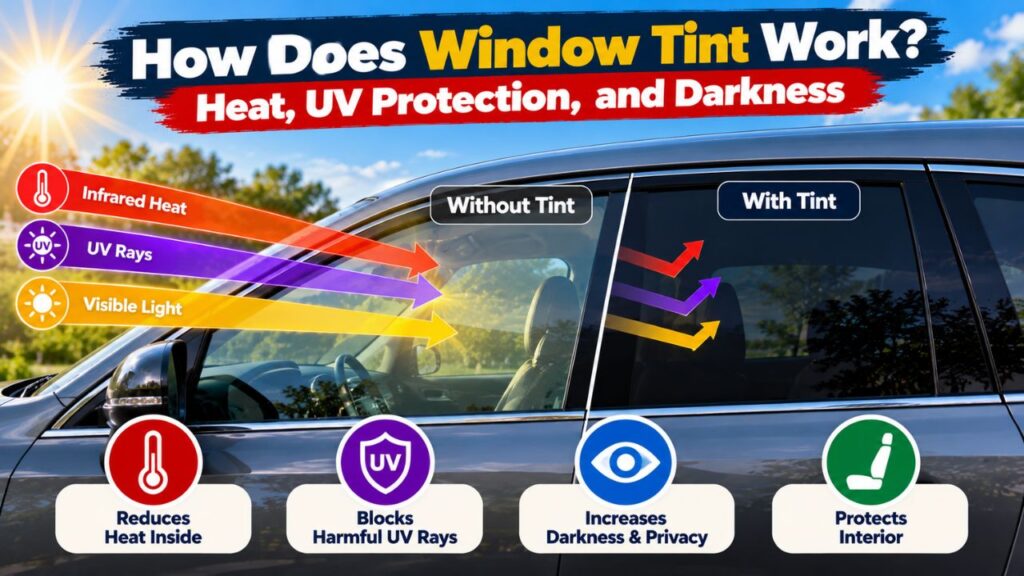
Automotive window tint changes the way sunlight passes through glass.
Sunlight contains different forms of electromagnetic radiation, including visible light, ultraviolet radiation, and infrared radiation.
A window film can be designed to interact with these parts of sunlight differently.
For example, it may allow much of the visible light to pass through while reflecting or absorbing a greater portion of the infrared energy.
Step 1: Sunlight Reaches the Tinted Window
When sunlight strikes a vehicle window, several things happen:
- Some solar energy is reflected away.
- Some energy is absorbed by the glass and film.
- Some energy passes through into the vehicle.
The proportions depend on the glass and film materials.
Ordinary automotive glass already absorbs or reflects certain wavelengths. Applying window tint changes the combined optical properties.
A film designed for solar control can reduce the total solar energy entering the cabin.
However, it does not necessarily block visible light, infrared radiation, and ultraviolet radiation by the same percentages.
Step 2: The Film Filters Different Wavelengths
Window tint contains materials selected to control particular portions of the solar spectrum.
The three important categories are:
| Solar Radiation | Main Characteristics | How Window Tint Helps |
| Ultraviolet (UV) | Invisible radiation associated with skin exposure and material deterioration | UV-absorbing materials reduce transmission |
| Visible light | Light that allows people to see objects and colors | Tint controls transmission, glare, and appearance |
| Solar infrared (IR) | Invisible radiation that contributes to solar heating | Specialized films absorb or reflect portions of infrared energy |
A film can be highly effective at blocking UV radiation without being particularly dark.
Similarly, advanced solar-control film can reject considerable infrared energy while allowing relatively high visible light transmission.
This separation of performance characteristics is an important part of modern tint technology.
Step 3: Less Solar Energy Enters the Cabin
Solar-control tint reduces heat gain by changing how solar energy interacts with the window.
Reflective materials direct some energy away from the glass.
Absorbing materials convert some incoming radiation into heat within the film and glass.
Part of that absorbed heat eventually moves toward the outside, while some can move into the vehicle.
Therefore, absorbing sunlight is not the same as eliminating all of its thermal energy.
The result is determined by the entire glass-film assembly, not merely the darkness of the tint.
Key Takeaway: Window tint works by controlling the transmission, reflection, and absorption of sunlight. Different film technologies produce different levels of darkness, glare reduction, UV protection, and heat rejection.
What Is Automotive Window Tint Made Of?
Most aftermarket automotive window tint is a thin, flexible plastic film made primarily from polyester.
Polyester provides transparency, dimensional stability, and strength while allowing the manufacturer to incorporate light-control materials.
High-performance products may contain several layers.
Polyester Film Layers
Polyethylene terephthalate (PET) is a common base material in window film.
It creates a relatively clear and flexible foundation for dyes, coatings, and other specialized components.
Some products use a single main polyester layer, while others combine multiple layers to achieve different optical properties.
The Whole Building Design Guide’s window film technology overview explains how polyester substrates, adhesives, scratch-resistant coatings, dyes, and metallic layers contribute to window film construction.
Although the guide covers architectural applications, these fundamental materials and manufacturing methods also apply to automotive window films.
Adhesive Layer
Automotive window film normally attaches to the interior surface of the glass using an optically clear adhesive.
The adhesive must hold the film securely without causing excessive distortion.
Many automotive films use pressure-sensitive adhesives.
Before installation, a removable protective liner covers the adhesive to prevent contamination.
The installer removes this liner before positioning the film against the glass.
Dyes, Metals, or Ceramic Materials
Different tint products contain different light-control ingredients.
Common examples include:
- Dyes that absorb selected wavelengths
- Carbon-based pigments or particles
- Thin metallic coatings
- Ceramic particles
- Specialized multilayer optical structures
These materials help determine the film’s appearance and solar-control properties.
A darker-looking film does not necessarily contain more advanced heat-rejection technology.
Scratch-Resistant Coating
Many films include a protective coating on the surface facing the vehicle interior.
This layer helps reduce damage caused by normal window cleaning and everyday contact.
However, scratch resistance does not mean the film is impossible to scratch.
Abrasive cleaning tools, sharp objects, and unsuitable chemicals can still damage the surface.
How Does Window Tint Block Heat From the Sun?
Window tint reduces solar heat gain by reflecting and absorbing portions of the sunlight that would otherwise pass through automotive glass.
The exact mechanism depends on film construction.
Heat Reflection
Reflective films use materials designed to redirect some incoming solar radiation.
Metalized films are a common example.
Their thin metallic layers can reflect portions of solar energy away from the vehicle.
However, reflection does not always create a visibly mirrored window.
Some advanced films are engineered to reflect selected infrared wavelengths while remaining relatively transparent to visible light.
Heat Absorption
Certain films absorb a portion of the incoming solar radiation.
This energy heats the film and the surrounding glass.
Heat then moves from the glass toward both the exterior and interior environments.
The amount that reaches the cabin depends on the properties of the glass-film system and surrounding conditions.
Because absorbed energy can still contribute to cabin heating, a film’s heat performance cannot be determined by absorption alone.
Infrared Rejection
Solar infrared radiation contributes to the heat entering a vehicle through its windows.
Some ceramic, metalized, and multilayer films are engineered to reduce infrared transmission.
However, infrared rejection percentages must be interpreted carefully.
A manufacturer may report performance over a narrow wavelength range or a broader portion of the solar infrared spectrum.
Two products advertising similar infrared rejection numbers may not have been tested using identical methods.
Total Solar Energy Rejection
Total Solar Energy Rejection (TSER) is one of the most useful measurements when comparing automotive films for heat control.
It describes the percentage of total solar energy rejected by the tested glass-film assembly.
The 3M automotive window film product guide describes TSER and the distinction between infrared rejection measurements.
For example, if a particular glass-film assembly has a TSER of 50%, that means approximately half of the incident solar energy is rejected under the specified test conditions.
It does not mean the temperature inside the vehicle will become 50% lower.
Cabin temperature depends on additional factors, including outside temperature, ventilation, window area, insulation, sunlight exposure, and time.
How Do Different Types of Window Tint Work?
Automotive tint products use several technologies.
The main differences involve how they control light and solar energy, how they look, and how they perform over time.
Dyed Window Tint
Dyed window film contains colorants that absorb portions of visible light.
Its main purpose is to darken the glass and reduce visible glare.
Because it absorbs light, it can also influence solar heat transmission.
However, basic dyed films often provide less advanced infrared heat control than specialized ceramic or multilayer products.
Lower-quality dyed films may fade or change color over time.
Best for: Drivers who mainly want an affordable darker appearance and daytime privacy.
Metalized Window Tint
Metalized window tint contains thin metallic layers deposited onto the film.
These layers can reflect portions of solar radiation, improving heat-control performance.
Depending on the product, metalized film may have a noticeable reflective appearance.
Some metallic constructions may also interfere with wireless signals, radio reception, or other electronic communication systems.
The extent of interference depends on the film and vehicle technology.
Best for: Drivers seeking reflective solar-control performance where the particular film is compatible with the vehicle.
Carbon Window Tint
Carbon window tint commonly uses carbon-based materials to create its appearance and contribute to its optical properties.
Many carbon films have a neutral or charcoal appearance.
They are often marketed for color stability and solar-control performance.
However, carbon is not a single standardized performance category.
The amount of infrared and total solar energy rejected depends on the actual film formulation.
A product labeled carbon should be evaluated using its technical specifications rather than its name alone.
Best for: Drivers seeking a dark appearance and a balance between product cost and performance.
Ceramic Window Tint
Ceramic tint uses nonmetallic ceramic materials, often in very small particles, to control portions of solar radiation.
Depending on its design, a ceramic film can reduce infrared transmission while maintaining useful visible light transmission.
Advantages of suitable ceramic films may include:
- Strong solar heat rejection
- Good optical clarity
- UV protection
- Color stability
- Nonmetallic construction
- Reduced risk of interference associated with some metallic films
However, not every ceramic film provides identical performance.
The amount of heat rejected depends on the particular product and test conditions.
Best for: Drivers who prioritize heat rejection and visibility over simply choosing the darkest available film.
Multilayer Optical Window Tint
Some advanced products use numerous thin optical layers to control sunlight.
Instead of relying entirely on dark dyes or metallic reflectivity, the structure can be engineered to interact selectively with different wavelengths.
This may allow relatively high visible light transmission while rejecting substantial solar energy.
For example, 3M describes certain automotive films that use more than 200 optical layers to manage light and heat.
This illustrates why film technology matters more than darkness alone.
Window Tint Type Comparison
| Film Type | Main Technology | Typical Strength | Main Limitation |
| Dyed | Light-absorbing colorants | Affordable darkness and privacy | Heat rejection varies; some films fade |
| Metalized | Thin metallic coatings | Solar reflection | Potential signal interference |
| Carbon | Carbon-based materials | Stable-looking color in suitable products | Performance differs by formulation |
| Ceramic | Nonmetallic ceramic materials | Solar heat rejection with useful clarity | Often costs more |
| Multilayer optical | Multiple engineered optical layers | Selective light and heat control | Premium products may be expensive |
Film technology is only one factor. Product quality and measured performance are essential when making comparisons.
How Does Window Tint Percentage Work?
Window tint percentage refers to visible light transmission (VLT).
VLT measures how much visible light passes through the film or finished glass-film assembly under specified testing conditions.
A lower VLT means a darker window.
Common Tint Percentages
| Tint VLT | Visible Light Transmitted | General Appearance |
| 5% | 5% | Extremely dark |
| 20% | 20% | Dark |
| 35% | 35% | Moderately dark |
| 50% | 50% | Light |
| 70% | 70% | Very light |
These are nominal values. The actual result depends on the film and existing glass.
Why 20% Tint Is Darker Than 35% Tint
A 20% film allows less visible light through than a 35% film.
This usually provides greater daytime privacy but also restricts outward visibility more.
A 35% film allows more visible light through, which can be useful for driving in dim conditions.
Neither percentage tells you how much total solar heat the film rejects.
How Factory Glass Affects Final VLT
Automotive glass may already reduce visible light before aftermarket tint is installed.
Adding film generally reduces the total transmission further.
A simplified estimate is:
Combined VLT = Glass VLT × Film VLT
For example:
- Original glass VLT: 80%
- Installed film VLT: 35%
0.80 × 0.35 = 0.28
Estimated combined VLT = 28%
This is an idealized calculation. Actual results depend on the glass-film combination and measurement conditions.
Because tint laws often apply to the completed window, a tint meter may be needed to verify compliance.
How Does Window Tint Block UV Rays?
Ultraviolet radiation is an invisible part of sunlight.
UV exposure can contribute to skin damage and deterioration of vehicle interior materials.
Many automotive window films contain UV-absorbing compounds or other UV-control materials.
UV-Blocking Ingredients
Manufacturers may incorporate UV inhibitors into the adhesive or other film layers.
These materials absorb or otherwise reduce the transmission of ultraviolet wavelengths.
Some high-quality automotive films are advertised as blocking up to 99% or more of certain UV radiation.
However, the precise performance depends on the product and how it was tested.
Do not assume every tint provides the same UV protection.
Does Darker Tint Block More UV?
Not necessarily.
A nearly clear film can provide substantial UV protection when specifically engineered for that purpose.
Likewise, a dark film does not automatically provide the highest UV rejection.
Check the manufacturer’s UV performance specifications.
Visible light transmission and ultraviolet rejection measure different properties.
Does Window Tint Protect the Vehicle Interior?
By reducing ultraviolet radiation and portions of visible light and solar heat, suitable films can help limit some causes of interior fading and material deterioration.
This can benefit:
- Seat upholstery
- Dashboard materials
- Plastic trim
- Leather surfaces
- Interior decorative components
However, fading can still occur due to heat, visible light, material aging, and other environmental factors.
Window tint reduces certain exposures; it does not permanently prevent deterioration.
Does UV-Blocking Tint Eliminate Sun-Exposure Risks?
No.
Window tint can reduce UV transmission through the treated glass, but protection varies with the product and the vehicle’s other windows.
Occupants may still receive sunlight through untreated glass or when windows are open.
Tint should not be considered a complete substitute for other appropriate sun-protection measures.
How Does Window Tint Reduce Glare?
Glare occurs when bright light makes it difficult or uncomfortable to see.
Window tint reduces glare primarily by limiting the visible light that passes through the glass.
Daytime Glare Reduction
During bright sunlight, tint can reduce the intensity of light entering through side windows.
This may improve comfort when sunlight strikes the driver or passenger from the side.
Darker films typically reduce more visible light than lighter films in the same product series.
However, the benefit comes with a tradeoff.
The reduction in visible light also affects how easily drivers see outside in darker conditions.
Nighttime Visibility
At night, dark tint reduces light from streetlights, pedestrians, signs, and other vehicles.
This can make it more difficult to identify objects through the tinted windows.
For example, 20% VLT film transmits less visible light than 35% VLT film.
Even if both use advanced ceramic technology, the darker film still reduces outward visibility more.
A film’s ability to reject heat does not eliminate this effect.
For night driving, a lighter legally compliant film is generally preferable to a darker one when visibility is the priority.
How Does Window Tint Create Privacy?
Tint can make the vehicle interior harder to see by reducing transmitted visible light and changing how light and reflections interact at the glass.
However, privacy is strongly influenced by the brightness on each side of the window.
Privacy During the Day
In bright daylight, the outside of the vehicle may be much brighter than the interior.
Reflections on the glass and reduced light transmission can make it difficult to see inside.
Darker films usually increase this effect.
This is why 20% tint generally provides more daytime privacy than 35% tint.
Privacy at Night
The situation can change at night.
If the cabin lights are turned on while the surroundings are dark, people outside may see into the vehicle more easily.
Tint does not function as a guaranteed one-way barrier.
The relative brightness of the interior and exterior matters.
Does Window Tint Work Like a One-Way Mirror?
Not exactly.
Some reflective films create a mirror-like appearance under favorable lighting conditions.
However, the reflective effect can reverse when the interior becomes brighter than the exterior.
Ordinary automotive tint primarily reduces light transmission and may change reflectivity, but it does not guarantee one-way vision.
How Is Window Tint Installed on Car Windows?
Most aftermarket automotive window film is installed on the inside surface of the glass.
The adhesive attaches the film to the interior side, while the outer glass surface remains exposed to weather and normal exterior washing.
Step 1: Clean the Window Thoroughly
The installer removes dirt, grease, and other contaminants from the glass.
Proper cleaning is important because small particles can become trapped beneath the film.
Trapped dirt may appear as bumps or spots after installation.
Step 2: Measure and Shape the Film
The film is cut to fit the window.
Some installers use computer-cut templates, while others cut and shape the film manually.
For curved glass, the installer may temporarily place the film on the outside to measure and heat-shrink it into the required shape.
This is a preparation step.
The final film is normally applied to the inside of the window.
Step 3: Remove the Protective Liner
The installer removes the temporary liner that protects the adhesive.
An application solution may be used to help position the film against the glass.
This solution allows adjustments before the film is fully secured.
Step 4: Apply and Smooth the Film
The installer positions the film on the interior surface and works out excess solution and air using suitable installation tools.
Correct positioning helps prevent wrinkles, trapped contamination, and poorly fitted edges.
Special care may be necessary around rear defroster lines, curved glass, and other window features.
Step 5: Allow the Film to Cure
The adhesive needs time to stabilize after installation.
During this period, some moisture haze or small water pockets may be visible.
Normal curing conditions depend on the film, temperature, humidity, and installation method.
Follow the installer’s guidance regarding:
- When windows may be rolled down
- When the film may be cleaned
- Appropriate cleaning products
- How long temporary moisture effects may remain
Persistent bubbles, peeling, or visible contamination after the recommended curing period may require professional inspection.
Does Window Tint Work Immediately After Installation?
The film begins affecting light transmission as soon as it is installed.
Its visible darkness and solar-control properties do not require a lengthy chemical activation process.
However, the adhesive system still needs time to cure.
What Happens During Curing?
After installation, residual application solution gradually evaporates or moves out of the film-glass interface.
The adhesive bond stabilizes as this process progresses.
Temporary cloudiness or small moisture patterns may become less noticeable.
Curing can take longer during cool or humid conditions.
Does Window Tint Become Darker After Curing?
The film’s rated VLT does not normally change dramatically because it cures.
However, the appearance may become more uniform as trapped installation moisture disappears.
A freshly installed film may look hazy in certain areas before curing is complete.
If the film changes color significantly over time, that may indicate product aging or degradation rather than normal curing.
Does Window Tint Make a Parked Car Cooler?
Window tint can reduce the rate at which solar energy enters a parked vehicle through treated windows.
This may improve comfort and reduce solar heat gain.
However, a parked vehicle can still become dangerously hot.
Why a Tinted Car Still Heats Up
Sunlight may enter through untreated glass, including the windshield.
The vehicle also absorbs solar energy through its roof, body panels, and other surfaces.
Heat can accumulate inside the enclosed cabin.
Even high-performance tint cannot eliminate all these heat sources.
The temperature inside a parked vehicle can still rise substantially.
Never rely on window tint to make a parked vehicle safe for children, pets, or anyone unable to leave independently.
Does Darker Tint Always Keep a Car Cooler?
No.
A darker film may absorb more visible light while providing less overall solar energy rejection than a lighter, high-performance film.
For heat control, compare TSER and other relevant performance measurements.
Do not choose the darkest available film solely because you assume it will provide maximum cooling.
Does Window Tint Affect Electronics or Defrosters?
The answer depends on the film and its installation.
GPS, Radio, and Mobile Signals
Some metal-containing films can affect radio-frequency transmission or reception.
However, the degree of interference depends on the metallic layer, window coverage, antenna position, and vehicle design.
Nonmetallic ceramic and certain other film constructions avoid this particular concern.
If signal compatibility matters, review the manufacturer’s technical information before installation.
Rear Window Defrosters
Many vehicle rear windows contain thin defroster elements on the interior glass surface.
Tint can be installed over compatible defroster-equipped glass using appropriate methods.
However, removing old tint or scraping the window carelessly can damage the heating elements.
Professional removal is particularly useful when the old film is strongly bonded to the defroster grid.
Does Tint Make Glass Shatterproof?
No.
Ordinary solar-control window tint is not the same as a dedicated safety or security film.
Some film products may help retain glass fragments when breakage occurs, but their performance depends on film design, thickness, attachment, and testing.
Standard window tint should never be considered shatterproof or bulletproof.
Is Window Tint Legal on Every Car Window?
No.
Automotive window tint is regulated differently across U.S. states and may also depend on the vehicle classification and glass location.
A shade permitted on rear windows may be prohibited on front side windows.
Windshields generally face more restrictive requirements.
Front Side Windows
Front side windows are important for identifying pedestrians, cyclists, and nearby traffic.
States may require a relatively high minimum visible light transmission.
For this reason, a dark film that looks attractive on the rear glass may not be suitable or lawful on the driver’s window.
Rear Windows
Some states permit darker tint on rear side and back windows, sometimes with additional conditions.
Vehicle type and mirror requirements may affect the applicable rules.
Windshield Tint
Many jurisdictions restrict the use of dark tint across the main windshield viewing area.
Some permit specific upper windshield strips or narrowly defined treatments.
Before installation, verify the current law through the relevant state authority.
Remember that the legal requirement may apply to the final glass-film combination rather than the advertised film percentage.
How to Choose Window Tint That Works Best for Your Car
Choosing the right film begins with identifying whether your priority is heat rejection, privacy, appearance, glare reduction, or UV protection.
These goals do not always require the same tint technology or shade.
For Better Heat Rejection
Choose a film with verified total solar energy rejection.
Compare technical data sheets under equivalent test conditions.
A suitable ceramic or multilayer film may provide strong heat control without excessively dark glass.
For More Privacy
Choose a legally permitted film with lower visible light transmission.
A darker film generally makes the cabin harder to see during daylight.
However, remember that dark tint also reduces outward visibility and does not guarantee privacy at night.
For Better Night Visibility
Choose a higher VLT film.
The additional transmitted light can make it easier to see through windows in dim conditions.
Visibility and legal compliance should take priority for front side windows and windshields.
For UV Protection
Select a product with clearly documented UV rejection.
A dark appearance is not necessary for strong UV performance.
Some relatively clear films are specifically designed to reduce UV transmission.
For Long-Term Durability
Review:
- Film manufacturer and product series
- Color-stability specifications
- Warranty terms
- Installer reputation
- Cleaning requirements
- Compatibility with the vehicle’s glass
A properly installed, suitable film is generally more dependable than choosing an unfamiliar product based only on darkness or marketing claims.
Common Misconceptions About How Window Tint Works
Understanding a few common misconceptions can prevent poor purchasing decisions.
Myth: Darker Tint Always Blocks More Heat
Fact: Heat rejection depends on solar-control technology and measured performance.
A lighter high-performance film may reject more solar energy than a darker basic film.
Myth: All Ceramic Tint Performs the Same
Fact: Ceramic products differ in their materials, construction, and tested specifications.
The label alone does not establish performance.
Myth: A 20% Film Always Produces a 20% Window
Fact: Existing glass can reduce the final VLT further.
The completed glass-film combination must be measured when an accurate legal reading is required.
Myth: Window Tint Completely Stops UV Radiation
Fact: Many products provide substantial UV rejection, but performance varies.
Check the actual manufacturer’s specifications and remember that other windows and sunlight exposure remain relevant.
Myth: Window Tint Makes a Car Safe in Hot Weather
Fact: Tint may reduce solar heat gain, but an enclosed vehicle can still heat up dangerously.
Tint is not a substitute for ventilation, climate control, or safe parking practices.
Conclusion
Understanding how does window tint work comes down to how specialized films control different parts of sunlight.
Automotive window tint uses polyester layers, adhesives, and light-control materials to reduce visible light transmission, ultraviolet exposure, glare, and solar heat gain.
Dyed films primarily provide darkness, while metalized, ceramic, carbon-based, and multilayer technologies can offer different combinations of solar-control performance.
The most important distinction is that tint darkness and heat rejection are not the same measurement.
A high-quality lighter film may provide better heat control than a dark film with limited infrared performance.
For everyday driving, I recommend selecting a product based on its tested TSER, UV rejection, visible light transmission, and compatibility with the vehicle. Legal requirements and nighttime visibility should also influence the decision.
The best window tint is one that improves comfort and provides the desired appearance without unnecessarily restricting the driver’s ability to see.
FAQs About How Does Window Tint Work
How Does Window Tint Work Without Blocking All Light?
Window tint uses materials that absorb or reflect selected wavelengths while allowing other light to pass through. Advanced films can reject portions of solar infrared energy and block UV radiation while remaining relatively transparent to visible light.
Does Window Tint Work From the Inside or Outside?
Most aftermarket automotive window film is installed on the inside surface of the glass. Installers may temporarily position film on the outside for measuring or heat-shrinking curved pieces, but the final adhesive installation is normally on the interior.
Does Window Tint Work Better in Hot Weather?
Window tint reduces solar energy entering through the treated glass under suitable sunlight conditions. Its cooling benefit is often more noticeable when solar heat gain is significant. However, the actual cabin temperature depends on sunlight, ventilation, vehicle construction, and other environmental conditions.
Can Window Tint Block Heat Without Being Dark?
Yes. Certain ceramic and multilayer optical films are designed to reject substantial solar energy while transmitting relatively high levels of visible light. Compare TSER and the film’s tested properties rather than assuming darker tint is required for effective heat control.
Does Window Tint Stop People From Seeing Inside?
Window tint can make the interior harder to see, particularly during daylight when the outside is brighter than the cabin. However, it does not guarantee complete privacy. Interior lighting and the relative brightness on either side of the glass affect visibility.
How Long Does Automotive Window Tint Last?
Lifespan depends on the film’s construction, installation quality, environmental exposure, and maintenance. Quality films may remain functional for many years, while lower-quality products can fade, discolor, or peel sooner. Check the product warranty and inspect the film for signs of deterioration.
Does Window Tint Reduce Visibility at Night?
Yes. Tint reduces the amount of visible light passing through the treated window. Dark films can make pedestrians, signs, and other objects harder to see in low-light conditions. A lighter film generally provides better nighttime outward visibility than a darker one.