Car window tint is primarily made of a thin polyester plastic called polyethylene terephthalate (PET), combined with adhesives, protective coatings, and light-control materials such as dyes, carbon, metals, or ceramic particles. These materials are arranged in extremely thin layers to create a flexible film that adheres to automotive glass.
Although window tint looks like a simple dark sheet, its construction can be surprisingly complex. Basic dyed films use coloring materials to reduce visible sunlight, while advanced ceramic and multilayer films use specialized technology to manage solar heat without requiring extremely dark glass.
The materials also affect durability, optical clarity, heat rejection, UV protection, and compatibility with electronic devices. Two window films with the same darkness percentage may perform very differently because of their internal construction.
Understanding these differences is useful when comparing dyed, carbon, metalized, and ceramic window tints.
In this article, I explain what window tint is made of, the purpose of each film layer, and how different materials control sunlight and heat. I also cover how manufacturers produce window films, how ceramic tint differs from regular tint, what makes certain films more durable, and which materials are worth considering for your vehicle.
What Is Window Tint Made Of? Main Materials Explained
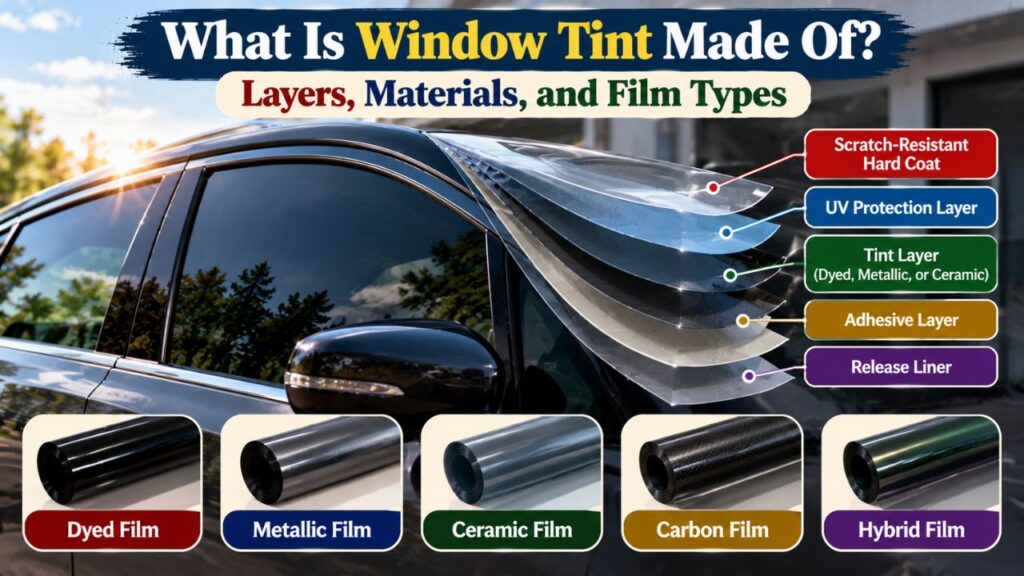
Most aftermarket automotive window films are built around a thin polyester base.
Manufacturers combine that base with different materials to achieve the desired darkness, heat rejection, reflectivity, durability, and optical clarity.
A typical window tint may contain several layers, although the exact construction varies by manufacturer and product series.
| Window Tint Component | Common Material | Main Purpose |
| Base film | PET polyester | Provides flexible structural support |
| Color or performance layer | Dyes, pigments, carbon, metals, or ceramics | Controls visible light and solar energy |
| UV-control components | UV absorbers or inhibitors | Reduce ultraviolet transmission and material degradation |
| Adhesive | Optical-grade acrylic or another suitable adhesive | Bonds the film to glass |
| Scratch-resistant coating | Protective hard coating | Resists surface abrasion |
| Laminating layers | Polyester films and bonding adhesives | Combine multiple functional layers |
| Removable release liner | Coated polyester or similar material | Protects adhesive before installation |
Not every window film uses all these components in the same arrangement.
Some contain only a few functional layers, while advanced products may incorporate many extremely thin layers.
According to the European Window Film Association’s manufacturing guidance, window films generally use a polyester substrate, scratch-resistant coating, installation adhesive, and protective release liner. Additional materials, including dyes and metal coatings, provide specific performance characteristics.
Key Takeaway: PET polyester provides the foundation of most car window films. The additional materials determine how the film looks, handles sunlight, and performs over time.
Why Is Polyester Used to Make Window Tint?
Polyethylene terephthalate, usually abbreviated PET, is a thermoplastic polymer from the polyester family.
It is the primary structural material in many automotive window films.
PET is used because it can be manufactured into a very thin, transparent sheet while retaining useful mechanical properties.
Optical Clarity
Automotive window film must allow drivers to see through the glass without excessive distortion.
PET can be manufactured with high optical clarity.
When combined with properly formulated coatings and adhesives, it allows manufacturers to produce films with different darkness levels while maintaining a clear view.
However, poor manufacturing or installation can still create haze or distortion.
The polyester base alone doesn’t guarantee excellent optical quality.
Flexibility and Strength
Car windows are rarely completely flat.
Many side and rear windows have curved surfaces.
Polyester film is flexible enough to conform to automotive glass when processed and installed correctly.
Certain films can also be heat-shaped to fit curved windows.
This flexibility helps make PET suitable for a wide range of vehicle designs.
Dimensional Stability
PET offers useful dimensional stability under normal conditions.
This means the material can maintain its shape relatively well when properly manufactured and used.
Dimensional stability matters because window film experiences changes in temperature and sunlight exposure.
However, excessive heat, incompatible products, or improper installation can still damage the film.
Compatibility With Coatings
Polyester can be combined with dyes, metals, ceramic coatings, adhesives, and protective treatments.
This versatility allows manufacturers to use the same general base material for different types of window tint.
The result may be an affordable dyed film or a much more advanced solar-control product.
What Are the Different Layers of Car Window Tint?
Window tint is generally a laminated product, meaning multiple materials are combined into a functional sheet.
Each layer serves a different purpose.
1. Scratch-Resistant Surface Coating
The outermost exposed surface usually contains a protective hard coating.
Its purpose is to reduce scratching and abrasion during ordinary use.
Automotive windows experience repeated contact with cleaning cloths, dust, and other materials.
Some side windows also move against seals whenever they are raised or lowered.
A suitable hard coating helps protect the film’s surface.
However, scratch-resistant doesn’t mean scratch-proof.
Sharp tools, abrasive cleaners, and damaged window seals can still scratch or damage the film.
2. Polyester Base Layer
The PET layer provides the film’s primary structural support.
It holds the functional coatings together and allows the material to be handled, shaped, and installed.
Some window films contain more than one polyester layer.
These may be bonded together to achieve specific optical or mechanical properties.
3. Light- and Heat-Control Layer
This layer determines many of the film’s visible and solar-control characteristics.
Depending on the product, it may contain:
- Organic dyes.
- Color pigments.
- Carbon-based materials.
- Extremely thin metallic coatings.
- Ceramic materials.
- Specialized multilayer optical structures.
A film may use more than one type of light-control technology.
For example, some products combine coloring materials with metallic or other solar-control components.
4. UV-Blocking Components
Many window films contain materials designed to absorb or reduce ultraviolet radiation.
These may be included within a coating, adhesive, or another functional layer.
UV protection helps reduce ultraviolet exposure through the glass and can contribute to protecting interior materials from sunlight-related deterioration.
However, not all films have identical UV-blocking performance.
Check the manufacturer’s specifications.
5. Installation Adhesive
The adhesive bonds the film to the inside surface of the glass.
Many automotive window films use optically clear pressure-sensitive acrylic adhesives.
The adhesive must provide reliable bonding without creating excessive haze or optical distortion.
Poor adhesion or contamination can contribute to peeling, bubbles, or other defects.
6. Protective Release Liner
Before installation, the adhesive is covered by a removable liner.
This protects the adhesive from dirt, scratches, and accidental contact.
The installer removes the liner immediately before applying the film.
The release liner is not part of the window tint left on the car after installation.
It is a temporary protective component used during manufacturing, handling, storage, and application.
What Is Dyed Window Tint Made Of?
Dyed window tint uses polyester film combined with color-producing dyes or pigments.
These coloring materials absorb some visible light, creating the familiar dark appearance.
Dyed film is generally among the less expensive types of automotive window tint.
How Dyed Film Works
The dyes reduce the amount of visible light passing through the glass.
This creates several effects:
- Darker-looking windows.
- Reduced visible sunlight.
- Some glare reduction.
- Greater daytime privacy.
However, the film’s ability to manage solar heat depends on more than its darkness.
A basic dyed film may absorb substantial sunlight without providing the total solar heat rejection of certain advanced products.
Advantages of Dyed Tint
Dyed window tint is appealing because it is:
- Generally affordable.
- Available in several darkness levels.
- Suitable for creating a neutral dark appearance.
- Usually nonmetallic.
- Widely available from installers.
It can be a reasonable choice when appearance and privacy matter more than premium heat rejection.
Disadvantages of Dyed Tint
Some lower-quality dyed films can fade or change color after prolonged sunlight exposure.
An older film may develop a purple or uneven appearance.
This doesn’t happen to every dyed film.
Modern color-stable products can use improved materials and manufacturing processes to reduce fading.
Best use: Drivers who want a lower-cost tint primarily for appearance, privacy, and visible glare reduction.
What Is Carbon Window Tint Made Of?
Carbon window tint uses carbon-based materials within or alongside a polyester film structure.
The exact carbon formulation varies by manufacturer.
Some products use finely dispersed carbon-containing materials to create a dark, relatively neutral appearance.
How Carbon Tint Works
Carbon-containing components influence how the film absorbs and transmits light.
Depending on the product, they may contribute to:
- Visible light reduction.
- Solar energy management.
- Color stability.
- A neutral charcoal appearance.
Carbon tint doesn’t normally require a continuous metallic layer.
This makes it appealing for drivers who want a nonmetallic window film.
Is Carbon Tint Better Than Dyed Tint?
Some carbon films provide improved color stability and solar performance compared with basic dyed films.
However, not every carbon film is better than every dyed product.
The result depends on the manufacturing process and the actual film specifications.
For example, a premium dyed film may outperform an inexpensive carbon film in certain measurements.
Compare the product’s tested heat rejection, UV protection, and durability rather than relying only on the material category.
Does Carbon Window Tint Contain Metal?
Carbon film doesn’t necessarily contain a functional metallic coating.
However, manufacturers may combine different technologies in certain products.
If signal compatibility is important, check whether the specific film is officially classified as nonmetalized.
Best use: Drivers who want a dark appearance, good color stability, and a nonmetallic film at a midrange price.
What Is Metalized Window Tint Made Of?
Metalized window tint combines a polyester base with extremely thin layers of metal.
Aluminum is one material used in metalized film manufacturing, although other metals or alloys may be used.
The metallic layer is applied through specialized manufacturing processes.
How Metalized Window Tint Works
Metallic coatings can reflect portions of incoming solar radiation.
This can reduce the amount of solar energy transmitted through the glass.
The coatings may also influence the film’s:
- Visible reflectivity.
- Color.
- Heat rejection.
- Glare performance.
- Appearance from outside the vehicle.
Some metalized films have a noticeable reflective look, while others are designed to appear relatively neutral.
How Metal Is Applied to Window Film
Two important manufacturing methods are vacuum metallizing and sputtering.
Vacuum metallizing: Metal is evaporated inside specialized equipment and deposited as a thin coating on the polyester film.
Sputtering: Energetic particles dislodge atoms from a metal or alloy target, allowing them to form a controlled coating on the film.
These processes create much thinner metallic layers than ordinary household aluminum foil.
The coating is part of the film’s engineered structure.
Advantages of Metalized Tint
A properly manufactured metalized film may provide:
- Useful solar heat rejection.
- Reflective solar-control properties.
- Durable coloration.
- Reduced visible glare.
- A distinctive appearance.
Can Metalized Tint Interfere With Electronics?
Some metallic films can affect the reception of certain radio-frequency signals.
The likelihood depends on the film’s construction, the frequency involved, and the vehicle’s antenna arrangement.
Potentially affected systems can include:
- Radio reception.
- GPS-related signals.
- Mobile communications.
- Certain vehicle antenna systems.
However, interference isn’t guaranteed with every metalized film.
Ask the manufacturer about compatibility with your vehicle’s electronic systems.
Best use: Drivers who want reflective solar control and have verified that the selected film is compatible with their vehicle.
What Is Ceramic Window Tint Made Of?
Ceramic window tint typically combines a polyester base with specialized ceramic-containing coatings or particles.
These materials are engineered to control portions of solar radiation, particularly infrared energy.
Ceramic window tint isn’t made from a rigid sheet of household ceramic.
The ceramic-related materials exist within extremely thin film layers.
How Ceramic Materials Reject Heat
Ceramic coatings can absorb or reflect selected wavelengths of infrared radiation, depending on their composition.
Infrared radiation contributes to solar heating.
By managing portions of that energy, ceramic films can reduce heat transmission through automotive windows.
The specific performance varies among products.
According to Eastman’s technical description of infrared-control ceramic films, these PET-based films use ceramic coatings that absorb and, to some extent, reflect solar infrared radiation. The products also incorporate mounting adhesives and protective release liners.
What Are Nano-Ceramic Particles?
Nano-ceramic technology uses extremely small ceramic-related particles or structures.
Their small dimensions allow manufacturers to create thin coatings designed to manage solar radiation while maintaining useful visible transparency.
The word nano refers to the scale of the technology.
However, nano-ceramic isn’t one universal formula.
Different manufacturers use proprietary material combinations and production methods.
A nano-ceramic label alone doesn’t guarantee a particular heat rejection percentage.
Advantages of Ceramic Window Tint
Ceramic films may offer:
- Strong infrared rejection.
- Useful total solar energy rejection.
- High visible clarity.
- UV protection.
- Solar control at relatively light shades.
- Nonmetallic construction in many products.
- Good color stability.
The actual benefits depend on the selected product.
Does Ceramic Tint Block Radio Signals?
Nonmetalized ceramic films generally avoid the radio-frequency interference concerns associated with some metalized window films.
However, check the specific product’s construction.
Not every film described as ceramic has identical layers or performance.
Is Ceramic Tint Better Than Regular Tint?
Ceramic tint may provide better heat rejection than basic dyed film, especially when both products have similar VLT.
However, ceramic films are not automatically superior in every measurement.
A well-designed multilayer optical film or another premium product can also offer strong solar-control performance.
Best use: Drivers who prioritize heat rejection, optical clarity, and solar control without relying on very dark glass.
Dyed vs. Carbon vs. Metalized vs. Ceramic Window Tint
The following table compares the main automotive window tint materials.
| Film Type | Main Light-Control Material | General Appearance | Heat Control | Main Limitation |
| Dyed | Dyes or pigments | Dark, usually nonreflective | Product-dependent; often basic | Lower-quality products may fade |
| Carbon | Carbon-containing materials | Neutral charcoal | Moderate to high, depending on film | Performance varies considerably |
| Metalized | Thin metal or alloy coatings | May be reflective | Often strong solar control | Possible electronic interference |
| Ceramic | Specialized ceramic components | Usually neutral, low-reflective | Often strong infrared control | Higher price for premium products |
| Multilayer optical | Multiple engineered optical layers | Clear to dark | Can be high even at light VLT | Product complexity and cost |
No material category guarantees a specific percentage of heat rejection or UV protection.
The exact film series matters.
What Is Hybrid Window Tint Made Of?
Hybrid window tint combines more than one functional technology.
For example, a manufacturer may combine dyed polyester with a metallic coating.
Other products may combine different nonmetallic light-control materials.
Why Manufacturers Combine Materials
Different components manage sunlight differently.
One material may provide darkness, while another improves infrared rejection or reflectivity.
Combining layers allows manufacturers to balance:
- Appearance.
- Visible light transmission.
- Heat rejection.
- Reflectivity.
- Cost.
- Durability.
A hybrid film may offer performance between two traditional categories, but this isn’t guaranteed.
The term doesn’t describe one standardized chemical formulation.
Is Hybrid Tint Better Than Ceramic?
Not necessarily.
Hybrid and ceramic films can use very different technologies.
A high-quality hybrid film may outperform a poorly specified ceramic product in certain measurements.
Compare the actual film data instead of treating ceramic as automatically the best option.
How Is Automotive Window Tint Manufactured?
Window tint manufacturing involves several processes designed to turn raw polyester and other materials into a thin, optically clear product.
The exact methods depend on the film technology.
Step 1: Manufacturing the Polyester Base
PET is processed into a thin film.
The material is formed and stretched under controlled conditions to obtain the desired thickness and physical properties.
Optical clarity is important because the final film will be installed over glass used for visibility.
Step 2: Adding Light-Control Materials
Depending on the product, manufacturers introduce dyes, pigments, carbon-containing materials, metallic coatings, ceramic components, or other optical treatments.
These can be incorporated using methods such as:
- Coloring.
- Coating.
- Vacuum deposition.
- Sputtering.
- Laminating.
Different methods produce different film structures.
Step 3: Combining Multiple Layers
Some films use several sheets of polyester bonded together.
Others contain specialized coatings on a single primary substrate.
Advanced multilayer products can contain many very thin functional layers.
The total number of layers doesn’t automatically determine which film performs best.
Their materials and optical design matter more.
Step 4: Applying Protective Coatings
The exposed surface receives a scratch-resistant coating.
This helps the installed film tolerate routine handling and cleaning.
Step 5: Applying Adhesive
Manufacturers add a transparent adhesive suitable for the intended glass application.
The adhesive must provide reliable bonding without creating unacceptable optical distortion.
Step 6: Adding the Release Liner
A protective liner covers the adhesive during storage and transportation.
The liner is removed during installation.
Step 7: Cutting and Preparing the Film
The finished film is supplied in rolls or prepared in other suitable formats.
Professional installers cut or plot the film to fit the vehicle’s glass.
Certain automotive films are heat-shaped to conform to curved windows before being installed on the interior glass surface.
How Thick Is Car Window Tint?
Automotive window film is extremely thin.
Many solar-control films have thicknesses in the general range of approximately 1–2 mil, although products vary.
One mil equals 0.001 inch, not one millimeter.
| Film Thickness | Inches | Millimeters |
| 1 mil | 0.001 | 0.0254 mm |
| 1.5 mil | 0.0015 | 0.0381 mm |
| 2 mil | 0.002 | 0.0508 mm |
| 4 mil | 0.004 | 0.1016 mm |
| 8 mil | 0.008 | 0.2032 mm |
Thicker films aren’t automatically better at rejecting heat.
For example, a thin advanced solar-control film may outperform a thicker basic dyed film.
Thickness becomes especially relevant when comparing ordinary solar-control films with specialized safety and security films.
Is Window Tint the Same as Security Film?
No.
Ordinary automotive tint is mainly designed for solar control, glare reduction, and appearance.
Security films use materials and constructions intended to improve glass-fragment retention or resistance to certain impacts.
They are often thicker than conventional solar-control films.
However, applying a thick film doesn’t make automotive glass bulletproof or eliminate injury risk.
Products should be evaluated according to their specific tested applications.
How Do Window Tint Materials Control Sunlight?
Sunlight contains different forms of electromagnetic radiation.
Three important categories for automotive windows are ultraviolet, visible, and infrared radiation.
Different window tint materials interact with these portions of sunlight differently.
Visible Light Transmission (VLT)
VLT describes how much visible light passes through a window or film-and-glass assembly.
For example:
- 5% VLT: Very dark.
- 20% VLT: Dark.
- 35% VLT: Moderately dark.
- 50% VLT: Light to medium.
- 70% VLT: Relatively light.
A lower VLT means less visible light enters the vehicle.
However, it doesn’t automatically indicate better infrared or total solar heat rejection.
Total Solar Energy Rejection (TSER)
TSER describes the proportion of incident solar energy rejected by the filmed glass under specified test conditions.
It is useful for comparing overall solar heat control.
A film with higher TSER generally reduces more solar energy transmission under equivalent testing conditions.
When comparing products, verify that the values are measured under comparable conditions.
Infrared Rejection
Infrared rejection refers to how a film manages portions of infrared radiation.
However, manufacturers may use different infrared measurement methods and wavelength ranges.
Two products advertising high infrared rejection may not have identical overall solar heat performance.
For a more complete evaluation, compare infrared specifications alongside TSER.
UV Rejection
UV rejection measures the reduction in ultraviolet radiation passing through the film or window.
Many quality automotive films provide high UV rejection.
However, the exact performance depends on the product and testing method.
The film’s visible darkness doesn’t necessarily indicate its UV-blocking ability.
Key Takeaway: VLT measures darkness, TSER measures overall solar energy rejection, and UV rejection describes ultraviolet protection. One number cannot accurately describe every aspect of window tint performance.
Is Factory Window Tint Made From the Same Material?
Not always.
Factory privacy glass and aftermarket window tint can look similar, but they are created differently.
Factory Privacy Glass
Many vehicles have rear windows manufactured with darker-colored glass.
The color may come from materials incorporated into the glass during production.
This type of factory tint isn’t necessarily an adhesive polyester film.
Since the color is part of the glass, it doesn’t peel away like an aftermarket film.
However, factory privacy glass doesn’t automatically provide the same solar-control properties as a high-performance aftermarket ceramic film.
Its actual performance depends on the glass specification.
Aftermarket Window Tint
Aftermarket tint is a separate film installed on existing glass.
It usually consists of PET polyester, functional coatings, and adhesive.
It can be removed and replaced using suitable procedures.
The final window’s visible light transmission depends on both the film and the original glass.
Does Adding Film Over Factory Tint Make It Darker?
Yes.
Installing aftermarket tint over factory privacy glass generally reduces the completed window’s VLT further.
For example, applying a 35% film to glass that already transmits 30% of visible light would produce an estimated combined VLT of:
30 × 35 ÷ 100 = 10.5%
This is a simplified estimate.
Actual measurements depend on the glass and film.
Check legal requirements before layering aftermarket tint over existing privacy glass.
Is Car Window Tint Made From Plastic or Vinyl?
Most conventional automotive window tint is based on polyester plastic, specifically PET.
It isn’t generally made from the same material as ordinary vinyl wraps.
Window Tint vs. Vinyl Wrap
Automotive window tint is designed to maintain controlled transparency.
Vinyl wraps are commonly used on painted vehicle surfaces to change color or appearance.
Most standard vinyl wraps aren’t suitable substitutes for transparent automotive window film.
Their optical properties, adhesives, and intended applications differ.
Window Tint vs. Paint Protection Film
Paint protection film is usually installed over painted exterior panels to reduce damage from minor impacts and abrasion.
Many modern paint protection films use thermoplastic polyurethane (TPU).
Window tint typically uses PET polyester.
These materials are designed for different functions.
Don’t assume a product suitable for painted body panels is automatically appropriate for vehicle windows.
Is Window Tint Material Safe for Car Windows?
Quality automotive window film is designed for installation on compatible vehicle glass.
However, safety depends on the film’s optical properties, placement, and installation.
Optical Distortion
Drivers need a clear view through windows.
Poor-quality films, damaged materials, or improper installation can create haze, bubbles, or distortion.
Avoid films that interfere with the ability to recognize pedestrians, vehicles, and road hazards.
Nighttime Visibility
Darker films reduce visible light entering the vehicle.
A 20% film permits less light than a 35% film.
This difference can become important at night or during poor weather.
Choose an appropriate VLT for each window’s location and the applicable legal requirements.
Electronic Compatibility
Nonmetalized films generally avoid some signal-interference problems associated with metallic coatings.
However, compatibility should be checked for the actual product and vehicle.
Glass Compatibility
Automotive window film should be selected for the intended glass.
The windshield, side windows, rear glass, and special coated glass can have different requirements.
Follow the vehicle and film manufacturers’ guidance.
A product designed for automotive glass shouldn’t automatically be assumed appropriate for plastic convertible windows, acrylic panels, or other nonglass surfaces.
What Makes Some Window Tint Last Longer Than Others?
Window tint durability depends on its materials, construction, installation, and exposure conditions.
Premium materials can offer advantages, but improper installation or maintenance may still cause problems.
Color Stability
Some lower-quality dyed films may fade or develop unwanted color changes after repeated UV exposure.
Products designed for color stability may resist those changes better.
However, durability varies by brand and film series.
Adhesive Quality
The adhesive must remain bonded to the glass through temperature changes and normal vehicle use.
Poor adhesion, contamination, or improper installation can contribute to peeling or bubbles.
A quality adhesive system helps maintain long-term performance.
Protective Hard Coating
The scratch-resistant top layer helps protect the film during cleaning and daily use.
Without suitable abrasion resistance, the surface may become damaged more easily.
Installation Quality
Even an advanced film can fail prematurely when installed incorrectly.
Common problems include:
- Contaminated glass.
- Trapped debris.
- Damaged film during shaping.
- Incorrect trimming.
- Poor edge adhesion.
- Inadequate curing.
Professional installation can help reduce these risks, particularly on complex curved glass.
Cleaning and Maintenance
Use cleaners approved by the film manufacturer.
Avoid abrasive pads, sharp tools, and cleaning methods that may damage the coating.
Follow the installer’s instructions before lowering freshly tinted windows or cleaning new film.
How to Choose the Best Window Tint Material for Your Car
The best window film depends on what you want to improve.
Choosing solely by the darkness percentage or marketing label can lead to disappointing results.
For Affordable Privacy
A quality dyed film may be suitable.
It provides a dark appearance without the cost of many premium solar-control products.
Choose a reputable product with acceptable color stability and warranty coverage.
For a Balance of Price and Performance
Carbon film is worth comparing.
It may provide useful solar control and color stability at a moderate cost.
However, examine the actual product specifications.
For Maximum Solar Heat Control
Compare high-performance ceramic and multilayer optical films.
Pay attention to TSER and tested infrared performance.
Don’t assume a darker shade necessarily provides better heat rejection.
For Electronic Compatibility
Consider a verified nonmetalized product.
This is particularly relevant if you want to minimize the possibility of interference with antennas and communication systems.
For Better Nighttime Visibility
Choose a lighter legally compliant VLT, especially for windows critical to driving.
A premium light film may offer useful solar protection without substantially reducing visible light.
For Long-Term Durability
Compare:
- Manufacturer reputation.
- Tested solar performance.
- Color stability.
- Adhesive quality.
- Scratch-resistant coating.
- Warranty terms.
- Installer workmanship.
The exact film series matters more than broad descriptions such as premium, nano, or professional grade.
Common Misconceptions About Window Tint Materials
All Window Tint Is Made of the Same Plastic
Most automotive films use PET polyester, but their additional layers vary.
Dyed, carbon, metalized, ceramic, and multilayer films have different functional materials.
Ceramic Tint Is Made From Solid Ceramic
Ceramic tint is not a rigid sheet of ceramic.
It uses specialized ceramic-containing materials within thin-film construction.
Darker Window Tint Always Blocks More Heat
Visible darkness and total solar heat rejection measure different properties.
A lighter advanced film may reject more solar energy than a darker basic film.
Carbon and Ceramic Tint Are the Same
Carbon and ceramic films use different functional materials.
Both may be nonmetallic, but their construction and performance vary.
All Metallic Tint Interferes With Electronics
Certain metalized films can cause signal interference, but the effect depends on their construction and the vehicle’s electronic systems.
Not every metallic film causes noticeable interference.
All Ceramic Tint Performs Identically
Ceramic is a broad technology category.
Different manufacturers use different formulations, coatings, and film structures.
Compare verified specifications rather than assuming the label guarantees a particular result.
Conclusion
So, what is window tint made of? Most aftermarket automotive window films use a PET polyester base combined with adhesives, protective coatings, and functional materials that control light and solar energy.
Dyed films use coloring materials for darkness, carbon films use carbon-containing components, metalized films incorporate thin metallic layers, and ceramic films use specialized ceramic technology to manage solar radiation.
These materials influence appearance, heat rejection, UV protection, electronic compatibility, and durability.
For a basic dark appearance, a quality dyed or carbon film may be sufficient. If solar heat rejection is the main priority, compare ceramic and advanced multilayer films using verified performance measurements.
I recommend selecting window tint based on its actual construction, tested specifications, legal suitability, and installation quality rather than choosing solely by darkness or product name.
FAQs About What Is Window Tint Made Of
Is Car Window Tint Made of Plastic?
Yes. Most aftermarket car window tint is primarily made from PET polyester, a type of plastic.
Manufacturers add coatings, adhesives, and other materials to control sunlight, heat, and appearance.
What Material Is Ceramic Window Tint Made From?
Ceramic window tint generally uses a PET polyester base with specialized ceramic-containing materials.
These may be incorporated into coatings or other thin-film layers.
The exact formulation varies by manufacturer.
Does Window Tint Contain Metal?
Some window tint contains metal, while other types do not.
Metalized films use thin metallic coatings.
Many dyed, carbon, ceramic, and multilayer optical films are designed without functional metallic layers.
Is Carbon Window Tint Made From Real Carbon?
Carbon window tint uses carbon-containing materials to influence the film’s optical and solar-control properties.
However, the exact materials and manufacturing processes vary between products.
What Is the Adhesive on Window Tint Made Of?
Many automotive window films use optical-grade acrylic pressure-sensitive adhesives.
These adhesives are designed to bond the film to glass while maintaining clarity.
Other adhesive systems may also be used depending on the manufacturer.
Is Window Tint the Same as Vinyl?
No. Conventional automotive window tint is generally PET-based, while many vehicle vinyl wraps use PVC or other vinyl-related materials.
Window tint is designed for controlled visibility through glass, while vehicle wraps are primarily used to alter exterior appearance.
Is Nano-Ceramic Window Tint Made of Nanoparticles?
Many nano-ceramic films use extremely small ceramic-related particles or engineered structures to manage solar energy.
However, nano-ceramic isn’t a single standardized formula, and specific materials vary by manufacturer.
What Is the Difference Between Dyed and Ceramic Window Tint?
Dyed tint primarily uses coloring materials to reduce visible light.
Ceramic tint uses specialized ceramic-containing technology to manage solar radiation, particularly infrared energy.
A quality ceramic film may provide greater heat rejection at the same darkness level, depending on its specifications.
Is Factory Window Tint a Plastic Film?
Not always.
Many factory privacy windows are manufactured using colored glass rather than aftermarket adhesive film.
Aftermarket tint is normally a separate PET-based film applied to existing glass.
What Makes Window Tint Scratch-Resistant?
A protective hard coating on the film’s exposed surface helps resist everyday scratching and abrasion.
However, sharp objects, abrasive cleaners, and damaged window seals can still scratch the material.