People tint their car windows to reduce solar heat, block ultraviolet (UV) rays, cut glare, improve privacy, and give their vehicles a different appearance. For many drivers, comfort and sun protection matter more than making the glass look dark.
A car’s windows expose occupants to sunlight during commutes, road trips, and even short errands. On bright days, sun through side windows can make one side of the body feel warmer, while glare may make driving tiring. Strong sunlight can also affect interior materials over time. A suitable automotive film can reduce some of these effects, but the amount depends on its specifications and the glass underneath.
Tint is not without tradeoffs. Very dark windows can reduce visibility at night, and laws restrict how much light certain windows must transmit. Also, a dark shade is not proof of superior heat or UV protection; some nearly clear films offer significant solar control.
In this article, I explain the main reasons drivers tint their windows, how different films work, what tint percentages mean, and which benefits are worth paying for. I also cover legal limits, visibility concerns, and common mistakes when choosing a film.
Why do people tint their car windows? Six everyday reasons
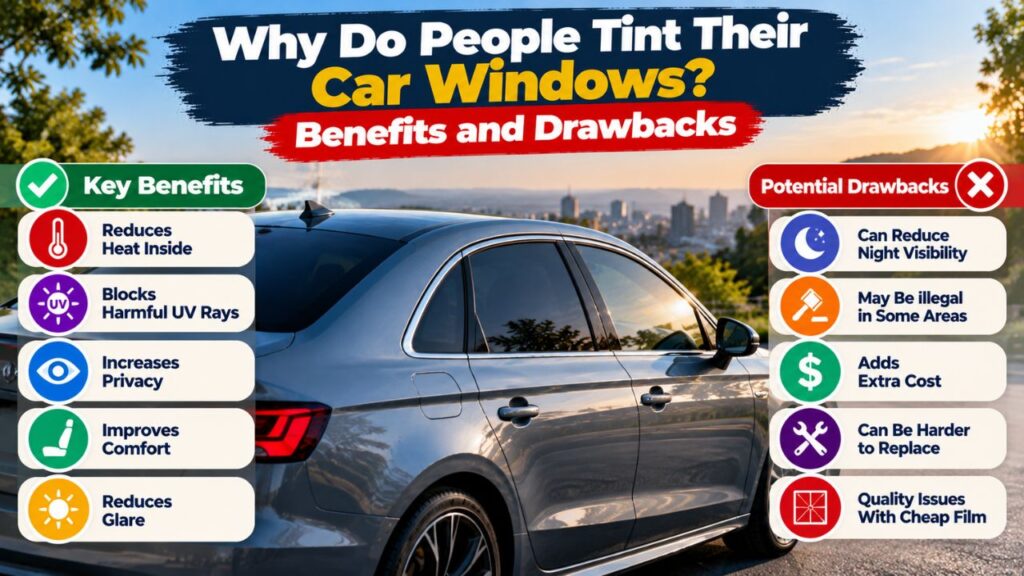
Window tint serves several purposes beyond changing a vehicle’s appearance.
The most important benefits depend on the film’s construction, shade, and measured performance.
1. Reduce Solar Heat Inside the Car
One of the main reasons people tint their car windows is to reduce the amount of solar heat entering the cabin.
Sunlight passes through automotive glass and warms the dashboard, seats, steering wheel, and other interior surfaces.
Those surfaces absorb solar energy and contribute to the temperature inside the vehicle.
A suitable heat-rejecting window film reduces part of the solar energy transmitted through the glass.
This can make driving more comfortable, particularly when sunlight enters through the side windows.
The International Window Film Association’s automotive window film guidance identifies heat control as a major benefit of automotive tint and explains how reducing solar heat can improve passenger comfort.
High-performance tint may also reduce the demand placed on the vehicle’s air conditioning, although the actual effect depends on weather, vehicle design, and operating conditions.
However, tint does not stop a parked vehicle from becoming dangerously hot.
A closed vehicle can still reach unsafe temperatures even with high-quality window film.
2. Protect Skin From Ultraviolet Rays
Many drivers install window tint to reduce UV exposure while traveling.
Ultraviolet radiation is associated with skin damage, premature skin aging, and increased skin cancer risk.
Automotive glass provides some UV protection, but the level depends on its construction.
Modern laminated windshields generally block substantial amounts of UVA and UVB radiation. Many side and rear windows made from tempered glass block UVB more effectively than UVA.
According to The Skin Cancer Foundation’s guidance on car window tint and UV protection, suitable transparent window films can block 99% of UV radiation without requiring very dark glass.
This means drivers seeking UV protection do not necessarily need a low-VLT tint.
A clear or lightly tinted product with verified UV-blocking performance may be appropriate.
Window tint should still be considered part of a broader sun-protection strategy rather than a complete substitute for sunscreen or protective clothing.
3. Reduce Glare While Driving
Bright sunlight can make driving uncomfortable, particularly when the sun is low in the sky.
Glare may come through the windshield, side windows, or rear glass.
A suitable tint reduces the amount of visible light passing through treated windows.
This may help with:
- Discomfort from direct sunlight
- Reflections on interior surfaces
- Bright sunlight entering through side windows
- Eye strain during long daytime drives
- Excessive brightness for rear-seat passengers
Glare reduction depends partly on the film’s visible light transmission.
A darker film generally reduces more visible light.
However, reducing visible light too much can create visibility problems at night.
The objective should be comfortable daytime visibility without sacrificing safe low-light driving.
Important: Tint is not a reliable way to eliminate glare from every source, and dark front window tint can interfere with nighttime visibility.
4. Improve Privacy Inside the Vehicle
Privacy is another common reason people tint their cars.
Darker windows make it more difficult for someone outside the vehicle to see into the cabin under many daylight conditions.
This can help occupants feel less exposed while sitting in traffic or parked in public areas.
Privacy tint is especially popular for:
- Rear passenger windows
- Family SUVs
- Minivans
- Limousines
- Vehicles carrying passengers in the back seat
It may also make belongings less immediately visible to passersby.
However, privacy depends on lighting conditions.
If the vehicle’s interior is brightly illuminated while the outside is dark, people may still be able to see inside.
Window tint is not a substitute for securing valuables. Dark glass does not prevent theft, and ordinary automotive tint is not a security system.
5. Reduce Interior Fading and Sun Damage
Drivers also use window film to help protect their vehicle’s interior materials.
Sunlight can contribute to gradual deterioration of:
- Dashboard surfaces
- Leather and vinyl upholstery
- Fabric seats
- Plastic trim
- Interior decorative materials
UV radiation is an important factor in some types of fading and material degradation.
Visible light, heat, and the composition of the material also influence long-term aging.
Window film with effective UV blocking and solar heat rejection can reduce some of these exposures.
However, it cannot guarantee that upholstery, leather, or dashboard materials will never fade or crack.
Regular cleaning, conditioning where appropriate, and limiting prolonged direct sunlight remain useful.
6. Improve the Car’s Exterior Appearance
Some people tint their windows primarily because they prefer the appearance.
Tinted windows can create a more consistent visual style across the vehicle.
Depending on the selected film, the result may look:
- Lightly shaded and subtle
- Neutral charcoal
- Dark and private
- Similar to factory privacy glass
- More uniform across the side and rear windows
Some drivers choose a darker appearance for SUVs and trucks, while others prefer a light shade that preserves the original look.
Appearance is largely personal preference.
However, the final tint shade must comply with applicable state laws and provide adequate driving visibility.
How Does Car Window Tint Provide These Benefits?
Automotive window tint is typically a thin film installed on the interior surface of compatible vehicle glass.
The film contains materials that control how light and solar energy pass through the window.
Depending on its construction, a film may absorb, reflect, or otherwise reduce the transmission of different portions of sunlight.
How Window Film Controls Sunlight
Sunlight contains several forms of electromagnetic radiation.
For automotive window tint, three categories are especially relevant.
Ultraviolet radiation (UV): Associated with skin damage and deterioration of certain interior materials.
Visible light: Determines how bright the window appears and how much light passes through it.
Infrared radiation (IR): An invisible portion of sunlight that contributes to solar heating.
Window films can manage these forms of energy differently.
For example, a film may block most UV radiation while allowing substantial visible light to pass through.
Another film may provide greater privacy through a darker appearance without delivering the strongest overall heat rejection.
This is why darkness alone cannot tell you whether a tint is effective.
Why Some Tints Reject More Heat Than Others
Window films use different solar-control technologies.
Basic dyed film mainly reduces visible light and glare while providing varying levels of solar performance.
More advanced films may use ceramic particles, metallic coatings, or multilayer technology to control a broader portion of solar energy.
These materials can improve heat rejection without necessarily requiring extremely dark glass.
However, no single film technology automatically guarantees the best performance.
Actual manufacturer specifications matter more than broad marketing categories.
Do Darker Tinted Windows Provide Better Protection?
Darker windows provide greater reduction in visible light, but they do not automatically provide better UV blocking or overall heat rejection.
The distinction becomes clearer when looking at window tint percentages.
Understanding Visible Light Transmission
Window darkness is commonly expressed as Visible Light Transmission (VLT).
VLT measures the percentage of visible light passing through the tested window.
A higher VLT means a lighter appearance.
A lower VLT means a darker appearance.
| Tint VLT | General Appearance | Main Consideration |
| 70% | Very light, nearly clear | Useful when visibility is a priority |
| 50% | Light to moderate shade | Moderate visible-light reduction |
| 35% | Noticeably tinted | Greater daytime privacy |
| 20% | Dark | More limited low-light visibility |
| 5% | Very dark, often called limo tint | Significant visibility restrictions |
These are general appearance descriptions, not recommendations for legal use on particular windows.
The vehicle’s existing glass also affects the final VLT after film installation.
For example, installing film labeled 35% VLT on glass that already reduces visible light will produce a finished window with lower transmission than the film rating alone.
Why Light Window Tint Can Still Reject Heat
Modern solar-control films can reduce infrared and other solar energy while transmitting relatively high amounts of visible light.
This means a light ceramic film may outperform a darker basic dyed film in total heat rejection.
When comparing products for thermal performance, check the manufacturer’s Total Solar Energy Rejected (TSER) rating.
TSER describes the percentage of total solar energy rejected by the tested film-and-glass combination.
Higher TSER generally indicates less solar energy entering through the window under comparable testing conditions.
Do not confuse TSER with an infrared rejection percentage measured over a narrow wavelength range.
Does Dark Tint Block More UV Rays?
Not necessarily.
A clear UV-protective film can provide very high UV rejection.
A darker product without an equally effective UV-blocking system may offer less protection.
For drivers mainly concerned about UV exposure, the verified UV rejection rating matters more than tint darkness.
What Types of Car Window Tint Do People Choose?
Different automotive window films emphasize cost, appearance, heat control, or other performance characteristics.
The most suitable option depends on the driver’s priorities.
| Window Tint Type | Main Advantage | Main Limitation |
| Dyed tint | Affordable appearance and glare control | Heat rejection varies and may be limited |
| Carbon tint | Color options and solar control | Performance varies by product |
| Ceramic tint | Often strong heat rejection without metallic layers | Usually more expensive |
| Metallized tint | Reflective solar-control properties | Some constructions may interfere with wireless signals |
| Clear UV film | UV protection with minimal darkening | Limited privacy and visible-glare reduction |
Dyed Window Tint
Dyed film is commonly selected by drivers who want a darker appearance and reduced glare without spending as much as they might on premium products.
It can provide useful privacy and visible-light control.
However, its solar heat rejection depends on its formulation.
Basic dyed film may offer less heat control than advanced ceramic or other high-performance films.
Carbon Window Tint
Carbon-based tint is marketed as an option for drivers seeking a combination of appearance and solar performance.
Some carbon films offer good color stability and heat rejection.
However, the term carbon tint does not establish a specific TSER rating or guarantee that the film will outperform dyed alternatives.
Compare technical specifications from individual manufacturers.
Ceramic Window Tint
Ceramic tint uses specialized ceramic-based materials to manage solar energy.
Many premium ceramic films are designed to provide strong heat rejection while maintaining relatively low reflectivity.
Metal-free ceramic constructions can also avoid certain electronic signal interference concerns associated with some metallized films.
Ceramic tint is often appealing to drivers prioritizing heat control and long-term comfort.
However, the performance varies across brands and product lines.
Metallized Window Tint
Metallized film uses thin metallic layers to manage solar radiation.
Some products provide strong solar reflection and heat rejection.
However, certain metallic constructions may affect radio-frequency signals.
This may matter for vehicles using GPS, cellular connections, or other wireless systems.
Check the film manufacturer’s compatibility information rather than assuming every metallized product causes interference.
Clear UV-Blocking Window Film
Clear or nearly transparent UV-blocking films are useful when a driver wants sun protection without noticeably darkening the windows.
They may be particularly attractive when state regulations restrict visible tint on front windows.
However, legal requirements still apply to the finished glazing.
A nearly clear film is not automatically legal in every location or on every window.
What Are the Disadvantages of Tinting Car Windows?
Tinting provides practical benefits, but it also has limitations.
Understanding these tradeoffs can help prevent an expensive or unsuitable installation.
Reduced Nighttime Visibility
Very dark tint can make it harder to see through side and rear windows after sunset.
This is especially concerning when:
- Driving on poorly lit roads
- Turning at intersections
- Backing into parking spaces
- Looking for pedestrians
- Driving in rain or low-light conditions
The darker the glass, the less visible light reaches the driver.
Even a high-quality ceramic film cannot eliminate the basic visibility tradeoff associated with low VLT.
Drivers who regularly travel at night may prefer a lighter shade.
State Window Tint Restrictions
Window tint laws vary across the United States.
Different states may regulate:
- Windshield tint placement
- Front side window VLT
- Rear side window darkness
- Rear window tint
- Reflectivity
- Medical exemptions
The legal limit can also depend on the vehicle’s classification.
A tint percentage permitted on the rear windows of an SUV may not be allowed on the front side windows.
Check current state requirements before installation.
Installation and Maintenance Problems
Poorly installed tint may develop:
- Bubbles
- Wrinkles
- Peeling edges
- Dust trapped beneath the film
- Optical distortion
- Uneven appearance
Film quality and adhesive performance also affect durability.
A professional installer can help reduce these problems, although proper installation does not make every film immune to aging or damage.
Higher Costs for Premium Films
High-performance tint can cost substantially more than basic film.
The total expense depends on the vehicle, number of windows, film series, local labor rates, and whether old tint must be removed.
The additional cost may be worthwhile when measurable heat-rejection benefits matter.
However, paying more does not guarantee that every specification will improve.
Tint Doesn’t Make a Car Completely Private or Secure
Dark tint can discourage casual viewing into the vehicle under certain lighting conditions.
It does not prevent someone from breaking a window or gaining access to the car.
Likewise, ordinary tint is not equivalent to purpose-designed security glazing.
Drivers should continue securing their vehicles and avoiding unnecessary valuables left in view.
Is Window Tint Worth It for Everyday Driving?
Window tint can be worthwhile when the selected product addresses a specific problem.
Its value depends on driving conditions, budget, local tint laws, and personal preferences.
When Heat Reduction Is the Priority
If direct sunlight frequently makes the cabin uncomfortable, a film with high verified TSER may be worth considering.
This is particularly relevant for drivers spending substantial time in sunny or hot conditions.
A lighter high-performance film may provide a better balance of heat control and visibility than a dark basic film.
When UV Protection Is the Priority
Drivers concerned mainly about UV exposure can consider a transparent or light film with independently documented UV-blocking performance.
Darkness is not necessary for strong UV protection.
Look for clear specifications rather than relying solely on advertising descriptions.
When Privacy Is the Priority
A darker legal shade may be suitable for rear passenger windows.
For family vehicles, privacy can be particularly useful for passengers who prefer less visibility from outside.
However, evaluate nighttime visibility and do not assume tint guarantees privacy under every lighting condition.
When Appearance Is the Main Goal
If the goal is simply a darker exterior appearance, a reputable dyed or other suitable film may meet the need at a lower cost.
There may be little reason to pay for the highest-performance heat-rejecting film if thermal comfort is not a priority.
However, durability, clarity, and legal compliance should still influence the selection.
How to Choose the Right Window Tint for Your Car
The best tint is the one that balances your main goals with safe visibility and legal requirements.
Use the following steps before scheduling an installation.
- Identify your main reason for tinting. Decide whether heat reduction, UV protection, privacy, glare control, or appearance matters most.
- Check current state tint laws. Confirm the permitted VLT and other restrictions for each window you intend to tint.
- Choose an appropriate darkness. Consider nighttime driving, weather conditions, and the vehicle’s existing glass.
- Compare technical specifications. Review TSER for overall heat control, UV rejection for sun protection, and VLT for visible-light transmission.
- Compare exact film products. Ask for the manufacturer and film series rather than accepting only descriptions such as premium, ceramic, or infrared.
- Choose a qualified installer. Confirm the installation process, film warranty, workmanship coverage, and aftercare instructions.
Avoid choosing film exclusively from a heat-lamp demonstration or a photograph of a tinted vehicle.
Demonstrations can illustrate differences under specific conditions, but standardized product specifications provide a more useful basis for comparing overall solar performance.
Key Takeaway: Select tint by the benefit you actually want. A light film with verified heat and UV performance can be more useful than a very dark film chosen only for appearance.
Common Misconceptions About Why People Tint Their Windows
Several popular assumptions about automotive tint can create unrealistic expectations.
Darker Tint Always Means a Cooler Car
Darkness measures visible-light transmission, not complete solar heat rejection.
Film technology and TSER matter more when overall heat reduction is the goal.
Window Tint Is Only for Privacy
Privacy is one benefit, but UV protection, heat reduction, glare control, and appearance are also common reasons for tinting.
Some drivers use nearly transparent film specifically because they want UV protection without dark windows.
Factory Privacy Glass Is the Same as Ceramic Tint
Factory privacy glass often gets its darker appearance from color incorporated into the glass.
Aftermarket ceramic film uses additional solar-control materials.
The two can have different UV and heat-rejection characteristics.
A dark factory window does not automatically have the same thermal performance as a premium ceramic film.
Tint Completely Stops Interior Fading
Film can reduce exposure to certain forms of solar radiation.
However, interior materials may still age due to heat, visible light, normal wear, and other environmental conditions.
Tint reduces certain exposures rather than eliminating every cause of deterioration.
Dark Tint Is Always Legal on Rear Windows
Rear-window restrictions vary by state, vehicle type, and glazing position.
Never assume that a dark shade is legal simply because similar vehicles use it.
Conclusion
So, why do people tint their car windows? The most common reasons are reducing solar heat, limiting UV exposure, cutting glare, improving privacy, protecting interior materials, and changing the vehicle’s appearance.
For many drivers, the strongest practical benefits come from improved comfort and sun protection rather than darkness alone.
A suitable window film can provide substantial UV protection and effective solar heat rejection without making the windows extremely dark.
If heat control is your main concern, I recommend prioritizing verified TSER performance. If privacy matters most, select an appropriate legal VLT. For UV protection, consider a product with documented UV-blocking performance, even if it is nearly transparent.
The best decision balances the film’s measured benefits, safe driving visibility, installation quality, and applicable state laws.
FAQs About why do people tint their car windows
Does Window Tint Really Keep a Car Cooler?
Yes. A suitable solar-control window film can reduce the amount of solar heat entering through treated glass.
However, the actual temperature difference depends on the film, sunlight, ventilation, vehicle construction, and other conditions.
Window tint does not prevent a parked vehicle from reaching dangerously high temperatures.
Why Do People Tint Their Back Windows Darker Than Their Front Windows?
Drivers often choose darker rear windows for additional passenger privacy and reduced visible sunlight.
Another reason is that many states allow darker tint on rear windows than on front side windows, although the exact requirements vary.
The chosen darkness should still provide adequate visibility and comply with local laws.
Is It Better to Get Ceramic Tint or Regular Tint?
Ceramic tint may be worth the additional cost when strong heat rejection and good optical performance are priorities.
Basic dyed tint can be a practical option for drivers mainly seeking appearance and glare reduction.
Compare the actual film specifications rather than assuming every ceramic product is better than every non-ceramic alternative.
Can You Tint Car Windows Without Making Them Dark?
Yes. Clear and lightly tinted automotive films can provide substantial UV protection, and certain high-performance products also offer useful solar heat rejection.
These options are attractive when maintaining visible-light transmission is important.
Always confirm the finished window meets applicable legal requirements.
Does Tinting Car Windows Make Them Harder to Break?
Ordinary automotive window tint is not designed to make vehicle glass break-proof.
Some films may help retain glass fragments under certain conditions, but that does not establish meaningful protection against forced entry.
Dedicated safety or security films have different performance objectives and should be evaluated separately.
Is Car Window Tinting Worth the Money?
It can be worthwhile if you want reduced solar heat, better UV protection, less glare, or additional daytime privacy.
The value depends on the quality of the film, the vehicle’s use, local climate, and total installation cost.
A reputable film with documented specifications is usually a better purchase than choosing an unverified product solely because it is very dark.