Yes, window tinting is worth it for many drivers because quality automotive window film can reduce solar heat, block harmful ultraviolet radiation, minimize daytime glare, and improve privacy. However, whether the investment makes sense depends on your climate, driving habits, budget, and the type of film you choose.
Professional window tinting typically costs between $100 and $800 for many vehicles, with premium ceramic films often costing more than basic dyed options. Although cheaper tint can improve appearance and reduce glare, higher-performance films may provide greater heat rejection without making the windows excessively dark.
UV protection is another important benefit. The Skin Cancer Foundation reports that qualifying UV window films can block at least 99% of UVA and UVB radiation. This protection can be particularly valuable for people who spend long periods driving in sunny conditions.
Still, window tinting has drawbacks, including installation expenses, potential visibility problems, and state-specific legal restrictions.
In this article, I cover the benefits and disadvantages of window tinting, installation costs, film types, heat and UV protection, legal requirements, and long-term value. You’ll learn when tinting is worth the money and when keeping factory glass unchanged may be the better decision.
Is Window Tinting Worth It for Most Drivers?
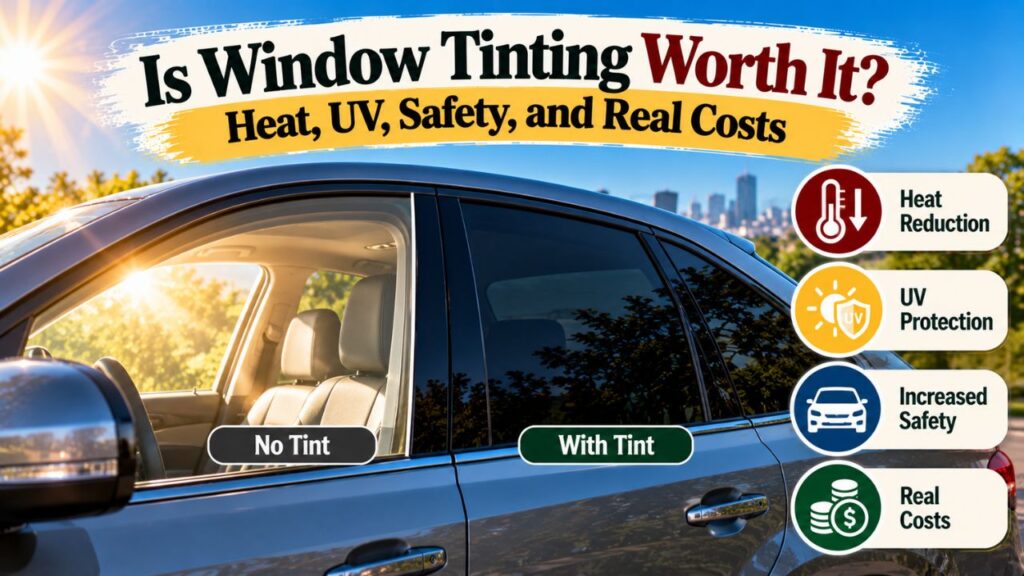
Window tinting is generally worth considering when a vehicle receives substantial sunlight, the driver wants additional UV protection, or solar heat and glare regularly make driving uncomfortable.
However, the benefits differ depending on how and where the vehicle is used.
A driver in Arizona or Florida may notice more practical value from solar-control window film than someone who primarily drives short distances in a cooler region.
Similarly, a driver who spends several hours on the road every day may benefit more from UV protection than someone who uses a vehicle only occasionally.
When Window Tinting Is Worth the Money
Window tinting may be a good investment if you:
- Drive frequently during sunny daytime hours.
- Live in a hot or sunny climate.
- Want to reduce heat entering through vehicle windows.
- Spend long periods beside side-window glass.
- Want additional UV protection for occupants.
- Experience uncomfortable daytime glare.
- Prefer more privacy inside the vehicle.
- Want to reduce sunlight-related interior fading.
- Plan to keep the vehicle for several years.
Higher-quality window film can provide these benefits while maintaining relatively light window shades.
When Window Tinting May Not Be Worth It
Tinting may provide less value if you:
- Drive primarily at night.
- Live in a mild climate with limited direct sunlight.
- Rarely use the vehicle.
- Already have effective factory solar-control glass.
- Plan to sell the vehicle soon.
- Have a very limited budget.
- Need maximum nighttime visibility.
- Cannot find a suitable film that complies with local laws.
Tinting is not a necessary upgrade for every vehicle.
The most important question is whether the expected benefits justify the actual installation cost.
Key Takeaway: Window tinting is most valuable for drivers exposed to frequent sunlight who want better thermal comfort, UV protection, and glare control. Its benefits may be smaller for occasional or mostly nighttime driving.
What Are the Benefits of Window Tinting?
Automotive window tint provides several benefits beyond changing the appearance of a vehicle.
The most useful improvements involve heat reduction, UV protection, glare management, and interior comfort.
1. Reduced Heat Inside the Vehicle
Solar heat enters vehicles through the windshield, side windows, rear glass, and sunroof.
Window film can reduce the amount of solar energy passing through treated glass.
This may make the cabin more comfortable during sunny weather.
High-performance films can reject substantial solar energy without requiring extremely dark windows.
However, the amount of improvement depends on the film and vehicle.
Tint does not eliminate heat entering through the body panels, windshield, or untreated glass.
A parked vehicle can still become dangerously hot even with high-performance window film.
Important: Never leave children, pets, or anyone unable to exit independently inside a parked vehicle, regardless of its window tint or outside temperature.
2. Better Protection Against UV Radiation
Ultraviolet radiation is an important reason to consider window tinting.
Most ordinary automotive glass blocks much of the sun’s UVB radiation.
However, protection against UVA radiation varies by glass type.
Laminated windshields generally provide stronger UVA protection than many untreated side windows.
According to The Skin Cancer Foundation’s guidance on UV window film, qualifying window films can block more than 99% of UVA and UVB radiation.
The organization also explains that UVA exposure can occur while driving, particularly through side windows.
This makes UV-blocking film a useful addition for drivers who spend substantial time in vehicles.
However, tint is not a replacement for other recommended sun protection measures.
3. Reduced Daytime Glare
Bright sunlight can cause discomfort when driving.
Window tint reduces some of the visible light passing through the glass, which may help with glare.
This can be useful during:
- Early morning commutes
- Late afternoon driving
- Long highway trips
- Travel through open, sunny landscapes
- Driving near highly reflective surfaces
However, glare reduction depends substantially on the film’s darkness.
A darker film may reduce more visible light but also make driving more difficult in low-light conditions.
The goal should be comfortable, legally compliant visibility rather than maximum darkness.
4. Improved Daytime Privacy
Window tint can make it harder for people outside the vehicle to see into the cabin.
This may improve privacy when driving or parking.
However, tinted windows do not provide complete privacy.
People may still see inside when:
- The interior is brightly illuminated.
- The vehicle is parked under strong lighting.
- The viewer is close to the window.
- The selected film has a relatively high VLT.
- Light enters through untreated glass.
Tint should not be treated as a security system.
Valuables should still be removed from view or secured appropriately.
5. Reduced Interior Fading
Sunlight can contribute to fading and deterioration of vehicle interiors.
UV radiation, visible light, and heat may affect upholstery, leather, dashboards, and plastic trim.
Window films that reduce UV exposure and total solar energy can help slow some of these effects.
However, they cannot completely prevent interior aging.
Material quality, temperatures, cleaning products, and normal wear also affect how interiors deteriorate.
6. Improved Vehicle Appearance
Tinted windows can create a more uniform exterior appearance.
Some drivers prefer a darker finish that complements the vehicle’s paint and trim.
Others prefer nearly clear ceramic film that provides solar protection without significantly changing the appearance.
This benefit is subjective.
A professionally installed tint can look clean and consistent, while poor installation may make a vehicle look worse.
Key Takeaway: Window tinting can improve comfort, UV protection, daytime privacy, and appearance. The actual benefits depend on the film’s specifications, darkness, and installation quality.
Does Window Tinting Actually Keep Your Car Cooler?
Yes, solar-control window film can reduce heat entering through vehicle glass, but the amount of cooling depends on the film’s total solar energy rejection and the surrounding conditions.
Not every dark window film provides strong heat protection.
A basic dyed film may darken the glass while allowing more solar energy into the vehicle than a premium ceramic film.
How Window Tint Reduces Heat
Sunlight contains several forms of radiation.
These include:
- Ultraviolet radiation
- Visible light
- Infrared radiation
Automotive solar-control films manage these wavelengths through absorption and reflection.
Different film technologies use different materials.
Some metallized films reflect substantial solar energy, while advanced ceramic films often use engineered particles to reduce selected infrared wavelengths.
The total heat reduction depends on the combined optical performance of the film and glass.
What Is Total Solar Energy Rejection?
Total Solar Energy Rejected (TSER) describes the percentage of incoming solar energy rejected by the tested glazing system.
It is an important measurement when comparing films for heat control.
For example, a film system with 55% TSER rejects 55% of total incoming solar energy under the specified test conditions.
That does not mean the entire vehicle’s cabin temperature will decrease by 55%.
It describes solar energy rejection through the tested glass.
Is 95% Infrared Rejection the Same as 95% Heat Rejection?
No.
Some manufacturers advertise very high infrared-rejection percentages.
However, the measurement may apply only to a selected portion of the infrared spectrum.
Infrared Rejection (IRR), Infrared Energy Rejection (IRER), and TSER are different measurements.
When comparing overall solar heat protection, TSER is generally more useful than a single narrow-band infrared figure.
Can Tint Reduce Air Conditioning Use?
It may.
A film that reduces solar heat entering the cabin may reduce the cooling demand during sunny driving.
However, actual air conditioning use depends on:
- Outside temperature
- Solar exposure
- Vehicle insulation
- Glass area
- Fan and temperature settings
- Driving duration
- Film performance
There is no reliable universal fuel-savings percentage that applies to every tinted vehicle.
For electric vehicles, reduced solar load may help cabin cooling efficiency, but it does not guarantee a measurable increase in driving range.
Key Takeaway: Quality solar-control film can reduce heat entering through glass, but advertised infrared percentages should not be confused with total vehicle cooling. Compare TSER for a more meaningful assessment.
How Much Does Window Tinting Cost?
Professional window tinting costs vary considerably across the United States.
The biggest factors are the film type, vehicle size, number of windows, local labor rates, and installation complexity.
Average Window Tinting Costs by Film Type
| Film Type | Approximate Professional Cost | Main Advantage |
| Dyed window tint | 100–350 | Affordable glare reduction and appearance |
| Carbon window tint | 200–500 | Balanced cost and solar control |
| Ceramic window tint | 300–800 | Strong heat performance in premium products |
| Premium specialty ceramic | $800+ possible | Advanced solar control and premium features |
These are broad planning ranges, not guaranteed prices.
The figures are consistent with AutoZone’s automotive window tint pricing guide, which explains how film technology, glass area, and labor influence the final cost.
A full windshield, panoramic roof, or removal of old film may be charged separately.
How Much Does Tint Cost by Vehicle Type?
Vehicle size also affects installation prices.
| Vehicle | Approximate Professional Tinting Cost |
| Compact sedan | 150–400 |
| Midsize sedan | 150–450 |
| SUV or crossover | 200–500 |
| Crew-cab pickup | 150–400 |
| Minivan or large van | 250–600 |
These are approximate standard-installation ranges. Premium films and additional glass coverage can increase the cost.
For an accurate comparison, request quotes using the same film type and window coverage.
Is DIY Window Tinting Cheaper?
Yes, the initial material cost is usually lower.
Basic DIY film may cost around 30–50, although premium film and a complete vehicle kit can cost considerably more.
You may also need:
- Application solution
- Squeegees
- Cutting tools
- Cleaning materials
- Heat-shaping equipment
- Replacement film if mistakes occur
Curved rear windows can be difficult for inexperienced installers.
A professional installation generally provides a more predictable finish and may include workmanship warranty coverage.
What Makes Professional Tinting Expensive?
The total price includes more than the window film.
Professional installers must account for glass preparation, cutting, shaping, application, and quality control.
Complex glass can require additional work.
Premium products also have higher material costs.
A reputable installer may offer warranty support for covered defects.
Key Takeaway: Window tinting is available across several price ranges. Basic film offers lower initial cost, while premium ceramic film typically requires a larger investment.
Is Ceramic Window Tinting Worth the Extra Money?
Ceramic tint is often worth the additional cost for drivers who want strong heat rejection at a legal, relatively light shade and prefer a film without conductive metallic layers.
However, ceramic is not automatically the best value for every driver.
A quality carbon or metallic film may provide enough heat reduction for less money.
Ceramic vs. Carbon vs. Dyed Tint
| Feature | Dyed Tint | Carbon Tint | Ceramic Tint |
| Cost | Low | Medium | High |
| Basic glare reduction | Yes | Yes | Yes |
| UV protection | Product-dependent | Often high | Often high |
| Heat rejection | Usually modest | Moderate to strong | Often strong to excellent |
| Appearance | Usually dark and neutral | Often charcoal | Often neutral and low-reflective |
| Wireless signal concerns | Typically none from metallic layers | Typically none | None from genuinely metal-free ceramic films |
| Long-term color stability | Product-dependent | Often good | Often good |
| Best use | Budget appearance and glare | Midrange performance | Premium comfort and heat protection |
The exact product matters more than the category alone.
A basic ceramic film is not guaranteed to outperform every carbon film.
When Ceramic Tint Is Worth It
Ceramic may justify its higher price when:
- You drive frequently in intense sunlight.
- Your vehicle has large side windows.
- Heat reduction matters more than appearance alone.
- You want a lighter film with useful solar control.
- You prefer a low-reflective appearance.
- You want to avoid potential metallic signal interference.
- You plan to keep the vehicle for several years.
Choose based on published performance data rather than the word ceramic in the product name.
When Regular Tint Is Enough
A less expensive film may meet your needs if your primary goals are:
- Improving vehicle appearance
- Reducing daytime glare
- Creating moderate privacy
- Adding verified UV protection
- Staying within a small budget
If you rarely drive in hot weather, the additional cost of premium ceramic may be difficult to justify.
Key Takeaway: Premium ceramic tint is most attractive for regular daytime driving and stronger heat control. For basic appearance and glare reduction, lower-cost film may offer better value.
Is Window Tinting Worth It for UV Protection?
UV protection can be one of the strongest reasons to install automotive window film.
Unlike a purely cosmetic upgrade, verified UV-blocking film addresses a specific type of sunlight exposure.
Does Factory Glass Already Block UV Radiation?
Yes, automotive glass provides some UV protection.
However, protection varies by glass type and vehicle.
Modern laminated windshields typically block a substantial amount of UVA and UVB radiation.
Untreated tempered side and rear glass may allow more UVA radiation to pass through.
This is why adding UV-blocking film to side windows can be useful even when the windshield already provides good protection.
Does Dark Tint Block More UV Than Clear Tint?
Not necessarily.
A nearly clear film can provide excellent UV protection when designed specifically for that purpose.
A dark film without strong UV-blocking properties may offer less protection than expected.
Look for documented UVA and UVB rejection rather than judging protection by appearance.
A quality product may offer more than 99% UV rejection while allowing much of the visible light through.
Is UV Window Film Worth It for Long-Distance Drivers?
It can be particularly beneficial for drivers who spend extended periods beside sun-exposed glass.
Examples include:
- Delivery drivers
- Commuters with long daytime routes
- Truck drivers
- Rideshare drivers
- Road-trip travelers
- People who transport children frequently
However, film does not block UV exposure when windows are open or sunlight enters through untreated areas.
Continue using appropriate sun protection when needed.
Key Takeaway: UV-blocking film can be worthwhile even without dark tint. Choose a product with verified UV performance, especially if you spend significant time driving in daylight.
Does Window Tinting Improve Privacy and Security?
Window tint can improve privacy, especially during daylight.
However, its effectiveness depends on lighting conditions and film darkness.
Daytime Privacy Benefits
Darkened windows can make it more difficult to see the cabin from outside.
This can be useful when parking in busy areas or driving with passengers.
However, privacy is not absolute.
Sunlight direction, interior brightness, and viewing distance all affect what others can see.
Does Tint Give Privacy at Night?
Not necessarily.
When the vehicle interior is brighter than the surroundings, people outside may still see through tinted windows.
A dark film does not automatically provide one-way privacy.
Likewise, the driver may have a harder time seeing out through very dark glass at night.
Does Window Tint Prevent Break-Ins?
Ordinary tint should not be treated as a security barrier.
Some specially designed security films can help hold broken glass fragments together under certain conditions.
However, conventional automotive tint is not equivalent to an impact-resistant security system.
Tint also does not prevent a determined person from breaking a vehicle window.
Avoid leaving valuables visible inside a parked vehicle.
Key Takeaway: Window tint can improve daytime privacy, but it does not provide complete nighttime privacy or reliable theft protection.
What Are the Disadvantages of Window Tinting?
Window tinting has real limitations that should be considered before paying for installation.
The main disadvantages involve cost, reduced visibility, legal compliance, and potential installation defects.
Reduced Visibility at Night
Dark window film reduces visible light passing through the glass.
This can make it harder to see pedestrians, cyclists, road hazards, and other objects in low-light conditions.
The problem may become more noticeable during:
- Night driving
- Heavy rain
- Poorly illuminated roads
- Parking maneuvers
- Reversing
- Turns across dark sidewalks
A film’s heat-rejection capability does not compensate for inadequate visible light transmission.
Use a legal shade that preserves comfortable visibility.
Legal Restrictions
Automotive tint laws vary by state.
A tint percentage permitted on rear windows may not be allowed on front side windows.
Many states also restrict windshield tinting and excessive reflectivity.
Installing noncompliant film may lead to fines, inspection problems, or required removal.
Installation Defects
Poorly installed film can develop:
- Visible bubbles
- Creases
- Dust contamination
- Crooked edges
- Peeling
- Haze
- Adhesive problems
Some moisture patterns are normal while tint cures.
Persistent defects may require correction or replacement.
Maintenance Requirements
Tinted windows should be cleaned using products and methods compatible with the film.
Abrasive tools can scratch the interior film surface.
The film may also require an initial curing period before windows can be lowered or cleaned.
Possible Wireless Signal Interference
Some metallic window films contain conductive layers that may affect certain radio-frequency signals.
Potentially affected systems include GPS, cellular reception, and specific glass-mounted antennas.
Not every metallized film causes interference.
Metal-free ceramic and carbon films avoid this particular concern.
Key Takeaway: Window tinting has tradeoffs. Dark shades can impair nighttime visibility, illegal installations can become expensive, and low-quality workmanship may reduce durability.
Is Window Tinting Legal in the United States?
Window tinting is legal in many forms, but the permitted darkness and placement depend on state regulations.
There is no single automotive tint percentage that is legal for every window in every state.
Understanding Window Tint Percentages
Tint darkness is measured using Visible Light Transmission (VLT).
A higher percentage means more visible light passes through.
| VLT | General Appearance |
| 70% | Very light |
| 50% | Light |
| 35% | Moderately dark |
| 20% | Dark |
| 5% | Extremely dark |
These are approximate appearance categories, not legal recommendations.
Does Factory Glass Affect Tint Darkness?
Yes.
Factory glass may already reduce the amount of visible light entering the vehicle.
For example:
- Factory glass VLT: 80%
- Added film VLT: 70%
A simplified calculation gives:
0.80 × 0.70 = 0.56
Approximate finished VLT = 56%
Therefore, applying a 70% VLT film does not necessarily produce a finished window with 70% VLT.
A calibrated tint meter provides a more reliable compliance measurement.
Are Ceramic Tints Exempt From Tint Laws?
No.
Ceramic, carbon, dyed, and metallic films must meet applicable VLT and other legal requirements.
Ceramic technology may allow useful heat rejection at a lighter shade, but it does not create a legal exemption.
Before installation, check the current requirements published by the relevant state motor vehicle or law enforcement agency.
Key Takeaway: Legal compliance depends on the finished glass and applicable state rules, not the marketing category of the film. Verify VLT and reflectivity requirements before choosing a shade.
How Long Does Window Tinting Last?
High-quality professionally installed window tint can remain useful for many years.
However, there is no universal lifespan that applies to every film.
Durability depends on the film’s construction, adhesive, sunlight exposure, installation quality, and maintenance.
How Long Does Dyed Window Tint Last?
Basic dyed films may deteriorate faster than premium products.
Possible problems include color changes, peeling, and adhesive failure.
However, quality varies substantially between manufacturers.
A reputable dyed film may outperform an inexpensive product marketed as ceramic.
Does Ceramic Window Tint Last Longer?
Premium ceramic films are often designed for long-term color stability and solar performance.
Some products include limited lifetime warranty coverage.
However, a lifetime warranty does not guarantee that every installation will remain flawless indefinitely.
Read the written terms to understand the coverage and exclusions.
What Causes Window Tint to Fail?
Common causes include:
- Poor installation
- Contaminated glass
- Low-quality adhesive
- Excessive abrasion
- Improper cleaning
- Material deterioration
- Damage during tint removal or window repairs
Choose quality film and follow the manufacturer’s aftercare instructions.
Key Takeaway: Window tint can provide long-term value, but film quality and installation workmanship matter more than a fixed advertised lifespan.
Does Window Tinting Increase Car Resale Value?
Window tinting may make a vehicle more attractive to certain buyers, but it does not guarantee an increase in resale value.
Buyer preferences vary.
Some people appreciate tinted windows for their appearance and comfort.
Others may dislike dark glass or worry about local legal restrictions.
When Tint May Help Resale Appeal
A professionally installed, legally compliant film may be viewed favorably when:
- The film is in excellent condition.
- The shade looks consistent.
- The vehicle is used in a hot climate.
- The product has recognizable specifications.
- The installation warranty is transferable, where applicable.
However, these features do not establish a predictable dollar increase in resale price.
When Tint May Hurt Resale Appeal
Window tint can become a drawback when it is:
- Too dark
- Illegal in the buyer’s state
- Bubbling or peeling
- Discolored
- Poorly trimmed
- Scratched
- Difficult to remove
A buyer may request a lower price or expect the film to be removed.
Should You Tint a Car Just Before Selling It?
Usually not solely for resale value.
The installation cost may not be recovered.
If the existing glass looks clean and the vehicle is being sold soon, leaving it unchanged may be the more economical decision.
Key Takeaway: Tint may improve buyer appeal but should not be treated as a guaranteed resale investment. Its main financial value usually comes from the owner’s use and enjoyment.
Is Window Tinting Worth It Financially?
Window tinting is generally better evaluated as a comfort and protection upgrade than as an investment that produces direct financial returns.
Any savings from air conditioning use or interior preservation are difficult to predict accurately for an individual vehicle.
A practical method is to calculate the cost over your expected ownership period.
Window Tinting Cost Per Year
Use:
Annual Tint Cost = Installed Price ÷ Years of Ownership
Suppose a professional tint installation costs $350 and you plan to keep the vehicle for five years.
$350 ÷ 5 = $70 per year
The installation effectively costs approximately $70 per year over that ownership period.
This does not account for financing, future repairs, replacement, or the time value of money.
Comparing Regular and Ceramic Tint
Consider two hypothetical installation quotes:
| Expense | Quality Carbon Tint | Premium Ceramic Tint |
| Installed price | $250 | $550 |
| Planned ownership | 5 years | 5 years |
| Annualized cost | $50 | $110 |
| Additional annual cost for ceramic | — | $60 |
In this example, ceramic tint costs an additional $300 overall, equivalent to $60 per year over five years.
Whether the upgrade is worthwhile depends on the actual heat-rejection improvement and how much you value it.
If you drive in intense sunlight every day, the additional cost may be reasonable.
If you drive only short distances in mild weather, the difference may provide little practical benefit.
Can Window Tint Pay for Itself?
Possibly in some situations, but there is no reliable general payback period.
Tint may reduce solar heat and potentially lower air conditioning demand.
It may also help limit sunlight-related interior deterioration.
However, these benefits do not translate into predictable financial savings for every vehicle.
Avoid assuming that window tint will automatically pay for itself through reduced fuel consumption or increased resale value.
Key Takeaway: Window tinting is primarily a comfort and protection expense. Annualizing the installation cost provides a practical way to decide whether the benefits are worth the price.
DIY vs. Professional Window Tinting: Which Is More Worth It?
DIY tinting can reduce initial costs, but professional installation usually offers more predictable workmanship.
The right option depends on the size of the job and your experience.
When DIY Tinting Makes Sense
DIY may be suitable if you:
- Want to tint one or two simple windows.
- Have a clean workspace.
- Already own the necessary tools.
- Can purchase appropriate precut film.
- Have experience applying adhesive film.
- Are comfortable replacing damaged material.
DIY costs can increase quickly when mistakes require additional film.
Rear windshields with complex curves are particularly challenging.
When Professional Tinting Is Better
Professional installation is usually preferable for:
- Complete vehicle tinting
- Premium ceramic films
- Large SUVs and vans
- Curved rear windshields
- Vehicles with delicate glass-mounted electronics
- Drivers who expect a clean, consistent finish
A professional shop may also provide warranty coverage for certain installation defects.
What Should You Ask the Installer?
Before paying, ask:
- What is the exact film brand and product series?
- What is its published TSER?
- How much UV radiation does it reject?
- What is the expected finished VLT?
- Is the film legal on the selected windows?
- Does the price include all requested glass?
- Is old film removal included?
- What does the warranty cover?
- Does the warranty include replacement labor?
- How long should the film cure before normal window operation?
Comparing the same film specifications and window coverage helps prevent misleading price comparisons.
Key Takeaway: DIY is attractive for simple, low-cost projects. Professional installation generally offers better value for complete vehicles and expensive films when consistent workmanship matters.
Which Window Tint Is Worth Buying for Different Drivers?
There is no single film type that provides the best value for every vehicle.
Choose according to your primary reason for tinting.
| Driver’s Main Priority | Recommended Starting Option | Reason |
| Lowest installation cost | Quality dyed film | Basic glare reduction and appearance |
| Balanced price and heat control | Carbon film | Useful midrange performance |
| Strong heat rejection | Premium ceramic film | Often strong TSER at suitable VLT |
| UV protection without darkness | Verified clear UV-blocking film | High UV protection with minimal visual change |
| Neutral appearance | Quality ceramic or carbon film | Often low-reflective finishes |
| Reflective appearance | Suitable metallized film | Reflective solar-control layer |
| Electronics compatibility | Metal-free ceramic or carbon | Avoids metallic signal concerns |
| Frequent nighttime driving | Higher-VLT compliant film or no additional tint | Preserves more visible light |
Best for Daily Commuters
A quality carbon or ceramic film is a reasonable starting choice.
Daily driving provides more opportunities to benefit from heat rejection and UV protection.
Compare TSER and the legal finished VLT before choosing.
Best for Families With Children
Verified UV-blocking film can be useful for reducing radiation entering through side and rear glass.
Choose suitable VLT and ensure adequate visibility.
Tint does not replace safe sun exposure practices and does not make parked vehicles safe for unattended children.
Best for Budget-Conscious Drivers
A reputable dyed or carbon film may provide enough improvement without the price of premium ceramic.
Choose based on actual film quality and warranty terms.
Avoid excessively dark or unverified products simply because they are inexpensive.
Best for Drivers in Hot Climates
Premium ceramic tint is often worth considering because solar heat rejection is a major priority.
However, compare actual TSER values rather than assuming the most expensive ceramic option is automatically best.
Best for Drivers in Cooler Climates
A lighter, UV-focused film may provide more practical value than expensive maximum-heat-rejection tint.
If the vehicle receives little sunlight and is driven mostly at night, additional tint may not be worthwhile.
Key Takeaway: Match the film to your actual driving conditions. High-performance ceramic suits heat-focused drivers, while a lighter or less expensive film may be sufficient for UV protection and glare control.
Common Window Tinting Mistakes That Waste Money
Several purchasing mistakes can reduce the value of window tinting.
Choosing Tint Only by Darkness
A darker tint does not automatically provide better UV protection or heat rejection.
Compare technical specifications instead.
Ignoring Total Solar Energy Rejection
A high infrared-rejection claim can sound impressive without describing overall solar performance.
Look for TSER and confirm the testing conditions.
Paying for Ceramic Without Checking the Product
Not all ceramic films provide the same performance.
Ask for the exact film series and published specifications.
Choosing the Cheapest Installer
A very low price may reflect limited experience, inexpensive materials, or reduced warranty support.
Compare workmanship and product quality.
Installing Illegal Tint
Removing noncompliant film and paying for replacement can eliminate the value of the original installation.
Check the law before purchasing.
Going Too Dark for Night Driving
Very dark side windows can reduce visibility in poorly illuminated conditions.
Choose a shade that supports safe driving, not just privacy.
Ignoring Factory Glass Performance
Some vehicles already use solar-control or UV-protective glass.
Determine what protection is already present before paying for an additional film.
Assuming All Lifetime Warranties Are Equal
Warranty coverage varies by manufacturer and installer.
Some warranties cover film defects but exclude removal or replacement labor.
Review the actual terms.
Key Takeaway: The best way to avoid wasted money is to compare film specifications, select a legal VLT, and choose a reputable installer with clear warranty coverage.
Final Verdict: Is Window Tinting Worth the Cost?
For many drivers, window tinting offers meaningful benefits that can justify the installation price.
However, it is not automatically a worthwhile upgrade.
| Situation | Is Tinting Worth It? | Main Reason |
| Daily driving in strong sunlight | Usually yes | Heat and UV protection |
| Long-distance daytime commuting | Usually yes | Comfort and UV reduction |
| Frequent travel with children | Often yes | Additional side-window UV protection |
| Vehicle with large glass areas | Often yes | More potential solar heat exposure |
| Driver wanting only a darker appearance | Depends | Mainly a personal preference |
| Mostly nighttime driving | Less compelling | Reduced light transmission may be undesirable |
| Vehicle being sold soon | Often not financially worthwhile | Cost may not be recovered |
| Tight budget and limited sun exposure | Optional | Benefits may not justify expense |
| Strong factory UV and heat protection | Depends | Additional improvement may be modest |
For most drivers who regularly experience strong sunlight, professionally installed, legally compliant window tint is worth considering. A quality carbon film offers a sensible middle ground, while premium ceramic is attractive when strong heat rejection matters enough to justify the additional cost.
For occasional drivers or those who mainly drive at night, keeping the existing glass or using a lighter UV-blocking film may be the better option.
Conclusion
Window tinting is worth it for many drivers, particularly those who want improved solar heat control, UV protection, and reduced daytime glare. It can also provide better daytime privacy and help limit certain forms of sunlight-related interior deterioration.
However, the value depends on the film, installation quality, climate, and driving habits.
Basic dyed tint may be sufficient for appearance and glare reduction, while carbon and ceramic films can offer stronger solar-control performance. Premium ceramic often provides the greatest appeal for drivers who prioritize heat rejection at a relatively light shade.
Window tinting also has limitations. Dark films can reduce nighttime visibility, improper installations may fail prematurely, and illegal shades can create additional costs.
Before buying, compare TSER, UV rejection, finished VLT, installation quotes, and warranty terms.
If you spend significant time driving in sunny weather and plan to keep your vehicle for several years, quality window tinting can be a worthwhile comfort upgrade. If your vehicle rarely receives strong sunlight or you prioritize maximum nighttime visibility, the extra expense may not be necessary.
FAQs About Is Window Tinting Worth It
Is window tinting worth the money for a daily driver?
Yes, particularly if you drive frequently in sunny or hot conditions. Quality tint can reduce solar heat, block substantial UV radiation, and improve daytime comfort. Whether the cost is justified depends on the film’s performance and how long you plan to keep the vehicle.
Does window tinting actually make your car cooler?
Yes. Solar-control films can reduce the amount of heat entering through treated glass. However, the improvement depends on the film’s TSER, glass area, sunlight exposure, and vehicle conditions. Tint does not prevent parked vehicles from becoming dangerously hot.
Is ceramic window tint worth the extra cost?
Ceramic tint may be worth paying more for if strong heat rejection and electronic compatibility matter to you. Premium ceramic films often provide substantial solar control at lighter shades. However, a quality carbon film may be sufficient for drivers with smaller budgets.
Is 35% window tint worth it?
A 35% VLT film can provide a moderately dark appearance and useful daytime glare reduction. However, heat and UV protection depend on the specific product, not just its darkness. Confirm the finished glass VLT complies with applicable laws before installation.
Does window tinting increase resale value?
Not necessarily. High-quality, legal tint may appeal to certain buyers, but it does not guarantee a higher resale price. Damaged, excessively dark, or illegal film may reduce buyer interest or require removal.
Is window tinting worth it for UV protection alone?
It can be. Verified clear or lightly tinted UV-blocking films can provide strong protection without significantly darkening vehicle windows. This may be useful for people who drive frequently in daylight or spend long periods beside side-window glass.
Should I get window tint if I mostly drive at night?
It depends on your priorities, but dark tint may not be worthwhile. Lower VLT reduces visible light and can make it harder to see hazards in poorly illuminated conditions. If UV protection is the primary goal, consider a suitable high-VLT film that complies with local regulations.