Yes, window tint can help with heat by reducing the amount of solar energy that passes through a car’s glass. High-performance automotive films can make direct sunlight feel less intense, reduce heat buildup while driving, and potentially lower the demand on the air conditioner. However, how much difference you notice depends on the film, glass, weather, and which windows are treated.
A dark tint is not automatically the coolest option. Basic dyed films mainly reduce visible light, while advanced ceramic and other spectrally selective films can reject more solar energy at a lighter shade. Manufacturers often advertise infrared rejection percentages, but those figures do not describe all the heat entering a vehicle.
Tint also has clear limitations. It cannot stop a parked car from becoming dangerously hot, and the darkest available shade may reduce nighttime visibility or violate state laws.
In this article, I explain how window tint blocks heat, which films work best, how to compare TSER and infrared ratings, what cooling results to expect, and how to choose a legal film for everyday driving.
Does Window Tint Help With Heat Inside a Car?
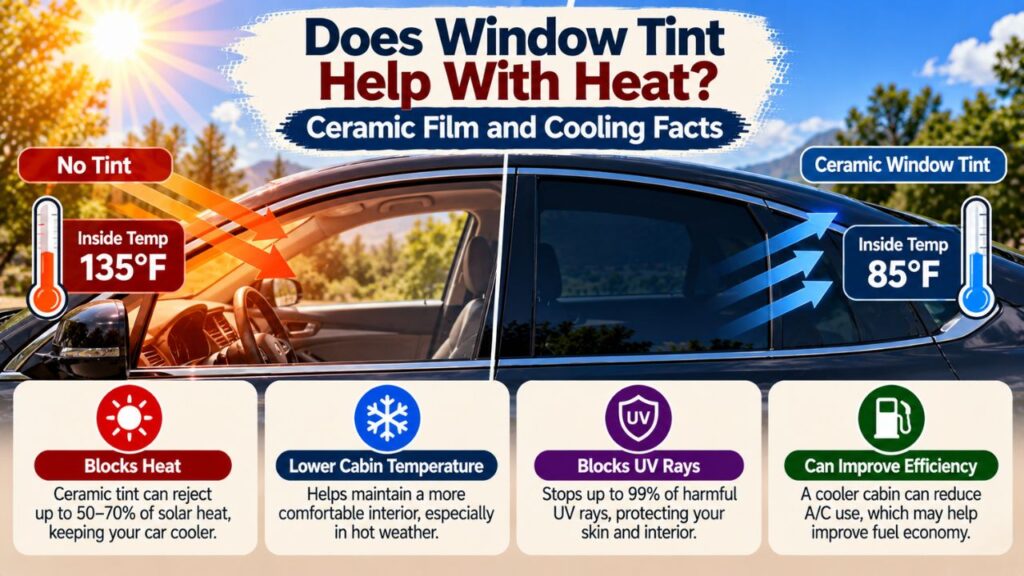
Yes. Automotive window tint can reduce solar heat entering a vehicle, although its effectiveness depends on the film’s construction and performance ratings.
Sunlight passes through untreated vehicle glass and warms the dashboard, seats, steering wheel, and other interior surfaces.
These surfaces absorb energy and release heat into the surrounding air.
The result can be a noticeably hotter interior, especially when the vehicle is exposed to direct sunlight.
A properly selected window film reduces part of the solar energy reaching these surfaces.
The International Window Film Association’s heat-control guidance explains that window films can reduce incoming solar heat by reflecting or absorbing solar energy, potentially improving comfort and reducing air-conditioning demand.
How Solar Heat Enters Through Car Windows
Sunlight contains different forms of electromagnetic radiation.
For window tinting, the most relevant are:
- Ultraviolet (UV) radiation: Contributes to sun exposure and material deterioration.
- Visible light: Provides illumination and also contributes to solar heating.
- Infrared radiation: Represents a substantial portion of the sun’s energy and contributes to heat gain.
Automotive glass already blocks or absorbs some of this radiation.
However, significant solar energy can still pass through the untreated glass.
When sunlight reaches interior surfaces, the energy is absorbed and converted into heat.
A quality window film reduces the amount of solar energy transmitted into the vehicle.
How Window Tint Blocks Heat
Window films control solar energy through several mechanisms.
Reflection: Certain films reflect part of the incoming solar radiation away from the glass.
Absorption: Some films absorb solar energy within their layers. Part of that energy is subsequently released toward the outside, although some may still transfer inward.
Selective filtering: Advanced films target particular wavelengths while allowing substantial visible light through.
These mechanisms explain why two films with similar darkness can provide different levels of heat rejection.
Does Window Tint Actually Lower Cabin Temperature?
Window tint can reduce solar heat gain, which may result in a cooler cabin under comparable conditions.
However, the exact temperature change depends on many variables.
These include:
- Outside temperature
- Sunlight intensity
- Length of exposure
- Film type and shade
- Amount of glass covered
- Vehicle color and interior materials
- Ventilation and air-conditioning operation
A film’s heat rejection percentage cannot be directly converted into a specific reduction in cabin temperature.
For example, a film rated at 60% total solar energy rejection does not mean the entire car becomes 60% cooler.
Key Takeaway: Window tint can reduce the rate and amount of solar heat entering through treated glass, but it cannot eliminate heat buildup or guarantee a particular cabin temperature.
Which Window Tint Is Best for Heat Rejection?
High-performance ceramic and other advanced solar-control films are generally strong choices when heat reduction is the main priority.
However, the best option depends on the exact film specifications rather than its category alone.
Heat Rejection by Window Tint Type
| Window Tint Type | Typical Heat-Control Performance | Main Advantage | Main Limitation |
| Basic dyed tint | Low to moderate | Affordable glare reduction and privacy | Limited infrared control |
| Carbon tint | Moderate to high | Heat control with a nonreflective appearance | Performance varies |
| Metallic tint | Moderate to high | Effective solar reflection | Potential electronic interference |
| Ceramic tint | Often high | Strong heat rejection with good visibility | Higher cost |
| Advanced multilayer film | Often high | Selective solar control | Premium pricing |
| Clear heat-rejecting film | Product-dependent | Heat control with little darkening | Limited privacy |
These are general comparisons, not measured ratings for particular products.
A high-quality carbon or multilayer film may outperform a low-quality product marketed as ceramic.
Always examine the exact film’s technical data.
Does Regular Dyed Tint Help With Heat?
Yes, but its heat-rejection performance is usually more limited than that of premium ceramic film.
Dyed tint primarily changes how much visible light passes through the glass.
Darker dyed films may reduce glare and part of the solar energy entering the vehicle.
However, blocking visible light does not necessarily mean the film rejects infrared energy effectively.
For drivers who mainly want an affordable darker appearance, dyed tint can still be useful.
If reducing heat is the primary goal, upgrading to a suitable solar-control film may provide a more noticeable benefit.
Does Carbon Window Tint Reduce Heat?
Yes. Carbon-based automotive films can provide solar heat rejection, depending on their construction.
They often offer a balance between appearance, color stability, and thermal performance.
Some carbon films reject more solar energy than basic dyed films.
However, the word carbon does not represent a standardized level of heat rejection.
Different products can perform very differently.
Compare carbon tint specifications against ceramic alternatives at similar visible light transmission levels.
Does Ceramic Window Tint Help With Heat?
Yes. Ceramic window tint can provide strong heat rejection while allowing more visible light through than many traditional dark films.
Ceramic films use specialized particles or coatings to manage solar energy.
This makes them attractive for drivers who want substantial heat reduction without installing extremely dark tint.
Their potential benefits include:
- Strong infrared heat control
- Reduced direct sunlight discomfort
- High UV rejection in many products
- Good optical clarity
- Less concern about signal interference with nonmetallic constructions
However, ceramic films vary in quality.
A premium ceramic product is not automatically identical to an inexpensive film carrying the same label.
Does Metallic Window Tint Block More Heat?
Some metallic films provide strong solar heat rejection because their coatings reflect incoming radiation.
In certain applications, they can compete with ceramic films.
However, metallized constructions may create an unwanted reflective appearance or interfere with some electronic signals.
The effect depends on the film design and vehicle equipment.
For modern vehicles containing antennas, GPS systems, or other electronic components, confirm compatibility before choosing metallic tint.
Does Clear Window Tint Reduce Heat?
Yes. Some light or nearly clear window films are specifically designed to reject solar heat.
These films can provide meaningful thermal benefits without dramatically darkening the glass.
They may be useful when maintaining outward visibility is important.
However, clear appearance does not establish whether a film is legal for a particular window.
Check the relevant state requirements, especially for windshields.
How Much Heat Can Window Tint Reject?
The heat rejected by a window film depends on its technology, shade, and test conditions.
Manufacturers may publish several measurements, but those values describe different aspects of performance.
The most useful figure for evaluating overall solar heat rejection is generally Total Solar Energy Rejected (TSER).
Understanding Total Solar Energy Rejection
TSER represents the percentage of total incident solar energy prevented from entering through a tested film-and-glass system.
It considers solar energy across the relevant spectrum, rather than measuring only a narrow infrared band.
A higher TSER value indicates stronger overall rejection under the specified test conditions.
For example:
| TSER Rating | Total Solar Energy Rejected | Total Solar Energy Not Rejected |
| 30% | 30% | 70% |
| 40% | 40% | 60% |
| 50% | 50% | 50% |
| 60% | 60% | 40% |
| 70% | 70% | 30% |
These values illustrate what TSER percentages mean. They are not ratings for specific films.
Actual thermal performance also depends on the glass used during testing.
Real Example of Ceramic Tint Heat Rejection
According to 3M’s official automotive window film guidance, its Ceramic IR Series can reject up to 66% of total solar energy and up to 95% of infrared radiation within its specified measurement conditions.
This demonstrates why different heat-related percentages should not be treated as interchangeable.
The 95% infrared figure does not mean the film prevents 95% of all solar heat from entering the vehicle.
For the advertised maximum performance, the overall solar-energy rejection figure is lower.
It is also important to remember that a rating measured on treated glass does not describe the temperature of the entire vehicle.
What Is Infrared Rejection?
Infrared rejection describes how effectively a film rejects infrared radiation within the wavelength range used for testing.
It may appear on a specification sheet as IR rejection or IRR.
Some manufacturers measure a relatively narrow wavelength range, such as 900–1,000 nanometers.
Others provide a broader infrared measurement.
A film advertising 95% infrared rejection may therefore be reporting a result that cannot be directly compared with another manufacturer’s infrared percentage.
For an accurate comparison, check the wavelength range and testing method.
What Is Infrared Energy Rejection?
Infrared Energy Rejection, often abbreviated IRER, is another performance measurement.
It accounts for infrared energy over a broader specified range and considers energy that may be transferred inward after absorption.
This can provide more useful information than a narrow-band infrared rejection figure.
However, IRER still measures infrared energy rather than the entire solar spectrum.
For overall heat control, compare TSER first and use infrared figures as supporting information.
Key Takeaway: Choose window tint based on the total solar energy it rejects at your preferred shade, not simply the largest advertised infrared percentage.
Does Darker Window Tint Keep a Car Cooler?
Darker window tint can reduce visible sunlight, but it is not automatically better at rejecting solar heat.
The darkness of a film is measured using Visible Light Transmission (VLT).
A lower VLT means less visible light passes through.
Window Tint Percentages Explained
| VLT Percentage | Appearance | Visible Light Transmission |
| 70% | Very light | 70% passes through |
| 50% | Light | 50% passes through |
| 35% | Medium | 35% passes through |
| 20% | Dark | 20% passes through |
| 5% | Extremely dark | 5% passes through |
These percentages describe visible light, not total solar heat rejection.
A 5% tint can appear much darker than a 50% film without necessarily providing better overall heat rejection.
Can 50% Ceramic Tint Reject More Heat Than 5% Dyed Tint?
Yes, depending on the specific products.
A high-performance 50% ceramic film may reject more total solar energy than a dark 5% dyed film.
This is possible because advanced ceramic technology can target wavelengths associated with solar heating while allowing more visible light to pass.
However, the comparison must be based on actual product specifications.
Not every 50% ceramic film will outperform every 5% dyed film.
The correct metric is TSER under comparable testing conditions.
Does 5% Tint Block the Most Heat?
Not necessarily.
A 5% film blocks most visible light, but its infrared and overall solar energy rejection depend on its construction.
It may also make nighttime driving significantly more difficult.
In many states, extremely dark tint is prohibited on front side windows.
Choose the shade based on both thermal performance and safe, legal visibility.
Does Window Tint Keep Your Car Cooler When Parked?
Window tint can slow solar heat gain while a vehicle is parked in sunlight.
However, it cannot keep a parked vehicle at a safe or comfortable temperature indefinitely.
The vehicle still absorbs heat through untreated glass, body panels, and other surfaces.
Heat can accumulate inside the cabin even when the windows have premium ceramic film.
Why Parked Cars Still Get Extremely Hot
When sunlight enters a vehicle, interior surfaces absorb energy.
Those surfaces warm the surrounding air.
The vehicle’s enclosed design limits how quickly the heat escapes.
Tinted windows reduce some of the incoming solar energy, but they don’t eliminate it.
The outside temperature, sunlight intensity, ventilation, and duration of parking remain important.
Does Tint Prevent the Dashboard and Seats From Getting Hot?
Tint can reduce direct solar energy reaching the seats, dashboard, steering wheel, and other interior surfaces.
This may make those surfaces less hot than they would be without film under comparable conditions.
The improvement is particularly noticeable when the film is installed on windows receiving intense sunlight.
However, interior materials can still reach uncomfortable temperatures.
Direct sunlight through an untreated windshield or sunroof may continue heating the cabin.
Can Window Tint Prevent Heatstroke in a Parked Car?
No.
Window tint should never be treated as protection against heatstroke in a parked vehicle.
The National Highway Traffic Safety Administration’s heatstroke prevention guidance warns that parked cars can become dangerously hot and that leaving children unattended in vehicles can be fatal.
Tinting does not eliminate this danger.
Never leave a child, pet, or vulnerable person unattended in a parked vehicle, even with premium ceramic tint, cracked windows, or shade.
Does Window Tint Help the Air Conditioner Work Better?
Window tint can reduce solar heat entering through treated windows.
This may reduce the amount of heat the air-conditioning system must remove to maintain a comfortable cabin.
However, it does not change the air conditioner’s mechanical cooling capacity.
Can Tint Help the Car Cool Down Faster?
Potentially, yes.
If window tint reduces the amount of solar heat entering the cabin, the air conditioner may have less incoming heat to overcome.
This can improve comfort during hot-weather driving.
However, actual cooling time depends on many factors, including the cabin’s starting temperature, airflow, outside weather, and HVAC performance.
A specific reduction in cooling time cannot be guaranteed from film ratings alone.
Can Window Tint Reduce AC Usage?
It may reduce the cooling load in sunny conditions.
This can sometimes allow the vehicle to maintain a comfortable temperature with less intensive air-conditioning operation.
However, the effect depends on the vehicle and driving conditions.
It would be inaccurate to promise a specific reduction in fuel consumption or electric vehicle energy use without testing the complete vehicle under comparable conditions.
Does Window Tint Improve Electric Vehicle Range?
Reducing solar heat gain may decrease some of the energy needed for cabin cooling in hot weather.
That could benefit electric vehicle efficiency under certain conditions.
However, actual range changes depend on the vehicle, HVAC system, weather, and driving pattern.
Window film manufacturers’ heat rejection ratings are not direct measurements of electric vehicle range improvements.
Does Factory Window Tint Help With Heat?
Factory privacy glass and aftermarket heat-rejecting film are not necessarily equivalent.
Some vehicles have darkened rear glass, while others use specialized solar-control glazing.
Their thermal performance varies.
Factory Privacy Glass vs. Ceramic Tint
Factory privacy glass is manufactured with color incorporated into the glass.
It can reduce visible light and provide additional privacy.
However, a dark appearance does not establish strong infrared heat rejection.
Aftermarket ceramic tint can add a specialized heat-control layer to compatible glass.
| Feature | Factory Privacy Glass | Aftermarket Ceramic Tint |
| Dark appearance | Often yes | Available in different shades |
| UV protection | Depends on glass | Often high |
| Infrared rejection | Varies | Often high |
| Heat rejection | Depends on glazing | Depends on film |
| Removable | Not without replacing the glass | Usually removable |
| Installation | Factory manufactured | Applied to existing glass |
Some modern factory glazing already provides good solar-control performance.
Check the vehicle’s specifications before assuming aftermarket film will produce a large additional improvement.
Can You Put Ceramic Tint Over Factory Tint?
Sometimes, yes.
Compatible aftermarket film can be installed over factory privacy glass.
However, the finished window will generally transmit less visible light than the original glass.
The installer must also confirm that the film is compatible with the glazing and that the final VLT complies with applicable laws.
For heat control, choose a film with suitable solar-energy rejection rather than simply making already-dark glass even darker.
Which Car Windows Should You Tint to Reduce Heat?
The most useful window coverage depends on where sunlight enters the cabin.
A large untreated glass area can continue admitting substantial solar energy even if the other windows have premium film.
Front Side Windows
Front side windows are exposed to direct sunlight during many driving conditions.
High-performance film on these windows can reduce solar heat entering near the driver and front passenger.
However, front-window tint is subject to state-specific light-transmission requirements.
Choose a legal shade that preserves good outward visibility.
Rear Side Windows
Rear side windows can admit considerable sunlight, especially in SUVs and minivans.
Tinting them may improve rear-passenger comfort.
Some vehicles already have factory privacy glass, but that does not establish its heat-rejection performance.
Adding a suitable film may provide additional solar control when the glass and film are compatible.
Rear Windshield
A large rear windshield can admit solar energy into the cabin.
High-performance film may reduce this heat gain.
However, rear defroster lines, antennas, and other glass-mounted systems require careful installation.
A qualified installer should verify film compatibility and use appropriate application techniques.
Front Windshield
The windshield is often one of the largest glass areas in a car.
Consequently, sunlight entering through it can contribute substantially to cabin heating.
However, windshield tinting is highly regulated.
Many states restrict aftermarket windshield tint to specified areas or allow only certain films under particular conditions.
Never assume a nearly transparent ceramic film is automatically legal across the entire windshield.
Vehicle-specific issues, including sensors, cameras, head-up displays, and optical distortion, must also be considered.
Sunroof and Panoramic Roof Glass
Large panoramic roofs can contribute to solar heat gain.
Some vehicles include factory solar-control coatings or shades.
Adding aftermarket film may affect heat absorption and the thermal behavior of the glass.
For certain glazing systems, incompatible film can increase thermal stress.
Consult the vehicle manufacturer and a qualified film installer before modifying panoramic or laminated roof glass.
Is Ceramic Window Tint Worth It for Heat Reduction?
Ceramic tint can be worth the higher price when reducing solar heat is one of your main priorities.
It is particularly attractive for drivers who spend substantial time in hot, sunny conditions.
However, the best value comes from choosing a film with suitable verified performance rather than purchasing the most expensive option automatically.
When Ceramic Tint Is a Good Investment
Ceramic tint may make sense if:
- You frequently drive in strong sunlight.
- The cabin becomes uncomfortable from direct sun exposure.
- You prefer a lighter shade with meaningful heat rejection.
- Your vehicle has large side windows.
- You want good UV protection and reduced glare.
- You intend to keep the vehicle for several years.
Compare the ceramic film’s TSER rating with other available products.
When Basic Tint May Be Enough
A quality dyed or carbon film may be sufficient if your main goals are privacy, appearance, and some glare reduction.
It can also make sense when you rarely drive in intense sunlight.
However, don’t expect inexpensive dark film to match the thermal performance of every premium ceramic product.
Ceramic vs. Regular Tint for Heat
| Priority | Regular Dyed Tint | Quality Ceramic Tint |
| Affordable installation | Usually better | Usually more expensive |
| Darkened appearance | Yes | Yes |
| Glare reduction | Yes | Yes |
| UV protection | Often high | Often high |
| Strong heat rejection | Usually less effective | Often better |
| Light shade with heat control | Limited performance | Often advantageous |
| Long-term value | Depends on quality | Depends on quality and cost |
These comparisons describe common product characteristics rather than guaranteed performance for every film.
A reputable manufacturer, reliable installer, and clear technical specifications are important regardless of the tint category.
How to Choose Window Tint That Actually Rejects Heat
When comparing products, look beyond the tint percentage and marketing claims.
A high-quality film should have published performance data that can be compared with alternatives.
Check the TSER Rating First
Ask the installer for the Total Solar Energy Rejected percentage at the shade you intend to install.
Compare films at similar visible light transmission levels and under comparable test conditions.
A high TSER rating is more relevant to overall solar heat control than an isolated narrow-band infrared measurement.
Compare the Actual Installed VLT
The film’s advertised darkness is not necessarily the final light transmission of the window.
Existing automotive glass may already reduce visible light.
For example, if the original glass transmits 75% of visible light and the applied film transmits 50%, the simplified combined transmission is:
0.75 × 0.50 × 100 = 37.5%
The finished window may therefore measure approximately 37.5% VLT, not 50%.
Actual measurements may vary.
Check legal requirements based on the completed window.
Ask About the Glass Used in Performance Testing
Film performance sheets may report results on different glass types.
The original glass can influence the combined solar-energy rejection and VLT.
When comparing films, check whether the manufacturers used comparable glass configurations.
Otherwise, headline percentages may not represent an equivalent comparison.
Verify the Exact Film Series
A brand may sell multiple film technologies at very different prices.
Ask the installer to identify:
- Manufacturer
- Film series
- Selected VLT
- TSER rating
- Infrared measurement and wavelength range
- Warranty coverage
- Total installed cost
A shop advertising ceramic tint without identifying the actual product may make comparisons difficult.
Consider Professional Installation
The film must be applied correctly to achieve a clean, durable result.
Poor installation may cause bubbles, contamination, peeling, or optical distortion.
Use an installer experienced with your vehicle’s glass and electronics.
Confirm that the film and installation meet applicable state requirements.
Common Misconceptions About Window Tint and Heat
Several popular assumptions about heat-rejecting tint can lead to disappointing purchases.
Myth 1: The Darkest Tint Always Keeps the Car Coolest
False.
Darkness measures visible light transmission, not total solar energy rejection.
Some lighter high-performance films reject more solar heat than darker basic films.
Myth 2: A Film With 99% Infrared Rejection Blocks 99% of All Heat
False.
Infrared rejection may be measured over only part of the infrared spectrum.
It does not represent the percentage of all solar energy rejected.
Compare TSER for overall solar heat control.
Myth 3: Ceramic Tint Makes Air Conditioning Unnecessary
False.
Ceramic tint can reduce solar heat gain but cannot control every source of heat entering or developing inside a vehicle.
Air conditioning and ventilation may still be necessary for comfort.
Myth 4: Factory Dark Glass Always Has Strong Heat Rejection
False.
Some factory privacy glass primarily controls visible light.
Other factory glazing includes specialized solar-control technology.
Its performance depends on the actual glass specification.
Myth 5: Window Tint Makes a Parked Car Safe During Summer
False.
A parked vehicle can still reach dangerous temperatures despite heat-rejecting film.
Tint should never be treated as a substitute for proper hot-car safety precautions.
How to Keep a Car Cooler Along With Window Tint
Window tint works best when combined with practical heat-management habits.
Park in the Shade When Possible
Parking under suitable shade can reduce direct sunlight reaching the vehicle.
However, shade does not guarantee a safe cabin temperature.
Never leave children or pets inside an unattended vehicle.
Use a Windshield Sunshade
A well-fitting reflective windshield shade can reduce direct sunlight striking the dashboard and front cabin surfaces while the vehicle is parked.
It can complement heat-rejecting film on other windows.
Remove the shade before driving.
Use the Vehicle’s Ventilation and AC Properly
When entering a hot vehicle, follow the manufacturer’s recommended ventilation and air-conditioning procedures.
Ventilating the cabin may help remove some accumulated hot air.
Then use the AC system to maintain a comfortable temperature.
Keep Window Tint in Good Condition
Inspect the film for peeling, bubbling, or damage.
Clean tinted windows using products approved by the manufacturer.
Avoid abrasive scrapers or harsh cleaning tools.
A properly maintained film can continue providing its intended solar-control properties throughout its service life.
Conclusion
So, does window tint help with heat? Yes. Automotive window tint can reduce solar heat entering through treated glass, making direct sunlight less uncomfortable and potentially reducing the cooling demand on the air conditioner.
However, not every tint provides the same benefit.
Basic dyed film mainly controls visible light, while quality ceramic and other advanced films can offer stronger solar heat rejection at a wider range of shades.
When comparing products, prioritize Total Solar Energy Rejected (TSER) rather than assuming the darkest film or highest infrared rejection claim is automatically best.
For drivers who frequently experience hot, sunny weather, high-performance ceramic tint is often worth considering.
Choose a film that balances heat rejection, visibility, legal requirements, installation quality, and price.
Most importantly, remember that even premium window tint cannot prevent a parked car from becoming dangerously hot.
FAQs About Does Window Tint Help With Heat
How Much Cooler Does Window Tint Make a Car?
There is no universal temperature reduction. The result depends on the film’s TSER rating, outside temperature, sunlight intensity, treated window area, and vehicle conditions. Quality heat-rejecting tint can reduce solar heat gain, but its performance rating does not directly translate into a fixed cabin temperature drop.
Does 35% Tint Help With Heat?
Yes, 35% tint can reduce some solar energy entering the vehicle. However, its actual heat rejection depends on the film technology. A 35% ceramic film may provide substantially different thermal performance from a 35% basic dyed film. Check the exact TSER rating.
Does Ceramic Tint Keep a Car Cooler Than Regular Tint?
Often, yes. High-quality ceramic tint generally provides stronger infrared and overall solar heat control than basic dyed tint. However, the difference varies by product, shade, and testing conditions. Compare the specifications rather than the film labels alone.
Does Window Tint Help With Heat in Winter?
Yes, window tint still affects incoming solar energy during winter. Heat-rejecting films can reduce solar warmth entering through treated glass, which may be less desirable in cold weather. Standard automotive tint is primarily designed for solar control rather than improving the vehicle’s thermal insulation.
Does Window Tint Help With Heat if It Is Light?
Yes. Advanced light-colored and nearly clear films can reject substantial solar energy while allowing a high percentage of visible light through. However, not all light films offer strong heat rejection. Check TSER and the film’s legal suitability for the intended window.
Does Tint Reduce Heat From the Windshield?
Heat-rejecting film can reduce solar energy entering through a compatible windshield, but windshield tint regulations and vehicle glass requirements must be followed. Some states restrict aftermarket windshield film even when it appears nearly clear.
Is Expensive Ceramic Tint Worth It for Heat?
It can be worthwhile when heat reduction is a major priority. However, a premium price does not guarantee the best value. Compare TSER at similar VLT levels, warranty coverage, installer quality, and total price before purchasing.