Darker window tint can block more solar heat, but darker does not always mean better heat rejection. A dark 5% dyed tint may reject less total solar energy than a much lighter 50% ceramic tint. The amount of heat a film blocks depends primarily on its construction, infrared performance, and total solar energy rejection (TSER), not just how dark it looks.
Traditional dyed films generally gain some heat-rejection performance as they become darker because they absorb more incoming visible light. However, advanced ceramic and multilayer films can manage infrared and other solar radiation without requiring extremely low visible light transmission.
This distinction matters when choosing automotive window tint. Installing the darkest available film may reduce glare and increase privacy, but it can also create nighttime visibility problems and violate state tint regulations.
A lighter, high-performance film may provide a better balance of cooling, visibility, and legal compliance.
In this article, I explain how tint darkness affects heat rejection, compare actual performance data from different film technologies, and show which specifications matter most. You’ll also learn whether ceramic tint blocks more heat than dyed tint, how different percentages perform, and how to choose a film that keeps your vehicle comfortable without unnecessary darkness.
Does Darker Window Tint Block More Heat Than Lighter Tint?
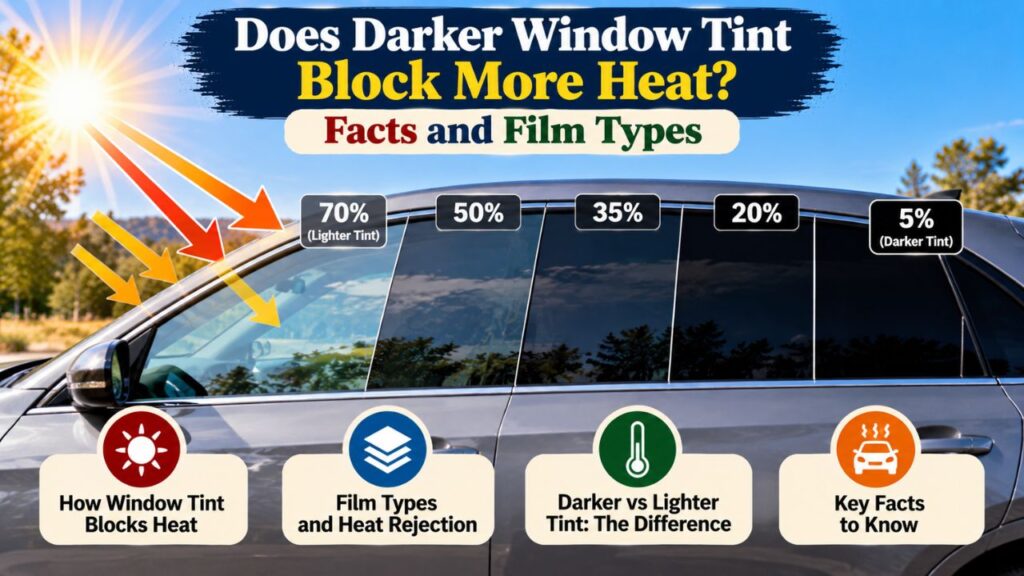
Within the same film series, darker shades often reject more total solar energy than lighter shades. However, a lighter high-performance film can outperform a much darker basic film.
The important distinction is whether you’re comparing two shades of the same product or two different film technologies.
Darker Tint Usually Reduces More Visible Light
Tint darkness is measured using Visible Light Transmission (VLT).
VLT indicates the percentage of visible light passing through the film or glass.
A lower VLT means a darker appearance.
| Window tint | Nominal visible light transmitted | General appearance |
| 70% | 70% | Very light |
| 50% | 50% | Light |
| 35% | 35% | Medium-dark |
| 20% | 20% | Dark |
| 15% | 15% | Very dark |
| 5% | 5% | Extremely dark |
For example, a 5% film allows much less visible light through than a 50% film.
Because visible light carries some solar energy, reducing its transmission can contribute to total solar heat rejection.
However, visible light isn’t the only source of solar heating.
Solar Heat Isn’t Determined by Tint Darkness Alone
Sunlight contains several types of radiation.
- Ultraviolet (UV): Contributes a relatively small portion of solar energy but can damage skin and vehicle interior materials.
- Visible light: Provides illumination and carries a meaningful portion of solar energy.
- Infrared (IR): Carries a substantial portion of solar energy associated with heat.
A film that blocks large amounts of visible light but transmits much of the infrared spectrum may provide less effective heat control than expected.
High-performance films can reduce infrared transmission while allowing comparatively more visible light through.
This is why light ceramic or multilayer films can sometimes outperform darker dyed products.
Darker Tint Can Absorb More Heat Without Rejecting It All
Some films manage sunlight primarily through absorption.
Absorbing solar radiation warms the film and glass.
Part of that energy may transfer toward the outside, while another portion can move toward the vehicle interior.
Therefore, a film that absorbs large amounts of radiation does not necessarily prevent all of that energy from contributing to cabin heat.
Reflective and spectrally selective films may manage solar energy differently.
To compare actual performance, you need more than a tint’s darkness.
Key Takeaway: Darker tint generally reduces more visible light, but total heat rejection depends on how the film handles solar energy across the entire spectrum.
Real Test Results: Dark Tint vs. Light Ceramic Tint
Manufacturer performance data provides a useful way to compare darkness with heat rejection.
The results below come from LLumar’s official North American automotive window film performance data.
The measurements were obtained using representative film samples on ¼-inch (6 mm) clear glass under the manufacturer’s stated test conditions.
Darker vs. Lighter Window Tint Heat Rejection Chart
| Window film | Film technology | VLT | Total solar energy rejected |
| LLumar ATC 05 | Dyed | 5% | 44% |
| LLumar ATC 35 | Dyed | 38% | 35% |
| LLumar ATC 50 | Dyed | 60% | 28% |
| LLumar CTX 50 | Ceramic | 55% | 43% |
| LLumar IRX 50 | Nano-ceramic | 54% | 50% |
| LLumar IRX 35 | Nano-ceramic | 39% | 54% |
| LLumar IRX 05 | Nano-ceramic | 6% | 62% |
These are specific product measurements, not universal heat-rejection percentages for every dyed or ceramic film.
The actual performance on a vehicle can differ because the original glass has its own solar properties.
What the Results Reveal
Consider two significantly different shades:
LLumar ATC 05:
- Visible light transmission: 5%.
- Total solar energy rejection: 44%.
- Appearance: Extremely dark.
LLumar IRX 50:
- Visible light transmission: 54%.
- Total solar energy rejection: 50%.
- Appearance: Relatively light.
In this comparison, the much lighter IRX 50 rejects six percentage points more total solar energy than the extremely dark ATC 05.
That means a lighter film can outperform a substantially darker one when the technologies differ.
Does Going Darker Help Within the Same Film Series?
Yes, it often does.
For example, LLumar’s ATC dyed series reports:
- ATC 50: 28% TSER.
- ATC 35: 35% TSER.
- ATC 05: 44% TSER.
As the dyed film becomes darker, total solar energy rejection increases.
The IRX ceramic series shows a similar overall pattern:
- IRX 50: 50% TSER.
- IRX 35: 54% TSER.
- IRX 05: 62% TSER.
However, the IRX series provides substantially greater total heat rejection than the basic dyed series at several comparable shades.
The difference illustrates why both film technology and VLT matter.
Is an Extra 5% or 10% Heat Rejection Noticeable?
A difference in total solar energy rejection means the films transmit different amounts of solar energy under the stated test conditions.
However, it doesn’t translate directly into the same percentage difference in cabin temperature.
For example, increasing TSER from 50% to 60% does not mean your car will be 10% cooler.
Actual interior temperatures depend on multiple factors, including:
- Solar intensity.
- Original vehicle glass.
- Windshield size.
- Vehicle color and interior materials.
- Outside temperature.
- Ventilation.
- Air-conditioning operation.
A higher TSER can improve solar heat control, but the cabin-temperature effect must be evaluated separately.
Key Takeaway: Actual product data shows that a lighter premium film can reject more heat than a darker basic film. Compare tested TSER values rather than relying on shade percentages.
How Does Window Tint Actually Block Solar Heat?
Automotive window film controls solar heat through a combination of reflection, absorption, and transmission.
Different film technologies use these mechanisms in different proportions.
Heat Reflection
Reflective films redirect some incoming solar energy away from the vehicle.
Certain metallized and specialized multilayer films use reflective structures to reduce solar transmission.
However, excessive visible reflectivity may create a mirror-like appearance and can be restricted by window tint laws.
The effectiveness of a reflective film depends on which parts of the solar spectrum it reflects.
A product doesn’t need to look highly reflective to manage infrared radiation effectively.
Heat Absorption
Some films absorb solar radiation rather than allowing it to pass directly through.
This can reduce the amount of sunlight reaching occupants and interior materials.
However, the absorbed energy warms the glass and film.
Some of that heat may subsequently move into the cabin.
Absorption is therefore only one part of the film’s overall solar performance.
Infrared Rejection
High-performance films are often designed to reject infrared radiation.
Infrared is a major contributor to incoming solar energy.
Ceramic films and specialized optical films can target parts of this spectrum without blocking as much visible light.
That is why infrared-control technology may provide a better balance of heat rejection and visibility than darkness alone.
However, infrared rejection claims should be interpreted carefully because they may cover different wavelength ranges.
Which Window Tint Blocks the Most Heat?
There is no single material category that always provides the highest heat rejection.
Performance varies among dyed, carbon, metallized, ceramic, and multilayer films.
A premium film in one category may outperform a lower-quality product in another.
Dyed Window Tint
Dyed tint primarily reduces visible light through absorption.
Darker dyed films typically offer more glare reduction and somewhat greater total solar energy rejection than lighter versions of the same product.
However, basic dyed films usually provide less advanced infrared control than premium solar-control technologies.
They can still be useful when privacy, appearance, and price are the main priorities.
Carbon Window Tint
Carbon-based films use carbon-containing materials to influence solar transmission and appearance.
Depending on the formulation, they may offer better solar performance than certain entry-level dyed films.
However, carbon tint is not a single standardized technology.
Different manufacturers use different constructions.
The word carbon alone doesn’t establish how much heat a film rejects.
Ceramic Window Tint
Ceramic tint uses microscopic ceramic-based materials designed to manage solar radiation.
High-performance ceramic films can reject substantial infrared energy while remaining relatively light.
This makes ceramic tint attractive for drivers wanting heat control without very dark windows.
However, not every ceramic film performs equally.
Some premium multilayer films also provide strong solar control without relying solely on ceramic construction.
Metallized Window Tint
Metallized films incorporate metallic layers or particles that can reflect or otherwise manage solar radiation.
Some provide strong heat-rejection performance.
However, certain metallized films may interfere with wireless signals, depending on their construction and the vehicle’s electronics.
Metallic reflectivity may also affect legal compliance.
Window Tint Technology Comparison
| Film technology | Heat-rejection potential | Does it need to be dark? |
| Basic dyed | Typically moderate | Darkness contributes significantly |
| Carbon | Varies by product | Not necessarily |
| Ceramic | Can be high | No |
| Metallized | Can be high | No |
| Advanced multilayer optical | Can be high | No |
Practical Recommendation: When heat rejection is your priority, compare specific film products rather than assuming ceramic, carbon, or dark dyed tint is automatically the best option.
Does Darker Ceramic Window Tint Block More Heat?
Within many ceramic film lines, darker shades provide somewhat greater total solar energy rejection.
However, the improvement may be smaller than the change in visible darkness suggests.
Comparing 50%, 35%, and 5% Ceramic Tint
Using the LLumar IRX example:
| Film | Visible light transmission | Total solar energy rejection |
| IRX 50 | 54% | 50% |
| IRX 35 | 39% | 54% |
| IRX 05 | 6% | 62% |
Moving from IRX 50 to IRX 05 substantially reduces visible light transmission.
The total solar energy rejection increases by 12 percentage points.
That can be a meaningful solar-performance improvement, but it comes with a much darker appearance.
For drivers who frequently travel at night, the reduced visibility may outweigh the additional heat rejection.
Why a Light Ceramic Film Can Still Perform Well
Ceramic films are designed to control solar radiation through their specialized materials.
These materials may reduce infrared transmission without requiring the film to absorb large amounts of visible light.
As a result, a 50% ceramic film can provide useful heat control while allowing more light into the vehicle.
This is particularly valuable for windows where visibility is a major concern.
Is Dark Ceramic Tint Always Better Than Light Ceramic Tint?
No.
A darker film may provide higher TSER, but the best choice depends on what you value.
Light ceramic tint often has advantages for:
- Nighttime visibility.
- Preserving the vehicle’s original appearance.
- Daytime visibility through side windows.
- Meeting stricter VLT regulations.
Dark ceramic tint often has advantages for:
- Greater daytime privacy.
- A darker exterior appearance.
- Additional visible glare reduction.
- Potentially higher TSER within the same film line.
The better choice balances those factors rather than maximizing darkness.
What Is the Difference Between TSER, IRR, and IRER?
Understanding heat-rejection ratings is essential when choosing window film.
Some products advertise very high infrared rejection numbers that don’t represent total solar heat rejection.
Total Solar Energy Rejection (TSER)
TSER measures the percentage of total solar energy rejected by the filmed glass under specified test conditions.
It includes the overall effect of different parts of the solar spectrum.
For example:
- 40% TSER means 40% of the incident solar energy is rejected.
- 60% TSER means 60% is rejected.
The higher value generally indicates better overall solar heat rejection under comparable conditions.
For automotive heat-control comparisons, TSER is one of the most useful figures.
Infrared Rejection (IRR)
IRR measures infrared rejection over a specified wavelength range.
For example, a manufacturer may report infrared rejection between 900 and 1,000 nanometers.
That number can be useful for understanding performance in that part of the spectrum.
However, it does not necessarily describe infrared rejection across the full solar infrared range.
Infrared Energy Rejection (IRER)
IRER measures solar infrared energy rejection over a broader specified wavelength range.
It also accounts for absorbed energy that may be reradiated toward the vehicle interior.
Depending on the test standard, it can provide a more complete view of infrared-related heat performance than a narrow-band IRR figure.
Why a 95% Infrared Rejection Claim Can Be Misleading
Suppose a film advertises 95% infrared rejection.
That doesn’t automatically mean it rejects 95% of total solar heat.
The claim may describe only a narrow portion of the infrared spectrum.
Visible light and other wavelengths also contribute to total solar energy.
For a meaningful comparison, ask for the film’s TSER and the measurement method used for the infrared claim.
The 3M Automotive Window Film product specifications and technical explanations distinguish visible light transmission, total solar energy rejection, and different infrared-rejection measurements. The manufacturer also explains that its Crystalline films can reject more heat than many darker films without substantially changing a vehicle’s appearance.
Key Takeaway: TSER is generally the most useful starting point for comparing overall heat rejection. Infrared figures provide additional context but shouldn’t replace total solar-energy measurements.
Does 5% Tint Block More Heat Than 20%, 35%, or 50%?
A 5% tint is darker than all three alternatives.
However, whether it blocks more heat depends on the products being compared.
5% vs. 20% Window Tint
Within the same film technology and series, 5% tint often provides somewhat greater total solar heat rejection than 20%.
It also provides stronger daytime privacy and more glare reduction.
However, 5% tint significantly reduces nighttime visibility.
A premium 20% ceramic film may reject more total heat than a basic 5% dyed film.
5% vs. 35% Window Tint
A 5% film blocks substantially more visible light than a 35% film.
Within the same series, it may also reject more total solar energy.
However, a 35% premium film can outperform a 5% entry-level product.
The 35% option also allows considerably more light through, making it more practical for many driving situations where legally permitted.
5% vs. 50% Window Tint
A 50% tint is relatively light compared with 5%.
However, advanced 50% films can offer strong heat rejection.
The LLumar comparison shows that IRX 50 rejects 50% of total solar energy, while ATC 05 rejects 44%.
Therefore, a much lighter high-performance ceramic film can block more total solar heat than a very dark dyed tint.
Which Percentage Is Best for Heat Rejection?
There isn’t one universally best VLT percentage.
The optimal choice depends on film performance, legal restrictions, and visibility needs.
If heat rejection is your primary concern, start with the film’s TSER rating and select the lightest shade that provides the desired performance.
This may help preserve visibility while still reducing cabin heat.
Does Darker Tint Keep a Parked Car Cooler?
Darker tint may reduce the amount of solar energy entering the vehicle, but it does not guarantee a cooler cabin than a lighter high-performance film.
The vehicle’s interior temperature depends on several variables.
What Happens Inside a Parked Car?
When sunlight enters through vehicle windows, interior surfaces absorb energy and warm up.
The warmed surfaces transfer heat to the surrounding air.
The cabin temperature can rise significantly when the vehicle is parked in direct sunlight.
Window tint can reduce some incoming solar energy, but it cannot eliminate all heat transfer.
A car with high-performance tint can still become dangerously hot while parked.
Does Tint Completely Prevent Interior Heat Buildup?
No.
Even with advanced solar-control films, sunlight may continue entering through untreated glass.
Heat also transfers through the vehicle’s roof, body panels, and other surfaces.
The resulting cabin temperature depends on external conditions and the vehicle’s overall thermal characteristics.
Safety Warning: Never leave children, pets, or vulnerable passengers unattended in a parked vehicle. Dark or high-performance window tint does not make a closed vehicle safe in hot weather.
Does Darker Tint Reduce Air-Conditioning Use?
A suitable heat-rejecting film may help reduce solar cooling demand under certain conditions.
However, the actual effect depends on the vehicle, climate, treated glass area, and air-conditioning system.
There is no universal percentage of fuel or electricity savings that applies to every tinted vehicle.
If your main reason for installing tint is comfort, compare tested heat-rejection performance rather than relying on unsupported energy-savings claims.
Does Darker Window Tint Block More UV Rays?
Not necessarily.
UV rejection depends on the film’s formulation and the wavelengths it is designed to block.
Many high-quality automotive films provide substantial UV protection in both light and dark shades.
UV Protection Isn’t the Same as Heat Rejection
UV radiation contributes only part of the total energy arriving from the sun.
A film can block more than 99% of specified UV wavelengths while providing relatively modest total solar heat rejection.
For example, LLumar’s published performance chart reports greater than 99% ultraviolet protection across the listed ATC dyed and IRX ceramic shades, despite their different TSER ratings.
This demonstrates that strong UV protection doesn’t automatically require a very dark film.
Can 70% Tint Block UV Rays?
Yes.
Some nearly clear and light automotive films provide substantial UV protection.
Their appearance depends on visible light transmission, while their UV-blocking performance depends on the film’s materials.
If UV protection is the main objective, compare the manufacturer’s specified UV rejection rating rather than choosing the darkest shade.
Does More UV Rejection Mean Better Cooling?
Not necessarily.
UV rejection and total solar heat rejection measure different properties.
A film with excellent UV blocking may still allow significant visible and infrared energy into the car.
For heat control, TSER is a more useful overall performance measurement.
Is Darker Window Tint Better for Privacy and Glare?
Darker tint generally provides stronger daytime privacy and reduces more visible sunlight.
These benefits are more directly related to VLT than overall heat rejection.
Darker Tint for Daytime Privacy
A 5% tint makes it considerably harder to see into a vehicle than a 50% tint in many daylight conditions.
However, even dark tint doesn’t provide guaranteed privacy.
Passengers may remain visible when the interior is illuminated or when sunlight enters through other windows.
Darker Tint for Sunlight Glare
Lower VLT means less visible light passes through the window.
This usually reduces glare from bright sunlight.
However, very dark film also reduces visibility in poor lighting.
The best shade balances glare reduction with the light needed to identify the surroundings.
Darker Tint for Nighttime Driving
Dark film can make it harder to see:
- Pedestrians and cyclists.
- Curbs and sidewalks.
- Road edges.
- Cross traffic.
- Objects during reversing.
- Obstacles in poorly illuminated parking areas.
A high-performance ceramic film with lower VLT is still dark.
The ceramic technology does not eliminate the visibility limitations associated with reduced light transmission.
Practical Recommendation: If you frequently drive after sunset, consider a lighter legally compliant film with strong heat rejection rather than choosing very dark tint for appearance alone.
Is Darker Window Tint Legal in the United States?
Window tint laws vary by state, vehicle type, and window position.
In many states, front side windows face stricter VLT restrictions than rear passenger windows.
Some states also regulate reflectivity, tint color, and windshield applications.
Front Side Windows
A very dark 5%, 15%, or 20% film may be illegal on front side windows in many states.
For example, Texas generally requires the completed front side windows to transmit at least 25% of visible light and meet its reflectivity requirements.
Other states have different minimums.
Verify the current requirements in your registration state before installation.
Rear Windows
Rear side windows and rear windshields may have more flexible darkness requirements.
However, those rules are not identical throughout the United States.
Some restrictions also depend on vehicle classification and outside mirror equipment.
Check the law for the specific windows you intend to tint.
Why the Final VLT Can Be Darker Than the Film Label
Original automotive glass already reduces some visible light.
When a film is installed, the combined window usually transmits less visible light than the film alone.
For a simplified estimate:
Combined VLT = Original glass VLT × Film VLT ÷ 100
For example, if the original glass transmits 80% of visible light:
- With 50% film: approximately 40% combined VLT.
- With 35% film: approximately 28% combined VLT.
- With 20% film: approximately 16% combined VLT.
These are mathematical approximations.
Actual measurements depend on the glass, film, and testing method.
For legal compliance, use a suitable calibrated tint meter to verify the finished window.
How to Choose Window Tint for Maximum Heat Rejection
Choosing the right tint involves more than selecting a percentage.
The most effective approach is to compare actual solar performance and then select an appropriate shade.
Step 1: Check the Film’s TSER Rating
Start by comparing total solar energy rejection.
A higher TSER generally means better solar heat control when the films are evaluated under comparable test conditions.
Don’t rely only on an advertised infrared rejection percentage.
Step 2: Compare the Same Glass Testing Conditions
Film performance can change depending on the glass on which it is installed.
Manufacturer data may be measured using clear 6 mm glass, standard automotive glass, or another specified reference.
When comparing products, check whether the measurements were obtained using similar conditions.
Otherwise, the numbers may not be directly comparable.
Step 3: Choose a Suitable Film Technology
If you want meaningful heat rejection with a relatively light appearance, compare ceramic and advanced multilayer films.
Dyed films may be sufficient when privacy and appearance are more important than maximum heat control.
Metallized films are another option, but confirm electronic compatibility and reflectivity requirements.
Step 4: Select the Lightest Practical VLT
Once you identify a film with suitable heat rejection, choose a shade that balances comfort, privacy, and visibility.
Going darker may increase TSER within the same series, but the improvement should be weighed against reduced nighttime visibility.
A lighter film may provide a better daily-driving experience.
Step 5: Check the Tint Laws Before Installation
Confirm the required VLT and reflectivity limits for the intended windows.
Remember that the original glass affects the final VLT.
Discuss compliance with the installer before choosing the film.
Step 6: Compare Warranty and Installation Quality
High-performance film can be expensive.
A suitable warranty and professional installation help protect that investment.
Ask the installer for:
- Exact film manufacturer and product series.
- Published solar-performance specifications.
- Expected final VLT.
- Installation warranty.
- Product warranty.
- Care and curing instructions.
Avoid comparing films solely on price or shade.
Common Mistakes When Choosing Dark Tint for Heat Protection
Several common assumptions can lead to disappointing results.
Assuming 5% Tint Always Blocks the Most Heat
A 5% film is extremely dark, but darkness is not a reliable ranking of total solar heat performance across brands and technologies.
A lighter premium film may perform better.
Comparing Infrared Rejection Numbers Alone
A film advertising 95% infrared rejection may be reporting performance over a limited wavelength range.
That number doesn’t necessarily mean 95% of total solar energy is rejected.
Compare TSER and review the measurement definitions.
Ignoring Nighttime Visibility
Very dark tint can reduce the visibility of pedestrians, curbs, and other hazards.
This is especially important on side windows used for driving decisions.
Choose visibility and legal compliance before appearance.
Assuming Ceramic Tint Is Always Superior
Ceramic films can perform well, but product quality and construction vary.
A premium nonceramic multilayer film may outperform a lower-quality ceramic film.
Always compare actual technical data.
Expecting Tint to Eliminate Parked-Car Heat
Window film can reduce solar heat transmission, but it cannot completely prevent a vehicle from becoming hot.
Do not treat tint as a substitute for safe parking practices or proper air conditioning.
Applying Additional Film Over Factory Privacy Glass
Factory privacy glass may already have low visible light transmission.
Adding another dark film can make the completed window extremely dark.
Measure the original glass before adding aftermarket tint.
Conclusion
So, does darker window tint block more heat? Often yes when comparing different shades within the same film series, but not necessarily when comparing different technologies.
A darker dyed tint may reject less total solar energy than a much lighter high-performance ceramic or multilayer film.
The most useful measurement for comparing overall solar heat control is Total Solar Energy Rejection (TSER), supported by appropriate infrared-performance data.
If your priority is cooling, choose a film with strong documented heat rejection rather than automatically selecting 5% or 15% tint.
For everyday driving, I recommend a lighter, legally compliant high-performance film when it provides sufficient heat rejection. It can offer a better balance of comfort and nighttime visibility than very dark basic tint.
Choose window tint based on verified solar performance, safe visibility, and legal requirements—not darkness alone.
FAQs About Does Darker Window Tint Block More Heat
Does 5% Window Tint Block More Heat Than 35%?
Within the same film series, 5% tint often rejects more total solar energy than 35% tint.
However, a premium 35% ceramic film may reject more heat than a basic 5% dyed film.
Compare the actual TSER ratings rather than relying only on tint percentages.
Does 20% Tint Keep a Car Cooler Than 50%?
A 20% film may reject more total solar energy than a 50% film from the same series.
However, a high-performance 50% ceramic film can outperform a basic 20% dyed product.
The difference depends on film construction and measured solar performance.
Can Clear Window Tint Block Heat?
Yes. Some nearly clear automotive films use advanced solar-control technology to reject meaningful infrared energy and total solar heat.
They can help reduce direct solar heating while preserving relatively high visible light transmission.
Their actual performance depends on the product’s specifications.
Does Darker Tint Make a Car Hotter?
A darker film can absorb more solar energy and become warmer than a lighter film.
However, that doesn’t automatically mean it causes higher cabin temperatures.
The amount of absorbed energy transferred toward the interior depends on the film and glass construction.
Compare total solar energy rejection to understand overall heat-control performance.
Is Ceramic Tint Better Than Dark Regular Tint for Heat?
High-quality ceramic tint can reject more solar heat than basic dark dyed tint, including in relatively light shades.
However, not every ceramic product is superior to every dyed, metallized, or multilayer film.
Check TSER and other verified specifications before choosing.
Does Darker Tint Block More UV Rays?
Not necessarily.
Many light and dark premium films block similar amounts of UV radiation.
UV protection depends mainly on film composition rather than visible darkness.
A nearly clear UV-blocking film can provide substantial protection without creating a dark appearance.
What Window Tint Percentage Is Best for Keeping Heat Out?
There is no single best percentage for every vehicle.
A 35% or 50% high-performance film may provide strong heat rejection while allowing more light through than 5% or 15% tint.
For maximum comfort, compare TSER, the vehicle’s existing glass, nighttime visibility, and local tint laws before selecting a shade.