Finding the best ball joints for gmc sierra is less about choosing the cheapest part and more about matching the joint or control-arm assembly to the truck’s suspension design. Steel versus aluminum or stamped arms, lift height, model year, drive configuration, and front suspension type can all change compatibility.
My first choice is SUCOSO 2-4 Inch Lift Upper Control Arms. Its tubular steel construction, direct-bolt installation, and geometry-focused design make it a particularly sensible upgrade for a lifted Sierra used on or off the road.
My second choice is TadaMark Front Upper Control Arm Steel. The package includes upper arms with pre-assembled ball joints plus lower ball joints, although the steel-control-arm limitation makes careful fitment checking essential.
My third choice is PremiumpartsWhosale PremiumpartsWhosale a-Premium 2-Pack Front Lower Ball Joint. It covers a wide range of Chevrolet and GMC applications, includes grease fittings and installation hardware, and offers a one-year warranty, but the catalog fitment still requires close attention to arm and knuckle construction.
The comparison below separates complete control-arm solutions from standalone lower-joint replacements. The detailed sections explain fitment boundaries, construction, installation considerations, maintenance, common mistakes, and which type of buyer each option suits best.
Best Ball Joints for Gmc Sierra
I selected these parts for direct relevance to GMC Sierra suspension repairs, the amount of useful fitment information supplied, customer-feedback evidence where available, and practical variety across replacement joints, control arms, and complete front-end kits. The ranking also considers whether a product solves a specific need, such as correcting geometry on a lifted truck or replacing several worn components at once, without claiming hands-on testing.
| # | Image | Product | Price on Amazon |
|---|---|---|---|
| 1 |  |
SUCOSO 2-4 Inch Lift Upper Control Arms | Check Price |
| 2 | 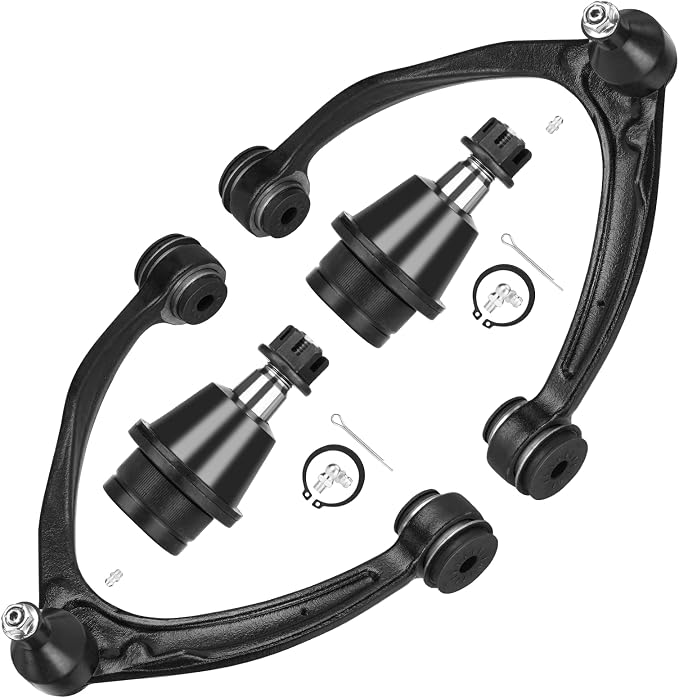 |
TadaMark Front Upper Control Arm Steel | Check Price |
| 3 |  |
PremiumpartsWhosale PremiumpartsWhosale a-Premium 2-Pack Front Lower Ball Joint | Check Price |
| 4 |  |
Detroit Axle Detroit Axle 2 Front Lower Ball Joints | Check Price |
| 5 |  |
Detroit Axle 12-Piece Front End Kit | Check Price |
SUCOSO 2-4 Inch Lift Upper Control Arms
The SUCOSO package is aimed at a very specific but common Sierra situation: a 2007–2018 1500 with a 2–4 inch lift. Instead of replacing only a worn joint, it supplies tubular steel upper control arms with ball joints already included. That gives the buyer a broader suspension refresh and can be more practical when the original stamped-steel arms are bent, tired, or unsuitable for the truck’s modified ride height.
Its main advantage is geometry correction. A lift changes the relationship between the control arm, knuckle, and wheel, so a purpose-built upper arm can help restore usable camber and caster range and support more predictable straight-line handling. The design also aims to provide additional suspension travel and tire clearance, which may matter to owners running larger tires or using their trucks away from pavement.
There are important boundaries. It does not fit stock-height models, 2007 Classic trucks, or vehicles using a 3.5-inch lifted knuckle kit. The supplied information also excludes stock wheels with 275- or 285-width tires. It is listed for six-lug Silverado and Sierra 1500 applications, along with related Tahoe, Yukon, and Suburban models, so the exact chassis and wheel setup should be confirmed before ordering.
Pros
- Tubular steel upper arms are an upgrade over stamped-steel originals.
- Designed for 2–4 inch lifted 1500 trucks.
- Ball joints are included with the control arms.
- Direct-bolt installation requires no cutting or welding.
Cons
- Not suitable for stock-height trucks.
- Excludes 2007 Classic models and certain lifted-knuckle setups.
- Wheel and tire combinations need extra compatibility checking.
My Opinion
This is the strongest match for a lifted Sierra owner who wants an upper-control-arm upgrade rather than a narrow joint-only repair. It ranks first because its intended use, construction, and geometry benefits align clearly with a common modified-truck need, provided the lift and wheel restrictions fit.
TadaMark Front Upper Control Arm Steel
TadaMark takes a package approach that covers both sides of the front suspension. The four-piece kit includes left and right forged-steel upper control arms with pre-assembled ball joints, along with two lower ball joints. For a truck needing several related components, that can reduce the need to combine mismatched parts from multiple listings.
The forged-steel construction is the key selling point. Compared with a lighter or stamped design, a high-strength steel arm is intended to provide a stable base for the ball joint during normal suspension movement. The pre-assembled upper joints also simplify the parts list, although installation still involves removing and installing suspension components and should not be treated as a casual bolt-on task for an inexperienced owner.
Fitment is more complicated than the broad model-year range suggests. The supplied application list covers many 2007–2016 Sierra and Silverado 1500 trucks and related SUVs, but it specifically says the kit fits forged-steel control arms only, not aluminum or stamped-steel versions. Reference numbers K80669, K80670, and K6541 can help with comparison, while the vehicle’s existing arm material remains the deciding factor.
This package suits a stock or near-stock repair more naturally than a dedicated lift correction. It can be attractive when both upper arms and lower joints show wear, but it is less appropriate for someone who needs only one replacement joint or has a suspension configuration outside the listed steel-arm applications.
Pros
- Includes both upper arms and two lower ball joints.
- Forged-steel construction is intended for strength and stability.
- Upper ball joints arrive pre-assembled.
- Broad coverage across several GM 1500-based vehicles.
Cons
- Only fits forged-steel control-arm applications.
- Does not fit aluminum or stamped-steel arms.
- Vehicle-specific confirmation is especially important.
My Opinion
TadaMark is a useful second choice for a buyer planning a multi-part front suspension repair on a compatible steel-arm truck. Its package is more comprehensive than a two-joint box, but the material restriction prevents it from being a universal answer for every Sierra in the stated years.
PremiumpartsWhosale PremiumpartsWhosale a-Premium 2-Pack Front Lower Ball Joint
The A-Premium set is a focused replacement for the front lower driver- and passenger-side ball joints. That makes it a logical choice when the upper control arms remain serviceable and the problem is limited to lower-joint wear. Supplying both sides together also encourages a more balanced repair rather than replacing one joint today and waiting for the other to develop similar play.
Several practical details improve its ownership appeal. The joints come pre-greased and include grease fittings, allowing the owner to add lubricant at service intervals. Rubber bushings are intended to help absorb vibration and noise, while the included castle nuts and cotter pins provide the hardware needed to secure the joint after installation. A one-year warranty is also listed, giving the buyer a defined support period.
Compatibility is the main caution. The catalog includes Sierra 1500 applications from 1999 through 2016, but the requirements vary by year: some early trucks are listed as four-wheel drive only, while certain 2004–2006 applications require front torsion-bar suspension. For 2007–2016 Sierra models, the parts are specified for trucks with steel control arms and exclude aluminum steering knuckles.
Because these are lower joints rather than complete arms, installation may require separating a pressed-in or tightly seated joint from the existing control arm. That can involve specialized tools and significant force. A buyer without the equipment should budget for professional installation rather than assuming the included hardware makes the job simple.
Pros
- Two-piece set covers both front lower positions.
- Pre-greased joints include grease fittings.
- Castle nuts and cotter pins are included.
- One-year warranty is listed.
Cons
- Fitment varies by drivetrain, suspension, and year.
- Not intended for aluminum steering knuckles.
- Does not replace worn control arms.
My Opinion
This is a sensible third-place option for a targeted lower-joint repair on a compatible steel-arm Sierra. Its lubrication provisions and complete left/right format are useful, but the buyer must verify the exact suspension configuration before ordering and plan the installation realistically.
Detroit Axle Detroit Axle 2 Front Lower Ball Joints
Detroit Axle’s two-piece lower-joint set covers a wide selection of Chevrolet and GMC trucks and SUVs from 1999 through 2016. It is aimed at replacing the front lower joints rather than refreshing the complete control arm, so it can make financial and practical sense when the existing arms are still structurally sound.
One notable strength is the large amount of vehicle detail in the fitment description. It distinguishes among four-wheel-drive, all-wheel-drive, rear-wheel-drive torsion-bar, cast-iron-arm, and gross-vehicle-weight applications. For example, several 2007–2016 Sierra and Silverado entries are specifically tied to cast-iron control arms. That level of detail is helpful, but it also signals that a simple year-and-model search may not be enough.
The set is particularly relevant to owners of cast-iron-arm configurations across Silverado, Sierra, Tahoe, Yukon, Escalade, Avalanche, and related vehicles. It should not be treated as a universal lower-joint replacement for every truck sharing the same body generation. The existing arm material and suspension layout must agree with the listed application.
At 2.86 pounds for the item listing, it is presented as a compact two-joint replacement rather than a complete front-end overhaul. That keeps the parts choice focused, but worn tie rods, sway-bar links, or control-arm bushings will remain unresolved. If several steering and suspension components are loose, a broader kit may offer a more efficient repair path.
Pros
- Two front lower joints are supplied as a pair.
- Extensive fitment information covers many GM applications.
- Useful for compatible cast-iron control-arm configurations.
- Focused replacement avoids buying unrelated components.
Cons
- Compatibility depends heavily on arm material and drivetrain.
- Does not address worn tie rods or other front-end parts.
- Broad catalog coverage can make incorrect ordering easier.
My Opinion
Detroit Axle is a strong choice when the truck’s original configuration matches the detailed application notes and only the lower joints need replacement. Its high customer-feedback volume adds selection confidence, but the complicated fitment makes VIN, chassis, and component inspection worthwhile before purchase.
Detroit Axle 12-Piece Front End Kit
This Detroit Axle package is the broadest option in the group. It includes two upper control arms with ball joints, two lower ball joints, two sway-bar end links, four tie rods, and two rack-and-pinion boots and bellows. Rather than solving one isolated wear point, it targets several components that commonly contribute to looseness, noise, uneven tire wear, or vague steering.
The kit can be efficient for a 2007–2013 Silverado or Sierra 1500 that needs a substantial front-end refresh. Replacing related parts together may save repeated tear-down time and makes it easier to perform one alignment after the suspension work is complete. It also gives the buyer new upper arms instead of requiring the original arms to remain in service.
Its most important limitation is explicit: the lower ball joints fit steel control arms only. That restriction should be checked before considering the kit, especially because related GM trucks can use different arm materials and suspension arrangements. The application list also spans numerous Cadillac, Chevrolet, and GMC models, so the year range alone does not guarantee a match.
A complete kit is not automatically the best answer for a truck with one failed joint. It can add parts that are still healthy, and installing multiple steering components increases the need for careful torque procedures and a professional alignment. On the other hand, for a high-mileage front end with several worn pieces, the broader coverage can be more convenient than assembling separate replacements.
Pros
- Includes 12 front-end components in one package.
- Combines upper arms, ball joints, tie rods, sway links, and rack boots.
- Useful for a comprehensive repair on compatible 2007–2013 trucks.
- Components undergo impact, wear, and fatigue testing according to the supplied data.
Cons
- Lower joints fit steel control arms only.
- May include unnecessary parts for a single-joint repair.
- Requires careful fitment and alignment planning.
My Opinion
This is the best match for a compatible truck needing several front-end parts at once, not for a narrowly defined repair. Its coverage is impressive, but the steel-arm requirement and larger installation scope place it fifth as an all-purpose choice.
How I Selected These Best Ball Joints for Gmc Sierra
The selection starts with application relevance rather than brand familiarity. I compared the stated Sierra model years, drivetrain notes, control-arm materials, lift requirements, and included components. A replacement that fits only a specific steel-arm or lifted configuration can still rank highly when that limitation is clearly tied to a valuable use case.
I also separated standalone lower joints from upper control-arm assemblies and complete front-end packages. Those products solve different problems, so ranking them only by component count would mislead a buyer. Customer-feedback volume and ratings were considered as supporting evidence, while the supplied fitment details, hardware, lubrication provisions, warranty information, and stated construction helped define practical value.
Control-arm material is one of the most important checks in this category. Several choices fit steel or cast-iron arms only and should not be ordered from a model year alone.
A lifted Sierra needs a different decision process from a stock-height truck. A geometry-correcting upper-arm package may be more useful than a lower-joint-only replacement when lift-related alignment range is the real problem.
How to Choose the Best Ball Joints for Gmc Sierra
Start by identifying exactly which joint is worn and what type of control arm or steering knuckle is on the truck. Then match the replacement to the model year, drivetrain, suspension design, and any lift or wheel changes. The cheapest-looking part is not a bargain if it requires returning the order or cannot be pressed into the existing arm.
- Confirm the truck’s year, cab or chassis generation, drivetrain, and six-lug configuration where applicable.
- Inspect whether the control arms are steel, cast iron, stamped steel, or aluminum.
- Choose upper arms for geometry or arm-condition problems, not just a lower-joint failure.
- Prefer a two-sided set when both joints have similar mileage and wear.
- Plan for an alignment after suspension components are replaced.
Identify the Actual Failure
A lower ball joint replacement is appropriate when the joint is worn but the control arm remains sound. A complete upper-arm assembly makes more sense when the upper joint and arm are both questionable, or when a lifted truck needs corrected suspension geometry. If tie rods, sway links, boots, and several joints are loose, a full front-end package may reduce repeated labor.
Check Arm and Knuckle Material
Do not rely on “GMC Sierra 1500” as the only fitment information. The supplied products repeatedly distinguish steel or cast-iron arms from aluminum or stamped-steel versions. Look at the installed component, compare the shape and mounting points with the listing information, and use the seller’s vehicle-confirmation tool when available.
Match the Lift and Wheel Setup
Lifted trucks introduce compatibility issues that stock applications do not. The SUCOSO upper-arm package is intended for a 2–4 inch lift and excludes certain 3.5-inch lifted-knuckle kits and some stock-wheel, wide-tire combinations. Measure the actual suspension configuration rather than assuming every lift kit produces the same geometry.
Consider Repair Scope
A two-joint box keeps a targeted repair focused, while a four-piece control-arm package or 12-piece front-end kit replaces more aging hardware at once. More parts can be efficient on a high-mileage truck, but it also means more installation steps and more opportunities for an incorrect match. Buy the scope that fits the condition of the entire front end.
Compatibility Checks Before Ordering
Gather the VIN, model year, drive type, engine if the listing separates applications, and information about prior suspension work. Inspect the control-arm material with the vehicle safely supported, and compare the existing joint position with the product’s stated front lower or upper location.
For older Sierras, note that some listings divide applications by four-wheel drive, rear-wheel drive with front torsion-bar suspension, or all-wheel drive. A 1999–2006 truck may not share the same lower-joint application as a 2007–2016 truck, even when both are called a Sierra 1500.
Aftermarket wheels and tires deserve their own check. Wide tires can change clearance at the arm, joint, and wheel, while lift components can alter the relationship between the control arm and steering knuckle. If the listing names a tire-width or wheel restriction, treat it as a hard warning rather than a minor suggestion.
Installation Planning for a First-Time Buyer
Ball-joint work is a suspension repair, so the truck must be supported securely with quality jack stands on a stable surface. A floor jack should support a component only during controlled movement, never as the sole support while fasteners are being removed.
Tools and Labor
A lower-joint replacement may require a ball-joint press, suitable sockets, a torque wrench, and a way to separate tapered studs without damaging nearby parts. Upper control-arm replacement can be more straightforward when the assembly arrives with the joint installed, but the spring and steering knuckle still demand respect. If the necessary press or safe lifting equipment is unavailable, professional installation is the safer choice.
Before Driving
Compare the old and new parts before disassembly is complete. Check stud direction, mounting-hole position, grease-fitting access, and included nuts or pins. After installation, inspect that cotter pins are properly installed where specified, confirm that brake lines and ABS wiring are not strained, and have the front end aligned before extended driving.
Alignment and First-Use Checks
Any replacement that changes the control-arm position or removes steering and suspension hardware can affect alignment. An alignment is especially important after installing upper control arms on a lifted truck, because the purpose of those arms is partly to restore usable camber and caster range.
For the first short drive, pay attention to steering-centering, clunks, pulling, vibration, or rubbing. Recheck for visible interference with wheels at full steering lock and look for loose or displaced hardware after the initial drive. A new joint should not be used to mask an unresolved problem elsewhere in the front suspension.
Maintenance and Service Life
Grease fittings can be valuable when the replacement joint is designed to accept periodic lubrication. Use the correct grease and avoid forcing lubricant until a boot distorts or ruptures. The A-Premium set is listed as pre-greased and includes fittings, but that does not eliminate the need to inspect the boot and fitting during routine service.
Keep an eye on torn boots, rust around the stud or housing, looseness, unusual tire wear, and new suspension noise. A lubrication point cannot repair a damaged boot, bent arm, or worn mounting hole. Vehicles used on rough roads, in mud, or where road salt is common may benefit from more frequent visual checks.
When to Replace More Than the Ball Joint
A joint-only repair is efficient when the control arm, bushings, tie rods, and sway-bar links remain in good condition. Replacing the entire arm becomes more reasonable when its bushings are cracked, the arm is damaged, or a lifted truck needs a geometry-oriented upgrade.
Consider a broader kit when several parts show play during inspection or when repeated labor would cost more than addressing related wear together. The Detroit Axle 12-piece package is an example of that approach, but its steel-arm restriction and wider installation scope must be confirmed first.
Common Mistakes to Avoid
Most ordering problems in this category come from assuming that a shared body name guarantees shared suspension parts. Installation mistakes can also create noise, premature wear, or unsafe steering behavior.
- Ordering by year and model without checking steel, cast-iron, stamped-steel, or aluminum construction.
- Installing a stock-height joint or arm on a lifted truck without checking geometry needs.
- Ignoring four-wheel-drive, all-wheel-drive, torsion-bar, or gross-vehicle-weight notes.
- Reusing damaged nuts, cotter pins, boots, or mounting hardware when replacement pieces are supplied.
- Skipping the alignment after removing control arms or steering components.
- Assuming a complete kit is better when only one compatible joint is actually needed.
Do not force a part into place because the year range appears correct. Stop and recheck the arm material, mounting shape, and suspension configuration before proceeding.
Storage and Ownership Tips for Spare Parts
If a replacement part will not be installed immediately, keep it sealed and dry, away from direct sunlight, solvents, and moisture. Protect rubber boots from sharp tools and avoid stacking heavy items on top of assemblies that could bend studs or damage fittings.
Keep the product packaging and fitment information until installation is complete. This makes it easier to compare left and right components, retain reference numbers, and resolve a mismatch before the truck is disassembled. After installation, record the date and mileage so future inspections are based on actual service history.
FAQS About Best Ball Joints for Gmc Sierra
Are these ball joints compatible with every GMC Sierra 1500?
No. Compatibility varies by year, drivetrain, control-arm material, steering knuckle, suspension type, and lift configuration. Several products fit steel or cast-iron arms only, while the SUCOSO package is intended for 2–4 inch lifted applications.
Should I replace both lower ball joints at the same time?
A matched two-piece set is practical when both sides have similar mileage or wear. Replacing both can provide a more consistent repair, but the decision should follow an inspection of each joint and the surrounding control arms.
Are upper control arms better than lower ball-joint replacements?
Neither is universally better. Upper arms are appropriate when the upper joint or arm is worn, or when a lifted truck needs geometry support. Lower-joint replacements are more suitable when the lower joints are the failed parts and the existing arms are still serviceable.
Do these parts fit aluminum control arms?
Not all of them. The TadaMark kit, A-Premium lower joints, and Detroit Axle 12-piece kit include steel-arm limitations in the supplied data. Confirm the arm material on the vehicle before ordering.
Is an alignment needed after ball-joint installation?
An alignment is strongly advisable after control-arm work and sensible after any repair that disturbs steering or suspension positioning. It can identify camber, caster, or toe changes that may cause pulling or uneven tire wear.
Can I install a ball joint without a press?
Some complete upper control-arm assemblies reduce pressing work because the joint arrives installed. Standalone lower-joint replacement may require a press or specialized tool, and a professional shop is the safer option if the correct equipment is unavailable.
Final Thoughts
The best ball joints for gmc sierra depend on the truck’s exact suspension and repair scope. My top three are the SUCOSO 2-4 Lift Upper Control Arms with Ball Joints for lifted trucks, TadaMark Forged Steel Front Upper Control Arms with Ball Joints for compatible steel-arm repairs, and A-Premium Front Lower Ball Joints for a focused two-sided replacement. Confirm fitment before purchase, install carefully, and schedule an alignment when suspension geometry has been disturbed.