Finding the best ball joints for jeep tj is less about choosing the longest feature list and more about matching the replacement to your axle, driving habits, and repair plan. A daily-driven TJ may need a straightforward four-joint replacement, while a trail rig with larger tires may benefit from a rebuildable or more adjustable design.
My first choice is Rough Country Rough Country Heavy Duty Replacement Ball Joints. The polyurethane dust boots and limited lifetime replacement warranty add useful ownership value for a TJ that sees regular road and trail use.
My second choice is KDSA KDSA 13PC 4WD Front Track Bar Tie Rods Ball. It includes the four ball joints along with a track bar, tie-rod components, and stabilizer links, making it appealing when several steering and suspension parts need attention at once.
My third choice is American Iron Offroad American Iron Offroad AI-1103 Ball Joint Delete. American Iron Offroad American Iron Offroad AI-1103 Ball Joint Delete takes third place as a specialized upgrade rather than a conventional replacement. Its rebuildable spherical-bearing design, adjustable steering feel, and clearance for RCV axles or larger tires make it interesting for serious off-road builds, although its unusual design is not the simplest choice for every TJ.
The comparison below explains where each option fits, what its supplied specifications mean in everyday ownership, and where the limitations deserve attention. I will also cover axle and year compatibility, installation planning, maintenance, common mistakes, and how to choose a replacement without treating every TJ as if it had the same needs.
Best Ball Joints for Jeep Tj
I selected these products for their direct relevance to TJ front suspension work, the amount of useful fitment and construction information supplied, and available customer-feedback evidence. I also included both conventional four-joint kits and a broader steering kit so the comparison reflects different repair situations rather than only one product style.
| # | Image | Product | Price on Amazon |
|---|---|---|---|
| 1 | 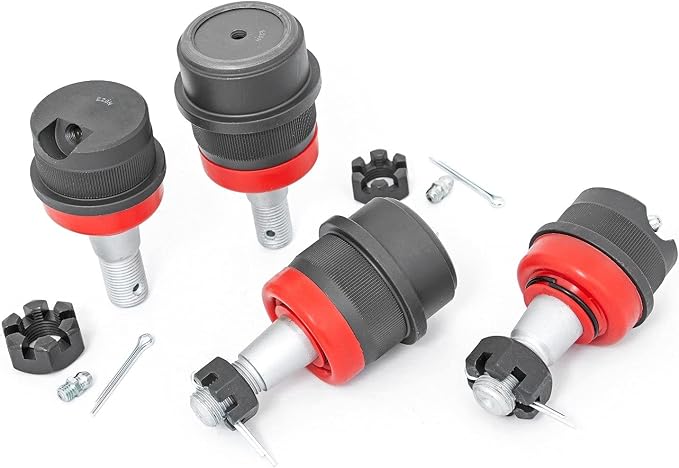 |
Rough Country Rough Country Heavy Duty Replacement Ball Joints | Check Price |
| 2 |  |
KDSA KDSA 13PC 4WD Front Track Bar Tie Rods Ball | Check Price |
| 3 |  |
American Iron Offroad American Iron Offroad AI-1103 Ball Joint Delete | Check Price |
| 4 |  |
STZJAYE 10642 Upper Lower Ball Joint Kit | Check Price |
| 5 |  |
STICHLER STICHLER Front Ball Joints 4pcs | Check Price |
Rough Country Rough Country Heavy Duty Replacement Ball Joints
Rough Country’s 10642 set is the most balanced choice in this group for a TJ owner seeking a conventional replacement. It includes two upper and two lower ball joints, so the buyer receives a complete four-joint set rather than having to piece together separate upper and lower components.
Compatibility with Dana 30 and Dana 44 axles is important because those are common axle families in Jeep applications, but it should still be confirmed against the actual vehicle before ordering. A chromoly ball stud gives this set a stronger material story than a basic stock-style replacement, while the polyurethane dust boot is intended to help keep contamination away from the joint.
The limited lifetime replacement warranty is another reason it ranks first. A warranty cannot prevent installation problems or compensate for an incorrect fit, but it provides more ownership reassurance than a short coverage period. The trade-off is that this remains a standard replacement set, not an adjustable or rebuildable high-clearance system for a heavily modified rock crawler.
Pros
- Complete set of two upper and two lower ball joints.
- Fits Dana 30 and Dana 44 axle applications.
- Chromoly ball studs and polyurethane dust boots.
- Backed by a limited lifetime replacement warranty.
Cons
- Fitment still needs to be checked against the specific TJ and axle.
- Does not offer the rebuildable adjustability of a spherical-bearing system.
My Opinion
This is the easiest recommendation for most owners who want a straightforward, complete replacement from a recognizable aftermarket brand. Confirm the axle first, and plan for a proper press-equipped installation rather than assuming the job is a quick bolt-on repair.
KDSA KDSA 13PC 4WD Front Track Bar Tie Rods Ball
KDSA’s kit is aimed at a much larger front-end refresh. Along with four front ball joints, it includes a front track bar, several tie-rod and drag-link components, adjusting sleeves, and two front stabilizer bar links. That scope can be valuable when steering looseness or front-end wear is spread across multiple parts rather than isolated to the ball joints.
The listed fitment covers 1997–2006 four-wheel-drive Jeep TJ and Wrangler models, but the number of included pieces makes compatibility checking especially important. Every component must match the vehicle’s specific steering arrangement and axle configuration. The package weighs 34.8 pounds, which also reinforces that this is a substantial replacement kit rather than a small ball-joint-only order.
Some components use grease fittings while others are sealed. Greasable parts can give an owner more control over lubrication, but they also require a regular maintenance habit. The supplied information says the kit is intended for easy installation with precision tolerances that support alignment, yet replacing this many front-end parts still calls for careful measurement and a final alignment.
Pros
- Combines four ball joints with major front steering and suspension parts.
- Listed for 1997–2006 four-wheel-drive TJ applications.
- Includes both greasable and sealed component designs.
- One purchase can address several worn front-end parts.
Cons
- More parts mean more opportunities for a fitment mismatch.
- Requires more installation time and alignment planning than a four-joint set.
- Warranty coverage is listed as one year with a 30-day return option.
My Opinion
This is the better choice when a TJ needs a broad front-end repair, not merely four new joints. I would not buy it just to replace ball joints unless the track bar, tie-rod pieces, and stabilizer links also need replacement.
American Iron Offroad American Iron Offroad AI-1103 Ball Joint Delete
American Iron Offroad’s AI-1103 is the most specialized option here. Instead of using a conventional ball-joint arrangement, it replaces weak factory-style joints with a spherical-bearing system intended for demanding off-road use. The design is listed for Dana 30 and Dana 44 axles and covers TJ, YJ, XJ, and JK applications across a wide model range.
The adjustable torque studs let the owner fine-tune steering feel, which may appeal to drivers who dislike vague steering or are trying to address looseness in a modified Jeep. Its lower cup is shaped for additional clearance around RCV axles and larger tires, so it is more relevant to a trail-focused build than to a completely stock commuter TJ.
Another meaningful difference is serviceability. The 3/4-inch PTFE Teflon-lined spherical bearings are described as fully rebuildable with basic hand tools and without a hydraulic press. That could reduce future service complexity, but it also means the owner is choosing a different maintenance and adjustment approach from a normal replacement joint. The small supplied customer-feedback sample also gives less evidence than the higher-volume options.
Pros
- Rebuildable spherical-bearing design can be serviced with basic hand tools.
- Adjustable torque studs allow steering-feel tuning.
- High-clearance lower cup suits RCV axles and larger tires.
- Listed for Dana 30 and Dana 44 axles across several Jeep lines.
Cons
- More specialized than a standard factory-style replacement.
- May be unnecessary for a stock or lightly used TJ.
- Customer-feedback volume is limited in the supplied data.
My Opinion
This is the intriguing choice for an experienced off-road builder who values adjustability, serviceability, and clearance. For a daily driver seeking uncomplicated replacement parts, its specialized design may add complexity without delivering a useful benefit.
STZJAYE 10642 Upper Lower Ball Joint Kit
STZJAYE’s kit follows the familiar 10642-style format: two upper and two lower ball joints for Dana 30 or Dana 44 axles. It covers a wide range of Jeep applications, including TJ models from 1997 through 2006 and TJ Unlimited models from 2004 through 2006. That broad catalog fitment is convenient, but it makes vehicle and axle verification essential before purchase.
The listed construction details focus on a steel shaft tube, increased thickness, and an electro-coated surface intended to resist salt, dirt, and water. For a Jeep driven in wet climates or on treated winter roads, corrosion resistance around suspension hardware is a practical consideration. The supplied information also describes the material as suitable across high- and low-temperature conditions, though it does not provide a service-life test or load rating.
As a replacement set, it is best suited to an owner who wants all four joints in one package and does not need the broader steering parts included with KDSA. Its 4.1 rating from a small group of customer responses is less reassuring than the stronger feedback attached to some alternatives, so I would place extra emphasis on confirming dimensions and inspecting the rest of the front axle while the work is underway.
Pros
- Includes two upper and two lower ball joints.
- Listed for Dana 30 and Dana 44 axles.
- Wide fitment coverage includes TJ and TJ Unlimited models.
- Electro-coated shaft tube is intended to resist common contaminants.
Cons
- Fitment list is broad and should not replace vehicle-specific verification.
- Customer-feedback rating is lower than the top-ranked options.
- No special adjustability or rebuildable design is listed.
My Opinion
This is a reasonable budget-oriented alternative when the application is confirmed carefully. I would choose it for a standard four-joint repair after checking the axle, model year, and replacement dimensions rather than relying only on the listing’s broad compatibility range.
STICHLER STICHLER Front Ball Joints 4pcs
STICHLER’s four-piece set is another conventional Dana 30 and Dana 44 replacement. Its stated coverage includes 1997–2006 four-wheel-drive Wrangler TJ and TJ Unlimited models, along with several Cherokee, Comanche, Grand Cherokee, and YJ applications. That makes it potentially useful for Jeep owners working across multiple vehicles, provided the axle and year match exactly.
The construction description separates the main parts: a precision-forged body, a 42Cr ball pin with a stated hardness range, a grade 10.9 fastener, and a chloroprene rubber dust cover. Those details suggest attention to strength and contamination protection, while the 24-month basic warranty gives it a defined support period. They do not, however, establish how the set will perform in a particular Jeep or under a particular tire and suspension setup.
With a 3.8 rating from a small number of customer responses, it ranks below the other standard four-joint options in this comparison. It may still suit a stock or mildly modified TJ owner who values the listed hardware details and two-year coverage, but the limited feedback means careful inspection and a dependable installation process matter even more.
Pros
- Complete four-piece upper and lower ball-joint set.
- Listed for TJ, TJ Unlimited, XJ, YJ, and ZJ applications.
- Includes a grade 10.9 fastener and chloroprene dust cover.
- Provides a 24-month basic warranty.
Cons
- Lowest customer-feedback rating among these five products.
- Broad fitment range requires careful year and axle confirmation.
- No rebuildable or adjustable feature is listed.
My Opinion
STICHLER is a plausible conventional replacement when the two-year warranty and stated hardware construction are priorities. Its lower feedback score keeps it from leading the list, so I would compare exact fitment and return support before selecting it over Rough Country.
How I Selected These Ball Joints for a Jeep TJ
The selection starts with application relevance: every option is presented for Jeep platforms that include the TJ, and most list Dana 30 and Dana 44 compatibility. I then weighed whether the package supplies all four joints, expands into a complete front-end refresh, or offers a specialized upgrade for modified off-road vehicles.
Product details also matter because ball joints are safety-related suspension components. Material descriptions, dust-boot design, serviceability, warranty information, fitment years, and the difference between sealed and greasable parts all help show how an option may fit a buyer’s ownership plan. Customer ratings were considered as supporting evidence, not as proof of long-term performance.
Compatibility is the first filter. A strong construction claim cannot make the wrong axle or model-year application fit correctly.
The ranking favors a complete and broadly useful replacement first, then a comprehensive front-end kit, followed by a specialized upgrade. The remaining three conventional kits can still make sense, but their smaller feedback samples or lower ratings make careful verification more important.
Choose a normal four-joint kit for a normal replacement. Choose a rebuildable spherical system only when its adjustability, clearance, and service approach solve a real problem on the Jeep.
How to Choose Ball Joints for a Jeep TJ
Start with the Jeep’s year, four-wheel-drive configuration, axle family, and current modifications. Then decide whether the job is limited to ball joints or whether worn steering and suspension parts justify a broader kit. The best choice is the one that fits the vehicle and repair objective without adding unnecessary complexity.
- Confirm Dana 30 or Dana 44 compatibility before ordering.
- Check whether the kit includes two upper and two lower joints.
- Match the product to the TJ year and Unlimited configuration.
- Consider sealed parts versus components with grease fittings.
- Reserve specialized adjustable systems for modified or demanding trail rigs.
Axle and model-year fitment
Listings often cover several Jeep families at once, including YJ, TJ, XJ, ZJ, and MJ. That broad list is useful but not definitive for an individual vehicle. Verify the axle installed in the Jeep, not merely the axle originally associated with the model, especially if the vehicle has been swapped or modified.
Four-joint kit or complete front-end package?
A four-piece set makes sense when inspection shows the ball joints are the main problem. A package such as the KDSA kit becomes more practical when the track bar, tie-rod ends, drag link, adjusting sleeves, and stabilizer links also show wear. Replacing healthy parts simply because they are included can increase cost and create more installation variables.
Standard replacement versus spherical upgrade
Conventional joints are the familiar path for most road-driven TJs. The AI-1103 system is better viewed as a design change for an off-road build that can benefit from rebuildability, steering adjustment, and extra clearance. It should not be selected solely because “heavy duty” sounds stronger; the owner must also be comfortable with its different service requirements.
Plan the Installation Before Removing Parts
Ball-joint replacement is not just a parts-ordering task. The joints are pressed into the steering knuckle or axle housing, and removing them can require specialized tools, significant force, and careful support. Before starting, confirm that the kit contains the correct upper and lower pieces and that the required press or ball-joint service tool is available.
Take photos of the original arrangement and keep hardware organized. If the job includes tie rods, sleeves, or a track bar, record approximate positions and measurements before disassembly. These notes may help get the Jeep close enough for an initial move, but they do not replace a professional alignment after the work.
Alignment and Steering Checks After Replacement
Any time ball joints or steering links are replaced, inspect the rest of the front end before final tightening. Look for damaged boots, loose fasteners, bent parts, and worn bushings. The steering wheel position, toe, and other alignment settings can change during the repair, particularly when a broad kit replaces several linkage components.
After installation, perform a slow initial check in a safe area. Listen for unusual noises, watch for wandering, and confirm that steering returns normally. A proper alignment is the correct next step, especially if the Jeep has larger tires, altered ride height, or a history of steering shake.
Greasing and Routine Maintenance
Sealed ball joints generally do not offer a routine grease point, while greasable components need appropriate lubrication at sensible intervals. Do not assume every part in a mixed kit is serviced the same way; the KDSA package specifically includes both greasable and sealed fittings.
During oil changes or trail inspections, examine dust boots for tears and check for grease loss, rust, or contamination. On the best ball joints for jeep tj, a healthy boot and correctly secured hardware are still important because even a well-made joint can suffer when dirt and water reach the bearing surface.
How to Make the Ball Joints Last Longer
Durability depends on more than the brand printed on the box. Avoid repeatedly striking suspension parts in a way that damages boots or threads, keep the fasteners properly tightened, and correct worn steering components before they place unusual loads on the new joints. Frequent mud, water, and salt exposure also justify more regular inspection.
Large tires, wheel offset changes, heavy trail use, and suspension lifts can increase stress throughout the front end. They do not automatically rule out a standard replacement, but they do make inspection intervals and installation quality more important. A rebuildable system may be worthwhile for a severe build only when the owner intends to use its serviceability.
Recognizing Ball-Joint Wear
Common warning signs can include looseness at the wheel, uneven tire wear, wandering, clunking, or steering shake. None of these symptoms proves that the ball joints are the sole cause. Track bars, tie-rod ends, wheel bearings, bushings, tires, and alignment can create similar behavior.
Support the Jeep securely and use an appropriate inspection method for the axle and suspension. If movement is present, identify its source before ordering parts. Replacing ball joints without finding a loose track bar or damaged linkage can leave the original handling problem unresolved.
Common Mistakes to Avoid When Buying or Installing
Most avoidable problems come from treating a broad fitment listing as a guarantee or from underestimating the rest of the front-end system. A careful checklist is more useful than choosing solely by rating or by the phrase “heavy duty.”
- Do not order before confirming the axle and exact TJ configuration.
- Do not assume a four-piece kit includes steering links or a track bar.
- Do not mix up upper and lower joints during installation.
- Do not reuse questionable fasteners or damaged dust boots.
- Do not skip alignment after replacing multiple front-end parts.
- Do not diagnose every steering shake as a ball-joint failure.
- Do not select a specialized spherical system without understanding its adjustment and service needs.
When a Broader Front-End Kit Makes Sense
A complete kit is most useful when inspection finds wear in several connected components. If the track bar and tie-rod ends are tight but the ball joints are loose, a four-joint package is usually the more focused purchase. If several parts have play and the Jeep is already disassembled, consolidating the repair may save repeated labor.
Keep in mind that replacing more parts does not eliminate the need to confirm each component’s fitment. A large package can be convenient, but it also makes a careful parts count and post-installation alignment more important.
FAQS About Best Ball Joints for Jeep Tj
What are the best ball joints for Jeep TJ owners who want a standard replacement?
Rough Country’s Heavy Duty Replacement Ball Joints rank first here because the set includes all four joints, lists Dana 30 and Dana 44 compatibility, uses chromoly ball studs, and includes a limited lifetime replacement warranty. The axle and vehicle still need to be confirmed before ordering.
Do these Jeep TJ ball-joint kits fit both Dana 30 and Dana 44 axles?
Rough Country, STZJAYE, STICHLER, and American Iron Offroad list Dana 30 and Dana 44 applications. The KDSA package lists TJ four-wheel-drive compatibility, but buyers should use the supplied compatibility chart and verify the actual axle before purchase.
Should I buy a complete front-end kit instead of four Jeep TJ ball joints?
Buy a broader kit only when the track bar, tie-rod components, drag link, or stabilizer links also need replacement. If the ball joints are the only worn parts, a focused four-piece set avoids replacing healthy components unnecessarily.
Are rebuildable ball-joint alternatives worthwhile on a TJ?
The American Iron Offroad AI-1103 may be worthwhile for a modified trail Jeep needing adjustable steering feel, RCV clearance, and rebuildability. A stock or lightly used TJ may be better served by a conventional replacement because it is simpler and more familiar.
Will new ball joints fix Jeep TJ death wobble?
They may help if worn ball joints are contributing to the problem, but death wobble can also involve the track bar, tie rods, alignment, tires, wheel bearings, or other suspension parts. Inspect the entire front end rather than assuming the ball joints are the only cause.
Final Thoughts
For most owners, Rough Country Heavy Duty Replacement Ball Joints are the strongest all-around pick among these best ball joints for jeep tj. KDSA’s 13-piece kit is the better second choice when several front-end parts need replacement, while American Iron Offroad’s AI-1103 is the specialized third choice for a modified, serious off-road build. STZJAYE and STICHLER remain alternatives, but exact fitment and installation quality should guide the final decision.