A V6 engine does not require the biggest jump starter on the market, but it does benefit from enough reserve to handle a weak battery, cold weather, and repeated start attempts. The best jump starter for V6 should combine adequate engine coverage with safe clamps, practical storage size, and dependable charge retention.
Most gasoline V6 engines fall comfortably within the published capability of all three products below. The NOCO GB40 is rated for gasoline engines up to 6.0L, the GB50 extends that to 7.0L, and the AstroAI S8 supports gasoline engines up to 6.0L.
My primary recommendation is the NOCO Boost GB40 1000A UltraSafe Lithium Jump Starter. I would choose it for most V6 sedans, crossovers, SUVs, minivans, and gasoline pickups because its 1000A output, 6.0L gasoline-engine coverage, reverse-polarity protection, spark-resistant connection, and compact design are well matched to normal V6 emergency use.
I would choose the NOCO Boost GB50 1500A UltraSafe Lithium Jump Starter when I wanted more reserve for a larger V6 SUV, truck, cold-weather driving, or a household with several vehicles. It raises gasoline-engine coverage to 7.0L and diesel coverage to 4.5L while retaining NOCO’s protected connection system.
The AstroAI S8 1500A Car Battery Jump Starter is the compact value alternative. AstroAI specifies 1500A peak current, 6.0L gasoline/3.0L diesel support, 10,000mAh battery capacity, BOOST mode, smart clamps, and a three-mode flashlight.
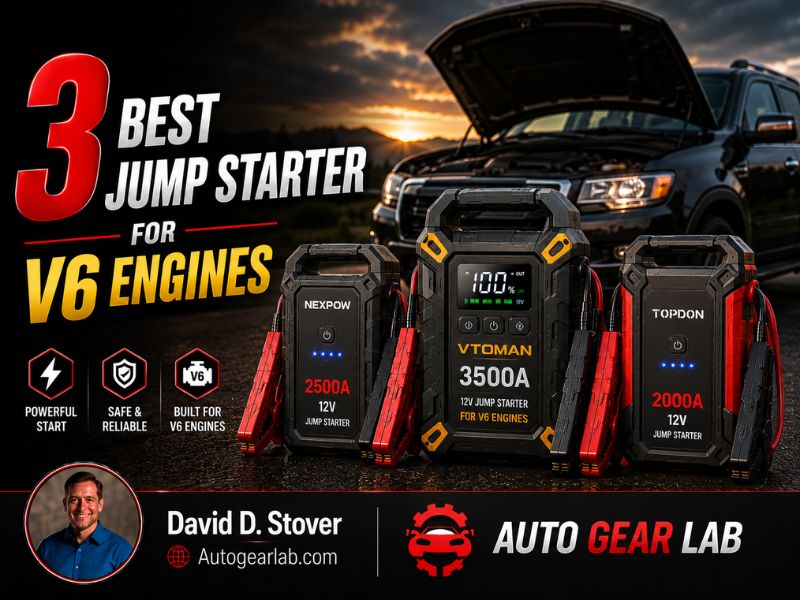
3 Jump Starters for V6 Engines Reviewed
| Image | Product Name | Check Price |
|---|---|---|
Best Choice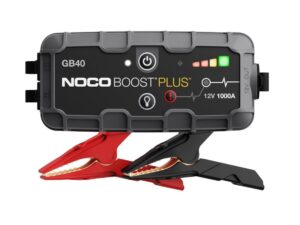 | NOCO Boost GB40 1000A UltraSafe Lithium Jump Starter | Check Price |
Second Best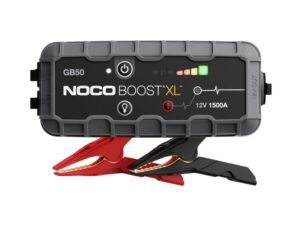 | NOCO Boost GB50 1500A UltraSafe Lithium Jump Starter | Check Price |
Third Choice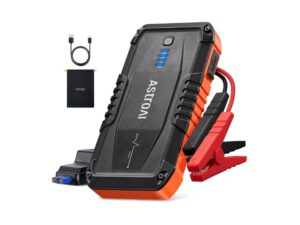 | AstroAI S8 1500A Car Battery Jump Starter | Check Price |
1. NOCO Boost GB40 1000A UltraSafe Lithium Jump Starter
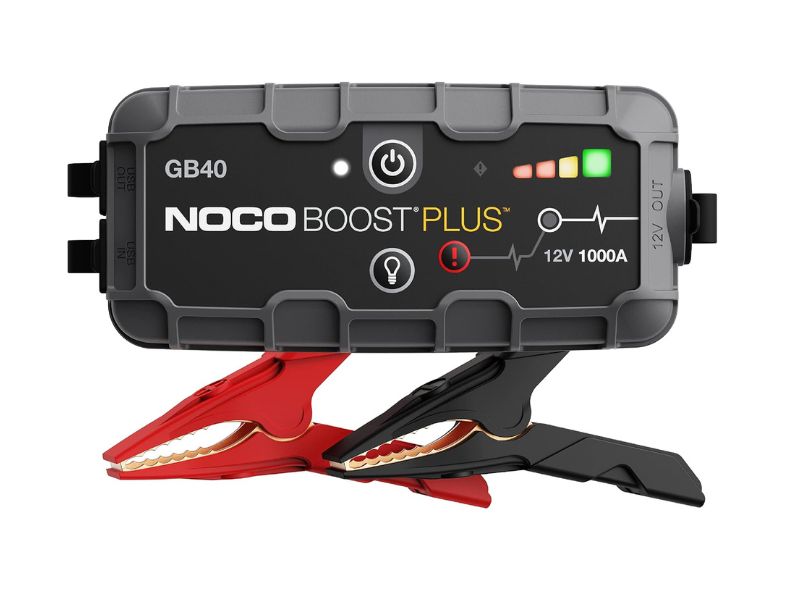
Key Features
- 1000A peak output
- Gas engines up to 6.0L
- Diesel engines up to 3.0L
- 12V lithium jump starter
- Reverse-polarity protection
- Spark-resistant normal connection
- USB power-bank function
- Built-in flashlight
- Compact portable design
The NOCO GB40 is the easiest recommendation for most V6 owners because its published gasoline-engine rating already exceeds the displacement of typical V6 passenger vehicles.
NOCO rates the GB40 for gasoline engines up to 6.0 liters and diesel engines up to 3.0 liters. That gives it plenty of theoretical displacement margin for common V6 engines in sedans, crossovers, minivans, SUVs, and many pickups.
For a V6, that margin matters more than chasing an enormous 3000A or 5000A marketing figure.
Most modern gasoline V6 engines are well below 6.0L. A correctly sized jump starter therefore does not need to be physically large or excessively powerful to be useful.
The GB40’s greatest advantage is its balance.
It is small enough to leave in the vehicle while still providing enough starting capability for a wide range of gasoline engines. That makes it more likely to be available when the battery actually fails.
Its normal connection system includes reverse-polarity protection and spark-resistant operation. These are particularly useful for drivers who may only use a jump starter once every few years.
Reverse polarity means the positive and negative clamps are connected backward.
The protection system helps identify that mistake before a normal jump attempt.
Spark resistance also reduces the likelihood of connection sparks during ordinary protected operation.
These features do not eliminate the need to verify polarity manually.
Always locate the vehicle manufacturer’s designated positive jump point and recommended negative or chassis ground.
The GB40 also functions as a USB power bank. That can help keep a phone charged if the vehicle battery is so weak that the cabin USB ports no longer work.
A built-in flashlight is useful when the battery fails at night.
For V6 ownership, the biggest reason I prefer the GB40 is efficiency of size.
It offers enough headroom without giving you the bulk of a professional shop jump box.
The main limitation is that the 6.0L rating does not mean unlimited reserve.
Cold weather, a heavily sulfated battery, poor clamp contact, and a worn starter can make a start much more demanding than engine displacement alone suggests.
Drivers who regularly see severe winter temperatures or who own a larger V6 truck or SUV may prefer the GB50 for extra margin.
What I Like
- Excellent fit for most gasoline V6 engines
- Very compact for the capability
- Reverse-polarity protection
- Spark-resistant normal operation
- Useful USB and flashlight functions
- Huge current Amazon rating history
What I Do Not Like
- Less reserve than the GB50
- Only 3.0L diesel compatibility
- Basic USB charging compared with newer high-power USB-C units
The GB40 is my primary choice for most V6 vehicles because it provides enough starting capability without unnecessary size. For a typical V6 sedan, crossover, minivan, or gasoline SUV, it is the model I would keep charged in the vehicle.
2. NOCO Boost GB50 1500A UltraSafe Lithium Jump Starter
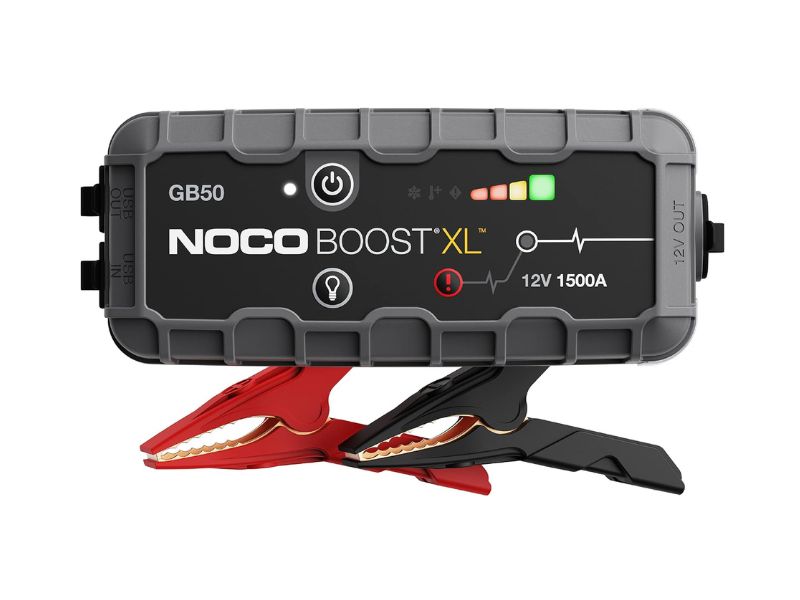
Key Features
- 1500A peak output
- Gas engines up to 7.0L
- Diesel engines up to 4.5L
- 12V lithium design
- Reverse-polarity protection
- Spark-resistant connection
- USB power-bank function
- Integrated flashlight
- More reserve than the GB40
The GB50 is the better choice when extra starting margin is more important than minimizing size.
NOCO rates it at 1500A, with gasoline-engine compatibility up to 7.0L and diesel coverage up to 4.5L.
For a V6, that is more engine capability than most owners will ever need.
The reason to buy it is not that a normal V6 suddenly requires 7.0L-class capacity.
The benefit is additional reserve when conditions are difficult.
That can matter during:
- Freezing weather
- Extended parking
- Aging battery condition
- Larger SUVs
- V6 pickups
- Repeated jump attempts
- Multi-vehicle household use
Cold starts place more strain on both the vehicle battery and the jump starter.
Oil becomes thicker, battery performance drops, and the starter motor may need more current.
A larger jump starter can therefore be useful even when both products exceed the engine’s displacement on paper.
The GB50 retains NOCO’s normal spark-resistant and reverse-polarity-protected connection system. Its Amazon listing specifically identifies those protections along with 1500A output and the 7.0L/4.5L engine limits.
NOCO also supports its GB50 clamp platform with heavy-duty precision clamps designed around high-current transfer and tight battery-terminal access.
This can be useful in vehicles where battery terminals are recessed or surrounded by plastic covers.
The GB50 remains portable enough for a trunk or cargo organizer.
It is larger than the GB40, but not remotely as cumbersome as a traditional commercial jump box.
For a V6 truck or SUV, I think that size increase is reasonable if you want extra winter margin.
It is also a better household choice when the same jump starter may need to assist a V6 vehicle today and a larger V8 vehicle tomorrow.
What I Like
- Strong 7.0L gasoline-engine rating
- Extra reserve for difficult starts
- Better fit for V6 SUVs and pickups
- Reverse-polarity protection
- Spark-resistant normal connection
- Useful multi-vehicle capability
What I Do Not Like
- More capacity than many V6 sedans need
- Larger than the GB40
- Still not designed for true commercial repeated-use duty
The GB50 is my choice for a V6 owner who wants additional margin rather than the smallest possible jump pack. It is particularly attractive for larger SUVs, trucks, winter climates, or households with multiple vehicle sizes.
3. AstroAI S8 1500A Car Battery Jump Starter
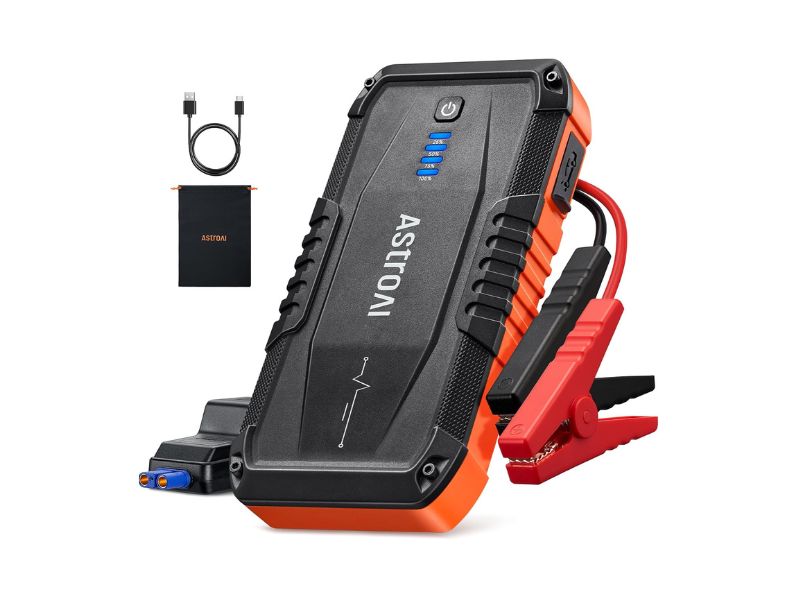
Key Features
- 1500A peak output
- Gas engines up to 6.0L
- Diesel engines up to 3.0L
- 10,000mAh NMC lithium battery
- BOOST mode
- Smart jumper clamps
- Three-mode flashlight
- Portable power-bank capability
- Compact design
The AstroAI S8 is the value-focused alternative for a V6 owner who wants a compact jump starter without paying primarily for a premium brand.
AstroAI specifies 1500A peak output, support for gasoline engines up to 6.0L and diesel engines up to 3.0L, a 10,000mAh lithium NMC battery, and a 12V vehicle architecture.
That makes it comfortably suitable on paper for most gasoline V6 engines.
Its published gasoline limit is the same as the NOCO GB40 even though the S8 carries a larger 1500A headline number.
That illustrates why I do not rank jump starters solely by peak amps.
If two manufacturers both rate their products for a 6.0L gasoline engine, the larger peak number does not automatically prove the unit will perform better in every real-world start.
Cable resistance, battery chemistry, temperature, state of charge, and clamp contact all matter.
The S8 includes a BOOST mode for batteries whose voltage is too low for the normal smart-clamp detection system.
That can be useful when a battery is extremely discharged.
I would use normal protected mode first.
Before activating BOOST, verify:
- The vehicle uses 12V
- Red is connected to positive
- Black is connected to the approved negative or ground point
- The battery is not frozen
- The battery is not leaking or physically damaged
AstroAI also specifies 10 safety protections, including protections intended to manage incorrect or abnormal electrical conditions.
The S8 is especially attractive for storage.
AstroAI lists it at roughly 0.95 pounds in its current product comparison information, making it very easy to keep in a small emergency kit.
The three-mode flashlight and power-bank function add useful roadside capability without making the device much larger.
For a typical V6 commuter vehicle, that portability is a real advantage.
What I Like
- Good value for a V6 engine
- 1500A advertised output
- 6.0L gasoline coverage
- BOOST mode for very low voltage
- Smart clamp protections
- Extremely compact and lightweight
What I Do Not Like
- Less established rating history than the two NOCO models
- Lower premium feel than GB40/GB50
- 3.0L diesel limit
- BOOST mode requires careful polarity confirmation
The AstroAI S8 is a sensible option for a V6 owner who prioritizes low weight and value. It provides more than enough published gasoline-engine headroom for most V6 cars while remaining easy to store.
V6 Jump Starter Comparison
| Product | Peak Output | Gas Engine Limit | Diesel Limit | Low-Voltage Mode | Main Advantage | Ideal Use |
| NOCO GB40 | 1000A | 6.0L | 3.0L | Manual override | Best balance of size and safety | Most V6 cars and SUVs |
| NOCO GB50 | 1500A | 7.0L | 4.5L | Manual override | Extra starting reserve | V6 trucks, large SUVs, winter use |
| AstroAI S8 | 1500A | 6.0L | 3.0L | BOOST | Compact value | Everyday V6 emergency kit |
For an ordinary gasoline V6, all three provide enough published displacement coverage. The GB40 is the best overall balance, the GB50 adds useful reserve, and the S8 emphasizes low weight and value.
How to Choose the Best Jump Starter for V6 Engines
Match the Jump Starter to Engine Displacement
V6 describes cylinder count, not actual engine size.
A V6 may be:
- 2.5L
- 3.0L
- 3.5L
- 3.6L
- 3.8L
- 4.0L
- Or another displacement
That is why the manufacturer’s gasoline-engine limit matters more than simply seeing “V6” on the vehicle specification sheet.
The GB40 and AstroAI S8 both support gasoline engines up to 6.0L, while the GB50 supports up to 7.0L.
All three therefore have substantial displacement headroom for typical gasoline V6 engines.
Gasoline V6 vs Diesel V6
Fuel type matters.
Diesel engines generally require greater starting effort than gasoline engines of comparable displacement.
That is why jump-starter manufacturers publish separate diesel ratings.
The GB40 and AstroAI S8 support up to 3.0L diesel, while the GB50 reaches 4.5L diesel.
If your V6 is diesel, check its exact displacement before purchasing.
1000A vs 1500A for a V6
A normal gasoline V6 does not automatically need 1500A.
The GB40 is only rated at 1000A yet supports gasoline engines up to 6.0L.
That is already well above the displacement of many V6 engines.
A 1500A unit gives additional reserve, but reserve is most useful for:
- Colder climates
- Larger batteries
- Larger V6 SUVs
- V6 pickups
- Aging batteries
- Multi-vehicle use
For a normal V6 sedan or crossover, 1000A from a reputable manufacturer is generally a very reasonable class.
Cold Weather Changes Starting Demand
Cold temperatures make starting more difficult.
The vehicle battery produces less effective output, while thicker cold oil increases cranking resistance.
This is where buying some margin above the minimum engine requirement can be worthwhile.
If I lived in a severe winter region with a V6 SUV or truck, I would lean toward the GB50.
For moderate climates and a healthy V6 car, the GB40 is usually the more efficient choice.
Do Not Compare Peak Amps Blindly
Peak amperage is not a perfect cross-brand measurement.
A 1500A product from one company is not necessarily 50% more capable than a 1000A product from another.
Look at:
- Engine-displacement limit
- Battery chemistry
- Cable quality
- Clamp design
- Protection system
- Low-voltage operation
- Temperature range
- Stored energy
- Manufacturer documentation
The fact that both the 1000A GB40 and 1500A AstroAI S8 are rated for up to 6.0L gasoline engines demonstrates why engine compatibility should remain central.
Reverse-Polarity Protection Matters
A roadside emergency is not the ideal time to discover you have connected the clamps backward.
The GB40 and GB50 include reverse-polarity protection and spark-resistant connection technology.
The AstroAI S8 also uses a smart-clamp system with multiple protections.
These features are useful safeguards, especially for occasional users.
Still confirm the clamp colors and terminal markings yourself.
Understand Manual Override or BOOST
A severely discharged battery can fall below the voltage required for smart automatic detection.
That is why some jump starters provide BOOST or manual override.
Use normal protected mode first.
Only use forced output after checking:
- System voltage
- Battery condition
- Positive and negative polarity
- Correct jump points
Do not jump a battery that is frozen, cracked, swollen, leaking, smoking, or unusually hot.
Think About Cable Access
Some V6 vehicles place the battery under plastic covers, near the firewall, or in the trunk while providing remote under-hood jump posts.
Before an emergency, identify:
- Positive jump terminal
- Approved ground point
- Battery-cover access
- Clamp clearance
NOCO’s compatible precision-clamp design is specifically shaped to fit a range of terminal sizes and tighter access points.
Portability Matters More Than Many Buyers Expect
A V6 usually does not need a massive commercial jump box.
Compact lithium units make more sense for most drivers because they can stay permanently in the vehicle.
The AstroAI S8 is especially light, while the GB40 also stays in a very manageable portable format.
A jump starter that is always in the trunk is more useful than a more powerful one left at home.
USB Charging Adds Roadside Value
A dead vehicle battery can also disable the vehicle’s USB ports.
A jump starter with power-bank functionality can keep a phone available for:
- Navigation
- Roadside assistance
- Emergency calls
- Flashlight use
All three products provide portable-device charging capability.
Avoid heavily draining the jump starter on a phone before trying to start the car.
Preserve starting reserve first.
Keep the Jump Starter Charged
Check the pack periodically.
I would inspect it:
- Before winter
- Before long trips
- Before airport parking
- Before camping
- After every jump
- After heavy power-bank use
Lithium packs can hold a charge for long periods, but they should not be ignored indefinitely.
How to Jump-Start a V6 Safely
1. Confirm 12V Compatibility
These products are intended for compatible 12V automotive systems.
2. Inspect the Battery
Do not jump a battery that is visibly damaged, frozen, leaking, swollen, or unusually hot.
3. Turn Off Accessories
Switch off HVAC, headlights, heated seats, audio, and unnecessary electronics.
4. Locate the Approved Positive Jump Point
Use the terminal identified by the vehicle manufacturer.
5. Connect the Red Clamp
Attach it securely to positive.
6. Connect the Black Clamp
Attach it to the approved negative or chassis-ground point.
7. Check the Jump Starter Indicators
Correct any polarity or connection warning.
8. Use Normal Mode First
Do not immediately activate BOOST or override.
9. Crank Briefly
Follow the jump-starter and vehicle instructions.
Do not hold the starter continuously.
10. Allow Cooling Between Attempts
Repeated long starts generate heat in the starter, cables, clamps, and booster.
11. Stop After Repeated Failure
A discharged battery may not be the only problem.
12. Disconnect Safely
Follow the vehicle and jump-starter manual.
13. Recharge the Jump Starter
Restore its internal battery before putting it away.
Common V6 Jump Starter Buying Mistakes
Buying Only by Cylinder Count
Engine displacement and fuel type matter more.
Buying the Largest Amp Number
A normal gasoline V6 rarely needs extreme advertised output.
Ignoring Winter Conditions
Cold weather can justify additional reserve.
Using a Gasoline Rating for a Diesel
Use the separate diesel limit.
Ignoring Battery Access
Check whether the clamps can reach the designated jump points.
Using BOOST Immediately
Protected normal operation should be attempted first.
Leaving the Booster Discharged
Emergency equipment needs periodic charge checks.
Assuming the Battery Is Fixed After One Jump
Repeated battery failure can indicate a charging-system or battery-health problem.
Frequently Asked Questions
What is the best jump starter for V6 engines?
The NOCO GB40 is my primary recommendation for most gasoline V6 vehicles.
It supports gasoline engines up to 6.0L while providing 1000A output, reverse-polarity protection, spark-resistant normal operation, and compact lithium portability.
Is 1000A enough for a V6?
Yes, a quality 1000A jump starter is enough for many gasoline V6 engines.
NOCO rates the GB40 for gasoline engines up to 6.0L, which comfortably exceeds the displacement of most V6 passenger vehicles.
Is 1500A better for a V6?
It provides extra reserve, but most gasoline V6 engines do not strictly require it.
The GB50 is useful for larger SUVs, trucks, cold weather, or multi-vehicle households because it extends gasoline compatibility to 7.0L.
What size jump starter do I need for a 3.5L V6?
A reputable jump starter rated for at least 3.5L gasoline is sufficient on paper.
All three products reviewed here exceed that requirement substantially.
What size jump starter do I need for a 3.6L V6?
Any of these three provides significant gasoline-engine displacement headroom for a 3.6L V6.
The GB40 and AstroAI S8 support up to 6.0L gas, while the GB50 supports up to 7.0L.
Is the NOCO GB40 good for a V6 SUV?
Yes, it is a strong fit for many gasoline V6 SUVs.
Its manufacturer rating extends to 6.0L gasoline engines.
Is the GB50 better for a V6 truck?
Yes when you want more reserve for a larger vehicle or difficult starting conditions.
Its 1500A output and 7.0L gasoline rating provide more margin than the GB40.
Is the AstroAI S8 enough for a V6?
Yes, AstroAI rates the S8 for gasoline engines up to 6.0L.
It also includes 1500A peak output, BOOST mode, smart clamps, and a 10,000mAh internal battery.
Do V6 engines need more jump power than four-cylinder engines?
Usually they require more starting energy, but battery and engine design also matter.
A larger engine can demand more cranking current, especially in cold conditions, but there is no single amp requirement for every V6.
Does a V6 truck need 2000A?
Not necessarily; engine displacement and operating conditions matter more than cylinder count alone.
A properly rated 1000A–1500A quality unit can cover many gasoline V6 trucks.
Which jump starter is best for cold weather?
The GB50 offers the most useful reserve of these three for difficult winter starts.
Its larger published starting capability and 7.0L gasoline-engine rating give additional margin.
Can a jump starter start a completely dead V6 battery?
Sometimes, provided the vehicle battery is not physically damaged and the booster supports low-voltage starting.
Extremely low voltage may require an approved BOOST or manual-override mode.
What does BOOST mode do?
BOOST forces starting output when the vehicle battery is too low for normal detection.
The AstroAI S8 includes a dedicated BOOST mode for this situation.
Is manual override safe?
It requires more care because normal automatic protection may be reduced or bypassed.
Confirm polarity, 12V compatibility, and battery condition before using it.
Can I use a V6 jump starter on a V8?
Only when the V8 displacement remains within the manufacturer’s gasoline-engine limit.
The GB50 supports gasoline engines up to 7.0L, while the GB40 and S8 are rated up to 6.0L.
Can I use one on a diesel V6?
Yes only when the diesel displacement falls within the product’s published diesel limit.
The GB40 and S8 reach 3.0L diesel, while the GB50 supports up to 4.5L diesel.
How often should I recharge my jump starter?
Recharge after use and check its battery level every few months.
Check it more frequently before winter, long trips, or extended vehicle storage.
Can I leave a jump starter in my car?
Yes within the manufacturer’s approved storage-temperature range.
Avoid prolonged extreme heat and periodically inspect the unit for swelling, damage, or low charge.
Conclusion
The best jump starter for V6 engines should provide enough gasoline-engine headroom without becoming unnecessarily large or expensive. For most V6 owners, engine displacement, safety electronics, cold-weather reserve, clamp access, and portability matter more than chasing the largest advertised peak-amp figure.
The NOCO GB40 remains my primary recommendation. Its 1000A output, 6.0L gasoline-engine rating, reverse-polarity protection, spark-resistant normal connection, and compact lithium design make it a strong match for most V6 sedans, crossovers, minivans, and SUVs.
The NOCO GB50 is the better option for drivers who want additional reserve. Its 1500A output and 7.0L gasoline / 4.5L diesel coverage make it particularly attractive for V6 pickups, large SUVs, winter driving, and multi-vehicle households.
The AstroAI S8 is the value-focused alternative. Its 1500A rating, 6.0L gasoline compatibility, BOOST mode, smart clamps, and compact 10,000mAh design give typical V6 owners plenty of published capability without much storage bulk.
For an ordinary gasoline V6, I would choose the NOCO GB40. If I regularly faced freezing temperatures or wanted extra reserve for a larger V6 SUV or truck, I would move to the NOCO GB50.